Spandidos Publications Logo
  • About
    • About Spandidos
    • Aims and Scopes
    • Abstracting and Indexing
    • Editorial Policies
    • Reprints and Permissions
    • Job Opportunities
    • Terms and Conditions
    • Contact
  • Journals
    • All Journals
    • Oncology Letters
      • Oncology Letters
      • Information for Authors
      • Editorial Policies
      • Editorial Board
      • Aims and Scope
      • Abstracting and Indexing
      • Bibliographic Information
      • Archive
    • International Journal of Oncology
      • International Journal of Oncology
      • Information for Authors
      • Editorial Policies
      • Editorial Board
      • Aims and Scope
      • Abstracting and Indexing
      • Bibliographic Information
      • Archive
    • Molecular and Clinical Oncology
      • Molecular and Clinical Oncology
      • Information for Authors
      • Editorial Policies
      • Editorial Board
      • Aims and Scope
      • Abstracting and Indexing
      • Bibliographic Information
      • Archive
    • Experimental and Therapeutic Medicine
      • Experimental and Therapeutic Medicine
      • Information for Authors
      • Editorial Policies
      • Editorial Board
      • Aims and Scope
      • Abstracting and Indexing
      • Bibliographic Information
      • Archive
    • International Journal of Molecular Medicine
      • International Journal of Molecular Medicine
      • Information for Authors
      • Editorial Policies
      • Editorial Board
      • Aims and Scope
      • Abstracting and Indexing
      • Bibliographic Information
      • Archive
    • Biomedical Reports
      • Biomedical Reports
      • Information for Authors
      • Editorial Policies
      • Editorial Board
      • Aims and Scope
      • Abstracting and Indexing
      • Bibliographic Information
      • Archive
    • Oncology Reports
      • Oncology Reports
      • Information for Authors
      • Editorial Policies
      • Editorial Board
      • Aims and Scope
      • Abstracting and Indexing
      • Bibliographic Information
      • Archive
    • Molecular Medicine Reports
      • Molecular Medicine Reports
      • Information for Authors
      • Editorial Policies
      • Editorial Board
      • Aims and Scope
      • Abstracting and Indexing
      • Bibliographic Information
      • Archive
    • World Academy of Sciences Journal
      • World Academy of Sciences Journal
      • Information for Authors
      • Editorial Policies
      • Editorial Board
      • Aims and Scope
      • Abstracting and Indexing
      • Bibliographic Information
      • Archive
    • International Journal of Functional Nutrition
      • International Journal of Functional Nutrition
      • Information for Authors
      • Editorial Policies
      • Editorial Board
      • Aims and Scope
      • Abstracting and Indexing
      • Bibliographic Information
      • Archive
    • International Journal of Epigenetics
      • International Journal of Epigenetics
      • Information for Authors
      • Editorial Policies
      • Editorial Board
      • Aims and Scope
      • Abstracting and Indexing
      • Bibliographic Information
      • Archive
    • Medicine International
      • Medicine International
      • Information for Authors
      • Editorial Policies
      • Editorial Board
      • Aims and Scope
      • Abstracting and Indexing
      • Bibliographic Information
      • Archive
  • Articles
  • Information
    • Information for Authors
    • Information for Reviewers
    • Information for Librarians
    • Information for Advertisers
    • Conferences
  • Language Editing
Spandidos Publications Logo
  • About
    • About Spandidos
    • Aims and Scopes
    • Abstracting and Indexing
    • Editorial Policies
    • Reprints and Permissions
    • Job Opportunities
    • Terms and Conditions
    • Contact
  • Journals
    • All Journals
    • Biomedical Reports
      • Information for Authors
      • Editorial Policies
      • Editorial Board
      • Aims and Scope
      • Abstracting and Indexing
      • Bibliographic Information
      • Archive
    • Experimental and Therapeutic Medicine
      • Information for Authors
      • Editorial Policies
      • Editorial Board
      • Aims and Scope
      • Abstracting and Indexing
      • Bibliographic Information
      • Archive
    • International Journal of Epigenetics
      • Information for Authors
      • Editorial Policies
      • Editorial Board
      • Aims and Scope
      • Abstracting and Indexing
      • Bibliographic Information
      • Archive
    • International Journal of Functional Nutrition
      • Information for Authors
      • Editorial Policies
      • Editorial Board
      • Aims and Scope
      • Abstracting and Indexing
      • Bibliographic Information
      • Archive
    • International Journal of Molecular Medicine
      • Information for Authors
      • Editorial Policies
      • Editorial Board
      • Aims and Scope
      • Abstracting and Indexing
      • Bibliographic Information
      • Archive
    • International Journal of Oncology
      • Information for Authors
      • Editorial Policies
      • Editorial Board
      • Aims and Scope
      • Abstracting and Indexing
      • Bibliographic Information
      • Archive
    • Medicine International
      • Information for Authors
      • Editorial Policies
      • Editorial Board
      • Aims and Scope
      • Abstracting and Indexing
      • Bibliographic Information
      • Archive
    • Molecular and Clinical Oncology
      • Information for Authors
      • Editorial Policies
      • Editorial Board
      • Aims and Scope
      • Abstracting and Indexing
      • Bibliographic Information
      • Archive
    • Molecular Medicine Reports
      • Information for Authors
      • Editorial Policies
      • Editorial Board
      • Aims and Scope
      • Abstracting and Indexing
      • Bibliographic Information
      • Archive
    • Oncology Letters
      • Information for Authors
      • Editorial Policies
      • Editorial Board
      • Aims and Scope
      • Abstracting and Indexing
      • Bibliographic Information
      • Archive
    • Oncology Reports
      • Information for Authors
      • Editorial Policies
      • Editorial Board
      • Aims and Scope
      • Abstracting and Indexing
      • Bibliographic Information
      • Archive
    • World Academy of Sciences Journal
      • Information for Authors
      • Editorial Policies
      • Editorial Board
      • Aims and Scope
      • Abstracting and Indexing
      • Bibliographic Information
      • Archive
  • Articles
  • Information
    • For Authors
    • For Reviewers
    • For Librarians
    • For Advertisers
    • Conferences
  • Language Editing
Login Register Submit
  • This site uses cookies
  • You can change your cookie settings at any time by following the instructions in our Cookie Policy. To find out more, you may read our Privacy Policy.

    I agree
Search articles by DOI, keyword, author or affiliation
Search
Advanced Search
presentation
Experimental and Therapeutic Medicine
Join Editorial Board Propose a Special Issue
Print ISSN: 1792-0981 Online ISSN: 1792-1015
Journal Cover
September 2012 Volume 4 Issue 3

Full Size Image

Sign up for eToc alerts
Recommend to Library

Journals

International Journal of Molecular Medicine

International Journal of Molecular Medicine

International Journal of Molecular Medicine is an international journal devoted to molecular mechanisms of human disease.

International Journal of Oncology

International Journal of Oncology

International Journal of Oncology is an international journal devoted to oncology research and cancer treatment.

Molecular Medicine Reports

Molecular Medicine Reports

Covers molecular medicine topics such as pharmacology, pathology, genetics, neuroscience, infectious diseases, molecular cardiology, and molecular surgery.

Oncology Reports

Oncology Reports

Oncology Reports is an international journal devoted to fundamental and applied research in Oncology.

Experimental and Therapeutic Medicine

Experimental and Therapeutic Medicine

Experimental and Therapeutic Medicine is an international journal devoted to laboratory and clinical medicine.

Oncology Letters

Oncology Letters

Oncology Letters is an international journal devoted to Experimental and Clinical Oncology.

Biomedical Reports

Biomedical Reports

Explores a wide range of biological and medical fields, including pharmacology, genetics, microbiology, neuroscience, and molecular cardiology.

Molecular and Clinical Oncology

Molecular and Clinical Oncology

International journal addressing all aspects of oncology research, from tumorigenesis and oncogenes to chemotherapy and metastasis.

World Academy of Sciences Journal

World Academy of Sciences Journal

Multidisciplinary open-access journal spanning biochemistry, genetics, neuroscience, environmental health, and synthetic biology.

International Journal of Functional Nutrition

International Journal of Functional Nutrition

Open-access journal combining biochemistry, pharmacology, immunology, and genetics to advance health through functional nutrition.

International Journal of Epigenetics

International Journal of Epigenetics

Publishes open-access research on using epigenetics to advance understanding and treatment of human disease.

Medicine International

Medicine International

An International Open Access Journal Devoted to General Medicine.

Journal Cover
September 2012 Volume 4 Issue 3

Full Size Image

Sign up for eToc alerts
Recommend to Library

  • Article
  • Citations
    • Cite This Article
    • Download Citation
    • Create Citation Alert
    • Remove Citation Alert
    • Cited By
  • Similar Articles
    • Related Articles (in Spandidos Publications)
    • Similar Articles (Google Scholar)
    • Similar Articles (PubMed)
  • Download PDF
  • Download XML
  • View XML
Article

Establishment of a conditional transgenic mouse model expressing human uncoupling protein 2 in vascular smooth muscle cells

  • Authors:
    • Shuangtao Ma
    • De Li
    • Dachun Yang
    • Yan Tan
    • Bing Tang
    • Feipeng Jin
    • Sihua Jiang
    • Xiuchuan Li
    • Yongjian Yang
  • View Affiliations / Copyright

    Affiliations: Department of Cardiology, General Hospital of PLA Chengdu Military Area Command, Chengdu, Sichuan 610083, P.R. China
  • Pages: 545-547
    |
    Published online on: June 25, 2012
       https://doi.org/10.3892/etm.2012.620
  • Expand metrics +
Metrics: Total Views: 0 (Spandidos Publications: | PMC Statistics: )
Metrics: Total PDF Downloads: 0 (Spandidos Publications: | PMC Statistics: )
Cited By (CrossRef): 0 citations Loading Articles...

This article is mentioned in:


Abstract

Increased oxidative stress is involved in the development of vascular dysfunction and remodeling. Uncoupling protein 2 (UCP2) regulates the production of reactive oxygen species in vascular smooth muscle cells (SMCs). To promote the study of the role of UCP2 in vascular diseases, a transgenic mouse model expressing human UCP2 (hUCP2) in vascular SMCs was established. We constructed a plasmid carrying the 2.3 kb rabbit smooth muscle myosin heavy chain promoter and the hUCP2 gene. We used this plasmid to produce transgenic mice by pro-nuclear microinjection. Six offspring were identified as founder mice that were used to establish a transgenic mouse lineage. The transgenic mice showed a significant increase in hUCP mRNA expression in the aorta. Moreover, hUCP2 overexpression inhibited the production of superoxide and increased the bioavailability of nitric oxide (NO). In this study, we established a hUCP2 transgenic mouse model, which will enable further studies on the role of UCP2 in vascular dysfunction and remodeling.

Introduction

It has been reported that reactive oxygen species (ROS) are involved in several vascular diseases, including endothelial dysfunction and atherosclerosis (1). Uncoupling protein 2 (UCP2) belongs to the mitochondrial anion carrier family and is expressed in several types of cells, including vascular smooth muscle cells (SMCs) (2). UCP2 is known to be involved in the uncoupling of the proton electrochemical gradient, resulting in the reduced production of ROS. A previous study demonstrated that LDLR−/− mice with UCP2-ablated macrophages had significantly larger aortic atherosclerotic lesions than the controls despite lower cholesterol levels, indicating a protective role for UCP2 in atherosclerosis (3). Lombard reported that UCP2 knockout enhanced the high salt diet-induced increase in superoxide production and decrease in nitric oxide (NO) bioavailability, eliciting a consequent elevation of blood pressure and markedly enhancing the impairment of vasodilation, suggesting that UCP2 plays an important role in the development of salt-related hypertension and vascular dysfunction (4). These studies strongly support the theory that UCP2 is closely related to the development of vascular diseases.

Although the UCP2 is highly conserved between mouse and human, there are species differences over the protein sequence. Other researchers have created transgenic mice that overexpressed UCP2 in hepatocytes (5) and hypocretin neurons (6) for the study of obesity. However, the effect of the overexpression of human UCP2 (hUCP2) specifically in vascular SMCs has not been addressed. In the present study, to facilitate the functional study of hUCP2, we report the establishment of transgenic mice carrying the hUCP2 gene in vascular SMCs. This model provides a tool that may be used to define the role of SMC-derived hUCP2 in the development of vascular disease.

Materials and methods

Animal care

Handling of animals and all experimental procedures were approved by the Institutional Animal Care and Use Committee of the General Hospital of PLA Chengdu Military Area Command. Transgenic founder mice were generated on an FVB background. The cDNA from hUCP2 under the control of the rabbit smooth muscle myosin heavy chain promoter was cloned into the pRP.Des2d vector (Cyagen Biosciences Inc., Guangzhou, China) and verified by sequencing. The linearized pRP.Ex2d-SMHC>UCP2 was purified from agarose gel using a QIAquick Gel Extraction kit (Qiagen, Chatsworth, CA, USA), adjusted to a final concentration of 1 mg/ml in Tris-EDTA (TE) buffer and used as a DNA solution for microinjection. The female FVB mice were hormonally superovulated and mated with male FVB mice. Next morning the fertilized one-cell eggs were collected from the oviducts. The eggs were microinjected with the DNA solution under a microscope. The injected fertilized eggs were transplanted into the oviducts of pseudo-pregnant FVB mice. Transgenic mice were identified by PCR with the forward and reverse primers 5′-GGAGATACCAAAGCACCGTCAA and 5′-CATAGGTCACCAGCTCAGCACA, respectively. The internal control was identified by PCR with the forward and reverse primers 5′-TCT TAG CTC TGC TCT CCG GT and 5′-CAC TGG CTG AGG AAG GAG AC, respectively.

Gene expression analysis

The RNA from the aorta was prepared using the RNeasy mini kit (Qiagen) and reverse transcription and PCR were performed using a QuantiTect SYBR Green one-step RT-PCR kit (Qiagen) according to the manufacturer’s specifications. A standard curve was prepared for each assay by the serial dilution of cDNA synthesized from pooled RNA. The samples and standards were analyzed in triplicate (7).

Dihydroethidium assay

To assess the levels of superoxide production, the fresh frozen aortae were cut into 20-μm thick sections. Following incubation in Krebs solution for 30 min, the samples were incubated in the dark with dihydroethidium (DHE; Sigma-Aldrich, St. Louis, MO, USA) diluted in Krebs solution (40 μmol/l) for 30 min at 37°C followed by a 15-min wash in DHE-free Krebs. To quantitate the DHE fluorescence, the glass slides were placed under a Leica DM LB2 Fluorescent Microscope (Leica, Wetzlar, Germany) fitted with a rhodamine filter set (8).

NO bioavailability assay

NO levels in the freshly isolated aortae were assessed using 4,5-diaminofluorescein diacetate (DAF-2 DA; Sigma-Aldrich, St Louis, MO), as described previously. Aortae were prepared in the manner described for the DHE assay and vessel sections were loaded with 5 μmol/l DAF-2 DA in the dark for 45 min. When the dye loading was complete, the vessels were rinsed three times with fresh Krebs solution. To quantitate the DAF-2 DA fluorescence, the glass slides were placed under the Leica DM LB2 fluorescent microscope fitted with a fluorescein isothiocyanate filter set (8).

Statistical analysis

Data are the mean ± SEM. The statistical differences in mean values were assessed by the Student’s t-test. Two-sided p-values <0.05 were considered to indicate a statistically significant result.

Results

Establishment of hUCP2 transgenic mice

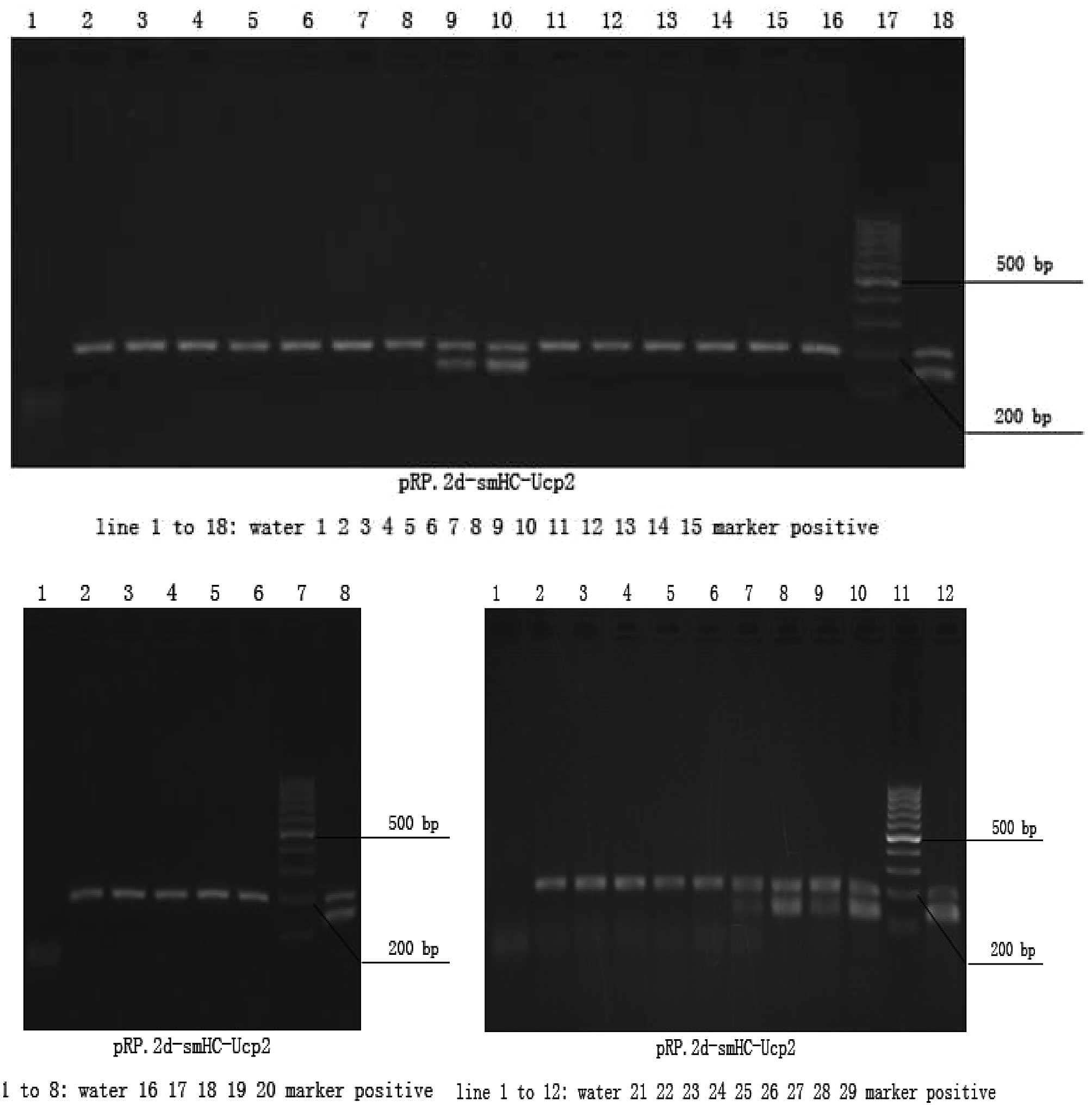
The transgenic fragments containing the full length rabbit smooth muscle myosin heavy chain promoter and hUCP2 cDNA were microinjected into the male pronuclei of 220 fertilized oocytes of FVB mice. A total of 160 injected eggs were implanted into the oviducts of 6 pseudo-pregnant foster mothers, which gave birth to 29 offspring. Six offspring mice were identified to be carrying the hUCP2 cDNA by PCR analysis (Fig. 1).

Figure 1

PCR results of transgenic mice. 8, 9, 26, 27, 28, 29: transgenic founder mice. Ucp2, uncoupling protein 2.

UCP2 expression in aorta

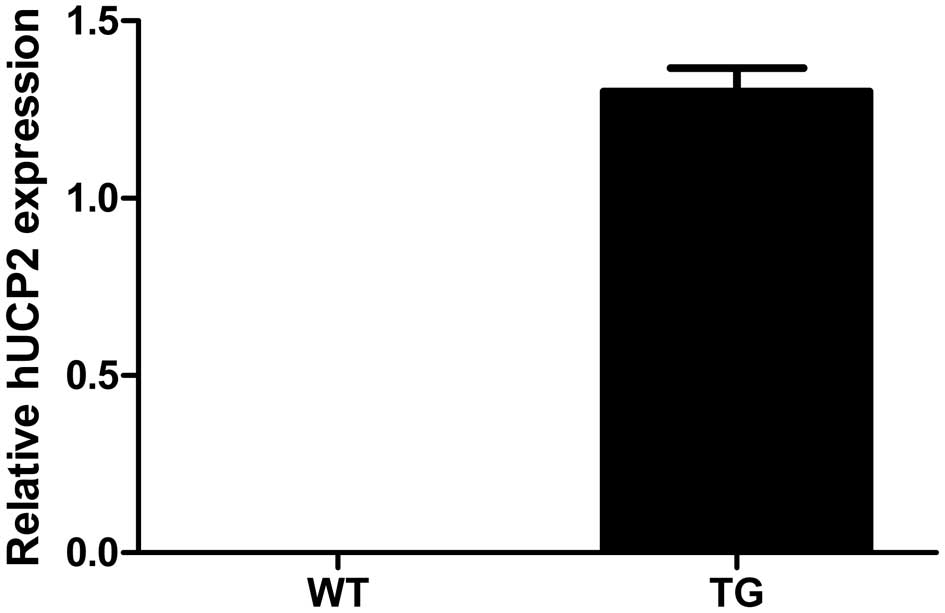
Real-time PCR analysis confirmed that the transgenic construct was abundantly expressed in the aortae of the transgenic mice (TG) and that the UCP2 transcript was undetectable in the wild-type (WT) animals (Fig. 2).

Figure 2

PCR results of hUCP2 expression in aorta. hUCP2, human uncoupling protein 2; WT, wild-type littermates; TG, transgenic mice.

Superoxide level

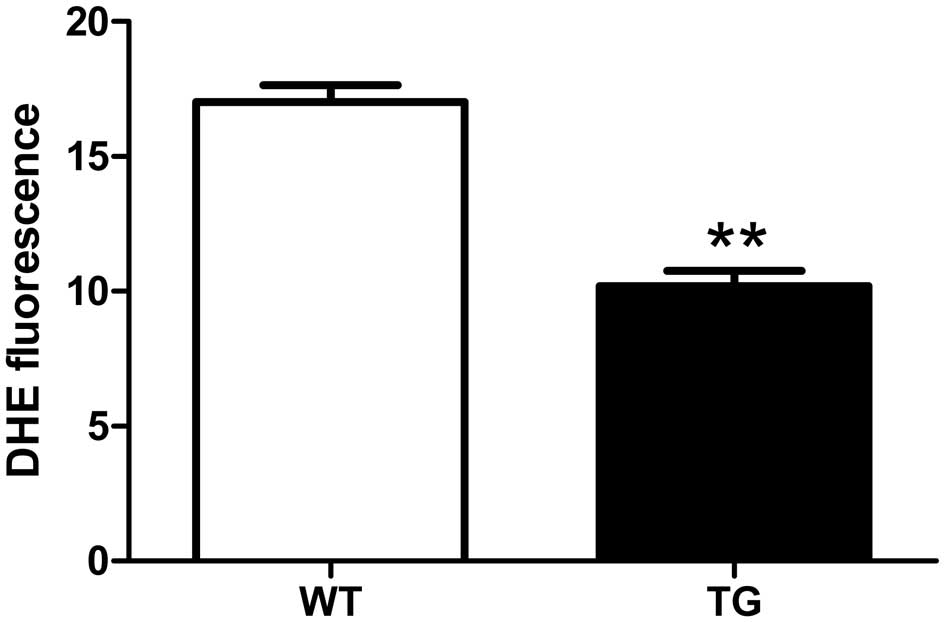
Superoxide anion production in the aorta was assessed by DHE staining. We found that the DHE fluorescence was significantly lower in the aortae from the UCP2 TG mice than in those from their WT littermates (p<0.01; Fig. 3).

Figure 3

Superoxide production in aorta. Summarized data showing the average fluorescence intensity in aortae from each group. Values are the mean ± SEM; n=6 per group. WT, wild-type littermates; TG, transgenic mice. DHE, dihydroethidium. **p<0.01 vs. the WT group.

NO availability

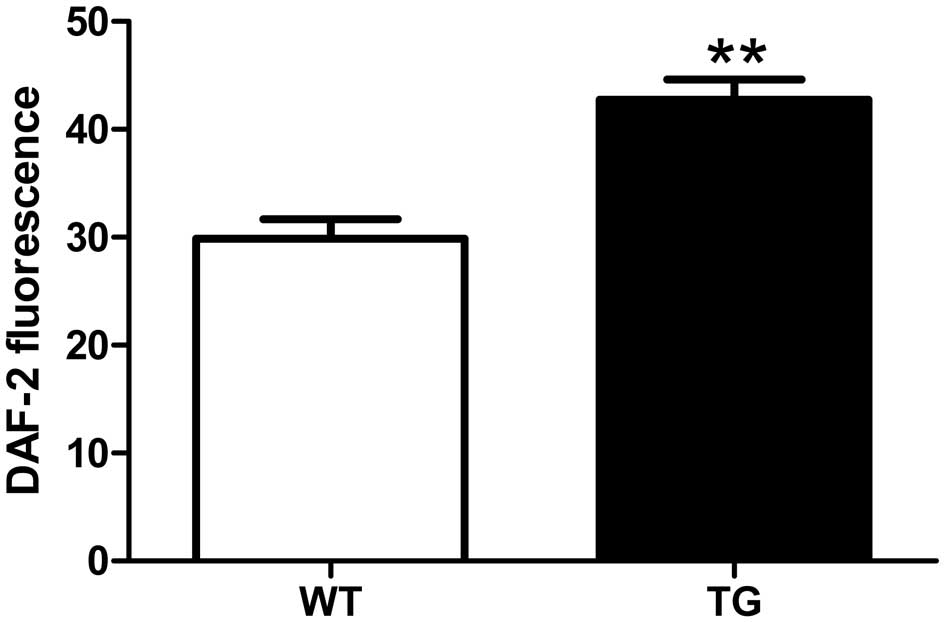
The production of NO in the aorta was assessed by DAF-2 DA staining. We found that DAF-2 DA fluorescence was significantly higher in the aortae from the UCP2 TG mice than in those from their WT littermates (p<0.01; Fig. 4).

Figure 4

NO production in aorta. Summarized data showing the average fluorescence intensity in aortae from each group. Values are the mean ± SEM; n=6 per group. WT, wild-type littermates; TG, transgenic mice; DAF-2, 4,5-diaminofluorescein. **p<0.01 vs. the WT group.

Discussion

In the present study, we report the establishment and initial characterization of a mouse model with the transgenic expression of human UCP2 in vascular SMCs under the control of the smooth muscle myosin heavy chain promoter. In the hUCP2 transgenic mouse, the hUCP2 mRNA was abundantly present in the aorta.

The aortae from the hUCP2 transgenic mice have significantly lower levels of superoxide and markedly higher levels of NO than the aortae from the WT mice. These characteristics may provide certain beneficial effects on the development of vascular dysfunction and remodeling.

In summary, we have established a transgenic mouse model with vascular SMC-specific overexpression of hUCP2. This model provides a novel tool for studies of the vascular effects of SMC-derived hUCP2.

Acknowledgements

We acknowledge Cyagen Biosciences for technical assistance and Dr Song Hu of Chengdu Medical College for animal care. This study was supported by the Natural Science Foundation of China (No. 81100232, to Shuangtao Ma).

References

1. 

Chisolm GM and Steinberg D: The oxidative modification hypothesis of atherogenesis: an overview. Free Radic Biol Med. 28:1815–1826. 2000. View Article : Google Scholar : PubMed/NCBI

2. 

Rousset S, Alves-Guerra MC, Mozo J, Miroux B, Cassard-Doulcier AM, Bouillaud F and Ricquier D: The biology of mitochondrial uncoupling proteins. Diabetes. 53(Suppl 1): S130–S135. 2004. View Article : Google Scholar

3. 

Blanc J, Alves-Guerra MC, Esposito B, Rousset S, Gourdy P, Ricquier D, Tedgui A, Miroux B and Mallat Z: Protective role of uncoupling protein 2 in atherosclerosis. Circulation. 107:388–390. 2003. View Article : Google Scholar : PubMed/NCBI

4. 

Lombard JH: Uncoupling protein 2 (UCP2): Another player in the complex drama of vascular salt sensitivity. Am J Hypertens. 23:8162010. View Article : Google Scholar : PubMed/NCBI

5. 

Tsuboyama-Kasaoka N, Sano K, Shozawa C, Osaka T and Ezaki O: Studies of UCP2 transgenic and knockout mice reveal that liver UCP2 is not essential for the antiobesity effects of fish oil. Am J Physiol Endocrinol Metab. 294:E600–E606. 2008. View Article : Google Scholar : PubMed/NCBI

6. 

Conti B, Sanchez-Alavez M, Winsky-Sommerer R, Morale MC, Lucero J, Brownell S, Fabre V, Huitron-Resendiz S, Henriksen S, Zorrilla EP, et al: Transgenic mice with a reduced core body temperature have an increased life span. Science. 314:825–828. 2006. View Article : Google Scholar : PubMed/NCBI

7. 

Yang D, Ma S, Tan Y, Li D, Tang B, Zhang X, Sun M and Yang Y: Increased expression of calpain and elevated activity of calcineurin in the myocardium of patients with congestive heart failure. Int J Mol Med. 26:159–164. 2010. View Article : Google Scholar : PubMed/NCBI

8. 

Zhu J, Huang T and Lombard JH: Effect of high-salt diet on vascular relaxation and oxidative stress in mesenteric resistance arteries. J Vasc Res. 44:382–390. 2007. View Article : Google Scholar : PubMed/NCBI

Related Articles

  • Abstract
  • View
  • Download
  • Twitter
Copy and paste a formatted citation
Spandidos Publications style
Ma S, Li D, Yang D, Tan Y, Tang B, Jin F, Jiang S, Li X and Yang Y: Establishment of a conditional transgenic mouse model expressing human uncoupling protein 2 in vascular smooth muscle cells. Exp Ther Med 4: 545-547, 2012.
APA
Ma, S., Li, D., Yang, D., Tan, Y., Tang, B., Jin, F. ... Yang, Y. (2012). Establishment of a conditional transgenic mouse model expressing human uncoupling protein 2 in vascular smooth muscle cells. Experimental and Therapeutic Medicine, 4, 545-547. https://doi.org/10.3892/etm.2012.620
MLA
Ma, S., Li, D., Yang, D., Tan, Y., Tang, B., Jin, F., Jiang, S., Li , X., Yang, Y."Establishment of a conditional transgenic mouse model expressing human uncoupling protein 2 in vascular smooth muscle cells". Experimental and Therapeutic Medicine 4.3 (2012): 545-547.
Chicago
Ma, S., Li, D., Yang, D., Tan, Y., Tang, B., Jin, F., Jiang, S., Li , X., Yang, Y."Establishment of a conditional transgenic mouse model expressing human uncoupling protein 2 in vascular smooth muscle cells". Experimental and Therapeutic Medicine 4, no. 3 (2012): 545-547. https://doi.org/10.3892/etm.2012.620
Copy and paste a formatted citation
x
Spandidos Publications style
Ma S, Li D, Yang D, Tan Y, Tang B, Jin F, Jiang S, Li X and Yang Y: Establishment of a conditional transgenic mouse model expressing human uncoupling protein 2 in vascular smooth muscle cells. Exp Ther Med 4: 545-547, 2012.
APA
Ma, S., Li, D., Yang, D., Tan, Y., Tang, B., Jin, F. ... Yang, Y. (2012). Establishment of a conditional transgenic mouse model expressing human uncoupling protein 2 in vascular smooth muscle cells. Experimental and Therapeutic Medicine, 4, 545-547. https://doi.org/10.3892/etm.2012.620
MLA
Ma, S., Li, D., Yang, D., Tan, Y., Tang, B., Jin, F., Jiang, S., Li , X., Yang, Y."Establishment of a conditional transgenic mouse model expressing human uncoupling protein 2 in vascular smooth muscle cells". Experimental and Therapeutic Medicine 4.3 (2012): 545-547.
Chicago
Ma, S., Li, D., Yang, D., Tan, Y., Tang, B., Jin, F., Jiang, S., Li , X., Yang, Y."Establishment of a conditional transgenic mouse model expressing human uncoupling protein 2 in vascular smooth muscle cells". Experimental and Therapeutic Medicine 4, no. 3 (2012): 545-547. https://doi.org/10.3892/etm.2012.620
Follow us
  • Twitter
  • LinkedIn
  • Facebook
About
  • Spandidos Publications
  • Careers
  • Cookie Policy
  • Privacy Policy
How can we help?
  • Help
  • Live Chat
  • Contact
  • Email to our Support Team