Spandidos Publications Logo
  • About
    • About Spandidos
    • Aims and Scopes
    • Abstracting and Indexing
    • Editorial Policies
    • Reprints and Permissions
    • Job Opportunities
    • Terms and Conditions
    • Contact
  • Journals
    • All Journals
    • Oncology Letters
      • Oncology Letters
      • Information for Authors
      • Editorial Policies
      • Editorial Board
      • Aims and Scope
      • Abstracting and Indexing
      • Bibliographic Information
      • Archive
    • International Journal of Oncology
      • International Journal of Oncology
      • Information for Authors
      • Editorial Policies
      • Editorial Board
      • Aims and Scope
      • Abstracting and Indexing
      • Bibliographic Information
      • Archive
    • Molecular and Clinical Oncology
      • Molecular and Clinical Oncology
      • Information for Authors
      • Editorial Policies
      • Editorial Board
      • Aims and Scope
      • Abstracting and Indexing
      • Bibliographic Information
      • Archive
    • Experimental and Therapeutic Medicine
      • Experimental and Therapeutic Medicine
      • Information for Authors
      • Editorial Policies
      • Editorial Board
      • Aims and Scope
      • Abstracting and Indexing
      • Bibliographic Information
      • Archive
    • International Journal of Molecular Medicine
      • International Journal of Molecular Medicine
      • Information for Authors
      • Editorial Policies
      • Editorial Board
      • Aims and Scope
      • Abstracting and Indexing
      • Bibliographic Information
      • Archive
    • Biomedical Reports
      • Biomedical Reports
      • Information for Authors
      • Editorial Policies
      • Editorial Board
      • Aims and Scope
      • Abstracting and Indexing
      • Bibliographic Information
      • Archive
    • Oncology Reports
      • Oncology Reports
      • Information for Authors
      • Editorial Policies
      • Editorial Board
      • Aims and Scope
      • Abstracting and Indexing
      • Bibliographic Information
      • Archive
    • Molecular Medicine Reports
      • Molecular Medicine Reports
      • Information for Authors
      • Editorial Policies
      • Editorial Board
      • Aims and Scope
      • Abstracting and Indexing
      • Bibliographic Information
      • Archive
    • World Academy of Sciences Journal
      • World Academy of Sciences Journal
      • Information for Authors
      • Editorial Policies
      • Editorial Board
      • Aims and Scope
      • Abstracting and Indexing
      • Bibliographic Information
      • Archive
    • International Journal of Functional Nutrition
      • International Journal of Functional Nutrition
      • Information for Authors
      • Editorial Policies
      • Editorial Board
      • Aims and Scope
      • Abstracting and Indexing
      • Bibliographic Information
      • Archive
    • International Journal of Epigenetics
      • International Journal of Epigenetics
      • Information for Authors
      • Editorial Policies
      • Editorial Board
      • Aims and Scope
      • Abstracting and Indexing
      • Bibliographic Information
      • Archive
    • Medicine International
      • Medicine International
      • Information for Authors
      • Editorial Policies
      • Editorial Board
      • Aims and Scope
      • Abstracting and Indexing
      • Bibliographic Information
      • Archive
  • Articles
  • Information
    • Information for Authors
    • Information for Reviewers
    • Information for Librarians
    • Information for Advertisers
    • Conferences
  • Language Editing
Spandidos Publications Logo
  • About
    • About Spandidos
    • Aims and Scopes
    • Abstracting and Indexing
    • Editorial Policies
    • Reprints and Permissions
    • Job Opportunities
    • Terms and Conditions
    • Contact
  • Journals
    • All Journals
    • Biomedical Reports
      • Information for Authors
      • Editorial Policies
      • Editorial Board
      • Aims and Scope
      • Abstracting and Indexing
      • Bibliographic Information
      • Archive
    • Experimental and Therapeutic Medicine
      • Information for Authors
      • Editorial Policies
      • Editorial Board
      • Aims and Scope
      • Abstracting and Indexing
      • Bibliographic Information
      • Archive
    • International Journal of Epigenetics
      • Information for Authors
      • Editorial Policies
      • Editorial Board
      • Aims and Scope
      • Abstracting and Indexing
      • Bibliographic Information
      • Archive
    • International Journal of Functional Nutrition
      • Information for Authors
      • Editorial Policies
      • Editorial Board
      • Aims and Scope
      • Abstracting and Indexing
      • Bibliographic Information
      • Archive
    • International Journal of Molecular Medicine
      • Information for Authors
      • Editorial Policies
      • Editorial Board
      • Aims and Scope
      • Abstracting and Indexing
      • Bibliographic Information
      • Archive
    • International Journal of Oncology
      • Information for Authors
      • Editorial Policies
      • Editorial Board
      • Aims and Scope
      • Abstracting and Indexing
      • Bibliographic Information
      • Archive
    • Medicine International
      • Information for Authors
      • Editorial Policies
      • Editorial Board
      • Aims and Scope
      • Abstracting and Indexing
      • Bibliographic Information
      • Archive
    • Molecular and Clinical Oncology
      • Information for Authors
      • Editorial Policies
      • Editorial Board
      • Aims and Scope
      • Abstracting and Indexing
      • Bibliographic Information
      • Archive
    • Molecular Medicine Reports
      • Information for Authors
      • Editorial Policies
      • Editorial Board
      • Aims and Scope
      • Abstracting and Indexing
      • Bibliographic Information
      • Archive
    • Oncology Letters
      • Information for Authors
      • Editorial Policies
      • Editorial Board
      • Aims and Scope
      • Abstracting and Indexing
      • Bibliographic Information
      • Archive
    • Oncology Reports
      • Information for Authors
      • Editorial Policies
      • Editorial Board
      • Aims and Scope
      • Abstracting and Indexing
      • Bibliographic Information
      • Archive
    • World Academy of Sciences Journal
      • Information for Authors
      • Editorial Policies
      • Editorial Board
      • Aims and Scope
      • Abstracting and Indexing
      • Bibliographic Information
      • Archive
  • Articles
  • Information
    • For Authors
    • For Reviewers
    • For Librarians
    • For Advertisers
    • Conferences
  • Language Editing
Login Register Submit
  • This site uses cookies
  • You can change your cookie settings at any time by following the instructions in our Cookie Policy. To find out more, you may read our Privacy Policy.

    I agree
Search articles by DOI, keyword, author or affiliation
Search
Advanced Search
presentation
Experimental and Therapeutic Medicine
Join Editorial Board Propose a Special Issue
Print ISSN: 1792-0981 Online ISSN: 1792-1015
Journal Cover
December-2014 Volume 8 Issue 6

Full Size Image

Sign up for eToc alerts
Recommend to Library

Journals

International Journal of Molecular Medicine

International Journal of Molecular Medicine

International Journal of Molecular Medicine is an international journal devoted to molecular mechanisms of human disease.

International Journal of Oncology

International Journal of Oncology

International Journal of Oncology is an international journal devoted to oncology research and cancer treatment.

Molecular Medicine Reports

Molecular Medicine Reports

Covers molecular medicine topics such as pharmacology, pathology, genetics, neuroscience, infectious diseases, molecular cardiology, and molecular surgery.

Oncology Reports

Oncology Reports

Oncology Reports is an international journal devoted to fundamental and applied research in Oncology.

Experimental and Therapeutic Medicine

Experimental and Therapeutic Medicine

Experimental and Therapeutic Medicine is an international journal devoted to laboratory and clinical medicine.

Oncology Letters

Oncology Letters

Oncology Letters is an international journal devoted to Experimental and Clinical Oncology.

Biomedical Reports

Biomedical Reports

Explores a wide range of biological and medical fields, including pharmacology, genetics, microbiology, neuroscience, and molecular cardiology.

Molecular and Clinical Oncology

Molecular and Clinical Oncology

International journal addressing all aspects of oncology research, from tumorigenesis and oncogenes to chemotherapy and metastasis.

World Academy of Sciences Journal

World Academy of Sciences Journal

Multidisciplinary open-access journal spanning biochemistry, genetics, neuroscience, environmental health, and synthetic biology.

International Journal of Functional Nutrition

International Journal of Functional Nutrition

Open-access journal combining biochemistry, pharmacology, immunology, and genetics to advance health through functional nutrition.

International Journal of Epigenetics

International Journal of Epigenetics

Publishes open-access research on using epigenetics to advance understanding and treatment of human disease.

Medicine International

Medicine International

An International Open Access Journal Devoted to General Medicine.

Journal Cover
December-2014 Volume 8 Issue 6

Full Size Image

Sign up for eToc alerts
Recommend to Library

  • Article
  • Citations
    • Cite This Article
    • Download Citation
    • Create Citation Alert
    • Remove Citation Alert
    • Cited By
  • Similar Articles
    • Related Articles (in Spandidos Publications)
    • Similar Articles (Google Scholar)
    • Similar Articles (PubMed)
  • Download PDF
  • Download XML
  • View XML
Article

Levels of circulating TNF‑related apoptosis‑inducing ligand in celiac disease

  • Authors:
    • Claudio Celeghini
    • Tarcisio Not
    • Alessia Norcio
    • Lorenzo Monasta
    • Paola Secchiero
  • View Affiliations / Copyright

    Affiliations: Department of Life Sciences, University of Trieste, Trieste I‑34138, Italy, Institute for Maternal and Child Health ‑ IRCCS ‘Burlo Garofolo’, Trieste I-34137, Italy, Department of Morphology, Surgery and Experimental Medicine and LTTA Centre, University of Ferrara, Ferrara I-44121, Italy
  • Pages: 1906-1908
    |
    Published online on: October 15, 2014
       https://doi.org/10.3892/etm.2014.2026
  • Expand metrics +
Metrics: Total Views: 0 (Spandidos Publications: | PMC Statistics: )
Metrics: Total PDF Downloads: 0 (Spandidos Publications: | PMC Statistics: )
Cited By (CrossRef): 0 citations Loading Articles...

This article is mentioned in:


Abstract

It has previously been demonstrated that the circulating levels of TNF‑related apoptosis‑inducing ligand (TRAIL) are significantly lower in patients with type 1 diabetes (T1D) than in normal age- and gender‑matched controls. Since celiac disease (CD) is often associated with T1D, a retrospective study was performed to analyze the sera of a cohort of pediatric subjects: i) patients with CD at onset (n=100); ii) patients with potential CD (n=45); iii) patients with CD associated with other auto‑immune diseases (n=17); and iv) patients with eosinophilic esophagitis (n=15). Among the patients with CD, 49 were also analyzed after six months on a gluten‑free diet, while data were also available for 13 patients after one year on a gluten‑free diet. No significant differences were found in the circulating levels of TRAIL between the patients with CD and the patients with either eosinophilic esophagitis or potential CD. Patients with CD associated with other auto‑immune diseases showed significantly lower levels of TRAIL when compared with patients with CD alone. The gluten‑free diet did not significantly modify the levels of circulating TRAIL at 6 or 12 months. Thus, although T1D and CD share common immunological features, the circulating levels of TRAIL show a significant difference between the two pathologies, and do not appear to be modulated in CD.

Introduction

Celiac disease (CD) is an autoimmune-mediated enteropathy, characterized by gluten-triggered small bowel mucosal lesions in genetically susceptible individuals. The current diagnostic criteria for CD require intestinal mucosal villous atrophy and the presence of serum anti-transglutaminase type 2 (anti-TG2) antibodies, both of which disappear when the patient adopts a gluten-free diet (GFD) (1). Patients with CD have an increased risk of developing other autoimmune disorders, in particular, type 1 diabetes (T1D) (2). T1D and these pathologies are considered to be related by a common genetic background. All of these diseases are associated with organ-specific autoantibodies that can be detected prior to the development of clinical symptoms. In particular, the first association between CD and T1D was suggested in 1969, and the genetic risk factors associated with the two diseases include human leukocyte antigen (HLA) genes and non-HLA genes (3).

In this context, previous studies have suggested that the TNF superfamily member TNF-related apoptosis-inducing ligand (TRAIL), a mediator of the immune system with anti-cancer activity (4,5), also plays an important role in the control of autoimmune diseases (6), and in particular in T1D (7–9). As compared with other TNF family members, TRAIL has a complex biology since it interacts with four transmembrane receptors (TRAIL-R1, -R2, -R3 and -R4) (4) and one soluble receptor (osteoprotegerin) (10).

On these bases, the aim of the present study was to analyze the serum levels of TRAIL in patients with celiac disease, studying a pediatric retrospective cohort, including patients with overt CD prior to and following 6–12 months on a gluten-free diet, patients with potential CD, patients with CD associated with other autoimmunities, and patients with eosinophilic esophagitis.

Materials and methods

Study population

Sera of pediatric individuals followed at the Institute for Maternal and Child Health - IRCCS ‘Burlo Garofolo’ of Trieste, Italy were obtained from: i) patients with CD at onset (n=100) and from the same CD patients after six (n=49) and 12 (n=13) months of gluten-free diet; ii) patients with potential CD (n=45); iii) patients with CD associated with other auto-immune diseases (n=17); and iv) patients with eosinophilic esophagitis (n=15). Parents/caregivers of all patients provided informed consent to blood sample drawing and storage for research purposes, in accordance with the Declaration of Helsinki of 1975. Data reported in Table I include the age and gender of the patients and the diagnosis. The study was approved by the Independent Bioethics Committee of the Institute for Maternal and Child Health-IRCCS ‘Burlo Garofolo’ (Trieste, Italy).

Table I

Description of the sample of patients on which circulating levels of TRAIL were measured.

Table I

Description of the sample of patients on which circulating levels of TRAIL were measured.

PathologiesNo. (%)Age, yearsaMale gender (%)TRAIL, pg/mlaP-valueb
CD100 (56.5)6.3 (3.7–9.9)35 (35)100.0 (79.3–124.2)Reference
Potential CD45 (25.4)6.6 (3.9–10.7)20 (44)93.6 (79.8–113.3)0.315
CD + other autoimmunity17 (9.6)9.1 (4.1–16.5)4 (24)86.0 (75.1–92.4)0.047
Eosinophilic esophagitis15 (8.5)12.8 (10.1–15.6)12 (80)88.1 (75.6–138.0)0.684
Total177 (100.0)7.1 (3.9–11.0)71 (40)94.7 (78.9–119.9)

{ label (or @symbol) needed for fn[@id='tfn1-etm-08-06-1906'] } TRAIL, TNF-related apoptosis-inducing ligand; CD, celiac disease.

a Median and interquartile range

b Mann-Whitney rank sum test for the comparison of the values of TRAIL between groups, P-value of comparison with the CD group.

TRAIL ELISA assay

Serum levels of TRAIL were measured in duplicate with a Human TRAIL/TNFSF10 Quantikine ELISA kit (R&D Systems, Minneapolis, MN, USA) following the manufacturer’s instructions, as previously described (11,12). Selected samples were run in each ELISA plate as internal controls, confirming the reproducibility of determinations over time.

Statistical analysis

Box plots were used to represent the distribution of values in different groups of patients. After verifying that TRAIL serum values did not distribute normally (skewness and kurtosis joint normality test), the non-parametric Mann-Whitney rank-sum test was applied to compare the TRAIL values among different populations. The Wilcoxon signed-rank test for paired samples was used to compare the levels of TRAIL at onset with those following 6 and 12 months on a gluten-free diet. Correlation coefficients were calculated using Spearman’s rank correlation coefficient rho. A P-value <0.05 was considered to indicate a statistically significant difference. All analyses were conducted using Stata/IC 11.2 software for Windows (Stata Corp LP, College Station, TX, USA).

Results

Determination of the levels of circulating TRAIL in patients with CD at onset

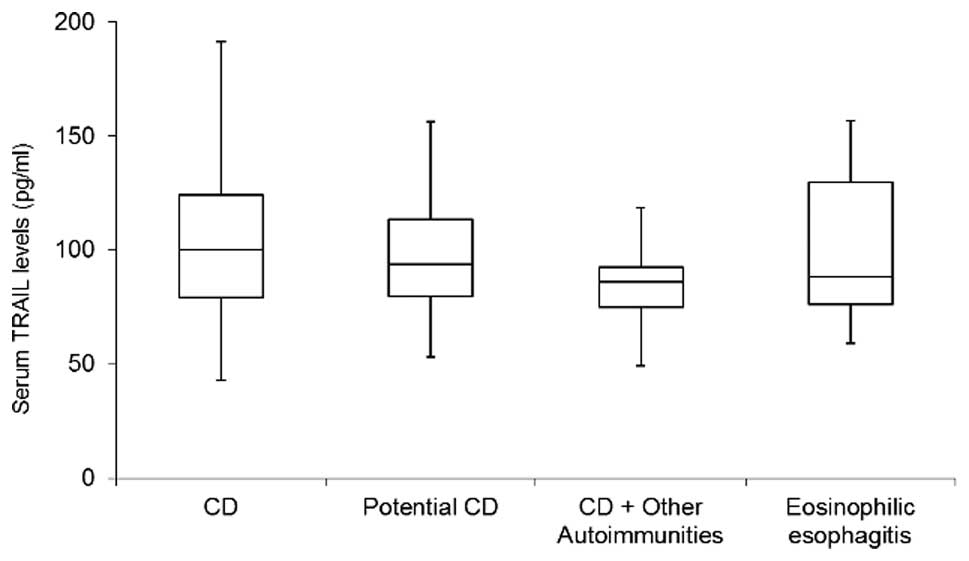
As mentioned in Materials and methods, the cohort of individuals analyzed in the present study included: 100 patients with CD at onset, 45 patients with potential CD, 17 patients with CD associated with another autoimmunity, and 15 patients with eosinophilic esophagitis (Table I). No significant differences among the groups were observed in relation to the male to female ratio and no significant correlation was observed between serum TRAIL levels and the age of the patients. The circulating levels of TRAIL assessed in patients with CD were not significantly different when compared with those in patients with potential CD, nor when compared with those in patients with eosinophilic esophagitis (Table I, Fig. 1). Notably, the analysis of TRAIL levels between patients with CD with and without other concomitant autoimmune disorders (T1D, Hashimoto’s thyroiditis, Addison’s disease, vitiligo, autoimmune atrophic gastritis and psoriasis) revealed significantly lower levels in patients with other autoimmune disorders (P=0.047). This suggests that the concomitant presence of other autoimmune diseases impacts on the circulating levels of TRAIL in CD.

Figure 1

Levels of circulating TNF-related apoptosis-inducing ligand (TRAIL) in patients with different pathologies. CD, celiac disease.

Determination of the levels of circulating TRAIL in patients with CD at follow-up

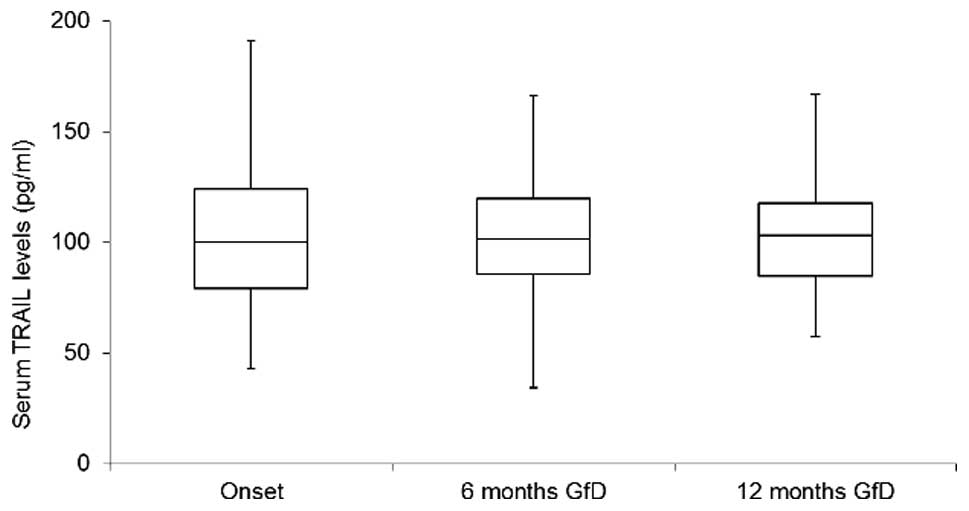
In the next group of experiments, in the cohort of CD patients, the serum levels of TRAIL were evaluated after 6 and 12 months on a gluten-free diet. TRAIL values at disease onset were not significantly different from the levels measured after six months on a gluten-free diet (n=49; P=0.773; Fig. 2). These data were confirmed also for a small subset of patients (n=13) for which data were also available after 1 year of a gluten-free diet (difference between onset and 12 months: P=0.279; difference between 6 and 12 months: P=0.553).

Figure 2

Levels of circulating TNF-related apoptosis-inducing ligand (TRAIL) in patients with celiac disease at onset and following 6 and 12 months of a gluten-free diet (GfD).

Discussion

By analyzing a cohort of pediatric patients affected by CD, the current study has demonstrated that the circulating levels of TRAIL are not significantly different in CD patients with respect to those in patients with potential CD or eosinophilic esophagitis, while the circulating levels of TRAIL are significantly lower in patients with CD and concomitant autoimmune disorders when compared with those in CD patients with no such disorders. In addition, the levels of circulating TRAIL remained stable over a 6–12 month follow-up performed on a fraction of the same CD patients that continued to receive a gluten-free diet.

From these results, it may be inferred that the behavior of circulating TRAIL profoundly differs between T1D and CD. In fact, it has previous been demonstrated that circulating levels of TRAIL significantly decrease in T1D, with the lowest levels of TRAIL being documented in T1D patients with diabetic ketoacidosis (DKA) and depending on the severity of the disease (10). Moreover, TRAIL serum levels at T1D onset showed an inverse correlation with the insulin requirement at different time points up to 21 months of follow-up (10) and these data were in agreement with an independent study performed on T2D, which showed that circulating levels of TRAIL increased in patients with insulin therapy (13).

The present study suggests that the association between the circulating levels of TRAIL and the severity of the auto-immune reaction should be further explored, taking into account that CD patients with other concomitant auto-immune diseases showed significantly lower levels as compared with those in CD patients without concomitant auto-immune diseases. The lack of a correlation between the natural history and/or the response to therapy in CD, and the circulating levels of TRAIL in CD is suggested by the lack of differences observed between CD patients prior to and following a gluten-free diet. By contrast, the fact that TRAIL levels are significantly lower in T1D patients with DKA at onset and with a higher insulin requirement, points to a possible association between TRAIL and the metabolic stress underlying T1D (10). Thus, unlike with other cytokines, which appear to be modulated in CD (14–16), circulating levels of TRAIL do not appear to change, despite the ability of TRAIL to modulate the immune response in different experimental settings. It remains to be demonstrated whether TRAIL might be modulated at the gut level.

Acknowledgements

CC, TN and PS designed the study; AN performed the experiments; LM performed the statistical analyses; CC and TN wrote the first draft of the manuscript under the supervision of PS; and all authors contributed to the final editing of the manuscript.

References

1 

Green PH and Cellier C: Celiac disease. N Engl J Med. 357:1731–1743. 2007. View Article : Google Scholar : PubMed/NCBI

2 

Scaramuzza AE, Mantegazza C, Bosetti A and Zuccotti GV: Type 1 diabetes and celiac disease: The effects of gluten free diet on metabolic control. World J Diabetes. 4:130–134. 2013. View Article : Google Scholar : PubMed/NCBI

3 

Hooft C, Roels H and Devos E: Diabetes and coeliac disease. Lancet. 2:11921969.PubMed/NCBI

4 

Secchiero P and Zauli G: TNF-related apoptosis-inducing ligand and the regulation of hematopoiesis. Curr Op Hematol. 15:42–48. 2008. View Article : Google Scholar : PubMed/NCBI

5 

Secchiero P, Gonelli A, Celeghini C, et al: Activation of the nitric oxide synthase pathway represents a key component of tumor necrosis factor-related apoptosis-inducing ligand-mediated cytotoxicity on hematologic malignancies. Blood. 98:2220–2228. 2001. View Article : Google Scholar

6 

Vinay DS and Kwon BS: The tumour necrosis factor/TNF receptor superfamily: therapeutic targets in autoimmune diseases. Clin Exp Immunol. 164:145–157. 2011. View Article : Google Scholar : PubMed/NCBI

7 

Di Bartolo BA, Chan J, Bennett MR, Cartland S, Bao S, Tuch BE and Kavurma MM: TNF-related apoptosis-inducing ligand (TRAIL) protects against diabetes and atherosclerosis in ApoE−/− mice. Diabetologia. 54:3157–3167. 2011.PubMed/NCBI

8 

Zauli G, Toffoli B, di Iasio MG, Celeghini C, Fabris B and Secchiero P: Treatment with recombinant tumor necrosis factor-related apoptosis-inducing ligand alleviates the severity of streptozotocin-induced diabetes. Diabetes. 59:1261–1265. 2010. View Article : Google Scholar

9 

Tornese G, Iafusco D, Monasta L, et al: The levels of circulating TRAIL at the onset of type 1 diabetes are markedly decreased in patients with ketoacidosis and with the highest insulin requirement. Acta Diabetol. 51:239–246. 2014. View Article : Google Scholar : PubMed/NCBI

10 

Zauli G, Melloni E, Capitani S and Secchiero P: Role of full-length osteoprotegerin in tumor cell biology. Cell Molecular Life Sci. 66:841–851. 2009. View Article : Google Scholar : PubMed/NCBI

11 

Volpato S, Ferrucci L, Secchiero P, et al: Association of tumor necrosis factor-related apoptosis-inducing ligand with total and cardiovascular mortality in older adults. Atherosclerosis. 215:452–458. 2011. View Article : Google Scholar

12 

Secchiero P, Corallini F, Ceconi C, Parrinello G, Volpato S, Ferrari R and Zauli G: Potential prognostic significance of decreased serum levels of TRAIL after acute myocardial infarction. PloS One. 4:e44422009. View Article : Google Scholar : PubMed/NCBI

13 

Secchiero P, Corallini F, Beltrami AP, et al: An imbalanced OPG/TRAIL ratio is associated to severe acute myocardial infarction. Atherosclerosis. 210:274–277. 2010. View Article : Google Scholar : PubMed/NCBI

14 

Xiang G, Zhang J, Ling Y and Zhao L: Circulating level of TRAIL concentration is positively associated with endothelial function and increased by diabetic therapy in the newly diagnosed type 2 diabetic patients. Clin Endocrinol (Oxf). 80:228–234. 2013. View Article : Google Scholar

15 

Lahdenperä AI, Hölttä V, Ruohtula T, et al: Up-regulation of small intestinal interleukin-17 immunity in untreated coeliac disease but not in potential coeliac disease or in type 1 diabetes. Clin Exp Immunol. 167:226–234. 2012.PubMed/NCBI

16 

Pagliari D, Cianci R, Frosali S, Landolfi R, Cammarota G, Newton EE and Pandolfi F: The role of IL-15 in gastrointestinal diseases: A bridge between innate and adaptive immune response. Cytokine Growth Factor Rev. 24:455–466. 2013. View Article : Google Scholar : PubMed/NCBI

Related Articles

  • Abstract
  • View
  • Download
  • Twitter
Copy and paste a formatted citation
Spandidos Publications style
Celeghini C, Not T, Norcio A, Monasta L and Secchiero P: Levels of circulating TNF‑related apoptosis‑inducing ligand in celiac disease. Exp Ther Med 8: 1906-1908, 2014.
APA
Celeghini, C., Not, T., Norcio, A., Monasta, L., & Secchiero, P. (2014). Levels of circulating TNF‑related apoptosis‑inducing ligand in celiac disease. Experimental and Therapeutic Medicine, 8, 1906-1908. https://doi.org/10.3892/etm.2014.2026
MLA
Celeghini, C., Not, T., Norcio, A., Monasta, L., Secchiero, P."Levels of circulating TNF‑related apoptosis‑inducing ligand in celiac disease". Experimental and Therapeutic Medicine 8.6 (2014): 1906-1908.
Chicago
Celeghini, C., Not, T., Norcio, A., Monasta, L., Secchiero, P."Levels of circulating TNF‑related apoptosis‑inducing ligand in celiac disease". Experimental and Therapeutic Medicine 8, no. 6 (2014): 1906-1908. https://doi.org/10.3892/etm.2014.2026
Copy and paste a formatted citation
x
Spandidos Publications style
Celeghini C, Not T, Norcio A, Monasta L and Secchiero P: Levels of circulating TNF‑related apoptosis‑inducing ligand in celiac disease. Exp Ther Med 8: 1906-1908, 2014.
APA
Celeghini, C., Not, T., Norcio, A., Monasta, L., & Secchiero, P. (2014). Levels of circulating TNF‑related apoptosis‑inducing ligand in celiac disease. Experimental and Therapeutic Medicine, 8, 1906-1908. https://doi.org/10.3892/etm.2014.2026
MLA
Celeghini, C., Not, T., Norcio, A., Monasta, L., Secchiero, P."Levels of circulating TNF‑related apoptosis‑inducing ligand in celiac disease". Experimental and Therapeutic Medicine 8.6 (2014): 1906-1908.
Chicago
Celeghini, C., Not, T., Norcio, A., Monasta, L., Secchiero, P."Levels of circulating TNF‑related apoptosis‑inducing ligand in celiac disease". Experimental and Therapeutic Medicine 8, no. 6 (2014): 1906-1908. https://doi.org/10.3892/etm.2014.2026
Follow us
  • Twitter
  • LinkedIn
  • Facebook
About
  • Spandidos Publications
  • Careers
  • Cookie Policy
  • Privacy Policy
How can we help?
  • Help
  • Live Chat
  • Contact
  • Email to our Support Team