Introduction
Acariasis in animals, a common veterinary skin
disease, may reduce the productivity and the quality of products
obtained from animals, and can even lead to death (1). At present, various chemical agents are
widely used to treat and control psoroptic and sarcoptic mange in
veterinary clinics, and relatively good treatment effectiveness has
been obtained with certain drugs, including ivermectin and
abamectin. However, the use of chemicals could result in resistance
in target species, toxicity and environmental hazards (2).
Ligularia Cass. of the family Compositae or
Asteraceae is a genus highly diversified in the eastern
Qinghai-Tibet Plateau region and adjacent areas, where >100
species exist (3,4). The Ligularia Cass. genus is one
of the large genera in the Compositae-Senecioneae-Tussilagininae
classification (5). Ligularia
virgaurea is one of the main species of Ligularia Cass.,
and is a noxious weed widely distributed in the alpine grassland of
the eastern Qinghai-Tibet Plateau (6). Ligularia Cass. has been used for
medicinal purposes, particularly for the treatment of jaundice,
scarlet fever, rheumatoid arthritis and hepatic function failure
(7). Extracts of this genus of
plants have been reported to have antioxidant (8), analgesic, anti-inflammatory (9) and antitumor activity (10); anti-ulcerogenic (11), anti-obesity (12) and antihepatotoxic effects (13) and anticomplement activity (14). However, to the best of our knowledge,
the acaricidal activity of L. virgaurea has not been
investigated. The aim of the present study was to evaluate the
possible acaricidal activity of an ethanol extract of L.
virgaurea against Sarcoptes scabiei.
Materials and methods
Plant material and extraction
L. virgaurea was collected from Ganzi in
Sichuan Province, southwest China in July 2013. A thermal refluxing
method was used to extract the biological components into ethanol,
as previously described (15).
Following the concentration of the extract by the evaporation of
ethanol, the extract was diluted with distilled water containing
glycerin (10%) to varying concentrations.
Mites
The S. scabiei mites were isolated from the
scabs and ear cerumen of the infested legs and ears of naturally
infected rabbits. The scabs and ear cerumen were placed in Petri
dishes and incubated at 35°C for 30 min in an incubator. The adult
mites were then collected for testing. Following the collection of
the samples, the rabbits were treated immediately. Institutional
ethical and animal care guidelines of South China Agricultural
University Experimental Animal Ethics Committee were adhered to
during the sampling exercise, and all procedures were conducted in
accordance with the Guide for the Care and Use of Laboratory
Animals of the National Institutes of Health (8th ed, 2012).
In vitro assay of acaricidal
activity
The ethanol extract was diluted to concentrations of
2, 1, 0.5 and 0.25 g/ml with 10% glycerin, and 0.5-ml samples of
the extract were added to Petri dishes (diameter, 10 cm; height, 2
cm) with filter paper chips to absorb the liquid.
To test the activity against S. scabiei, 10
specimens were placed on the filter paper in the Petri dishes and
incubated at 25°C under 75% relative humidity for 0.5, 1, 2, 4 or 6
h (16,17). Three replicates were performed for
each concentration of the extract. Three Petri dishes containing
0.5 ml distilled water and glycerin (16,18)
acted as an untreated (negative) control, and 2% ivermectin was
used as the positive control. The mites were regularly stimulated
with a needle to determine their viability, and mites were recorded
as dead if no reaction was shown (19).
Statistical analysis
All computations were conducted using SPSS
statistical software (version 20.0; SPSS, Inc., Chicago, IL, USA)
(20). The significance of
differences in the mean mite mortality between different
concentrations was calculated using a probability method. The
median lethal time value (LT50) and the median lethal
concentration value (LC50) were calculated by the
complementary log-log (CLL) model (21).
Results
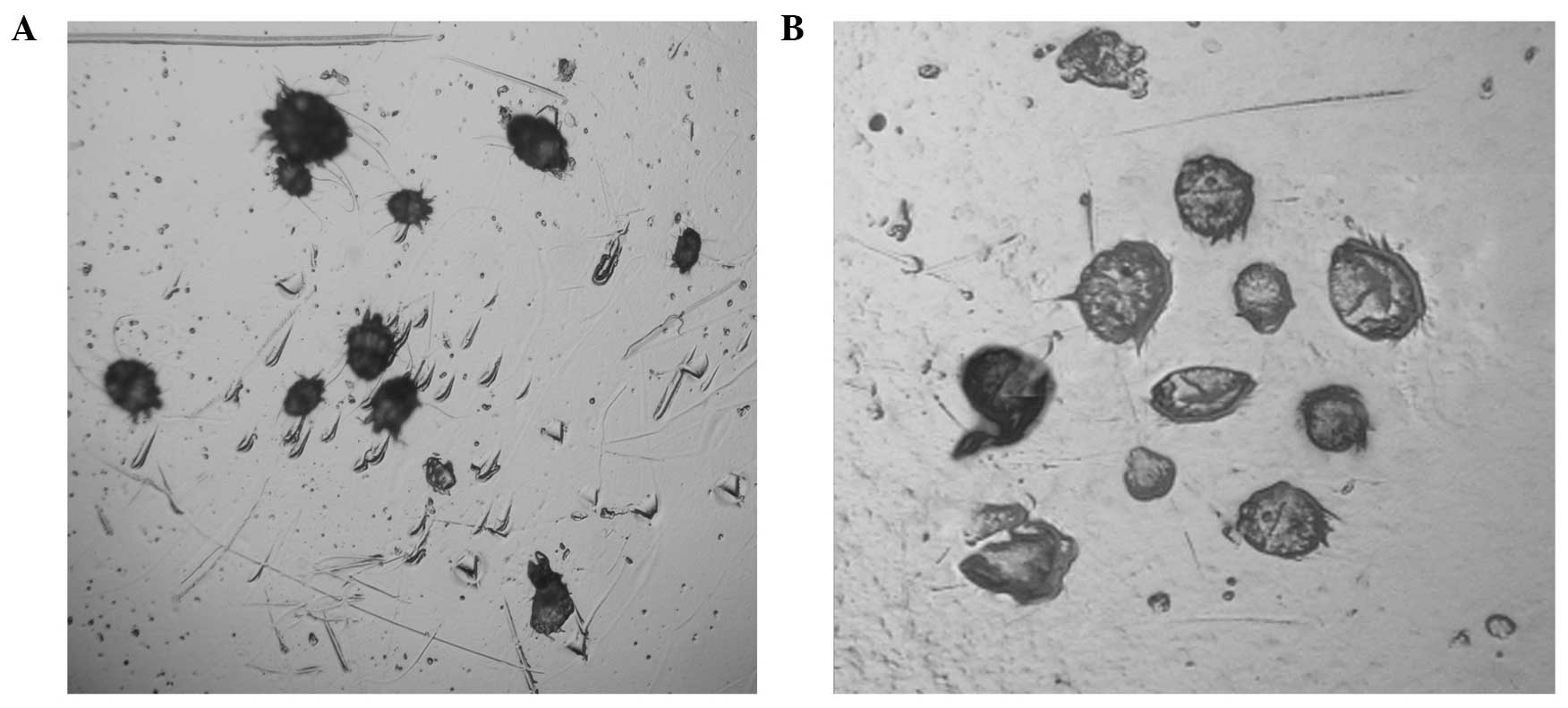
Considerable differences in acaricidal activity were
observed among the different concentrations of the ethanol extract.
The highest concentration of the extract (2 g/ml) caused 100%
mortality in the test mites. In the negative control group, treated
with 10% glycerin, the mites remained alive after the 6-h treatment
period (Fig. 1). In addition, in the
ivermectin-treated positive control group, a number of the mites
remained alive in the sample following the 6-h treatment period.
This may be because the S. scabiei test mites had developed
resistance to ivermectin. Mortality rates for the mites treated
with the four concentrations of the extract are shown in Table I. The toxicity of the ethanol extract
was evaluated using a CLL model. Pearson's Chi-square test and the
Hosmer-Lemeshow goodness-of-fit statistic indicated that the data
fitted the CLL model. The LT50 and LC50
values of the ethanol extract against S. scabiei are shown
in Tables II and III, respectively. The ethanol extract
demonstrated strong toxicity to mites, and its activity was
concentration- and time-dependent. The results indicate that an
ethanol extract of L. virgaurea at concentrations of 2, 1
and 0.5 g/ml was highly toxic to S. scabiei. The
LT50 values for solutions of the extract at
concentrations of 2, 1, 0.5 and 0.25 g/ml were 0.716, 1.741, 2.968
and 4.838 h, respectively, and the LC50 values for 1, 2,
4 and 6 h treatment times were 1.388, 0.624, 0.310 and 0.213 g/ml,
respectively.
 | Table I.Acaricidal activity of the ethanol
extract of Ligularia virgaurea against Sarcoptes scabiei
in vitro. |
Table I.
Acaricidal activity of the ethanol
extract of Ligularia virgaurea against Sarcoptes scabiei
in vitro.
|
| Mean mortality, % ±
SD |
|---|
|
|
|
|---|
| Test agent | 0.5 h | 1 h | 2 h | 4 h | 6 h |
|---|
| Extract |
|
|
|
|
|
| 2
g/ml |
36.67±6.67A,a |
66.67±8.82A,a |
100.00±0.00A,a |
100.00±0.00A,a |
100.00±0.00A,a |
| 1
g/ml |
20.00±5.77A,a,c |
40.00±0.00B,b |
63.33±3.33B,b |
80.00±5.77B,b |
100.00±0.00A,a |
| 0.5
g/ml |
13.33±6.67A,b,c |
30.00±5.77B,c |
46.67±8.82B,c,e |
63.33±3.33C,c |
80.00±5.77B,b |
| 0.25
g/ml |
6.67±3.33A,b |
13.33±3.33C,d |
30.00±5.57B,d |
46.67±3.33D,d |
56.67±3.33C,c |
| Positive
control |
10.00±5.77A,b |
16.67±3.33C,d |
36.67±3.33B,d,e |
66.67±3.33C,c |
83.33±3.33B,b |
| Negative
control |
0.00±0.00B,c |
0.00±0.00D,e |
3.33±3.33C,f |
10.00±0.00D,d |
16.67±3.33D,d |
| Table II.Probit regression analysis of the
toxicity (LT50) of the ethanol extract of Ligularia
virgaurea against Sarcoptes scabiei in vitro. |
Table II.
Probit regression analysis of the
toxicity (LT50) of the ethanol extract of Ligularia
virgaurea against Sarcoptes scabiei in vitro.
| Concentration | Regression
equation | LT50
(95% FL), h | Pearson
Chi-square |
|---|
| 2 g/ml | y=1.894x–1.357 | 0.716
(0.490–0.892) | 0.521 |
| 1 g/ml | y=0.500x–0.871 | 1.741
(1.219–2.224) | 3.606 |
| 0.5 g/ml | y=0.312x–0.926 | 2.968
(2.263–3.765) | 2.567 |
| 0.25 g/ml | y=0.270x–1.306 | 4.838
(3.940–6.427) | 2.753 |
| Table III.Probit regression analysis of the
toxicity (LC50) of the ethanol extract of Ligularia
virgaurea against Sarcoptes scabiei in vitro. |
Table III.
Probit regression analysis of the
toxicity (LC50) of the ethanol extract of Ligularia
virgaurea against Sarcoptes scabiei in vitro.
| Time (h) | Regression
equation | LC50
(95% FL), g/ml | Pearson
Chi-square |
|---|
| 1 | y=0.777x–1.078 | 1.388
(1.076–1.922) | 1.161 |
| 2 | y=1.501x–0.936 | 0.624
(0.427–0.807) | 1.770 |
| 4 | y=1.423x–0.441 | 0.310
(0.058–0.504) | 0.634 |
| 6 | y=3.259x–0.694 | 0.213
(−0.092–0.322) | 0.330 |
Discussion
The results of this study demonstrate for the first
time, to the best of our knowledge, that an ethanol extract of
L. virgaurea has strong acaricidal activity. The extract,
obtained from L. virgaurea by refluxing in ethanol,
exhibited a strong toxic effect against S. scabiei. The
toxicity of the extract was shown to be time- and
concentration-dependent. Similar effects have been observed for an
ethanol extract of Eupatorium adenophorum against S.
scabiei (17,22), 9-oxo-10,11-dehydroageraphorone
extracted from E. adenophorum against S. scabiei and
Psoroptes cuniculi in vitro (16,23), and
for neem oil against Amblyomma variegatum (24). The results of the present study
suggest that the ethanol extract from L. virgaurea contains
acaricidal component(s). It is likely that the acaricidal
component(s) are soluble in organic solvents, such as alcohol,
methanol and acetone, and is consistent with previous observation
that the acaricidal components obtained from natural plants are
volatile compounds (25,26). Although L. virgaurea is
regarded as a weed, this study provides a basis for its utilization
in the development of plant-derived acaricidal drugs. These
preliminary results indicate that L. virgaurea may be a
source of novel acaricidal compounds that are able to effectively
control mites in livestock. Further systematic studies are
warranted to identify the active compounds in L. virgaurea
and to evaluate them in clinical trials, animal acute toxicity
tests and safety tests. Previous studies have shown that some of
the effective components from L. virgaurea are not toxic to
humans or animals (27). Following
further in-depth evaluation, L. virgaurea, as a potent
herbal drug, may have the potential to be more widely applied in
treatments for humans and animals.
Acknowledgements
This study was supported by the Special Fund for
Agroscientific Research in the Public Interest (grant. no.
201203062) and the Science and Technology Support Program of
Sichuan Province (grant. no. 2015SZ0201).
References
|
1
|
Shang XF, Miao XL, Wang DS, et al:
Acaricidal activity of extracts from Adonis coerulea Maxim. against
Psoroptes cuniculi in vitro and in vivo. Vet Parasitol.
195:136–141. 2013. View Article : Google Scholar : PubMed/NCBI
|
|
2
|
Borges FA, Almeida GD, Heckler RP, Lemes
RT, Onizuka MK and Borges DG: Anthelmintic resistance impact on
tropical beef cattle productivity: effect on weight gain of weaned
calves. Trop Anim Health Pro. 45:723–727. 2013. View Article : Google Scholar
|
|
3
|
Liu JQ, Wang YJ, Wang AL, Hideaki O and
Abbott RJ: Radiation and diversification within the
Ligularia-Cremanthodium-Parasenecio complex (Asteraceae) triggered
by uplift of the Qinghai-Tibetan Plateau. Mol Phylogenet Evol.
38:31–49. 2006. View Article : Google Scholar : PubMed/NCBI
|
|
4
|
Tori M, Honda K, Nakamizo H, et al:
Chemical constituents of Ligularia virgaurea and its diversity in
southwestern Sichuan of China. Tetrahedron. 62:4988–4995. 2006.
View Article : Google Scholar
|
|
5
|
Liu SW, Deng DS and Liu JQ: The origin,
evolution and distribution of Ligularia Cass. (Compositae). Zhi Wu
Fen Lei Xue Bao. 32:514–525. 1994.(In Chinese).
|
|
6
|
Ma R, Wang M, Zhao K, Guo S, Zhao Q and
Sun K: Allelopathy of aqueous extract from Ligularia virgaurea, a
dominant weed in psychro-grassland, on pasture plants. Ying Yong
Sheng Tai Xue Bao. 17:845–850. 2006.(In Chinese). PubMed/NCBI
|
|
7
|
Bae JH, Yu SO, Kim YM, et al:
Physiological activity of methanol extracts from Ligularia fischeri
and their hyperplasia inhibition activity of cancer cell. J
Bio-Environ Control. 18:67–73. 2009.(In Korean).
|
|
8
|
Shang YF, Kim SM, Song DG, Pan CH, Lee WJ
and Um BH: Isolation and identification of antioxidant compounds
from Ligularia fischeri. J Food Sci. 75:C530–C535. 2010. View Article : Google Scholar : PubMed/NCBI
|
|
9
|
Lee KH and Choi EM: Analgesic and
anti-inflammatory effects of Ligularia fischeri leaves in
experimental animals. J Ethnopharmacol. 120:103–107. 2008.
View Article : Google Scholar : PubMed/NCBI
|
|
10
|
Lee DK, Kim JK, Kim JS, et al: Inhibitory
effect of Ligularia Stenocephala on the cancer metastasis. Nat Prod
Sci. 18:89–96. 2012.
|
|
11
|
Lee BI, Nugroho A, Bachri MS, et al:
Anti-ulcerogenic effect and HPLC analysis of the caffeoylquinic
acid-rich extract from Ligularia stenocephala. Biol Pharm Bull.
33:493–497. 2010. View Article : Google Scholar : PubMed/NCBI
|
|
12
|
Nugroho A, Bachri MS, Choi JW, et al: The
inhibitory effect of the caffeoylquinic acid-rich extract of
Ligularia stenocephala leaves on obesity in the high fat
diet-induced rat. Nat Prod Sci. 16:80–87. 2010.
|
|
13
|
Choi J, Park JK, Lee KT, et al: In vivo
antihepatotoxic effects of Ligularia fischeri var. spiciformis and
the identification of the active component, 3,4-dicaffeoylquinic
acid. J Med Food. 8:348–352. 2005. View Article : Google Scholar : PubMed/NCBI
|
|
14
|
Moon HI, Lee JH and Lee YC: Inhibitory
effects of organic solvent extracts from Korean local plants on the
complement classical pathway. Immunopharm Immunot. 34:12–14. 2012.
View Article : Google Scholar
|
|
15
|
Cetin H, Cilek J, Oz E, Aydin L, Deveci O
and Yanikoglu A: Acaricidal activity of Satureja thymbra L.
essential oil and its major components, carvacrol and γ-terpinene
against adult Hyalomma marginatum (Acari: Ixodidae). Vet Parasitol.
170:287–290. 2010. View Article : Google Scholar : PubMed/NCBI
|
|
16
|
Liao F, Hu Y, Tan H, et al: Acaricidal
activity of 9-oxo-10, 11-dehydroageraphorone extracted from
Eupatorium adenophorum in vitro. Exp Parasitol. 140:8–11. 2014.
View Article : Google Scholar : PubMed/NCBI
|
|
17
|
Nong X, Ren YJ, Wang JH, Xie Y, Fang CL,
Yang DY, et al: Clinical efficacy of botanical extracts from
Eupatorium adenophorum against the Sarcoptes scabiei (Sarcoptidae:
Sarcoptes) in rabbits. Vet Parasitol. 195:157–164. 2013. View Article : Google Scholar : PubMed/NCBI
|
|
18
|
Fichi G, Flamini G, Giovanelli F, Otranto
D and Perrucci S: Efficacy of an essential oil of Eugenia
caryophyllata against Psoroptes cuniculi. Exp Parasitol.
115:168–172. 2007. View Article : Google Scholar : PubMed/NCBI
|
|
19
|
Pasay C, Mounsey K, Stevenson G, et al:
Acaricidal activity of eugenol based compounds against scabies
mites. PLoS One. 5:e120792010. View Article : Google Scholar : PubMed/NCBI
|
|
20
|
Zhang L, Koyyalamudi SR, Jeong SC, et al:
Antioxidant and immunomodulatory activities of polysaccharides from
the roots of Sanguisorba officinalis. Int J Biol Macromol.
51:1057–1062. 2012. View Article : Google Scholar : PubMed/NCBI
|
|
21
|
Qiu J, Song F, Mao L, Tu J and Guan X:
Time-dose-mortality data and modeling for the entomopathogenic
fungus Aschersonia placenta against the whitefly Bemisia tabaci.
Can J Microbiol. 59:97–101. 2013. View Article : Google Scholar : PubMed/NCBI
|
|
22
|
Nong X, Fang CL, Wang JH, et al:
Acaricidal activity of extract from Eupatorium adenophorum against
the Psoroptes cuniculi and Sarcoptes scabiei in vitro. Vet
Parasitol. 187:345–349. 2012. View Article : Google Scholar : PubMed/NCBI
|
|
23
|
Nong X, Li SH, Chen FZ, et al: Isolation
and identification of acaricidal compounds in Eupatorium
adenophorum petroleum ether extract and determination of their
acaricidal activity against Psoroptes cuniculi. Vet Parasitol.
203:197–202. 2014. View Article : Google Scholar : PubMed/NCBI
|
|
24
|
Abdel-Ghaffar F and Semmler M: Efficacy of
neem seed extract shampoo on head lice of naturally infected humans
in Egypt. Parasitol Res. 100:329–332. 2007. View Article : Google Scholar : PubMed/NCBI
|
|
25
|
Du YH, Li JL, Jia RY, et al: Acaricidal
activity of four fractions and octadecanoic
acid-tetrahydrofuran-3,4-diyl ester isolated from chloroform
extracts of neem (Azadirachta indica) oil against Sarcoptes scabiei
var. cuniculi larvae in vitro. Vet Parasitol. 163:175–178. 2009.
View Article : Google Scholar : PubMed/NCBI
|
|
26
|
Rim IS and Jee CH: Acaricidal effects of
herb essential oils against Dermatophagoides farinae and D.
pteronyssinus (Acari: Pyroglyphidae) and qualitative analysis of a
herb Mentha pulegium (pennyroyal). Korean J Parasitol. 44:133–138.
2006. View Article : Google Scholar : PubMed/NCBI
|
|
27
|
Derda M, Hadaś E and Thiem B: Plant
extracts as natural amoebicidal agents. Parasitol Res. 104:705–708.
2009. View Article : Google Scholar : PubMed/NCBI
|