Spandidos Publications Logo
  • About
    • About Spandidos
    • Aims and Scopes
    • Abstracting and Indexing
    • Editorial Policies
    • Reprints and Permissions
    • Job Opportunities
    • Terms and Conditions
    • Contact
  • Journals
    • All Journals
    • Oncology Letters
      • Oncology Letters
      • Information for Authors
      • Editorial Policies
      • Editorial Board
      • Aims and Scope
      • Abstracting and Indexing
      • Bibliographic Information
      • Archive
    • International Journal of Oncology
      • International Journal of Oncology
      • Information for Authors
      • Editorial Policies
      • Editorial Board
      • Aims and Scope
      • Abstracting and Indexing
      • Bibliographic Information
      • Archive
    • Molecular and Clinical Oncology
      • Molecular and Clinical Oncology
      • Information for Authors
      • Editorial Policies
      • Editorial Board
      • Aims and Scope
      • Abstracting and Indexing
      • Bibliographic Information
      • Archive
    • Experimental and Therapeutic Medicine
      • Experimental and Therapeutic Medicine
      • Information for Authors
      • Editorial Policies
      • Editorial Board
      • Aims and Scope
      • Abstracting and Indexing
      • Bibliographic Information
      • Archive
    • International Journal of Molecular Medicine
      • International Journal of Molecular Medicine
      • Information for Authors
      • Editorial Policies
      • Editorial Board
      • Aims and Scope
      • Abstracting and Indexing
      • Bibliographic Information
      • Archive
    • Biomedical Reports
      • Biomedical Reports
      • Information for Authors
      • Editorial Policies
      • Editorial Board
      • Aims and Scope
      • Abstracting and Indexing
      • Bibliographic Information
      • Archive
    • Oncology Reports
      • Oncology Reports
      • Information for Authors
      • Editorial Policies
      • Editorial Board
      • Aims and Scope
      • Abstracting and Indexing
      • Bibliographic Information
      • Archive
    • Molecular Medicine Reports
      • Molecular Medicine Reports
      • Information for Authors
      • Editorial Policies
      • Editorial Board
      • Aims and Scope
      • Abstracting and Indexing
      • Bibliographic Information
      • Archive
    • World Academy of Sciences Journal
      • World Academy of Sciences Journal
      • Information for Authors
      • Editorial Policies
      • Editorial Board
      • Aims and Scope
      • Abstracting and Indexing
      • Bibliographic Information
      • Archive
    • International Journal of Functional Nutrition
      • International Journal of Functional Nutrition
      • Information for Authors
      • Editorial Policies
      • Editorial Board
      • Aims and Scope
      • Abstracting and Indexing
      • Bibliographic Information
      • Archive
    • International Journal of Epigenetics
      • International Journal of Epigenetics
      • Information for Authors
      • Editorial Policies
      • Editorial Board
      • Aims and Scope
      • Abstracting and Indexing
      • Bibliographic Information
      • Archive
    • Medicine International
      • Medicine International
      • Information for Authors
      • Editorial Policies
      • Editorial Board
      • Aims and Scope
      • Abstracting and Indexing
      • Bibliographic Information
      • Archive
  • Articles
  • Information
    • Information for Authors
    • Information for Reviewers
    • Information for Librarians
    • Information for Advertisers
    • Conferences
  • Language Editing
Spandidos Publications Logo
  • About
    • About Spandidos
    • Aims and Scopes
    • Abstracting and Indexing
    • Editorial Policies
    • Reprints and Permissions
    • Job Opportunities
    • Terms and Conditions
    • Contact
  • Journals
    • All Journals
    • Biomedical Reports
      • Information for Authors
      • Editorial Policies
      • Editorial Board
      • Aims and Scope
      • Abstracting and Indexing
      • Bibliographic Information
      • Archive
    • Experimental and Therapeutic Medicine
      • Information for Authors
      • Editorial Policies
      • Editorial Board
      • Aims and Scope
      • Abstracting and Indexing
      • Bibliographic Information
      • Archive
    • International Journal of Epigenetics
      • Information for Authors
      • Editorial Policies
      • Editorial Board
      • Aims and Scope
      • Abstracting and Indexing
      • Bibliographic Information
      • Archive
    • International Journal of Functional Nutrition
      • Information for Authors
      • Editorial Policies
      • Editorial Board
      • Aims and Scope
      • Abstracting and Indexing
      • Bibliographic Information
      • Archive
    • International Journal of Molecular Medicine
      • Information for Authors
      • Editorial Policies
      • Editorial Board
      • Aims and Scope
      • Abstracting and Indexing
      • Bibliographic Information
      • Archive
    • International Journal of Oncology
      • Information for Authors
      • Editorial Policies
      • Editorial Board
      • Aims and Scope
      • Abstracting and Indexing
      • Bibliographic Information
      • Archive
    • Medicine International
      • Information for Authors
      • Editorial Policies
      • Editorial Board
      • Aims and Scope
      • Abstracting and Indexing
      • Bibliographic Information
      • Archive
    • Molecular and Clinical Oncology
      • Information for Authors
      • Editorial Policies
      • Editorial Board
      • Aims and Scope
      • Abstracting and Indexing
      • Bibliographic Information
      • Archive
    • Molecular Medicine Reports
      • Information for Authors
      • Editorial Policies
      • Editorial Board
      • Aims and Scope
      • Abstracting and Indexing
      • Bibliographic Information
      • Archive
    • Oncology Letters
      • Information for Authors
      • Editorial Policies
      • Editorial Board
      • Aims and Scope
      • Abstracting and Indexing
      • Bibliographic Information
      • Archive
    • Oncology Reports
      • Information for Authors
      • Editorial Policies
      • Editorial Board
      • Aims and Scope
      • Abstracting and Indexing
      • Bibliographic Information
      • Archive
    • World Academy of Sciences Journal
      • Information for Authors
      • Editorial Policies
      • Editorial Board
      • Aims and Scope
      • Abstracting and Indexing
      • Bibliographic Information
      • Archive
  • Articles
  • Information
    • For Authors
    • For Reviewers
    • For Librarians
    • For Advertisers
    • Conferences
  • Language Editing
Login Register Submit
  • This site uses cookies
  • You can change your cookie settings at any time by following the instructions in our Cookie Policy. To find out more, you may read our Privacy Policy.

    I agree
Search articles by DOI, keyword, author or affiliation
Search
Advanced Search
presentation
Experimental and Therapeutic Medicine
Join Editorial Board Propose a Special Issue
Print ISSN: 1792-0981 Online ISSN: 1792-1015
Journal Cover
May-2016 Volume 11 Issue 5

Full Size Image

Sign up for eToc alerts
Recommend to Library

Journals

International Journal of Molecular Medicine

International Journal of Molecular Medicine

International Journal of Molecular Medicine is an international journal devoted to molecular mechanisms of human disease.

International Journal of Oncology

International Journal of Oncology

International Journal of Oncology is an international journal devoted to oncology research and cancer treatment.

Molecular Medicine Reports

Molecular Medicine Reports

Covers molecular medicine topics such as pharmacology, pathology, genetics, neuroscience, infectious diseases, molecular cardiology, and molecular surgery.

Oncology Reports

Oncology Reports

Oncology Reports is an international journal devoted to fundamental and applied research in Oncology.

Experimental and Therapeutic Medicine

Experimental and Therapeutic Medicine

Experimental and Therapeutic Medicine is an international journal devoted to laboratory and clinical medicine.

Oncology Letters

Oncology Letters

Oncology Letters is an international journal devoted to Experimental and Clinical Oncology.

Biomedical Reports

Biomedical Reports

Explores a wide range of biological and medical fields, including pharmacology, genetics, microbiology, neuroscience, and molecular cardiology.

Molecular and Clinical Oncology

Molecular and Clinical Oncology

International journal addressing all aspects of oncology research, from tumorigenesis and oncogenes to chemotherapy and metastasis.

World Academy of Sciences Journal

World Academy of Sciences Journal

Multidisciplinary open-access journal spanning biochemistry, genetics, neuroscience, environmental health, and synthetic biology.

International Journal of Functional Nutrition

International Journal of Functional Nutrition

Open-access journal combining biochemistry, pharmacology, immunology, and genetics to advance health through functional nutrition.

International Journal of Epigenetics

International Journal of Epigenetics

Publishes open-access research on using epigenetics to advance understanding and treatment of human disease.

Medicine International

Medicine International

An International Open Access Journal Devoted to General Medicine.

Journal Cover
May-2016 Volume 11 Issue 5

Full Size Image

Sign up for eToc alerts
Recommend to Library

  • Article
  • Citations
    • Cite This Article
    • Download Citation
    • Create Citation Alert
    • Remove Citation Alert
    • Cited By
  • Similar Articles
    • Related Articles (in Spandidos Publications)
    • Similar Articles (Google Scholar)
    • Similar Articles (PubMed)
  • Download PDF
  • Download XML
  • View XML
Article

Negative signals for adenomyomatosis of the gallbladder upon diffusion‑weighted whole body imaging with background body signal suppression/T2‑weighted image fusion analysis

  • Authors:
    • Minoru Tomizawa
    • Fuminobu Shinozaki
    • Kazunori Fugo
    • Takafumi Sunaoshi
    • Eriko Sugiyama
    • Daisuke Kano
    • Misaki Shite
    • Ryouta Haga
    • Yoshiya Fukamizu
    • Satoshi Kagayama
    • Rumiko Hasegawa
    • Yoshinori Shirai
    • Yasufumi Motoyoshi
    • Takao Sugiyama
    • Shigenori Yamamoto
    • Takashi Kishimoto
    • Naoki Ishige
  • View Affiliations / Copyright

    Affiliations: Department of Gastroenterology, National Hospital Organization Shimoshizu Hospital, Yotsukaido, Chiba 284‑0003, Japan, Department of Radiology, National Hospital Organization Shimoshizu Hospital, Yotsukaido, Chiba 284‑0003, Japan, Department of Molecular Pathology, Chiba University Graduate School of Medicine, Chuo, Chiba 260‑8670, Japan, Department of Surgery, National Hospital Organization Shimoshizu Hospital, Yotsukaido, Chiba 284‑0003, Japan, Department of Neurology, National Hospital Organization Shimoshizu Hospital, Yotsukaido, Chiba 284‑0003, Japan, Department of Rheumatology, National Hospital Organization Shimoshizu Hospital, Yotsukaido, Chiba 284‑0003, Japan, Department of Pediatrics, National Hospital Organization Shimoshizu Hospital, Yotsukaido, Chiba 284‑0003, Japan, Department of Neurosurgery, National Hospital Organization Shimoshizu Hospital, Yotsukaido, Chiba 284‑0003, Japan
  • Pages: 1777-1780
    |
    Published online on: March 2, 2016
       https://doi.org/10.3892/etm.2016.3126
  • Expand metrics +
Metrics: Total Views: 0 (Spandidos Publications: | PMC Statistics: )
Metrics: Total PDF Downloads: 0 (Spandidos Publications: | PMC Statistics: )
Cited By (CrossRef): 0 citations Loading Articles...

This article is mentioned in:


Abstract

Differentiation between adenomyomatosis (ADM) and cancer of the gallbladder is necessary during diagnosis. Diffusion‑weighted whole body imaging with background body signal suppression (DWIBS) images are able to indicate cancer and inflammation. The fusion of a DWIBS with a T2 weighted image (DWIBS/T2) facilitates both functional and anatomical investigations. In the present study, patient records and images from patients with surgically confirmed ADM from April 2012 to October 2014 were analyzed retrospectively. The enrolled patients, including 6 men (64.2±13.1 years) and 4 women (57.3±12.4 years) were subjected to DWIBS/T2 during routine clinical practice. The diagnosis of ADM was based on magnetic resonance cholangiopancreatography, transabdominal ultrasonography, and endoscopic ultrasonography; ADM was diagnosed definitively when cystic lesions were observed, indicating the Rokitansky‑Aschoff sinus. A single patient was indicated to be positive by DWIBS/T2 imaging. The Rokitansky‑Aschoff sinus revealed a relatively high signal intensity; however, it was not as strong as that of the spleen. The signal intensity was also high on an apparent diffusion coefficient map, suggesting T2 shine‑through. The thickened wall displayed low signal intensity. The aforementioned results indicate that ADM may be negative upon DWIBS/T2 imaging; one false positive case was determined to be ADM, accompanied by chronic cholecystitis. The majority of patients with ADM displayed negative findings upon DWIBS/T2 imaging, and chronic cholecystitis may cause false positives.

Introduction

Adenomyomatosis of the gallbladder (ADM) is defined as the epithelial proliferation and hypertrophy of the muscles of the gallbladder wall (1). An outpouching of the gallbladder mucosa into the thickened muscular layer is termed Rokitansky-Aschoff sinus (2). ADM may be further divided into three subtypes: Fundal, segmental and diffuse (3). A major challenge in ADM diagnosis arises from the difficulty in distinguishing the disease from gallbladder cancer (4).

Recent advances in diagnostic imaging have improved the distinction between ADM and gallbladder cancer. Contrast-enhanced endoscopic ultrasonography (EUS) is beneficial for the differential diagnosis of gallbladder wall thickening (5). High-resolution ultrasound is also advantageous for differentiating gallbladder cancers from ADM (6); however, the challenge of differentiating gallbladder cancer from ADM has yet to be resolved. A primary cause of the challenge is intratumoral cystic components, which create difficulty in discerning between gallbladder cancer and ADM (7).

Diffusion-weighted whole body imaging with background body signal suppression (DWIBS) images are acquired through multiple-signal averaging, pre-pulse fat suppression, and heavy diffusion weighting during free breathing (8); DWIBS is based upon diffusion-weighted imaging (DWI), which visualizes and assesses the random movement of water at the molecular level (Brownian motion) (9,10). An advantage of DWIBS is that it provides a strong contrast of cancerous tissues against the adjacent non-cancerous tissues, which is useful for detection and staging, and for monitoring the response to therapy (11). A major limitation of DWIBS is that anatomical analysis may occasionally prove difficult (12,13). Using a workstation, DWIBS images may be overlapped with T2-weighed images (T2WIs) to create DWIBS/T2 fusion images (11,14,15); these DWIBS/T2 images can clearly provide functional information about the anatomy.

Therefore, DWIBS/T2 images of ADM were analyzed in the present study in order to investigate the distinctions between ADM and gallbladder cancer.

Patients and methods

Patients

Patient records and images from April 2012 to October 2014 were analyzed retrospectively. The enrolled patients included 6 men (64.2±13.1 years) and 4 women (57.3±12.4 years). Of the 10 patients, 8 had fundal, and 2 had segmental ADM. The patients underwent DWIBS/T2 as part of routine clinical practice. A number of patients (n=3) underwent surgery due to a clinical suspicion of gallbladder cancer. The surgical specimens confirmed the diagnosis of ADM. All patients underwent regular follow-up (duration, 1–27 months), and none of the patients demonstrated any evidence of gallbladder cancer. The study was submitted to the ethics committee of the National Hospital Organization Shimoshizu Hospital (Yotsukaido, China) for review and was not considered a clinical trial as it was conducted during routine clinical practice. Patient anonymity was preserved.

Diagnosis of ADM

The diagnosis of ADM was based upon imaging techniques, including computed tomography (CT; SOMATOM Emotion 16; Siemens AG, Munich, Germany), transabdominal ultrasonography (US; SSA-700A; Toshiba Medical Systems Corporation, Ohtawara, Japan), EUS (GF-UCT260; Olympus Corporation, Tokyo, Japan) and magnetic resonance cholangiopancreatography (MRCP; Philips Healthcare, DA Best, The Netherlands), with Achieva Software version 3.2.2 The diagnosis of ADM was predominately based on the visualization of the Rokitansky-Aschoff sinus by MRCP, as represented by the pearl necklace sign (16). Wall thickening >10 mm, disruption of the normal layers of the gallbladder wall and hypoechoic lesions in the wall were absent upon US and EUS (17). Microcysts were observed during examination using US and EUS, indicating the presence of the Rokitansky-Aschoff sinus (18). CT imaging was applied for the detection of the wall thickening (19).

Magnetic resonance imaging (MRI)

All MRI examinations were performed using an 1.5 Tesla scanner (Achieva, software version 3.2.2; Philips Medical Systems B.V., Eindhoven, The Netherlands). The T1-weighted images (T1WIs), T2WIs and diffusion-weighted images were obtained with pulse sequences, as depicted in Table I. The DWIBS/T2 images were constructed with the Extended MR WorkSpace (Philips Medical Systems B.V.), and the sequences are displayed in Table I. DWI gradients were applied along the x-, y- and z-axes prior to and after a 180° inversion pre-pulse to obtain fat-saturated, isotropic images with DWI sensitivity using the following parameters for a single stack: b value, 0 mm2/sec and 800 mm2/sec; repetition time/echo time/inversion recovery, 6,960/79/150 msec; acquisition matrix, 176×115; reconstruction matrix, 256; field of view, right/left, 530 mm, anterior/posterior, 349 mm, and feet/head, 226 mm; slice thickness, 6 mm; size of reconstructed voxel, 2.07×2.08×6 mm3; and 4 averages. An apparent diffusion coefficient (ADC) map was produced from the recorded ADC values in order to eliminate the possibility of T2 shine-through and to differentiate malignant lesions from non-malignant causes of restricted diffusion (20).

Table I.

Pulse sequences used in the present study.

Table I.

Pulse sequences used in the present study.

ParameterT1-weighted imagingT2-weighted imagingDWI (DWIBS)
SequencesGRESEEPI SE
TR, msecShortest1,00011,250
TE, msecFirst, 2.3 (out-phase); second: 4.6 (in-phase)9083
Flip angle, °759090
NSA114
Slice thickness, mm885
Slice gap110
Fat saturationNoneNoneSPAIR
Phase encoding direction Posterior-anterior Posterior-anterior Posterior-anterior

[i] TR, repetition time; TE, echo time; DWI, diffusion-weighted imaging; DWIBS, diffusion-weighted whole body imaging with background body signal suppression/T2 image fusion; GRE, gradient echo; SE, spin echo; EPI, echo planar imaging; NSA, number of signal averages; SPAIR, spectral attenuated inversion recovery.

Results

ADM is negative upon DWBS/T2 imaging

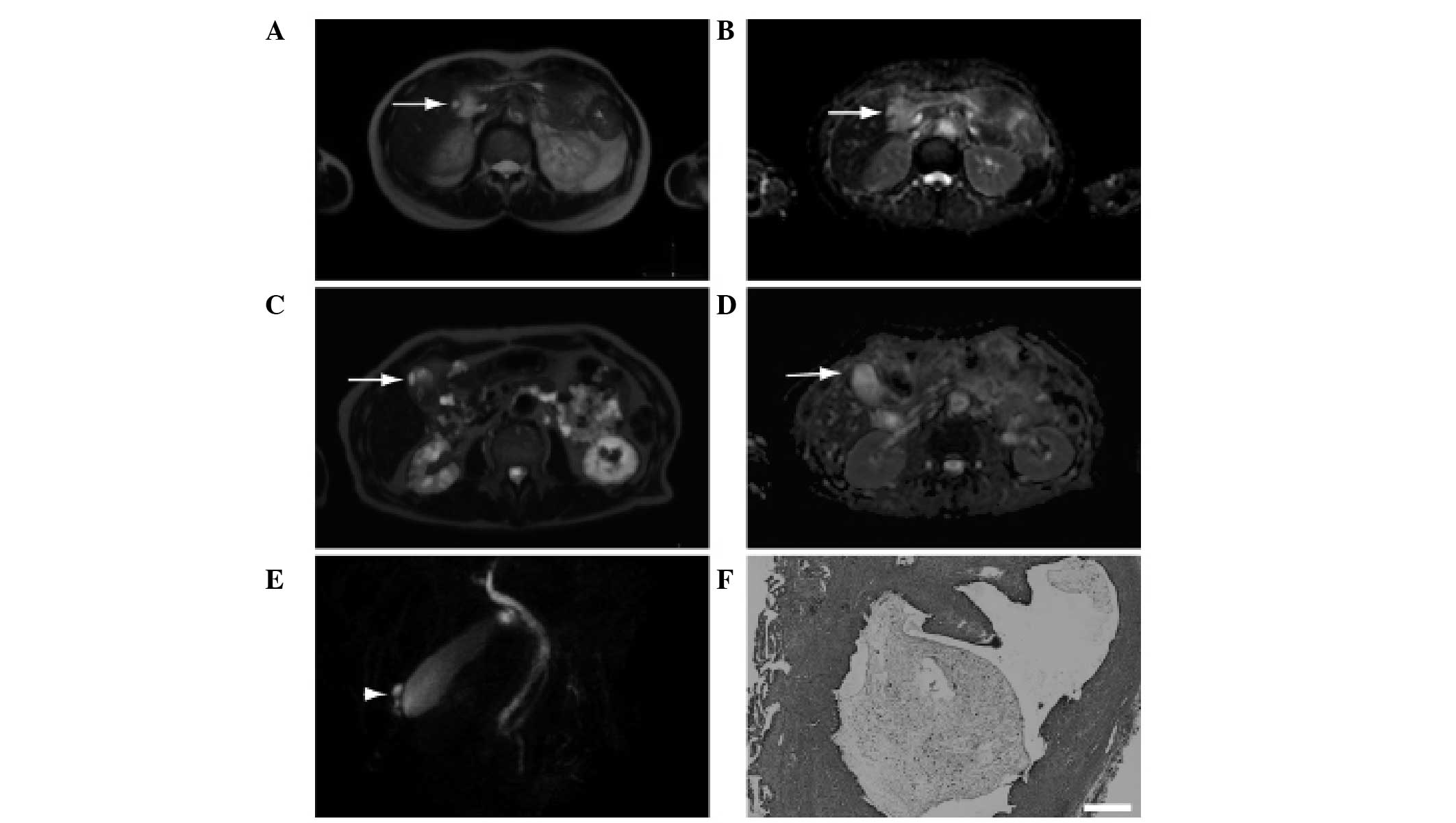
Patient characteristics are displayed in Table II. All variables were within normal limits. Upon DWIBS/T2 imaging, only 1 patient had positive results. Cystic lesions in the thickened wall exhibited a relatively high signal intensity upon DWIBS/T2 imaging; however, the intensity was not as strong as that from the spleen (Fig. 1A). The spleen displayed high signal intensity upon DWIBS/T2 imaging. The intensity of the cystic lesion was also high on the ADC map (Fig. 1B), indicating the presence of T2 shine-through. It was determined that the cystic lesion was a Rokitansky-Aschoff sinus. Low signal intensity was observed for the thickened wall. The aforementioned results indicate that ADM may be negative upon DWIBS/T2 imaging.

Figure 1.

Diffusion-weighted whole body imaging with background body signal suppression (DWIBS)/T2-weighted image fusion (DWIBS/T2) of adenomyomatosis of gallbladder. (A and B) DWIBS/T2 observations for gallbladder wall thickening in a 65-year-old woman. High signal intensity is visible in the fundus of gallbladder (A) upon DWIBS/T2 imaging and (B) on the apparent diffusion coefficient (ADC) map, the latter indicating T2 shine-through. (C-F) DWIBS/T2 findings for gallbladder wall thickening in a 63-year-old man. (C) High signal intensity is observed in the fundus of the gallbladder upon DWIBS/T2 imaging. (D) No high signal is visible in the fundus of the gallbladder on the ADC map. The high signal intensity upon DWIBS/T2 imaging was determined as a positive finding, and suspected of malignancy. (E) Magnetic resonance cholangiopancreatography showing the pearl necklace sign. (F) Surgical specimen showing the proliferation of muscle fiber, and the dilated Rokitansky-Aschoff sinus (original magnification, ×40; scale bar, 500 µm). Lymphocyte infiltration is observed. The patient was later diagnosed with chronic cholecystitis and adenomyomatosis.

Table II.

Patient characteristics.

Table II.

Patient characteristics.

VariableValue (mean ± standard deviation)
WBC, 103/µl5.0±1.0
Hb, g/dl14.3±1.2
CRP, mg/dl0.15±0.10
T-Bil, mg/dl0.98±0.33
ALP, IU/l190±95
AST, IU/l20.1±5.1
ALT, IU/l17.6±5.4
GGT, IU/l26.7±14.4
CEA, ng/ml2.2±1.5
CA19–9, U/ml12.0±8.4

[i] WBC, white blood cell count; Hb, hemoglobin; CRP, C-reactive protein; T-Bil, total bilirubin; ALP, alkaline phosphatase; AST, aspartate aminotransferase; ALT, alanine aminotransferase; GGT, γ-glutamyl transpeptidase; CEA, carcinoembryonic antigen; CA19–9, carbohydrate antigen 19–9.

ADM is concomitant with chronic cholecystitis

A high signal intensity was observed upon DWIBS/T2 imaging for a second patient (Fig. 1C); however, the patient's ADC map did not reveal any high intensity signals (Fig. 1D). It was suggested that the patient may have gallbladder cancer; however, the pearl necklace sign (21) was observed during MRCP (Fig. 1E). Due to the complexities involved in differentiating between ADM and gallbladder cancer, the patient underwent surgery. The surgical specimen revealed the presence of ADM concomitant with chronic cholecystitis (Fig. 1F). On the basis of the aforementioned findings, it was concluded that the high signal intensity observed during DWIBS/T2 imaging was a false positive.

Discussion

DWI is known to improve the accuracy of the diagnosis of gallbladder cancer (22). Upon DWI, a high signal intensity is observed for cystic lesions in ADM, indicating the presence of the Rokitansky-Aschoff sinus (22). Compared with benign lesions, gallbladder cancer displays significantly lower signal intensity on the ADC map (23). These studies indicate that a definitive diagnosis of ADM or gallbladder cancer is dependent upon the ADC values. In the present study, the Rokitansky-Aschoff sinus was negative upon DWIBS/T2 imaging, as was the thickened wall of the ADM. The ADC values or ADC map were also valuable in diagnosing T2 shine-through for the Rokitansky-Aschoff sinus, and in confirming the ADM or gallbladder cancer diagnoses.

At present, few previous studies have reported the use of DWI for the diagnosis of ADM, and no report has been found regarding the use of DWIBS in ADM diagnosis. Ogawa et al (24) reported the use of DWI in gallbladder diseases; DWI was positive in 11% of their patients (they determined a result to be positive when a high signal was observed). There is a possibility that T2-shine through may be read as a positive result. Therefore, in the present study, the possibility of T2-shine through was omitted using a ADC map and ADM was negative with DWIBS/T2. In addition, DWIBS/T2 enabled the evaluation of signals in anatomical settings. These findings suggested that negative DWIBS/T2 results may be considered useful for the diagnosis of ADM.

The ADC values for gallbladder cancer are significantly lower, as compared with those for benign lesions (22). In the present study, only 1 of 10 patients displayed low signal intensity on the ADC map. It was suggested that the patient had gallbladder cancer; however, the surgical specimen revealed the presence of chronic cholecystitis with ADM, highlighting the difficulty in differentiating between chronic cholecystitis and ADM (4). Chronic cholecystitis is known to cause false positives in DWI (24). One patient with false positive DWI findings was diagnosed with chronic cholecystitis in the present study. Inflammation is also known to give rise to false positives in DWI (25). It was speculated that chronic cholecystitis may be the underlying cause of the false positive findings in the present case.

A limitation of the present study is that it was based upon a small number of patients. Another limitation was that the present study did not include patients with gallbladder cancer. In the future, we propose to include greater numbers of patients, in particular, those with gallbladder cancer.

In conclusion, the majority of the patients with ADM displayed negative findings upon DWIBS/T2 imaging. A patient with a false positive finding had accompanying chronic cholecystitis.

References

1 

Colquhoun J: Adenomyomatosis of the gall-bladder (intramural diverticulosis). Br J Radiol. 34:101–112. 1961. View Article : Google Scholar : PubMed/NCBI

2 

Williams I, Slavin G, Cox A, Simpson P and de Lacey G: Diverticular disease (adenomyomatosis) of the gallbladder: A radiological-pathological survey. Br J Radiol. 59:29–34. 1986. View Article : Google Scholar : PubMed/NCBI

3 

Kim JH, Jeong IH, Han JH, Kim JH, Hwang JC, Yoo BM, Kim JH, Kim MW and Kim WH: Clinical/pathological analysis of gallbladder adenomyomatosis; Type and pathogenesis. Hepatogastroenterology. 57:420–425. 2010.PubMed/NCBI

4 

Kim BS, Oh JY, Nam KJ, Cho JH, Kwon HJ, Yoon SK, Jeong JS and Noh MH: Focal thickening at the fundus of the gallbladder: Computed tomography differentiation of fundal type adenomyomatosis and localized chronic cholecystitis. Gut Liver. 8:219–223. 2014. View Article : Google Scholar : PubMed/NCBI

5 

Imazu H, Mori N, Kanazawa K, Chiba M, Toyoizumi H, Torisu Y, Koyama S, Hino S, Ang TL and Tajiri H: Contrast-enhanced harmonic endoscopic ultrasonography in the differential diagnosis of gallbladder wall thickening. Dig Dis Sci. 59:1909–1916. 2014. View Article : Google Scholar : PubMed/NCBI

6 

Joo I, Lee JY, Kim JH, Kim SJ, Kim MA, Han JK and Choi BI: Differentiation of adenomyomatosis of the gallbladder from early-stage, wall-thickening-type gallbladder cancer using high-resolution ultrasound. Eur Radiol. 23:730–738. 2013. View Article : Google Scholar : PubMed/NCBI

7 

Yoshimitsu K, Irie H, Aibe H, Tajima T, Nishie A, Asayama Y, Matake K, Yamaguchi K, Matsuura S and Honda H: Well-differentiated adenocarcinoma of the gallbladder with intratumoral cystic components due to abundant mucin production: A mimicker of adenomyomatosis. Eur Radiol. 15:229–233. 2005. View Article : Google Scholar : PubMed/NCBI

8 

Takahara T, Imai Y, Yamashita T, Yasuda S, Nasu S and Van Cauteren M: Diffusion weighted whole body imaging with background body signal suppression (DWIBS): Technical improvement using free breathing, STIR and high resolution 3D display. Radiat Med. 22:275–282. 2004.PubMed/NCBI

9 

Sehy JV, Ackerman JJ and Neil JJ: Apparent diffusion of water, ions and small molecules in the Xenopus oocyte is consistent with Brownian displacement. Magn Reson Med. 48:42–51. 2002. View Article : Google Scholar : PubMed/NCBI

10 

Koike N, Cho A, Nasu K, Seto K, Nagaya S, Ohshima Y and Ohkohchi N: Role of diffusion-weighted magnetic resonance imaging in the differential diagnosis of focal hepatic lesions. World J Gastroenterol. 15:5805–5812. 2009. View Article : Google Scholar : PubMed/NCBI

11 

Kwee TC, Takahara T, Ochiai R, Nievelstein RA and Luijten PR: Diffusion-weighted whole-body imaging with background body signal suppression (DWIBS): Features and potential applications in oncology. Eur Radiol. 18:1937–1952. 2008. View Article : Google Scholar : PubMed/NCBI

12 

Ohno Y, Koyama H, Onishi Y, Takenaka D, Nogami M, Yoshikawa T, Matsumoto S, Kotani Y and Sugimura K: Non-small cell lung cancer: Whole-body MR examination for M-stage assessment-utility for whole-body diffusion-weighted imaging compared with integrated FDG PET/CT. Radiology. 248:643–654. 2008. View Article : Google Scholar : PubMed/NCBI

13 

Fischer MA, Nanz D, Hany T, Reiner CS, Stolzmann P, Donati OF, Breitenstein S, Schneider P, Weishaupt D, von Schulthess GK and Scheffel H: Diagnostic accuracy of whole-body MRI/DWI image fusion for detection of malignant tumours: A comparison with PET/CT. Eur Radiol. 21:246–255. 2011. View Article : Google Scholar : PubMed/NCBI

14 

Sommer G, Wiese M, Winter L, Lenz C, Klarhöfer M, Forrer F, Lardinois D and Bremerich J: Preoperative staging of non-small-cell lung cancer: Comparison of whole-body diffusion-weighted magnetic resonance imaging and 18F-fluorodeoxyglucose-positron emission tomography/computed tomography. Eur Radiol. 22:2859–2867. 2012. View Article : Google Scholar : PubMed/NCBI

15 

Nechifor-Boilă IA, Bancu S, Buruian M, Charlot M, Decaussin-Petrucci M, Krauth JS, Nechifor-Boilă AC and Borda A: Diffusion weighted imaging with background body signal suppression/T2 image fusion in magnetic resonance mammography for breast cancer diagnosis. Chirurgia (Bucur). 108:199–205. 2013.PubMed/NCBI

16 

Stunell H, Buckley O, Geoghegan T, O'Brien J, Ward E and Torreggiani W: Imaging of adenomyomatosis of the gall bladder. J Med Imaging Radiat Oncol. 52:109–117. 2008. View Article : Google Scholar : PubMed/NCBI

17 

Kim HJ, Park JH, Park DI, Cho YK, Sohn CI, Jeon WK, Kim BI and Choi SH: Clinical usefulness of endoscopic ultrasonography in the differential diagnosis of gallbladder wall thickening. Dig Dis Sci. 57:508–515. 2012. View Article : Google Scholar : PubMed/NCBI

18 

Akatsu T, Aiura K, Shimazu M, Ueda M, Wakabayashi G, Tanabe M, Kawachi S and Kitajima M: Can endoscopic ultrasonography differentiate nonneoplastic from neoplastic gallbladder polyps? Dig Dis Sci. 51:416–421. 2006. View Article : Google Scholar : PubMed/NCBI

19 

Ching BH, Yeh BM, Westphalen AC, Joe BN, Qayyum A and Coakley FV: CT differentiation of adenomyomatosis and gallbladder cancer. AJR Am J Roentgenol. 189:62–66. 2007. View Article : Google Scholar : PubMed/NCBI

20 

Wang Y, Miller FH, Chen ZE, Merrick L, Mortele KJ, Hoff FL, Hammond NA, Yaghmai V and Nikolaidis P: Diffusion-weighted MR imaging of solid and cystic lesions of the pancreas. Radiographics. 31:E47–E64. 2011. View Article : Google Scholar : PubMed/NCBI

21 

Haradome H, Ichikawa T, Sou H, Yoshikawa T, Nakamura A, Araki T and Hachiya J: The pearl necklace sign: An imaging sign of adenomyomatosis of the gallbladder at MR cholangiopancreatography. Radiology. 227:80–88. 2003. View Article : Google Scholar : PubMed/NCBI

22 

Lee NK, Kim S, Kim TU, Kim DU, Seo HI and Jeon TY: Diffusion-weighted MRI for differentiation of benign from malignant lesions in the gallbladder. Clin Radiol. 69:e78–e85. 2014. View Article : Google Scholar : PubMed/NCBI

23 

Yoshioka M, Watanabe G, Uchinami H, Miyazawa H, Abe Y, Ishiyama K, Hashimoto M, Nakamura A and Yamamoto Y: Diffusion-weighted MRI for differential diagnosis in gallbladder lesions with special reference to ADC cut-off values. Hepatogastroenterology. 60:692–698. 2013.PubMed/NCBI

24 

Ogawa T, Horaguchi J, Fujita N, Noda Y, Kobayashi G, Ito K, Koshita S, Kanno Y, Masu K and Sugita R: High b-value diffusion-weighted magnetic resonance imaging for gallbladder lesions: Differentiation between benignity and malignancy. J Gastroenterol. 47:1352–1360. 2012. View Article : Google Scholar : PubMed/NCBI

25 

Padhani AR, Koh DM and Collins DJ: Whole-body diffusion-weighted MR imaging in cancer: Current status and research directions. Radiology. 261:700–718. 2011. View Article : Google Scholar : PubMed/NCBI

Related Articles

  • Abstract
  • View
  • Download
  • Twitter
Copy and paste a formatted citation
Spandidos Publications style
Tomizawa M, Shinozaki F, Fugo K, Sunaoshi T, Sugiyama E, Kano D, Shite M, Haga R, Fukamizu Y, Kagayama S, Kagayama S, et al: Negative signals for adenomyomatosis of the gallbladder upon diffusion‑weighted whole body imaging with background body signal suppression/T2‑weighted image fusion analysis. Exp Ther Med 11: 1777-1780, 2016.
APA
Tomizawa, M., Shinozaki, F., Fugo, K., Sunaoshi, T., Sugiyama, E., Kano, D. ... Ishige, N. (2016). Negative signals for adenomyomatosis of the gallbladder upon diffusion‑weighted whole body imaging with background body signal suppression/T2‑weighted image fusion analysis. Experimental and Therapeutic Medicine, 11, 1777-1780. https://doi.org/10.3892/etm.2016.3126
MLA
Tomizawa, M., Shinozaki, F., Fugo, K., Sunaoshi, T., Sugiyama, E., Kano, D., Shite, M., Haga, R., Fukamizu, Y., Kagayama, S., Hasegawa, R., Shirai, Y., Motoyoshi, Y., Sugiyama, T., Yamamoto, S., Kishimoto, T., Ishige, N."Negative signals for adenomyomatosis of the gallbladder upon diffusion‑weighted whole body imaging with background body signal suppression/T2‑weighted image fusion analysis". Experimental and Therapeutic Medicine 11.5 (2016): 1777-1780.
Chicago
Tomizawa, M., Shinozaki, F., Fugo, K., Sunaoshi, T., Sugiyama, E., Kano, D., Shite, M., Haga, R., Fukamizu, Y., Kagayama, S., Hasegawa, R., Shirai, Y., Motoyoshi, Y., Sugiyama, T., Yamamoto, S., Kishimoto, T., Ishige, N."Negative signals for adenomyomatosis of the gallbladder upon diffusion‑weighted whole body imaging with background body signal suppression/T2‑weighted image fusion analysis". Experimental and Therapeutic Medicine 11, no. 5 (2016): 1777-1780. https://doi.org/10.3892/etm.2016.3126
Copy and paste a formatted citation
x
Spandidos Publications style
Tomizawa M, Shinozaki F, Fugo K, Sunaoshi T, Sugiyama E, Kano D, Shite M, Haga R, Fukamizu Y, Kagayama S, Kagayama S, et al: Negative signals for adenomyomatosis of the gallbladder upon diffusion‑weighted whole body imaging with background body signal suppression/T2‑weighted image fusion analysis. Exp Ther Med 11: 1777-1780, 2016.
APA
Tomizawa, M., Shinozaki, F., Fugo, K., Sunaoshi, T., Sugiyama, E., Kano, D. ... Ishige, N. (2016). Negative signals for adenomyomatosis of the gallbladder upon diffusion‑weighted whole body imaging with background body signal suppression/T2‑weighted image fusion analysis. Experimental and Therapeutic Medicine, 11, 1777-1780. https://doi.org/10.3892/etm.2016.3126
MLA
Tomizawa, M., Shinozaki, F., Fugo, K., Sunaoshi, T., Sugiyama, E., Kano, D., Shite, M., Haga, R., Fukamizu, Y., Kagayama, S., Hasegawa, R., Shirai, Y., Motoyoshi, Y., Sugiyama, T., Yamamoto, S., Kishimoto, T., Ishige, N."Negative signals for adenomyomatosis of the gallbladder upon diffusion‑weighted whole body imaging with background body signal suppression/T2‑weighted image fusion analysis". Experimental and Therapeutic Medicine 11.5 (2016): 1777-1780.
Chicago
Tomizawa, M., Shinozaki, F., Fugo, K., Sunaoshi, T., Sugiyama, E., Kano, D., Shite, M., Haga, R., Fukamizu, Y., Kagayama, S., Hasegawa, R., Shirai, Y., Motoyoshi, Y., Sugiyama, T., Yamamoto, S., Kishimoto, T., Ishige, N."Negative signals for adenomyomatosis of the gallbladder upon diffusion‑weighted whole body imaging with background body signal suppression/T2‑weighted image fusion analysis". Experimental and Therapeutic Medicine 11, no. 5 (2016): 1777-1780. https://doi.org/10.3892/etm.2016.3126
Follow us
  • Twitter
  • LinkedIn
  • Facebook
About
  • Spandidos Publications
  • Careers
  • Cookie Policy
  • Privacy Policy
How can we help?
  • Help
  • Live Chat
  • Contact
  • Email to our Support Team