Introduction
Thyroid carcinoma (TC) is one of the most prevalent
cancer types of the endocrine system and its incidence is gradually
increasing (1). According to
histologic features, TC may be classified into four types, namely
papillary, medullary, follicular and anaplastic TC (2). Among all cases, papillary TC (PTC)
accounts for 80% of malignancies (3). Although the outcomes for patients with
early-stage PTC are favorable, the five-year survival rate for
patients with PTC in the advanced stage remains low (4). Thus, it is crucial to understand the
molecular mechanisms of PTC progression and identify more effective
therapeutic strategies.
Long non-coding RNAs (lncRNAs) are a group of
non-coding RNAs of >200 nucleotides in length (5). lncRNAs have no protein-coding ability
and account for a large proportion of genomic transcripts. A vast
amount of evidence has indicated that lncRNAs act as modulators in
tumor progression (6). lncRNAs have
been reported to participate in multiple pathological processes in
cancer, including cell survival, proliferation and
epithelial-mesenchymal transition (7). Numerous lncRNAs have been observed to
be aberrantly expressed in the tissues and to be implicated in the
progression of various types of tumor. For instance, lncRNA mucin
(MUC)5B-antisense non-coding RNA 1 enhances lung adenocarcinoma
metastasis by regulating MUC5B expression (8). Overexpression of lncRNA DQ786243
predicts poor prognosis and contributes to the progression of
hepatocellular carcinoma (HCC) (9).
Cytoskeleton regulator RNA enhances glioma development via sponging
microRNA (miR)-16 (10). These
results support the important roles of lncRNAs in cancer.
A previous study revealed that lncRNA DiGeorge
syndrome critical region gene 5 (DGCR5) is a suppressor of lung
cancer, HCC and pancreatic ductal adenocarcinoma progression
(11–13). However, the role of DGCR5 in PTC has
remained elusive. The present study therefore aimed to investigate
the role of DGCR5 in PTC progression and to determine the
underlying mechanisms. It was demonstrated that DGCR5 suppressed
PTC cell proliferation and invasion through acting as a sponge for
miR-2861. The present study suggested that DGCR5 may be a promising
therapeutic target for PTC.
Materials and methods
Patients and samples
A total of 32 PTC samples (14 males and 18 females;
age range, 37–61 years old; median age, 52 years old) and adjacent
non-cancerous tissues (2 cm away from the lesion) were obtained
from Yunnan Tumor Hospital (Kunming, China) between September 2014
and October 2016. All tissues were frozen in liquid nitrogen and
stored at −80°C after the surgery. The current study was approved
by the Ethics Committee on Human Research of Yunnan Tumor Hospital
(Kunming, China). Written informed consent was provided by all
patients.
Cell culture
The TPC1 PTC cell line and the Nthyori3-1 human
thyroid epithelial cell line were purchased from the Cell Bank of
The Chinese Academy of Sciences (Beijing, China) and cultured in
RPMI-1640 medium supplemented with 10% fetal bovine serum (FBS;
Gibco; Thermo Fisher Scientific, Inc., Waltham, MA, USA), 100 U/ml
penicillin and 100 mg/ml streptomycin (Gibco; Thermo Fisher
Scientific, Inc.) at 37°C in a humidified atmosphere containing 5%
CO2.
Transient transfection
Cells in 6-well dishes were transfected with
pcDNA3.1-DGCR5 (2 µg), pcDNA3.1-vector (Addgene, Inc., Cambridge,
MA, USA), miR-2861 mimics (50 nM, 5′-GGGGCCUGGCGGUGGGCGG-3′) or
negative control mimics (50 nM, 5′-UCACAACCUCCUAGAAAGAGUAGA-3′;
both Shanghai GenePharma Co., Ltd. Shanghai, China) using
Lipofectamine 2000 (Invitrogen; Thermo Fisher Scientific, Inc.)
according to the manufacturer's protocols.
Reverse transcription quantitative
polymerase chain reaction (RT-qPCR)
RNA isolation from homogenized tissues or cells was
performed using TRIzol reagent (Invitrogen; Thermo Fisher
Scientific, Inc.). Extracted RNA (1 µg) was reverse-transcribed
into complementary DNA using the QuantiTect Reverse Transcription
Kit (cat. no. 205313; Qiagen, Valencia, CA, USA). PCR was performed
using SYBR-Green Premix Ex Taq II (cat. no. RR820A; Takara, Otsu,
Japan) on an Applied Biosystems Step One Plus Real-Time PCR System
(Applied Biosystems, Thermo Fisher Scientific, Inc.). The
thermocycling conditions were as follows: Initial denaturation at
95°C for 10 min; followed by 40 cycles of denaturation at 95°C for
15 sec and elongation at 60°C for 1 min. Gene expression levels
were normalized to the levels of U6 and quantified according to the
2−ΔΔCq method (14).
Primer sequences are listed in Table
I. Melting curve analysis was conducted at 95°C for 15 sec,
60°C for 1 min and 95°C for 15 sec for quantification of the
results.
 | Table I.Primer sequences for polymerase chain
reaction. |
Table I.
Primer sequences for polymerase chain
reaction.
|
| Primer (5′-3′) |
|---|
|
|
|
|---|
| Gene | Forward | Reverse |
|---|
| DGCR5 |
CCAAGCCTGTCTGTGTGTTC |
GGGAGACACAGACCACAAGA |
| miR-2861 |
AACGAGACGACGACAGAC |
GGGGCCUGGCGGUGGGCGG |
| U6 |
CTCGCTTCGGCAGCACA |
AACGCTTCACGAATTTGCGT |
Cell Counting Kit (CCK)8 proliferation
assay
Cells were seeded into a 96-well plate at
2×10³ cells/well and cultured for 24, 48 or 72 h.
Subsequently, 10 µl CCK-8 stain (Beyotime, Shanghai, China) was
added to each well, followed by incubation for 2 h at 37°C and
determination of the absorbance at 450 nm using an ELx808
microplate reader (BioTek Instruments, Inc., Winooski, VT,
USA).
Transwell assay
For the invasion assay, 2×10⁴ cells in
200 µl serum-free medium were placed in each of the upper chambers
of a Transwell plate (8 µm pore; Corning, Inc., Corning, NY, USA)
whose membrane filters had been pre-coated with
Matrigel® (Corning, Inc.). The lower chambers were
filled with 600 µl medium containing 10% FBS. After incubation for
24 h, cells on the upper side were wiped away and the cells that
had moved into the lower side of the membrane were fixed with
methanol for 30 min at 25°C and stained with 0.1% crystal violet
for 30 min at 25°C. The cells were observed through an Olympus
microscope (Olympus Corp., Tokyo, Japan) and the number of cells
was counted in five randomly selected fields. The results were
expressed as the average number of invaded cells in each field.
Luciferase assay
The potential targets of DGCR5 were predicted using
the miRDB tool (http://mirdb.org/miRDB/index.html). Then DGCR5
sequences containing the wild-type (WT) binding site for miR-2861,
the cDNA of which was obtained from the aforementioned RT-qPCR
analysis, was amplified by PCR. The mutant (Mut) binding site was
synthesized by Sangon Biotech Co., Ltd. (Shanghai, China). These
sequences were cloned into pmiR-GLO vector (Promega Corporation,
Madison, WI, USA) to obtain reporter vector. For luciferase
reporter assay, miR-2861 or scramble mimics and WT or Mut of DGCR5
fragment were co-transfected into 1×10⁵ TPC1 cells along
with 2 ng Renilla luciferase herpes simplex virus tyrosine kinase
plasmid (Promega Corp., Madison, WI, USA). Luciferase activity was
detected using the Dual-Luciferase Reporter Assay System (Promega
Corp.) according to the manufacturer's protocols, and the ratio of
Firefly to Renilla luciferase activity was determined.
Statistical analysis
SPSS version 19 (IBM Corp., Armonk, NY, USA) or
GraphPad Prism 5.0 (GraphPad Software, Inc, La Jolla, CA, USA) was
used for data analysis. All results were expressed as the mean ±
standard deviation. Student's t-test or one-way analysis of
variance followed by Tukey's post-hoc test were utilized to
determine the statistical significance of differences between
groups. Spearman's rank correlation analysis was used to determine
the correlation between miR-2861 and DGCR5 expression. P<0.05
was considered to indicate a statistically significant
difference.
Results
DGCR5 is downregulated in PTC
tissues
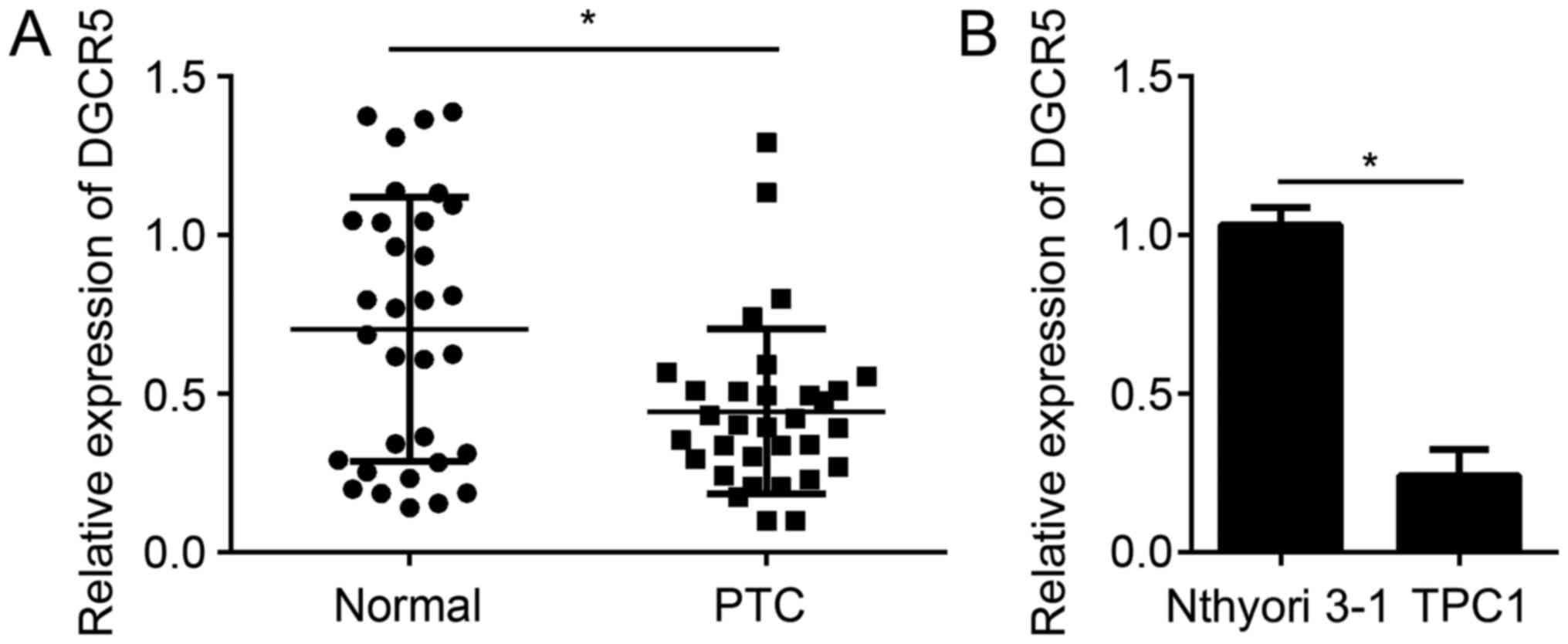
To identify the potential function of DGCR5 in PTC
progression, the levels of DGCR5 were measured in 32 pairs of PTC
tissues and adjacent normal tissues by RT-qPCR. The results
indicated that DGCR5 was significantly downregulated in PTC tissues
compared with that in adjacent normal tissues (Fig. 1A). Similarly, RT-qPCR analysis was
used to assess the levels of DGCR5 in the TPC1 PTC cell line and in
the Nthyori 3–1 normal thyroid cell line. The results indicated
that DGCR5 was also downregulated in the PTC cell line compared
with that in the normal cell line (Fig.
1B). These results suggested that DGCR5 may be a tumor
suppressor in PTC.
DGCR5 overexpression inhibits PTC cell
proliferation and invasion
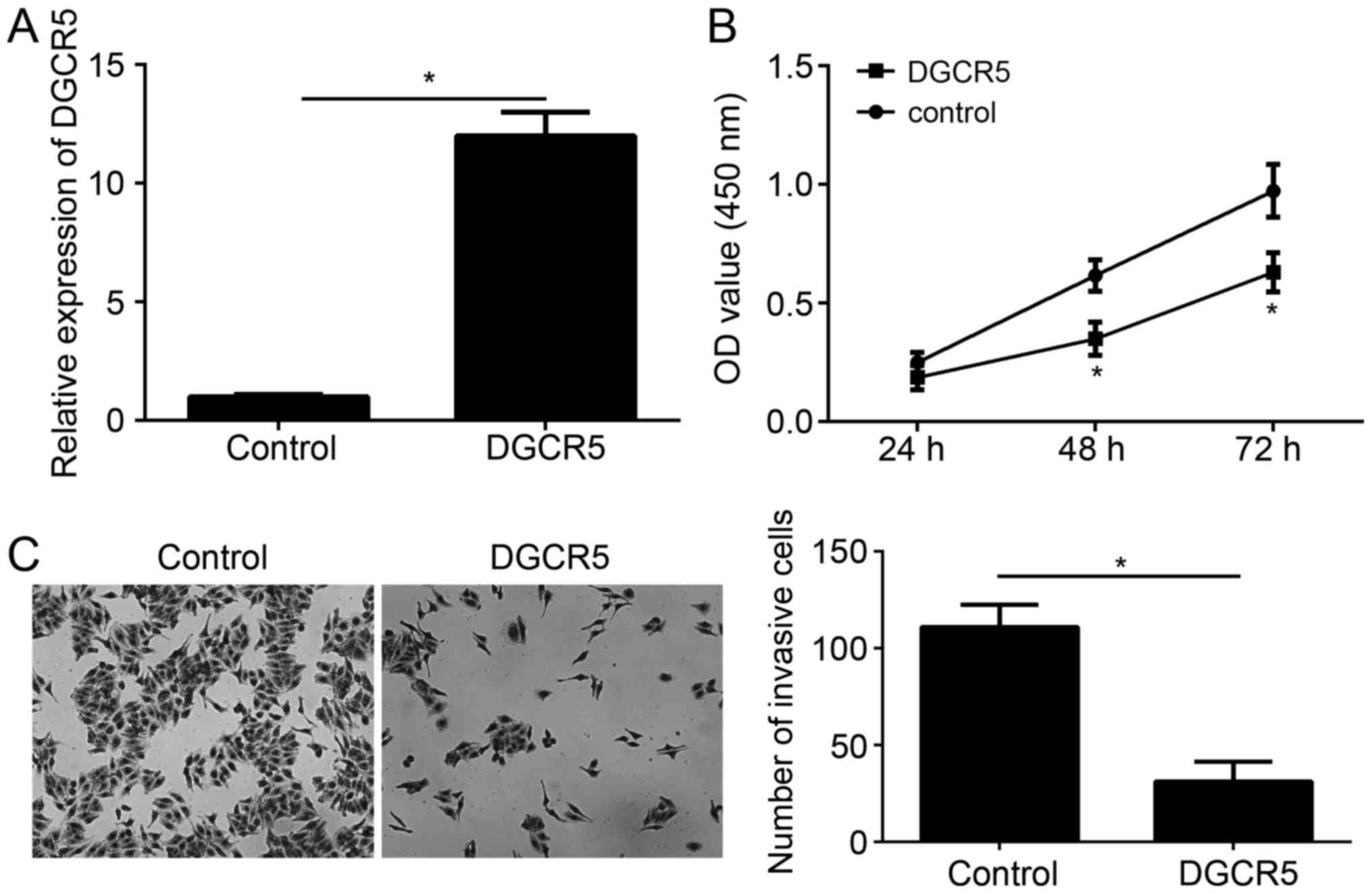
The present study further sought to explore the
roles of DGCR5 in PTC. Thus, DGCR5 was overexpressed in TPC1 cells
via transfection with pcDNA3.1-DGCR5. RT-qPCR analysis revealed
that overexpression of DGCR5 significantly promoted DGCR5
expression compared with that in the control-transfected cells
(Fig. 2A). Subsequently, the cells
were subjected to CCK8 and Transwell invasion assays to determine
the effect of DGCR5 on PTC cell growth and invasion. The results
indicated that ectopic expression of DGCR5 markedly inhibited the
proliferation and invasion of TPC1 cells (Fig. 2B and C).
DGCR5 sequesters miR-2861
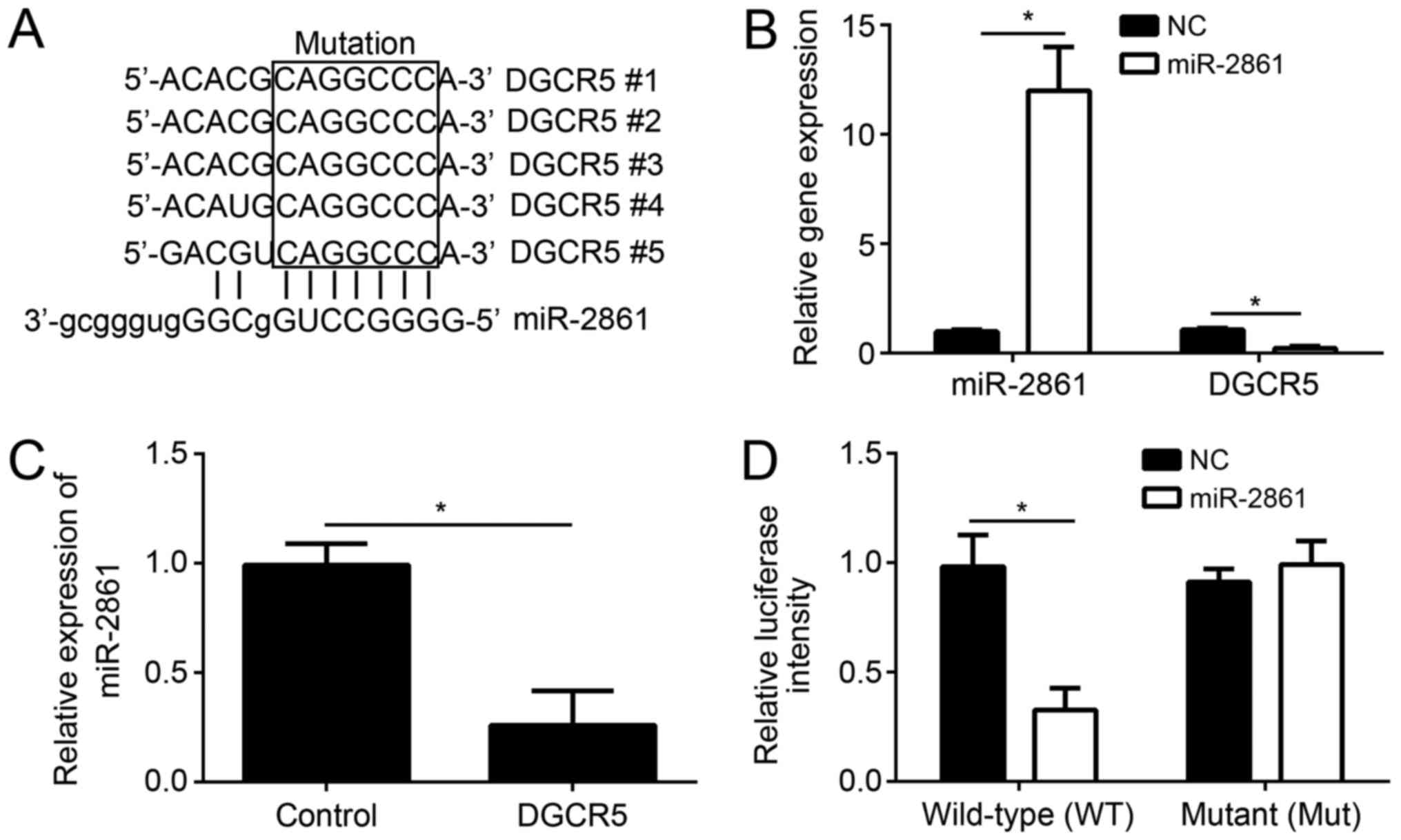
To determine the molecular mechanisms of the roles
of DGCR5 in PTC, potential target miRs of DGCR5 were predicted by a
bioinformatics analysis. Among the miRs identified, miR-2861 stood
out, as it had five potential binding sites for DGCR5 (Fig. 3A). Of note, transfection of miR-2861
mimics significantly reduced the levels of DGCR5 in TPC1 cells
compared with that in negative control-transfected cells (Fig. 3B). Consistently, overexpression of
DGCR5 also led to decreased levels of miR-2861 in TPC1 cells
(Fig. 3C), indicating a close
association between DGCR5 and miR-2861. To further confirm the
direct interaction of DGCR5 and miR-2861, a luciferase reporter
assay was performed. The results revealed that ectopic expression
of miR-2861 significantly repressed the luciferase activity of
DGCR5-WT, but not that of DGCR5-Mut in TPC1 cells (Fig. 3D). These results suggested that DGCR5
sequesters miR-2861 in TPC1 cells.
Correlation of DGCR5 and miR-2861
levels in PTC
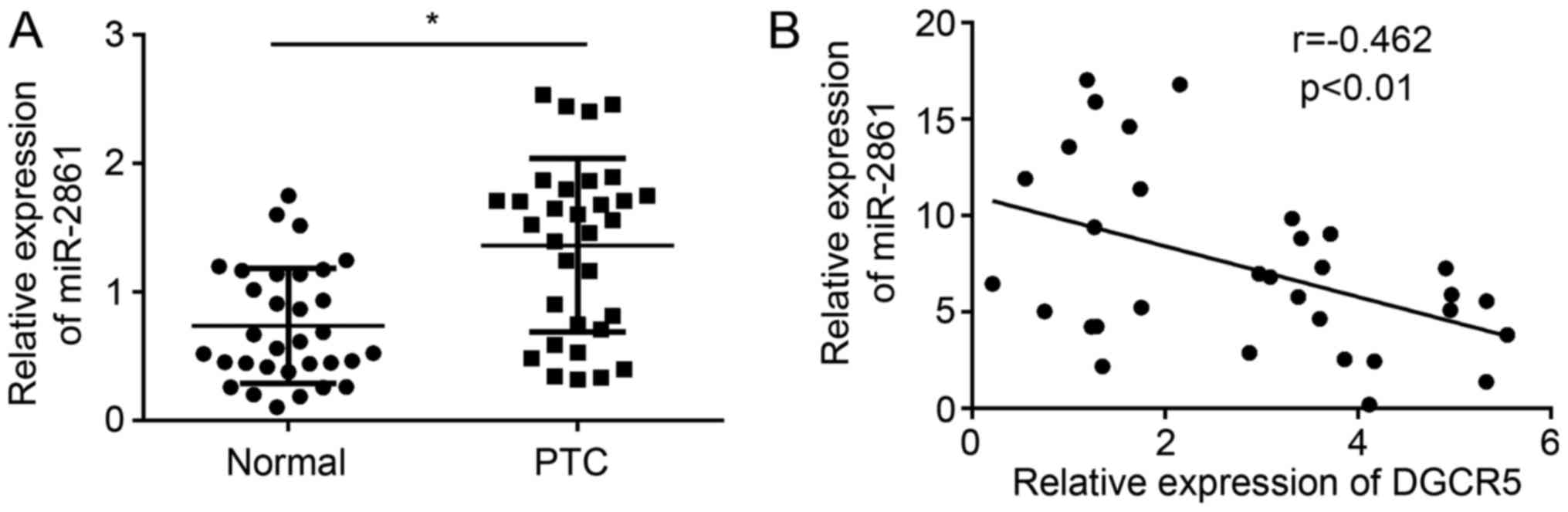
Next, the levels of miR-2861 in PTC tissues were
measured by RT-qPCR. The results illustrated that the miR-2861
levels in PTC tissues were higher than those in normal tissues
(Fig. 4A). Furthermore, the levels
of DGCR5 were inversely correlated with those of miR-2861 in PTC
tissues (Fig. 4B), further
supporting that DGCR5 serves as a miR sponge for miR-2861.
miR-2861 mimics abrogate the effects
of DGCR5 overexpression
The above results demonstrated that DGCR5 regulates
miR-2861 levels in PTC cells. Therefore, the present study then
sought to determine whether miR-2861 is involved in DGCR5-mediated
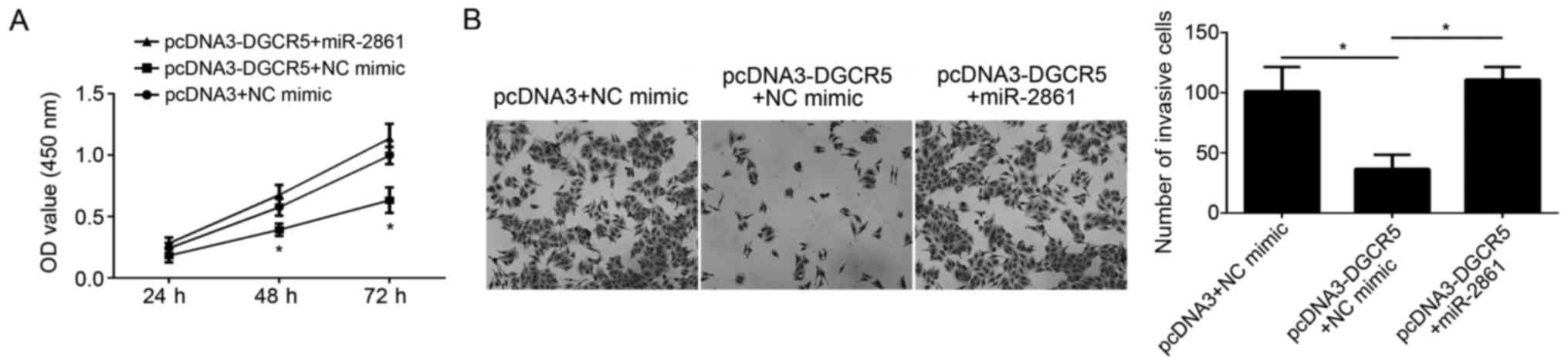
regulation of PTC cells. A CCK8 and a Transwell invasion assay were
performed, and the results indicated that overexpression of DGCR5
inhibited TPC1 cell proliferation and invasion, whereas
co-transfection with miR-2861 mimics significantly abrogated this
effect (Fig. 5A and B). Taken
together, it was demonstrated that DGCR5 acts as a tumor suppressor
via sequestering miR-2861.
Discussion
Initially, lncRNAs were assumed to represent
transcriptional noise with no cellular function. However, it was
then demonstrated that lncRNAs possess essential functions in
various biological processes, including the regulation of
development, the immune response and tumorigenesis (15,16). In
cancer, lncRNAs have been proven to affect numerous important
cellular processes, including proliferation, apoptosis, invasion
and the cell cycle (17).
lncRNA has been reported to be aberrantly expressed
and involved in PTC progression (18). For instance, lncRNA maternally
expressed 3 inhibits PTC cell invasion through suppressing Rac
family small GTPase 1 (19). lncRNA
AB074169 is downregulated and suppresses cell proliferation via
modulation of KH-type splicing regulatory protein-mediated p21
expression in PTC (20). lncRNA
small nucleolar RNA host gene 12 promotes PTC progression by
activating the Wnt/β-catenin axis (21). lncRNA PTC susceptibility candidate 3
contributes to PTC development and progression through inhibiting
miR-574-5p (22). lncRNA
HIT000218960 promotes PTC cell proliferation by increasing high
mobility group AT-hook 2 expression (23). Overexpression of lncRNA NR_036575.1
was reported to promote PTC progression (24).
As for DGCR5, its function has remained to be fully
elucidated. Wang et al (11)
reported that DGCR5 promotes non-small cell lung cancer cell
stemness by regulating miR-330-5p/CD44 signaling. A study by Chen
et al (25) suggested that
DGCR5 promotes lung cancer progression through sponging miR-1180.
In HCC, downregulation of DGCR5 was associated with poor prognosis
(13). In addition, Yong et
al (12) indicated that DGCR5 is
involved in regulating the malignant behavior of pancreatic ductal
adenocarcinoma. However, the possible role of DGCR5 and PTC and its
progression has remained elusive. To the best of our knowledge, the
present study was the first to investigate this issue.
The present study demonstrated that DGCR5 expression
was significantly downregulated in 32 PTC tissues compared with
that in adjacent normal tissues. A CCK8 and a Transwell invasion
assay revealed that ectopic overexpression of DGCR5 significantly
suppressed the proliferation and invasion of TPC1 cells. lncRNAs
may serve as competing endogenous (ce)RNAs for miRs (26) and previously, DGCR5 was also reported
to be a ceRNA in lung cancer (25).
Thus, it was further explored whether DGCR5 has a similar mechanism
of action in PTC. Through a bioinformatics analysis, miR-2861 was
identified as a target of DGCR5. The direct interaction of DGCR5
and miR-2861 was demonstrated by a luciferase reporter assay.
miR-2861 overexpression has previously reported to be associated
with PTC metastasis (27). Other
studies have indicated that miR-2861 is involved in the development
of lung and cervical cancer (28,29). The
present results indicate that miR-2861 is upregulated in PTC
tissues compared with that in adjacent normal tissues, also
suggesting that miR-2861 may serve as an oncogene in PTC.
Furthermore, rescue experiments demonstrated that miR-2861
overexpression significantly promoted the proliferation and
invasion of TPC1 cells transfected with pcDNA3.1-DGCR5.
However, the present study has certain limitations.
The mechanism via which DGCR5 expression is regulated in PTC
remains elusive. Furthermore, the downstream targets of the
DGCR5/miR-2861 axis still require to be elucidated. In addition, it
remains to be determined whether DGCR5 regulates any further miRs
in PTC. The authors of the current study only used a small number
of samples. In the future, more samples were required to determine
the association between the expression level of DGCR5 or miR-2861
with tumor clinical features, including tumor stage and
metastasis.
Acknowledgements
Not applicable.
Funding
The present study was supported by Yunnan Science
and Technology Project [grant no. 2017FE467(−080)].
Availability of data and materials
All data generated or analyzed during this study are
included in this published article.
Authors' contributions
FC, ZF and ZD initiated and designed the work,
analyzed and interpreted the results, and wrote this manuscript.
SY, JZ, PL and CY performed some experiments. All authors read and
approved the final manuscript.
Ethics approval and consent to
participate
For the use of human samples, the protocol for this
study was approved by the Institutional Ethics Committee of Yunnan
Tumor Hospital and all enrolled patients signed a written informed
consent document.
Patient consent for publication
All patients within this study provide consent for
the publication of their data.
Competing interests
The authors declare that they have no competing
interests.
References
|
1
|
Chen AY, Jemal A and Ward EM: Increasing
incidence of differentiated thyroid cancer in the United States,
1988-2005. Cancer. 115:3801–3807. 2009. View Article : Google Scholar : PubMed/NCBI
|
|
2
|
Liang L, Xu J, Wang M, Xu G, Zhang N, Wang
G and Zhao Y: LncRNA HCP5 promotes follicular thyroid carcinoma
progression via miRNAs sponge. Cell Death Dis. 9:3722018.
View Article : Google Scholar : PubMed/NCBI
|
|
3
|
Gimm O: Thyroid cancer. Cancer Lett.
163:143–156. 2001. View Article : Google Scholar : PubMed/NCBI
|
|
4
|
Hundahl SA, Fleming ID, Fremgen AM and
Menck HR: A National Cancer Data Base report on 53,856 cases of
thyroid carcinoma treated in the U.S., 1985-1995 [see commetns].
Cancer. 83:2638–2648. 1998. View Article : Google Scholar : PubMed/NCBI
|
|
5
|
Liu B, Ye B, Yang L, Zhu X, Huang G, Zhu
P, Du Y, Wu J, Qin X, Chen R, et al: Long noncoding RNA lncKdm2b is
required for ILC3 maintenance by initiation of Zfp292 expression.
Nat Immunol. 18:499–508. 2017. View
Article : Google Scholar : PubMed/NCBI
|
|
6
|
Zhu P, Wang Y, Wu J, Huang G, Liu B, Ye B,
Du Y, Gao G, Tian Y, He L and Fan Z: LncBRM initiates YAP1
signalling activation to drive self-renewal of liver cancer stem
cells. Nat Commun. 7:136082016. View Article : Google Scholar : PubMed/NCBI
|
|
7
|
Wang Y, Gu J, Lin X, Yan W, Yang W and Wu
G: lncRNA BANCR promotes EMT in PTC via the Raf/MEK/ERK signaling
pathway. Oncol Lett. 15:5865–5870. 2018.PubMed/NCBI
|
|
8
|
Yuan S, Liu Q, Hu Z, Zhou Z, Wang G, Li C,
Xie W, Meng G, Xiang Y, Wu N, et al: Long non-coding RNA MUC5B-AS1
promotes metastasis through mutually regulating MUC5B expression in
lung adenocarcinoma. Cell Death Dis. 9:4502018. View Article : Google Scholar : PubMed/NCBI
|
|
9
|
Zeng B, Lin Z, Ye H, Cheng D, Zhang G,
Zhou J, Huang Z, Wang M, Cai C, Zeng J, et al: Upregulation of
LncDQ is associated with poor prognosis and promotes tumor
progression via epigenetic regulation of the EMT pathway in HCC.
Cell Physiol Biochem. 46:1122–1133. 2018. View Article : Google Scholar : PubMed/NCBI
|
|
10
|
Chen X, Li D, Gao Y, Tang W, Iw L, Cao Y
and Hao B: Long intergenic noncoding RNA 00152 promotes glioma cell
proliferation and invasion by interacting with MiR-16. Cell Physiol
Biochem. 46:1055–1064. 2018. View Article : Google Scholar : PubMed/NCBI
|
|
11
|
Wang R, Dong HX, Zeng J, Pan J and Jin XY:
LncRNA DGCR5 contributes to CSC-like properties via modulating
miR-330-5p/CD44 in NSCLC. J Cell Physiol. 233:7447–7456. 2018.
View Article : Google Scholar : PubMed/NCBI
|
|
12
|
Yong S, Yabin Y, Bing Z, Chuanrong Z,
Dianhua G, Jianhuai Z, Weidong Y, Shuming W and Ling L: Reciprocal
regulation of DGCR5 and miR-320a affects the cellular malignant
phenotype and 5-FU response in pancreatic ductal adenocarcinoma.
Oncotarget. 8:90868–90878. 2017. View Article : Google Scholar : PubMed/NCBI
|
|
13
|
Huang R, Wang X, Zhang W, Zhangyuan G, Jin
K, Yu W, Xie Y, Xu X, Wang H and Sun B: Down-regulation of LncRNA
DGCR5 correlates with poor prognosis in hepatocellular carcinoma.
Cell Physiol Biochem. 40:707–715. 2016. View Article : Google Scholar : PubMed/NCBI
|
|
14
|
Livak KJ and Schmittgen TD: Analysis of
relative gene expression data using real-time quantitative PCR and
the 2(-Delta Delta C(T)) method. Methods. 25:402–408. 2001.
View Article : Google Scholar : PubMed/NCBI
|
|
15
|
Ye B, Liu B, Yang L, Zhu X, Zhang D, Wu W,
Zhu P, Wang Y, Wang S, Xia P, et al: LncKdm2b controls self-renewal
of embryonic stem cells via activating expression of transcription
factor Zbtb3. EMBO J. 37:e971742018. View Article : Google Scholar : PubMed/NCBI
|
|
16
|
Zhu P, Wang Y, Huang G, Ye B, Liu B, Wu J,
Du Y, He L and Fan Z: lnc-β-Catm elicits EZH2-dependent β-catenin
stabilization and sustains liver CSC self-renewal. Nat Struct Mol
Biol. 23:631–639. 2016. View Article : Google Scholar : PubMed/NCBI
|
|
17
|
Esteller M: Non-coding RNAs in human
disease. Nat Rev Genet. 12:861–874. 2011. View Article : Google Scholar : PubMed/NCBI
|
|
18
|
Lan X, Zhang H, Wang Z, Dong W, Sun W,
Shao L, Zhang T and Zhang D: Genome-wide analysis of long noncoding
RNA expression profile in papillary thyroid carcinoma. Gene.
569:109–117. 2015. View Article : Google Scholar : PubMed/NCBI
|
|
19
|
Wang C, Yan G, Zhang Y, Jia X and Bu P:
Long non-coding RNA MEG3 suppresses migration and invasion of
thyroid carcinoma by targeting of Rac1. Neoplasma. 62:541–549.
2015. View Article : Google Scholar : PubMed/NCBI
|
|
20
|
Gou Q, Gao L, Nie X, Pu W, Zhu J, Wang Y,
Liu X, Tan S, Zhou JK, Gong Y, et al: Long noncoding RNA AB074169
inhibits cell proliferation via modulation of KHSRP-mediated p21
expression in papillary thyroid carcinoma. Cancer Res.
78:4163–4174. 2018. View Article : Google Scholar : PubMed/NCBI
|
|
21
|
Ding S, Qu W, Jiao Y, Zhang J, Zhang C and
Dang S: LncRNA SNHG12 promotes the proliferation and metastasis of
papillary thyroid carcinoma cells through regulating wnt/β-catenin
signaling pathway. Cancer Biomark. 22:217–226. 2018. View Article : Google Scholar : PubMed/NCBI
|
|
22
|
Wang X, Lu X, Geng Z, Yang G and Shi Y:
LncRNA PTCSC3/miR-574-5p governs cell proliferation and migration
of papillary thyroid carcinoma via Wnt/β-catenin signaling. J Cell
Biochem. 118:4745–4752. 2017. View Article : Google Scholar : PubMed/NCBI
|
|
23
|
Li T, Yang XD, Ye CX, Shen ZL, Yang Y,
Wang B, Guo P, Gao ZD, Ye YJ, Jiang KW and Wang S: Long noncoding
RNA HIT000218960 promotes papillary thyroid cancer oncogenesis and
tumor progression by upregulating the expression of high mobility
group AT-hook 2 (HMGA2) gene. Cell Cycle. 16:224–231. 2017.
View Article : Google Scholar : PubMed/NCBI
|
|
24
|
Sun W, Lan X, Wang Z, Dong W, He L, Zhang
T and Zhang H: Overexpression of long non-coding RNA NR_036575.1
contributes to the proliferation and migration of papillary thyroid
cancer. Med Oncol. 33:1022016. View Article : Google Scholar : PubMed/NCBI
|
|
25
|
Chen EG, Zhang JS, Xu S, Zhu XJ and Hu HH:
Long non-coding RNA DGCR5 is involved in the regulation of
proliferation, migration and invasion of lung cancer by targeting
miR-1180. Am J Cancer Res. 7:1463–1475. 2017.PubMed/NCBI
|
|
26
|
Wang Y, Zeng X, Wang N, Zhao W, Zhang X,
Teng S, Zhang Y and Lu Z: Long noncoding RNA DANCR, working as a
competitive endogenous RNA, promotes ROCK1-mediated proliferation
and metastasis via decoying of miR-335-5p and miR-1972 in
osteosarcoma. Mol Cancer. 17:892018. View Article : Google Scholar : PubMed/NCBI
|
|
27
|
Wang Z, Zhang H, Zhang P, Li J, Shan Z and
Teng W: Upregulation of miR-2861 and miR-451 expression in
papillary thyroid carcinoma with lymph node metastasis. Med Oncol.
30:5772013. View Article : Google Scholar : PubMed/NCBI
|
|
28
|
Zhao M, Li L, Zhou J, Cui X, Tian Q, Jin Y
and Zhu Y: MiR-2861 behaves as a biomarker of lung cancer stem
cells and regulates the HDAC5-ERK system genes. Cell Reprogram.
20:99–106. 2018. View Article : Google Scholar : PubMed/NCBI
|
|
29
|
Xu J, Wan X, Chen X, Fang Y, Cheng X, Xie
X and Lu W: miR-2861 acts as a tumor suppressor via targeting
EGFR/AKT2/CCND1 pathway in cervical cancer induced by human
papillomavirus virus 16 E6. Sci Rep. 6:289682016. View Article : Google Scholar : PubMed/NCBI
|