Introduction
Lower extremity deep vein thrombosis (DVT) is a
common venous disease in clinical practice. The pathogenesis of
this disease is considered to involve three factors that were first
suggested by the German pathologist Rudolf Virchow in 1865. These
three factors include poor blood circulation, vascular intima
injury and alterations in blood composition caused by various
reasons, such as hypercoagulability (1,2).
The role of homocysteine (Hcy) in the pathogenesis
of DVT has been reported in a large number of studies (3–6). Hcy, an
amino acid and an important intermediate product in the metabolism
of methionine and cysteine, is associated with vascular injury
(7,8). Hcy is unstable and prone to oxidization
into Hcy or Hcy-Cys disulfide (9,10).
Furthermore, a small amount of Hcy is present in the plasma in a
reduced form. Hcy has been reported to be a possible risk factor of
vascular endothelial injury and hypercoagulability (11,12). A
previous epidemiological study revealed that ~25% of patients with
venous thromboembolism exhibited elevated levels of Hcy to
different extents, while one third of patients with venous
thromboembolism developed hyperhomocysteinemia (8,9).
Additionally, Hcy may be involved in thrombosis by damaging the
vascular endothelium, activating platelets and the coagulation
system, and inhibiting protein C (11–13).
However, the specific mechanism underlying the damage of
endothelial cells caused by Hcy remains unclear.
In the present study, the serum Hcy levels of 96
patients were analyzed, and hyperhomocysteinemia was observed to be
closely correlated with DVT. Furthermore, human umbilical vein
endothelial cells (HUVECs) were stimulated with different
concentrations of Hcy, in order to investigate the effects of Hcy
on the viability and migration ability of HUVECs. It was further
confirmed that Hcy functioned by downregulating the expression of
vascular endothelial growth factor (VEGF).
Materials and methods
Clinical data
The study group comprised of 96 patients with DVT,
who were treated at Qianfoshan Hospital of Shandong University
(Jinan, China) between December 2014 and March 2016. Among these,
46 patients were male and 50 were female. The age of these patients
ranged between 33 and 79 years, with a mean age of 52.3±6.5 years.
Definitive DVT diagnosis of these patients was established by color
Doppler ultrasound (14). In
addition, 80 subjects were recruited into the control group,
including 38 male and 42 female subjects, with an age ranging
between 32 and 75 years and a mean age of 53.5±5.6 years. These
control subjects were healthy based on physical examinations.
Patients with atrial fibrillation, diabetes, liver and kidney
dysfunction, cerebral hemorrhage, cerebral infarction, thyroid
dysfunction and malignant tumors were excluded from the two groups.
Individuals who took a variety of vitamins and had recently used
anticoagulation and/or hemostatic drugs were also excluded.
Differences in the age, gender, body weight and other
characteristics of the two groups were not statistically
significant.
Elbow vein blood samples were collected in vacuum
tubes from all subjects at a fasting state in the morning after
hospitalization or on the day of outpatient service. Detection of
Hcy was completed on the same day following serum separation. Serum
Hcy levels were measured by high-sensitivity immunoturbidimetry as
previously described (3).
Written informed consent was obtained from patients
prior to participation, and the Ethics Committee of Qianfoshan
Hospital of Shandong University (Jinan, China) provided approval
for the present study.
Reagents
The M199 culture medium was purchased from GE
Healthcare Life Sciences (HyClone; Logan, UT, USA). Fetal bovine
serum (FBS; Gibco; Thermo Fisher Scientific, Inc.), cell culture
plates (6-well and 24-well), cell counting kit-8 (CCK-8) and the
VEGF-A ELISA kit (eBioscience) were purchased from Thermo Fisher
Scientific, Inc. (Waltham, MA, USA). Transwell chambers (0.4 µm in
diameter; 24-well type) were purchased from Corning, Inc. (Corning,
NY, USA). The Total RNA extraction kit, RNA reverse transcription
(RT) kit, and quantitative polymerase chain reaction (qPCR)
reaction system, which included: 2.0 µl dNTP, 2.5 µl 10×PCR buffer,
0.15 µl Taq Hot Start, 2.0 µl genomic DNA and 0.5 µl 10 µM forward
and reverse primers, were purchased from Tiangen Biotech Co., Ltd.
(Beijing, China). The VEGF antibody (cat. no. ab69479; 1:500) was
purchased from Abcam (Cambridge, UK). The anti-mouse secondary
antibody (1:2,000) was purchased from Cell Signaling Technology,
Inc. (Danvers, MA, USA; cat. no. 7076P2). Analytical grade, pure
Hcy was purchased from Sigma-Aldrich (Merck KGaA, Darmstadt,
Germany), while recombinant human VEGF (with a working
concentration of 5 ng/ml) was purchased from PeproTech, Inc. (Rocky
Hill, NJ, USA). Crystal violet dye was purchased from Beyotime
Institute of Biotechnology (Shanghai, China). Primers used in qPCR
were synthesized by BGI (Shenzhen, China).
Instruments and equipment
Determination of serum Hcy levels was conducted
using an automatic biochemical analyzer (Olympus Corp., Tokyo,
Japan), and the corresponding reagents and standards were provided
by Abbott Pharmaceutical Co. Ltd. (Lake Bluff, IL, USA). Other
instruments included a gel imaging device (GelDoc 2000; Bio-Rad
Laboratories, Inc., Hercules, CA, USA), PCR machine (Mastercycler
nexus; Eppendorf, Hamburg, Germany) and image-enabled inverted
optical microscope (CKX31; Olympus Corp.). Experiments were
conducted strictly in accordance with the protocols provided by the
instrument manufacturer.
HUVEC collection and culture
HUVECs were obtained from the umbilical cord of
healthy full-term fetuses delivered by cesarean section at
Qianfoshan Hospital of Shandong University. Briefly, the umbilical
veins were picked subsequent to washing with phosphate-buffered
saline (PBS). Next, 0.25% trypsin was injected into the lumen of
the veins and incubated for 8–10 min at 37°C. The digestive juice
in the veins was then collected, and M199 medium containing 20% FBS
was added to rinse the lumen. Subsequently, the aforementioned
fluids were collected, placed into a 50-ml centrifuge tube and
centrifuged at 1,200 × g at 4°C for 5 min. The supernatant was
discarded, complete medium (M199 medium containing 20% FBS) was
added and homogenized by shaking, and the cells were counted using
a counting plate. Cells were then cultured in a 25-cm2
culture flask at a density of 2–5×10⁵ cells/ml in an
incubator with 5% CO2 at 37°C. After 24 h of culture,
the medium was replaced by fresh M199 medium containing 20% FBS,
and 2.5 µl/ml recombinant VEGF was added. Cells in 3–10 generations
were collected for use in subsequent experiments. HUVECs were
evaluated using VIII factor related antigen staining. HUVECs were
fixed using 4% paraformaldehyde (dissolved in PBS) at 25°C for 5
min and stained by VIII antibody (1:200; cat. no. ab78852; Abcam),
then incubated at 37°C for 1 h. After washing with PBS, related
Alexa Fluor® conjugated secondary goat-anti-mouse
antibody (1:1,000; cat. no. A-11029; Invitrogen; Thermo Fisher
Scientific, Inc.) was added and the expression of the VIII factor
was observed using fluorescence microscope (magnification,
×200).
Cell transfection
At 1 day prior to transfection, the HUVECs were
seeded into 6-well plates at a density of 1.5–3×10⁵
cells/well. When 30–50% confluence was reached, cells were
transfected with VEGF-small interfering RNA (siRNA) using
Lipofectamine 2000 (Invitrogen; Thermo Fisher Scientific, Inc.) at
room temperature for 20 min. VEGF-siRNA was designed and
synthesized by Sigma-Aldrich (Merck KGaA, Darmstadt Germany), and
the sequences were as follows: Antisense,
5′-AAAGUAGUGCUUCACCACUUC-3′, and sense,
5′-UCAUCACGAAGUGGUGAAGAA-3′. The negative control was also provided
by Sigma-Aldrich (Merck KGaA), with the following sequence:
Forward, 5′-UUCUCCGAACGUGUCACGUTT-3′ and reverse,
5′-ACGUGACACGUUCGGAGAATT-3′.
RT-qPCR
Total RNA was extracted using chloroform from the
collected HUVECs. Subsequent to determining the RNA concentration
using a spectrophotometer (Bio-Rad Laboratories, Inc.), total RNA
was reversely transcribed into cDNA using an RT kit, and then
subjected to qPCR using STBR-Green (Tiangen Biotech Co., Ltd.). The
primer sequences used were as follows: VEGF,
5′-CGCAAGAAATCCCGGTATAAGTCC-3′ (upstream), and
5′-CGTTCGTTTAACTCAAGCTGCCTC-3′ (downstream); GAPDH,
5′-AACGGATTTGGTCGTATTGGG-3′ (upstream), and
5′-CCTGGAAGATGGTGATGGGAT-3′ (downstream). GAPDH served as the
internal control, while VEGF was the target molecule. The reaction
conditions of PCR amplification consisted of pre-denaturation at
95°C for 5 min, denaturation at 95°C for 30 sec, annealing at 58°C
for 30 sec, and extension at 72°C for 30 sec, with a total of 30
cycles performed.
Western blot analysis
Total proteins were extracted using
radioimmunopricipitation assay buffer (Beyotime Institute of
Biotechnology) from the HUVECs, and the protein concentration was
determined using the bicinchoninic acid method. Next, 40 µg total
protein was isolated by sodium dodecyl sulfate-polyacrylamide gel
(10%) electrophoresis, transferred onto a polyvinylidene difluoride
film and incubated with 5% bovine serum albumin at room temperature
for 1 h in order to block nonspecific binding. Subsequently, the
VEGF primary antibody was added and incubated at 4°C overnight. The
film was then washed three times with Tris-buffered saline and
Tween-20 for 10 min each time, followed by addition of the
corresponding secondary antibody and incubation for 1 h at 37°C.
Following further washing for three times (10 min each), VEGF
expression was detected by enhanced chemiluminescence (EMD
Millipore, Billerica, MA, USA), and the gray value was analyzed
using Quantity One 4.62 software (Bio-Rad Laboratories, Inc.).
Detection of cell viability by CCK-8
assay
The concentration of HUVECs was adjusted to
3.0×10⁴ cells/ml, and cells were cultured in 96-well
plates at a density of 3,000 cells/well in an incubator with 5%
CO2 at 37°C for 24 h. Subsequently, different
concentrations of Hcy were added to untransfected and transfected
cells, and then 10 µl CCK-8 reagent was added to each wells at
various time points, including at 0, 24, 48 and 72 h. Subsequently,
the samples were homogenized by shaking and placed in an incubator
for 1 h at 37°C. Finally, the optical density value was measured at
a wavelength of 450 nm.
Detection of the invasion ability of
cells by a Transwell assay
HUVECs were prepared into a single-cell suspension
using trypsin (Beyotime Institute of Biotechnology) and the number
of cells was counted. Following centrifugation at 1,200 × g at 4°C
for 5 min, the supernatant was discarded, and cells were
resuspended the cells using M199 medium containing 1% FBS. Next,
the cell concentration was adjusted to 1×10⁶/ml. In a
sterile 24-well plate, 600 µl double antibody-free M199 medium
(containing 10% FBS) was added to the wells, and the Transwell
chambers were placed into the wells. Subsequently, 100 µ of the
aforementioned cell suspension was placed into the prepared
chambers, and the plate was placed in an incubator with 5%
CO2 at 37°C for 12 h. The solution in the upper chambers
was discarded, and the chambers were washed with PBS to remove
culture medium and other impurities. The collected cells were fixed
with methanol for 10 min and stained with crystal violet for 20
min. Cells in the chambers on the upper layer of the membrane were
cleaned with a cotton swabs. A total of five visual fields were
selected under a microscope, and the number of cells in each field
was counted.
Detection of VEGF-A expression level
by ELISA
HUVECs were collected, and the cell concentration
was adjusted to 1×10⁵/ml, followed by culture in 24-well
plates at a density of 500 µl/well in an incubator with 5%
CO2 at 37°C. After the cells were treated with different
concentrations of Hcy for 24 h, serum-free M199 medium was added
and cells were incubated for a further 24 h. The supernatant was
collected, centrifuged at 1,000 rpm for 10 min in order to remove
the cell mass, and then centrifuged at 12,000 rpm for 10 min to
remove the cell debris. The supernatant was collected and used to
determine the content of VEGF-A by an ELISA kit (cat. no. JN-03012;
R&D Systems, Inc., Minneapolis, MN, USA), according to the
manufacturer's protocol.
Statistical analysis
Data were statistically analyzed using SPSS version
16.0 software (SPSS, Inc., Chicago, IL, USA. Measurement data are
expressed as the mean ± standard deviation. Intergroup comparison
was conducted using Student's t-test or χ2 test.
P<0.05 was considered to indicate a difference that was
statistically significant.
Results
Serum Hcy levels are significantly
increased in DVT patients
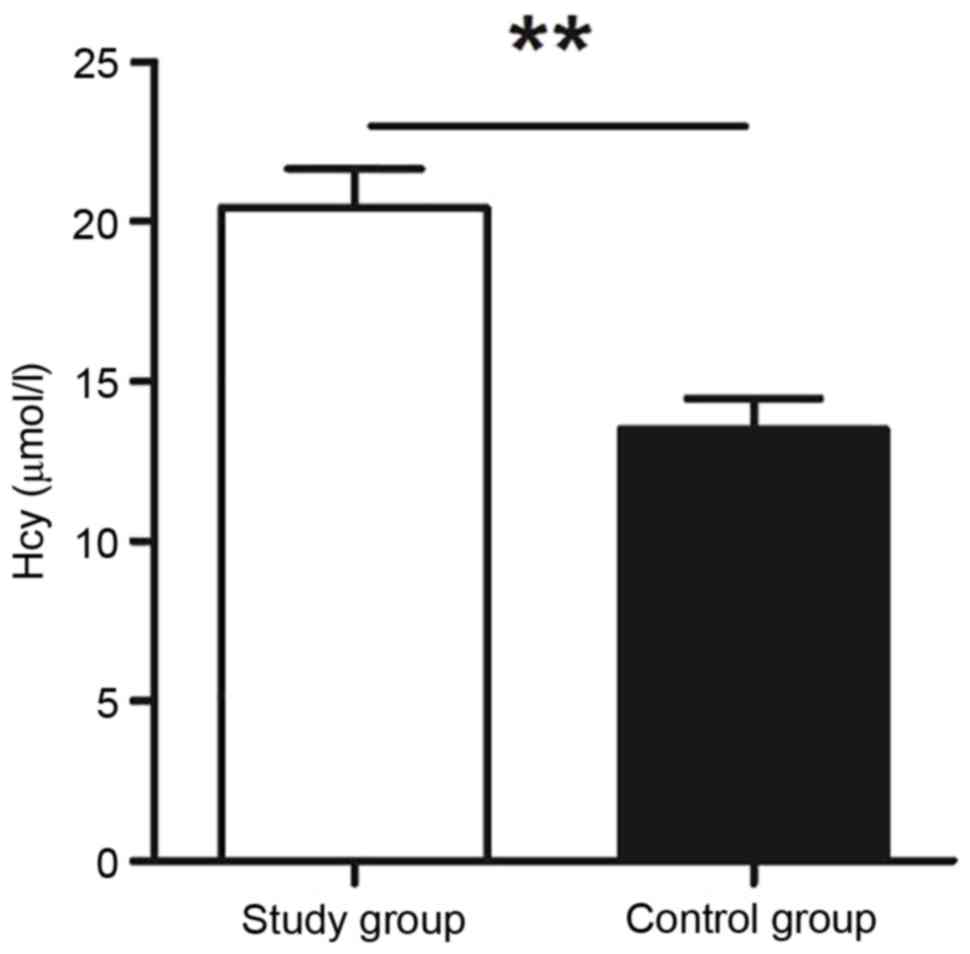
Serum Hcy levels in samples obtained from DVT
patients and control subjects were compared using a Student's
t-test. The results revealed that Hcy levels in the serum of DVT
patients were significantly increased when compared with those in
the controls (Fig. 1).
Hcy significantly inhibits the
viability of HUVECs
Previous studies have revealed that Hcy may promote
the formation of DVT by damaging the vascular endothelium (4,5). In
order to confirm the effect of Hcy on endothelial cells, the effect
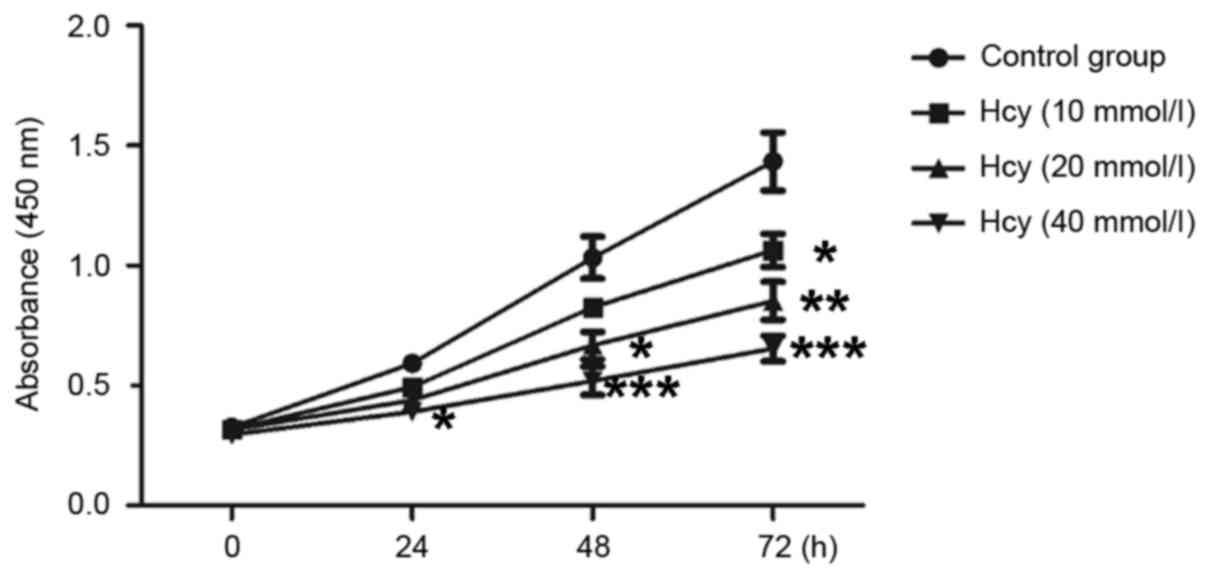
of different concentrations of Hcy (10, 20 and 40 mmol/l) on the
viability of HUVECs was initially detected by CCK-8 assay. The
results indicated that HUVEC viability was inhibited by all the
examined concentrations of Hcy, while this inhibitory effect was
more notable with the increase in Hcy concentration, suggesting a
concentration-dependent effect (Fig.
2).
Hcy significantly inhibits the
migration ability of HUVECs
The migration ability of HUVECs is closely
associated with the post-injury repair of the vascular endothelium
(15,16). To determine the effect of Hcy on the
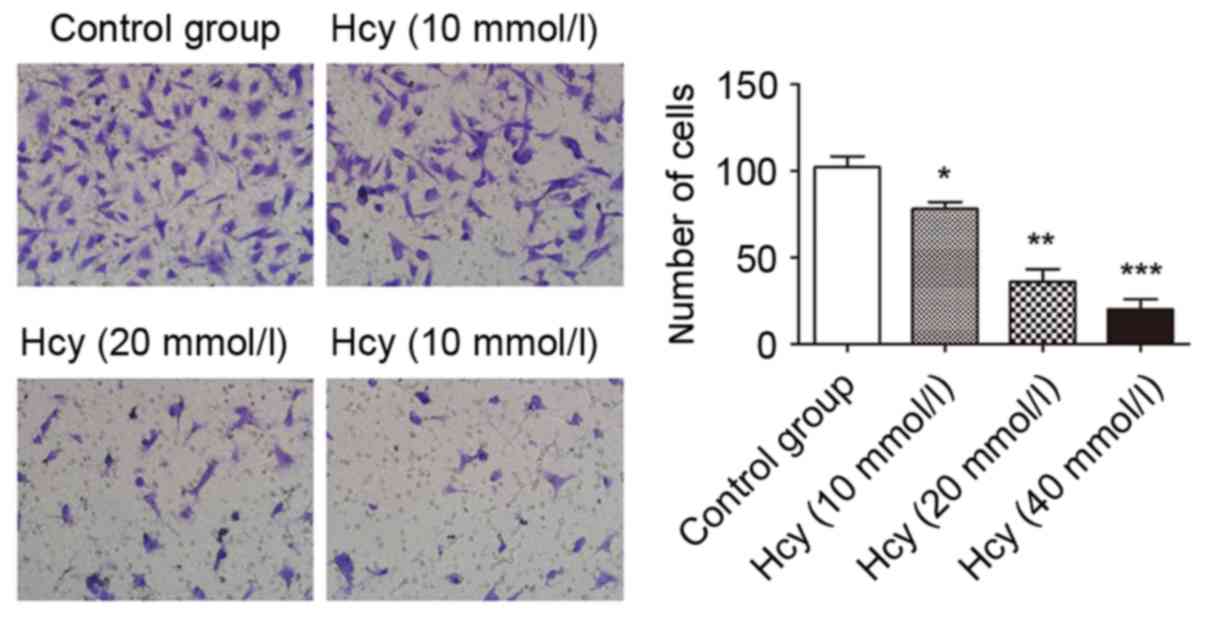
migration ability of endothelial cells, HUVECs were treated with
different concentrations of Hcy (10, 20 and 40 mmol/l) and then
cell migration was detected by a Transwell assay. The results
demonstrated that Hcy exerted a significant inhibitory effect on
the migration ability of endothelial cells, and this effect was
concentration-dependent (Fig.
3).
Hcy significantly downregulates VEGF
expression in HUVECs
The earlier experiments of the present study
preliminarily confirmed that Hcy was able to significantly inhibit
the viability and migration ability of HUVECs. In order to further
investigate the mechanism underlying the effect of Hcy on HUVECs,
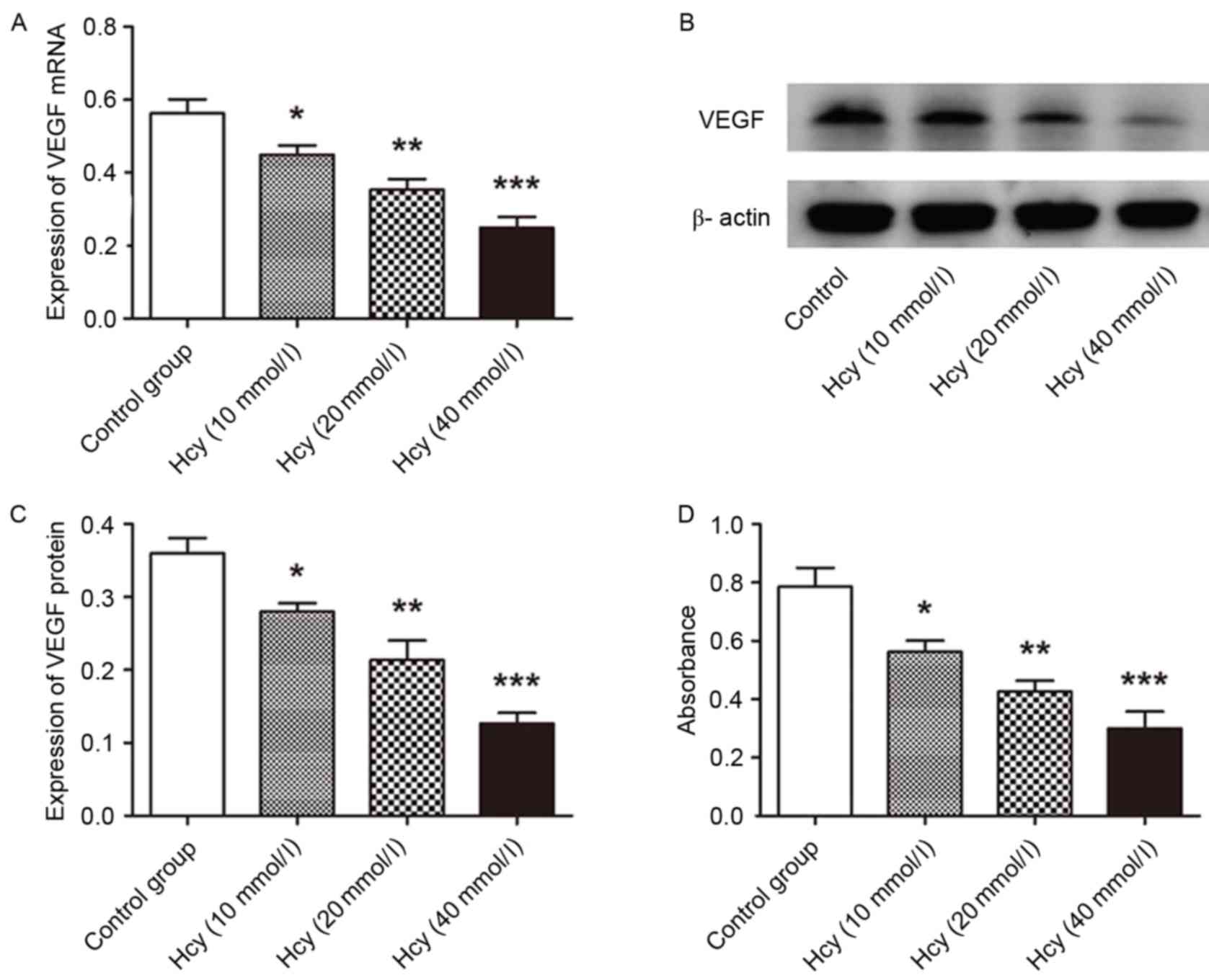
the expression levels of VEGF in HUVECs treated with Hcy was
measured by RT-qPCR and western blot analysis. It was observed that
treatment with Hcy significantly downregulated the mRNA (Fig. 4A) and protein (Fig. 4B and C) expression levels of VEGF in
HUVECs. In addition, as determined by ELISA, the expression of
VEGF-A was significantly downregulated in the supernatant of HUVECs
(Fig. 4D).
Hcy inhibits the viability and
migration of HUVECs by downregulating VEGF expression
Given that VEGF serves an important role in the
regulation of various biological behaviors of endothelial cells,
its expression level affects the viability, proliferation and
migration of endothelial cells (17). Based on the earlier experimental
results, Hcy was suggested to inhibit the viability and migration
ability of HUVECs by downregulating VEGF expression. Thus, the
study aimed to further confirm this inference. Initially, the
specific siRNA of VEGF was synthesized, and transfection of cells
with VEGF-siRNA did not reduce the inhibitory effect of Hcy on the
viability and migration ability of HUVECs (Fig. 5A and B). This indicated that VEGF may
be involved in the viability and migration ability of HUVECs.
Furthermore, 5 ng/ml recombinant human VEGF was then exogenously
added to HUVECs treated with Hcy. It was observed that the
inhibitory effect of Hcy on the viability and migration ability of
HUVECs was significantly decreased following VEGF treatment
(Fig. 5C and D). This finding
suggested that the inhibitory effect of Hcy on the viability and
migration ability of HUVECs may be achieved by downregulating the
expression of VEGF.
Discussion
DVT is a common clinical disease with high
incidence, recurrence, mortality and disability rates (14). Although the pathogenesis of DVT is
complex, three well-recognized causes of this disease include poor
blood circulation, blood vessel wall damage and the blood
hypercoagulability (18,19). In the present study, it was also
determined that serum Hcy levels were significantly increased for
patients with DVT. In recent years, studies have focused on the
role of Hcy in the occurrence and development of DVT, as well as on
the underlying mechanism (5,6). Hcy is a sulfur amino acid and an
important intermediate product in the metabolism of methionine and
cysteine. It is mainly produced through the demethylation of
methionine in the liver, muscles and other tissues (20). Previous studies have confirmed that
Hcy exerts a toxic effect on endothelial cells (8,9). In
addition, the oxidation reaction of Hcy is considered to result in
the production of hydrogen peroxide. Hydrogen peroxide has a strong
stimulating and toxic effect on vascular endothelial cells, which
may cause alterations in the vascular endothelial cell structures,
thickening of the vascular wall or even blocking of the vessels
(20–22). However, at present, the specific
mechanism underlying the effect of Hcy on endothelial cells remains
poorly understood.
In the present study, the effect of Hcy on
endothelial cells was investigated. The results revealed that Hcy
treatment was able to significantly inhibit the viability of
HUVECs. This indicates that Hcy may cause alterations in the vessel
wall structure by inhibiting the viability of endothelial cells.
Following injury, the vascular endothelium experiences a complex
process of neovascularization and repair. This occurs through the
activation of associated growth factor receptors in vascular
endothelial cells, while endothelial cells migrate and proliferate
to form the surrounding matrix and embryonic structure. The
embryonic structure then expands to forms a ring, which eventually
forms a complete vascular cavity (11–13,23). The
current study further demonstrated that Hcy had a significant
inhibitory effect on the migration of endothelial cells, which may
lead to inhibition of the post-injury repair process of the
vascular endothelium. Taken together, the inhibitory effect of Hcy
on the viability and the migratory capacity of HUVECs jointly
promoted damage to the vascular wall and changes in vascular wall
structure, increasing the incidence of DVT in patients with
hyperhomocysteinemia.
Notably, the present study confirmed that Hcy
inhibited the viability and migration ability of HUVECs by
downregulating the expression of VEGF. VEGF is a glycosylated
secreted polypeptide factor that specifically stimulates vascular
endothelial cell proliferation and angiogenesis (17). Furthermore, as a typical angiogenic
factor, VEGF serves a crucial role in the regulation of the
viability, proliferation and migration of endothelial cells, as
well as promotes neovascularization, post-injury repair and the
establishment of collateral circulation. Previous studies have
confirmed that VEGF was effective in the prevention and treatment
of myocardial infarction and occlusive vascular diseases, and VEGF
treatment was referred to as a type of ‘molecular bypass surgery’
(24,25). As a vascular repair factor, the
protective effect of VEGF on blood vessels in cardiovascular
disease has been reported in a large number of studies (26–29). In
the present study, the effect of Hcy on HUVECs was detected by
upregulating and downregulating VEGF expression, which confirmed
that Hcy was able to inhibit VEGF expression.
In conclusion, the present study confirmed that Hcy
inhibited the viability and migration ability of endothelial cells
by downregulating the expression of VEGF, causing damage to
endothelial cells and affecting the post-injury repair process.
This may be one of the mechanisms underlying the high incidence of
DVT in patients with hyperhomocysteinemia. Furthermore, VEGF was
indicated to be a key molecule in the process through which Hcy
promoted DVT formation, suggesting that VEGF treatment may improve
the prognosis of DVT patients with hyperhomocysteinemia. Please
note that all our manuscripts now require the addition of the
following sections:
Acknowledgements
Not applicable.
Funding
No funding was received.
Availability of data and materials
The datasets used and/or analysed during the current
study available from the corresponding author on reasonable
request.
Authors' contributions
JY made substantial contributions to the conception
and design of the work, and drafted the work. JY, LLZ, XPW, RZ,
ZXM, KW, BW, HW, ZLS and GXL performed the acquisition, analysis
and interpretation of data for the work. JY, LLZ, XPW, RZ, ZXM, KW,
BW, HW, ZLS and GXL revised critically for important intellectual
content. JY, LLZ, XPW, RZ, ZXM, KW, BW, HW, ZLS and GXL gave final
approval of the version to be published. JY, LLZ, XPW, RZ, ZXM, KW,
BW, HW, ZLS and GXL, agree to be accountable for all aspects of the
work in ensuring that questions related to the accuracy or
integrity of any part of the work are appropriately investigated
and resolved.
Ethics approval and consent to
participate
Written informed consent was obtained from patients
prior to participation, and the Ethics Committee of Qianfoshan
Hospital of Shandong University (Jinan, China) provided approval
for the present study.
Patient consent for publication
Not applicable.
Competing interests
The authors declare that they have no competing
interests.
References
|
1
|
Robertson LA, Evans CJ, Lee AJ, Allan PL,
Ruckley CV and Fowkes FG: Incidence and risk factors for venous
reflux in the general population: Edinburgh vein study. Eur J Vasc
Endovasc Surg. 48:208–214. 2014. View Article : Google Scholar : PubMed/NCBI
|
|
2
|
White RH: The epidemiology of venous
thromboembolism. Circulation. 107 (Suppl 1):I4–I18. 2003.
View Article : Google Scholar : PubMed/NCBI
|
|
3
|
Hsu TS, Hsu LA, Chang CJ, Sun CF, Ko YL,
Kuo CT, Chiang CW and Lee YS: Importance of hyperhomocysteinemia as
a risk factor for venous thromboembolism in a Taiwanese population.
A case-control study. Thromb Res. 102:387–395. 2001. View Article : Google Scholar : PubMed/NCBI
|
|
4
|
Boers GH: Hyperhomocysteinemia as a risk
factor for arterial and venous disease. A review of evidence and
relevance. Thromb Haemost. 78:520–522. 1997. View Article : Google Scholar : PubMed/NCBI
|
|
5
|
Simioni P, Prandoni P, Burlina A, Tormene
D, Sardella C, Ferrari V, Benedetti L and Girolami A:
Hyperhomocysteinemia and deep-vein thrombosis. A case-control
study. Thromb Haemost. 76:883–886. 1996. View Article : Google Scholar : PubMed/NCBI
|
|
6
|
Ospina-Romero M, Cannegieter SC, den
Heijer M, Doggen CJM, Rosendaal FR and Lijfering WM:
Hyperhomocysteinemia and risk of first venous thrombosis: The
influence of (Unmeasured) confounding factors. Am J Epidemiol.
187:1392–1400. 2018. View Article : Google Scholar : PubMed/NCBI
|
|
7
|
De Stefano V, Casorelli I, Rossi E,
Zappacosta B and Leone G: Interaction between hyperhomocysteinemia
and inherited thrombophilic factors in venous thromboembolism.
Semin Thromb Hemost. 26:305–311. 2000. View Article : Google Scholar : PubMed/NCBI
|
|
8
|
Makris M: Hyperhomocysteinemia and
thrombosis. Clin Lab Haematol. 22:133–143. 2000. View Article : Google Scholar : PubMed/NCBI
|
|
9
|
Ebbesen LS: Hyperhomocysteinemia,
thrombosis and vascular biology. Cell Mol Biol (Noisy-le-grand).
50:917–930. 2004.PubMed/NCBI
|
|
10
|
Fridman O: Hyperhomocysteinemia:
Atherothrombosis and neurotoxicity. Acta Physiol Pharmacol Ther
Latinoam. 49:21–30. 1999.(In Spanish). PubMed/NCBI
|
|
11
|
Makin AJ, Chung NA, Silverman SH and Lip
GY: Alterations of thrombogenesis, endothelial damage and oxidative
stress with reperfusion during femoral artery bypass surgery for
peripheral vascular disease. Pathophysiol Haemost Thromb.
32:158–164. 2002. View Article : Google Scholar : PubMed/NCBI
|
|
12
|
Sametz W, Prasthofer S, Wintersteiger R
and Juan H: Vascular effects of isoprostanes after endothelial
damage. Prostaglandins Leukot Essent Fatty Acids. 61:369–372. 1999.
View Article : Google Scholar : PubMed/NCBI
|
|
13
|
Spaet TH and Gaynor E: Vascular
endothelial damage and thrombosis. Adv Cardiol. 4:47–66. 1970.
View Article : Google Scholar : PubMed/NCBI
|
|
14
|
Stubbs MJ, Mouyis M and Thomas M: Deep
vein thrombosis. BMJ. 360:k3512018. View
Article : Google Scholar : PubMed/NCBI
|
|
15
|
Theodorou K and Boon RA: Endothelial cell
metabolism in atherosclerosis. Front Cell Dev Biol. 6:822018.
View Article : Google Scholar : PubMed/NCBI
|
|
16
|
Wen HC, Kao C, Hsu RC, Huo YN, Ting PC,
Chen LC, Hsu SP, Juan SH and Lee WS: Thy-1-induced migration
inhibition in vascular endothelial cells through reducing the RhoA
activity. PLoS One. 8:e615062013. View Article : Google Scholar : PubMed/NCBI
|
|
17
|
Coultas L, Chawengsaksophak K and Rossant
J: Endothelial cells and VEGF in vascular development. Nature.
438:937–945. 2005. View Article : Google Scholar : PubMed/NCBI
|
|
18
|
Rosendaal FR: Venous thrombosis: A
multicausal disease. Lancet. 353:1167–1173. 1999. View Article : Google Scholar : PubMed/NCBI
|
|
19
|
Cattaneo M: Hyperhomocysteinemia,
atherosclerosis and thrombosis. Thromb Haemost. 81:165–176. 1999.
View Article : Google Scholar : PubMed/NCBI
|
|
20
|
Yang RX, Huang SY, Yan FF, Lu XT, Xing YF,
Liu Y, Liu YF and Zhao YX: Danshensu protects vascular endothelia
in a rat model of hyperhomocysteinemia. Acta Pharmacol Sin.
31:1395–1400. 2010. View Article : Google Scholar : PubMed/NCBI
|
|
21
|
Cattaneo M: Hyperhomocysteinemia and
venous thromboembolism. Semin Thromb Hemost. 32:716–723. 2006.
View Article : Google Scholar : PubMed/NCBI
|
|
22
|
den Heijer M and Keijzer MB:
Hyperhomocysteinemia as a risk factor for venous thrombosis. Clin
Chem Lab Med. 39:710–713. 2001.PubMed/NCBI
|
|
23
|
de Groot K, Goldberg C, Bahlmann FH,
Woywodt A, Haller H, Fliser D and Haubitz M: Vascular endothelial
damage and repair in antineutrophil cytoplasmic antibody-associated
vasculitis. Arthritis Rheum. 56:3847–3853. 2007. View Article : Google Scholar : PubMed/NCBI
|
|
24
|
Pinedo HM: The role of VEGF in oncology:
Effects on hemostasis and thrombosis. Pathophysiol Haemost Thromb.
33 (Suppl 1):S11–S12. 2003. View Article : Google Scholar
|
|
25
|
Swanson N, Hogrefe K, Javed Q, Malik N and
Gershlick AH: Vascular endothelial growth factor (VEGF)-eluting
stents: In vivo effects on thrombosis, endothelialization and
intimal hyperplasia. J Invasive Cardiol. 15:688–692.
2003.PubMed/NCBI
|
|
26
|
Abdel-Rahman O and ElHalawani H: Risk of
cardiovascular adverse events in patients with solid tumors treated
with ramucirumab: A meta analysis and summary of other VEGF
targeted agents. Crit Rev Oncol Hematol. 102:89–100. 2016.
View Article : Google Scholar : PubMed/NCBI
|
|
27
|
Girardi F, Franceschi E and Brandes AA:
Cardiovascular safety of VEGF-targeting therapies: Current evidence
and handling strategies. Oncologist. 15:683–694. 2010. View Article : Google Scholar : PubMed/NCBI
|
|
28
|
Koransky ML, Robbins RC and Blau HM: VEGF
gene delivery for treatment of ischemic cardiovascular disease.
Trends Cardiovasc Med. 12:108–114. 2002. View Article : Google Scholar : PubMed/NCBI
|
|
29
|
Schaper W and Buschmann I: VEGF and
therapeutic opportunities in cardiovascular diseases. Curr Opin
Biotechnol. 10:541–543. 1999. View Article : Google Scholar : PubMed/NCBI
|