Spandidos Publications Logo
  • About
    • About Spandidos
    • Aims and Scopes
    • Abstracting and Indexing
    • Editorial Policies
    • Reprints and Permissions
    • Job Opportunities
    • Terms and Conditions
    • Contact
  • Journals
    • All Journals
    • Oncology Letters
      • Oncology Letters
      • Information for Authors
      • Editorial Policies
      • Editorial Board
      • Aims and Scope
      • Abstracting and Indexing
      • Bibliographic Information
      • Archive
    • International Journal of Oncology
      • International Journal of Oncology
      • Information for Authors
      • Editorial Policies
      • Editorial Board
      • Aims and Scope
      • Abstracting and Indexing
      • Bibliographic Information
      • Archive
    • Molecular and Clinical Oncology
      • Molecular and Clinical Oncology
      • Information for Authors
      • Editorial Policies
      • Editorial Board
      • Aims and Scope
      • Abstracting and Indexing
      • Bibliographic Information
      • Archive
    • Experimental and Therapeutic Medicine
      • Experimental and Therapeutic Medicine
      • Information for Authors
      • Editorial Policies
      • Editorial Board
      • Aims and Scope
      • Abstracting and Indexing
      • Bibliographic Information
      • Archive
    • International Journal of Molecular Medicine
      • International Journal of Molecular Medicine
      • Information for Authors
      • Editorial Policies
      • Editorial Board
      • Aims and Scope
      • Abstracting and Indexing
      • Bibliographic Information
      • Archive
    • Biomedical Reports
      • Biomedical Reports
      • Information for Authors
      • Editorial Policies
      • Editorial Board
      • Aims and Scope
      • Abstracting and Indexing
      • Bibliographic Information
      • Archive
    • Oncology Reports
      • Oncology Reports
      • Information for Authors
      • Editorial Policies
      • Editorial Board
      • Aims and Scope
      • Abstracting and Indexing
      • Bibliographic Information
      • Archive
    • Molecular Medicine Reports
      • Molecular Medicine Reports
      • Information for Authors
      • Editorial Policies
      • Editorial Board
      • Aims and Scope
      • Abstracting and Indexing
      • Bibliographic Information
      • Archive
    • World Academy of Sciences Journal
      • World Academy of Sciences Journal
      • Information for Authors
      • Editorial Policies
      • Editorial Board
      • Aims and Scope
      • Abstracting and Indexing
      • Bibliographic Information
      • Archive
    • International Journal of Functional Nutrition
      • International Journal of Functional Nutrition
      • Information for Authors
      • Editorial Policies
      • Editorial Board
      • Aims and Scope
      • Abstracting and Indexing
      • Bibliographic Information
      • Archive
    • International Journal of Epigenetics
      • International Journal of Epigenetics
      • Information for Authors
      • Editorial Policies
      • Editorial Board
      • Aims and Scope
      • Abstracting and Indexing
      • Bibliographic Information
      • Archive
    • Medicine International
      • Medicine International
      • Information for Authors
      • Editorial Policies
      • Editorial Board
      • Aims and Scope
      • Abstracting and Indexing
      • Bibliographic Information
      • Archive
  • Articles
  • Information
    • Information for Authors
    • Information for Reviewers
    • Information for Librarians
    • Information for Advertisers
    • Conferences
  • Language Editing
Spandidos Publications Logo
  • About
    • About Spandidos
    • Aims and Scopes
    • Abstracting and Indexing
    • Editorial Policies
    • Reprints and Permissions
    • Job Opportunities
    • Terms and Conditions
    • Contact
  • Journals
    • All Journals
    • Biomedical Reports
      • Information for Authors
      • Editorial Policies
      • Editorial Board
      • Aims and Scope
      • Abstracting and Indexing
      • Bibliographic Information
      • Archive
    • Experimental and Therapeutic Medicine
      • Information for Authors
      • Editorial Policies
      • Editorial Board
      • Aims and Scope
      • Abstracting and Indexing
      • Bibliographic Information
      • Archive
    • International Journal of Epigenetics
      • Information for Authors
      • Editorial Policies
      • Editorial Board
      • Aims and Scope
      • Abstracting and Indexing
      • Bibliographic Information
      • Archive
    • International Journal of Functional Nutrition
      • Information for Authors
      • Editorial Policies
      • Editorial Board
      • Aims and Scope
      • Abstracting and Indexing
      • Bibliographic Information
      • Archive
    • International Journal of Molecular Medicine
      • Information for Authors
      • Editorial Policies
      • Editorial Board
      • Aims and Scope
      • Abstracting and Indexing
      • Bibliographic Information
      • Archive
    • International Journal of Oncology
      • Information for Authors
      • Editorial Policies
      • Editorial Board
      • Aims and Scope
      • Abstracting and Indexing
      • Bibliographic Information
      • Archive
    • Medicine International
      • Information for Authors
      • Editorial Policies
      • Editorial Board
      • Aims and Scope
      • Abstracting and Indexing
      • Bibliographic Information
      • Archive
    • Molecular and Clinical Oncology
      • Information for Authors
      • Editorial Policies
      • Editorial Board
      • Aims and Scope
      • Abstracting and Indexing
      • Bibliographic Information
      • Archive
    • Molecular Medicine Reports
      • Information for Authors
      • Editorial Policies
      • Editorial Board
      • Aims and Scope
      • Abstracting and Indexing
      • Bibliographic Information
      • Archive
    • Oncology Letters
      • Information for Authors
      • Editorial Policies
      • Editorial Board
      • Aims and Scope
      • Abstracting and Indexing
      • Bibliographic Information
      • Archive
    • Oncology Reports
      • Information for Authors
      • Editorial Policies
      • Editorial Board
      • Aims and Scope
      • Abstracting and Indexing
      • Bibliographic Information
      • Archive
    • World Academy of Sciences Journal
      • Information for Authors
      • Editorial Policies
      • Editorial Board
      • Aims and Scope
      • Abstracting and Indexing
      • Bibliographic Information
      • Archive
  • Articles
  • Information
    • For Authors
    • For Reviewers
    • For Librarians
    • For Advertisers
    • Conferences
  • Language Editing
Login Register Submit
  • This site uses cookies
  • You can change your cookie settings at any time by following the instructions in our Cookie Policy. To find out more, you may read our Privacy Policy.

    I agree
Search articles by DOI, keyword, author or affiliation
Search
Advanced Search
presentation
Experimental and Therapeutic Medicine
Join Editorial Board Propose a Special Issue
Print ISSN: 1792-0981 Online ISSN: 1792-1015
Journal Cover
July-2026 Volume 32 Issue 1

Full Size Image

Sign up for eToc alerts
Recommend to Library

Journals

International Journal of Molecular Medicine

International Journal of Molecular Medicine

International Journal of Molecular Medicine is an international journal devoted to molecular mechanisms of human disease.

International Journal of Oncology

International Journal of Oncology

International Journal of Oncology is an international journal devoted to oncology research and cancer treatment.

Molecular Medicine Reports

Molecular Medicine Reports

Covers molecular medicine topics such as pharmacology, pathology, genetics, neuroscience, infectious diseases, molecular cardiology, and molecular surgery.

Oncology Reports

Oncology Reports

Oncology Reports is an international journal devoted to fundamental and applied research in Oncology.

Experimental and Therapeutic Medicine

Experimental and Therapeutic Medicine

Experimental and Therapeutic Medicine is an international journal devoted to laboratory and clinical medicine.

Oncology Letters

Oncology Letters

Oncology Letters is an international journal devoted to Experimental and Clinical Oncology.

Biomedical Reports

Biomedical Reports

Explores a wide range of biological and medical fields, including pharmacology, genetics, microbiology, neuroscience, and molecular cardiology.

Molecular and Clinical Oncology

Molecular and Clinical Oncology

International journal addressing all aspects of oncology research, from tumorigenesis and oncogenes to chemotherapy and metastasis.

World Academy of Sciences Journal

World Academy of Sciences Journal

Multidisciplinary open-access journal spanning biochemistry, genetics, neuroscience, environmental health, and synthetic biology.

International Journal of Functional Nutrition

International Journal of Functional Nutrition

Open-access journal combining biochemistry, pharmacology, immunology, and genetics to advance health through functional nutrition.

International Journal of Epigenetics

International Journal of Epigenetics

Publishes open-access research on using epigenetics to advance understanding and treatment of human disease.

Medicine International

Medicine International

An International Open Access Journal Devoted to General Medicine.

Journal Cover
July-2026 Volume 32 Issue 1

Full Size Image

Sign up for eToc alerts
Recommend to Library

  • Article
  • Citations
    • Cite This Article
    • Download Citation
    • Create Citation Alert
    • Remove Citation Alert
    • Cited By
  • Similar Articles
    • Related Articles (in Spandidos Publications)
    • Similar Articles (Google Scholar)
    • Similar Articles (PubMed)
  • Download PDF
  • Download XML
  • View XML

  • Supplementary Files
    • Supplementary_Data1.pdf
    • Supplementary_Data2.xlsx
    • Supplementary_Data3.xlsx
    • Supplementary_Data4.xlsx
    • Supplementary_Data5.xlsx
    • Supplementary_Data6.pdf
    • Supplementary_Data7.pdf
    • Supplementary_Data8.pdf
    • Supplementary_Data9.pdf
    • Supplementary_Data10.xlsx
Article Open Access

Glycolytic reprogramming in host response to Borrelia burgdorferi: A gene signature revealed by integrative bioinformatics analysis and machine learning

  • Authors:
    • Yan Dong
    • Yantong Chen
    • Yanshuang Luo
    • Meng Liu
    • Chao Song
    • Xuesong Chen
    • Fusong Yang
    • Qingyi Luo
    • Guozhong Zhou
  • View Affiliations / Copyright

    Affiliations: Faculty of Life Science and Technology and The Affiliated Anning First People's Hospital, Kunming University of Science and Technology, Kunming, Yunnan 650302, P.R. China, Department of Pain Medicine, The Affiliated Anning First People's Hospital of Kunming University of Science and Technology, Kunming, Yunnan 650302, P.R. China, Department of Ultrasound, Yanan Hospital of Kunming City, The Affiliated Hospital of Kunming Medical University, Kunming, Yunnan 650302, P.R. China, School of Basic Medical Sciences, Kunming University of Science and Technology, Kunming, Yunnan 650500, P.R. China
    Copyright: © Dong et al. This is an open access article distributed under the terms of Creative Commons Attribution License.
  • Article Number: 187
    |
    Published online on: May 12, 2026
       https://doi.org/10.3892/etm.2026.13182
  • Expand metrics +
Metrics: Total Views: 0 (Spandidos Publications: | PMC Statistics: )
Metrics: Total PDF Downloads: 0 (Spandidos Publications: | PMC Statistics: )
Cited By (CrossRef): 0 citations Loading Articles...

This article is mentioned in:


Abstract

Lyme disease (LD), a multifaceted condition caused by Borrelia burgdorferi (Bb), remains poorly understood, particularly regarding metabolic pathways. This study aimed to evaluate the role of glycolysis‑related genes (GRGs) in LD pathogenesis and identify key genes and mechanisms relevant to diagnosis and therapy. Differentially expressed GRGs were identified and further analyzed by correlation analysis and Gene Ontology and Kyoto Encyclopedia of Genes and Genomes enrichment analyses. Key genes were screened using least absolute shrinkage and selection operator (LASSO) and support vector machine‑recursive feature elimination, followed by gene set enrichment analysis, gene set variation analysis and immune infiltration analysis using CIBERSORT. Diagnostic value was assessed by receiver operating characteristic and nomogram analyses, and a competing endogenous RNA network and protein‑drug interaction predictions were constructed. The expression of key genes was further validated by reverse transcription‑quantitative PCR (RT‑qPCR) in Bb‑infected THP‑1 cells, and glucose and lactate concentrations in the culture supernatants were measured using commercial colorimetric assay kits. A total of 63 differentially expressed GRGs were identified. Of note, two key genes [lactate dehydrogenase A (LDHA) and thioredoxin (TXN)] exhibited a strong diagnostic performance. Immune infiltration analysis revealed that these genes were associated with regulatory T cells (r=0.33, P=0.05), gamma delta T cells (r=‑0.34, P=0.042), CD4 memory resting T cells (r=‑0.4, P=0.016) and monocytes (r=‑0.36, P=0.03). The potential glycolysis‑targeting drugs were predicted. RT‑qPCR analysis revealed increased LDHA and TXN expression in Bb‑infected THP‑1 cells. In addition, Bb stimulation reduced extracellular glucose levels and increased lactate accumulation in culture supernatants. Overall, this integrative analysis revealed notable alterations in glycolytic genes during Bb infection, suggesting that dysregulation of glycolysis contributes to LD immunopathology. The identified key genes (LDHA and TXN) may serve as infection‑related transcriptional response markers, offering insights into LD mechanisms and potential precision‑based strategies.
View Figures

Figure 1

Flow chart for bioinformatics
analysis of GRGs analysis in LD. GRGs, glycolysis-related genes;
LD, Lyme disease; GEO, Gene Expression Omnibus; GO, Gene Ontology;
KEGG, Kyoto Encyclopedia of Genes and Genomes; LASSO, Least
Absolute Shrinkage and Selection Operator; SVM-RFE, Support Vector
Machine-Recursive Feature Elimination; GSEA, Gene Set Enrichment
Analysis; GSVA, Gene Set Variation Analysis; ceRNA, competing
endogenous RNA; ROC, receiver operating characteristic; RT-qPCR,
reverse transcription-quantitative PCR.

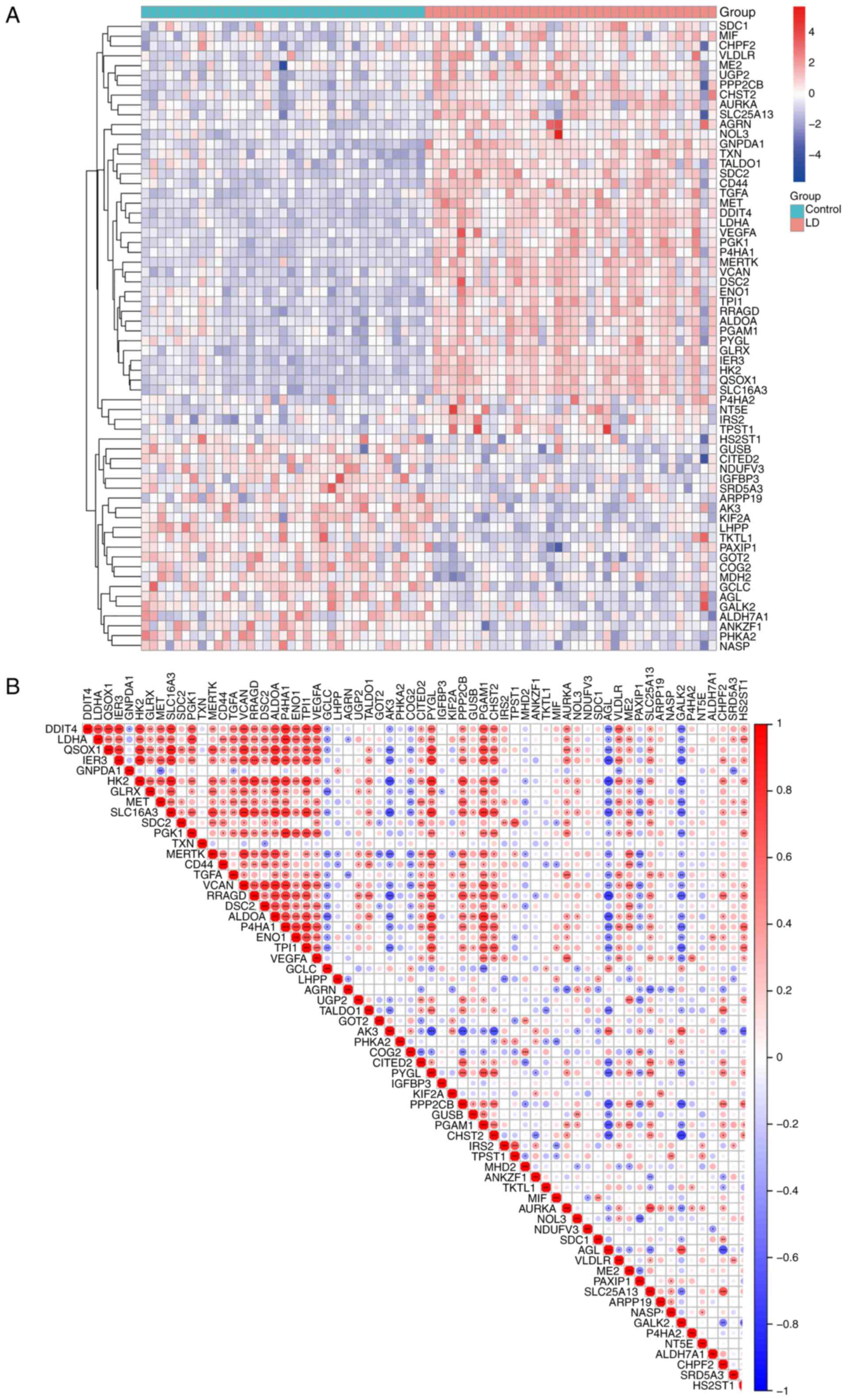
Figure 2

Analysis of expression levels of GRGs
in LD. (A) Heat-map showing the expression pattern of GRGs in
different samples. (B) Correlation heat map showing the correlation
coefficients of the 63 GRGs. Red and green represent positive and
negative correlations, respectively. *P<0.05,
**P<0.01, ***P<0.001. GRGs,
glycolysis-related genes; LD, lyme disease.

Figure 3

Enrichment analysis and machine
learning approach reveals 2 genes in 63 GRGs were identified as key
genes for LD. (A) KEGG term analysis of differentially expressed
GRGs. (B) GO term analysis of differentially expressed GRGs. (C)
ten-fold cross-validation curve for the LASSO logistic regression
model used to determine the optimal penalty parameter. (D)
coefficient profiles of candidate genes in the LASSO model as a
function of log(λ). (E) Classification accuracy of the SVM-RFE
model with different numbers of selected features. (F)
Cross-validation error of the SVM-RFE model with different numbers
of selected features. Finally, 14 genes (maximum precision=0.957,
minimum root mean square error=0.0429) were identified as the best
key genes; (G) The vein plot revealed two key gene
regulation-related genes (LDHA and TXN) identified through LASSO
and SVM-RFE methods. GRGs, glycolysis-related genes; LD, Lyme
disease; GO, Gene Ontology; KEGG, Kyoto Encyclopedia of Genes and
Genomes; LASSO, Least Absolute Shrinkage and Selection Operator;
SVM-RFE, Support Vector Machine-Recursive Feature Elimination; CV,
cross validation.

Figure 4

Single-gene GSEA-KEGG pathway
analysis. GSEA-KEGG pathway analysis of (A) LDHA and (B) TXN. GSEA,
Gene Set Enrichment Analysis; KEGG, Kyoto Encyclopedia of Genes and
Genomes.

Figure 5

GSVA enrichment results based on
KEGG. (A) GSVA results of the KEGG set in the LDHA high expressed
group; (B) GSVA results of the KEGG set in the TXN high expressed
group. GSVA, Gene Set Variation Analysis; KEGG, Kyoto Encyclopedia
of Genes and Genomes.

Figure 6

Results of the CIBERSORT analysis of
the immune infiltration analysis. (A) PC analysis was performed
between LD group and control group. Red points and ellipses
indicate LD samples and blue points and ellipses indicate normal
samples. (B) Box plot showing the significant difference in the
infiltration of 22 immune cell types between the LD group and
control group. (C) Correlation landscape of immune cell
infiltration and its association with the key genes LDHA and TXN.
The heatmap displays the Pearson correlation coefficients between
the expression levels of 2 hub glycolysis-related differential
genes (columns) and the infiltration levels of 22 immune cell types
(rows) as determined by CIBERSORT analysis with the LM22 signature
matrix. Red colors indicate positive correlations, while blue
colors indicate negative correlations. Color intensity reflects the
strength of correlation. (D) Representative scatter plots showing
the correlations between the expression levels of LDHA/TXN and
selected immune cell subsets, including resting memory CD4 T cells,
gamma delta T cells, regulatory T cells and monocytes. Correlation
coefficients and P-values are shown in each panel.
*P<0.05, **P<0.01,
***P<0.001. PC, principal component; LD, Lyme
disease.

Figure 7

The candidate drug-gene interactions
and ceRNA regulatory network construction. (A) Drug-gene
interaction network constructed based on the Drug Gene Interaction
Database. Red ellipse points represent genes and blue rectangle
points represent drugs. (B) Predicted drug's molecular formula,
gene and adjusted P-value. (C) A ceRNA regulatory network centered
on 2 hub GRGs in Lyme disease. This focused sub-network illustrates
the post-transcriptional regulation of 2 key GRGs through
lncRNA-miRNA-mRNA interactions. Red ellipse represent mRNAs (LDHA
and TXN), green triangles represent miRNAs (n=26) and blue diamonds
represent lncRNAs (n=34). A total of 59 nodes and 60 edges are
shown. Edge width represents the prediction confidence score from
integrated analysis of the miRanda, miRDB and TargetScan databases.
Network visualization was performed using Cytoscape v3.10.2 with a
force-directed layout algorithm. crRNA, competing endogenous RNA;
lncNRA, long non-coding RNA; miRNA, microRNAs; GRGs,
glycolysis-related genes.

Figure 8

ROC curve, calibration plot and
decision curve analysis of the LDHA-TXN model. (A) ROC curves of
the two individual key genes, LDHA and TXN, in the GSE42606 cohort.
The corresponding AUC values are shown in the panel. (B) ROC curve
of the combined two-gene diagnostic model constructed using LDHA
and TXN in the GSE42606 cohort. The AUC and 95% CI are indicated in
the figure. (C) ROC curves of the individual genes LDHA and TXN in
the independent validation cohort GSE63085, showing their
diagnostic performance in external validation. (D) ROC curve of the
combined two-gene diagnostic model in the independent validation
cohort GSE63085. The AUC and 95% CI are shown in the panel. (E)
Calibration curve of the nomogram/model. (F) DCA of the two-gene
model. The red line represents the net benefit of the model, while
the gray and black lines represent the strategies of treating all
patients or none, respectively. (G) Nomogram constructed based on
LDHA and TXN for individualized prediction of Lyme disease risk. In
the nomogram, each variable corresponds to a score and the total
score can be calculated by summing the scores of all variables. The
ROC curve, calibration plot, and DCA shown were generated from
pooled out-of-fold predictions obtained during outer 5-fold
cross-validation, whereas the nomogram was fitted on the full
dataset after validation for visualization only. ROC, receiver
operating characteristic; AUC, area under curve; CV,
cross-validation; DCA, decision curve analysis; OOF,
out-of-fold.

Figure 9

Validation of LDHA and TXN expression
and glycolysis-related metabolic alterations in Lyme disease.
Normalized expression levels of (A) LDHA and (B) TXN in the
GSE42606 cohort between the control and Bb groups. Normalized
expression levels of (C) LDHA and (D) TXN in the GSE63085 cohort
between the control and Bb groups. Reverse
transcription-quantitative PCR validation of (E) LDHA and (F) TXN
mRNA expression in THP-1 cells after Bb stimulation compared with
the PBS control group. (G) LAC and (H) GLU levels in culture
supernatants of THP-1 cells after Bb stimulation and in the PBS
control group. *P<0.05, ***P<0.001.
LAC, lactate; GLU, extracellular glucose; Bb, Borrelia
burgdorferi.
View References

1 

Steere AC, Strle F, Wormser GP, Hu LT, Branda JA, Hovius JW, Li X and Mead PS: Lyme borreliosis. Nat Rev Dis Primers. 2(16090)2016.PubMed/NCBI View Article : Google Scholar

2 

Kugeler KJ, Schwartz AM, Delorey MJ, Mead PS and Hinckley AF: Estimating the frequency of Lyme disease diagnoses, United States, 2010-2018. Emerg Infect Dis. 27:616–619. 2021.PubMed/NCBI View Article : Google Scholar

3 

Cardenas-de LGJ, De la Cruz-Valadez E, Ocampo-Candiani J and Welsh O: Clinical spectrum of Lyme disease. Eur J Clin Microbiol Infect Dis. 38:201–208. 2019.PubMed/NCBI View Article : Google Scholar

4 

Wormser GP, Ramanathan R, Nowakowski J, McKenna D, Holmgren D, Visintainer P, Dornbush R, Singh B and Nadelman RB: Duration of antibiotic therapy for early Lyme disease: A randomized double-blind placebo-controlled trial. Ann Intern Med. 138:697–704. 2003.PubMed/NCBI View Article : Google Scholar

5 

Bockenstedt LK, Gonzalez DG, Haberman AM and Belperron AA: Spirochete antigens persist near cartilage after murine Lyme borreliosis therapy. J Clin Invest. 122:2652–2660. 2012.PubMed/NCBI View Article : Google Scholar

6 

Williams MT, Zhang Y, Pulse ME, Berg RE and Allen MS: Suppression of host humoral immunity by Borrelia burgdorferi varies over the course of infection. Infect Immun. 92(e00018)2024.PubMed/NCBI View Article : Google Scholar

7 

Kraiczy P: Hide and seek: How Lyme disease spirochetes overcome complement attack. Front Immunol. 7(385)2016.PubMed/NCBI View Article : Google Scholar

8 

Elsner RA, Hastey CJ, Olsen KJ and Baumgarth N: Suppression of long-lived humoral immunity following Borrelia burgdorferi infection. PLoS Pathog. 11(e1004976)2015.PubMed/NCBI View Article : Google Scholar

9 

Soto-Heredero G, Gómez DLHM, Gabandé-Rodríguez E, Oller J and Mittelbrunn M: Glycolysis: A key player in the inflammatory response. FEBS J. 287:3350–3369. 2020.PubMed/NCBI View Article : Google Scholar

10 

O'Neill LA and Pearce EJ: Immunometabolism governs dendritic cell and macrophage function. J Exp Med. 213:15–23. 2016.PubMed/NCBI View Article : Google Scholar

11 

Ye L, Jiang Y and Zhang M: Crosstalk between glucose metabolism, lactate production and immune response modulation. Cytokine Growth Factor Rev. 68:81–92. 2022.PubMed/NCBI View Article : Google Scholar

12 

Pearce EL and Pearce EJ: Metabolic pathways in immune cell activation and quiescence. Immunity. 38:643. 2013.PubMed/NCBI View Article : Google Scholar

13 

Buck MD, Sowell RT, Kaech SM and Pearce EL: Metabolic instruction of immunity. Cell. 169:570–586. 2017.PubMed/NCBI View Article : Google Scholar

14 

Pålsson-McDermott EM and O'Neill L: Targeting immunometabolism as an anti-inflammatory strategy. Cell Res. 30:300–314. 2020.PubMed/NCBI View Article : Google Scholar

15 

Kornberg MD, Bhargava P, Kim PM, Putluri V, Snowman AM, Putluri N, Calabresi PA and Snyder SH: Dimethyl fumarate targets GAPDH and aerobic glycolysis to modulate immunity. Science. 360:449–453. 2018.PubMed/NCBI View Article : Google Scholar

16 

Shirai T, Nazarewicz RR, Wallis BB, Yanes RE, Watanabe R, Hilhorst M, Tian L, Harrison DG, Giacomini JC, Assimes TL, et al: The glycolytic enzyme PKM2 bridges metabolic and inflammatory dysfunction in coronary artery disease. J Exp Med. 213:337–354. 2016.PubMed/NCBI View Article : Google Scholar

17 

Peng M, Yin N, Chhangawala S, Xu K, Leslie CS and Li MO: Aerobic glycolysis promotes T helper 1 cell differentiation through an epigenetic mechanism. Science. 354:481–484. 2016.PubMed/NCBI View Article : Google Scholar

18 

Oosting M, Kerstholt M, Ter Horst R, Li Y, Deelen P, Smeekens S, Jaeger M, Lachmandas E, Vrijmoeth H, Lupse M, et al: Functional and genomic architecture of Borrelia burgdorferi-induced cytokine responses in humans. Cell Host Microbe. 20:822–833. 2016.PubMed/NCBI View Article : Google Scholar

19 

Kim TK, Tirloni L, Bencosme-Cuevas E, Kim TH, Diedrich JK, Yates JR and Mulenga A: Borrelia burgdorferi infection modifies protein content in saliva of Ixodes scapularis nymphs. BMC Genomics. 22(152)2021.PubMed/NCBI View Article : Google Scholar

20 

Corona A and Schwartz I: Borrelia burgdorferi: Carbon metabolism and the tick-mammal enzootic cycle. Microbiol Spectr. 3(10)2015.PubMed/NCBI View Article : Google Scholar

21 

Lynch A, Pearson P, Savinov SN, Li AY and Rich SM: Lactate dehydrogenase inhibitors suppress Borrelia burgdorferi growth in vitro. Pathogens. 12(962)2023.PubMed/NCBI View Article : Google Scholar

22 

Ritchie ME, Phipson B, Wu D, Hu Y, Law CW, Shi W and Smyth GK: limma powers differential expression analyses for RNA-sequencing and microarray studies. Nucleic Acids Res. 43(e47)2015.PubMed/NCBI View Article : Google Scholar

23 

Tibshirani R: Regression shrinkage selection via the LASSO. J R Stat Soc Series B Stat Methodol. 73:273–282. 2011.

24 

Sauerbrei W, Royston P and Binder H: Selection of important variables and determination of functional form for continuous predictors in multivariable model building. Stat Med. 26:5512–5528. 2007.PubMed/NCBI View Article : Google Scholar

25 

Guyon I, Weston J, Barnhill S and Vapnik V: Gene selection for cancer classification using support vector machines. Mach Learn. 46:389–422. 2002.

26 

Lewis MJ, Spiliopoulou A, Goldmann K, Pitzalis C, McKeigue P and Barnes MR: nestedcv: An R package for fast implementation of nested cross-validation with embedded feature selection designed for transcriptomics and high-dimensional data. Bioinform Adv. 3(vbad048)2023.PubMed/NCBI View Article : Google Scholar

27 

Chen H and Boutros PC: VennDiagram: A package for the generation of highly customizable Venn and Euler diagrams in R. BMC Bioinformatics. 12(35)2011.PubMed/NCBI View Article : Google Scholar

28 

Aran D, Hu Z and Butte AJ: xCell: Digitally portraying the tissue cellular heterogeneity landscape. Genome Biol. 18(220)2017.PubMed/NCBI View Article : Google Scholar

29 

Aran D: Cell-type enrichment analysis of bulk transcriptomes using xCell. Methods Mol Biol. 2120:264–276. 2020.PubMed/NCBI View Article : Google Scholar

30 

Gustavsson EK, Zhang D, Reynolds RH, Garcia-Ruiz S and Ryten M: ggtranscript: An R package for the visualization and interpretation of transcript isoforms using ggplot2. Bioinformatics. 38:3844–3846. 2022.PubMed/NCBI View Article : Google Scholar

31 

Hänzelmann S, Castelo R and Guinney J: GSVA: Gene set variation analysis for microarray and RNA-seq data. BMC Bioinformatics. 14(7)2013.PubMed/NCBI View Article : Google Scholar

32 

Lin Y, Liang R, Ye J, Li Q, Liu Z, Gao X, Piao X, Mai R, Zou D and Ge L: A twenty gene-based gene set variation score reflects the pathological progression from cirrhosis to hepatocellular carcinoma. Aging (Albany NY). 11:11157–11169. 2019.PubMed/NCBI View Article : Google Scholar

33 

Betel D, Wilson M, Gabow A, Marks DS and Sander C: The microRNA.org resource: Targets and expression. Nucleic Acids Res. 36:D149–D153. 2008.PubMed/NCBI View Article : Google Scholar

34 

John B, Enright AJ, Aravin A, Tuschl T, Sander C and Marks DS: Human MicroRNA targets. PLoS Biol. 2(e363)2004.PubMed/NCBI View Article : Google Scholar

35 

Mandrekar JN: Receiver operating characteristic curve in diagnostic test assessment. J Thorac Oncol. 5:1315–1316. 2010.PubMed/NCBI View Article : Google Scholar

36 

Robin X, Turck N, Hainard A, Tiberti N, Lisacek F, Sanchez JC and Müller M: pROC: An open-source package for R and S+ to analyze and compare ROC curves. BMC Bioinformatics. 12(77)2011.PubMed/NCBI View Article : Google Scholar

37 

Pajouheshnia R, Pestman WR, Teerenstra S and Groenwold RHH: A computational approach to compare regression modelling strategies in prediction research. BMC Med Res Methodol. 16(107)2016.PubMed/NCBI View Article : Google Scholar

38 

Livak KJ and Schmittgen TD: Analysis of relative gene expression data using real-time quantitative PCR and the 2(-Delta Delta C(T)) method. Methods. 25:402–408. 2001.PubMed/NCBI View Article : Google Scholar

39 

Schmittgen TD and Livak KJ: Analyzing real-time PCR data by the comparative C(T) method. Nat Protoc. 3:1101–1108. 2008.PubMed/NCBI View Article : Google Scholar

40 

Yoo M, Shin J, Kim J, Ryall KA, Lee K, Lee S, Jeon M, Kang J and Tan AC: DSigDB: Drug signatures database for gene set analysis. Bioinformatics. 31:3069–3071. 2015.PubMed/NCBI View Article : Google Scholar

41 

Kuleshov MV, Jones MR, Rouillard AD, Fernandez NF, Duan Q, Wang Z, Koplev S, Jenkins SL, Jagodnik KM, Lachmann A, et al: Enrichr: A comprehensive gene set enrichment analysis web server 2016 update. Nucleic Acids Res. 44:W90–W97. 2016.PubMed/NCBI View Article : Google Scholar

42 

Keenan AB, Jenkins SL, Jagodnik KM, Koplev S, He E, Torre D, Wang Z, Dohlman AB, Silverstein MC, Lachmann A, et al: The library of integrated network-based cellular signatures NIH program: System-level cataloging of human cells response to perturbations. Cell Syst. 6:13–24. 2018.PubMed/NCBI View Article : Google Scholar

43 

Tannahill GM, Curtis AM, Adamik J, Palsson-McDermott EM, McGettrick AF, Goel G, Frezza C, Bernard NJ, Kelly B, Foley NH, et al: Succinate is an inflammatory signal that induces IL-1β through HIF-1α. Nature. 496:238–242. 2013.PubMed/NCBI View Article : Google Scholar

44 

Palsson-McDermott EM, Curtis AM, Goel G, Lauterbach MAR, Sheedy FJ, Gleeson LE, van den Bosch MW, Quinn SR, Domingo-Fernandez R, Johnston DG, et al: Pyruvate kinase M2 regulates HIF-1α activity and IL-1β induction and is a critical determinant of the Warburg effect in LPS-activated macrophages. Cell Metab. 21:65–80. 2015.PubMed/NCBI View Article : Google Scholar

45 

O'Neill LA, Kishton RJ and Rathmell J: A guide to immunometabolism for immunologists. Nat Rev Immunol. 16:553–565. 2016.PubMed/NCBI View Article : Google Scholar

46 

Martínez-Reyes I and Chandel NS: Mitochondrial TCA cycle metabolites control physiology and disease. Nat Commun. 11(102)2020.PubMed/NCBI View Article : Google Scholar

47 

Chen S, Xu Y, Zhuo W and Zhang L: The emerging role of lactate in tumor microenvironment and its clinical relevance. Cancer Lett. 590(216837)2024.PubMed/NCBI View Article : Google Scholar

48 

Viola A, Munari F, Sánchez-Rodríguez R, Scolaro T and Castegna A: The metabolic signature of macrophage responses. Front Immunol. 10(1462)2019.PubMed/NCBI View Article : Google Scholar

49 

Barriales D, Martín-Ruiz I, Carreras-González A, Montesinos-Robledo M, Azkargorta M, Iloro I, Escobés I, Martín-Mateos T, Atondo E, Palacios A, et al: Borrelia burgdorferi infection induces long-term memory-like responses in macrophages with tissue-wide consequences in the heart. PLoS Biol. 19(e3001062)2021.PubMed/NCBI View Article : Google Scholar

50 

Sze CW, Lynch MJ, Zhang K, Neau DB, Ealick SE, Crane BR and Li C: Lactate dehydrogenase is the Achilles' heel of Lyme disease bacterium Borreliella burgdorferi. mBio. 16(e037284)2025.PubMed/NCBI View Article : Google Scholar

51 

Dai M, Wang L, Yang J, Chen J, Dou X, Chen R, Ge Y and Lin Y: LDHA as a regulator of T cell fate and its mechanisms in disease. Biomed Pharmacother. 158(114164)2023.PubMed/NCBI View Article : Google Scholar

52 

Bertini R, Howard OM, Dong HF, Oppenheim JJ, Bizzarri C, Sergi R, Caselli G, Pagliei S, Romines B, Wilshire JA, et al: Thioredoxin, a redox enzyme released in infection and inflammation, is a unique chemoattractant for neutrophils, monocytes and T cells. J Exp Med. 189:1783–1789. 1999.PubMed/NCBI View Article : Google Scholar

53 

Li B, Ming H, Qin S, Nice EC, Dong J, Du Z and Huang C: Redox regulation: Mechanisms, biology and therapeutic targets in diseases. Signal Transduct Target Ther. 10(72)2025.PubMed/NCBI View Article : Google Scholar

54 

Dagah OMA, Silaa BB, Zhu M, Pan Q, Qi L, Liu X, Liu Y, Peng W, Ullah Z, Yudas AF, et al: Exploring immune redox modulation in bacterial infections: Insights into thioredoxin-mediated interactions and implications for understanding host-pathogen dynamics. Antioxidants (Basel). 13(545)2024.PubMed/NCBI View Article : Google Scholar

55 

Shin JJ, Strle K, Glickstein LJ, Luster AD and Steere AC: Borrelia burgdorferi stimulation of chemokine secretion by cells of monocyte lineage in patients with Lyme arthritis. Arthritis Res Ther. 12(R168)2010.PubMed/NCBI View Article : Google Scholar

56 

Botey-Bataller J, Vrijmoeth HD, Ursinus J, Kullberg BJ, van den Wijngaard CC, Ter Hofstede H, Alaswad A, Gupta MK, Roesner LM, Huehn J, et al: A comprehensive genetic map of cytokine responses in Lyme borreliosis. Nat Commun. 15(3795)2024.PubMed/NCBI View Article : Google Scholar

57 

Lu Y, Osis G, Zmijewska AA, Traylor A, Thukral S, Wilson L, Barnes S, George JF and Agarwal A: Macrophage-specific lactate dehydrogenase expression modulates inflammatory function in vitro. Kidney360. 6:197–207. 2025.PubMed/NCBI View Article : Google Scholar

58 

Song YJ, Kim A, Kim GT, Yu HY, Lee ES, Park MJ, Kim YJ, Shim SM and Park TS: Inhibition of lactate dehydrogenase A suppresses inflammatory response in RAW 264.7 macrophages. Mol Med Rep. 19:629–647. 2019.PubMed/NCBI View Article : Google Scholar

59 

Qayyum N, Haseeb M, Kim MS and Choi S: Role of thioredoxin-interacting protein in diseases and its therapeutic outlook. Int J Mol Sci. 22(2754)2021.PubMed/NCBI View Article : Google Scholar

60 

Nakamura H, Herzenberg LA, Bai J, Araya S, Kondo N, Nishinaka Y, Herzenberg LA and Yodoi J: Circulating thioredoxin suppresses lipopolysaccharide-induced neutrophil chemotaxis. Proc Natl Acad Sci USA. 98:15143–15148. 2001.PubMed/NCBI View Article : Google Scholar

61 

Mason LM, Veerman CC, Geijtenbeek TB and Hovius JW: Menage a trois: Borrelia, dendritic cells and tick saliva interactions. Trends Parasitol. 30:95–103. 2014.PubMed/NCBI View Article : Google Scholar

62 

Shen S, Shin JJ, Strle K, McHugh G, Li X, Glickstein LJ, Drouin EE and Steere AC: Treg cell numbers and function in patients with antibiotic-refractory or antibiotic-responsive Lyme arthritis. Arthritis Rheum. 62:2127–2137. 2010.PubMed/NCBI View Article : Google Scholar

63 

Shi C, Sahay B, Russell JQ, Fortner KA, Hardin N, Sellati TJ and Budd RC: Reduced immune response to Borrelia burgdorferi in the absence of γδ T cells. Infect Immun. 79:3940–3946. 2011.PubMed/NCBI View Article : Google Scholar

64 

Tracy KE and Baumgarth N: Borrelia burgdorferi manipulates innate and adaptive immunity to establish persistence in rodent reservoir hosts. Front Immunol. 8(116)2017.PubMed/NCBI View Article : Google Scholar

65 

Salazar JC, Duhnam-Ems S, La Vake C, Cruz AR, Moore MW, Caimano MJ, Velez-Climent L, Shupe J, Krueger W and Radolf JD: Activation of human monocytes by live Borrelia burgdorferi generates TLR2-dependent and independent responses including induction of IFN-β. PLoS Pathog. 5(e1000444)2009.PubMed/NCBI View Article : Google Scholar

66 

Stokes JV, Moraru GM, McIntosh C, Kummari E, Rausch K and Varela-Stokes AS: Differentiated THP-1 cells exposed to pathogenic and nonpathogenic Borrelia species demonstrate minimal differences in production of inflammatory cytokines. Vector Borne Zoonotic Dis. 16:691–695. 2016.PubMed/NCBI View Article : Google Scholar

67 

Strle K, Drouin EE, Shen S, El Khoury J, McHugh G, Ruzic-Sabljic E, Strle F and Steere AC: Borrelia burgdorferi stimulates macrophages to secrete higher levels of cytokines and chemokines than Borrelia afzelii or Borrelia garinii. J Infect Dis. 200:1936–1943. 2009.PubMed/NCBI View Article : Google Scholar

68 

Lasky CE, Olson RM and Brown CR: Macrophage polarization during murine Lyme borreliosis. Infect Immun. 83:2627–2645. 2015.PubMed/NCBI View Article : Google Scholar

69 

Akinlusi I, Kan B, Shi T, Barragan J, Bouchot C and Cervantes J: Human microglia polarization following infection with the Lyme disease spirochete. J Investig Med. 73:172–178. 2025.PubMed/NCBI View Article : Google Scholar

70 

Woitzik P and Linder S: Molecular mechanisms of Borrelia burgdorferi phagocytosis and intracellular processing by human macrophages. Biology (Basel). 10(567)2021.PubMed/NCBI View Article : Google Scholar

Related Articles

  • Abstract
  • View
  • Download
  • Twitter
Copy and paste a formatted citation
Spandidos Publications style
Dong Y, Chen Y, Luo Y, Liu M, Song C, Chen X, Yang F, Luo Q and Zhou G: Glycolytic reprogramming in host response to <em>Borrelia burgdorferi</em>: A gene signature revealed by integrative bioinformatics analysis and machine learning. Exp Ther Med 32: 187, 2026.
APA
Dong, Y., Chen, Y., Luo, Y., Liu, M., Song, C., Chen, X. ... Zhou, G. (2026). Glycolytic reprogramming in host response to <em>Borrelia burgdorferi</em>: A gene signature revealed by integrative bioinformatics analysis and machine learning. Experimental and Therapeutic Medicine, 32, 187. https://doi.org/10.3892/etm.2026.13182
MLA
Dong, Y., Chen, Y., Luo, Y., Liu, M., Song, C., Chen, X., Yang, F., Luo, Q., Zhou, G."Glycolytic reprogramming in host response to <em>Borrelia burgdorferi</em>: A gene signature revealed by integrative bioinformatics analysis and machine learning". Experimental and Therapeutic Medicine 32.1 (2026): 187.
Chicago
Dong, Y., Chen, Y., Luo, Y., Liu, M., Song, C., Chen, X., Yang, F., Luo, Q., Zhou, G."Glycolytic reprogramming in host response to <em>Borrelia burgdorferi</em>: A gene signature revealed by integrative bioinformatics analysis and machine learning". Experimental and Therapeutic Medicine 32, no. 1 (2026): 187. https://doi.org/10.3892/etm.2026.13182
Copy and paste a formatted citation
x
Spandidos Publications style
Dong Y, Chen Y, Luo Y, Liu M, Song C, Chen X, Yang F, Luo Q and Zhou G: Glycolytic reprogramming in host response to <em>Borrelia burgdorferi</em>: A gene signature revealed by integrative bioinformatics analysis and machine learning. Exp Ther Med 32: 187, 2026.
APA
Dong, Y., Chen, Y., Luo, Y., Liu, M., Song, C., Chen, X. ... Zhou, G. (2026). Glycolytic reprogramming in host response to <em>Borrelia burgdorferi</em>: A gene signature revealed by integrative bioinformatics analysis and machine learning. Experimental and Therapeutic Medicine, 32, 187. https://doi.org/10.3892/etm.2026.13182
MLA
Dong, Y., Chen, Y., Luo, Y., Liu, M., Song, C., Chen, X., Yang, F., Luo, Q., Zhou, G."Glycolytic reprogramming in host response to <em>Borrelia burgdorferi</em>: A gene signature revealed by integrative bioinformatics analysis and machine learning". Experimental and Therapeutic Medicine 32.1 (2026): 187.
Chicago
Dong, Y., Chen, Y., Luo, Y., Liu, M., Song, C., Chen, X., Yang, F., Luo, Q., Zhou, G."Glycolytic reprogramming in host response to <em>Borrelia burgdorferi</em>: A gene signature revealed by integrative bioinformatics analysis and machine learning". Experimental and Therapeutic Medicine 32, no. 1 (2026): 187. https://doi.org/10.3892/etm.2026.13182
Follow us
  • Twitter
  • LinkedIn
  • Facebook
About
  • Spandidos Publications
  • Careers
  • Cookie Policy
  • Privacy Policy
How can we help?
  • Help
  • Live Chat
  • Contact
  • Email to our Support Team