Spandidos Publications Logo
  • About
    • About Spandidos
    • Aims and Scopes
    • Abstracting and Indexing
    • Editorial Policies
    • Reprints and Permissions
    • Job Opportunities
    • Terms and Conditions
    • Contact
  • Journals
    • All Journals
    • Oncology Letters
      • Oncology Letters
      • Information for Authors
      • Editorial Policies
      • Editorial Board
      • Aims and Scope
      • Abstracting and Indexing
      • Bibliographic Information
      • Archive
    • International Journal of Oncology
      • International Journal of Oncology
      • Information for Authors
      • Editorial Policies
      • Editorial Board
      • Aims and Scope
      • Abstracting and Indexing
      • Bibliographic Information
      • Archive
    • Molecular and Clinical Oncology
      • Molecular and Clinical Oncology
      • Information for Authors
      • Editorial Policies
      • Editorial Board
      • Aims and Scope
      • Abstracting and Indexing
      • Bibliographic Information
      • Archive
    • Experimental and Therapeutic Medicine
      • Experimental and Therapeutic Medicine
      • Information for Authors
      • Editorial Policies
      • Editorial Board
      • Aims and Scope
      • Abstracting and Indexing
      • Bibliographic Information
      • Archive
    • International Journal of Molecular Medicine
      • International Journal of Molecular Medicine
      • Information for Authors
      • Editorial Policies
      • Editorial Board
      • Aims and Scope
      • Abstracting and Indexing
      • Bibliographic Information
      • Archive
    • Biomedical Reports
      • Biomedical Reports
      • Information for Authors
      • Editorial Policies
      • Editorial Board
      • Aims and Scope
      • Abstracting and Indexing
      • Bibliographic Information
      • Archive
    • Oncology Reports
      • Oncology Reports
      • Information for Authors
      • Editorial Policies
      • Editorial Board
      • Aims and Scope
      • Abstracting and Indexing
      • Bibliographic Information
      • Archive
    • Molecular Medicine Reports
      • Molecular Medicine Reports
      • Information for Authors
      • Editorial Policies
      • Editorial Board
      • Aims and Scope
      • Abstracting and Indexing
      • Bibliographic Information
      • Archive
    • World Academy of Sciences Journal
      • World Academy of Sciences Journal
      • Information for Authors
      • Editorial Policies
      • Editorial Board
      • Aims and Scope
      • Abstracting and Indexing
      • Bibliographic Information
      • Archive
    • International Journal of Functional Nutrition
      • International Journal of Functional Nutrition
      • Information for Authors
      • Editorial Policies
      • Editorial Board
      • Aims and Scope
      • Abstracting and Indexing
      • Bibliographic Information
      • Archive
    • International Journal of Epigenetics
      • International Journal of Epigenetics
      • Information for Authors
      • Editorial Policies
      • Editorial Board
      • Aims and Scope
      • Abstracting and Indexing
      • Bibliographic Information
      • Archive
    • Medicine International
      • Medicine International
      • Information for Authors
      • Editorial Policies
      • Editorial Board
      • Aims and Scope
      • Abstracting and Indexing
      • Bibliographic Information
      • Archive
  • Articles
  • Information
    • Information for Authors
    • Information for Reviewers
    • Information for Librarians
    • Information for Advertisers
    • Conferences
  • Language Editing
Spandidos Publications Logo
  • About
    • About Spandidos
    • Aims and Scopes
    • Abstracting and Indexing
    • Editorial Policies
    • Reprints and Permissions
    • Job Opportunities
    • Terms and Conditions
    • Contact
  • Journals
    • All Journals
    • Biomedical Reports
      • Information for Authors
      • Editorial Policies
      • Editorial Board
      • Aims and Scope
      • Abstracting and Indexing
      • Bibliographic Information
      • Archive
    • Experimental and Therapeutic Medicine
      • Information for Authors
      • Editorial Policies
      • Editorial Board
      • Aims and Scope
      • Abstracting and Indexing
      • Bibliographic Information
      • Archive
    • International Journal of Epigenetics
      • Information for Authors
      • Editorial Policies
      • Editorial Board
      • Aims and Scope
      • Abstracting and Indexing
      • Bibliographic Information
      • Archive
    • International Journal of Functional Nutrition
      • Information for Authors
      • Editorial Policies
      • Editorial Board
      • Aims and Scope
      • Abstracting and Indexing
      • Bibliographic Information
      • Archive
    • International Journal of Molecular Medicine
      • Information for Authors
      • Editorial Policies
      • Editorial Board
      • Aims and Scope
      • Abstracting and Indexing
      • Bibliographic Information
      • Archive
    • International Journal of Oncology
      • Information for Authors
      • Editorial Policies
      • Editorial Board
      • Aims and Scope
      • Abstracting and Indexing
      • Bibliographic Information
      • Archive
    • Medicine International
      • Information for Authors
      • Editorial Policies
      • Editorial Board
      • Aims and Scope
      • Abstracting and Indexing
      • Bibliographic Information
      • Archive
    • Molecular and Clinical Oncology
      • Information for Authors
      • Editorial Policies
      • Editorial Board
      • Aims and Scope
      • Abstracting and Indexing
      • Bibliographic Information
      • Archive
    • Molecular Medicine Reports
      • Information for Authors
      • Editorial Policies
      • Editorial Board
      • Aims and Scope
      • Abstracting and Indexing
      • Bibliographic Information
      • Archive
    • Oncology Letters
      • Information for Authors
      • Editorial Policies
      • Editorial Board
      • Aims and Scope
      • Abstracting and Indexing
      • Bibliographic Information
      • Archive
    • Oncology Reports
      • Information for Authors
      • Editorial Policies
      • Editorial Board
      • Aims and Scope
      • Abstracting and Indexing
      • Bibliographic Information
      • Archive
    • World Academy of Sciences Journal
      • Information for Authors
      • Editorial Policies
      • Editorial Board
      • Aims and Scope
      • Abstracting and Indexing
      • Bibliographic Information
      • Archive
  • Articles
  • Information
    • For Authors
    • For Reviewers
    • For Librarians
    • For Advertisers
    • Conferences
  • Language Editing
Login Register Submit
  • This site uses cookies
  • You can change your cookie settings at any time by following the instructions in our Cookie Policy. To find out more, you may read our Privacy Policy.

    I agree
Search articles by DOI, keyword, author or affiliation
Search
Advanced Search
presentation
Experimental and Therapeutic Medicine
Join Editorial Board Propose a Special Issue
Print ISSN: 1792-0981 Online ISSN: 1792-1015
Journal Cover
May-June 2010 Volume 1 Issue 3

Full Size Image

Sign up for eToc alerts
Recommend to Library

Journals

International Journal of Molecular Medicine

International Journal of Molecular Medicine

International Journal of Molecular Medicine is an international journal devoted to molecular mechanisms of human disease.

International Journal of Oncology

International Journal of Oncology

International Journal of Oncology is an international journal devoted to oncology research and cancer treatment.

Molecular Medicine Reports

Molecular Medicine Reports

Covers molecular medicine topics such as pharmacology, pathology, genetics, neuroscience, infectious diseases, molecular cardiology, and molecular surgery.

Oncology Reports

Oncology Reports

Oncology Reports is an international journal devoted to fundamental and applied research in Oncology.

Experimental and Therapeutic Medicine

Experimental and Therapeutic Medicine

Experimental and Therapeutic Medicine is an international journal devoted to laboratory and clinical medicine.

Oncology Letters

Oncology Letters

Oncology Letters is an international journal devoted to Experimental and Clinical Oncology.

Biomedical Reports

Biomedical Reports

Explores a wide range of biological and medical fields, including pharmacology, genetics, microbiology, neuroscience, and molecular cardiology.

Molecular and Clinical Oncology

Molecular and Clinical Oncology

International journal addressing all aspects of oncology research, from tumorigenesis and oncogenes to chemotherapy and metastasis.

World Academy of Sciences Journal

World Academy of Sciences Journal

Multidisciplinary open-access journal spanning biochemistry, genetics, neuroscience, environmental health, and synthetic biology.

International Journal of Functional Nutrition

International Journal of Functional Nutrition

Open-access journal combining biochemistry, pharmacology, immunology, and genetics to advance health through functional nutrition.

International Journal of Epigenetics

International Journal of Epigenetics

Publishes open-access research on using epigenetics to advance understanding and treatment of human disease.

Medicine International

Medicine International

An International Open Access Journal Devoted to General Medicine.

Journal Cover
May-June 2010 Volume 1 Issue 3

Full Size Image

Sign up for eToc alerts
Recommend to Library

  • Article
  • Citations
    • Cite This Article
    • Download Citation
    • Create Citation Alert
    • Remove Citation Alert
    • Cited By
  • Similar Articles
    • Related Articles (in Spandidos Publications)
    • Similar Articles (Google Scholar)
    • Similar Articles (PubMed)
  • Download PDF
  • Download XML
  • View XML
Article

Extra-nodal natural killer/T cell lymphoma, nasal-type, treated by concurrent chemoradiotherapy

  • Authors:
    • Nobuhiko Yoshikawa
    • Taisuke Inomata
    • Taiju Shinbo
    • Masatsugu Takahashi
    • Yasuo Uesugi
    • Yoshihumi Narumi
  • View Affiliations / Copyright

    Affiliations: Department of Radiology, Osaka Medical College, Osaka 569-8686, Japan. rad101@poh.osaka-med.ac.jp
  • Pages: 453-455
    |
    Published online on: May 1, 2010
       https://doi.org/10.3892/etm_00000070
  • Expand metrics +
Metrics: Total Views: 0 (Spandidos Publications: | PMC Statistics: )
Metrics: Total PDF Downloads: 0 (Spandidos Publications: | PMC Statistics: )
Cited By (CrossRef): 0 citations Loading Articles...

This article is mentioned in:


Abstract

The present study reports on a case of extra-nodal natural killer/T cell lymphoma, nasal-type (ENKL), stage IIEA, in a 50-year-old woman who presented with a white tumor on a refractory ulcer on the gum. Concurrent chemoradiotherapy was administered, and effected a partial response. However, tumor recurrence was observed 5 months after the final diagnosis, and the patient succumbed 1 month after recurrence. Although a definitive treatment for ENKL has yet to be established due to its rarity, radiation therapy (RT) is crucial to therapy, as ENKL is very sensitive to RT. However, treatment with radiation levels above 50 Gy with an extended RT field are required for a favorable outcome. The development of novel chemotherapy regimens may therefore be useful. Additionally, autologous or allogenic hematopoietic stem-cell transplantation may prove to be a promising approach.

Introduction

Extra-nodal natural killer (NK)/T cell lymphoma, nasal-type (ENKL), is a distinct entity according to the World Health Organization (WHO) classification of lymphoid tissue. Though rare in Western populations, it occurs with greater frequency among Asians, Mexicans and South Americans of American Indian descent. Due to its rarity and the lack of randomized controlled trials, a definitive treatment for ENKL remains to be established. Here, we describe our experience with a 50-year-old female patient who was diagnosed with ENKL stage IIEA and treated by concurrent chemoradiotherapy. Additional treatment options applied in previous studies are also discussed, including other chemotherapy regimens and autologous or allogenic hematopoietic stem-cell transplantation.

Case report

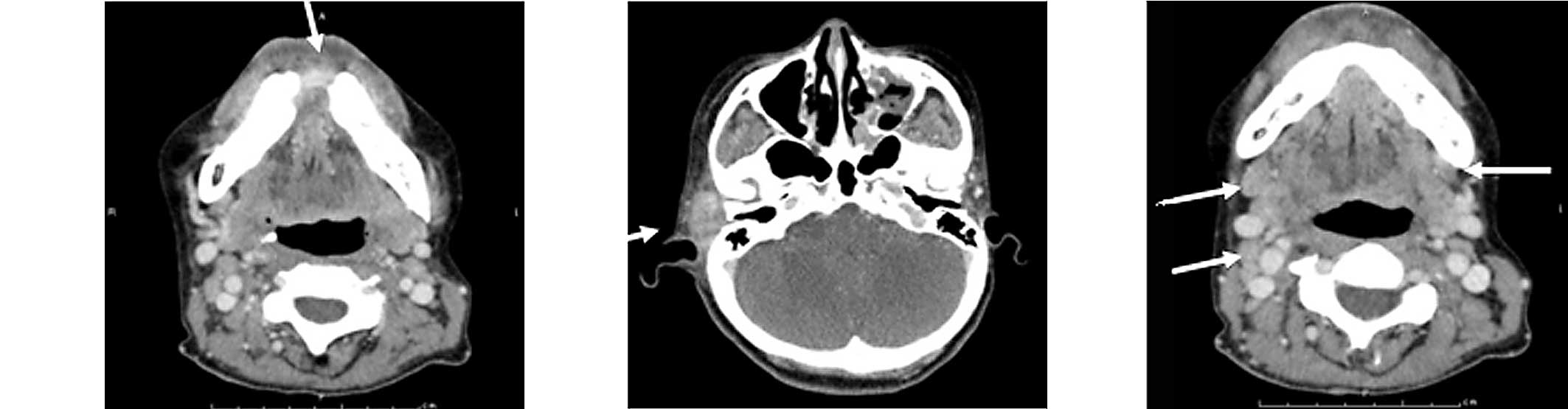
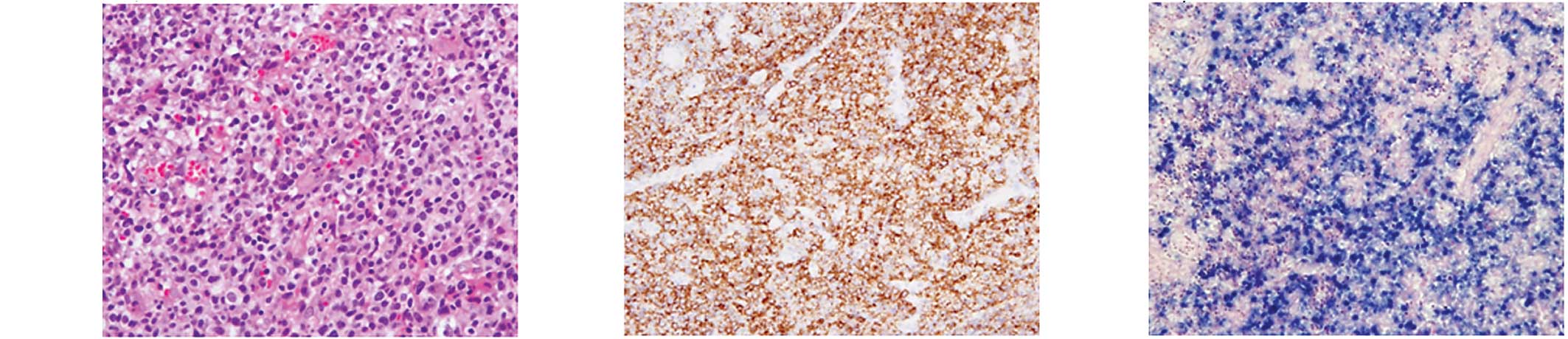
A 50-year-old woman presented at the Osaka Medical College Hospital in April 2008 with a suspected malignant white tumor on a refractory ulcer on the right-lower gum, accompanied by bilateral neck lymph node swelling. Levels of soluble IL-2 receptor (716 U/ml) were increased. Genetic examination revealed no rearrangement of T-cell receptors or immunoglobulin genes, and no chromosomal abnormalities. CT images revealed a slightly enhanced soft tissue mass with adjacent bone destruction and bilateral neck lymphadenopathy (Fig. 1). No other involved lesions were detected by garium-67 scintigraphy. Histological examination of biopsy specimens with H&E staining revealed diffuse infiltrate lymphoma cells. The immunophenotype was CD56+, cytoplasmic CD3+/−, CD16+, granzyme B+, CD20−, CD4− and CD8−. The specimens were also positive for Epstein-Barr virus encoded RNA (EBER) (Fig. 2).

Figure 1.

CT images of ENKL prior to the initial treatment. (A) Soft tissue mass adjacent to the mandible. (B) Soft tissue mass with slight contrast enhancement at the right temporal lobe. (C) Bilateral neck lymphadenopathy.

Figure 2.

Biopsy specimens from the gum. (A) H&E staining of a specimen showing diffuse infiltrate lymphoma cells. (B) Specimen positive for CD56 determined using an enzyme antibody technique. (C) Specimen positive for Epstein-Barr virus encoded RNA determined by in situ hybridyzation.

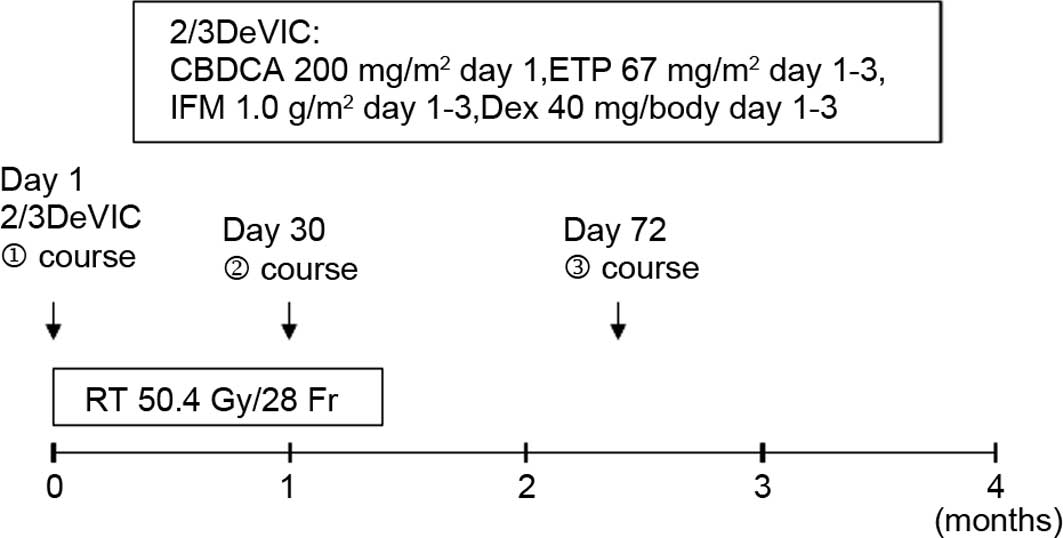
The tumor was diagnosed as ENKL stage IIEA. Concurrent chemoradiotherapy was administered according to the regimen described in the Japan Clinical Oncology Group (JCOG) trial 0211-DI (Fig. 3) (1). This protocol was recommended since ENKL is intractable and lacks a standard therapy. However, the case was not registered with the JCOG trial, and the protocol was not approved by an institutional review board, since it was necessary to commence treatment immediately. The patient provided informed written consent.

Figure 3.

Schedule and dosage of concurrent chemoradiotherapy (RT-2/3DeVIC regimen, Japan Clinical Oncology Group trial 0211-DI).

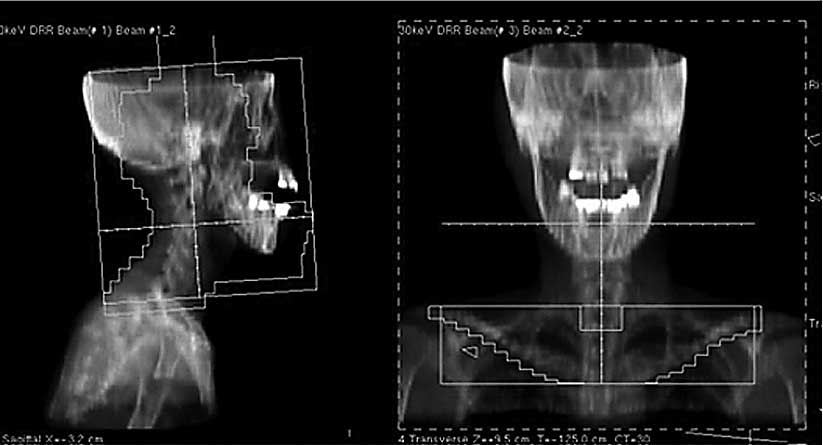
All extra-nodal lesions identified in the CT images as well as the bilateral neck and supraclavicular lymph node regions were included within the radiation portals. Using a 4-MV photon beam, 41.4 Gy in 23 fractions over 4.6 weeks was delivered to the extra-nodal site and to the neck and supraclavicular lymph node regions (Fig. 4A). Subsequently, the radiation portals were modified to avoid the spinal cord, and 9.0 Gy in 5 fractions over a week was delivered to the lesions with 4- and 10-MV photon beams (Fig. 4B). A 10-MeV electron beam was employed to adequately cover the mandibular tumor area. The patient suffered from grade 3 neutropenia and grade 3 acute oral mucositis, which required temporary intravenous hyperalimentation.

Figure 4.

Arrangement of the irradiated field. (A) From 0 to 41.4 Gy, two lateral opposed portals to the head and neck tumor and an anterior beam to the supraclavicular lymph node area were employed with a 4-MV photon beam. (B) From 41.4 to 50.4 Gy, anterior-posterior portals with 4- and 10-MV photon beams were employed to avoid the spinal cord, and the mandibular tumor area was irradiated with a 10-MeV electron beam.

On CT images captured 7 days after the completion of the radiation therapy, the therapeutic effect was determined to be a partial response. Five months after the final diagnosis, both in-field and distant tumor recurrences were observed on PET/CT images. Salvage chemotherapy (JALSG ALL202 protocol) was performed, but the patient succumbed 1 month after recurrence.

Discussion

ENKL is characterized histologically by angiocentric and polymorphous lymphoreticular infiltrates, and clinically by progressive necrotic lesions occurring mainly in the nasal cavity and a poor prognosis caused by rapid progression of the lesion into distinct organs. This lymphoma is very rare in Western populations, but occurs with greater frequency among Asians, Mexicans and South Americans of American Indian descent. It has been reported that NK/T cell lymphoma accounts for approximately 2.6% of all malignant lymphomas in Japan (2). ENKL is subcategorized into ‘nasal’ and ‘nasal-type’ ENKL according to the anatomic sites of the primary disease. In previous reports, nasal ENKL has been observed in the nasal cavity and upper aerodigestive area, while nasal-type ENKL has been noted in other sites (4,5). The nose and paranasal area, including the upper aerodigestive tract, is the origin of more than 80% of ENKL occurences. The skin is the second most frequent organ of origin, accounting for approximately 10% of occurrences, followed by the liver and/or spleen at 5% and, more rarely, the lungs, gastrointestinal tract, kidney, pancreas, testis and brain (7). Clinical characteristics differ between nasal and nasal-type ENKL: nasal-type ENKL is more advanced at diagnosis, and therefore, has a poorer prognosis than nasal ENKL (4).

As ENKL is very sensitive to radiation therapy (RT), RT plays a crucial role in its treatment, especially during the limited stages of the disease (stages I/II). Previous reports have suggested that RT as an initial treatment improves the local control probability (LCP) and overall survival (OS) of patients (5). Isobe et al reported that patients who received over 50 Gy with an RT field that included potential contiguous areas (the paranasal sinuses, palate and nasopharynx) with an adequate margin had a higher LCP. These results were statistically significant (5). Koom et al analyzed the dose-response relationships for local control, which showed a sigmoidal shape and reached a plateau at doses in excess of 54 Gy. However, the authors also found that dose escalation in patients who do not attain a complete response after the planned RT dose may improve the LCP (9). Therefore, doses over 50 Gy and an extended RT field are considered to confer a favorable prognosis (8).

Currently, combined chemotherapy is performed in many cases of ENKL, (3–7,9). However, ENKL is often resistant to the anthracycline-based chemotherapy used for malignant lymphomas (3,7). One possible explanation for this resistance is that ENKL commonly expresses P-glycoprotein, which is a product of the multidrug resistance-1 gene (11) and has an effect on anthracycline. Several reports have concluded that the addition of current chemotherapy regimes to radiation therapy for the treatment of ENKL may not improve the OS of the patients (4,6). Therefore, the development of effective chemotherapy regimens is an important step towards improving the prognosis of both limited and advanced stage ENKL. Several clinical studies of potential regimens are ongoing. For limited stage ENKL, Yamaguchi et al reported a favorable treatment outcome with concurrent chemoradiotherapy according to a DeVIC regimen (3), which consists of carboplatin, ifosphamide, etoposide and dexamethasone. Carboplatin and ifosphamide are not affected by P-glycoprotein, and etoposide is a key drug for the treatment of Epstein-Bar virus-related hemophagocytic syndrome. For advanced stage or relapsed ENKL, SMILE chemotherapy (consisting of L-asparaginase, methotrexate, ifosphamide, etoposide and dexamethasone) (10) and autologous or allogenic hematopoietic stem-cell transplantation have been reported to be effective, though these studies have only been conducted in a small patient sample.

In the current case, a complete response was not achieved after the completion of treatment, and no therapeutic effects of treatment were observed after recurrence. According to previous reports, the survival curves decrease abruptly within 1-2 years of treatment and later increase very slowly (4–9). Patients with a complete response and good local control tend to achieve a longer survival time (3,9). These studies and our current report indicate that additional boost irradiation may improve patient outcome. Furthermore, intensive follow-up and speedy induction salvage chemoradiotherapy should be performed.

References

1. 

Yamaguchi M, Tobinai K, Oguchi M, et al: Phase I/II Study of Concurrent Chemoradiotherapy for Localized Nasal Natural Killer/T-Cell Lymphoma: Japan Clinical Oncology Group Study JCOG0211. J Clin Oncol. 27:5594–6001. 2009. View Article : Google Scholar : PubMed/NCBI

2. 

Lymphoma Study Group of Japanese Pathologists: The World Health Organization classification of malignant lymphomas in Japan: incidence of recently recognized entities. Pathol Int. 50:696–702. 2000. View Article : Google Scholar

3. 

Yamaguchi M, Ogawa S, Nomoto Y, et al: Treatment outcome of nasal NK-T cell lymphoma: a report of 12 consecutively-diagnosed cases and a review of the literature. J Clin Exp Hematopathol. 41:93–99. 2001. View Article : Google Scholar

4. 

Cheung MMC, Chan JKC, Lau WH, Ngan RKC and Foo WWL: Early stage nasal T/NK-cell lymphoma: clinical outcome, prognostic factors, and the effect of treatment modality. Int J Radiat Oncol Biol Phys. 54:182–190. 2002. View Article : Google Scholar : PubMed/NCBI

5. 

Isobe K, Uno T, Tamaru J, et al: Extranodal natural killer/T-cell lymphoma, nasal type. Cancer. 106:609–615. 2006. View Article : Google Scholar : PubMed/NCBI

6. 

Kim K, Chie EK, Kim CW, Kim IH and Park CI: Treatment outcome of angiocentric T-cell and NK/T-cell lymphoma, nasal type: radiotherapy versus chemoradiotherapy. Jpn J Clin Oncol. 35:1–5. 2005. View Article : Google Scholar : PubMed/NCBI

7. 

Suzuki R, Takeuchi K, Ohshima K and Nakamura S: Extranodal NK/T-cell lymphoma: diagnosis and treatment cues. Hematol Oncol. 26:66–72. 2008. View Article : Google Scholar : PubMed/NCBI

8. 

Shikama N, Ikeda H, Nakamura S, et al: Localized aggressive non-Hodgkin’s lymphoma of the nasal cavity: a survey by the Japan Lymphoma Radiation Therapy Group. Int J Radiat Oncol Biol Phys. 51:1228–1233. 2001.

9. 

Koom W, Chung E, Yang W, et al: Angiocentric T-cell and NK/T-cell lymphomas: radiotherapeutic viewpoints. Int J Radiat Oncol Biol Phys. 59:1127–1137. 2004. View Article : Google Scholar : PubMed/NCBI

10. 

Yamaguchi M, Suzuki R, Kwong YL, et al: Phase I study of dexamethasone, methotrexate, ifosfamide, L-asparaginase, and etoposide (SMILE) chemotherapy for advanced-stage, relapsed or refractory extranodal natural killer (NK)/T-cell lymphoma and leukemia. Cancer Sci. 99:1016–1020. 2008. View Article : Google Scholar

11. 

Egashira M, Kawamata N, Sugimoto K, Kaneko T and Oshimi K: P-glycoprotein expression on normal and abnormally expanded natural killer and inhibition of P-glycoprotein function by cyclosporine A and its analogue, P SC83. Blood. 93:599–606. 1999.PubMed/NCBI

Related Articles

  • Abstract
  • View
  • Download
  • Twitter
Copy and paste a formatted citation
Spandidos Publications style
Yoshikawa N, Inomata T, Shinbo T, Takahashi M, Uesugi Y and Narumi Y: Extra-nodal natural killer/T cell lymphoma, nasal-type, treated by concurrent chemoradiotherapy . Exp Ther Med 1: 453-455, 2010.
APA
Yoshikawa, N., Inomata, T., Shinbo, T., Takahashi, M., Uesugi, Y., & Narumi, Y. (2010). Extra-nodal natural killer/T cell lymphoma, nasal-type, treated by concurrent chemoradiotherapy . Experimental and Therapeutic Medicine, 1, 453-455. https://doi.org/10.3892/etm_00000070
MLA
Yoshikawa, N., Inomata, T., Shinbo, T., Takahashi, M., Uesugi, Y., Narumi, Y."Extra-nodal natural killer/T cell lymphoma, nasal-type, treated by concurrent chemoradiotherapy ". Experimental and Therapeutic Medicine 1.3 (2010): 453-455.
Chicago
Yoshikawa, N., Inomata, T., Shinbo, T., Takahashi, M., Uesugi, Y., Narumi, Y."Extra-nodal natural killer/T cell lymphoma, nasal-type, treated by concurrent chemoradiotherapy ". Experimental and Therapeutic Medicine 1, no. 3 (2010): 453-455. https://doi.org/10.3892/etm_00000070
Copy and paste a formatted citation
x
Spandidos Publications style
Yoshikawa N, Inomata T, Shinbo T, Takahashi M, Uesugi Y and Narumi Y: Extra-nodal natural killer/T cell lymphoma, nasal-type, treated by concurrent chemoradiotherapy . Exp Ther Med 1: 453-455, 2010.
APA
Yoshikawa, N., Inomata, T., Shinbo, T., Takahashi, M., Uesugi, Y., & Narumi, Y. (2010). Extra-nodal natural killer/T cell lymphoma, nasal-type, treated by concurrent chemoradiotherapy . Experimental and Therapeutic Medicine, 1, 453-455. https://doi.org/10.3892/etm_00000070
MLA
Yoshikawa, N., Inomata, T., Shinbo, T., Takahashi, M., Uesugi, Y., Narumi, Y."Extra-nodal natural killer/T cell lymphoma, nasal-type, treated by concurrent chemoradiotherapy ". Experimental and Therapeutic Medicine 1.3 (2010): 453-455.
Chicago
Yoshikawa, N., Inomata, T., Shinbo, T., Takahashi, M., Uesugi, Y., Narumi, Y."Extra-nodal natural killer/T cell lymphoma, nasal-type, treated by concurrent chemoradiotherapy ". Experimental and Therapeutic Medicine 1, no. 3 (2010): 453-455. https://doi.org/10.3892/etm_00000070
Follow us
  • Twitter
  • LinkedIn
  • Facebook
About
  • Spandidos Publications
  • Careers
  • Cookie Policy
  • Privacy Policy
How can we help?
  • Help
  • Live Chat
  • Contact
  • Email to our Support Team