Spandidos Publications Logo
  • About
    • About Spandidos
    • Aims and Scopes
    • Abstracting and Indexing
    • Editorial Policies
    • Reprints and Permissions
    • Job Opportunities
    • Terms and Conditions
    • Contact
  • Journals
    • All Journals
    • Oncology Letters
      • Oncology Letters
      • Information for Authors
      • Editorial Policies
      • Editorial Board
      • Aims and Scope
      • Abstracting and Indexing
      • Bibliographic Information
      • Archive
    • International Journal of Oncology
      • International Journal of Oncology
      • Information for Authors
      • Editorial Policies
      • Editorial Board
      • Aims and Scope
      • Abstracting and Indexing
      • Bibliographic Information
      • Archive
    • Molecular and Clinical Oncology
      • Molecular and Clinical Oncology
      • Information for Authors
      • Editorial Policies
      • Editorial Board
      • Aims and Scope
      • Abstracting and Indexing
      • Bibliographic Information
      • Archive
    • Experimental and Therapeutic Medicine
      • Experimental and Therapeutic Medicine
      • Information for Authors
      • Editorial Policies
      • Editorial Board
      • Aims and Scope
      • Abstracting and Indexing
      • Bibliographic Information
      • Archive
    • International Journal of Molecular Medicine
      • International Journal of Molecular Medicine
      • Information for Authors
      • Editorial Policies
      • Editorial Board
      • Aims and Scope
      • Abstracting and Indexing
      • Bibliographic Information
      • Archive
    • Biomedical Reports
      • Biomedical Reports
      • Information for Authors
      • Editorial Policies
      • Editorial Board
      • Aims and Scope
      • Abstracting and Indexing
      • Bibliographic Information
      • Archive
    • Oncology Reports
      • Oncology Reports
      • Information for Authors
      • Editorial Policies
      • Editorial Board
      • Aims and Scope
      • Abstracting and Indexing
      • Bibliographic Information
      • Archive
    • Molecular Medicine Reports
      • Molecular Medicine Reports
      • Information for Authors
      • Editorial Policies
      • Editorial Board
      • Aims and Scope
      • Abstracting and Indexing
      • Bibliographic Information
      • Archive
    • World Academy of Sciences Journal
      • World Academy of Sciences Journal
      • Information for Authors
      • Editorial Policies
      • Editorial Board
      • Aims and Scope
      • Abstracting and Indexing
      • Bibliographic Information
      • Archive
    • International Journal of Functional Nutrition
      • International Journal of Functional Nutrition
      • Information for Authors
      • Editorial Policies
      • Editorial Board
      • Aims and Scope
      • Abstracting and Indexing
      • Bibliographic Information
      • Archive
    • International Journal of Epigenetics
      • International Journal of Epigenetics
      • Information for Authors
      • Editorial Policies
      • Editorial Board
      • Aims and Scope
      • Abstracting and Indexing
      • Bibliographic Information
      • Archive
    • Medicine International
      • Medicine International
      • Information for Authors
      • Editorial Policies
      • Editorial Board
      • Aims and Scope
      • Abstracting and Indexing
      • Bibliographic Information
      • Archive
  • Articles
  • Information
    • Information for Authors
    • Information for Reviewers
    • Information for Librarians
    • Information for Advertisers
    • Conferences
  • Language Editing
Spandidos Publications Logo
  • About
    • About Spandidos
    • Aims and Scopes
    • Abstracting and Indexing
    • Editorial Policies
    • Reprints and Permissions
    • Job Opportunities
    • Terms and Conditions
    • Contact
  • Journals
    • All Journals
    • Biomedical Reports
      • Information for Authors
      • Editorial Policies
      • Editorial Board
      • Aims and Scope
      • Abstracting and Indexing
      • Bibliographic Information
      • Archive
    • Experimental and Therapeutic Medicine
      • Information for Authors
      • Editorial Policies
      • Editorial Board
      • Aims and Scope
      • Abstracting and Indexing
      • Bibliographic Information
      • Archive
    • International Journal of Epigenetics
      • Information for Authors
      • Editorial Policies
      • Editorial Board
      • Aims and Scope
      • Abstracting and Indexing
      • Bibliographic Information
      • Archive
    • International Journal of Functional Nutrition
      • Information for Authors
      • Editorial Policies
      • Editorial Board
      • Aims and Scope
      • Abstracting and Indexing
      • Bibliographic Information
      • Archive
    • International Journal of Molecular Medicine
      • Information for Authors
      • Editorial Policies
      • Editorial Board
      • Aims and Scope
      • Abstracting and Indexing
      • Bibliographic Information
      • Archive
    • International Journal of Oncology
      • Information for Authors
      • Editorial Policies
      • Editorial Board
      • Aims and Scope
      • Abstracting and Indexing
      • Bibliographic Information
      • Archive
    • Medicine International
      • Information for Authors
      • Editorial Policies
      • Editorial Board
      • Aims and Scope
      • Abstracting and Indexing
      • Bibliographic Information
      • Archive
    • Molecular and Clinical Oncology
      • Information for Authors
      • Editorial Policies
      • Editorial Board
      • Aims and Scope
      • Abstracting and Indexing
      • Bibliographic Information
      • Archive
    • Molecular Medicine Reports
      • Information for Authors
      • Editorial Policies
      • Editorial Board
      • Aims and Scope
      • Abstracting and Indexing
      • Bibliographic Information
      • Archive
    • Oncology Letters
      • Information for Authors
      • Editorial Policies
      • Editorial Board
      • Aims and Scope
      • Abstracting and Indexing
      • Bibliographic Information
      • Archive
    • Oncology Reports
      • Information for Authors
      • Editorial Policies
      • Editorial Board
      • Aims and Scope
      • Abstracting and Indexing
      • Bibliographic Information
      • Archive
    • World Academy of Sciences Journal
      • Information for Authors
      • Editorial Policies
      • Editorial Board
      • Aims and Scope
      • Abstracting and Indexing
      • Bibliographic Information
      • Archive
  • Articles
  • Information
    • For Authors
    • For Reviewers
    • For Librarians
    • For Advertisers
    • Conferences
  • Language Editing
Login Register Submit
  • This site uses cookies
  • You can change your cookie settings at any time by following the instructions in our Cookie Policy. To find out more, you may read our Privacy Policy.

    I agree
Search articles by DOI, keyword, author or affiliation
Search
Advanced Search
presentation
International Journal of Molecular Medicine
Join Editorial Board Propose a Special Issue
Print ISSN: 1107-3756 Online ISSN: 1791-244X
Journal Cover
February-2019 Volume 43 Issue 2

Full Size Image

Sign up for eToc alerts
Recommend to Library

Journals

International Journal of Molecular Medicine

International Journal of Molecular Medicine

International Journal of Molecular Medicine is an international journal devoted to molecular mechanisms of human disease.

International Journal of Oncology

International Journal of Oncology

International Journal of Oncology is an international journal devoted to oncology research and cancer treatment.

Molecular Medicine Reports

Molecular Medicine Reports

Covers molecular medicine topics such as pharmacology, pathology, genetics, neuroscience, infectious diseases, molecular cardiology, and molecular surgery.

Oncology Reports

Oncology Reports

Oncology Reports is an international journal devoted to fundamental and applied research in Oncology.

Experimental and Therapeutic Medicine

Experimental and Therapeutic Medicine

Experimental and Therapeutic Medicine is an international journal devoted to laboratory and clinical medicine.

Oncology Letters

Oncology Letters

Oncology Letters is an international journal devoted to Experimental and Clinical Oncology.

Biomedical Reports

Biomedical Reports

Explores a wide range of biological and medical fields, including pharmacology, genetics, microbiology, neuroscience, and molecular cardiology.

Molecular and Clinical Oncology

Molecular and Clinical Oncology

International journal addressing all aspects of oncology research, from tumorigenesis and oncogenes to chemotherapy and metastasis.

World Academy of Sciences Journal

World Academy of Sciences Journal

Multidisciplinary open-access journal spanning biochemistry, genetics, neuroscience, environmental health, and synthetic biology.

International Journal of Functional Nutrition

International Journal of Functional Nutrition

Open-access journal combining biochemistry, pharmacology, immunology, and genetics to advance health through functional nutrition.

International Journal of Epigenetics

International Journal of Epigenetics

Publishes open-access research on using epigenetics to advance understanding and treatment of human disease.

Medicine International

Medicine International

An International Open Access Journal Devoted to General Medicine.

Journal Cover
February-2019 Volume 43 Issue 2

Full Size Image

Sign up for eToc alerts
Recommend to Library

  • Article
  • Citations
    • Cite This Article
    • Download Citation
    • Create Citation Alert
    • Remove Citation Alert
    • Cited By
  • Similar Articles
    • Related Articles (in Spandidos Publications)
    • Similar Articles (Google Scholar)
    • Similar Articles (PubMed)
  • Download PDF
  • Download XML
  • View XML
Article Open Access

Insulin gene enhancer binding protein 1 induces adipose tissue‑derived stem cells to differentiate into pacemaker‑like cells

  • Authors:
    • Jian Zhang
    • Mei Yang
    • An‑Kang Yang
    • Xi Wang
    • Yan‑Hong Tang
    • Qing‑Yan Zhao
    • Teng Wang
    • Yu‑Ting Chen
    • Cong‑Xin Huang
  • View Affiliations / Copyright

    Affiliations: Department of Cardiology, Renmin Hospital of Wuhan University, Wuhan, Hubei 430060, P.R. China
    Copyright: © Zhang et al. This is an open access article distributed under the terms of Creative Commons Attribution License.
  • Pages: 879-889
    |
    Published online on: November 27, 2018
       https://doi.org/10.3892/ijmm.2018.4002
  • Expand metrics +
Metrics: Total Views: 0 (Spandidos Publications: | PMC Statistics: )
Metrics: Total PDF Downloads: 0 (Spandidos Publications: | PMC Statistics: )
Cited By (CrossRef): 0 citations Loading Articles...

This article is mentioned in:


Abstract

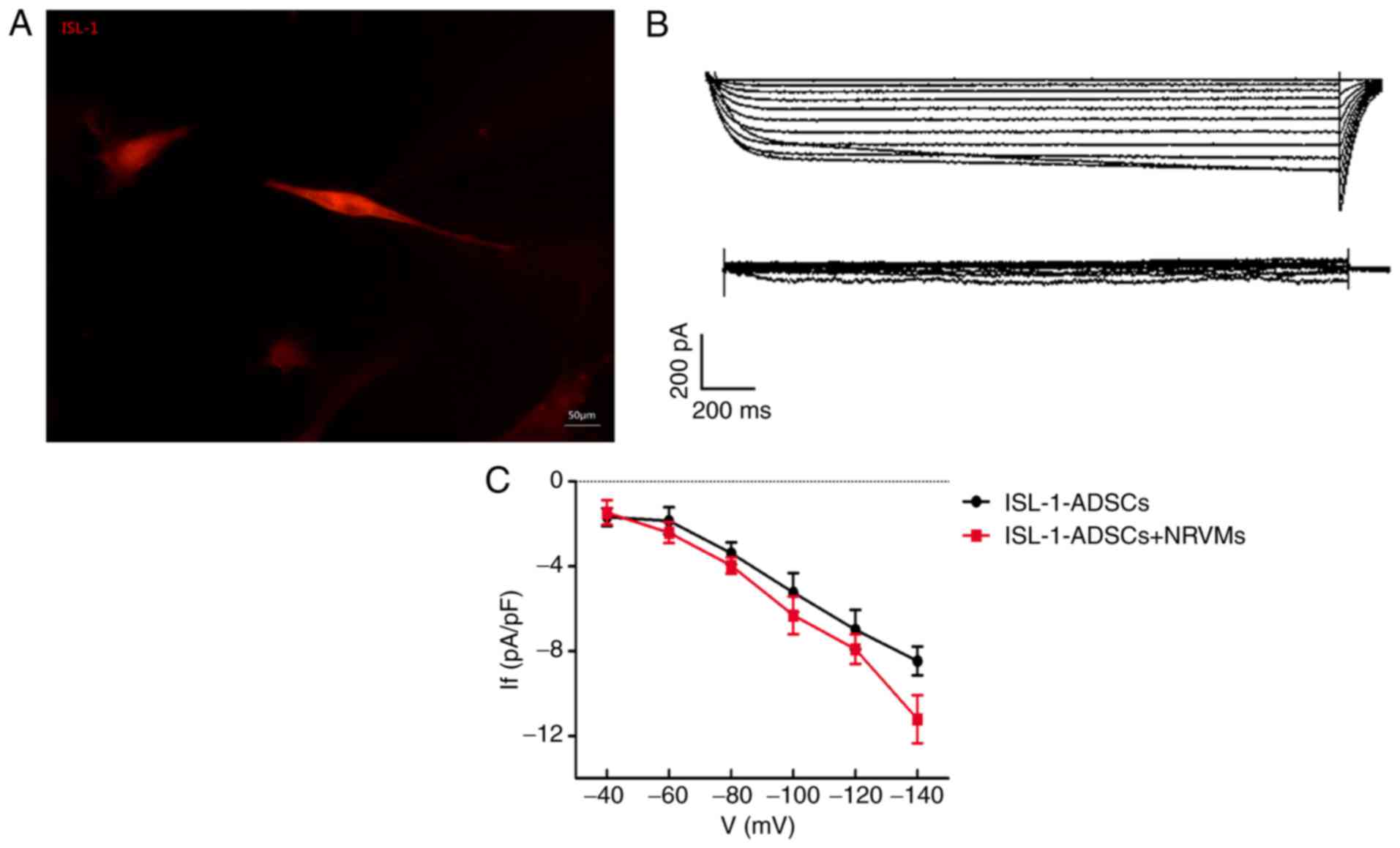
Hybrid approaches combining gene‑ and cell‑based therapies to make biological pacemakers are a promising therapeutic avenue for bradyarrhythmia. The present study aimed to direct adipose tissue‑derived stem cells (ADSCs) to differentiate specifically into cardiac pacemaker cells by overexpressing a single transcription factor, insulin gene enhancer binding protein 1 (ISL‑1). In the present study, the ADSCs were transfected with ISL‑1 or mCherry fluorescent protein lentiviral vectors and co‑cultured with neonatal rat ventricular cardiomyocytes (NRVMs) in vitro for 5‑7 days. The feasibility of regulating the differentiation of ADSCs into pacemaker‑like cells by overexpressing ISL‑1 was evaluated by observation of cell morphology and beating rate, reverse transcription‑quantitative polymerase chain reaction analysis, western blotting, immunofluorescence and analysis of electrophysiological activity. In conclusion, these data indicated that the overexpression of ISL‑1 in ADSCs may enhance the pacemaker phenotype and automaticity in vitro, features which were significantly increased following co‑culture induction.
View Figures

Figure 1

Figure 2

Figure 3

Figure 4

Figure 5

View References

1 

Cho HC and Marbán E: Biological therapies for cardiac arrhythmias: Can genes and cells replace drugs and devices. Circ Res. 106:674–685. 2010. View Article : Google Scholar : PubMed/NCBI

2 

Boink GJ, Christoffels VM, Robinson RB and Tan HL: The past, present, and future of pacemaker therapies. Trends Cardiovasc Med. 25:661–673. 2015. View Article : Google Scholar : PubMed/NCBI

3 

Cingolani E, Goldhaber JI and Marban E: Next-generation pacemakers: From small devices to biological pacemakers. Nat Rev Cardiol. 15:139–150. 2018. View Article : Google Scholar :

4 

Edelberg JM, Aird WC and Rosenberg RD: Enhancement of murine cardiac chronotropy by the molecular transfer of the human beta2 adrenergic receptor cDNA. J Clin Invest. 101:337–343. 1998. View Article : Google Scholar : PubMed/NCBI

5 

Boink GJ, Nearing BD, Shlapakova IN, Duan L, Kryukova Y, Bobkov Y, Tan HL, Cohen IS, Danilo P Jr, Robinson RB, et al: Ca(2+)-stimulated adenylyl cyclase AC1 generates efficient biological pacing as single gene therapy and in combination with HCN2. Circulation. 126:528–536. 2012. View Article : Google Scholar : PubMed/NCBI

6 

Miake J, Marbán E and Nuss HB: Biological pacemaker created by gene transfer. Nature. 419:132–133. 2002. View Article : Google Scholar : PubMed/NCBI

7 

Qu J, Plotnikov AN, Danilo P Jr, Shlapakova I, Cohen IS, Robinson RB and Rosen MR: Expression and function of a biological pacemaker in canine heart. Circulation. 107:1106–1109. 2003. View Article : Google Scholar : PubMed/NCBI

8 

Bucchi A, Plotnikov AN, Shlapakova I, Danilo P Jr, Kryukova Y, Qu J, Lu Z, Liu H, Pan Z, Potapova I, et al: Wild-type and mutant HCN channels in a tandem biological-electronic cardiac pacemaker. Circulation. 114:992–999. 2006. View Article : Google Scholar : PubMed/NCBI

9 

Boink GJ, Duan L, Nearing BD, Shlapakova IN, Sosunov EA, Anyukhovsky EP, Bobkov E, Kryukova Y, Ozgen N, Danilo P Jr, et al: HCN2/SkM1 gene transfer into canine left bundle branch induces stable, autonomically responsive biological pacing at physiological heart rates. J Am Coll Cardiol. 61:1192–1201. 2013. View Article : Google Scholar : PubMed/NCBI

10 

Ruhparwar A, Tebbenjohanns J, Niehaus M, Mengel M, Irtel T, Kofidis T, Pichlmaier AM and Haverich A: Transplanted fetal cardiomyocytes as cardiac pacemaker. Eur J Cardiothorac Surg. 21:853–857. 2002. View Article : Google Scholar : PubMed/NCBI

11 

Kehat I, Khimovich L, Caspi O, Gepstein A, Shofti R, Arbel G, Huber I, Satin J, Itskovitz-Eldor J and Gepstein L: Electromechanical integration of cardiomyocytes derived from human embryonic stem cells. Nat Biotechnol. 22:1282–1289. 2004. View Article : Google Scholar : PubMed/NCBI

12 

Xue T, Cho HC, Akar FG, Tsang SY, Jones SP, Marbán E, Tomaselli GF and Li RA: Functional integration of electrically active cardiac derivatives from genetically engineered human embryonic stem cells with quiescent recipient ventricular cardiomyocytes: Insights into the development of cell-based pacemakers. Circulation. 111:11–20. 2005. View Article : Google Scholar

13 

Plotnikov AN, Shlapakova I, Szabolcs MJ, Danilo P Jr, Lorell BH, Potapova IA, Lu Z, Rosen AB, Mathias RT, Brink PR, et al: Xenografted adult human mesenchymal stem cells provide a platform for sustained biological pacemaker function in canine heart. Circulation. 116:706–713. 2007. View Article : Google Scholar : PubMed/NCBI

14 

Shlapakova IN, Nearing BD, Lau DH, Boink GJ, Danilo P Jr, Kryukova Y, Robinson RB, Cohen IS, Rosen MR and Verrier RL: Biological pacemakers in canines exhibit positive chronotropic response to emotional arousal. Heart Rhythm. 7:1835–1840. 2010. View Article : Google Scholar : PubMed/NCBI

15 

Chauveau S, Anyukhovsky EP, Ben-Ari M, Naor S, Jiang YP, Danilo P Jr, Rahim T, Burke S, Qiu X, Potapova IA, et al: Induced pluripotent stem cell-derived cardiomyocytes provide in vivo biological pacemaker function. Circ Arrhythm Electrophysiol. 10:e0045082017. View Article : Google Scholar : PubMed/NCBI

16 

Dmitrieva RI, Minullina IR, Bilibina AA, Tarasova OV, Anisimov SV and Zaritskey AY: Bone marrow- and subcutaneous adipose tissue-derived mesenchymal stem cells: Differences and similarities. Cell Cycle. 11:377–383. 2012. View Article : Google Scholar

17 

Joo HJ, Kim JH and Hong SJ: Adipose tissue-derived stem cells for myocardial regeneration. Korean Circ J. 47:151–159. 2017. View Article : Google Scholar : PubMed/NCBI

18 

Brade T, Gessert S, Kuhl M and Pandur P: The amphibian second heart field: Xenopus islet-1 is required for cardiovascular development. Dev Biol. 311:297–310. 2007. View Article : Google Scholar : PubMed/NCBI

19 

Bu L, Jiang X, Martin-Puig S, Caron L, Zhu S, Shao Y, Roberts DJ, Huang PL, Domian IJ and Chien KR: Human ISL1 heart progenitors generate diverse multipotent cardiovascular cell lineages. Nature. 460:113–117. 2009. View Article : Google Scholar : PubMed/NCBI

20 

Weinberger F, Mehrkens D, Friedrich FW, Stubbendorff M, Hua X, Müller JC, Schrepfer S, Evans SM, Carrier L and Eschenhagen T: Localization of Islet-1-positive cells in the healthy and infarcted adult murine heart. Circ Res. 110:1303–1310. 2012. View Article : Google Scholar : PubMed/NCBI

21 

Mommersteeg MT, Dominguez JN, Wiese C, Norden J, de Gier-de VC, Burch JB, Kispert A, Brown NA, Moorman AF and Christoffels VM: The sinus venosus progenitors separate and diversify from the first and second heart fields early in development. Cardiovasc Res. 87:92–101. 2010. View Article : Google Scholar : PubMed/NCBI

22 

Sun Y, Liang X, Najafi N, Cass M, Lin L, Cai CL, Chen J and Evans SM: Islet 1 is expressed in distinct cardiovascular lineages, including pacemaker and coronary vascular cells. Dev Biol. 304:286–296. 2007. View Article : Google Scholar : PubMed/NCBI

23 

Tessadori F, van Weerd JH, Burkhard SB, Verkerk AO, de Pater E, Boukens BJ, Vink A, Christoffels VM and Bakkers J: Identification and functional characterization of cardiac pacemaker cells in zebrafish. PLoS One. 7:e476442012. View Article : Google Scholar : PubMed/NCBI

24 

Hoffmann S, Berger IM, Glaser A, Bacon C, Li L, Gretz N, Steinbeisser H, Rottbauer W, Just S and Rappold G: Islet1 is a direct transcriptional target of the homeodomain transcription factor Shox2 and rescues the Shox2-mediated bradycardia. Basic Res Cardiol. 108:3392013. View Article : Google Scholar : PubMed/NCBI

25 

Vedantham V, Galang G, Evangelista M, Deo RC and Srivastava D: RNA sequencing of mouse sinoatrial node reveals an upstream regulatory role for Islet-1 in cardiac pacemaker cells. Circ Res. 116:797–803. 2015. View Article : Google Scholar : PubMed/NCBI

26 

Dorn T, Goedel A, Lam JT, Haas J, Tian Q, Herrmann F, Bundschu K, Dobreva G, Schiemann M, Dirschinger R, et al: Direct nkx2-5 transcriptional repression of isl1 controls cardio-myocyte subtype identity. Stem Cells. 33:1113–1129. 2015. View Article : Google Scholar

27 

Liang X, Zhang Q, Cattaneo P, Zhuang S, Gong X, Spann NJ, Jiang C, Cao X, Zhao X, Zhang X, et al: Transcription factor ISL1 is essential for pacemaker development and function. J Clin Invest. 125:3256–3268. 2015. View Article : Google Scholar : PubMed/NCBI

28 

Bunnell BA, Flaat M, Gagliardi C, Patel B and Ripoll C: Adipose-derived stem cells: Isolation, expansion and differentiation. Methods. 45:115–120. 2008. View Article : Google Scholar : PubMed/NCBI

29 

Golden HB, Gollapudi D, Gerilechaogetu F, Li J, Cristales RJ, Peng X and Dostal DE: Isolation of cardiac myocytes and fibroblasts from neonatal rat pups. Methods Mol Biol. 843:205–214. 2012. View Article : Google Scholar : PubMed/NCBI

30 

Zhu Y, Liu T, Song K, Ning R, Ma X and Cui Z: ADSCs differentiated into cardiomyocytes in cardiac microenvironment. Mol Cell Biochem. 324:117–129. 2009. View Article : Google Scholar

31 

Choi YS, Dusting GJ, Stubbs S, Arunothayaraj S, Han XL, Collas P, Morrison WA and Dilley RJ: Differentiation of human adipose-derived stem cells into beating cardiomyocytes. J Cell Mol Med. 14:878–889. 2010. View Article : Google Scholar : PubMed/NCBI

32 

Livak KJ and Schmittgen TD: Analysis of relative gene expression data using real-time quantitative PCR and the 2(-Delta Delta C(T)) method. Methods. 25:402–408. 2001. View Article : Google Scholar

33 

Moretti A, Caron L, Nakano A, Lam JT, Bernshausen A, Chen Y, Qyang Y, Bu L, Sasaki M, Martin-Puig S, et al: Multipotent embryonic isl1+ progenitor cells lead to cardiac, smooth muscle, and endothelial cell diversification. Cell. 127:1151–1165. 2006. View Article : Google Scholar : PubMed/NCBI

34 

Moretti A, Bellin M, Jung CB, Thies TM, Takashima Y, Bernshausen A, Schiemann M, Fischer S, Moosmang S, Smith AG, et al: Mouse and human induced pluripotent stem cells as a source for multipotent Isl1+ cardiovascular progenitors. FASEB J. 24:700–711. 2010. View Article : Google Scholar

35 

Yi Q, Xu H, Yang K, Wang Y, Tan B, Tian J and Zhu J: Islet-1 induces the differentiation of mesenchymal stem cells into cardiomyocyte-like cells through the regulation of Gcn5 and DNMT-1. Mol Med Rep. 15:2511–2520. 2017. View Article : Google Scholar : PubMed/NCBI

36 

Shen H, Wang Y, Zhang Z, Yang J, Hu S and Shen Z: Mesenchymal stem cells for cardiac regenerative therapy: Optimization of cell differentiation strategy. Stem Cells Int. 2015:5247562015. View Article : Google Scholar : PubMed/NCBI

37 

Schuleri KH, Boyle AJ and Hare JM: Mesenchymal stem cells for cardiac regenerative therapy. Handb Exp Pharmacol. 195–218. 2007. View Article : Google Scholar : PubMed/NCBI

38 

Biel M, Schneider A and Wahl C: Cardiac HCN channels: Structure, function, and modulation. Trends Cardiovasc Med. 12:206–212. 2002. View Article : Google Scholar : PubMed/NCBI

39 

Shi W, Wymore R, Yu H, Wu J, Wymore RT, Pan Z, Robinson RB, Dixon JE, McKinnon D and Cohen IS: Distribution and prevalence of hyperpolarization-activated cation channel (HCN) mRNA expression in cardiac tissues. Circ Res. 85:e1-e61999. View Article : Google Scholar

40 

Liu J, Dobrzynski H, Yanni J, Boyett MR and Lei M: Organisation of the mouse sinoatrial node: Structure and expression of HCN channels. Cardiovasc Res. 73:729–738. 2007. View Article : Google Scholar : PubMed/NCBI

41 

Zicha S, Fernández-Velasco M, Lonardo G, L’Heureux N and Nattel S: Sinus node dysfunction and hyperpolarization-activated (HCN) channel subunit remodeling in a canine heart failure model. Cardiovasc Res. 66:472–481. 2005. View Article : Google Scholar : PubMed/NCBI

42 

Li N, Csepe TA, Hansen BJ, Dobrzynski H, Higgins RS, Kilic A, Mohler PJ, Janssen PM, Rosen MR, Biesiadecki BJ and Fedorov VV: Molecular mapping of sinoatrial node HCN channel expression in the human heart. Circ Arrhythm Electrophysiol. 8:1219–1227. 2015. View Article : Google Scholar : PubMed/NCBI

43 

Gros DB and Jongsma HJ: Connexins in mammalian heart function. Bioessays. 18:719–730. 1996. View Article : Google Scholar : PubMed/NCBI

44 

Martinez AD, Hayrapetyan V, Moreno AP and Beyer EC: Connexin43 and connexin45 form heteromeric gap junction channels in which individual components determine permeability and regulation. Circ Res. 90:1100–1107. 2002. View Article : Google Scholar : PubMed/NCBI

45 

Boyett MR, Inada S, Yoo S, Li J, Liu J, Tellez J, Greener ID, Honjo H, Billeter R, Lei M, et al: Connexins in the sinoatrial and atrioventricular nodes. Adv Cardiol. 42:175–197. 2006. View Article : Google Scholar : PubMed/NCBI

46 

Lakatta EG, Vinogradova T, Lyashkov A, Sirenko S, Zhu W, Ruknudin A and Maltsev VA: The integration of spontaneous intracellular Ca2+ cycling and surface membrane ion channel activation entrains normal automaticity in cells of the heart’s pacemaker. Ann NY Acad Sci. 1080:178–206. 2006. View Article : Google Scholar

47 

Maltsev VA and Lakatta EG: Dynamic interactions of an intracellular Ca2+ clock and membrane ion channel clock underlie robust initiation and regulation of cardiac pacemaker function. Cardiovasc Res. 77:274–284. 2008. View Article : Google Scholar

48 

Lakatta EG, Maltsev VA and Vinogradova TM: A coupled SYSTEM of intracellular Ca2+ clocks and surface membrane voltage clocks controls the timekeeping mechanism of the heart’s pacemaker. Circ Res. 106:659–673. 2010. View Article : Google Scholar : PubMed/NCBI

49 

Espinoza-Lewis RA, Liu H, Sun C, Chen C, Jiao K and Chen Y: Ectopic expression of Nkx2.5 suppresses the formation of the sinoatrial node in mice. Dev Biol. 356:359–369. 2011. View Article : Google Scholar : PubMed/NCBI

Related Articles

  • Abstract
  • View
  • Download
  • Twitter
Copy and paste a formatted citation
Spandidos Publications style
Zhang J, Yang M, Yang AK, Wang X, Tang YH, Zhao QY, Wang T, Chen YT and Huang CX: Insulin gene enhancer binding protein 1 induces adipose tissue‑derived stem cells to differentiate into pacemaker‑like cells. Int J Mol Med 43: 879-889, 2019.
APA
Zhang, J., Yang, M., Yang, A., Wang, X., Tang, Y., Zhao, Q. ... Huang, C. (2019). Insulin gene enhancer binding protein 1 induces adipose tissue‑derived stem cells to differentiate into pacemaker‑like cells. International Journal of Molecular Medicine, 43, 879-889. https://doi.org/10.3892/ijmm.2018.4002
MLA
Zhang, J., Yang, M., Yang, A., Wang, X., Tang, Y., Zhao, Q., Wang, T., Chen, Y., Huang, C."Insulin gene enhancer binding protein 1 induces adipose tissue‑derived stem cells to differentiate into pacemaker‑like cells". International Journal of Molecular Medicine 43.2 (2019): 879-889.
Chicago
Zhang, J., Yang, M., Yang, A., Wang, X., Tang, Y., Zhao, Q., Wang, T., Chen, Y., Huang, C."Insulin gene enhancer binding protein 1 induces adipose tissue‑derived stem cells to differentiate into pacemaker‑like cells". International Journal of Molecular Medicine 43, no. 2 (2019): 879-889. https://doi.org/10.3892/ijmm.2018.4002
Copy and paste a formatted citation
x
Spandidos Publications style
Zhang J, Yang M, Yang AK, Wang X, Tang YH, Zhao QY, Wang T, Chen YT and Huang CX: Insulin gene enhancer binding protein 1 induces adipose tissue‑derived stem cells to differentiate into pacemaker‑like cells. Int J Mol Med 43: 879-889, 2019.
APA
Zhang, J., Yang, M., Yang, A., Wang, X., Tang, Y., Zhao, Q. ... Huang, C. (2019). Insulin gene enhancer binding protein 1 induces adipose tissue‑derived stem cells to differentiate into pacemaker‑like cells. International Journal of Molecular Medicine, 43, 879-889. https://doi.org/10.3892/ijmm.2018.4002
MLA
Zhang, J., Yang, M., Yang, A., Wang, X., Tang, Y., Zhao, Q., Wang, T., Chen, Y., Huang, C."Insulin gene enhancer binding protein 1 induces adipose tissue‑derived stem cells to differentiate into pacemaker‑like cells". International Journal of Molecular Medicine 43.2 (2019): 879-889.
Chicago
Zhang, J., Yang, M., Yang, A., Wang, X., Tang, Y., Zhao, Q., Wang, T., Chen, Y., Huang, C."Insulin gene enhancer binding protein 1 induces adipose tissue‑derived stem cells to differentiate into pacemaker‑like cells". International Journal of Molecular Medicine 43, no. 2 (2019): 879-889. https://doi.org/10.3892/ijmm.2018.4002
Follow us
  • Twitter
  • LinkedIn
  • Facebook
About
  • Spandidos Publications
  • Careers
  • Cookie Policy
  • Privacy Policy
How can we help?
  • Help
  • Live Chat
  • Contact
  • Email to our Support Team