Spandidos Publications Logo
  • About
    • About Spandidos
    • Aims and Scopes
    • Abstracting and Indexing
    • Editorial Policies
    • Reprints and Permissions
    • Job Opportunities
    • Terms and Conditions
    • Contact
  • Journals
    • All Journals
    • Oncology Letters
      • Oncology Letters
      • Information for Authors
      • Editorial Policies
      • Editorial Board
      • Aims and Scope
      • Abstracting and Indexing
      • Bibliographic Information
      • Archive
    • International Journal of Oncology
      • International Journal of Oncology
      • Information for Authors
      • Editorial Policies
      • Editorial Board
      • Aims and Scope
      • Abstracting and Indexing
      • Bibliographic Information
      • Archive
    • Molecular and Clinical Oncology
      • Molecular and Clinical Oncology
      • Information for Authors
      • Editorial Policies
      • Editorial Board
      • Aims and Scope
      • Abstracting and Indexing
      • Bibliographic Information
      • Archive
    • Experimental and Therapeutic Medicine
      • Experimental and Therapeutic Medicine
      • Information for Authors
      • Editorial Policies
      • Editorial Board
      • Aims and Scope
      • Abstracting and Indexing
      • Bibliographic Information
      • Archive
    • International Journal of Molecular Medicine
      • International Journal of Molecular Medicine
      • Information for Authors
      • Editorial Policies
      • Editorial Board
      • Aims and Scope
      • Abstracting and Indexing
      • Bibliographic Information
      • Archive
    • Biomedical Reports
      • Biomedical Reports
      • Information for Authors
      • Editorial Policies
      • Editorial Board
      • Aims and Scope
      • Abstracting and Indexing
      • Bibliographic Information
      • Archive
    • Oncology Reports
      • Oncology Reports
      • Information for Authors
      • Editorial Policies
      • Editorial Board
      • Aims and Scope
      • Abstracting and Indexing
      • Bibliographic Information
      • Archive
    • Molecular Medicine Reports
      • Molecular Medicine Reports
      • Information for Authors
      • Editorial Policies
      • Editorial Board
      • Aims and Scope
      • Abstracting and Indexing
      • Bibliographic Information
      • Archive
    • World Academy of Sciences Journal
      • World Academy of Sciences Journal
      • Information for Authors
      • Editorial Policies
      • Editorial Board
      • Aims and Scope
      • Abstracting and Indexing
      • Bibliographic Information
      • Archive
    • International Journal of Functional Nutrition
      • International Journal of Functional Nutrition
      • Information for Authors
      • Editorial Policies
      • Editorial Board
      • Aims and Scope
      • Abstracting and Indexing
      • Bibliographic Information
      • Archive
    • International Journal of Epigenetics
      • International Journal of Epigenetics
      • Information for Authors
      • Editorial Policies
      • Editorial Board
      • Aims and Scope
      • Abstracting and Indexing
      • Bibliographic Information
      • Archive
    • Medicine International
      • Medicine International
      • Information for Authors
      • Editorial Policies
      • Editorial Board
      • Aims and Scope
      • Abstracting and Indexing
      • Bibliographic Information
      • Archive
  • Articles
  • Information
    • Information for Authors
    • Information for Reviewers
    • Information for Librarians
    • Information for Advertisers
    • Conferences
  • Language Editing
Spandidos Publications Logo
  • About
    • About Spandidos
    • Aims and Scopes
    • Abstracting and Indexing
    • Editorial Policies
    • Reprints and Permissions
    • Job Opportunities
    • Terms and Conditions
    • Contact
  • Journals
    • All Journals
    • Biomedical Reports
      • Information for Authors
      • Editorial Policies
      • Editorial Board
      • Aims and Scope
      • Abstracting and Indexing
      • Bibliographic Information
      • Archive
    • Experimental and Therapeutic Medicine
      • Information for Authors
      • Editorial Policies
      • Editorial Board
      • Aims and Scope
      • Abstracting and Indexing
      • Bibliographic Information
      • Archive
    • International Journal of Epigenetics
      • Information for Authors
      • Editorial Policies
      • Editorial Board
      • Aims and Scope
      • Abstracting and Indexing
      • Bibliographic Information
      • Archive
    • International Journal of Functional Nutrition
      • Information for Authors
      • Editorial Policies
      • Editorial Board
      • Aims and Scope
      • Abstracting and Indexing
      • Bibliographic Information
      • Archive
    • International Journal of Molecular Medicine
      • Information for Authors
      • Editorial Policies
      • Editorial Board
      • Aims and Scope
      • Abstracting and Indexing
      • Bibliographic Information
      • Archive
    • International Journal of Oncology
      • Information for Authors
      • Editorial Policies
      • Editorial Board
      • Aims and Scope
      • Abstracting and Indexing
      • Bibliographic Information
      • Archive
    • Medicine International
      • Information for Authors
      • Editorial Policies
      • Editorial Board
      • Aims and Scope
      • Abstracting and Indexing
      • Bibliographic Information
      • Archive
    • Molecular and Clinical Oncology
      • Information for Authors
      • Editorial Policies
      • Editorial Board
      • Aims and Scope
      • Abstracting and Indexing
      • Bibliographic Information
      • Archive
    • Molecular Medicine Reports
      • Information for Authors
      • Editorial Policies
      • Editorial Board
      • Aims and Scope
      • Abstracting and Indexing
      • Bibliographic Information
      • Archive
    • Oncology Letters
      • Information for Authors
      • Editorial Policies
      • Editorial Board
      • Aims and Scope
      • Abstracting and Indexing
      • Bibliographic Information
      • Archive
    • Oncology Reports
      • Information for Authors
      • Editorial Policies
      • Editorial Board
      • Aims and Scope
      • Abstracting and Indexing
      • Bibliographic Information
      • Archive
    • World Academy of Sciences Journal
      • Information for Authors
      • Editorial Policies
      • Editorial Board
      • Aims and Scope
      • Abstracting and Indexing
      • Bibliographic Information
      • Archive
  • Articles
  • Information
    • For Authors
    • For Reviewers
    • For Librarians
    • For Advertisers
    • Conferences
  • Language Editing
Login Register Submit
  • This site uses cookies
  • You can change your cookie settings at any time by following the instructions in our Cookie Policy. To find out more, you may read our Privacy Policy.

    I agree
Search articles by DOI, keyword, author or affiliation
Search
Advanced Search
presentation
International Journal of Molecular Medicine
Join Editorial Board Propose a Special Issue
Print ISSN: 1107-3756 Online ISSN: 1791-244X
Journal Cover
February-2019 Volume 43 Issue 2

Full Size Image

Sign up for eToc alerts
Recommend to Library

Journals

International Journal of Molecular Medicine

International Journal of Molecular Medicine

International Journal of Molecular Medicine is an international journal devoted to molecular mechanisms of human disease.

International Journal of Oncology

International Journal of Oncology

International Journal of Oncology is an international journal devoted to oncology research and cancer treatment.

Molecular Medicine Reports

Molecular Medicine Reports

Covers molecular medicine topics such as pharmacology, pathology, genetics, neuroscience, infectious diseases, molecular cardiology, and molecular surgery.

Oncology Reports

Oncology Reports

Oncology Reports is an international journal devoted to fundamental and applied research in Oncology.

Experimental and Therapeutic Medicine

Experimental and Therapeutic Medicine

Experimental and Therapeutic Medicine is an international journal devoted to laboratory and clinical medicine.

Oncology Letters

Oncology Letters

Oncology Letters is an international journal devoted to Experimental and Clinical Oncology.

Biomedical Reports

Biomedical Reports

Explores a wide range of biological and medical fields, including pharmacology, genetics, microbiology, neuroscience, and molecular cardiology.

Molecular and Clinical Oncology

Molecular and Clinical Oncology

International journal addressing all aspects of oncology research, from tumorigenesis and oncogenes to chemotherapy and metastasis.

World Academy of Sciences Journal

World Academy of Sciences Journal

Multidisciplinary open-access journal spanning biochemistry, genetics, neuroscience, environmental health, and synthetic biology.

International Journal of Functional Nutrition

International Journal of Functional Nutrition

Open-access journal combining biochemistry, pharmacology, immunology, and genetics to advance health through functional nutrition.

International Journal of Epigenetics

International Journal of Epigenetics

Publishes open-access research on using epigenetics to advance understanding and treatment of human disease.

Medicine International

Medicine International

An International Open Access Journal Devoted to General Medicine.

Journal Cover
February-2019 Volume 43 Issue 2

Full Size Image

Sign up for eToc alerts
Recommend to Library

  • Article
  • Citations
    • Cite This Article
    • Download Citation
    • Create Citation Alert
    • Remove Citation Alert
    • Cited By
  • Similar Articles
    • Related Articles (in Spandidos Publications)
    • Similar Articles (Google Scholar)
    • Similar Articles (PubMed)
  • Download PDF
  • Download XML
  • View XML
Article Open Access

Melatonin regulation of transcription in the reversal of morphine tolerance: Microarray analysis of differential gene expression

  • Authors:
    • Yu‑Che Cheng
    • Ru‑Yin Tsai
    • Yen‑Tseng Sung
    • Ing‑Jung Chen
    • Tzu‑Yi Tu
    • Ya‑Yuan Mao
    • Chih‑Shung Wong
  • View Affiliations / Copyright

    Affiliations: Proteomics Laboratory, Department of Medical Research, Cathay General Hospital, Taipei 10630, Taiwan, R.O.C., College of Nursing and Health Sciences, Da‑Yeh University, Changhua 51591, Taiwan, R.O.C., Department of Anesthesiology, Cathay General Hospital, Taipei 10630, Taiwan, R.O.C., School of Medicine, Fu Jen Catholic University, New Taipei City 24205, Taiwan, R.O.C.
    Copyright: © Cheng et al. This is an open access article distributed under the terms of Creative Commons Attribution License.
  • Pages: 791-806
    |
    Published online on: December 18, 2018
       https://doi.org/10.3892/ijmm.2018.4030
  • Expand metrics +
Metrics: Total Views: 0 (Spandidos Publications: | PMC Statistics: )
Metrics: Total PDF Downloads: 0 (Spandidos Publications: | PMC Statistics: )
Cited By (CrossRef): 0 citations Loading Articles...

This article is mentioned in:


Abstract

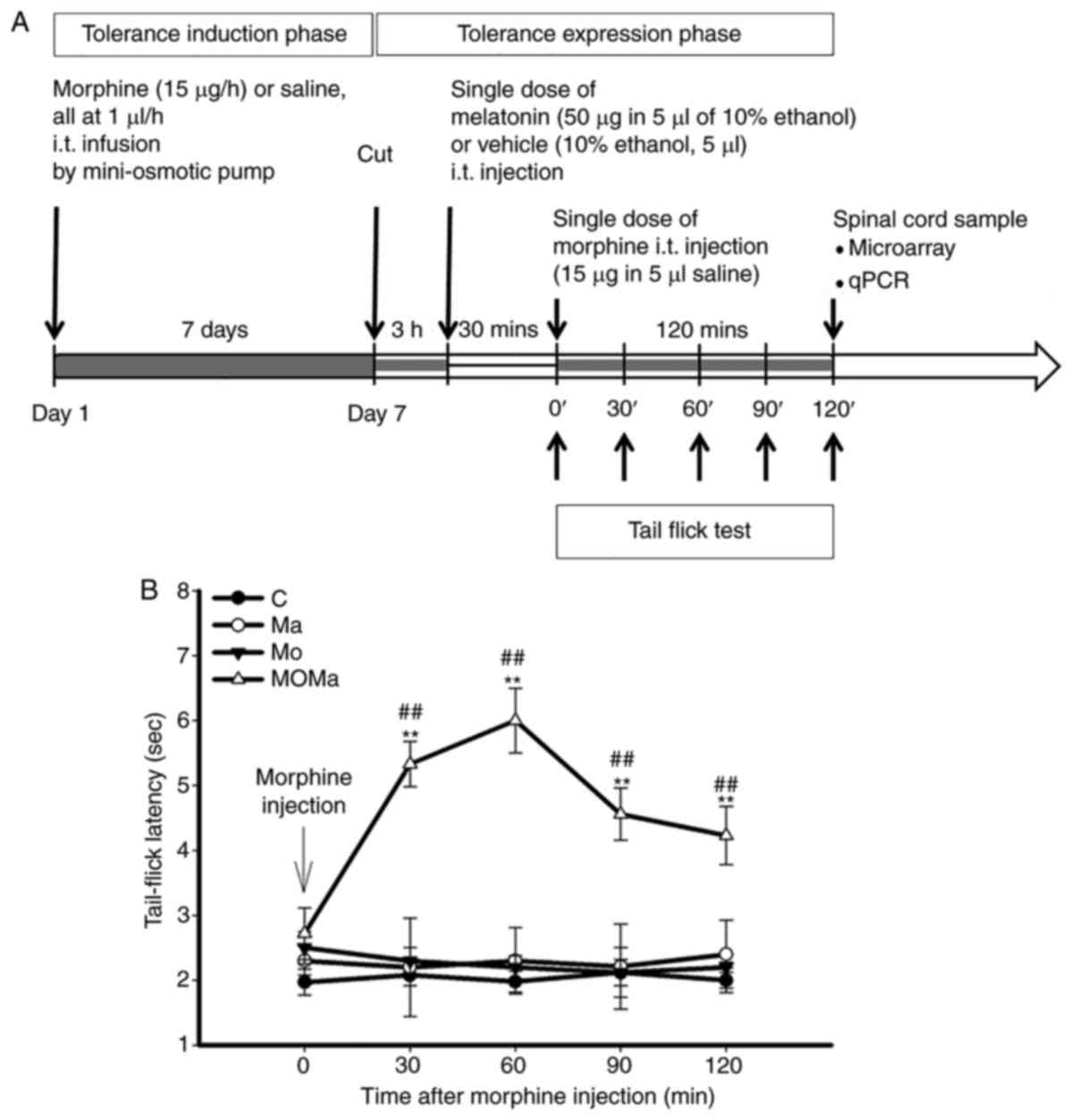
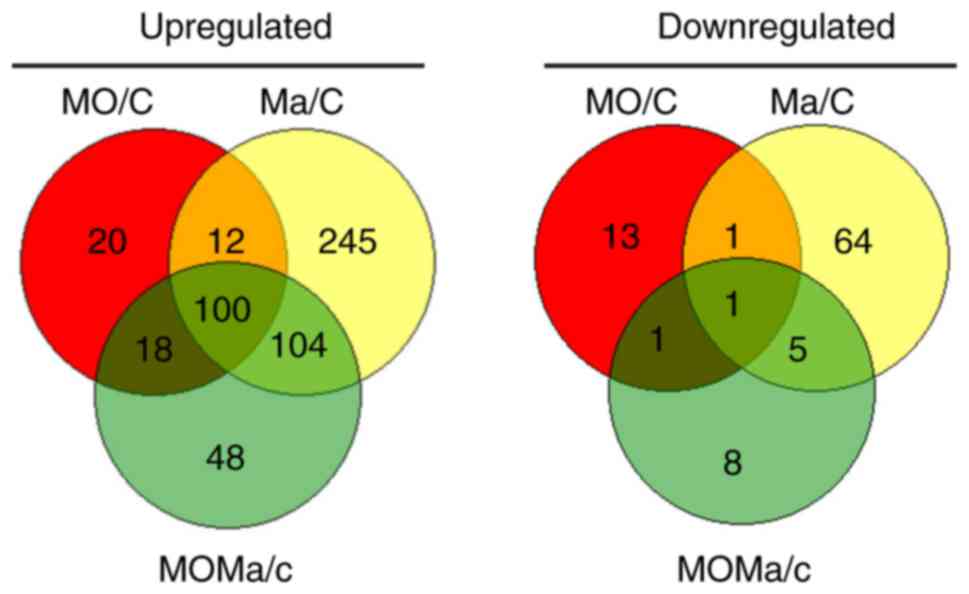
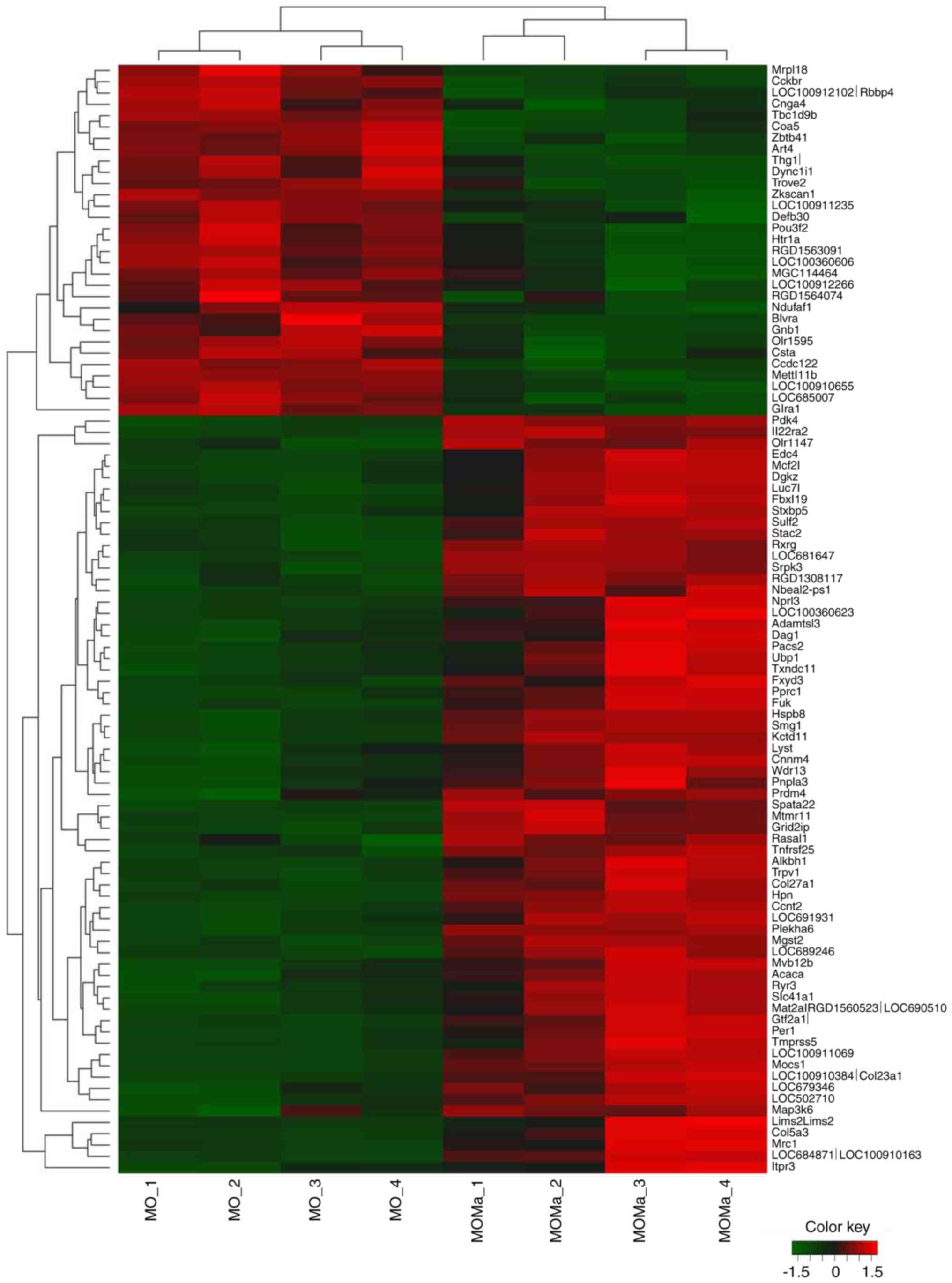
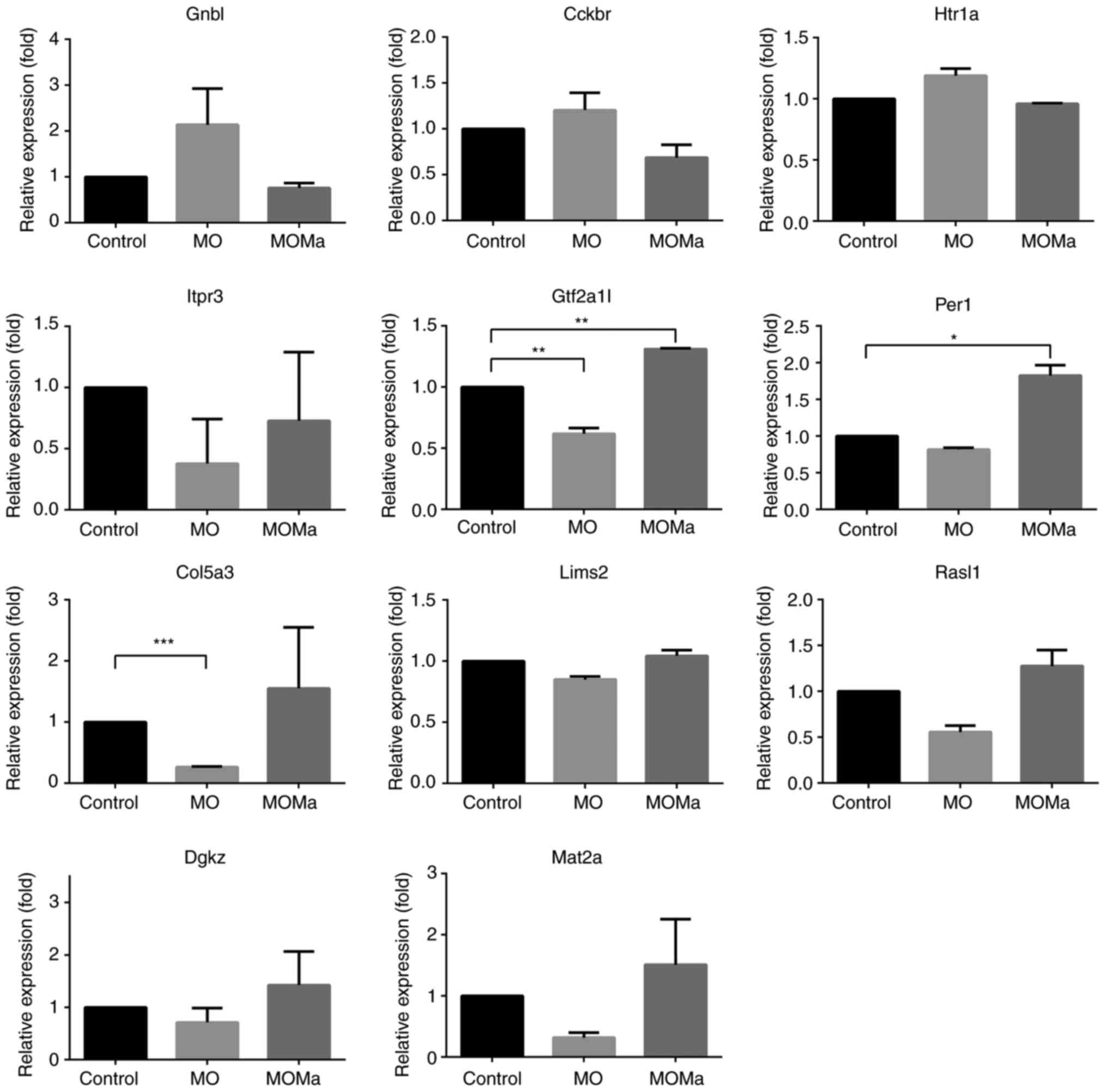
Tolerance and associated hyperalgesia induced by long‑term morphine administration substantially restrict the clinical use of morphine in pain treatment. Melatonin, a neurohormone released by the pineal gland, has been demonstrated to attenuate anti‑nociceptive morphine tolerance. The present study investigates differentially expressed genes in the process of morphine tolerance and altered gene expression subsequent to melatonin treatment in chronic morphine‑infused ratspinal cords. Morphine tolerance was induced in male Wistar rats by intrathecal morphine infusion (the MO group). Melatonin (the MOMa group) was administered to overcome the effects derived by morphine. The mRNA collected from L5‑S3 of the spinal cord was extracted and analysed by rat expression microarray. Principal component analysis and clustering analysis revealed that the overall gene profiles were different in morphine and melatonin treatments. Subsequent to Gene Ontology analysis, the biological processes of differentially expressed genes of MO and MOMa compared with the control group were constructed. Furthermore, a panel of genes exclusively expressed following melatonin treatment and another panel of genes with inverse expression between the MO and MOMa group were also established. Subsequent to PANTHER pathway analysis, a group of genes with inverse expression following melatonin administrated compared with morphine alone were identified. The expression levels of genes of interest were also confirmed using a reverse transcription‑quantitative polymerase chain reaction. The gene panel that was constructed suggests a potential signaling pathway in morphine tolerance development and is valuable for investigating the mechanism of morphine tolerance and the regulatory gene profiles of melatonin treatment. These results may contribute to the discovery of potential drug targets in morphine tolerance treatments in the future.
View Figures

Figure 1

Figure 2

Figure 3

Figure 4

View References

1 

Chen WW, Zhang X and Huang WJ: Pain control by melatonin: Physiological and pharmacological effects. Exp Ther Med. 12:1963–1968. 2016. View Article : Google Scholar : PubMed/NCBI

2 

Pasternak GW: When it comes to opiates, just say NO. J Clin Invest. 117:3185–3187. 2007. View Article : Google Scholar : PubMed/NCBI

3 

Günther T, Dasgupta P, Mann A, Miess E, Kliewer A, Fritzwanker S, Steinborn R and Schulz S: Targeting multiple opioid receptors-improved analgesics with reduced side effects. Br J Pharmacol. 175:2857–2868. 2018. View Article : Google Scholar

4 

Martini L and Whistler JL: The role of mu opioid receptor desensitization and endocytosis in morphine tolerance and dependence. Curr Opin Neurobiol. 17:556–564. 2007. View Article : Google Scholar : PubMed/NCBI

5 

Rosenblum A, Marsch LA, Joseph H and Portenoy RK: Opioids and the treatment of chronic pain: Controversies, current status, and future directions. Exp Clin Psychopharmacol. 16:405–416. 2008. View Article : Google Scholar : PubMed/NCBI

6 

Pang CS, Tsang SF and Yang JC: Effects of melatonin, morphine and diazepam on formalin-induced nociception in mice. Life Sci. 68:943–951. 2001. View Article : Google Scholar : PubMed/NCBI

7 

Lin SH, Huang YN, Kao JH, Tien LT, Tsai RY and Wong CS: Melatonin reverses morphine tolerance by inhibiting microglia activation and HSP27 expression. Life Sci. 152:38–43. 2016. View Article : Google Scholar : PubMed/NCBI

8 

Song L, Wu C and Zuo Y: Melatonin prevents morphine-induced hyperalgesia and tolerance in rats: Role of protein kinase C and N-methyl-D-aspartate receptors. BMC Anesthesiol. 15:122015. View Article : Google Scholar : PubMed/NCBI

9 

Xin W, Chun W, Ling L and Wei W: Role of melatonin in the prevention of morphine-induced hyperalgesia and spinal glial activation in rats: Protein kinase C pathway involved. Int J Neurosci. 122:154–163. 2012. View Article : Google Scholar

10 

Feng YM, Jia YF, Su LY, Wang D, Lv L, Xu L and Yao YG: Decreased mitochondrial DNA copy number in the hippocampus and peripheral blood during opiate addiction is mediated by autophagy and can be salvaged by melatonin. Autophagy. 9:1395–1406. 2013. View Article : Google Scholar : PubMed/NCBI

11 

Yahyavi-Firouz-Abadi N, Tahsili-Fahadan P, Riazi K, Ghahremani MH and Dehpour AR: Melatonin enhances the anti-convulsant and proconvulsant effects of morphine in mice: Role for nitric oxide signaling pathway. Epilepsy Res. 75:138–144. 2007. View Article : Google Scholar : PubMed/NCBI

12 

Raghavendra V and Kulkarni SK: Reversal of morphine tolerance and dependence by melatonin: Possible role of central and peripheral benzodiazepine receptors. Brain Res. 834:178–181. 1999. View Article : Google Scholar : PubMed/NCBI

13 

Garmabi B, Vousooghi N, Vosough M, Yoonessi A, Bakhtazad A and Zarrindast MR: Effect of circadian rhythm disturbance on morphine preference and addiction in male rats: Involvement of period genes and dopamine D1 receptor. Neuroscience. 322:104–114. 2016. View Article : Google Scholar : PubMed/NCBI

14 

Fan Y, Liang X, Wang R and Song L: Role of endogenous melatoninergic system in development of hyperalgesia and tolerance induced by chronic morphine administration in rats. Brain Res Bull. 135:105–112. 2017. View Article : Google Scholar : PubMed/NCBI

15 

Chou KY, Tsai RY, Tsai WY, Wu CT, Yeh CC, Cherng CH and Wong CS: Ultra-low dose (+)-naloxone restores the thermal threshold of morphine tolerant rats. J Formos Med Assoc. 112:795–800. 2013. View Article : Google Scholar : PubMed/NCBI

16 

Guiding principles in the care and use of animals of the American physiology society

17 

Grossman ML, Basbaum AI and Fields HL: Afferent and efferent connections of the rat tail flick reflex (a model used to analyze pain control mechanisms). J Comp Neurol. 206:9–16. 1982. View Article : Google Scholar : PubMed/NCBI

18 

Tsai RY, Chou KY, Shen CH, Chien CC, Tsai WY, Huang YN, Tao PL, Lin YS and Wong CS: Resveratrol regulates N-methyl-D-aspartate receptor expression and suppresses neuroinflammation in morphine-tolerant rats. Anesth Analg. 115:944–952. 2012. View Article : Google Scholar : PubMed/NCBI

19 

Pirooznia M, Nagarajan V and Deng Y: GeneVenn-A web application for comparing gene lists using Venn diagrams. Bioinformation. 1:420–422. 2007. View Article : Google Scholar : PubMed/NCBI

20 

Xu J, Kelly R, Fang H and Tong W: ArrayTrack: A free FDA bioinformatics tool to support emerging biomedical research-an update. Hum Genomics. 4:428–434. 2010.PubMed/NCBI

21 

Saldanha AJ: Java Treeview-extensible visualization of microarray data. Bioinformatics. 20:3246–3248. 2004. View Article : Google Scholar : PubMed/NCBI

22 

Gene ontology Enrichment analysis website.

23 

Mi H, Muruganujan A and Thomas PD: PANTHER in 2013: Modeling the evolution of gene function, and other gene attributes, in the context of phylogenetic trees. Nucleic Acids Res 41 (Database Issue). D377–D386. 2013.

24 

Livak KJ and Schmittgen TD: Analysis of relative gene expression data using real-time quantitative PCR and the 2(−Delta Delta C(T)) method. Methods. 25:402–408. 2001. View Article : Google Scholar

25 

Roeckel LA, Le Coz GM, Gavériaux-Ruff C and Simonin F: Opioid-induced hyperalgesia: Cellular and molecular mechanisms. Neuroscience. 338:160–182. 2016. View Article : Google Scholar : PubMed/NCBI

26 

Kwon HS, Johnson TV, Joe MK, Abu-Asab M, Zhang J, Chan CC and Tomarev SI: Myocilin mediates myelination in the peripheral nervous System through ErbB2/3 signaling. J Biol Chem. 288:26357–26371. 2013. View Article : Google Scholar : PubMed/NCBI

27 

Fontenille L, Rouquier S, Lutfalla G and Giorgi D: Microtubule-associated protein 9 (Map9/Asap) is required for the early steps of zebrafish development. Cell Cycle. 13:1101–1114. 2014. View Article : Google Scholar : PubMed/NCBI

28 

Downes GB and Gautam N: The G protein subunit gene families. Genomics. 62:544–552. 1999. View Article : Google Scholar

29 

Thal DM, Vuckovic Z, Draper-Joyce CJ, Liang YL, Glukhova A, Christopoulos A and Sexton PM: Recent advances in the determination of G protein-coupled receptor structures. Curr Opin Struct Biol. 51:28–34. 2018. View Article : Google Scholar : PubMed/NCBI

30 

Klein DC, Bailey MJ, Carter DA, Kim JS, Shi Q, Ho AK, Chik CL, Gaildrat P, Morin F, Ganguly S, et al: Pineal function: Impact of microarray analysis. Mol Cell Endocrinol. 314:170–183. 2010. View Article : Google Scholar

31 

Bohn LM, Gainetdinov RR, Lin FT, Lefkowitz RJ and Caron MG: Mu-opioid receptor desensitization by beta-arrestin-2 determines morphine tolerance but not dependence. Nature. 408:720–723. 2000. View Article : Google Scholar : PubMed/NCBI

32 

Zuo Z: The role of opioid receptor internalization and beta-arrestins in the development of opioid tolerance. Anesth Analg. 101:728–734, table of contents. 2005. View Article : Google Scholar : PubMed/NCBI

33 

Nagaleekar VK, Diehl SA, Juncadella I, Charland C, Muthusamy N, Eaton S, Haynes L, Garrett-Sinha LA, Anguita J and Rincón M: IP3 receptor-mediated Ca2+ release in naive CD4 T cells dictates their cytokine program. J Immunol. 181:8315–8322. 2008. View Article : Google Scholar : PubMed/NCBI

34 

Taylor CW and Tovey SC: IP(3) receptors: Toward understanding their activation. Cold Spring Harb Perspect Biol. 2:a0040102010. View Article : Google Scholar : PubMed/NCBI

35 

Liu D and Liman ER: Intracellular Ca2+ and the phospholipid PIP2 regulate the taste transduction ion channel TRPM5. Proc Natl Acad Sci USA. 100:15160–15165. 2003. View Article : Google Scholar : PubMed/NCBI

36 

Dang VC and Christie MJ: Mechanisms of rapid opioid receptor desensitization, resensitization and tolerance in brain neurons. Br J Pharmacol. 165:1704–1716. 2012. View Article : Google Scholar :

37 

Stafford K, Gomes AB, Shen J and Yoburn BC: mu-Opioid receptor downregulation contributes to opioid tolerance in vivo. Pharmacol Biochem Behav. 69:233–237. 2001. View Article : Google Scholar : PubMed/NCBI

38 

Polastron J, Meunier JC and Jauzac P: Chronic morphine induces tolerance and desensitization of mu-opioid receptor but not down-regulation in rabbit. Eur J Pharmacol. 266:139–146. 1994. View Article : Google Scholar : PubMed/NCBI

39 

Wang L, Liu H, Jiao Y, Wang E, Clark SH, Postlethwaite AE, Gu W and Chen H: Differences between mice and humans in regulation and the molecular network of collagen, type III, alpha-1 at the gene expression level: Obstacles that translational research must overcome. Int J Mol Sci. 16:15031–15056. 2015. View Article : Google Scholar : PubMed/NCBI

40 

Brodsky AN, Caldwell M and Harcum SW: Glycosylation and post-translational modification gene expression analysis by DNA microarrays for cultured mammalian cells. Methods. 56:408–417. 2012. View Article : Google Scholar :

Related Articles

  • Abstract
  • View
  • Download
  • Twitter
Copy and paste a formatted citation
Spandidos Publications style
Cheng YC, Tsai RY, Sung YT, Chen IJ, Tu TY, Mao YY and Wong CS: Melatonin regulation of transcription in the reversal of morphine tolerance: Microarray analysis of differential gene expression . Int J Mol Med 43: 791-806, 2019.
APA
Cheng, Y., Tsai, R., Sung, Y., Chen, I., Tu, T., Mao, Y., & Wong, C. (2019). Melatonin regulation of transcription in the reversal of morphine tolerance: Microarray analysis of differential gene expression . International Journal of Molecular Medicine, 43, 791-806. https://doi.org/10.3892/ijmm.2018.4030
MLA
Cheng, Y., Tsai, R., Sung, Y., Chen, I., Tu, T., Mao, Y., Wong, C."Melatonin regulation of transcription in the reversal of morphine tolerance: Microarray analysis of differential gene expression ". International Journal of Molecular Medicine 43.2 (2019): 791-806.
Chicago
Cheng, Y., Tsai, R., Sung, Y., Chen, I., Tu, T., Mao, Y., Wong, C."Melatonin regulation of transcription in the reversal of morphine tolerance: Microarray analysis of differential gene expression ". International Journal of Molecular Medicine 43, no. 2 (2019): 791-806. https://doi.org/10.3892/ijmm.2018.4030
Copy and paste a formatted citation
x
Spandidos Publications style
Cheng YC, Tsai RY, Sung YT, Chen IJ, Tu TY, Mao YY and Wong CS: Melatonin regulation of transcription in the reversal of morphine tolerance: Microarray analysis of differential gene expression . Int J Mol Med 43: 791-806, 2019.
APA
Cheng, Y., Tsai, R., Sung, Y., Chen, I., Tu, T., Mao, Y., & Wong, C. (2019). Melatonin regulation of transcription in the reversal of morphine tolerance: Microarray analysis of differential gene expression . International Journal of Molecular Medicine, 43, 791-806. https://doi.org/10.3892/ijmm.2018.4030
MLA
Cheng, Y., Tsai, R., Sung, Y., Chen, I., Tu, T., Mao, Y., Wong, C."Melatonin regulation of transcription in the reversal of morphine tolerance: Microarray analysis of differential gene expression ". International Journal of Molecular Medicine 43.2 (2019): 791-806.
Chicago
Cheng, Y., Tsai, R., Sung, Y., Chen, I., Tu, T., Mao, Y., Wong, C."Melatonin regulation of transcription in the reversal of morphine tolerance: Microarray analysis of differential gene expression ". International Journal of Molecular Medicine 43, no. 2 (2019): 791-806. https://doi.org/10.3892/ijmm.2018.4030
Follow us
  • Twitter
  • LinkedIn
  • Facebook
About
  • Spandidos Publications
  • Careers
  • Cookie Policy
  • Privacy Policy
How can we help?
  • Help
  • Live Chat
  • Contact
  • Email to our Support Team