Int J Oncol 25: [Related article:] 1543-1549, 2004; DOI: 10.3892/ijo.25.6.1543
Subsequently to the publication of the above article, an interested reader drew to the authors' attention that, for the images shown to represent different immunostaining experiments in Fig. 1B and E (the 'Group 2' experiments), the images were overlapping, which seemed to suggest that either the image for β-catenin or the image for c-Myc did not accurately represent the results of the experiment in question.
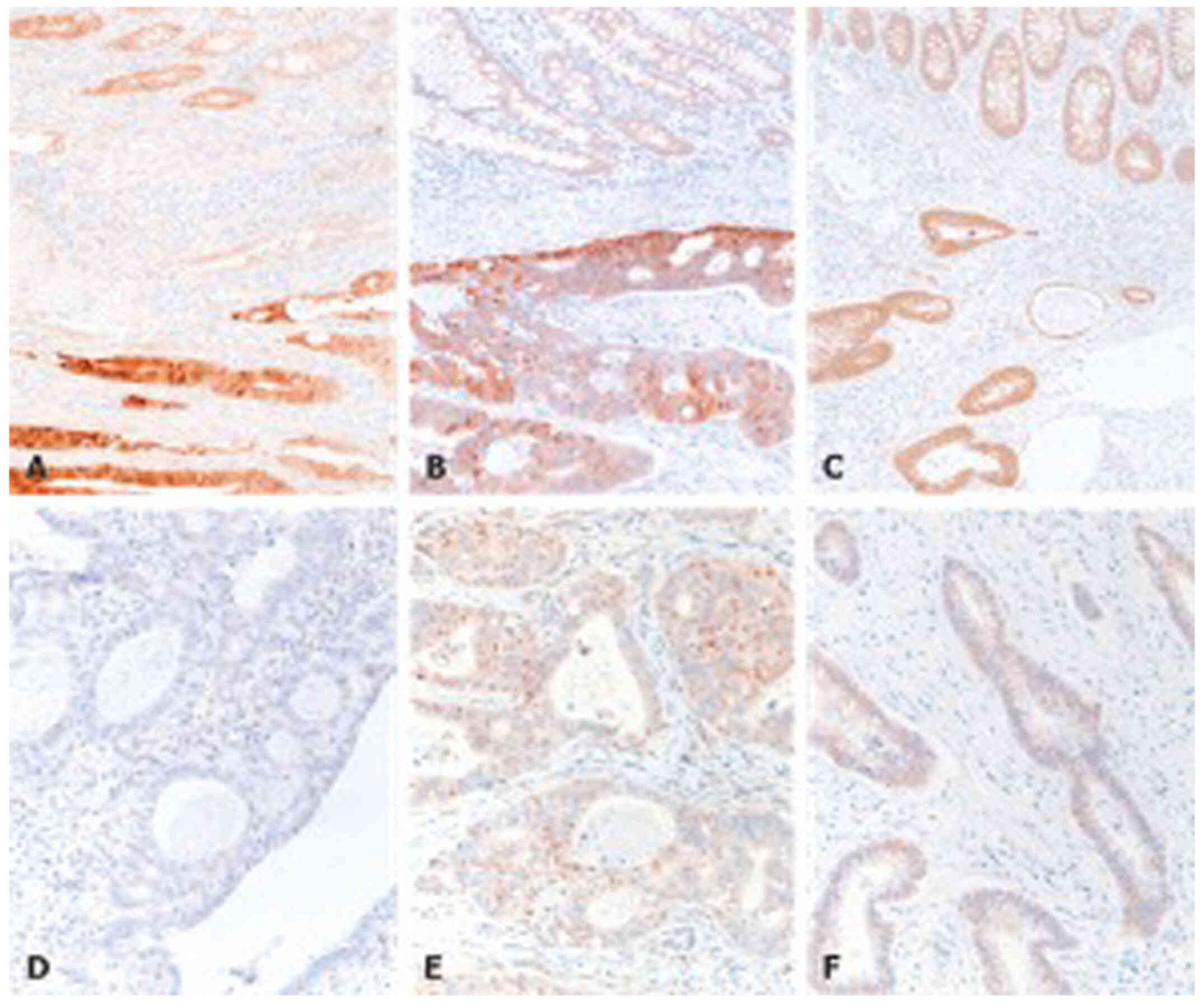 |
Figure 1
Immunohistochemistry of β-catenin (A-C) and c-Myc (D-F) in adenocarcinomas of the rectum after STNR group 1 (A and D) and group 2 (B and E) as well as without any radiation group 3 (C and F). (A and B) Strong nuclear and cytoplasmic expression of β-catenin is found in group 1 and group 2 tumour cells (lower part) after STNR in comparison to both normal mucosa (upper part) and group 3 control (C). Group 1 and group 2 tumours are different concerning the expression of c-Myc: (D) The tumour in (A) exhibits only a week immunostaining of c-Myc, whereas (E) illustrates that the tumour from (B) exibits a strong nuclear c-Myc immunostaining. (F) Nuclear expression of c-Myc was found in tumour cells without any radiotherapy (group 3). Original magnification: (A-C), ×20; (D-E), ×40.
|
After having re-examined their original data, the authors have realized that an error was inadvertently made during the assembly of this figure; namely, that Fig. 1E showed a section of Fig. 1B at a higher magnification (both images showed β-catenin immunostaining). The revised version of Fig. 1, correctly showing the results of the β-catenin immunostaining experiment in Fig. 1B and the c-Myc immunostaining experiment in Fig. 1E, is shown on the next page. The authors are grateful to the Editor of International Journal of Oncology for allowing them this opportunity to publish a Corrigendum, and all the authors agree with its publication. Furthermore, the authors apologize to the readership for any inconvenience caused.

















