Introduction
Coronary artery disease (CAD) is a public health
issue (1). Moran et al
predicted that aging and population growth is likely to increase
the incidence of CAD by more than a half over the next 20 years and
that projected unfavorable trends in blood pressure, diabetes,
total cholesterol and body mass index may accelerate the process.
National policy in China has been aimed at controlling cigarette
smoking, blood pressure and other risk factors which would
counteract the predicted future of a CAD epidemic (2). The renin-angiotensin system (RAS) is
known to be involved in the development of CAD, and an
angiotensinogen (AGT, a component of RAS) gene polymorphism has
been identified as a CAD risk. The results, however, have been
inconsistent. The M235T SNP is a methionine (Met) to threonine
(Thr) amino acid substitution at codon 235 designated as M and T
alleles, respectively. Previous meta-analyses have indicated that
the M235T polymorphism is correlated with an increased risk of CAD
(3,4). However, the meta-analysis included
only limited articles with Chinese ancestry since the most relevant
studies were published using the Chinese language in local
journals. Therefore, the association between the M235T polymorphism
and CAD among the Chinese Han population should be clarified. The
present study investigated whether or not the M235T polymorphism is
associated with CAD risk among the Chinese by performing a
meta-analysis of the data from the literature.
Materials and methods
Selection of studies
A comprehensive systematic search was conducted by
two independent reviewers (YJW and YP). A search through the
electronic databases including PubMed, China National Knowledge
Infrastructure, Wanfang and VIP database was conducted for studies
using the key words ‘coronary artery disease’, ‘angiotensinogen’,
‘M235T’ and ‘gene polymorphism’ for relevant citations. The
reference lists of retrieved reviews and articles were manually
screened. The publication language was restricted to English or
Chinese. The literature search was updated on 30 January 2012.
Selection criteria
The selection criteria used to determine which
studies were eligible included: i) evaluating the association of
M235T polymorphisms in the AGT gene with CAD; ii) using
case-control design; iii) studies containing sufficient data; iv)
the genotype distribution among the control population was required
to be in Hardy-Weinberg equilibrium (HWE).
Data extraction
The following information was extracted from the
eligible studies: i) name of the first author; ii) year of
publication; iii) region; iv) end point of assessment; v) control
status; vi) sample size of subjects with and without CAD; vii)
genotype distribution of subjects with and without CAD; and viii)
P-value for HWE test in subjects without CAD.
Statistical analysis
The association of M235T polymorphisms in the AGT
gene with CAD was estimated by calculating the pooled odds ratio
(OR) and 95% confidence interval (CI) under a homozygote comparison
(TT vs. MM), a heterozygote comparison (TT vs. MT), a dominant
model (MM+MT vs. TT) and a recessive model (TT+MT vs. MM). The
significance of the pooled OR was determined by Z-test. P<0.05
was considered to indicate a statistically significant result.
Q-testing was performed to evaluate whether the variation was due
to heterogeneity or chance, with I2 values of 25, 50 and
75% being defined as low, moderate and high estimates, respectively
(5). If heterogeneity was observed
among the studies, the pooled OR was estimated by the fixed-effects
model (P>0.10 or I2<50%) (6), otherwise, the random-effects model
was used to estimate the pooled OR. Sensitivity analyses were
conducted to evaluate the stability of the results (7). Publication bias was assessed by
Begg’s test (P<0.05 was considered to indicate a statistically
significant result) (8). Data
analysis was performed using STATA version 10.0 (Stata Corporation,
College Station, TX, USA).
Results
Characteristics of the studies
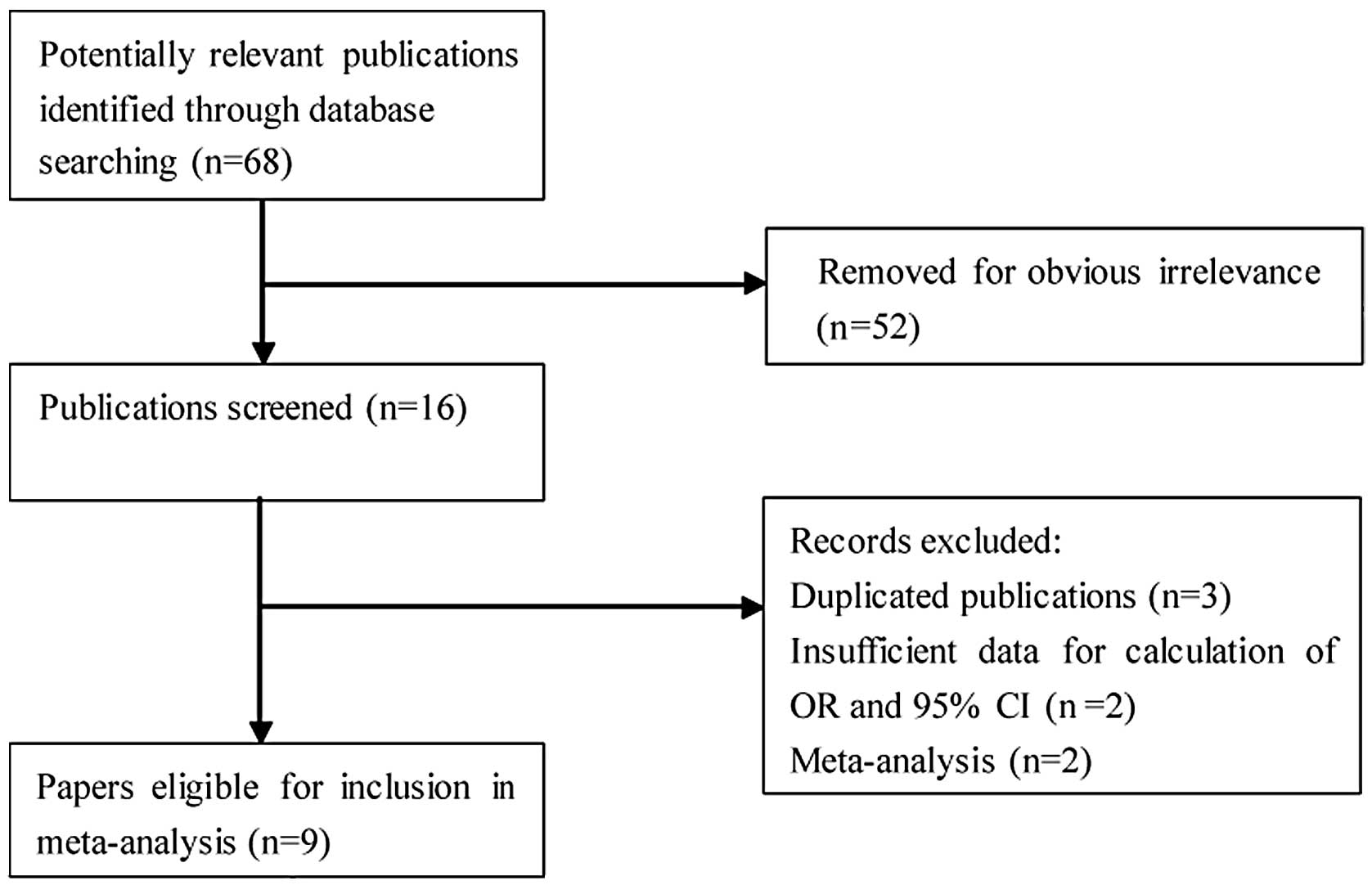
There were 68 articles relevant to the search words.
Through screening the title and reading the entire article, nine
eligible papers were selected for additional analysis. The flow
diagram of reviews shows the detailed process of selection
(Fig. 1). The total data of the
nine studies were gathered from 1192 CAD patients and 1089 controls
in the Chinese Han population. All the included studies for M235T
polymorphism were in HWE in controls. Of the nine retrospective
studies, four used population-based controls and five used
hospital-based controls (Table I).
All but one study investigated the myocardial infarction risk.
 | Table ICharacteristics of the included
studies for meta-analysis. |
Table I
Characteristics of the included
studies for meta-analysis.
| Study included | Area | End point | Source of
controls | Cases | Controls | Genotypes for
cases | Genotypes for
controls | HWE test |
|---|
|
|
|---|
| MM | MT | TT | MM | MT | TT |
|---|
| Ko et al, 1997
(9) | Taiwan | CAD | Hospital-based | 268 | 338 | 6 | 36 | 225 | 4 | 54 | 279 | 0.45 |
| Chen et al,
1998 (10) | Shanghai | MI | Population-based | 57 | 76 | 4 | 13 | 40 | 13 | 31 | 32 | 0.26 |
| Sheu et al,
1998 (11) | Taiwan | CAD | Population-based | 102 | 145 | 1 | 26 | 75 | 1 | 37 | 107 | 0.25 |
| Xie et al,
2001 (12) | Anhui | CAD | Hospital-based | 106 | 86 | 8 | 29 | 69 | 11 | 30 | 45 | 0.11 |
| Zhu et al,
2002 (13) | Nanjing | CAD | Hospital-based | 118 | 106 | 14 | 48 | 56 | 10 | 42 | 54 | 0.66 |
| Gu et al, 2003
(14) | Nantong | CAD | Population-based | 129 | 90 | 12 | 31 | 86 | 7 | 30 | 53 | 0.36 |
| Zhu et al,
2004 (15) | Beijing | CAD | Hospital-based | 192 | 98 | 12 | 75 | 105 | 8 | 36 | 54 | 0.59 |
| Li et al, 2004
(16) | Henan | CAD | Population-based | 120 | 80 | 11 | 60 | 49 | 14 | 41 | 25 | 0.69 |
| Ren et al,
2005 (17) | Shanxi | CAD | Hospital-based | 100 | 70 | 9 | 24 | 67 | 13 | 26 | 31 | 0.09 |
Results of the meta-analysis
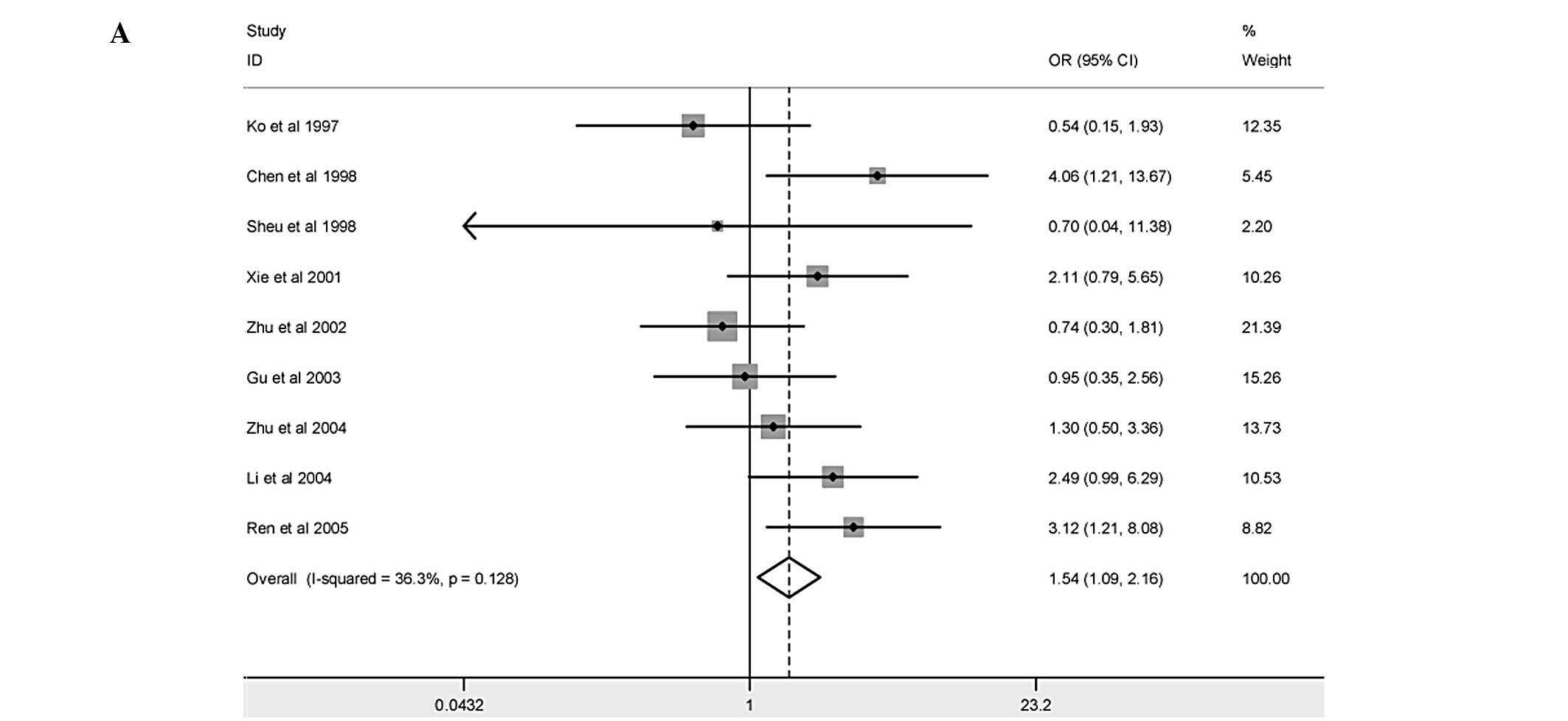
In this AGT M235T gene polymorphism meta-analysis,
the results were calculated in a homozygote comparison (OR=1.54;
95% CI, 1.09–2.16; P=0.13 for heterogeneity; Fig. 2A), a heterozygote comparison
(OR=1.30; 95% CI, 1.07–1.58; P=0.16 for heterogeneity; Fig. 2B), a dominant model (OR=0.72; 95%
CI, 0.55–0.94; P=0.04 for heterogeneity, by random effects model;
Fig. 2C) and a recessive model
(OR=1.37; 95% CI, 0.98–1.91; P=0.34 for heterogeneity; Fig. 2D). These results suggest that the
AGT gene M235T polymorphism is correlated with the increased risk
of CAD in the Chinese Han population. Sensitivity analysis was
performed for various comparisons in all the subgroups, when one
study (13) was excluded, the
results revealed no statistical significance and results of the
meta-analysis were credible (Table
II). Begg’s test was used to assess the publication bias,
however, no publication bias was detected in these studies
(Table II).
| Table IISummary ORs and 95% CI of the included
studies for meta-analysis. |
Table II
Summary ORs and 95% CI of the included
studies for meta-analysis.
| Genetic model | Sample size | Type of model | Test of
heterogeneity | Test of
association | Test of publication
bias | Sensitivity
analysis |
|---|
|
|
|
|
|
|---|
| Case | Control | I2 | P-value | OR | 95% CI | Z | P-value | OR | 95% CI |
|---|
| TT vs. MM | 1192 | 1089 | Fixed | 36.3% | 0.13 | 1.54 | 1.09–2.16 | 0.10 | 0.20 | 1.76 | 1.21–2.54 |
| TT vs. MT | | | Fixed | 31.7% | 0.16 | 1.30 | 1.07–1.58 | 2.81 | 0.01 | 1.37 | 1.11–1.69 |
| Dominant model | | | Random | 51.3% | 0.04 | 0.72 | 0.55–0.94 | 2.40 | 0.02 | 0.68 | 0.52–0.90 |
| Recessive
model | | | Fixed | 11.5% | 0.34 | 1.37 | 0.98–1.91 | 0.73 | 0.47 | 1.52 | 1.06–2.18 |
Discussion
CAD is the second leading cause of cardiovascular
mortalities in China. Although mortality from CAD is relatively low
compared with Western levels, the burden of CAD has been increasing
(18). This is partly due to the
increase in total cholesterol, reflecting an increasingly ‘Western
diet’ (19) and partly due to an
increase in the aged population. RAS plays a key role in regulating
blood pressure and the promotion of vascular growth. Chen et
al were the first to report the link between the M235T
polymorphism and CAD in the Chinese Han population, which carried
an approximately 4-fold increased risk of CAD (10). There has been some inconsistency,
with certain studies in support of this finding, whereas others
were not, suggesting that this polymorphism may serve as a possible
risk factor for CAD. In the present meta-analysis, we extracted
data from nine eligible studies, including a total of 1192 CAD
patients and 1089 controls, the studied population was confined to
Chinese individuals with a homogeneous genetic background.
Furthermore, all relevant studies published in English or Chinese
were included for the meta-analysis, which reduced language biases.
Our results suggest that the M235T polymorphism was significantly
associated with CAD in the Chinese Han population. The finding was
consistent with those from the previous meta-analysis, indicating
that the association was significant among Europeans and East
Asians (3).
The mechanism of how the AGT gene M235T polymorphism
relates to CAD risk is unclear. In a previous study, the serum AGT
level was shown to be higher in subjects carrying the 235T allele
(20). AGT interacts with renin to
produce angiotensin II (Ang II). Ang II has been demonstrated in
human and animal models to be involved in the development of
cardiomyocyte hypertrophy, and in cardiac fibrosis and the
modulation of cardiac fibroblast growth and collagen synthesis
(21). In addition, Ang II
activates vascular cell apoptosis, contributing to vascular
remodelling and cardiomyocyte loss in ischaemia-reperfusion and
myocardial infarction (22).
Stimulation of the AT1 receptor by Ang II is responsible for
vasoconstriction, endothelial dysfunction and the occurrence of
atherosclerosis (23), their
results were heterogeneous, and require further investigation.
However, limitations of the meta-analysis were that
the number of studies and the number of subjects in the studies
included in the meta-analysis by specific subgroups were small.
Therefore, more studies with larger sample sizes are required.
Additionally, the effects of gene-gene and gene-environment
interactions were not addressed in this meta-analysis.
In conclusion, our results suggest that the AGT gene
M235T polymorphism is involved in the susceptibility to CAD,
particularly in the Han ethnic group. Due to the limitations
mentioned, additional investigations should be performed to
investigate these associations.
References
|
1
|
Negi S and Anand A: Atherosclerotic
coronary heart disease-epidemiology, classification and management.
Cardiovasc Hematol Disord Drug Targets. 10:257–261. 2010.
View Article : Google Scholar : PubMed/NCBI
|
|
2
|
Moran A, Gu D, Zhao D, et al: Future
cardiovascular disease in China: Markov model and risk factor
scenario projections from the coronary heart disease policy model -
China. Circ Cardiovasc Qual and Outcomes. 3:243–252. 2010.
View Article : Google Scholar
|
|
3
|
Xu MQ, Ye Z, Hu FB and He L: Quantitative
assessment of the effect of angiotensinogen gene polymorphisms on
the risk of coronary heart disease. Circulation. 116:1356–1366.
2007. View Article : Google Scholar : PubMed/NCBI
|
|
4
|
Zafarmand MH, van der Schouw YT, Grobbee
DE, et al: The M235T polymorphism in the AGT gene and CHD risk:
evidence of a Hardy-Weinberg equilibrium violation and publication
bias in a meta-analysis. PLoS One. 3:e25332008. View Article : Google Scholar : PubMed/NCBI
|
|
5
|
Chen D, Liu JL, Liu Y, et al: Lack of an
association between -308G>A polymorphism of the TNF-α gene and
liver cirrhosis risk based on a meta-analysis. Genet Mol Res.
10:2765–2774. 2011.
|
|
6
|
Mantel N and Haenszel W: Statistical
aspects of the analysis of data from retrospective studies of
disease. J Natl Cancer Inst. 22:719–748. 1959.PubMed/NCBI
|
|
7
|
DerSimonian R and Laird N: Meta-analysis
in clinical trials. Control Clin Trials. 7:177–188. 1986.
View Article : Google Scholar : PubMed/NCBI
|
|
8
|
Egger M, Davey Smith G, Schneider M and
Minder C: Bias in meta-analysis detected by a simple, graphical
test. BMJ. 315:629–634. 1997. View Article : Google Scholar : PubMed/NCBI
|
|
9
|
Ko YL, Ko YS, Wang SM, et al:
Angiotensinogen and angiotensin-I converting enzyme gene
polymorphisms and the risk of coronary artery disease in Chinese.
Hum Genet. 100:210–214. 1997. View Article : Google Scholar : PubMed/NCBI
|
|
10
|
Chen D, Zhang M, Fan W, et al: A molecular
variant of angiotensinogen gene is associated with myocardial
infarction in Chinese. Zhonghua Yi Xue Yi Chuan Xue Za Zhi.
15:133–135. 1998.(In Chinese).
|
|
11
|
Sheu WH, Lee WJ, Jeng CY, et al:
Angiotensinogen gene polymorphism is associated with insulin
resistance in nondiabetic men with or without coronary heart
disease. Am Heart J. 136:125–131. 1998. View Article : Google Scholar : PubMed/NCBI
|
|
12
|
Xie Y, Zhang FM, Ma WZ, et al: Association
between gene polymorphism of renin-angiotensin system and coronary
heart disease. Nanjing Yi Ke Da Xue Xue Bao. 21:488–491. 2001.(In
Chinese).
|
|
13
|
Zhu TB, Xu W, Yang ZJ, et al: Association
analysis of three polymorphism of renin-angiotensin system genes
with coronary heart disease. Jiangsu Med J. 28:745–746. 2002.(In
Chinese).
|
|
14
|
Gu WD, Zhu JH, Pan M, et al: Effects of
angiotensinogen and apolipoprotein E gene polymorphisms on coronary
heart disease. Nan Tong Yi Xue Yuan Xue Bao. 23:394–395. 2003.(In
Chinese).
|
|
15
|
Zhu TN, Pan JQ, Shen ZJ, et al: Gene
polymorphisms of renin-angiotensin system and coronary thrombosis
disease. Zhongguo Shi Yan Xue Ye Xue Za Zhi. 12:674–679. 2004.(In
Chinese).
|
|
16
|
Li L, Fan XH, Zhang YW, et al: Association
between angiotensinogen gene polymorphism and severity of coronary
artery stenosis. J Med Forum. 25:12–14. 2004.(In Chinese).
|
|
17
|
Ren J, Jia YP, Lv JY and Guo XH:
Relationship between angiotensinogen gene M235T polymorphism and
coronary heart disease. J Shanxi Med Univ. 36:439–442. 2005.(In
Chinese).
|
|
18
|
Zhang XH, Lu ZL and Liu L: Coronary heart
disease in China. Heart. 94:1126–1131. 2008. View Article : Google Scholar : PubMed/NCBI
|
|
19
|
Critchley J, Liu J, Zhao D, et al:
Explaining the increase in coronary heart disease mortality in
Beijing between 1984 and 1999. Circulation. 110:1236–1244. 2004.
View Article : Google Scholar : PubMed/NCBI
|
|
20
|
Jeunemaitre X, Soubrier F, Kotelevtsev YV,
et al: Molecular basis of human hypertension: role of
angiotensinogen. Cell. 71:169–180. 1992. View Article : Google Scholar
|
|
21
|
Henrion D, Kubis N and Lévy BI:
Physiological and pathophysiological functions of the AT(2) subtype
receptor of angiotensin II: from large arteries to the
microcirculation. Hypertension. 38:1150–1157. 2001. View Article : Google Scholar : PubMed/NCBI
|
|
22
|
Horiuchi M, Akishita M and Dzau VJ: Recent
progress in angiotensin II type 2 receptor research in the
cardiovascular system. Hypertension. 33:613–21. 1999. View Article : Google Scholar : PubMed/NCBI
|
|
23
|
Dietz R, von Harsdorf R, Gross M, et al:
Angiotensin II and coronary artery disease, congestive heart
failure, and sudden cardiac death. Basic Res Cardiol. 93:101–108.
1998. View Article : Google Scholar : PubMed/NCBI
|