Spandidos Publications Logo
  • About
    • About Spandidos
    • Aims and Scopes
    • Abstracting and Indexing
    • Editorial Policies
    • Reprints and Permissions
    • Job Opportunities
    • Terms and Conditions
    • Contact
  • Journals
    • All Journals
    • Oncology Letters
      • Oncology Letters
      • Information for Authors
      • Editorial Policies
      • Editorial Board
      • Aims and Scope
      • Abstracting and Indexing
      • Bibliographic Information
      • Archive
    • International Journal of Oncology
      • International Journal of Oncology
      • Information for Authors
      • Editorial Policies
      • Editorial Board
      • Aims and Scope
      • Abstracting and Indexing
      • Bibliographic Information
      • Archive
    • Molecular and Clinical Oncology
      • Molecular and Clinical Oncology
      • Information for Authors
      • Editorial Policies
      • Editorial Board
      • Aims and Scope
      • Abstracting and Indexing
      • Bibliographic Information
      • Archive
    • Experimental and Therapeutic Medicine
      • Experimental and Therapeutic Medicine
      • Information for Authors
      • Editorial Policies
      • Editorial Board
      • Aims and Scope
      • Abstracting and Indexing
      • Bibliographic Information
      • Archive
    • International Journal of Molecular Medicine
      • International Journal of Molecular Medicine
      • Information for Authors
      • Editorial Policies
      • Editorial Board
      • Aims and Scope
      • Abstracting and Indexing
      • Bibliographic Information
      • Archive
    • Biomedical Reports
      • Biomedical Reports
      • Information for Authors
      • Editorial Policies
      • Editorial Board
      • Aims and Scope
      • Abstracting and Indexing
      • Bibliographic Information
      • Archive
    • Oncology Reports
      • Oncology Reports
      • Information for Authors
      • Editorial Policies
      • Editorial Board
      • Aims and Scope
      • Abstracting and Indexing
      • Bibliographic Information
      • Archive
    • Molecular Medicine Reports
      • Molecular Medicine Reports
      • Information for Authors
      • Editorial Policies
      • Editorial Board
      • Aims and Scope
      • Abstracting and Indexing
      • Bibliographic Information
      • Archive
    • World Academy of Sciences Journal
      • World Academy of Sciences Journal
      • Information for Authors
      • Editorial Policies
      • Editorial Board
      • Aims and Scope
      • Abstracting and Indexing
      • Bibliographic Information
      • Archive
    • International Journal of Functional Nutrition
      • International Journal of Functional Nutrition
      • Information for Authors
      • Editorial Policies
      • Editorial Board
      • Aims and Scope
      • Abstracting and Indexing
      • Bibliographic Information
      • Archive
    • International Journal of Epigenetics
      • International Journal of Epigenetics
      • Information for Authors
      • Editorial Policies
      • Editorial Board
      • Aims and Scope
      • Abstracting and Indexing
      • Bibliographic Information
      • Archive
    • Medicine International
      • Medicine International
      • Information for Authors
      • Editorial Policies
      • Editorial Board
      • Aims and Scope
      • Abstracting and Indexing
      • Bibliographic Information
      • Archive
  • Articles
  • Information
    • Information for Authors
    • Information for Reviewers
    • Information for Librarians
    • Information for Advertisers
    • Conferences
  • Language Editing
Spandidos Publications Logo
  • About
    • About Spandidos
    • Aims and Scopes
    • Abstracting and Indexing
    • Editorial Policies
    • Reprints and Permissions
    • Job Opportunities
    • Terms and Conditions
    • Contact
  • Journals
    • All Journals
    • Biomedical Reports
      • Information for Authors
      • Editorial Policies
      • Editorial Board
      • Aims and Scope
      • Abstracting and Indexing
      • Bibliographic Information
      • Archive
    • Experimental and Therapeutic Medicine
      • Information for Authors
      • Editorial Policies
      • Editorial Board
      • Aims and Scope
      • Abstracting and Indexing
      • Bibliographic Information
      • Archive
    • International Journal of Epigenetics
      • Information for Authors
      • Editorial Policies
      • Editorial Board
      • Aims and Scope
      • Abstracting and Indexing
      • Bibliographic Information
      • Archive
    • International Journal of Functional Nutrition
      • Information for Authors
      • Editorial Policies
      • Editorial Board
      • Aims and Scope
      • Abstracting and Indexing
      • Bibliographic Information
      • Archive
    • International Journal of Molecular Medicine
      • Information for Authors
      • Editorial Policies
      • Editorial Board
      • Aims and Scope
      • Abstracting and Indexing
      • Bibliographic Information
      • Archive
    • International Journal of Oncology
      • Information for Authors
      • Editorial Policies
      • Editorial Board
      • Aims and Scope
      • Abstracting and Indexing
      • Bibliographic Information
      • Archive
    • Medicine International
      • Information for Authors
      • Editorial Policies
      • Editorial Board
      • Aims and Scope
      • Abstracting and Indexing
      • Bibliographic Information
      • Archive
    • Molecular and Clinical Oncology
      • Information for Authors
      • Editorial Policies
      • Editorial Board
      • Aims and Scope
      • Abstracting and Indexing
      • Bibliographic Information
      • Archive
    • Molecular Medicine Reports
      • Information for Authors
      • Editorial Policies
      • Editorial Board
      • Aims and Scope
      • Abstracting and Indexing
      • Bibliographic Information
      • Archive
    • Oncology Letters
      • Information for Authors
      • Editorial Policies
      • Editorial Board
      • Aims and Scope
      • Abstracting and Indexing
      • Bibliographic Information
      • Archive
    • Oncology Reports
      • Information for Authors
      • Editorial Policies
      • Editorial Board
      • Aims and Scope
      • Abstracting and Indexing
      • Bibliographic Information
      • Archive
    • World Academy of Sciences Journal
      • Information for Authors
      • Editorial Policies
      • Editorial Board
      • Aims and Scope
      • Abstracting and Indexing
      • Bibliographic Information
      • Archive
  • Articles
  • Information
    • For Authors
    • For Reviewers
    • For Librarians
    • For Advertisers
    • Conferences
  • Language Editing
Login Register Submit
  • This site uses cookies
  • You can change your cookie settings at any time by following the instructions in our Cookie Policy. To find out more, you may read our Privacy Policy.

    I agree
Search articles by DOI, keyword, author or affiliation
Search
Advanced Search
presentation
Molecular Medicine Reports
Join Editorial Board Propose a Special Issue
Print ISSN: 1791-2997 Online ISSN: 1791-3004
Journal Cover
April 2013 Volume 7 Issue 4

Full Size Image

Sign up for eToc alerts
Recommend to Library

Journals

International Journal of Molecular Medicine

International Journal of Molecular Medicine

International Journal of Molecular Medicine is an international journal devoted to molecular mechanisms of human disease.

International Journal of Oncology

International Journal of Oncology

International Journal of Oncology is an international journal devoted to oncology research and cancer treatment.

Molecular Medicine Reports

Molecular Medicine Reports

Covers molecular medicine topics such as pharmacology, pathology, genetics, neuroscience, infectious diseases, molecular cardiology, and molecular surgery.

Oncology Reports

Oncology Reports

Oncology Reports is an international journal devoted to fundamental and applied research in Oncology.

Experimental and Therapeutic Medicine

Experimental and Therapeutic Medicine

Experimental and Therapeutic Medicine is an international journal devoted to laboratory and clinical medicine.

Oncology Letters

Oncology Letters

Oncology Letters is an international journal devoted to Experimental and Clinical Oncology.

Biomedical Reports

Biomedical Reports

Explores a wide range of biological and medical fields, including pharmacology, genetics, microbiology, neuroscience, and molecular cardiology.

Molecular and Clinical Oncology

Molecular and Clinical Oncology

International journal addressing all aspects of oncology research, from tumorigenesis and oncogenes to chemotherapy and metastasis.

World Academy of Sciences Journal

World Academy of Sciences Journal

Multidisciplinary open-access journal spanning biochemistry, genetics, neuroscience, environmental health, and synthetic biology.

International Journal of Functional Nutrition

International Journal of Functional Nutrition

Open-access journal combining biochemistry, pharmacology, immunology, and genetics to advance health through functional nutrition.

International Journal of Epigenetics

International Journal of Epigenetics

Publishes open-access research on using epigenetics to advance understanding and treatment of human disease.

Medicine International

Medicine International

An International Open Access Journal Devoted to General Medicine.

Journal Cover
April 2013 Volume 7 Issue 4

Full Size Image

Sign up for eToc alerts
Recommend to Library

  • Article
  • Citations
    • Cite This Article
    • Download Citation
    • Create Citation Alert
    • Remove Citation Alert
    • Cited By
  • Similar Articles
    • Related Articles (in Spandidos Publications)
    • Similar Articles (Google Scholar)
    • Similar Articles (PubMed)
  • Download PDF
  • Download XML
  • View XML
Article

The effects of carvedilol on cardiac structural remodeling: The role of endogenous nitric oxide in the activity of carvedilol

  • Authors:
    • Jiangbin Chen
    • Congxin Huang
    • Bin Zhang
    • Qiao Huang
    • Jing Chen
    • Lin Xu
  • View Affiliations / Copyright

    Affiliations: Department of Cardiology, Renmin Hospital of Wuhan University, Hubei 430060, P.R. China
  • Pages: 1155-1158
    |
    Published online on: February 19, 2013
       https://doi.org/10.3892/mmr.2013.1329
  • Expand metrics +
Metrics: Total Views: 0 (Spandidos Publications: | PMC Statistics: )
Metrics: Total PDF Downloads: 0 (Spandidos Publications: | PMC Statistics: )
Cited By (CrossRef): 0 citations Loading Articles...

This article is mentioned in:


Abstract

As a third-generation β-adrenergic blocker (β-blocker), carvedilol is able to reverse cardiac structural remodeling, however, its mechanism of action remains unclear. In order to investigate this mechanism, hypertension was induced in rats by unilateral renal artery narrowing. Additionally, carvedilol alone or carvedilol combined with L-NAME, a specific inhibitor of nitric oxide (NO) synthase, were administered to rats by gastric gavage for 8 weeks. Systolic blood pressure (SBP) was monitored once a week for each rat until sacrifice; the blood was kept to examine plasma NO level and the tissues were used for hematoxylin and eosin (H&E) and Masson's trichrome staining. Collagen volume fraction (CVF) and perivascular collagen area (PVCA) were calculated to quantitatively evaluate myocardial fibrosis. Our data showed that SBP was not different between the carvedilol-treated (Car) and carvedilol combined L-NAME groups (Car+L) at 8 weeks. Carvedilol significantly suppressed myocardial fibrosis and decreased both CVF and PVCA, although L-NAME blunted the effects caused by carvedilol. These results demonstrated that the effect caused by carvedilol on cardiac remodeling is largely dependent on endogenous NO.

Introduction

As a third-generation β-adrenergic blocker (β-blocker), carvedilol has been widely used for treating hypertension, myocardial infarction and heart failure (1–3). Although carvedilol is not superior to traditional β-blockers in blood pressure control, it still shows great benefit in the inhibition of collagen deposition (4). A previous study demonstrated that carvedilol’s action on blood pressure is largely mediated by endogenous nitric oxide (NO) (5). Considering the relationship between NO and left ventricle remodeling (6), we hypothesized that the effect of carvedilol on cardiac structural remodeling also depends on endogenous NO. In the present study, it was demonstrated that carvedilol reduces collagen volume fraction (CVF) and perivascular collagen area (PVCA) in a rat model of unilateral renal artery stenosis. The effect of carvedilol on cardiac remodeling is blunted by L-NAME, a specific inhibitor of NO synthase. The present study highlights the role of NO in the activity of carvedilol in cardiac structural remodeling.

Materials and methods

Animals and surgery

A total of 40 male Sprague-Dawley rats were used for narrowing the left renal artery using a modified 2-kidney 1-clip (2K1C) method. Briefly, all rats were anesthetized with urethane [5 mg/kg, intraperitoneally (i.p)], and the left kidneys were exposed by abdominal incision. A needle (0.25 mm, ID) was paralleled to place on the left renal arteries, and the arteries were gently tied together with silk. The needle was then pulled out and the blood was allowed to fill the left kidney as soon as possible in order to avoid irreversible damage. The abdomen was closed and the rats were gently placed in a warm cage until waking up. The animals were handled in strict accordance to the guidelines of the Institutional Animal Care and Use Committee of Wuhan University (Wuhan, China).

Blood pressure measurement and drug administration

Systolic blood pressure (SBP) of conscious rats was determined 4 weeks after surgery of 2K1C by the tail-cuff method. Three measurements were made per session, and the average value was obtained. Only the rats with SBP ≥160 mmHg (a total of 24 rats) were used for further treatments. These rats were randomly and equally classified into the control (Con), carvedilol-treated (Car) or carvedilol+L-NAME-treated groups (Car+L). An additional 8 rats were evaluated as the sham operation group (SO). These rats were fed with vehicle (distilled water, for SO and Con) or carvedilol (20 mg/kg/day) or carvedilol+L-NAME (20 and 25 mg/kg/day, respectively) by gastric gavage (7,8). SBP was continuously recorded in each rat from 1 to 8 weeks after administration of drug or vehicle.

Determination of plasma NO levels

At 8 weeks, all the rats were sacrificed following SBP measurement, and the blood was used to detect the NO (NO3) levels according to a previous study (5).

Histological diagnosis

Myocardium tissues were removed from the left ventricle (~3-mm thick) immediately following sacrifice. The samples were fixed in 10% pre-cooled paraformaldehyde for 72 h and embedded in paraffin for histological investigation. Paraffin-embedded tissues were sectioned into slices (~5 μm thick) and stained with hematoxylin and eosin (H&E). Masson’s trichrome staining was performed to assess myocardial fibrosis. Images were observed under an optical microscope at magnifications of ×400 (H&E) or ×200 (Masson’s). In order to quantitatively evaluate myocardial fibrosis, CVF and PVCA were calculated. CVF was defined as the sum of all the connective tissue areas of the entire section, divided by the sum of all the connective tissue and muscle areas in five fields of the section. PVCA was calculated as the ratio of the perivascular fibrotic area to the coronary vessel area from five fields of the section.

Statistical analysis

Data are presented as the means ± standard deviation (SD). Two-sample comparisons were performed using Student’s unpaired t-test, and four-sample comparisons were performed using one-way ANOVA (SPSS13.0). A P-value of <0.05 was considered to indicate a statistically significant difference.

Results

Four weeks after binding of the left renal artery, SBP in the Con group was significantly increased. As expected, carvedilol effectively decreased SBP only one week following drug treatment. SBP in the Car group reached a relatively lower lever over time compared with the level at the initiation of the treament and remained stable. Although the mean value of SBP was higher in the Car+L group, no statistical difference was detected between the Car and Car+L groups (149±7 mmHg, n=8, week 8 vs. 155±7 mmHg, n=8, week 8; P>0.05; Table I).

Table I

SBP following drug administration (mmHg).

Table I

SBP following drug administration (mmHg).

Time (weeks)SO (n=8)Con (n=8)Car (n=8)Car+L (n=8)
0110±9187±9a190±11a179±16a
1109±7189±12a172±13a,b167±11a,b
2114±11203±21a165±4a,b162±16a,b
3120±10197±10a147±6a,b150±10a,b
4121±6210±22a151±17a,b160±20a,b
5127±8198±9a139±10a,b151±9a,b
6121±6188±16a144±10a,b150±6a,b
7119±5191±19a148±9a,b157±14a,b
8124±9190±15a149±7a,b155±7a,b

a P<0.05 compared with SO;

b P<0.05 compared with Con. Time, the time for drug administration.

{ label (or @symbol) needed for fn[@id='tfn3-mmr-07-04-1155'] } SBP, systolic blood pressure.

{ label (or @symbol) needed for fn[@id='tfn4-mmr-07-04-1155'] } SO, sham operation; Con, control; Car, carvedilol-treated; Car+L, carvedilol+L-NAME-treated.

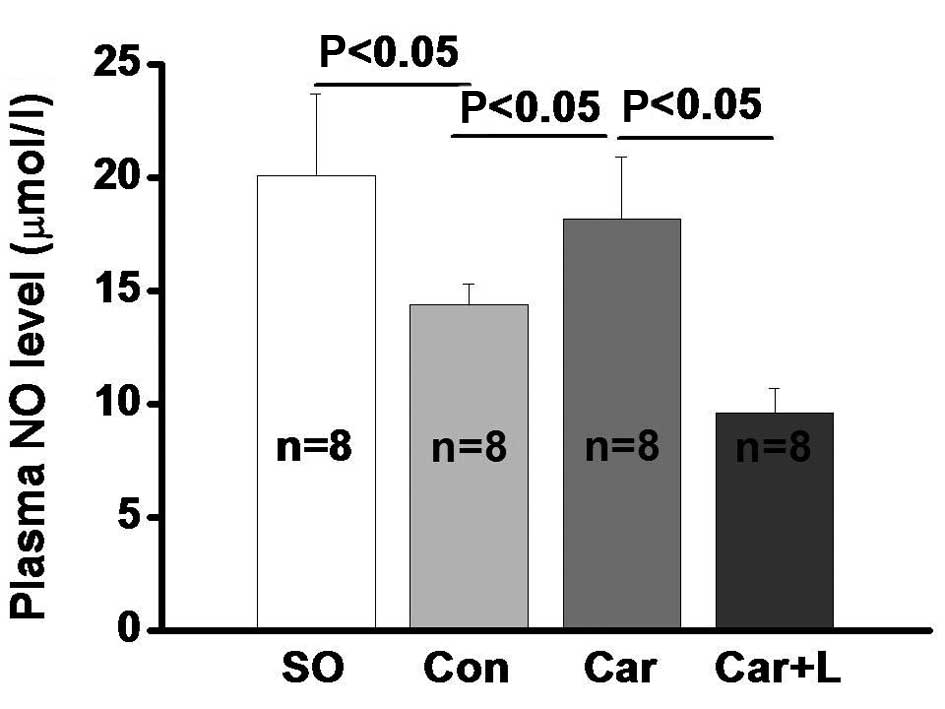
As previously reported (9), the concentration of plasma NO was significantly reduced in rats with hypertension (20.1±3.6 μmol/l in SO vs. 14.4±0.9 μmol/l in Con; P<0.05; Fig. 1). Carvedilol administration reversed the reduction of NO, although this effect was blocked by L-NAME (18.2±2.7 μmol/l in Car vs. 9.6±1.1 μmol/l in Car+L; P<0.05).

Figure 1

Plasma NO3 levels following different treatments.

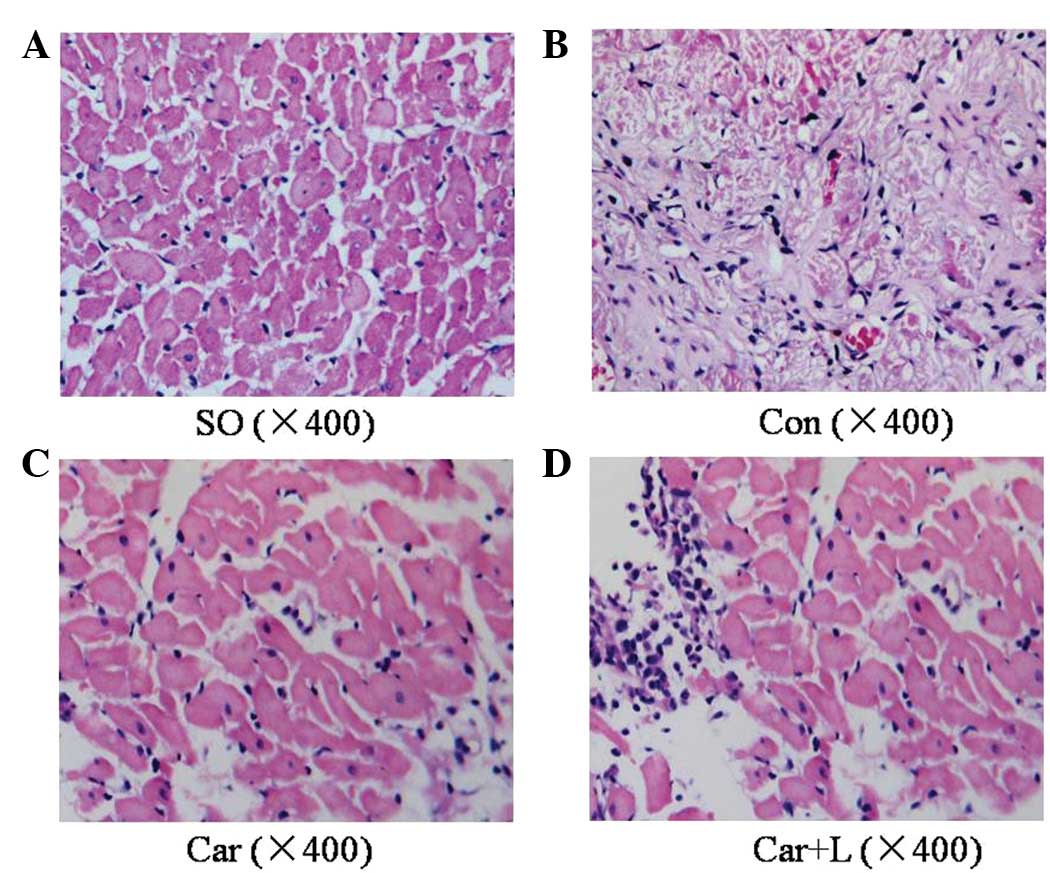
H&E and Masson’s staining showed that cardiac fibers exhibited an irregular shape and arrangement with myocardial fibrosis in the Con group. Moreover, the number of cardiac myocytes was markedly reduced. Carvedilol significantly suppressed these changes, although when combined with L-NAME, these effects were significantly blunted (Figs. 2 and 3). To quantitatively evaluate the influence of NO inhibition on the anti-remodeling effects of carvedilol, CVF and PVCA were calculated. Our results showed that carvedilol significantly decreased both CVF and PVCA in the hypertensive heart, although L-NAME blunted the effects caused by carvedilol (Table II).
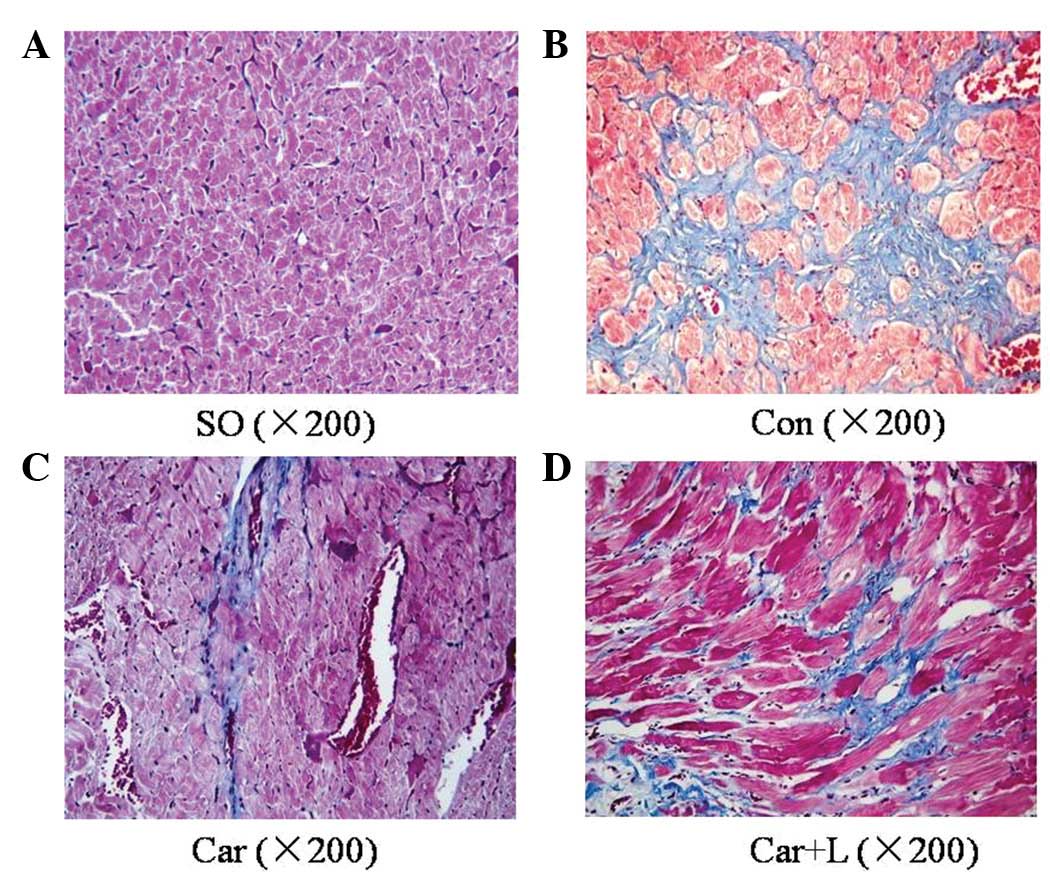
Figure 2

Hematoxylin and eosin (H&E) staining for each group following treatment. Typical tissue sections from the (A) SO, (B) Con, (C) Car and (D) Car+L goups (magnification, ×400). As shown in (B), hypertension alters the regular arrangement of cardiac muscle fibers. (C) Carvedilol reverses the disordered arrangement of fibers, while (D) L-NAME attenuates the effect caused by carvedilol. SO, sham operation; Con, control; Car, carvedilol-treated; Car+L, carvedilol+L-NAME-treated.

Figure 3

Masson’s trichrome staining for each group following treatment. Typical tissue sections from the (A) SO, (B) Con, (C) Car and (D) Car+L groups (magnification, ×200). (A) The red area shows cardiac muscle fibers, and the muscles were largely replaced by collagen (blue area in B). (C) Carvedilol rescues myocytes from fibrosis, although (D) when combined with L-NAME, this effect is attenuated. SO, sham operation; Con, control; Car, carvedilol-treated; Car+L, carvedilol+L-NAME-treated.

Table II

Comparisons of CVF and PVCA following different treatments.

Table II

Comparisons of CVF and PVCA following different treatments.

VariableSO (n=8)Con (n=8)Car (n=8)Car+L (n=8)
CVF (%)2.0±0.56.9±0.9a4.4±0.6a,b5.2±1.0a–c
PVCA (%)1.5±0.38.2±1.7a3.9±0.8a,b7.2±0.9a,c

a P<0.05 compared with SO;

b P<0.05 compared with Con;

c P<0.05 compared with Car.

{ label (or @symbol) needed for fn[@id='tfn8-mmr-07-04-1155'] } CVF, collagen volume fraction; PVCA, perivascular collagen area. SO, sham operation; Con, control; Car, carvedilol-treated; Car+L, carvedilol+L-NAME-treated.

Discussion

Different from traditional β-blockers, the mechanism underlying the blood pressure-lowering effect of carvedilol is more complicated (10). As well as the blockade of α1, β1 and β2 adrenergic receptors, Afonso et al(5) demonstrated that carvedilol’s action on blood pressure was largely dependent on NO (5). However, this conclusion was obtained from normal rats, and it remains unknown whether NO plays an important role on carvedilol’s action under pathological conditions. In the present study, high blood pressure was successfully induced by narrowing the left renal artery in the Con group, and was significantly decreased by the administration of carvedilol. Notably, inhibition of NO generation by L-NAME (Car+L group) appeared not to attenuate carvedilol effect on lowering blood pressure, although the mean value of SBP remained higher in the Car+L group compared with that in the Car group. This may be explained by the following factors: In the study by Afonso et al(5), carvedilol and L-NAME were used in normal rats for a short period of time, while in the present study, hypertension was firstly induced in rats and then drugs were administered for 8 weeks. Carvedilol effect on blood pressure may shift from the NO-dependent pathway to the α- and β-adrenergic receptor-dependent pathway after exposure to long and continuous pathological stimulations, such as high blood pressure, angiotensin II and catecholamine.

Besides blood pressure control, carvedilol can also bring benefit to patients with hypertension through its antihypotrophic effects. Previous studies have demonstrated that carvedilol prevents apoptosis and attenuates or reverses cardiac remodeling in various animal models, such as heart failure and ischemia/reperfusion injury (11,12). Since carvedilol increases the production of endogenous NO and NO prevents hypertrophy through cGMP/PKG pathway (13), we hypothesized that NO plays an important role in carvedilol effects on anti-remodeling. Our data showed that carvedilol reverses the reduction of serum NO level in rats with hypertension, and significantly decreases both CVF and PVCA. However, in the Car+L group these effects of carvedilol on CVF and PVCA appeared to be significantly attenuated. This means that the anti-remodeling effect of carvedilol in hypertrophy is largely dependent on endogenous NO. On the other hand, our results demonstrated that, as a critical anti-remodeling factor, endogenous NO plays an important role in the process of hypertrophy. In the future, more studies should focus on the mechanisms underlying how carvedilol increases the generation of endogenous NO.

As a third-generation β-blocker, carvedilol has been widely used in patients with hypertension, heart failure or coronary heart disease, and shows great advantages besides lowering blood pressure. In the present study, we showed that carvedilol significantly suppresses myocardial fibrosis and decreases both CVF and PVCA, while these effects were attenuated by L-NAME through inhibiting the generation of endogenous NO. Our study highlights the role of endogenous NO in carvedilol’s action on cardiac structural remodeling. In the future, further studies will focus on the mechanisms underlying how carvedilol increases the generation of endogenous NO.

References

1 

DiNicolantonio JJ and Hackam DG: Carvedilol: a third-generation β-blocker should be a first-choice β-blocker. Expert Rev Cardiovasc Ther. 10:13–25. 2012.

2 

Fonarow GC, Lukas MA, Robertson M, Colucci WS and Dargie HJ: Effects of carvedilol early after myocardial infarction: analysis of the first 30 days in Carvedilol Post-Infarct Survival Control in Left Ventricular Dysfunction (CAPRICORN). Am Heart J. 154:637–644. 2007. View Article : Google Scholar

3 

Bozkurt B, Bolos M, Deswal A, Ather S, Chan W, Mann DL and Carabello B: New insights into mechanisms of action of carvedilol treatment in chronic heart failure patients - a matter of time for contractility. J Card Fail. 18:183–193. 2012. View Article : Google Scholar : PubMed/NCBI

4 

Wei S, Chow LT and Sanderson JE: Effect of carvedilol in comparison with metoprolol on myocardial collagen postinfarction. J Am Coll Cardiol. 36:276–281. 2000. View Article : Google Scholar : PubMed/NCBI

5 

Afonso RA, Patarrão RS, Macedo MP and Carmo MM: Carvedilol’s actions are largely mediated by endogenous nitric oxide. Rev Port Cardiol. 25:911–917. 2006.

6 

Inaba S, Iwai M, Furuno M, Kanno H, Senba I, Okayama H, Mogi M, Higaki J and Horiuchi M: Role of angiotensin-converting enzyme 2 in cardiac hypertrophy induced by nitric oxide synthase inhibition. J Hypertens. 29:2236–2245. 2011. View Article : Google Scholar : PubMed/NCBI

7 

Li B, Liao YH, Cheng X, Ge H, Guo H and Wang M: Effects of carvedilol on cardiac cytokines expression and remodeling in rat with acute myocardial infarction. Int J Cardiol. 111:247–255. 2006. View Article : Google Scholar : PubMed/NCBI

8 

Rossoni G, Manfredi B, De Gennaro Colonna V, Berti M, Guazzi M and Berti F: Sildenafil reduces L-NAME-induced severe hypertension and worsening of myocardial ischaemia-reperfusion damage in the rat. Br J Pharmacol. 150:567–576. 2007. View Article : Google Scholar : PubMed/NCBI

9 

Isabelle M, Simonet S, Ragonnet C, Sansilvestri-Morel P, Clavreul N, Vayssettes-Courchay C and Verbeuren TJ: Chronic reduction of nitric oxide level in adult spontaneously hypertensive rats induces aortic stiffness similar to old spontaneously hypertensive rats. J Vasc Res. 49:309–318. 2012. View Article : Google Scholar : PubMed/NCBI

10 

Dulin B and Abraham WT: Pharmacology of carvedilol. Am J Cardiol. 93:3B–6B. 2004. View Article : Google Scholar

11 

Bellenger NG, Rajappan K, Rahman SL, Lahiri A, Raval U, Webster J, Murray GD, Coats AJ, Cleland JG and Pennell DJ; CHRISTMAS Study Steering Committee and Investigators. Effects of carvedilol on left ventricular remodelling in chronic stable heart failure: a cardiovascular magnetic resonance study. Heart. 90:760–764. 2004. View Article : Google Scholar : PubMed/NCBI

12 

Schulz R, Kelm M and Heusch G: Nitric oxide in myocardial ischemia/reperfusion injury. Cardiovasc Res. 61:402–413. 2004. View Article : Google Scholar : PubMed/NCBI

13 

Lindman BR and Chakinala MM: Modulating the nitric oxide - cyclic GMP pathway in the pressure-overloaded left ventricle and group II pulmonary hypertension. Int J Clin Pract Suppl. 168:15–22. 2010. View Article : Google Scholar : PubMed/NCBI

Related Articles

  • Abstract
  • View
  • Download
  • Twitter
Copy and paste a formatted citation
Spandidos Publications style
Chen J, Huang C, Zhang B, Huang Q, Chen J and Xu L: The effects of carvedilol on cardiac structural remodeling: The role of endogenous nitric oxide in the activity of carvedilol. Mol Med Rep 7: 1155-1158, 2013.
APA
Chen, J., Huang, C., Zhang, B., Huang, Q., Chen, J., & Xu, L. (2013). The effects of carvedilol on cardiac structural remodeling: The role of endogenous nitric oxide in the activity of carvedilol. Molecular Medicine Reports, 7, 1155-1158. https://doi.org/10.3892/mmr.2013.1329
MLA
Chen, J., Huang, C., Zhang, B., Huang, Q., Chen, J., Xu, L."The effects of carvedilol on cardiac structural remodeling: The role of endogenous nitric oxide in the activity of carvedilol". Molecular Medicine Reports 7.4 (2013): 1155-1158.
Chicago
Chen, J., Huang, C., Zhang, B., Huang, Q., Chen, J., Xu, L."The effects of carvedilol on cardiac structural remodeling: The role of endogenous nitric oxide in the activity of carvedilol". Molecular Medicine Reports 7, no. 4 (2013): 1155-1158. https://doi.org/10.3892/mmr.2013.1329
Copy and paste a formatted citation
x
Spandidos Publications style
Chen J, Huang C, Zhang B, Huang Q, Chen J and Xu L: The effects of carvedilol on cardiac structural remodeling: The role of endogenous nitric oxide in the activity of carvedilol. Mol Med Rep 7: 1155-1158, 2013.
APA
Chen, J., Huang, C., Zhang, B., Huang, Q., Chen, J., & Xu, L. (2013). The effects of carvedilol on cardiac structural remodeling: The role of endogenous nitric oxide in the activity of carvedilol. Molecular Medicine Reports, 7, 1155-1158. https://doi.org/10.3892/mmr.2013.1329
MLA
Chen, J., Huang, C., Zhang, B., Huang, Q., Chen, J., Xu, L."The effects of carvedilol on cardiac structural remodeling: The role of endogenous nitric oxide in the activity of carvedilol". Molecular Medicine Reports 7.4 (2013): 1155-1158.
Chicago
Chen, J., Huang, C., Zhang, B., Huang, Q., Chen, J., Xu, L."The effects of carvedilol on cardiac structural remodeling: The role of endogenous nitric oxide in the activity of carvedilol". Molecular Medicine Reports 7, no. 4 (2013): 1155-1158. https://doi.org/10.3892/mmr.2013.1329
Follow us
  • Twitter
  • LinkedIn
  • Facebook
About
  • Spandidos Publications
  • Careers
  • Cookie Policy
  • Privacy Policy
How can we help?
  • Help
  • Live Chat
  • Contact
  • Email to our Support Team