Introduction
Osteoblast differentiation from mesenchymal stem
cells (MSC) is a highly regulated process guided by complex
signaling cascades. BMP-2 functions as an effective
osteoblast-inducing signal and has been investigated extensively
(1). In the past two decades, a
number of transcription factors and small non-coding microRNAs
involved in BMP-2-induced osteoblast differentiation have been
identified (2–5). However, the precise molecular
mechanisms of osteoblast differentiation remain largely
unknown.
Long non-coding RNAs (long ncRNAs or lncRNAs) are
generally considered to represent non-protein coding transcripts of
>200 nucleotides (6). An
increasing number of studies have reported that lncRNAs participate
in diverse biological processes through distinct mechanisms in
mammalian biology (7,8). Aberrant lncRNA expression and
mutations have been linked to a diverse number of human diseases,
including cancer, cardiovascular dieases and Alzheimer’s disease
(9–11). Specifically, findings of previous
studies demonstrated that lncRNAs are extremely important for the
control of cell or tissue differentiation (12–15).
Although an increasing number of functional lncRNAs have been
characterized thus far, the functions of the majority of lncRNAs
remain unknown (16).
It is not known whether MSC commitment and
differentiation into osteoblasts relies on the modulation of lncRNA
expression. To address this question, in the present study, lncRNA
expression profiling was performed in MSCs undergoing
differentiation into osteoblasts at day 1 and 4. Differentially
expressed lncRNAs were then selected for bioinformatic analyses.
Results of this study are likely to provide an important foundation
for future studies on the lncRNA modulation of osteoblastic
differentiation.
Materials and methods
Cell culture and osteoblast
differentiation
C3H10T1/2 cells were obtained from the Chinese
Academy of Science Cell Bank (Shanghai, China) and were cultured in
Dulbecco’s modified Eagle’s medium (DMEM) containing 10% fetal
bovine serum (FBS; both Hyclone Laboratories, Inc., Logan, UT, USA)
at 37°C in a humidified atmosphere of 5% CO2 in air. To
induce osteoblast differentiation, the medium was replaced with
low-serum medium, consisting of DMEM supplemented with 5% FBS and
200 ng/ml rhBMP-2 (R&D Systems, Minneapolis, MN, USA) and the
medium was changed every 2–3 days.
Alkaline phosphatase (ALP) staining
Levels of osteoblast differentiation in C3H10T1/2
cells were determined using ALP staining. For ALP staining, cells
were washed with PBS twice, fixed with 70% ethanol for 20 min,
rinsed three times with deionized water and then incubated with the
BCIP/NBT liquid substrate system (Sigma-Aldrich, St. Louis, MO,
USA), an ALP substrate solution, for 30 min. Images of the stained
cells were then captured. For quantitative analysis, the ALP stain
was extracted with 10% cetylpyridinium chloride for 15 min and
quantified by measuring its absorbance at 540 nm. Relative ALP
staining was then calculated as a fold change of the control.
RNA isolation
Following incubation with 200 ng/ml BMP-2 for 1 or 4
days, total RNA was extracted using TRIzol (Invitrogen Life
Technologies, Carlsbad, CA, USA). RNA was also extracted from BMP-2
untreated cells. Total RNA from each sample was quantified using
the NanoDrop 1000 spectrophotometer (Thermo Fisher Scientific,
Waltham, MA, USA)and RNA integrity was assessed using standard
denaturing agarose gel electrophoresis.
Microarray detection and analysis
For microarray analysis, the Agilent Array platform
(Agilent Technologies, Santa Clara, CA, USA) was employed. Each
sample was amplified and transcribed into fluorescent cRNA along
the entire length of the transcripts without 3′ bias utilizing a
random priming method (Quick Amp Labeling kit, One-Color, Agilent
Technologies, p/n 5190-0442). The labeled cRNAs were hybridized
onto the Mouse lncRNA Array v2.0 (8×60K; Arraystar Inc., Rockville,
MD, USA) which was designed for the global profiling of 31,423
mouse lncRNAs and 25,376 protein-coding transcripts. The slides
were washed and the arrays were scanned using the Agilent G2505C
microarray scanner. Agilent Feature Extraction software (version
11.0.1.1) was used to analyze the acquired array images. Quantile
normalization and subsequent data processing were performed using
the GeneSpring GX version 11.5.1 software package (Agilent
Technologies). Differentially expressed lncRNAs and mRNAs were
identified through fold change filtering.
Category analysis of differentially
expressed lncRNAs
According to lncRNA genomic locations relative to
protein coding genes, lncRNAs are categorized as: i) sense, ii)
antisense, iii) bidirectional, iv) intronic and v) intergenic
(17). The differentially
expressed lncRNAs identified in this study were categorized based
on these groupings.
Bioinformatic analysis of lncRNA relative
to nearby protein-coding genes
One important function of lncRNAs is to regulate the
expression of nearby protein-coding genes. Therefore,
protein-coding genes were searched for differentially expressed
lncRNAs using the UCSC Genome Browser (http://genome.ucsc.edu/cgi-bin/hgGateway). Genes
transcribed within 300 kb were considered to represent nearby
coding genes and predicted lncRNAs nearby these coding genes were
integrated with differentially expressed mRNA in the microarray
(fold change ≥2.0 at day 4) (18).
The regulatory network between lncRNAs and nearby coding genes was
visually presented using the Cytoscape program (http://www.cytoscape.org/).
Statistical analysis
Experiments were repeated three times with the
exception of microarray experiments. Two group comparisons were
performed using the Student’s t test. P<0.05 was considered to
indicate a statistically significant difference.
Results
BMP-2 increased osteoblast-specific
marker ALP activity
Osteoblast differentiation from MSCs is regulated by
various cytokines and growth factors. BMP-2, a transforming growth
factor β superfamily member, is well known as one of the most
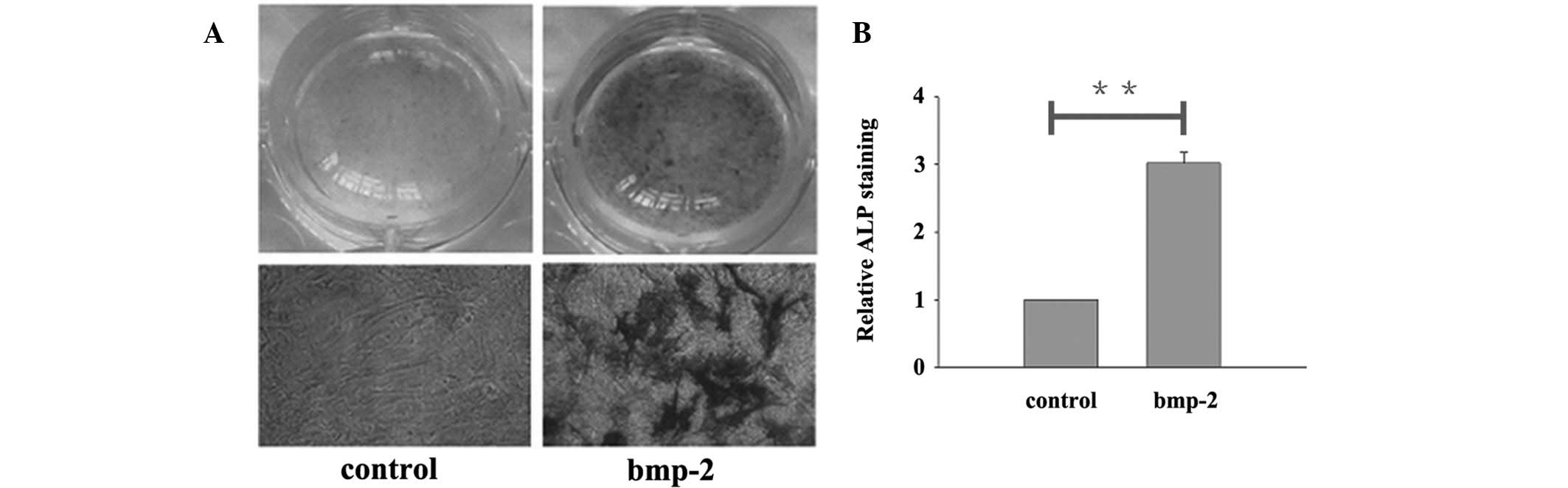
powerful osteoblast promoting factors (19). ALP activity is an early osteoblast
differentiation marker. In the present study, ALP activity in
C3H10T1/2 cells with and without BMP-2 treatment was analyzed for 7
days to investigate BMP-2-induced C3H10T1/2 cell osteoblast
differentiation. A significant increase in ALP acitivity in
BMP-2-induced C3H10T1/2 cells was observed (Fig. 1), indicating that BMP-2 stimulates
C3H10T1/2 cells into early osteoblast differentiation.
Differentially expressed profiles of the
lncRNAs in BMP-2- induced C3H10T1/2 cell osteoblast
differentiation
To investigate the expression profiles of lncRNAs
during MSC osteoblast differentiation, total RNA was extracted from
BMP-2 treated and untreated cells at day 1 and 4.
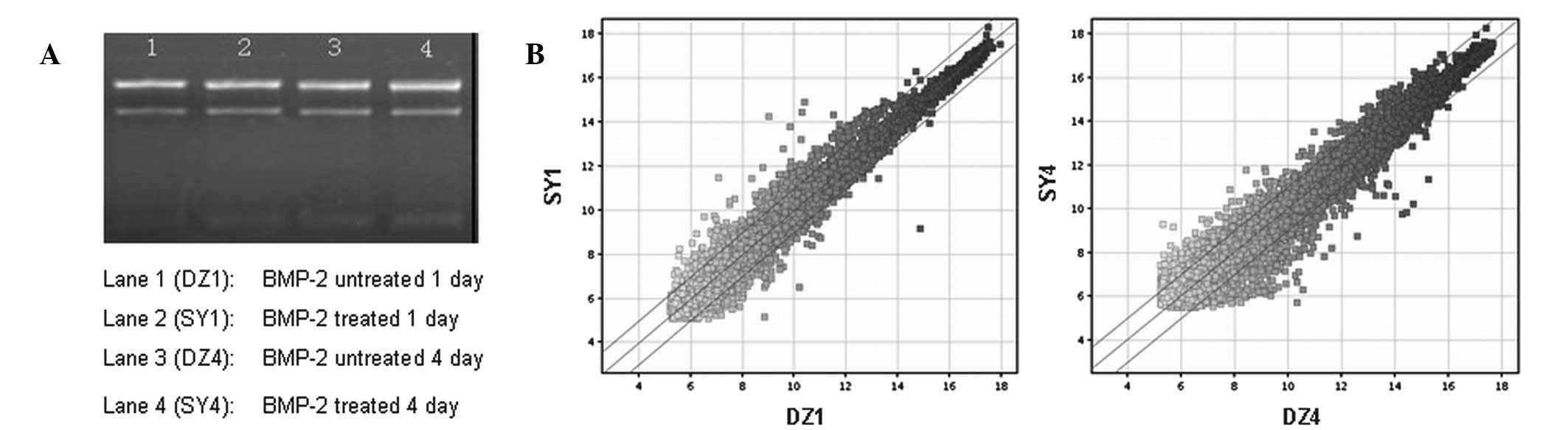
OD260/280 ratios were close to 2.0 and
OD260/230 ratios were >2.0 for all the samples. The
quality of total RNA was checked by gel electrophoresis (Fig. 2A), confirming that the RNA was of
good quality. Scatter plot analysis of the microarray data is shown
in Fig. 2B. Microarray expression
analysis of lncRNAs was then performed. Firstly, lncRNAs
upregulated or downregulated by >1.5-fold in BMP-2 treated or
untreated C3H10T1/2 cells for 1 day were screened, revealing 886
upregulated and 825 downregulated lncRNAs in the BMP-2 treated
group. Secondly, 595 upregulated and 548 downregulated lncRNAs by
>2-fold were identified at day 4. Continuously upregulated or
downregulated lncRNAs following prolonged BMP-2 treatment may be
more important for the control of osteoblast differentiation. We
also identified 59 upregulated (Table
I) and 57 downregulated lncRNAs (Table II) following 1 and 4 days of BMP-2
treatment in accordance with the described thresholds.
 | Table IUpregulated expression of 59 lncRNAs
in BMP-2 treated C3H10T1/2 cells for 1 and 4 days. |
Table I
Upregulated expression of 59 lncRNAs
in BMP-2 treated C3H10T1/2 cells for 1 and 4 days.
| lncRNA
symbol/name | lncRNA
symbol/name | lncRNA
symbol/name |
|---|
| uc009odu.1 | uc009gzn.1 | uc009bxq.1 |
| uc008drt.1 | AK144695 | BC023483 |
| uc007djg.1 | uc007cyp.1 | NR_027652 |
| CB272499 | AV570737 | AK201409 |
| AK043290 | AK032849 | AK032137 |
| AK030568 | mKIAA0031 | NR_033578 |
| AK148154 | uc.77 | AK148935 |
| AA656495 | uc007rco.1 |
ENSMUST00000122262 |
|
ENSMUST00000122215 |
ENSMUST00000121177 |
ENSMUST00000170943 |
|
ENSMUST00000120905 |
ENSMUST00000120431 |
ENSMUST00000120163 |
|
ENSMUST00000120127 |
ENSMUST00000120017 |
ENSMUST00000118988 |
|
ENSMUST00000118701 |
ENSMUST00000118061 |
ENSMUST00000117850 |
|
ENSMUST00000074110 |
ENSMUST00000053965 |
ENSMUST00000172364 |
|
ENSMUST00000171670 |
ENSMUST00000119457 |
ENSMUST00000080271 |
|
ENSMUST00000165702 |
ENSMUST00000135189 |
ENSMUST00000163579 |
|
ENSMUST00000160955 |
ENSMUST00000153890 |
ENSMUST00000151866 |
|
ENSMUST00000170806 |
ENSMUST00000170714 |
ENSMUST00000143202 |
|
ENSMUST00000121036 |
ENSMUST00000119775 |
ENSMUST00000081067 |
|
ENSMUST00000126138 |
MM9LINCRNAEXON11209− |
MM9LINCNAEXON10436+ |
|
MM9LINCRNAEXON11971− |
MM9LINCRNAEXON11966− | |
| Table IIDownregulated expression of 57 lncRNAs
in BMP-2 treated C3H10T1/2 cells for 1 and 4 days. |
Table II
Downregulated expression of 57 lncRNAs
in BMP-2 treated C3H10T1/2 cells for 1 and 4 days.
| lncRNA
symbol/name | lncRNA
symbol/name | lncRNA
symbol/name |
|---|
| uc009rnr.1 | uc009qfj.1 | BC099572 |
| AK044623 | mD53 | uc007cpz.1 |
| BC038927 | AK142678 | C130026I21Rik |
| BC038927 | AK137923 | mouselincRNA0231 |
| mouselincRNA0106 | mouselincRNA0243 | mouselincRNA1280 |
| AK043049 | BM942986 | AK156713 |
| AK143058 | AK137040 | AK136357 |
| AK134233 | AK089560 | AK054249 |
| AK046177 | AK044187 | AK043294 |
| AK039250 | AK032775 | AK031656 |
| AK031010 | AK030271 | AK029300 |
| AK020801 | AK014853 | AK013539 |
| AI551087 |
ENSMUST00000125230 |
ENSMUST00000122459 |
|
ENSMUST00000116393 |
ENSMUST00000170072 |
ENSMUST00000165050 |
|
ENSMUST00000162276 |
ENSMUST00000160831 |
ENSMUST00000160674 |
|
ENSMUST00000156260 |
ENSMUST00000154798 |
ENSMUST00000148528 |
|
ENSMUST00000147939 |
ENSMUST00000137032 |
ENSMUST00000133270 |
|
ENSMUST00000129933 |
MM9LINCRNAEXON10823+ |
MM9LINCRNAEXON11750+ |
|
MM9LINCRNAEXON11996+ |
MM9LINCRNAEXON11765+ |
MM9LINCRNAEXON11642− |
Category analysis of differentially
expressed lncRNAs
Based on a previous study by Ponting et
al(17), of the 116
differentially expressed lncRNAs identified in this study, 60.3%
were categorized as intergenic. In addition, 20.7% were catagorized
as sense. Details of the categories are presented in Table III.
| Table IIICategory analysis of differentially
expressed lncRNAs. |
Table III
Category analysis of differentially
expressed lncRNAs.
| lncRNAs | |
|---|
|
| |
|---|
| Category | Upregulated | Downregulated | % |
|---|
| Sense | 14 | 10 | 20.7 |
| Antisense | 7 | 12 | 16.4 |
| Bidirectional | 2 | 1 | 2.6 |
| Intronic | 0 | 0 | 0.0 |
| Intergenic | 36 | 24 | 60.3 |
Bioinformatic analysis of lncRNAs
relative to osteoblast differentiation
Unlike proteins or microRNAs, lncRNA function cannot
be inferred from sequence or structure. Studies have hypothesized a
number of regulatory paradigms to explain the mechanism by which
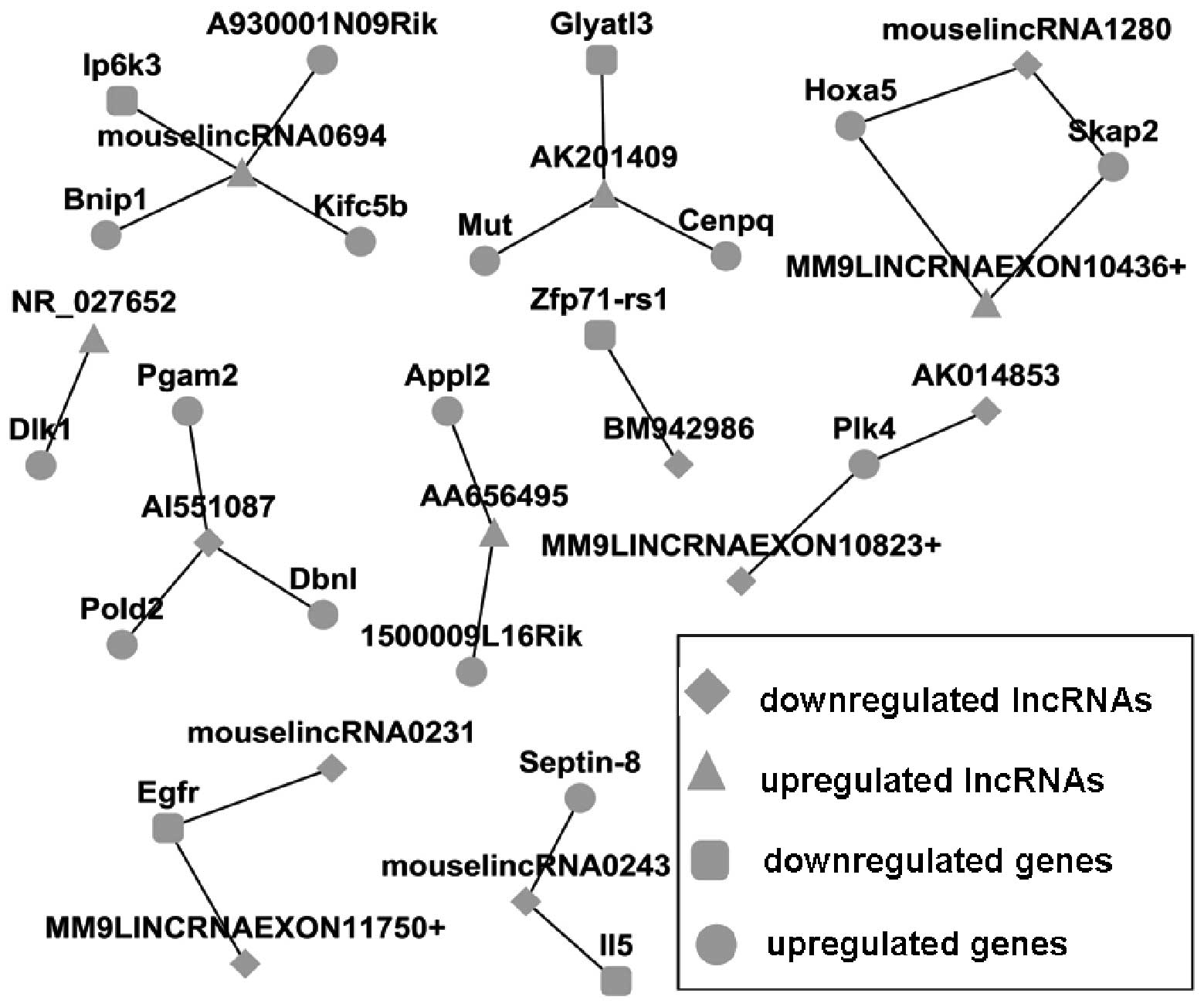
lncRNAs function. In the present study, the genomic context of
lncRNAs was highlighted. Differentially expressed nearby mRNAs were
combined and 24 differentially expressed lncRNAs and nearby coding
genes pairs were identified for 13 differentially expressed lncRNAs
and 20 differentially expressed mRNAs. Using the Cytoscape program,
a regulatory network was constructed between differentially
expressed lncRNA and nearby coding genes (Fig. 3).
Discussion
Specific lncRNAs, including linc-MD1, TINCR and
ANCR, have been previously reported to be involved in the control
of cell or tissue differentiation (12–15).
In the present study, the Arraystar microarray analysis was used to
identify differentially expressed lncRNAs associated with BMP-2
stimulated osteoblast differentiation. To the best of our
knowledge, this is the first study to demonstrate genome-wide
differentially expressed lncRNA profiling in MSCs undergoing early
osteoblast differentiation.
Although lncRNAs may have an important impact on a
diverse range of human diseases, the current understanding of the
molecular mechanisms by which lncRNAs function remain largely
unknown. Previous studies have demonstrated that lncRNAs may
function by controlling the transcriptional regulation of
neighboring coding genes (7,17,20).
For example, the ncRNA, Evf2, forms a complex with the
transcription factor, Dlx2, to induce the expression of adjacent
protein-coding genes (21).
Identifying differentially expressed nearby coding mRNA may enhance
understanding of the function and potential regulatory mechanisms
for lncRNAs. In the current study, 24 differentially expressed
lncRNAs and nearby coding genes pairs were identified. Among the
regulatory network between differentially expressed lncRNAs and
nearby protein-coding genes pairs, specifc nodes have been
previously reported to be involved in osteoblast differentiation or
bone metabolism. For example, the protein-coding gene, EGFR, a
nearby coding gene for differentially expressed lncRNA,
mouselincRNA0231, was downregulated by 2.2- and 2.8-fold following
BMP-2 treatment for 1 and 4 days, respectively. A previous study
reported that EGFR signaling suppresses osteoblast differentiation
by inhibiting the expression of master osteoblastic transcription
factors, Runx2 and Osterix (22).
We hypothesized that mouselincRNA0231 may negatively regulate
osteoblast differentiation by affecting EGFR signaling. DLK1 is a
novel regulator of bone mass and inhibits bone formation and
stimulates bone resorption (23,24)
and was upregulated in the BMP-2 treatment group. This upregulation
may have reduced the action of BMP-2. DLK1 is a nearby coding gene
for differentially expressed lncRNA NR_027652. Therefore, a
synergistic effect on osteoblast differentiation may exist between
DLK1 and NR_027652. IL-5, is a nearby coding gene for
mouselincRNA0243 and is a T cell-derived factor. Macias et
al previously reported that overexpression of IL-5 in a
transgenic mouse line mediated bone formation through the
mobilization of marrow-derived osteogenic progenitors (25). These pairings between lncRNA and
nearby coding protein may represent one of the regulatory
mechanisms by which lncRNAs control osteoblast differentiaton
through the regulation of neighboring osteoblast-related gene
expression. However, further studies must be performed to prove
this hypothesis.
In conclusion, 116 continuously differentially
expressed lncRNAs were identified in this study during
BMP-2-stimulated osteoblast differentiation for 1 and 4 days in
C3H10T1/2 mensenchymal stem cells. In addition, potential
regulatory mechanisms by which lncRNAs control osteoblast
differentiation were identified by bioinformatic analysis. Although
more studies are required to demonstrate the precise role and
mechanisms of lncRNAs in osteoblast differentiation, lncRNAs appear
to be potent candidates for osteoblast differentiation or
therapeutic agents for osteogenic disorders in the future.
Acknowledgements
This study was supported by grants from the National
Natural Science Foundation of China (nos. 81101357 and 81170327),
the Science and Technological Program for Dongguan’s Higher
Education, Science and Research and Health Care Institutions (no.
2011108102029) and the Science and Technology Innovation Fund of
Guangdong Medical College (no. STIF201104). Microarray experiments
were performed by KangChen Bio-tech (Shanghai, China).
References
|
1
|
Wozney JM, Rosen V, Celeste AJ, et al:
Novel regulators of bone formation: molecular clones and
activities. Science. 242:1528–1534. 1988. View Article : Google Scholar : PubMed/NCBI
|
|
2
|
Lin GL and Hankenson KD: Integration of
BMP, Wnt and notch signaling pathways in osteoblast
differentiation. J Cell Biochem. 112:3491–3501. 2011. View Article : Google Scholar : PubMed/NCBI
|
|
3
|
Huang J, Zhao L, Xing L and Chen D:
MicroRNA-204 regulates Runx2 protein expression and mesenchymal
progenitor cell differentiation. Stem Cells. 28:357–364.
2010.PubMed/NCBI
|
|
4
|
Rosen V: BMP2 signaling in bone
development and repair. Cytokine Growth Factor Rev. 20:475–480.
2009. View Article : Google Scholar : PubMed/NCBI
|
|
5
|
Dong S, Yang B, Guo H and Kang F:
MicroRNAs regulate osteogenesis and chondrogenesis. Biochem Biophys
Res Commun. 418:587–591. 2012. View Article : Google Scholar : PubMed/NCBI
|
|
6
|
ENCODE Project Consortium. Birney E,
Stamatoyannopoulos JA, Dutta A, et al: Identification and analysis
of functional elements in 1% of the human genome by the ENCODE
pilot project. Nature. 447:799–816. 2007.
|
|
7
|
Hung T and Chang HY: Long noncoding RNA in
genome regulation: prospects and mechanisms. RNA Biol. 7:582–585.
2010. View Article : Google Scholar : PubMed/NCBI
|
|
8
|
Wilusz JE, Sunwoo H and Spector DL: Long
noncoding RNAs: functional surprises from the RNA world. Genes Dev.
23:1494–1504. 2009. View Article : Google Scholar : PubMed/NCBI
|
|
9
|
Huarte M, Guttman M, Feldser D, et al: A
large intergenic noncoding RNA induced by p53 mediates global gene
repression in the p53 response. Cell. 142:409–419. 2010. View Article : Google Scholar : PubMed/NCBI
|
|
10
|
Esteller M: Non-coding RNAs in human
disease. Nat Rev Genet. 12:861–874. 2011. View Article : Google Scholar
|
|
11
|
Sui W, Li H, Ou M, Tang D and Dai Y:
Altered long non-coding RNA expression profile in patients with
IgA-negative mesangial proliferative glomerulonephritis. Int J Mol
Med. 30:173–178. 2012.PubMed/NCBI
|
|
12
|
Cesana M, Cacchiarelli D, Legnini I, et
al: A long noncoding RNA controls muscle differentiation by
functioning as a competing endogenous RNA. Cell. 147:358–369. 2011.
View Article : Google Scholar : PubMed/NCBI
|
|
13
|
Kretz M, Siprashvili Z, Chu C, et al:
Control of somatic tissue differentiation by the long non-coding
RNA TINCR. Nature. 493:231–235. 2013. View Article : Google Scholar : PubMed/NCBI
|
|
14
|
Kretz M, Webster DE, Flockhart RJ, et al:
Suppression of progenitor differentiation requires the long
noncoding RNA ANCR. Genes Dev. 26:338–343. 2012. View Article : Google Scholar : PubMed/NCBI
|
|
15
|
Ng SY, Johnson R and Stanton LW: Human
long non-coding RNAs promote pluripotency and neuronal
differentiation by association with chromatin modifiers and
transcription factors. EMBO J. 31:522–533. 2011.PubMed/NCBI
|
|
16
|
Wang KC and Chang HY: Molecular mechanisms
of long noncoding RNAs. Mol Cell. 43:904–914. 2011. View Article : Google Scholar
|
|
17
|
Ponting CP, Oliver PL and Reik W:
Evolution and functions of long noncoding RNAs. Cell. 136:629–641.
2009. View Article : Google Scholar : PubMed/NCBI
|
|
18
|
Han L, Zhang K, Shi Z, et al: LncRNA
profile of glioblastoma reveals the potential role of lncRNAs in
contributing to glioblastoma pathogenesis. Int J Oncol.
40:2004–2012. 2012.PubMed/NCBI
|
|
19
|
Chen D, Zhao M and Mundy GR: Bone
morphogenetic proteins. Growth Factors. 22:233–241. 2004.
View Article : Google Scholar
|
|
20
|
Mercer TR, Dinger ME and Mattick JS: Long
non-coding RNAs: insights into functions. Nat Rev Genet.
10:155–159. 2009. View
Article : Google Scholar : PubMed/NCBI
|
|
21
|
Feng J, Bi C, Clark BS, Mady R, Shah P and
Kohtz JD: The Evf-2 noncoding RNA is transcribed from the Dlx-5/6
ultraconserved region and functions as a Dlx-2 transcriptional
coactivator. Genes Dev. 20:1470–1484. 2006. View Article : Google Scholar : PubMed/NCBI
|
|
22
|
Zhu J, Shimizu E, Zhang X, Partridge NC
and Qin L: EGFR signaling suppresses osteoblast differentiation and
inhibits expression of master osteoblastic transcription factors
Runx2 and Osterix. J Cell Biochem. 112:1749–1760. 2011. View Article : Google Scholar : PubMed/NCBI
|
|
23
|
Abdallah BM, Ding M, Jensen CH, et al:
Dlk1/FA1 is a novel endocrine regulator of bone and fat mass and
its serum level is modulated by growth hormone. Endocrinology.
148:3111–3121. 2007. View Article : Google Scholar : PubMed/NCBI
|
|
24
|
Abdallah BM, Ditzel N, Mahmood A, et al:
DLK1 is a novel regulator of bone mass that mediates estrogen
deficiency-induced bone loss in mice. J Bone Miner Res.
26:1457–1471. 2011. View
Article : Google Scholar : PubMed/NCBI
|
|
25
|
Macias MP, Fitzpatrick LA, Brenneise I,
McGarry MP, Lee JJ and Lee NA: Expression of IL-5 alters bone
metabolism and induces ossification of the spleen in transgenic
mice. J Clin Invest. 107:949–959. 2001. View Article : Google Scholar : PubMed/NCBI
|