Spandidos Publications Logo
  • About
    • About Spandidos
    • Aims and Scopes
    • Abstracting and Indexing
    • Editorial Policies
    • Reprints and Permissions
    • Job Opportunities
    • Terms and Conditions
    • Contact
  • Journals
    • All Journals
    • Oncology Letters
      • Oncology Letters
      • Information for Authors
      • Editorial Policies
      • Editorial Board
      • Aims and Scope
      • Abstracting and Indexing
      • Bibliographic Information
      • Archive
    • International Journal of Oncology
      • International Journal of Oncology
      • Information for Authors
      • Editorial Policies
      • Editorial Board
      • Aims and Scope
      • Abstracting and Indexing
      • Bibliographic Information
      • Archive
    • Molecular and Clinical Oncology
      • Molecular and Clinical Oncology
      • Information for Authors
      • Editorial Policies
      • Editorial Board
      • Aims and Scope
      • Abstracting and Indexing
      • Bibliographic Information
      • Archive
    • Experimental and Therapeutic Medicine
      • Experimental and Therapeutic Medicine
      • Information for Authors
      • Editorial Policies
      • Editorial Board
      • Aims and Scope
      • Abstracting and Indexing
      • Bibliographic Information
      • Archive
    • International Journal of Molecular Medicine
      • International Journal of Molecular Medicine
      • Information for Authors
      • Editorial Policies
      • Editorial Board
      • Aims and Scope
      • Abstracting and Indexing
      • Bibliographic Information
      • Archive
    • Biomedical Reports
      • Biomedical Reports
      • Information for Authors
      • Editorial Policies
      • Editorial Board
      • Aims and Scope
      • Abstracting and Indexing
      • Bibliographic Information
      • Archive
    • Oncology Reports
      • Oncology Reports
      • Information for Authors
      • Editorial Policies
      • Editorial Board
      • Aims and Scope
      • Abstracting and Indexing
      • Bibliographic Information
      • Archive
    • Molecular Medicine Reports
      • Molecular Medicine Reports
      • Information for Authors
      • Editorial Policies
      • Editorial Board
      • Aims and Scope
      • Abstracting and Indexing
      • Bibliographic Information
      • Archive
    • World Academy of Sciences Journal
      • World Academy of Sciences Journal
      • Information for Authors
      • Editorial Policies
      • Editorial Board
      • Aims and Scope
      • Abstracting and Indexing
      • Bibliographic Information
      • Archive
    • International Journal of Functional Nutrition
      • International Journal of Functional Nutrition
      • Information for Authors
      • Editorial Policies
      • Editorial Board
      • Aims and Scope
      • Abstracting and Indexing
      • Bibliographic Information
      • Archive
    • International Journal of Epigenetics
      • International Journal of Epigenetics
      • Information for Authors
      • Editorial Policies
      • Editorial Board
      • Aims and Scope
      • Abstracting and Indexing
      • Bibliographic Information
      • Archive
    • Medicine International
      • Medicine International
      • Information for Authors
      • Editorial Policies
      • Editorial Board
      • Aims and Scope
      • Abstracting and Indexing
      • Bibliographic Information
      • Archive
  • Articles
  • Information
    • Information for Authors
    • Information for Reviewers
    • Information for Librarians
    • Information for Advertisers
    • Conferences
  • Language Editing
Spandidos Publications Logo
  • About
    • About Spandidos
    • Aims and Scopes
    • Abstracting and Indexing
    • Editorial Policies
    • Reprints and Permissions
    • Job Opportunities
    • Terms and Conditions
    • Contact
  • Journals
    • All Journals
    • Biomedical Reports
      • Information for Authors
      • Editorial Policies
      • Editorial Board
      • Aims and Scope
      • Abstracting and Indexing
      • Bibliographic Information
      • Archive
    • Experimental and Therapeutic Medicine
      • Information for Authors
      • Editorial Policies
      • Editorial Board
      • Aims and Scope
      • Abstracting and Indexing
      • Bibliographic Information
      • Archive
    • International Journal of Epigenetics
      • Information for Authors
      • Editorial Policies
      • Editorial Board
      • Aims and Scope
      • Abstracting and Indexing
      • Bibliographic Information
      • Archive
    • International Journal of Functional Nutrition
      • Information for Authors
      • Editorial Policies
      • Editorial Board
      • Aims and Scope
      • Abstracting and Indexing
      • Bibliographic Information
      • Archive
    • International Journal of Molecular Medicine
      • Information for Authors
      • Editorial Policies
      • Editorial Board
      • Aims and Scope
      • Abstracting and Indexing
      • Bibliographic Information
      • Archive
    • International Journal of Oncology
      • Information for Authors
      • Editorial Policies
      • Editorial Board
      • Aims and Scope
      • Abstracting and Indexing
      • Bibliographic Information
      • Archive
    • Medicine International
      • Information for Authors
      • Editorial Policies
      • Editorial Board
      • Aims and Scope
      • Abstracting and Indexing
      • Bibliographic Information
      • Archive
    • Molecular and Clinical Oncology
      • Information for Authors
      • Editorial Policies
      • Editorial Board
      • Aims and Scope
      • Abstracting and Indexing
      • Bibliographic Information
      • Archive
    • Molecular Medicine Reports
      • Information for Authors
      • Editorial Policies
      • Editorial Board
      • Aims and Scope
      • Abstracting and Indexing
      • Bibliographic Information
      • Archive
    • Oncology Letters
      • Information for Authors
      • Editorial Policies
      • Editorial Board
      • Aims and Scope
      • Abstracting and Indexing
      • Bibliographic Information
      • Archive
    • Oncology Reports
      • Information for Authors
      • Editorial Policies
      • Editorial Board
      • Aims and Scope
      • Abstracting and Indexing
      • Bibliographic Information
      • Archive
    • World Academy of Sciences Journal
      • Information for Authors
      • Editorial Policies
      • Editorial Board
      • Aims and Scope
      • Abstracting and Indexing
      • Bibliographic Information
      • Archive
  • Articles
  • Information
    • For Authors
    • For Reviewers
    • For Librarians
    • For Advertisers
    • Conferences
  • Language Editing
Login Register Submit
  • This site uses cookies
  • You can change your cookie settings at any time by following the instructions in our Cookie Policy. To find out more, you may read our Privacy Policy.

    I agree
Search articles by DOI, keyword, author or affiliation
Search
Advanced Search
presentation
Molecular Medicine Reports
Join Editorial Board Propose a Special Issue
Print ISSN: 1791-2997 Online ISSN: 1791-3004
Journal Cover
August-2014 Volume 10 Issue 2

Full Size Image

Sign up for eToc alerts
Recommend to Library

Journals

International Journal of Molecular Medicine

International Journal of Molecular Medicine

International Journal of Molecular Medicine is an international journal devoted to molecular mechanisms of human disease.

International Journal of Oncology

International Journal of Oncology

International Journal of Oncology is an international journal devoted to oncology research and cancer treatment.

Molecular Medicine Reports

Molecular Medicine Reports

Covers molecular medicine topics such as pharmacology, pathology, genetics, neuroscience, infectious diseases, molecular cardiology, and molecular surgery.

Oncology Reports

Oncology Reports

Oncology Reports is an international journal devoted to fundamental and applied research in Oncology.

Experimental and Therapeutic Medicine

Experimental and Therapeutic Medicine

Experimental and Therapeutic Medicine is an international journal devoted to laboratory and clinical medicine.

Oncology Letters

Oncology Letters

Oncology Letters is an international journal devoted to Experimental and Clinical Oncology.

Biomedical Reports

Biomedical Reports

Explores a wide range of biological and medical fields, including pharmacology, genetics, microbiology, neuroscience, and molecular cardiology.

Molecular and Clinical Oncology

Molecular and Clinical Oncology

International journal addressing all aspects of oncology research, from tumorigenesis and oncogenes to chemotherapy and metastasis.

World Academy of Sciences Journal

World Academy of Sciences Journal

Multidisciplinary open-access journal spanning biochemistry, genetics, neuroscience, environmental health, and synthetic biology.

International Journal of Functional Nutrition

International Journal of Functional Nutrition

Open-access journal combining biochemistry, pharmacology, immunology, and genetics to advance health through functional nutrition.

International Journal of Epigenetics

International Journal of Epigenetics

Publishes open-access research on using epigenetics to advance understanding and treatment of human disease.

Medicine International

Medicine International

An International Open Access Journal Devoted to General Medicine.

Journal Cover
August-2014 Volume 10 Issue 2

Full Size Image

Sign up for eToc alerts
Recommend to Library

  • Article
  • Citations
    • Cite This Article
    • Download Citation
    • Create Citation Alert
    • Remove Citation Alert
    • Cited By
  • Similar Articles
    • Related Articles (in Spandidos Publications)
    • Similar Articles (Google Scholar)
    • Similar Articles (PubMed)
  • Download PDF
  • Download XML
  • View XML
Article

Differential expression of stromal aromatase in obese females is regulated by DNA methylation

  • Authors:
    • Xian‑Cheng Zeng
    • Xiang Ao
    • Hai‑Feng Yang
    • Guang‑Xian  Zhang
    • Wen‑Hong Li
    • Qi‑Long Liu
    • Yue‑Liang Tang
    • Yi‑Cheng Xie
    • Wen‑Guang  He
    • Yan‑Nian Huang
    • Lei Zhang
    • Rong‑Jiang Li
  • View Affiliations / Copyright

    Affiliations: Department of General Surgery, Zengcheng People's Hospital (Boji-Affiliated Hospital of Sun Yat-Sen University), Zengcheng 511300, P.R. China, Department of Breast Surgery, The Affiliated Cancer Hospital of Guangzhou Medical University, Guangzhou 510095, P.R. China, Department of Pathology, The Second Affiliated Hospital of Guangzhou University of Chinese Medicine (Guangdong Provincial Hospital of TCM), Guangzhou 510120, P.R. China, School of Basic Medical Sciences, Guangzhou University of Chinese Medicine, Guangzhou 510006, P.R. China, Department of Clinical Laboratory, Zengcheng People's Hospital (Boji-Affiliated Hospital of Sun Yat-Sen University), Zengcheng 511300, P.R. China, Department of General Surgery, Affiliated Xixiang People's Hospital of Guangdong Medical College, Shenzhen 518102, P.R. China
  • Pages: 887-890
    |
    Published online on: May 27, 2014
       https://doi.org/10.3892/mmr.2014.2275
  • Expand metrics +
Metrics: Total Views: 0 (Spandidos Publications: | PMC Statistics: )
Metrics: Total PDF Downloads: 0 (Spandidos Publications: | PMC Statistics: )
Cited By (CrossRef): 0 citations Loading Articles...

This article is mentioned in:


Abstract

Obesity increases the incidence, progression and mortality of breast cancer among postmenopausal females. This is partly due to excessive estrogen production in the adipose tissue of obese females. Aromatase is a key enzyme in estrogen biosynthesis. In the current study, the tensional force‑triggered inducibility of aromatase expression was observed to vary in ASCs isolated from different disease‑free individuals. In addition, this phenomenon was associated with the activation of the aromatase PII promoter and its DNA methylation load. These findings highlight the impact of tensional forces on estrogen biosynthesis in obese females.

Introduction

Excessive estrogen exposure is a critical risk factor for breast cancer (1). While the ovary is the major site for estrogen biosynthesis in premenopausal females, adipose stromal cells (ASCs) in the breast are a significant source for local estrogen production. Estrogens produced in distal adipose tissues and within the breast tissues affect the growth of breast epithelial cells (2). Notably, excessive local estrogen production in the breast promotes estrogen-dependent breast cancer. At the molecular level, tumor cell-derived soluble factors, including cytokines and prostaglandin E2, stimulate the stromal expression of aromatase, a key enzyme in estrogen biosynthesis (3). Breast quadrants bearing malignant tumors consistently exhibit high levels of aromatase activity (4), and breast adipose tissue adjacent to the tumor has a marked increase in aromatase expression and activity (5–7). The clinically proven efficacy of aromatase inhibitors (AIs) in treating estrogen receptor-positive post-menopausal breast cancer indicates the important role of excessive local estrogen production in breast cancer development.

The transcription of the aromatase gene is controlled by a number of tissue and cell type-specific promoters that are located upstream of the aromatase coding region. In cancer-free breast adipose tissue, aromatase mRNA contributions are mainly from the relatively weak I.4 promoter, with a small amount of aromatase mRNA arising from the ovary-specific promoters, I.3 and PII. However, in ASCs adjacent to breast tumors, aromatase expression is activated by the proximally-located promoters, I.3 and PI (2). The switch in promoter utilization from weak I.4 to strong I.3 and PII promoters results in elevated aromatase expression and excessive production of local estrogen (8–9).

It has been shown that mechanical changes, including elevated extracellular matrix (ECM) stiffness and increased interstitial pressures, are associated with epithelial carcinomas. Furthermore, mechanical force due to altered architecture in the tissue microenvironment can affect the gene expression pattern (10–14). In the case of breast cancer, mechanical force significantly affects the invasive behaviors of breast tumor cells, as well as breast cancer incidence and mortality (15–18). The current study, aimed to assess whether ASCs from varying individuals have differential induction levels of aromatase expression responding to mechanical force.

Materials and methods

Cell culture

Primary human ASCs were isolated from individuals undergoing elective surgical procedures at the University of Virginia (Charlottesville, VA, USA), using methods previously published and approved by the University of Virginia’s Human Investigation Committee (21). The cells were cultured in Dulbecco’s modified Eagle’s medium/F12 medium (Gibco, Big Cabin, OK, USA) with 10% fetal bovine serum (HyClone, Lawrenceville, GA, USA) and 1% antibiotic-antimycotic solution (Gibco), using these previously described methods. Forskolin was purchased from Sigma-Aldrich (St. Louis, MO, USA) and used at a final concentration of 25 μM. 5-Aza-2′-deoxycytidine (AZA; Sigma-Aldrich) was used at a final concentration of 10 μM.

3D cultures were conducted in 24-well plates using collagen (collagen bovine type I; BD Bioscience, Franklin Lakes, NJ, USA). Briefly, 2×10⁵ cells were suspended in 125 μl medium and mixed with 125 μl collagen. Following gel-like 3D structure formation, medium was added to the top.

Aromatase activity assay

Aromatase activity was measured using a tritiated water-release assay as previously described (22). Aromatase activity was determined by the rate of conversion of (1β-3H)-androstenedione to estrone by aromatase. The quantity of 3H in extracts of medium was determined by liquid scintillation counting.

DNA methylation assay

Genomic DNA was obtained using the GenElute Mammalian Genomic DNA Miniprep kit from Sigma-Aldrich. BiSulfite conversion of genomic DNA was performed using the EpiTect Bisulfite kit (Qiagen, Hilden, Germany). PCR, TOPO TA cloning and sequencing (Beckman Coulter Genomics, Danvers, MA, USA) were performed.

Quantitative and semi-quantitative reverse transcription PCR (RT-PCR)

Total RNA was isolated using TRIzol reagent (Invitrogen Life Technologies, Carlsbad, CA, USA) according to the manufacturer’s instructions. The concentration of RNA was measured and the RNA was reverse-transcribed using the ImPrompII kit (Promega Corporation, Madison, WI, USA). Real-time PCR was performed using the SYBR-Green fluorescent dye and an ABI7900 Real-Time PCR System (Applied Biosystems, Foster City, CA, USA). The forward primer was 5′-TGGAATTATGAGGGCACATCC-3′ and the reverse primer was 5′-GTCCAATTCCCATGCAGTAGC-3′. Semi-quantitative RT-PCR was performed using pairs of primers for aromatase transcripts that are specific from promoters I.4, I.3 or PII. GAPDH served as internal control. The PCR conditions were as follows: 94°C for 2 min, 94°C for 30 sec, 56°C for 30 sec, 72°C for 1 min (35 cycles), 72°C for 10 min and then a hold at 4°C. The forward primer sequence for promoter I.3 was 5′-CCTTGTTTTGACTTGTAACCA-3′, for promoter I.4 was 5′-GTAGAACGTGACCAACTGG-3′ and for promoter II was 5′-GCAACAGGAGCTATAGAT-3′. The reverse primer sequence for all three promoters was 5′-ATT CCCATGCAGTAGCCAGG-3′. The GAPDH forward primer sequence was 5′-CCATCAATGACCCCTTCATTG-3′ and the reverse primer sequence was 5′-GACGGTGCCATGGAATTT-3′.

Statistical and data analysis

A paired t-test was used to analyze pairwise comparisons of collagen 3D-cultured cells with control cells. Data from independent measurements were collected for analysis. P<0.05 was considered to indicate a statistically significant difference.

Results

Differential expression of mechanical force-induced aromatase in ASCs of different individuals

The aim of the current study was to determine whether individuals respond to mechanical force differently in terms of aromatase induction.

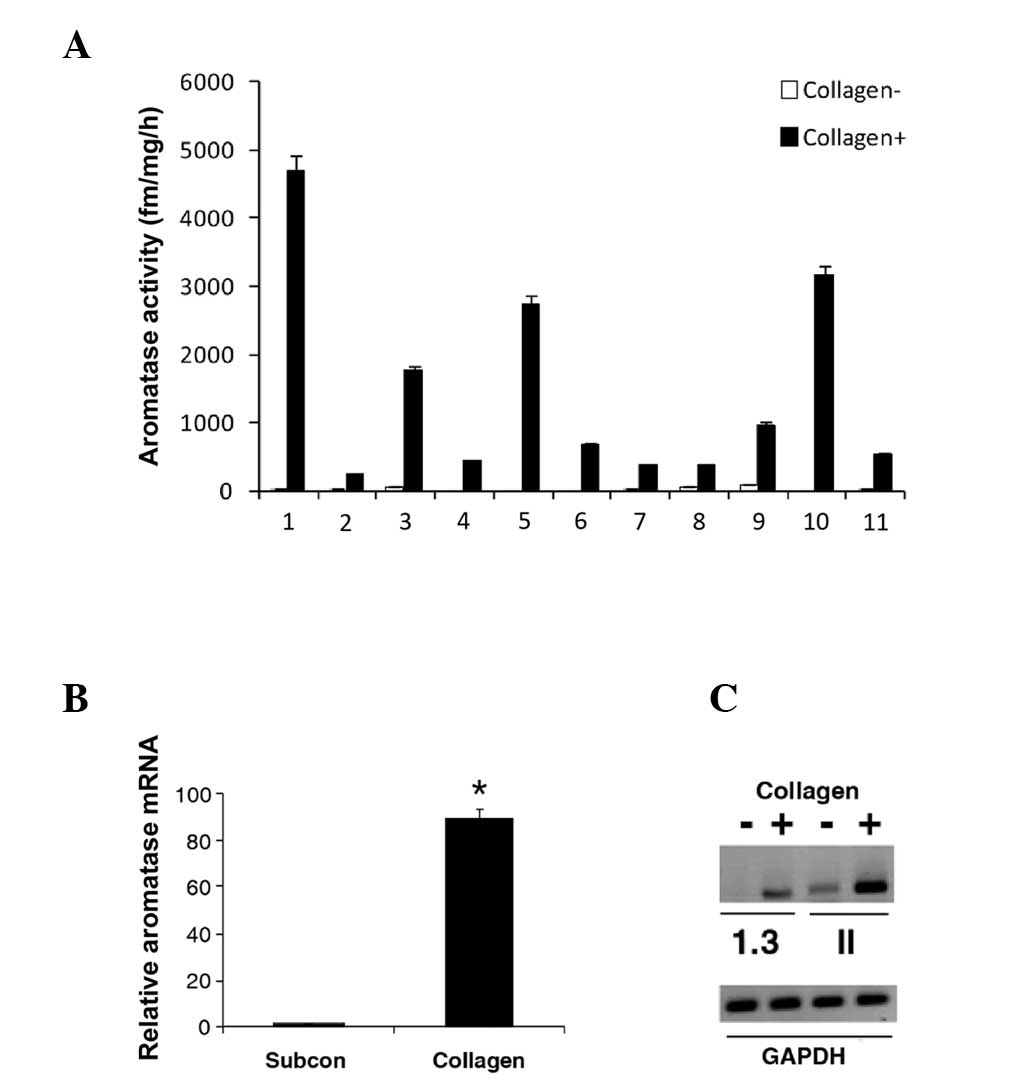
Stromal cells were isolated from the fat tissue excised from cancer-free individuals. Once growing confluently in regular growth medium, the ASCs were seeded in a 2D or collagen 3D system. The data of the aromatase activity assay showed that there was differential expression of mechanical force-induced aromatase in the different individuals (Fig. 1A). Aromatase mRNA was induced in response to mechanical force (Fig. 1B). In addition, the induction of aromatase expression was regulated by promoter I.3/PII (Fig. 1C).

Figure 1

Differential expression of mechanical force-induced aromatase in ASCs of various individuals. (A) Aromatase activity assay in ASCs from 11 individuals. Sample names are listed along the X axis, while aromatase activity is presented on the Y axis. (B) Collagen-induced aromatase expression in adipose stromal cells. *P<0.05, collagen vs subcon. (C) Promoter utilization was tested by semi-quantitative RT-PCR using the presence of collagen. ASCs, adipose stromal cells; RT-PCR, reverse transcription PCR.

Higher DNA methylation load of certain CpG sites of the PII promoter corresponds to the lower aromatase activation

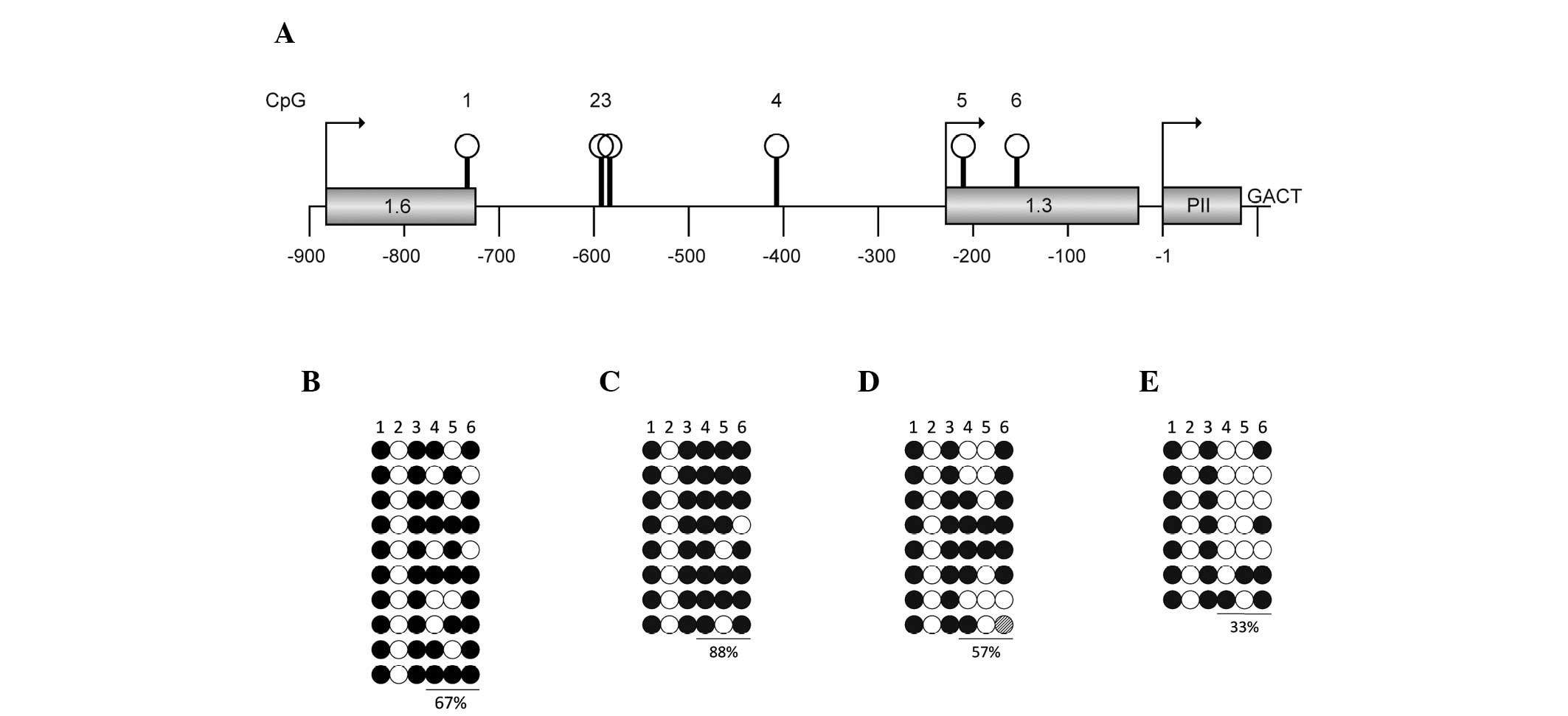
Next, the mechanism of differential expression in various individuals was determined. A DNA methylation assay was performed to test the methylation status of aromatase promoter PII (Fig. 2A). The differential induction of aromatase expression is associated with the DNA methylation load of the promoter region. The higher DNA methylation load of PII promoter is associated with the lower aromatase activation (Fig. 2B–E).

Figure 2

Correlation between DNA methylation status of aromatase promoter region and aromatase inducibility in ASCs of various individuals. (A) CpG sites of aromatase promoter. (B–E) DNA methylation analysis of CpG sites. ASCs, adipose stromal cells.

Reduction of DNA methylation load by AZA treatment restores aromatase activation

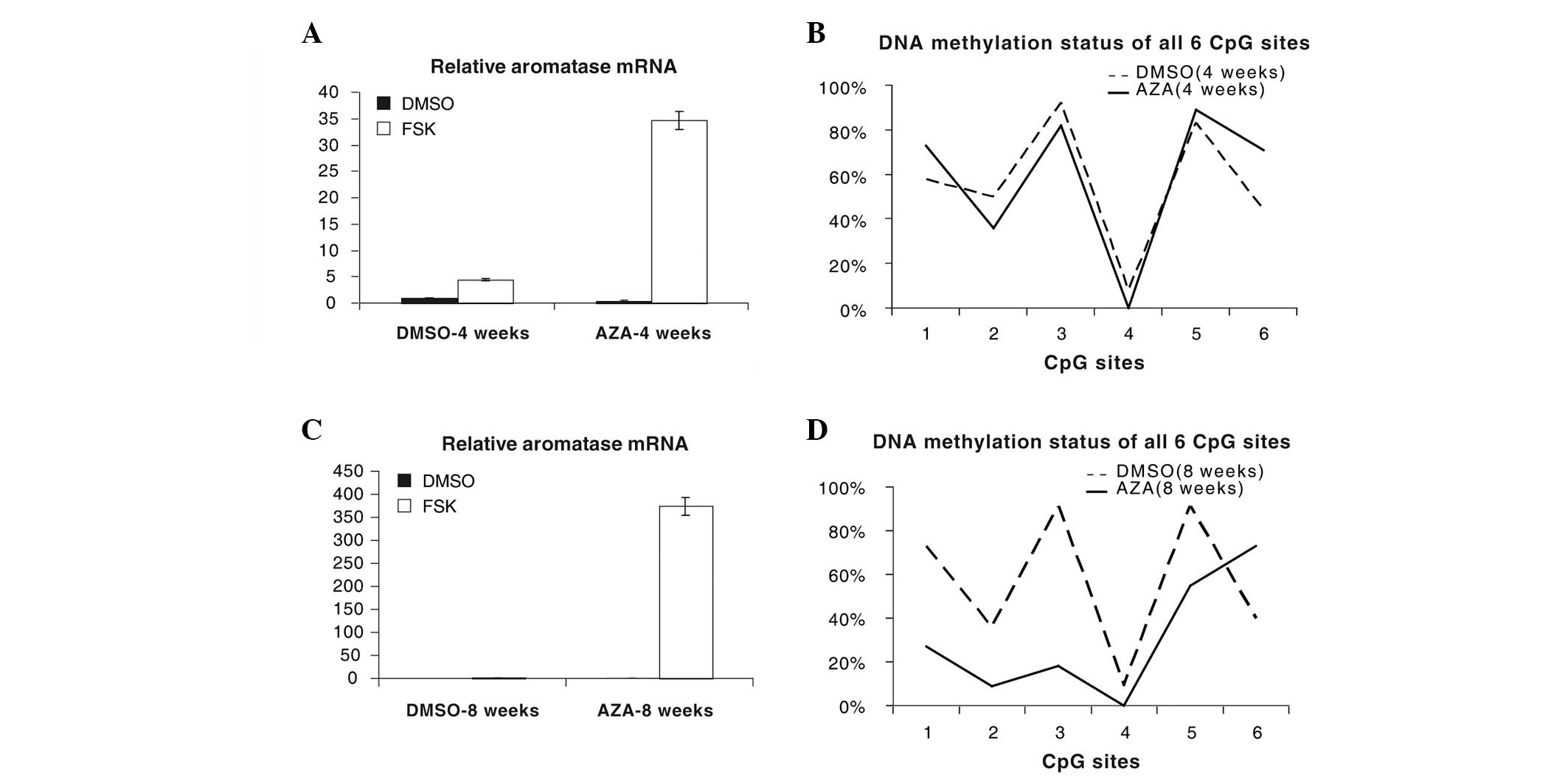
The cells were treated with AZA for 4 (Fig. 3A and B) or 8 weeks (Fig. 3C and D). Aromatase expression and DNA methylation status were analyzed. Along with reduction of the DNA methylation load, aromatase activation was restored.

Figure 3

Reduction of DNA methylation load by AZA treatment restores aromatase activation. (A) mRNA level of aromatase in response to forskolin (FSK) induction following AZA treatment for 4 weeks. (B) DNA methylation assay following AZA treatment for 4 weeks. (C) mRNA level of aromatase in response to forskolin induction following AZA treatment for 8 weeks. (D) DNA methylation assay following AZA treatment for 8 weeks. AZA, 5-Aza-2′-deoxycytidine.

Discussion

The current literature on the mechanical properties of tumors is almost exclusively focused on tumor cells (10,12). As altered mechanical homeostasis in breast tumors affects the epithelial and stromal compartments of the same tumor microenvironment, it is necessary to look beyond the ‘box’ of tumor cells by examining the impact of mechanical forces on the surrounding stroma. Furthermore, ASCs from different individuals may respond to mechanical forces differently, thus, individuals respond differently to risk factors of breast cancer. The current study data showed that there was differential expression of mechanical force-induced aromatase in differing individuals. It also showed that mechanical force activates the PII promoter and that the DNA methylation status of the PII promoter plays an important role in aromatase induction when ASCs respond to mechanical forces.

The efficacy of AIs in treating breast cancer has been clinically proven. However, AIs indiscriminately reduce estrogen synthesis throughout the body, causing major side-effects, including bone loss, increased fracture rates and abnormal lipid metabolism (21). Thus, it is worthwhile to develop inhibitors that selectively block aromatase and estrogen production in breast cancer. By contrast, aromatase I.3/PII promoters have been reported to be activated in tumors, but not in normal tissues (2). Logically, the specific inhibition of signals that lead to activation of promoter I.3/II is likely to inhibit aromatase expression specifically in tumor tissues. The current study data enhance our understanding of the regulation of aromatase expression in an epigenetic manner. These findings may lead to the identification of novel AIs.

Acknowledgements

This study was supported by the Science and Technology Project Foundation, Science and Technology Commission, Guangdong Province, P.R. China (grant no. 2010B031600147).

References

1 

Nass SJ and Davidson NE: The biology of breast cancer. Hematol Oncol Clin North Am. 13:311–332. 1999. View Article : Google Scholar

2 

Bulun SE, Lin Z, Imir G, et al: Regulation of aromatase expression in estrogen-responsive breast and uterine disease: from bench to treatment. Pharmacol Rev. 57:359–383. 2005. View Article : Google Scholar : PubMed/NCBI

3 

Simpson ER and Davis SR: Minireview: aromatase and the regulation of estrogen biosynthesis - some new perspectives. Endocrinology. 142:4589–4594. 2001.PubMed/NCBI

4 

O’Neill JS, Elton RA and Miller WR: Aromatase activity in adipose tissue from breast quadrants: a link with tumour site. Br Med J (Clin Res Ed). 296:741–743. 1988.PubMed/NCBI

5 

Bulun SE, Price TM, Aitken J, Mahendroo MS and Simpson ER: A link between breast cancer and local estrogen biosynthesis suggested by quantification of breast adipose tissue aromatase cytochrome P450 transcripts using competitive polymerase chain reaction after reverse transcription. J Clin Endocrinol Metab. 77:1622–1628. 1993. View Article : Google Scholar

6 

Harada N: Aberrant expression of aromatase in breast cancer tissues. J Steroid Biochem Mol Biol. 61:175–184. 1997. View Article : Google Scholar : PubMed/NCBI

7 

Sasano H and Harada N: Intratumoral aromatase in human breast, endometrial, and ovarian malignancies. Endocr Rev. 19:593–607. 1998.PubMed/NCBI

8 

Meng L, Zhou J, Sasano H, Suzuki T, Zeitoun KM and Bulun SE: Tumor necrosis factor alpha and interleukin 11 secreted by malignant breast epithelial cells inhibit adipocyte differentiation by selectively down-regulating CCAAT/enhancer binding protein alpha and peroxisome proliferator-activated receptor gamma: mechanism of desmoplastic reaction. Cancer Research. 61:2250–2255. 2001.

9 

Zhou J, Gurates B, Yang S, Sebastian S and Bulun SE: Malignant breast epithelial cells stimulate aromatase expression via promoter II in human adipose fibroblasts: an epithelial-stromal interaction in breast tumors mediated by CCAAT/enhancer binding protein beta. Cancer Research. 61:2328–2334. 2001.

10 

Avvisato CL, Yang X, Shah S, Hoxter B, Li W, Gaynor R, Pestell R, Tozeren A and Byers SW: Mechanical force modulates global gene expression and beta-catenin signaling in colon cancer cells. J Cell Sci. 120:2672–2682. 2007. View Article : Google Scholar : PubMed/NCBI

11 

Shyy JY and Chien S: Role of integrins in endothelial mechanosensing of shear stress. Circ Res. 91:769–775. 2002. View Article : Google Scholar : PubMed/NCBI

12 

Alenghat FJ and Ingber DE: Mechanotransduction: all signals point to cytoskeleton, matrix, and integrins. Sci STKE. 2002:pe62002.PubMed/NCBI

13 

Lopez JI, Mouw JK and Weaver VM: Biomechanical regulation of cell orientation and fate. Oncogene. 27:6981–6993. 2008. View Article : Google Scholar : PubMed/NCBI

14 

Nelson CM and Bissell MJ: Of extracellular matrix, scaffolds, and signaling: tissue architecture regulates development, homeostasis, and cancer. Annu Rev Cell Dev Biol. 22:287–309. 2006. View Article : Google Scholar : PubMed/NCBI

15 

Paszek MJ and Weaver VM: The tension mounts: mechanics meets morphogenesis and malignancy. J Mammary Gland Biol Neoplasia. 9:325–342. 2004. View Article : Google Scholar : PubMed/NCBI

16 

Ingber DE: Can cancer be reversed by engineering the tumor microenvironment? Semin Cancer Biol. 18:356–364. 2008. View Article : Google Scholar : PubMed/NCBI

17 

Le Beyec J, Xu R, Lee SY, Nelson CM, Rizki A, Alcaraz J and Bissell MJ: Cell shape regulates global histone acetylation in human mammary epithelial cells. Exp Cell Res. 313:3066–3075. 2007.PubMed/NCBI

18 

Wiseman BS and Werb Z: Stromal effects on mammary gland development and breast cancer. Science. 296:1046–1049. 2002. View Article : Google Scholar : PubMed/NCBI

19 

Katz AJ, Tholpady A, Tholpady SS, Shang H and Ogle RC: Cell surface and transcriptional characterization of human adipose-derived adherent stromal (hADAS) cells. Stem Cells. 23:412–423. 2005. View Article : Google Scholar : PubMed/NCBI

20 

Yue W and Brodie AM: Mechanisms of the actions of aromatase inhibitors 4-hydroxyandrostenedione, fadrozole, and aminoglutethimide on aromatase in JEG-3 cell culture. J Steroid Biochem Mol Biol. 63:317–328. 1997. View Article : Google Scholar : PubMed/NCBI

21 

Morales L, Neven P and Paridaens R: Choosing between an aromatase inhibitor and tamoxifen in the adjuvant setting. Curr Opin Oncol. 17:559–565. 2005. View Article : Google Scholar : PubMed/NCBI

Related Articles

  • Abstract
  • View
  • Download
  • Twitter
Copy and paste a formatted citation
Spandidos Publications style
Zeng XC, Ao X, Yang HF, Zhang GX, Li WH, Liu QL, Tang YL, Xie YC, He WG, Huang YN, Huang YN, et al: Differential expression of stromal aromatase in obese females is regulated by DNA methylation. Mol Med Rep 10: 887-890, 2014.
APA
Zeng, X., Ao, X., Yang, H., Zhang, G., Li, W., Liu, Q. ... Li, R. (2014). Differential expression of stromal aromatase in obese females is regulated by DNA methylation. Molecular Medicine Reports, 10, 887-890. https://doi.org/10.3892/mmr.2014.2275
MLA
Zeng, X., Ao, X., Yang, H., Zhang, G., Li, W., Liu, Q., Tang, Y., Xie, Y., He, W., Huang, Y., Zhang, L., Li, R."Differential expression of stromal aromatase in obese females is regulated by DNA methylation". Molecular Medicine Reports 10.2 (2014): 887-890.
Chicago
Zeng, X., Ao, X., Yang, H., Zhang, G., Li, W., Liu, Q., Tang, Y., Xie, Y., He, W., Huang, Y., Zhang, L., Li, R."Differential expression of stromal aromatase in obese females is regulated by DNA methylation". Molecular Medicine Reports 10, no. 2 (2014): 887-890. https://doi.org/10.3892/mmr.2014.2275
Copy and paste a formatted citation
x
Spandidos Publications style
Zeng XC, Ao X, Yang HF, Zhang GX, Li WH, Liu QL, Tang YL, Xie YC, He WG, Huang YN, Huang YN, et al: Differential expression of stromal aromatase in obese females is regulated by DNA methylation. Mol Med Rep 10: 887-890, 2014.
APA
Zeng, X., Ao, X., Yang, H., Zhang, G., Li, W., Liu, Q. ... Li, R. (2014). Differential expression of stromal aromatase in obese females is regulated by DNA methylation. Molecular Medicine Reports, 10, 887-890. https://doi.org/10.3892/mmr.2014.2275
MLA
Zeng, X., Ao, X., Yang, H., Zhang, G., Li, W., Liu, Q., Tang, Y., Xie, Y., He, W., Huang, Y., Zhang, L., Li, R."Differential expression of stromal aromatase in obese females is regulated by DNA methylation". Molecular Medicine Reports 10.2 (2014): 887-890.
Chicago
Zeng, X., Ao, X., Yang, H., Zhang, G., Li, W., Liu, Q., Tang, Y., Xie, Y., He, W., Huang, Y., Zhang, L., Li, R."Differential expression of stromal aromatase in obese females is regulated by DNA methylation". Molecular Medicine Reports 10, no. 2 (2014): 887-890. https://doi.org/10.3892/mmr.2014.2275
Follow us
  • Twitter
  • LinkedIn
  • Facebook
About
  • Spandidos Publications
  • Careers
  • Cookie Policy
  • Privacy Policy
How can we help?
  • Help
  • Live Chat
  • Contact
  • Email to our Support Team