Introduction
Proteasomal degradation has a critical role in a
wide range of cellular processes, including but not limited to cell
cycle control, gene transcription, DNA repair, protein trafficking,
antigen presentation and protein quality control (1). Abnormal proteasome activity is
implicated in the pathogenesis of cancer and other human diseases
(2–4). The observation that inhibition of
proteasome activity induced apoptosis preferentially in transformed
cells led to the introduction of proteasome inhibitors in clinical
trials for cancer therapy (5 and
refs. therein). Bortezomib (also known as Velcade® or
PS-341), a peptide boronate proteasome inhibitor, was subsequently
approved by the US Food and Drug Administration for the treatment
of relapsed/refractory multiple myeloma (MM) (6–8).
Although bortezomib has become a standard agent for MM and gained
certain success, numerous patients with MM do not respond to
bortezomib, whereas others often develop resistance (5,8).
Therefore, the development of novel approaches are required to
increase the efficacy of bortezomib for the treatment of MM.
The molecular basis underlying bortezomib resistance
in MM cells is unclear and may be attributed to a number of
different mechanisms. For example, mutation or aberrant expression
of ABC membrane transporters, such as P-glycoprotein, induces fast
excretion and/or reduced uptake of the drug. Induction of
functionally redundant or compensatory pathways as a natural
defense mechanism may diminish the effect of bortezomib. Other
major factors that may contribute to bortezomib resistance include
increased drug inactivation and metabolism, subcellular
redistribution, and evasion of apoptosis, necrosis, mitotic
catastrophe or senescence (9–11).
Currently, there is no specific or efficient method to overcome
bortezomib resistance in MM or other cancer types due to its
complex nature. Current attempts to solve this limitation are
mainly focused on combination therapy using a second anticancer
drug along with bortezomib. The majority of combined therapies thus
far lack a rigorous rationale and fail to highlight synergistic
effects. The key to the success of combination therapy is to attack
a specific target, which is essential for cell growth and survival
when proteasome activity is inhibited. Although it is difficult to
directly identify targets for combination therapy in mammalian
cells, the yeast Saccharomyces cerevisiae appears to be an
ideal model system that is used to obtain required information. A
number of the cellular pathways, including the proteasome system
are conserved from yeast to humans. All open reading frames of the
S. cerevisiae genome have been annotated and whole-genome
technologies are mature in yeast (12,13).
In fact, by taking advantage of the outcome of global synthetic
lethal analysis and profiling of chemical-genomic interactions in
yeast (12–14), it was revealed that dyclonine, a
major component of the cough droplets Sucrets, was able to increase
the cytotoxic effects of the proteasome inhibitor MG132 in breast
cancer cells (15). The present
study aimed to examine whether dyclonine may augment the cytotoxic
effects of bortezomib and overcome bortezomib resistance in MM
cells.
Materials and methods
Cell culture and cell viability
assay
RPMI8226 and bortezomib-resistant RPMI8226.BR MM
cell lines were provided by Dr R Orlowski (16). The cells were maintained in
RPMI-1640 (Invitrogen Life Technologies, Carlsbad, CA, USA)
supplemented with 10% fetal bovine serum in 5% CO2 at
37°C. Cell viability was measured by an
3-(4,5-dimethyl-2-thiazolyl)-2,5-diphenyl-2H-tetrazolium bromide
(MTT) assay as previously described (17). Specifically, the cells were
inoculated in 96-well plates at 4,000–6,000 cells/well 24 h prior
to the treatment with bortezomib, dyclonine or a combination of the
two. Dyclonine and MTT were purchased from Sigma-Aldrich (St.
Louis, MO, USA), whereas bortezomib was obtained from LC Labs
(Woburn, MA, USA) and dissolved in dimethylsulfoxide. Data were
derived from at least three independent experiments each conducted
in quadruplicate.
Immunoblotting analysis
The cells were washed three times with ice-cold
phosphate-buffered saline and scraped for centrifugation at 1,500 ×
g for 5 min. The cell pellets were lysed in buffer (50 mM Tris-Cl,
pH 7.5, 10 mM MgCl2, 100 mM KCl, 1% Triton X-100, 10%
glycerol, 1 mM DTT, 1X protease inhibitor cocktail). The cell
extracts were separated by SDS-PAGE (8% gel), followed by
immunoblotting with anti-poly (ADP-ribose) polymerase (PARP; Cell
Signaling Technology, Inc., Danvers, MA, USA) and anti-β-actin
(Sigma-Aldrich) antibodies, respectively. The signals were detected
by horseradish peroxidase-conjugated secondary antibody and
Visualizer Western Blot Detection kit (Upstate, Lake Placid, NY,
USA).
Results
Cytotoxicity analysis
To assess the potential application of dyclonine in
combination therapy with bortezomib for MM, RPMI8226 and
RPMI8226.BR cell lines were used. First, the cytotoxicity of
dyclonine in RPMI8226 and RPMI8226.BR cells was investigated using
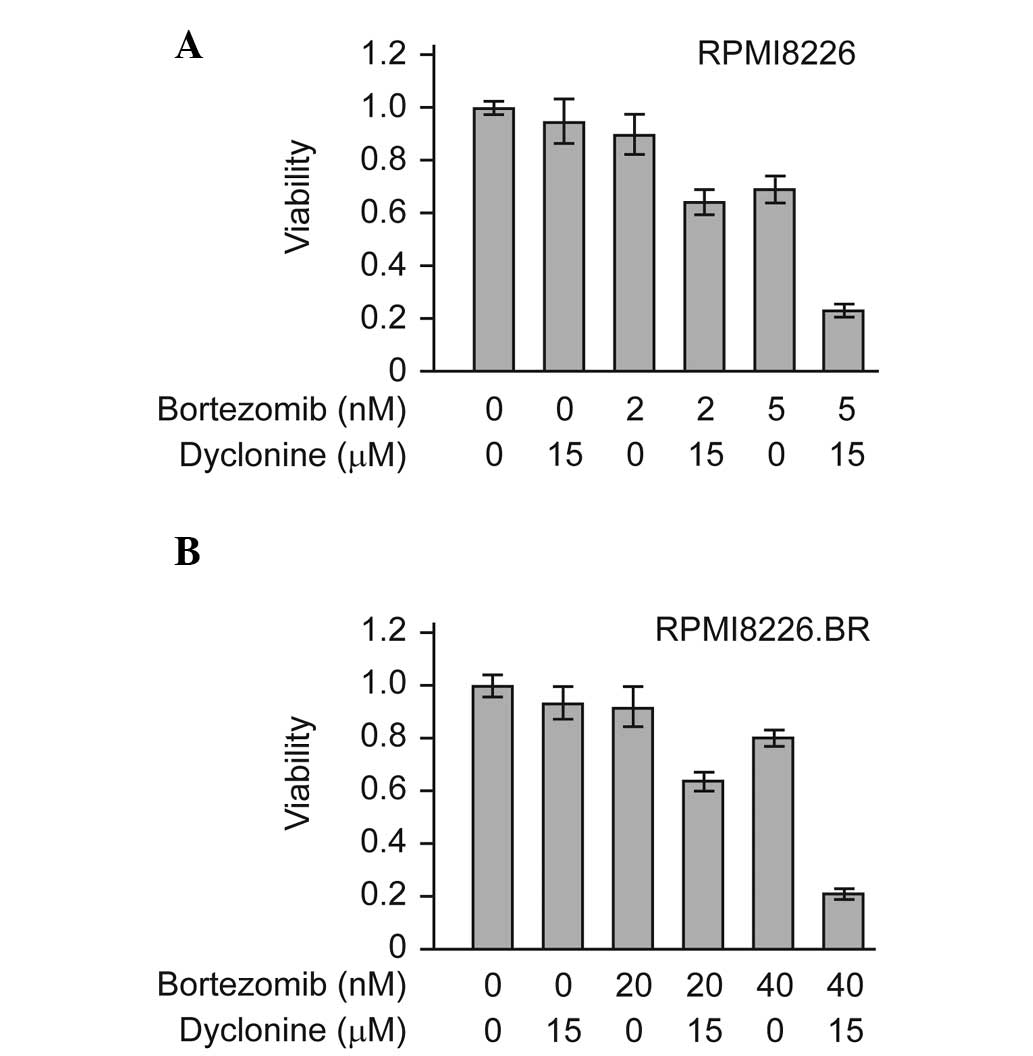
an MTT assay. Dyclonine appeared to have only a mild effect on the
viability of the two cell lines up to the concentration of 15 μM
(Fig. 1A and B). Then, it was
examined whether dyclonine augmented the cytotoxic effects of
bortezomib in RPMI8226 cells. Various doses of bortezomib were used
to treat the cells in the absence or presence of 15 μM dyclonine.
As demonstrated in Fig. 1A,
dyclonine substantially enhanced the cytotoxic effects of
bortezomib. Approximately 10 and 30% of RPMI8226 cells were killed
by 2 and 5 nM of bortezomib, respectively, in the absence of
dyclonine, but the numbers increased to 40 and 75% with the
addition of dyclonine.
Overcoming drug resistance
It was then determined whether dyclonine may
facilitate in overcoming drug resistance in bortezomib-resistant MM
cells. As demonstrated in Fig. 1B,
~8 and 20% of RPMI8226.BR cells died following treated with 20 and
40 nM bortezomib in the absence of dyclonine. The percentage of
inviable cells reached 35 and 80% with addition of dyclonine.
Therefore, dyclonine was able to reduce bortezomib resistance in MM
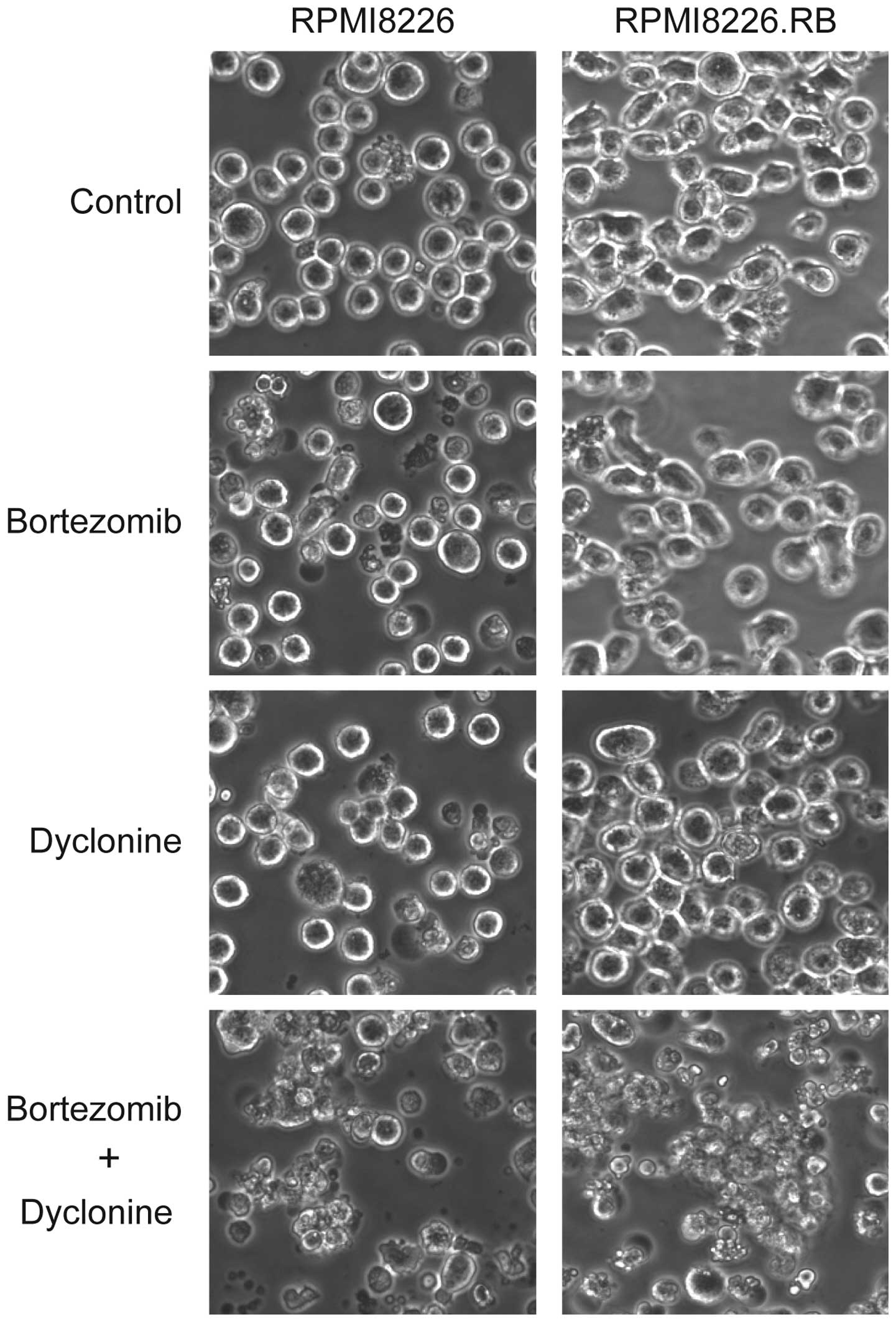
cells. Consistent with the MTT assay, examination of morphological
changes revealed cell death following simultaneous treatment with
bortezomib and dyclonine (Fig. 2).
By contrast, the treatment with individual agents did not result in
cell death. Taken together, these results suggest that dyclonine
enhanced the cytotoxic effects of bortezomib and minimized the drug
resistance in MM cells.
Induction of apoptosis following
combination treatment
To examine the induction of apoptosis by the
combined treatment with bortezomib and dyclonine, the cleavage of
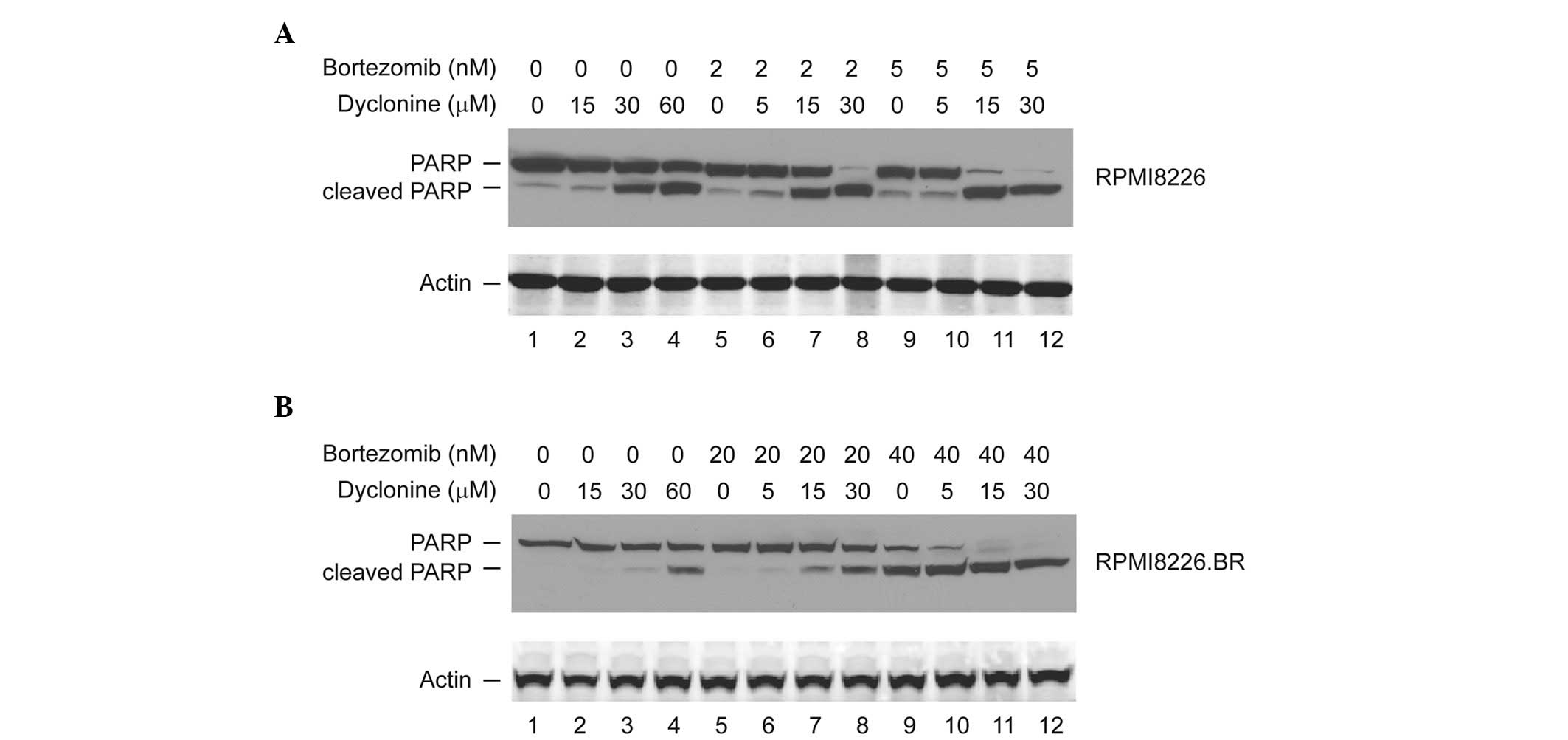
PARP was examined using immunoblotting analysis. A small fraction
of PARP was constantly cleaved in RPMI8226 cells in the absence of
bortezomib and dyclonine (Fig. 3A,
lane 1). The addition of dyclonine to the medium up to a
concentration of 15 μM did not induce PARP cleavage (Fig. 3A, comparing lanes 1 and 2).
Exposure of the cells to bortezomib at 2 and 5 nM only marginally
increased the cleavage of PARP (Fig.
3A, comparing lanes 1, 5 and 9). Notably, a marked increase in
cleaved PARP product was detected when the cells were
simultaneously treated with bortezomib (2 or 5 nM) and 15 μM
dyclonine (Fig. 3A, comparing
lanes 2, 5, 7, 9 and 11). In addition, dyclonine at high
concentrations (30 or 60 μM) also induced cleavage of PARP, but to
a notably weaker extent compared with that caused by the combined
treatment (Fig. 3A, comparing
lanes 3, 4, 8 and 12). Similarly, the cleavage of PARP in
RPMI8226.BR cells was markedly increased by the combined treatment
(Fig. 3B). These results indicate
that a combination of bortezomib and dyclonine has a greater
potential to induce apoptosis in MM cells than each individual
agent alone.
Discussion
While the proteasome has emerged as an important
target for cancer therapy, it remains a challenging task to improve
the efficacy of proteasome inhibitors, such as bortezomib, and to
overcome the occurrence of drug resistance (18). Combination therapy is in principle
a promising approach to increase the therapeutic effects of
bortezomib. The current strategy in preclinical studies and in
clinical trials is an application of a second anticancer agent
along with bortezomib, and rarely produces a satisfactory
synergistic effect (5,8). Taking advantage of the research
conducted in budding yeast (12–14),
we hypothesized that dyclonine may have a synergistic effect with
proteasome inhibitors in mammalian cells, and in fact, we
previously demonstrated that dyclonine enhanced the cytotoxic
effects of MG132 in breast cancer cells (15). The present study further
demonstrated that dyclonine augments the cytotoxic effects of
bortezomib and reduces drug resistance in MM cell lines.
It is currently unclear how dyclonine enhances the
cytotoxic effects of bortezomib. Two possible mechanisms have been
considered. First, dyclonine may facilitate bortezomib-induced
apoptosis. It is well established that the inhibition of the
proteasome induces apoptosis in cancer cells (5). Previous studies have suggested that
dyclonine is an inhibitor of the C-14 sterol reductase Erg24, which
is essential for ergosterol biosynthesis in yeast (19). There are two Erg24 homologs in
human cells with C-14 sterol reductase activity, including
3β-hydroxysterol C-14 reductase and the lamin B receptor (20,21).
Dyclonine likely inhibits the lipid biosynthesis pathway and
therefore, may impair the fluidity of cellular membranes, i.e.
plasma and mitochondrial membranes, in cancer cells. This may
augment the induction of apoptosis by inhibiting proteasome
activity. Second, dyclonine may have a synergistic effect with
bortezomib in deregulating lipid metabolism. Recent studies have
demonstrated that endoplasmic reticulum-associated degradation
(ERAD) has a crucial role in feedback regulation of cholesterol
synthesis (22,23). When sterols are depleted, the
membrane-bound transcription factors (SREBPs) are activated by ERAD
in which SREBPs are cleaved by the proteasome and the N-terminal
fragments are released from the membrane and enter the nucleus to
induce the genes required for cholesterol synthesis. By contrast,
when sterols build up in the cell, activation of SREBPs by ERAD is
inhibited. It is therefore hypothesized that bortezomib inhibits
the ERAD process and, as a consequence, prevents the activation of
SREBPs. Therefore, the inhibition of cholesterol synthesis by
dyclonine is not compensated by the ERAD-mediated feedback
mechanism. While further studies are required to decipher the
molecular basis of the interaction between bortezomib and
dyclonine, the present study unveils a potential novel use of
dyclonine in combination therapy with bortezomib for patients with
MM.
Acknowledgements
The authors would like to thank Dr R Ordowski for
providing the RPMI8226 and RPMI8226.BR cell lines. The present
study was supported by a fund from the Office of the Vice President
for Research at Wayne State University.
References
|
1
|
Varshavsky A: The ubiquitin system, an
immense realm. Annu Rev Biochem. 81:167–176. 2012. View Article : Google Scholar : PubMed/NCBI
|
|
2
|
Schwartz AL and Ciechanover A: The
ubiquitin-proteasome pathway and pathogenesis of human diseases.
Annu Rev Med. 50:57–74. 1999. View Article : Google Scholar : PubMed/NCBI
|
|
3
|
Xie Y: Feedback regulation of proteasome
gene expression and its implications in cancer therapy. Cancer
Metastasis Rev. 29:687–693. 2010. View Article : Google Scholar : PubMed/NCBI
|
|
4
|
Micel LN, Tentler JJ, Smith PG and
Eckhardt GS: Role of ubiquitin ligases and the proteasome in
oncogenesis: novel targets for anticancer therapies. J Clin Oncol.
31:1231–1238. 2013. View Article : Google Scholar : PubMed/NCBI
|
|
5
|
Orlowski RZ and Kuhn DJ: Proteasome
inhibitors in cancer therapy: lessons from the first decade. Clin
Cancer Res. 14:1649–1657. 2008. View Article : Google Scholar : PubMed/NCBI
|
|
6
|
Teicher BA, Ara G, Herbst R, Palombella VJ
and Adams J: The proteasome inhibitor PS-341 in cancer therapy.
Clin Cancer Res. 5:2638–2645. 1999.PubMed/NCBI
|
|
7
|
Voorhees PM and Orlowski RZ: The
proteasome and proteasome inhibitors in cancer therapy. Ann Rev
Pharmacol Toxicol. 46:189–213. 2006. View Article : Google Scholar : PubMed/NCBI
|
|
8
|
Kumar A, Galeb S and Djulbegovic B:
Treatment of patients with multiple myeloma: an overview of
systematic reviews. Acta Haematol. 125:8–22. 2011. View Article : Google Scholar : PubMed/NCBI
|
|
9
|
Gottesman MM: Mechanisms of cancer drug
resistance. Annu Rev Med. 53:615–627. 2002. View Article : Google Scholar : PubMed/NCBI
|
|
10
|
Dimri GP: What has senescence got to do
with cancer? Cancer Cell. 7:505–512. 2005. View Article : Google Scholar : PubMed/NCBI
|
|
11
|
Mansilla S, Bataller M and Portugal J:
Mitotic catastrophe as a consequence of chemotherapy. Anticancer
Agents Med Chem. 6:589–602. 2006. View Article : Google Scholar : PubMed/NCBI
|
|
12
|
Pan X, Ye P, Yuan DS, et al: A DNA
integrity network in the yeast Saccharomyces cerevisiae.
Cell. 124:1069–1081. 2006. View Article : Google Scholar : PubMed/NCBI
|
|
13
|
Tong AH, Lesage G, Bader GD, et al: Global
mapping of the yeast genetic interaction network. Science.
303:808–813. 2004. View Article : Google Scholar : PubMed/NCBI
|
|
14
|
Giaever G, Flaherty P, Kumm J, et al:
Chemogenomic profiling: identifying the functional interactions of
small molecules in yeast. Proc Natl Acad Sci USA. 101:793–798.
2004. View Article : Google Scholar : PubMed/NCBI
|
|
15
|
Ju D, Wang X and Xie Y: Dyclonine and
alverine citrate enhance the cytotoxic effects of proteasome
inhibitor MG132 on breast cancer cells. Intl J Mol Med. 23:205–209.
2009.PubMed/NCBI
|
|
16
|
Kuhn DJ, Chen Q, Voothees PM, et al:
Potent activity of carfilzomib, a novel, irreversible inhibitor of
the ubiquitin-proteasome pathway, against preclinical models of
multiple myeloma. Blood. 110:3281–3290. 2007. View Article : Google Scholar
|
|
17
|
Xu H, Ju D, Jarois T and Xie Y: Diminished
feedback regulation of proteasome expression and resistance to
proteasome inhibitors in breast cancer cells. Breast Cancer Res
Treat. 107:267–274. 2008. View Article : Google Scholar : PubMed/NCBI
|
|
18
|
Milano A, Iaffaioli RV and Caponigro F:
The proteasome: a worthwhile target for the treatment of solid
tumours? Eur J Cancer. 43:1125–1133. 2007. View Article : Google Scholar : PubMed/NCBI
|
|
19
|
Lees ND, Skaggs B, Kirsch DR and Bard M:
Cloning of the late genes in the ergosterol biosynthetic pathway of
Saccharomyces cerevisiae - a review. Lipids. 30:221–226.
1995. View Article : Google Scholar : PubMed/NCBI
|
|
20
|
Bennati AM, Castelli M, Fazia MA, et al:
Sterol dependent regulation of human TM7SF2 gene expression: role
of the encoded 3beta-hydroxysterol Delta14-reductase in human
cholesterol biosynthesis. Biochim Biophys Acta. 1761:677–668. 2006.
View Article : Google Scholar : PubMed/NCBI
|
|
21
|
Holmer L, Pezhman A and Worman HJ: The
human lamin B receptor/sterol reductase multigene family. Genomics.
54:469–476. 1998. View Article : Google Scholar : PubMed/NCBI
|
|
22
|
Meusser B, Hirsch C, Jarosch E and Sommer
T: ERAD: the long road to destruction. Nat Cell Biol. 7:766–772.
2005. View Article : Google Scholar : PubMed/NCBI
|
|
23
|
Goldstein JL, DeBose-Boyd RA and Brown MS:
Protein sensors for membrane sterols. Cell. 124:35–46. 2006.
View Article : Google Scholar : PubMed/NCBI
|