Spandidos Publications Logo
  • About
    • About Spandidos
    • Aims and Scopes
    • Abstracting and Indexing
    • Editorial Policies
    • Reprints and Permissions
    • Job Opportunities
    • Terms and Conditions
    • Contact
  • Journals
    • All Journals
    • Oncology Letters
      • Oncology Letters
      • Information for Authors
      • Editorial Policies
      • Editorial Board
      • Aims and Scope
      • Abstracting and Indexing
      • Bibliographic Information
      • Archive
    • International Journal of Oncology
      • International Journal of Oncology
      • Information for Authors
      • Editorial Policies
      • Editorial Board
      • Aims and Scope
      • Abstracting and Indexing
      • Bibliographic Information
      • Archive
    • Molecular and Clinical Oncology
      • Molecular and Clinical Oncology
      • Information for Authors
      • Editorial Policies
      • Editorial Board
      • Aims and Scope
      • Abstracting and Indexing
      • Bibliographic Information
      • Archive
    • Experimental and Therapeutic Medicine
      • Experimental and Therapeutic Medicine
      • Information for Authors
      • Editorial Policies
      • Editorial Board
      • Aims and Scope
      • Abstracting and Indexing
      • Bibliographic Information
      • Archive
    • International Journal of Molecular Medicine
      • International Journal of Molecular Medicine
      • Information for Authors
      • Editorial Policies
      • Editorial Board
      • Aims and Scope
      • Abstracting and Indexing
      • Bibliographic Information
      • Archive
    • Biomedical Reports
      • Biomedical Reports
      • Information for Authors
      • Editorial Policies
      • Editorial Board
      • Aims and Scope
      • Abstracting and Indexing
      • Bibliographic Information
      • Archive
    • Oncology Reports
      • Oncology Reports
      • Information for Authors
      • Editorial Policies
      • Editorial Board
      • Aims and Scope
      • Abstracting and Indexing
      • Bibliographic Information
      • Archive
    • Molecular Medicine Reports
      • Molecular Medicine Reports
      • Information for Authors
      • Editorial Policies
      • Editorial Board
      • Aims and Scope
      • Abstracting and Indexing
      • Bibliographic Information
      • Archive
    • World Academy of Sciences Journal
      • World Academy of Sciences Journal
      • Information for Authors
      • Editorial Policies
      • Editorial Board
      • Aims and Scope
      • Abstracting and Indexing
      • Bibliographic Information
      • Archive
    • International Journal of Functional Nutrition
      • International Journal of Functional Nutrition
      • Information for Authors
      • Editorial Policies
      • Editorial Board
      • Aims and Scope
      • Abstracting and Indexing
      • Bibliographic Information
      • Archive
    • International Journal of Epigenetics
      • International Journal of Epigenetics
      • Information for Authors
      • Editorial Policies
      • Editorial Board
      • Aims and Scope
      • Abstracting and Indexing
      • Bibliographic Information
      • Archive
    • Medicine International
      • Medicine International
      • Information for Authors
      • Editorial Policies
      • Editorial Board
      • Aims and Scope
      • Abstracting and Indexing
      • Bibliographic Information
      • Archive
  • Articles
  • Information
    • Information for Authors
    • Information for Reviewers
    • Information for Librarians
    • Information for Advertisers
    • Conferences
  • Language Editing
Spandidos Publications Logo
  • About
    • About Spandidos
    • Aims and Scopes
    • Abstracting and Indexing
    • Editorial Policies
    • Reprints and Permissions
    • Job Opportunities
    • Terms and Conditions
    • Contact
  • Journals
    • All Journals
    • Biomedical Reports
      • Information for Authors
      • Editorial Policies
      • Editorial Board
      • Aims and Scope
      • Abstracting and Indexing
      • Bibliographic Information
      • Archive
    • Experimental and Therapeutic Medicine
      • Information for Authors
      • Editorial Policies
      • Editorial Board
      • Aims and Scope
      • Abstracting and Indexing
      • Bibliographic Information
      • Archive
    • International Journal of Epigenetics
      • Information for Authors
      • Editorial Policies
      • Editorial Board
      • Aims and Scope
      • Abstracting and Indexing
      • Bibliographic Information
      • Archive
    • International Journal of Functional Nutrition
      • Information for Authors
      • Editorial Policies
      • Editorial Board
      • Aims and Scope
      • Abstracting and Indexing
      • Bibliographic Information
      • Archive
    • International Journal of Molecular Medicine
      • Information for Authors
      • Editorial Policies
      • Editorial Board
      • Aims and Scope
      • Abstracting and Indexing
      • Bibliographic Information
      • Archive
    • International Journal of Oncology
      • Information for Authors
      • Editorial Policies
      • Editorial Board
      • Aims and Scope
      • Abstracting and Indexing
      • Bibliographic Information
      • Archive
    • Medicine International
      • Information for Authors
      • Editorial Policies
      • Editorial Board
      • Aims and Scope
      • Abstracting and Indexing
      • Bibliographic Information
      • Archive
    • Molecular and Clinical Oncology
      • Information for Authors
      • Editorial Policies
      • Editorial Board
      • Aims and Scope
      • Abstracting and Indexing
      • Bibliographic Information
      • Archive
    • Molecular Medicine Reports
      • Information for Authors
      • Editorial Policies
      • Editorial Board
      • Aims and Scope
      • Abstracting and Indexing
      • Bibliographic Information
      • Archive
    • Oncology Letters
      • Information for Authors
      • Editorial Policies
      • Editorial Board
      • Aims and Scope
      • Abstracting and Indexing
      • Bibliographic Information
      • Archive
    • Oncology Reports
      • Information for Authors
      • Editorial Policies
      • Editorial Board
      • Aims and Scope
      • Abstracting and Indexing
      • Bibliographic Information
      • Archive
    • World Academy of Sciences Journal
      • Information for Authors
      • Editorial Policies
      • Editorial Board
      • Aims and Scope
      • Abstracting and Indexing
      • Bibliographic Information
      • Archive
  • Articles
  • Information
    • For Authors
    • For Reviewers
    • For Librarians
    • For Advertisers
    • Conferences
  • Language Editing
Login Register Submit
  • This site uses cookies
  • You can change your cookie settings at any time by following the instructions in our Cookie Policy. To find out more, you may read our Privacy Policy.

    I agree
Search articles by DOI, keyword, author or affiliation
Search
Advanced Search
presentation
Molecular Medicine Reports
Join Editorial Board Propose a Special Issue
Print ISSN: 1791-2997 Online ISSN: 1791-3004
Journal Cover
November-2014 Volume 10 Issue 5

Full Size Image

Sign up for eToc alerts
Recommend to Library

Journals

International Journal of Molecular Medicine

International Journal of Molecular Medicine

International Journal of Molecular Medicine is an international journal devoted to molecular mechanisms of human disease.

International Journal of Oncology

International Journal of Oncology

International Journal of Oncology is an international journal devoted to oncology research and cancer treatment.

Molecular Medicine Reports

Molecular Medicine Reports

Covers molecular medicine topics such as pharmacology, pathology, genetics, neuroscience, infectious diseases, molecular cardiology, and molecular surgery.

Oncology Reports

Oncology Reports

Oncology Reports is an international journal devoted to fundamental and applied research in Oncology.

Experimental and Therapeutic Medicine

Experimental and Therapeutic Medicine

Experimental and Therapeutic Medicine is an international journal devoted to laboratory and clinical medicine.

Oncology Letters

Oncology Letters

Oncology Letters is an international journal devoted to Experimental and Clinical Oncology.

Biomedical Reports

Biomedical Reports

Explores a wide range of biological and medical fields, including pharmacology, genetics, microbiology, neuroscience, and molecular cardiology.

Molecular and Clinical Oncology

Molecular and Clinical Oncology

International journal addressing all aspects of oncology research, from tumorigenesis and oncogenes to chemotherapy and metastasis.

World Academy of Sciences Journal

World Academy of Sciences Journal

Multidisciplinary open-access journal spanning biochemistry, genetics, neuroscience, environmental health, and synthetic biology.

International Journal of Functional Nutrition

International Journal of Functional Nutrition

Open-access journal combining biochemistry, pharmacology, immunology, and genetics to advance health through functional nutrition.

International Journal of Epigenetics

International Journal of Epigenetics

Publishes open-access research on using epigenetics to advance understanding and treatment of human disease.

Medicine International

Medicine International

An International Open Access Journal Devoted to General Medicine.

Journal Cover
November-2014 Volume 10 Issue 5

Full Size Image

Sign up for eToc alerts
Recommend to Library

  • Article
  • Citations
    • Cite This Article
    • Download Citation
    • Create Citation Alert
    • Remove Citation Alert
    • Cited By
  • Similar Articles
    • Related Articles (in Spandidos Publications)
    • Similar Articles (Google Scholar)
    • Similar Articles (PubMed)
  • Download PDF
  • Download XML
  • View XML
Article Open Access

Upregulation of heat shock factor 1 transcription activity is associated with hepatocellular carcinoma progression

  • Authors:
    • Shulian Li
    • Wanli Ma
    • Teng Fei
    • Qiang Lou
    • Yaqin Zhang
    • Xiukun  Cui
    • Xiaoming Qin
    • Jun  Zhang
    • Guangchao Liu
    • Zheng Dong
    • Yuanfang Ma
    • Zhengshun Song
    • Yanzhong Hu
  • View Affiliations / Copyright

    Affiliations: State Key Laboratory of Antibody Engineering, Department of Genetics and Cell Biology, Henan University School of Medicine, Henan 475004, P.R. China, Department of Surgery, Huaihe Hospital Affiliated to Henan University, Kaifeng, Henan 475004, P.R. China, Department of Surgery, Shanghai Tenth People's Hospital Affiliated to Tongji University, Shanghai 20072, P.R. China, Department of Surgery, Shanghai Tenth People's Hospital Affiliated to Tongji University, Shanghai 20072, P.R. China
    Copyright: © Li et al. This is an open access article distributed under the terms of Creative Commons Attribution License [CC BY_NC 3.0].
  • Pages: 2313-2321
    |
    Published online on: September 8, 2014
       https://doi.org/10.3892/mmr.2014.2547
  • Expand metrics +
Metrics: Total Views: 0 (Spandidos Publications: | PMC Statistics: )
Metrics: Total PDF Downloads: 0 (Spandidos Publications: | PMC Statistics: )
Cited By (CrossRef): 0 citations Loading Articles...

This article is mentioned in:


Abstract

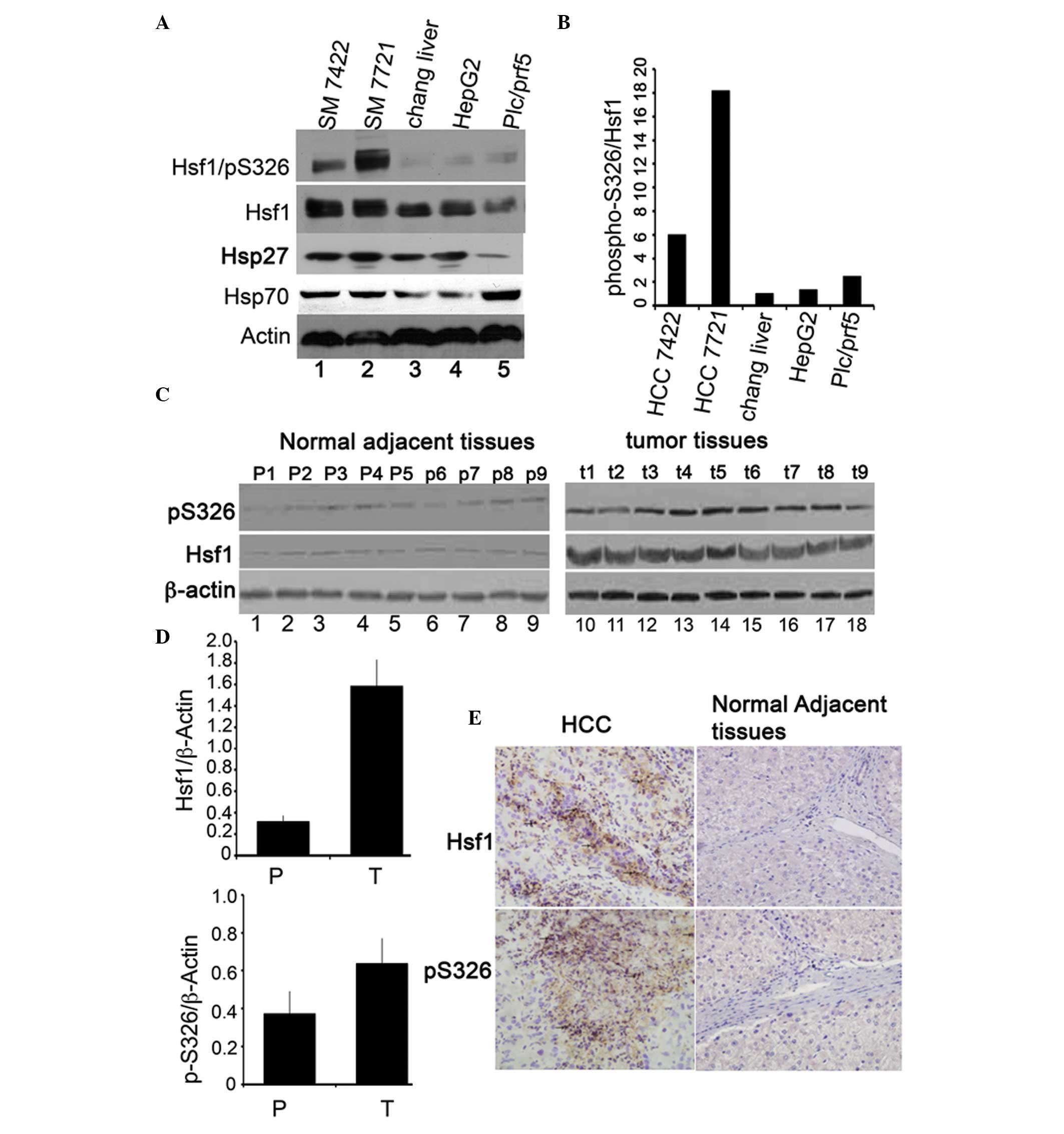
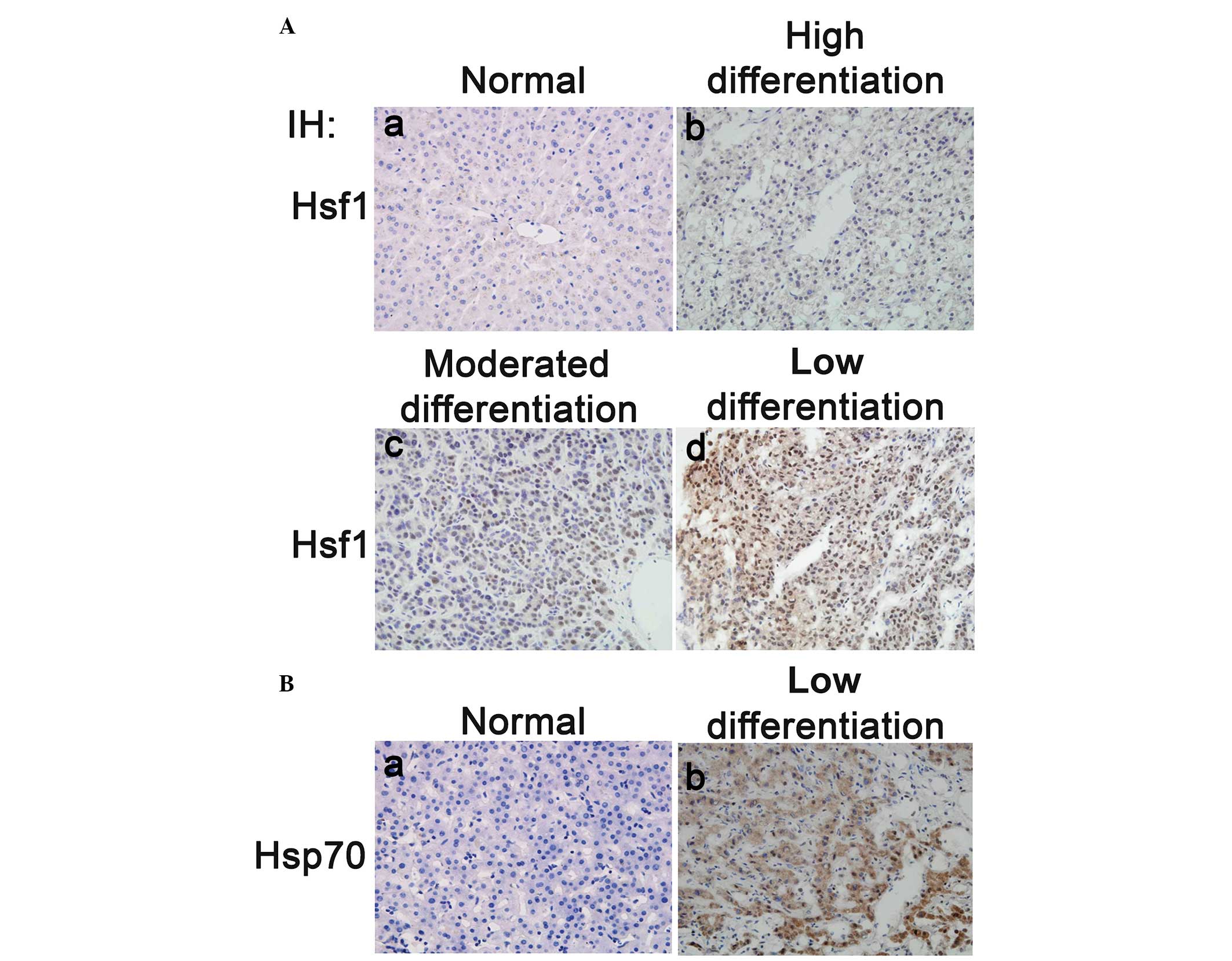
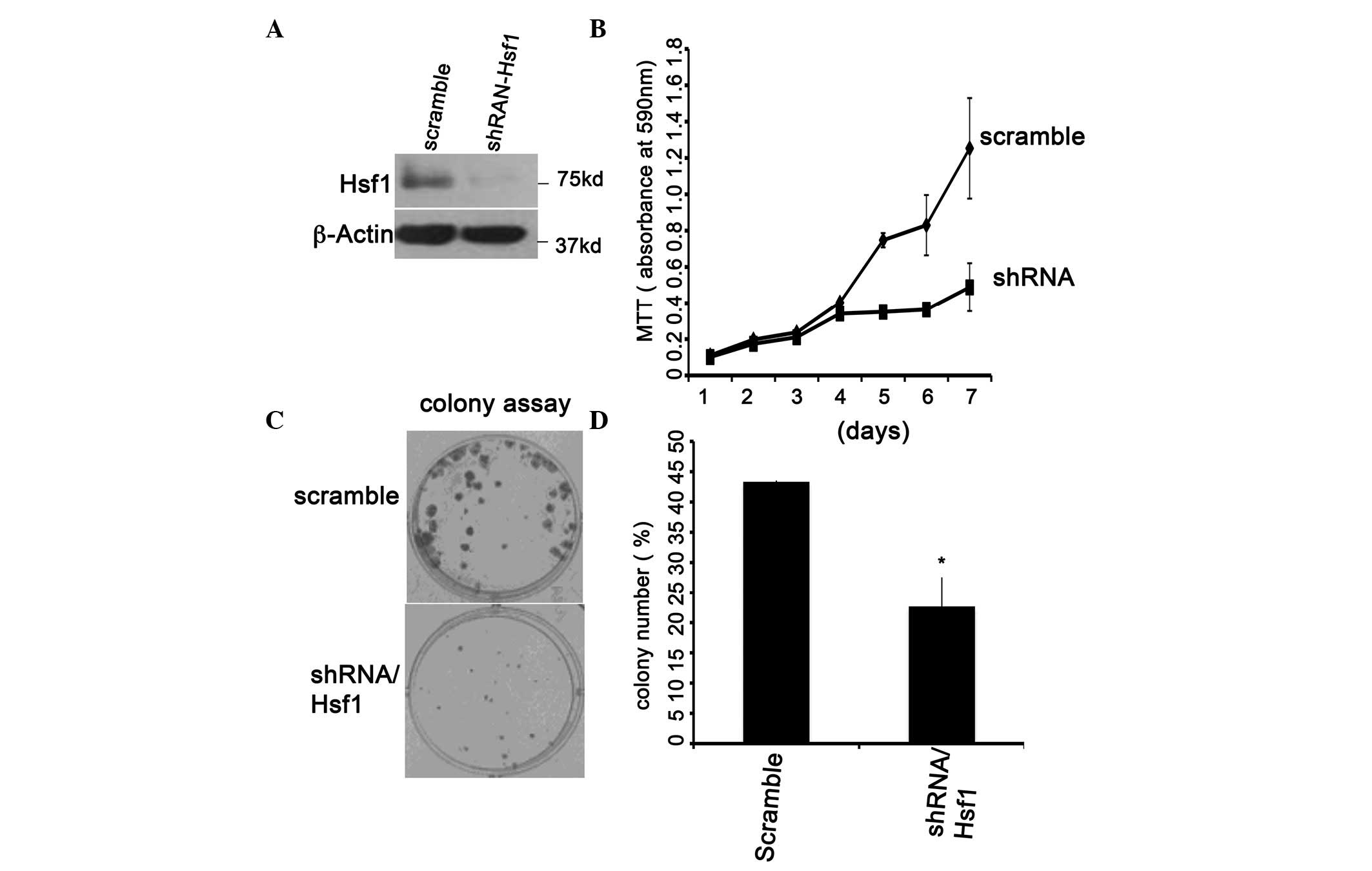
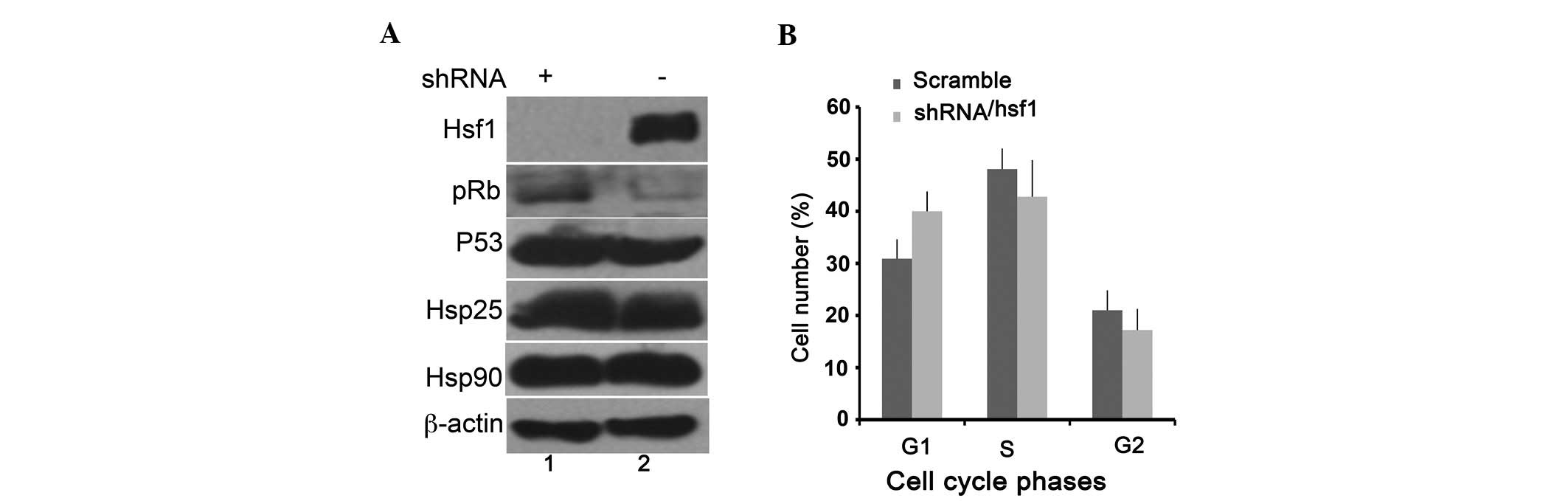
Heat shock factor 1 (HSF1) is associated with tissue‑specific tumorigenesis in a number of mouse models, and has been used a as prognostic marker of cancer types, including breast and prostatic cancer. However, its role in human hepatocellular carcinoma (HCC) is not well understood. Using immunoblotting and immunohistochemical staining, it was identified that HSF1 and its serine (S) 326 phosphorylation, a biomarker of HSF1 activation, are significantly upregulated in human HCC tissues and HCC cell lines compared with their normal counterparts. Cohort analyses indicated that upregulation of the expression of HSF1 and its phospho‑S326 is significantly correlated with HCC progression, invasion and patient survival prognosis (P<0.001); however, not in the presence of a hepatitis B virus infection and the expression of alpha-fetoprotein and carcinoembryonic antigen. Knockdown of HSF1 with shRNA induced the protein expression of tumor suppressor retinoblastoma protein, resulting in attenuated plc/prf5 cell growth and colony formation in vitro. Taken together, these data markedly support that HSF1 is a potential prognostic marker and therapeutic target for the treatment of HCC.
View Figures

Figure 1

Figure 2

Figure 3

Figure 4

View References

1 

Sorger PK: Heat shock factor and the heat shock response. Cell. 65:363–366. 1991. View Article : Google Scholar : PubMed/NCBI

2 

Qian SB, McDonough H, Boellmann F, et al: CHIP-mediated stress recovery by sequential ubiquitination of substrates and HSP70. Nature. 440:551–555. 2006. View Article : Google Scholar : PubMed/NCBI

3 

Christians E: HSF1 knock-out. J Biol Chem. 286:le26–le27. 2011. View Article : Google Scholar : PubMed/NCBI

4 

Dai C, Whitesell L, Rogers AB and Lindquist S: Heat shock factor 1 is a powerful multifaceted modifier of carcinogenesis. Cell. 130:1005–1018. 2007. View Article : Google Scholar : PubMed/NCBI

5 

Meng L, Gabai VL and Sherman MY: Heat-shock transcription factor HSF1 has a critical role in human epidermal growth factor receptor-2-induced cellular transformation and tumorigenesis. Oncogene. 29:5204–5213. 2010. View Article : Google Scholar

6 

Wang Y, Theriault JR, He H, et al: Expression of a dominant negative heat shock factor-1 construct inhibits aneuploidy in prostate carcinoma cells. J Biol Chem. 279:32651–32659. 2004. View Article : Google Scholar : PubMed/NCBI

7 

Mendillo ML, Santagata S, Koeva M, et al: HSF1 drives a transcriptional program distinct from heat shock to support highly malignant human cancers. Cell. 150:549–562. 2012. View Article : Google Scholar : PubMed/NCBI

8 

Santón A, García-Cosío M, Cristóbal E, et al: Expression of heat shock proteins in classical Hodgkin lymphoma: correlation with apoptotic pathways and prognostic significance. Histopathology. 58:1072–1080. 2011.PubMed/NCBI

9 

Xi C, Hu Y, Buckhaults P, et al: Heat shock factor HSF1 cooperates with ErbB2 (Her2/Neu) protein to promote mammary tumorigenesis and metastasis. J Biol Chem. 287:35646–35657. 2012. View Article : Google Scholar : PubMed/NCBI

10 

Cheng Q, Chang JT, Geradts J, et al: Amplification and high-level expression of heat shock protein 90 marks aggressive phenotypes of human epidermal growth factor receptor 2 negative breast cancer. Breast Cancer Res. 14:R622012. View Article : Google Scholar

11 

Calderwood SK and Gong J: Molecular chaperones in mammary cancer growth and breast tumor therapy. J Cell Biochem. 113:1096–1103. 2012. View Article : Google Scholar : PubMed/NCBI

12 

Kamal A, Thao L, Sensintaffar J, et al: A high-affinity conformation of Hsp90 confers tumour selectivity on Hsp90 inhibitors. Nature. 425:407–410. 2003. View Article : Google Scholar : PubMed/NCBI

13 

Zhang F, Lazorchak AS, Liu D, et al: Inhibition of the mTORC2 and chaperone pathways to treat leukemia. Blood. 119:6080–6088. 2012. View Article : Google Scholar : PubMed/NCBI

14 

Modi S, Stopeck A, Linden H, et al: HSP90 inhibition is effective in breast cancer: a phase II trial of tanespimycin (17-AAG) plus trastuzumab in patients with HER2-positive metastatic breast cancer progressing on trastuzumab. Clin Cancer Res. 17:5132–5139. 2011. View Article : Google Scholar : PubMed/NCBI

15 

Min JN, Huang L, Zimonjic DB, et al: Selective suppression of lymphomas by functional loss of HSF1 in a p53-deficient mouse model for spontaneous tumors. Oncogene. 26:5086–5097. 2007. View Article : Google Scholar : PubMed/NCBI

16 

Jin X, Moskophidis D and Mivechi NF: Heat shock transcription factor 1 is a key determinant of HCC development by regulating hepatic steatosis and metabolic syndrome. Cell Metab. 14:91–103. 2011. View Article : Google Scholar : PubMed/NCBI

17 

Zou J, Guo Y, Guettouche T, et al: Repression of heat shock transcription factor HSF1 activation by HSP90 (HSP90 complex) that forms a stress-sensitive complex with HSF1. Cell. 94:471–480. 1998. View Article : Google Scholar

18 

Shi Y, Mosser DD and Morimoto RI: Molecular chaperones as HSF1-specific transcriptional repressors. Genes Dev. 12:654–666. 1998. View Article : Google Scholar : PubMed/NCBI

19 

Bulman AL, Hubl ST and Nelson HC: The DNA-binding domain of yeast heat shock transcription factor independently regulates both the N- and C-terminal activation domains. J Biol Chem. 276:40254–40262. 2001. View Article : Google Scholar

20 

Hietakangas V, Ahlskog JK, Jakobsson AM, et al: Phosphorylation of serine 303 is a prerequisite for the stress-inducible SUMO modification of heat shock factor 1. Mol Cell Biol. 23:2953–2968. 2003. View Article : Google Scholar : PubMed/NCBI

21 

Peng W, Zhang Y, Zheng M, et al: Cardioprotection by CaMKII-deltaB is mediated by phosphorylation of heat shock factor 1 and subsequent expression of inducible heat shock protein 70. Circ Res. 106:102–110. 2010. View Article : Google Scholar : PubMed/NCBI

22 

Holmberg CI, Hietakangas V, Mikhailov A, et al: Phosphorylation of serine 230 promotes inducible transcriptional activity of heat shock factor 1. EMBO J. 20:3800–3810. 2001. View Article : Google Scholar : PubMed/NCBI

23 

Chou SD, Prince T, Gong J and Calderwood SK: mTOR is essential for the proteotoxic stress response, HSF1 activation and heat shock protein synthesis. PLoS One. 7:e396792012. View Article : Google Scholar : PubMed/NCBI

24 

Han KH, Kudo M, Ye SL, et al: Asian consensus workshop report: expert consensus guideline for the management of intermediate and advanced hepatocellular carcinoma in Asia. Oncology. 81:158–64. 2011. View Article : Google Scholar

25 

Yoshimoto S, Loo TM, Atarashi K, et al: Obesity-induced gut microbial metabolite promotes liver cancer through senescence secretome. Nature. 499:97–101. 2013. View Article : Google Scholar : PubMed/NCBI

26 

Bertino G, Ardiri A, Malaguarnera M, et al: Hepatocellular carcinoma serum markers. Semin Oncol. 39:410–433. 2012. View Article : Google Scholar

27 

Fang F, Chang R and Yang L: Heat shock factor 1 promotes invasion and metastasis of hepatocellular carcinoma in vitro and in vivo. Cancer. 118:1782–1794. 2012. View Article : Google Scholar : PubMed/NCBI

28 

Gruden G, Carucci P, Lolli V, et al: Serum heat shock protein 27 levels in patients with hepatocellular carcinoma. Cell Stress Chaperones. 18:235–241. 2013. View Article : Google Scholar : PubMed/NCBI

29 

Rossi A, Ciafrè S, Balsamo M, et al: Targeting the heat shock factor 1 by RNA interference: a potent tool to enhance hyperthermochemotherapy efficacy in cervical cancer. Cancer Res. 66:7678–7685. 2006. View Article : Google Scholar : PubMed/NCBI

30 

Zhang J, Hu YZ, Xueli L, et al: The inhibition of CMV promoter by heat shock factor 4b is regulated by Daxx. Int J Biochem Cell Biol. 42:1698–1707. 2010. View Article : Google Scholar : PubMed/NCBI

31 

Raney AK, Milich DR, Easton AJ and McLachlan A: Differentiation-specific transcriptional regulation of the hepatitis B virus large surface antigen gene in human hepatoma cell lines. J Virol. 64:2360–2368. 1990.

32 

Jin X, Moskophidis D, Hu Y, et al: Heat shock factor 1 deficiency via its downstream target gene alphaB-crystallin (Hspb5) impairs p53 degradation. J Cell Biochem. 107:504–515. 2009. View Article : Google Scholar : PubMed/NCBI

33 

Huynh H: Molecularly targeted therapy in hepatocellular carcinoma. Biochem Pharmacol. 80:550–560. 2010. View Article : Google Scholar : PubMed/NCBI

34 

Lecomte S, Desmots F, Le Masson F, et al: Roles of heat shock factor 1 and 2 in response to proteasome inhibition: consequence on p53 stability. Oncogene. 29:4216–4224. 2010. View Article : Google Scholar : PubMed/NCBI

35 

Kim EH, Lee YJ, Bae S, et al: Heat shock factor 1-mediated aneuploidy requires a defective function of p53. Cancer Res. 69:9404–9412. 2009. View Article : Google Scholar : PubMed/NCBI

36 

Rokavec M, Wu W and Luo JL: IL6-mediated suppression of miR-200c directs constitutive activation of inflammatory signaling circuit driving transformation and tumorigenesis. Mol Cell. 45:777–789. 2012. View Article : Google Scholar

37 

Chew V, Tow C, Teo M, et al: Inflammatory tumour microenvironment is associated with superior survival in hepatocellular carcinoma patients. J Hepatol. 52:370–379. 2010. View Article : Google Scholar : PubMed/NCBI

38 

Xue H, Slavov D and Wischmeyer PE: Glutamine-mediated dual regulation of heat shock transcription factor-1 activation and expression. J Biol Chem. 287:40400–40413. 2012. View Article : Google Scholar : PubMed/NCBI

39 

Wen W, Ding J, Sun W, et al: Cyclin G1-mediated epithelial-mesenchymal transition via phosphoinositide 3-kinase/Akt signaling facilitates liver cancer progression. Hepatology. 55:1787–1798. 2012. View Article : Google Scholar : PubMed/NCBI

40 

Xia L, Huang W, Tian D, et al: Overexpression of forkhead box C1 promotes tumor metastasis and indicates poor prognosis in hepatocellular carcinoma. Hepatology. 57:610–624. 2013. View Article : Google Scholar : PubMed/NCBI

Related Articles

  • Abstract
  • View
  • Download
  • Twitter
Copy and paste a formatted citation
Spandidos Publications style
Li S, Ma W, Fei T, Lou Q, Zhang Y, Cui X, Qin X, Zhang J, Liu G, Dong Z, Dong Z, et al: Upregulation of heat shock factor 1 transcription activity is associated with hepatocellular carcinoma progression. Mol Med Rep 10: 2313-2321, 2014.
APA
Li, S., Ma, W., Fei, T., Lou, Q., Zhang, Y., Cui, X. ... Hu, Y. (2014). Upregulation of heat shock factor 1 transcription activity is associated with hepatocellular carcinoma progression. Molecular Medicine Reports, 10, 2313-2321. https://doi.org/10.3892/mmr.2014.2547
MLA
Li, S., Ma, W., Fei, T., Lou, Q., Zhang, Y., Cui, X., Qin, X., Zhang, J., Liu, G., Dong, Z., Ma, Y., Song, Z., Hu, Y."Upregulation of heat shock factor 1 transcription activity is associated with hepatocellular carcinoma progression". Molecular Medicine Reports 10.5 (2014): 2313-2321.
Chicago
Li, S., Ma, W., Fei, T., Lou, Q., Zhang, Y., Cui, X., Qin, X., Zhang, J., Liu, G., Dong, Z., Ma, Y., Song, Z., Hu, Y."Upregulation of heat shock factor 1 transcription activity is associated with hepatocellular carcinoma progression". Molecular Medicine Reports 10, no. 5 (2014): 2313-2321. https://doi.org/10.3892/mmr.2014.2547
Copy and paste a formatted citation
x
Spandidos Publications style
Li S, Ma W, Fei T, Lou Q, Zhang Y, Cui X, Qin X, Zhang J, Liu G, Dong Z, Dong Z, et al: Upregulation of heat shock factor 1 transcription activity is associated with hepatocellular carcinoma progression. Mol Med Rep 10: 2313-2321, 2014.
APA
Li, S., Ma, W., Fei, T., Lou, Q., Zhang, Y., Cui, X. ... Hu, Y. (2014). Upregulation of heat shock factor 1 transcription activity is associated with hepatocellular carcinoma progression. Molecular Medicine Reports, 10, 2313-2321. https://doi.org/10.3892/mmr.2014.2547
MLA
Li, S., Ma, W., Fei, T., Lou, Q., Zhang, Y., Cui, X., Qin, X., Zhang, J., Liu, G., Dong, Z., Ma, Y., Song, Z., Hu, Y."Upregulation of heat shock factor 1 transcription activity is associated with hepatocellular carcinoma progression". Molecular Medicine Reports 10.5 (2014): 2313-2321.
Chicago
Li, S., Ma, W., Fei, T., Lou, Q., Zhang, Y., Cui, X., Qin, X., Zhang, J., Liu, G., Dong, Z., Ma, Y., Song, Z., Hu, Y."Upregulation of heat shock factor 1 transcription activity is associated with hepatocellular carcinoma progression". Molecular Medicine Reports 10, no. 5 (2014): 2313-2321. https://doi.org/10.3892/mmr.2014.2547
Follow us
  • Twitter
  • LinkedIn
  • Facebook
About
  • Spandidos Publications
  • Careers
  • Cookie Policy
  • Privacy Policy
How can we help?
  • Help
  • Live Chat
  • Contact
  • Email to our Support Team