Introduction
Prostate cancer has become a significant worldwide
public health problem. The disease is the second leading cause of
cancer-related morbidity and mortality in males (1). The majority of cases of prostate
cancer present as localized disease and may be cured by surgery and
radiation (1,2). Until recently, there were only three
FDA-approved agents (estramustine, mitoxantrone and docetaxel) for
chemotherapy in prostate cancer (3–5).
However, numerous patients present with locally advanced or
metastatic prostate cancer, which is currently incurable. The
modulation of intracellular signaling pathways used as a means of
intervening with multistage cancer could become a molecular basis
for chemoprevention (5).
Berberine is a component of the Chinese herbal
medicine Huanglian (Coptis chinensis) and has been used for
centuries to treat diarrhea, most likely by inhibiting mucosal
chloride secretion (6). Modern
pharmacological research has identified that berberine is a
multi-pharmacological molecule exhibiting anti-inflammatory,
anti-arrhythmic and antitumor activities (7). In a number of studies, berberine has
been previously used clinically for the treatment of dysentery,
hypertension and inflammation (8,9). The
most noteworthy function of berberine is its ability to inhibit
cell growth and induce apoptosis in a number of human cancer cells
(10–13). Several mechanisms have been
reported to underlie the antitumor activity of berberine, including
the induction of cell cycle arrest and stimulation of cancer cell
caspase-dependent apoptosis (14–16).
However, there is limited information concerning the effect of
berberine on prostate cancer cell growth.
In the present study, the detailed underlying
mechanisms of the effect of berberine on inhibiting prostate cancer
cell growth in vitro were investigated. The observations of
the present study provide novel insights into the action of
berberine, which may aid in the identification of novel therapeutic
targets and development of strategies for treating human prostate
cancer.
Materials and methods
Cell culture
The LnCaP and PC-3 human prostate cancer cell lines
were obtained from the American Type Culture Collection (Manassas,
VA, USA). The cells were maintained in RPMI-1640 medium
supplemented with 10% fetal calf serum, L-glutamine (5 mmol/l),
non-essential amino acids (5 mmol/l), penicillin (100 U/ml) and
streptomycin (100 U/ml) (Invitrogen Life Technologies, Carlsbad,
CA, USA) at 37°C in a humidified 5% CO2 atmosphere.
Berberine was purchased from Sigma-Aldrich (St. Louis, MO, USA).
epidermal growth factor (EGF) was obtained from Cell Signaling
Technology Inc., (Beverly, MA, USA).
Cell viability assay
Cell proliferation was determined using an MTT
viability assay, the most commonly used assay for determining cell
growth and death. The MTT survival assay has been described in
detail in a previous study (17).
Briefly, exponentially growing cells were recultured (5,000
cells/well) overnight in 96-well tissue culture plates. Up to 20 μl
of MTT (Sigma-Aldrich) was directly added to the media in each
well, with a final concentration of 2 mg/ml. Following a 4 h
incubation, the medium containing MTT was discarded and 120 μl
dimethylsulfoxide was added for 10 min. The absorbance was measured
using an enzyme-linked immunosorbent assay reader (Bio-tek, Inc.,
Winooskie, VT, USA) at 570 nm, with the absorbance at 630 nm as the
background correction. The cell viability was expressed as the
percentage of untreated controls. All the experiments were
performed at least three times.
Cell cycle assays
The cells were removed from the culture dishes with
trypsin and collected into centrifuge tubes together with the
culture medium. All the contents were centrifuged for 5 min at
1,800 × g. The supernatant was decanted, washed once with 1X
phosphate-buffered saline (PBS) and centrifuged for another 5 min.
The cells were finally fixed with 5 ml of pre-cooled 70% ethanol
for at least 4 h. The fixed cells were centrifuged and washed with
1X PBS. Following centrifugation, the cell pellets were resuspended
in 500 μl propidium iodine (10 μg/ml) containing 300 μg/ml RNase
(Sigma-Aldrich). The cells were then incubated on ice for 30 min
and then filtered with a 53-μm nylon mesh. The cell cycle
distribution was calculated from 10,000 cells using ModFit LT
software (Becton-Dickinson, San Jose, CA, USA) using FACS Calibur
(Becton-Dickinson).
Apoptosis assay
Apoptosis analysis was undertaken by a flow
cytometer (Beckman, Irvine, CA, USA) and an Annexin V-fluorescein
isothiocyanate (FITC)/propidium iodide (PI) kit (BD Biosciences,
Sparks, MD, USA) was used to measure the percentage of apoptosis
induced by berberine. The cells were removed with trypsin and
collected into centrifuge tubes together with the culture medium. A
total of 5 μl Annexin V-FITC solution and 10 μl PI (1 μg/ml) were
added to the cells for 30 min away from the light. Flow cytometry
and Annexin V-FITC apoptosis analysis were performed as previously
described (18). The apoptotic
rates were calculated from 10,000 cells using ModFit LT software
with FACS Calibur.
Western blot analysis
The cell lysates were prepared, and western blot
analysis was performed as previously described (19). Equal aliquots of the total cell
protein (50 μg per lane) were electrophoresed on sodium dodecyl
sulfate-polyacrylamide gels, transferred onto polyvinylidene
fluoride membranes (Millipore, Billerica, MA, USA) and then blotted
using primary antibodies against β-actin (C-4), phospho (p)-EGFR
(Tyr 1092 m), EGFR (C-20) and prostate-specific antigen (PSA; C-19)
(all from Santa Cruz Biotech, Santa Cruz, CA, USA; 1:1,000
dilution) followed by incubation with secondary horseradish
peroxidase-labeled goat anti-mouse (GAM-007) and goat anti-rabbit
(SC-2004) IgG antibodies. The protein bands were visualized using
an enhanced chemiluminescence system (Union Bioscience Corporation,
Hangzhou, China) with prestained markers as molecular size
standards. At least three independent experiments were performed
for each cell type observed.
Statistical analysis
Data are presented as the mean ± standard deviation.
The experimental results of the treated and control groups were
compared using two-tailed Student’s t-test. All the statistical
tests were performed using SPSS version 17.0 (SPSS Inc., Chicago,
IL, USA). P≤0.05 was considered to indicate a statistically
significant difference.
Results
Berberine inhibits proliferation in
prostate cancer cells
The antiproliferative effects of berberine on LnCaP
and PC-3 human prostate carcinoma cells were investigated. The
cells were treated with 20, 100 and 200 μM berberine for 24, 48 and
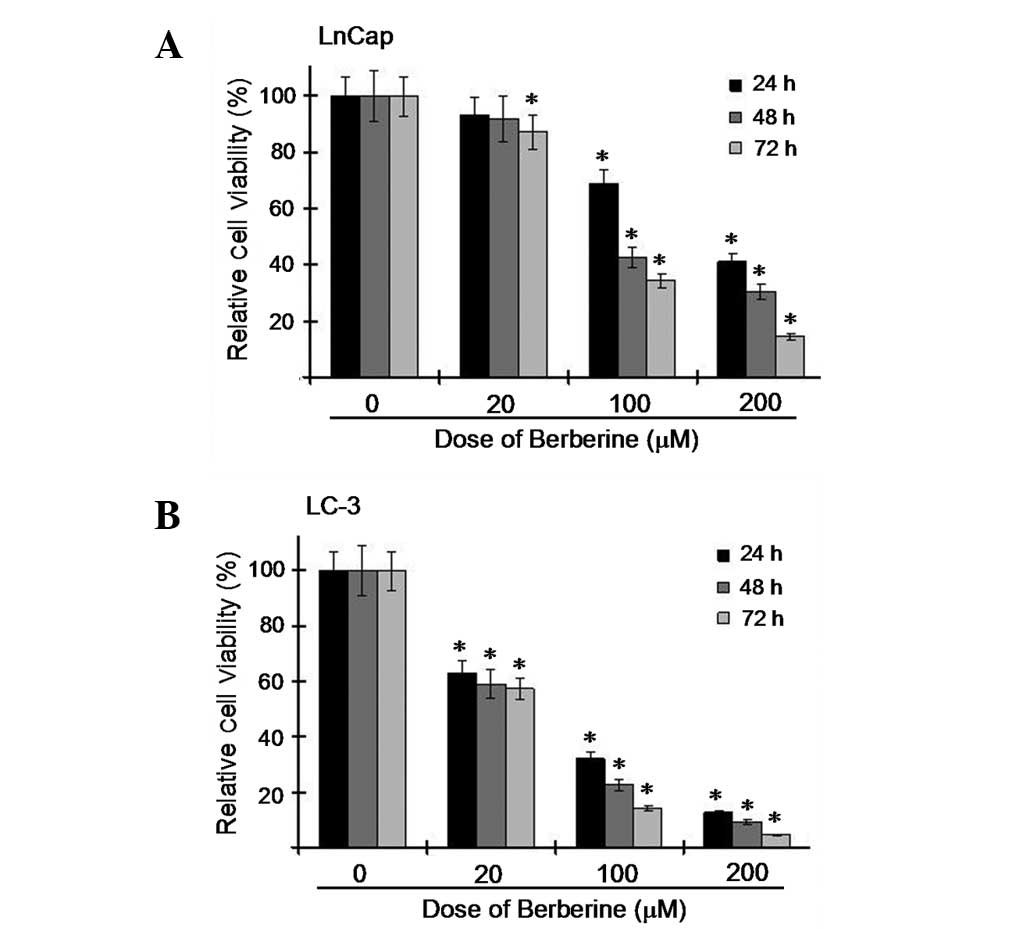
72 h. Berberine treatment in LnCaP cells resulted in a significant
reduction in cell proliferation at 20 μM (P<0.05) and 100 μM
(P<0.05) after 72 and 24 h treatment, respectively (Fig. 1A). Similar effects were observed in
PC-3 cells (Fig. 1B). However,
PC-3 cells responded more rapidly compared with the LnCaP cells,
with a reduction in viability observed at 20 μM (P<0.05) after
24 h treatment. These data indicate that berberine has a cytotoxic
effect on prostate carcinoma cells, in p53 wild-type (LnCaP) and
p53-mutated (PC-3) cells.
Berberine induces cell cycle arrest and
apoptosis in prostate cancer cells
Based on this preliminary data in which a growth
inhibitory effect of berberine was observed in LnCaP and PC-3
cells, a time point of 48 h after treatment was selected in order
to determine the possible inhibitory effect of berberine on cell
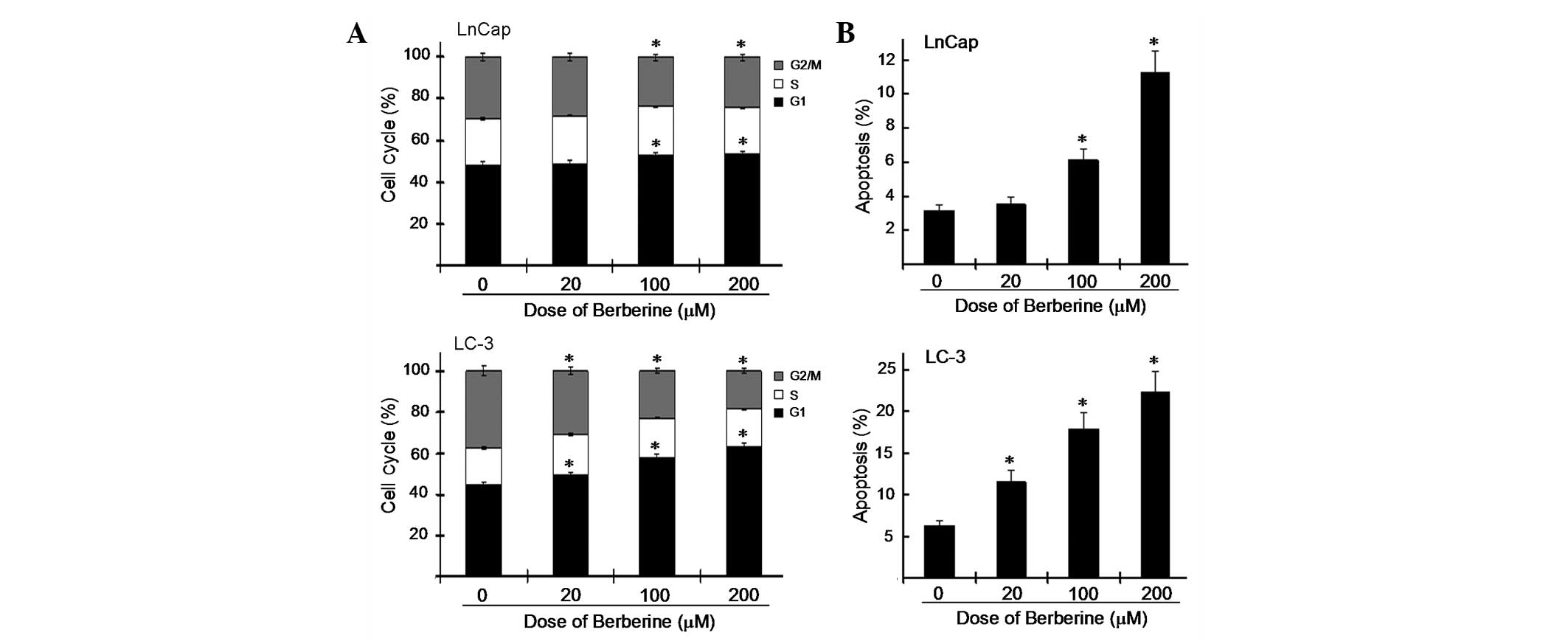
cycle progression and apoptosis. The LnCap cells demonstrated that
an increased number of cells had undergone G1 cell cycle arrest at
100 μM (P<0.005) 48 h following treatment, compared with DMSO
treatment. Simultaneously, the reduction of the G2/M phase was
observed in a dose-dependent manner, indicating that berberine
induces G1 phase cell cycle arrest in LnCap cells. Similar results
were obtained in PC-3 cells (Fig.
2A). An Annexin V assay was used to determine the effect of
berberine on apoptosis in prostate cancer cells. Treatment of LnCap
cells with berberine resulted in a significant increase in the
number of apoptotic cells at a concentration of 100 μM (P<0.05),
compared with the control cells (Fig.
2B). A similar effect was observed in the PC-3 cells.
Berberine inhibits the expression of PSA
in prostate cancer cells
PSA is a well-characterized target gene of the
androgen receptor (20). In the
present study, the effect of berberine on PSA expression in
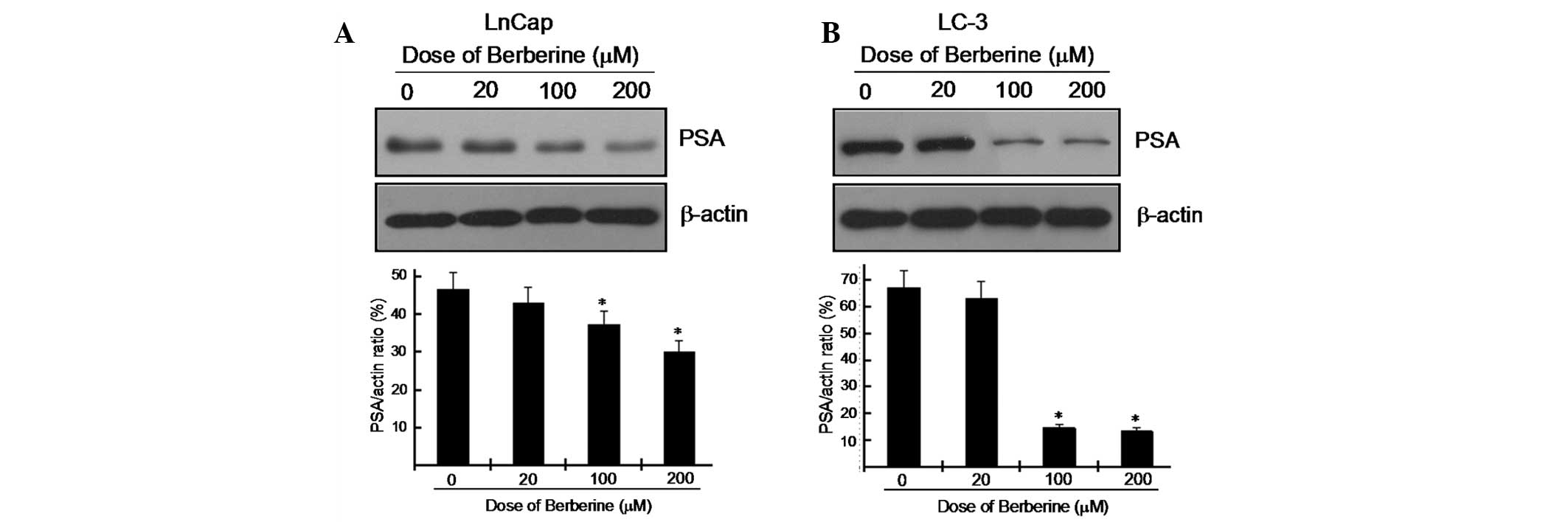
prostate cancer cells was determined. Using western blot analysis,
it was identified that a low dose of berberine (20 μM) resulted in
marginal decrease in PSA protein levels and the inhibition of PSA
at a dose of 100 μM or higher in LnCaP cells (Fig. 3A). Berberine also decreased PSA
expression in PC-3 cells (Fig.
3B).
Berberine inhibits the activation of EGFR
and reduces the expression and activation of EGFR induced by
EGF
PC-3 cells were selected to determine the effects of
berberine on the regulation of EGFR expression and activity.
Addition of berberine resulted in a decrease in the total EGFR and
phosphorylated EGFR levels (Fig.
4A). Furthermore, EGF-stimulated EGFR activation was also
inhibited by berberine (Fig.
4B).
Discussion
Prostate cancer is one of the leading causes of
cancer-related mortality in males (2). Since the information regarding the
effect of berberine on prostate cancer development is limited, the
purpose of this study was to investigate the mechanisms of action
of berberine in prostate cancer cells. The results revealed that
berberine treatment of these cell lines decreased growth rates in a
dose- and time-dependent manner. In general, three phases of the
cell cycle control cell proliferation, which is most commonly
inhibited by cell cycle arrest (6,21–23).
The present study demonstrated the potent inhibitory activity of
berberine on cell proliferation occurs by inducing G1 cell cycle
arrest in prostate cancer cells. Apoptosis is now recognized as a
critical process for the normal development of multicellular
organisms and is important in homeostasis. One aim of therapies for
various types of cancer, including prostate cancer, is to increase
the percentage of tumor cells undergoing apoptosis (12,15,24,25).
An Annexin V assay demonstrated that treatment of prostate cancer
cells with berberine resulted in a significant increase in the
number of apoptotic cells.
Several aspects of cell homeostasis, including
proliferation and cell survival, are regulated by EGFR. EGFR
expression or activation is implicated in multiple cancers
(16,26). A significant finding from the
present study is that berberine significantly downregulated the
expression and activity of EGFR in PC-3 cells. In addition,
berberine was able to downregulate EGFR activation stimulated by
EGF. Results from the present study provided novel findings
regarding the antitumor effects of berberine.
In conclusion, the present study provides insight
into the mechanism underlying the inhibition of cell growth in
human prostate cancer cells following treatment with berberine.
These results may serve as the basis studies for further
investigation into the effects of berberine as a prostate cancer
treatment.
References
|
1
|
Semenas J, Allegrucci C, Boorjian SA, et
al: Overcoming drug resistance and treating advanced prostate
cancer. Curr Drug Targets. 13:1308–1323. 2012. View Article : Google Scholar : PubMed/NCBI
|
|
2
|
Kohli M and Tindall DJ: New developments
in the medical management of prostate cancer. Mayo Clin Proc.
85:77–86. 2010. View Article : Google Scholar : PubMed/NCBI
|
|
3
|
Martin SK, Vaughan TB, Atkinson T, et al:
Emerging biomarkers of prostate cancer (Review). Oncol Rep.
28:409–417. 2012.PubMed/NCBI
|
|
4
|
Hilton WM, Padalecki SS, Ankerst DP, et
al: Temporal changes in the clinical approach to diagnosing
prostate cancer. J Natl Cancer Inst Monogr. 45:162–168. 2012.
View Article : Google Scholar
|
|
5
|
Paller CJ and Antonarakis ES: Management
of biochemically recurrent prostate cancer after local therapy:
evolving standards of care and new directions. Clin Adv Hematol
Oncol. 11:14–23. 2013.PubMed/NCBI
|
|
6
|
Khin-Maung U, Myo K, Nyunt-Nyunt W, et al:
Clinical trial of berberine in acute watery diarrhoea. Br Med J
(Clin Res Ed). 291:1601–1605. 1985. View Article : Google Scholar
|
|
7
|
Han J, Lin H and Huang W: Modulating gut
microbiota as an anti-diabetic mechanism of berberine. Med Sci
Monit. 17:RA164–167. 2011. View Article : Google Scholar : PubMed/NCBI
|
|
8
|
Yin J, Zhang H and Ye J: Traditional
chinese medicine in treatment of metabolic syndrome. Endocr Metab
Immune Disord Drug Targets. 8:99–111. 2008. View Article : Google Scholar : PubMed/NCBI
|
|
9
|
Liang KW, Ting CT, Yin SC, et al:
Berberine suppresses MEK/ERK-dependent Egr-1 signaling pathway and
inhibits vascular smooth muscle cell regrowth after in vitro
mechanical injury. Biochem Pharmacol. 71:806–817. 2006. View Article : Google Scholar : PubMed/NCBI
|
|
10
|
Lin TH, Kuo HC, Chou FP, et al: Berberine
enhances inhibition of glioma tumor cell migration and invasiveness
mediated by arsenic trioxide. BMC Cancer. 8:582008. View Article : Google Scholar : PubMed/NCBI
|
|
11
|
Liu B, Wang G, Yang J, et al: Berberine
inhibits human hepatoma cell invasion without cytotoxicity in
healthy hepatocytes. PLoS One. 6:e214162011. View Article : Google Scholar : PubMed/NCBI
|
|
12
|
Wang L, Liu L, Shi Y, et al: Berberine
induces caspase-independent cell death in colon tumor cells through
activation of apoptosis-inducing factor. PLoS One. 7:e364182012.
View Article : Google Scholar : PubMed/NCBI
|
|
13
|
Piyanuch R, Sukhthankar M, Wandee G, et
al: Berberine, a natural isoquinoline alkaloid, induces NAG-1 and
ATF3 expression in human colorectal cancer cells. Cancer Lett.
258:230–240. 2007. View Article : Google Scholar : PubMed/NCBI
|
|
14
|
Park KS, Kim JB, Bae J, et al: Berberine
inhibited the growth of thyroid cancer cell lines 8505C and TPC1.
Yonsei Med J. 53:346–351. 2012. View Article : Google Scholar : PubMed/NCBI
|
|
15
|
Fu L, Chen W, Guo W, et al: Berberine
targets AP-2/hTERT, NF-κB/COX-2, HIF-1α/VEGF and
cytochrome-C/caspase signaling to suppress human cancer cell
growth. PLoS One. 8:e692402013. View Article : Google Scholar
|
|
16
|
Wang L, Cao H, Lu N, et al: Berberine
inhibits proliferation and down-regulates epidermal growth factor
receptor through activation of Cbl in colon tumor cells. PLoS One.
8:e566662013. View Article : Google Scholar : PubMed/NCBI
|
|
17
|
Sun KK, Ji C, Li X, et al: Overexpression
of high mobility group protein B1 correlates with the proliferation
and metastasis of lung adenocarcinoma cells. Mol Med Rep.
7:1678–1682. 2013.PubMed/NCBI
|
|
18
|
Sun KK, Zhong N, Yang Y, et al: Enhanced
radiosensitivity of NSCLC cells by transducer of erbB2.1 (TOB1)
through modulation of the MAPK/ERK pathway. Oncol Rep.
29:2385–2391. 2013.PubMed/NCBI
|
|
19
|
Che J, Lu YW, Sun KK, et al:
Overexpression of TOB1 confers radioprotection to bronchial
epithelial cells through the MAPK/ERK pathway. Oncol Rep.
30:637–642. 2013.PubMed/NCBI
|
|
20
|
Li J, Cao B, Liu X, et al: Berberine
suppresses androgen receptor signaling in prostate cancer. Mol
Cancer Ther. 10:1346–1356. 2011. View Article : Google Scholar : PubMed/NCBI
|
|
21
|
Vidal A and Koff A: Cell-cycle inhibitors:
three families united by a common cause. Gene. 247:1–15. 2000.
View Article : Google Scholar : PubMed/NCBI
|
|
22
|
Mantena SK, Sharma SD and Katiyar SK:
Berberine inhibits growth, induces G1 arrest and apoptosis in human
epidermoid carcinoma A431 cells by regulating Cdki-Cdk-cyclin
cascade, disruption of mitochondrial membrane potential and
cleavage of caspase 3 and PARP. Carcinogenesis. 27:2018–2027. 2006.
View Article : Google Scholar : PubMed/NCBI
|
|
23
|
Chidambara Murthy KN, Jayaprakasha GK and
Patil BS: The natural alkaloid berberine targets multiple pathways
to induce cell death in cultured human colon cancer cells. Eur J
Pharmacol. 688:14–21. 2012. View Article : Google Scholar : PubMed/NCBI
|
|
24
|
Okada H and Mak TW: Pathways of apoptotic
and non-apoptotic death in tumour cells. Nat Rev Cancer. 4:592–603.
2004. View
Article : Google Scholar : PubMed/NCBI
|
|
25
|
Patil JB, Kim J and Jayaprakasha GK:
Berberine induces apoptosis in breast cancer cells (MCF-7) through
mitochondrial-dependent pathway. Eur J Pharmacol. 645:70–78. 2010.
View Article : Google Scholar : PubMed/NCBI
|
|
26
|
Prenzel N, Fischer OM, Streit S, et al:
The epidermal growth factor receptor family as a central element
for cellular signal transduction and diversification. Endocr Relat
Cancer. 8:11–31. 2001. View Article : Google Scholar : PubMed/NCBI
|