Spandidos Publications Logo
  • About
    • About Spandidos
    • Aims and Scopes
    • Abstracting and Indexing
    • Editorial Policies
    • Reprints and Permissions
    • Job Opportunities
    • Terms and Conditions
    • Contact
  • Journals
    • All Journals
    • Oncology Letters
      • Oncology Letters
      • Information for Authors
      • Editorial Policies
      • Editorial Board
      • Aims and Scope
      • Abstracting and Indexing
      • Bibliographic Information
      • Archive
    • International Journal of Oncology
      • International Journal of Oncology
      • Information for Authors
      • Editorial Policies
      • Editorial Board
      • Aims and Scope
      • Abstracting and Indexing
      • Bibliographic Information
      • Archive
    • Molecular and Clinical Oncology
      • Molecular and Clinical Oncology
      • Information for Authors
      • Editorial Policies
      • Editorial Board
      • Aims and Scope
      • Abstracting and Indexing
      • Bibliographic Information
      • Archive
    • Experimental and Therapeutic Medicine
      • Experimental and Therapeutic Medicine
      • Information for Authors
      • Editorial Policies
      • Editorial Board
      • Aims and Scope
      • Abstracting and Indexing
      • Bibliographic Information
      • Archive
    • International Journal of Molecular Medicine
      • International Journal of Molecular Medicine
      • Information for Authors
      • Editorial Policies
      • Editorial Board
      • Aims and Scope
      • Abstracting and Indexing
      • Bibliographic Information
      • Archive
    • Biomedical Reports
      • Biomedical Reports
      • Information for Authors
      • Editorial Policies
      • Editorial Board
      • Aims and Scope
      • Abstracting and Indexing
      • Bibliographic Information
      • Archive
    • Oncology Reports
      • Oncology Reports
      • Information for Authors
      • Editorial Policies
      • Editorial Board
      • Aims and Scope
      • Abstracting and Indexing
      • Bibliographic Information
      • Archive
    • Molecular Medicine Reports
      • Molecular Medicine Reports
      • Information for Authors
      • Editorial Policies
      • Editorial Board
      • Aims and Scope
      • Abstracting and Indexing
      • Bibliographic Information
      • Archive
    • World Academy of Sciences Journal
      • World Academy of Sciences Journal
      • Information for Authors
      • Editorial Policies
      • Editorial Board
      • Aims and Scope
      • Abstracting and Indexing
      • Bibliographic Information
      • Archive
    • International Journal of Functional Nutrition
      • International Journal of Functional Nutrition
      • Information for Authors
      • Editorial Policies
      • Editorial Board
      • Aims and Scope
      • Abstracting and Indexing
      • Bibliographic Information
      • Archive
    • International Journal of Epigenetics
      • International Journal of Epigenetics
      • Information for Authors
      • Editorial Policies
      • Editorial Board
      • Aims and Scope
      • Abstracting and Indexing
      • Bibliographic Information
      • Archive
    • Medicine International
      • Medicine International
      • Information for Authors
      • Editorial Policies
      • Editorial Board
      • Aims and Scope
      • Abstracting and Indexing
      • Bibliographic Information
      • Archive
  • Articles
  • Information
    • Information for Authors
    • Information for Reviewers
    • Information for Librarians
    • Information for Advertisers
    • Conferences
  • Language Editing
Spandidos Publications Logo
  • About
    • About Spandidos
    • Aims and Scopes
    • Abstracting and Indexing
    • Editorial Policies
    • Reprints and Permissions
    • Job Opportunities
    • Terms and Conditions
    • Contact
  • Journals
    • All Journals
    • Biomedical Reports
      • Information for Authors
      • Editorial Policies
      • Editorial Board
      • Aims and Scope
      • Abstracting and Indexing
      • Bibliographic Information
      • Archive
    • Experimental and Therapeutic Medicine
      • Information for Authors
      • Editorial Policies
      • Editorial Board
      • Aims and Scope
      • Abstracting and Indexing
      • Bibliographic Information
      • Archive
    • International Journal of Epigenetics
      • Information for Authors
      • Editorial Policies
      • Editorial Board
      • Aims and Scope
      • Abstracting and Indexing
      • Bibliographic Information
      • Archive
    • International Journal of Functional Nutrition
      • Information for Authors
      • Editorial Policies
      • Editorial Board
      • Aims and Scope
      • Abstracting and Indexing
      • Bibliographic Information
      • Archive
    • International Journal of Molecular Medicine
      • Information for Authors
      • Editorial Policies
      • Editorial Board
      • Aims and Scope
      • Abstracting and Indexing
      • Bibliographic Information
      • Archive
    • International Journal of Oncology
      • Information for Authors
      • Editorial Policies
      • Editorial Board
      • Aims and Scope
      • Abstracting and Indexing
      • Bibliographic Information
      • Archive
    • Medicine International
      • Information for Authors
      • Editorial Policies
      • Editorial Board
      • Aims and Scope
      • Abstracting and Indexing
      • Bibliographic Information
      • Archive
    • Molecular and Clinical Oncology
      • Information for Authors
      • Editorial Policies
      • Editorial Board
      • Aims and Scope
      • Abstracting and Indexing
      • Bibliographic Information
      • Archive
    • Molecular Medicine Reports
      • Information for Authors
      • Editorial Policies
      • Editorial Board
      • Aims and Scope
      • Abstracting and Indexing
      • Bibliographic Information
      • Archive
    • Oncology Letters
      • Information for Authors
      • Editorial Policies
      • Editorial Board
      • Aims and Scope
      • Abstracting and Indexing
      • Bibliographic Information
      • Archive
    • Oncology Reports
      • Information for Authors
      • Editorial Policies
      • Editorial Board
      • Aims and Scope
      • Abstracting and Indexing
      • Bibliographic Information
      • Archive
    • World Academy of Sciences Journal
      • Information for Authors
      • Editorial Policies
      • Editorial Board
      • Aims and Scope
      • Abstracting and Indexing
      • Bibliographic Information
      • Archive
  • Articles
  • Information
    • For Authors
    • For Reviewers
    • For Librarians
    • For Advertisers
    • Conferences
  • Language Editing
Login Register Submit
  • This site uses cookies
  • You can change your cookie settings at any time by following the instructions in our Cookie Policy. To find out more, you may read our Privacy Policy.

    I agree
Search articles by DOI, keyword, author or affiliation
Search
Advanced Search
presentation
Molecular Medicine Reports
Join Editorial Board Propose a Special Issue
Print ISSN: 1791-2997 Online ISSN: 1791-3004
Journal Cover
June-2015 Volume 11 Issue 6

Full Size Image

Sign up for eToc alerts
Recommend to Library

Journals

International Journal of Molecular Medicine

International Journal of Molecular Medicine

International Journal of Molecular Medicine is an international journal devoted to molecular mechanisms of human disease.

International Journal of Oncology

International Journal of Oncology

International Journal of Oncology is an international journal devoted to oncology research and cancer treatment.

Molecular Medicine Reports

Molecular Medicine Reports

Covers molecular medicine topics such as pharmacology, pathology, genetics, neuroscience, infectious diseases, molecular cardiology, and molecular surgery.

Oncology Reports

Oncology Reports

Oncology Reports is an international journal devoted to fundamental and applied research in Oncology.

Experimental and Therapeutic Medicine

Experimental and Therapeutic Medicine

Experimental and Therapeutic Medicine is an international journal devoted to laboratory and clinical medicine.

Oncology Letters

Oncology Letters

Oncology Letters is an international journal devoted to Experimental and Clinical Oncology.

Biomedical Reports

Biomedical Reports

Explores a wide range of biological and medical fields, including pharmacology, genetics, microbiology, neuroscience, and molecular cardiology.

Molecular and Clinical Oncology

Molecular and Clinical Oncology

International journal addressing all aspects of oncology research, from tumorigenesis and oncogenes to chemotherapy and metastasis.

World Academy of Sciences Journal

World Academy of Sciences Journal

Multidisciplinary open-access journal spanning biochemistry, genetics, neuroscience, environmental health, and synthetic biology.

International Journal of Functional Nutrition

International Journal of Functional Nutrition

Open-access journal combining biochemistry, pharmacology, immunology, and genetics to advance health through functional nutrition.

International Journal of Epigenetics

International Journal of Epigenetics

Publishes open-access research on using epigenetics to advance understanding and treatment of human disease.

Medicine International

Medicine International

An International Open Access Journal Devoted to General Medicine.

Journal Cover
June-2015 Volume 11 Issue 6

Full Size Image

Sign up for eToc alerts
Recommend to Library

  • Article
  • Citations
    • Cite This Article
    • Download Citation
    • Create Citation Alert
    • Remove Citation Alert
    • Cited By
  • Similar Articles
    • Related Articles (in Spandidos Publications)
    • Similar Articles (Google Scholar)
    • Similar Articles (PubMed)
  • Download PDF
  • Download XML
  • View XML
Article Open Access

Circadian gene hClock enhances proliferation and inhibits apoptosis of human colorectal carcinoma cells in vitro and in vivo

  • Authors:
    • Yaping Wang
    • Ruizhe Qian
    • Ning Sun
    • Chao Lu
    • Zongyou Chen
    • Luchun Hua
  • View Affiliations / Copyright

    Affiliations: Department of Surgery, Huashan Hospital, Fudan University, Shanghai 200040, P.R. China, Department of Physiology and Pathophysiology, Shanghai Medical College, Fudan University, Shanghai 200032, P.R. China
    Copyright: © Wang et al. This is an open access article distributed under the terms of Creative Commons Attribution License [CC BY_NC 3.0].
  • Pages: 4204-4210
    |
    Published online on: January 26, 2015
       https://doi.org/10.3892/mmr.2015.3247
  • Expand metrics +
Metrics: Total Views: 0 (Spandidos Publications: | PMC Statistics: )
Metrics: Total PDF Downloads: 0 (Spandidos Publications: | PMC Statistics: )
Cited By (CrossRef): 0 citations Loading Articles...

This article is mentioned in:


Abstract

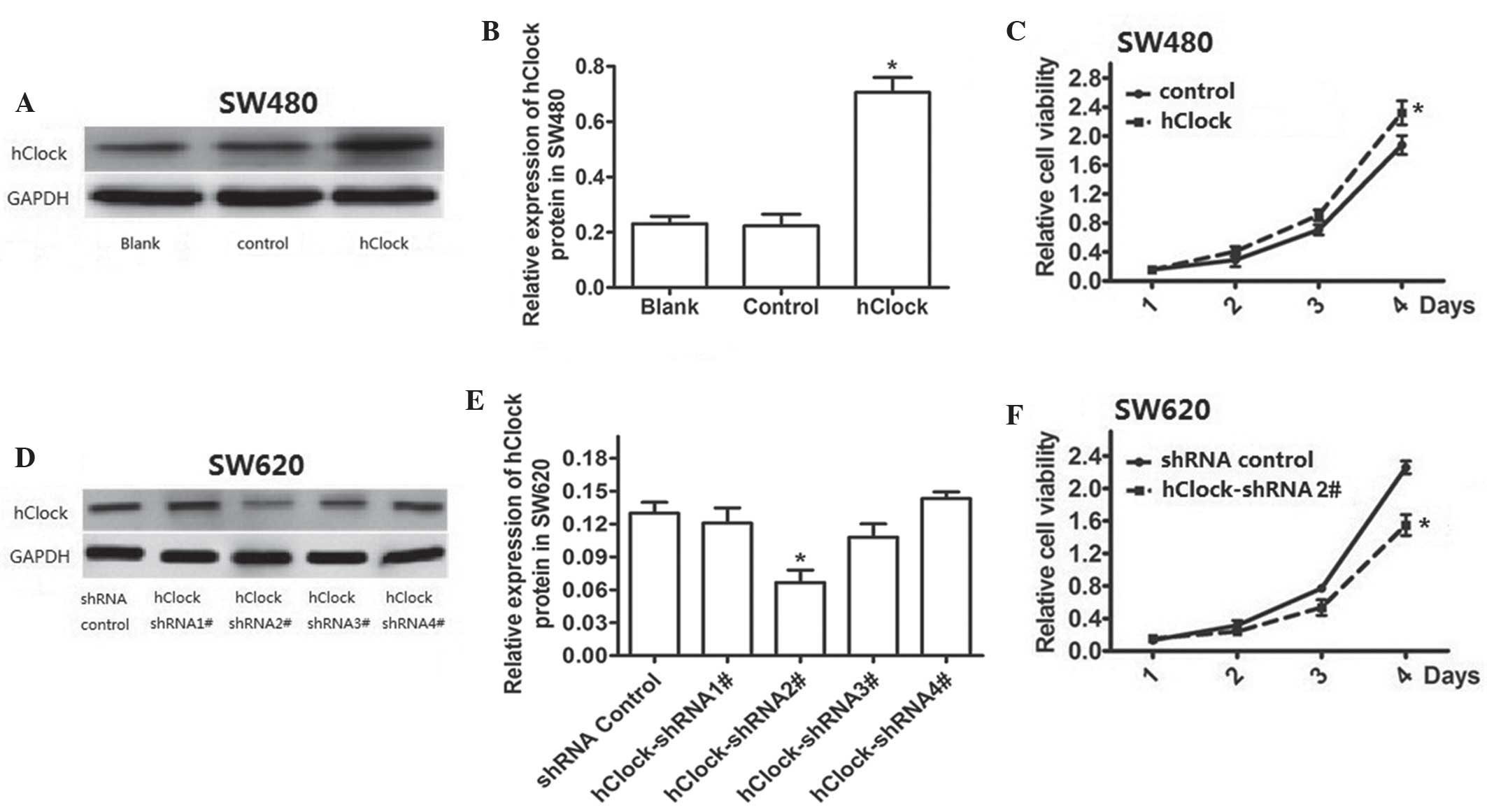
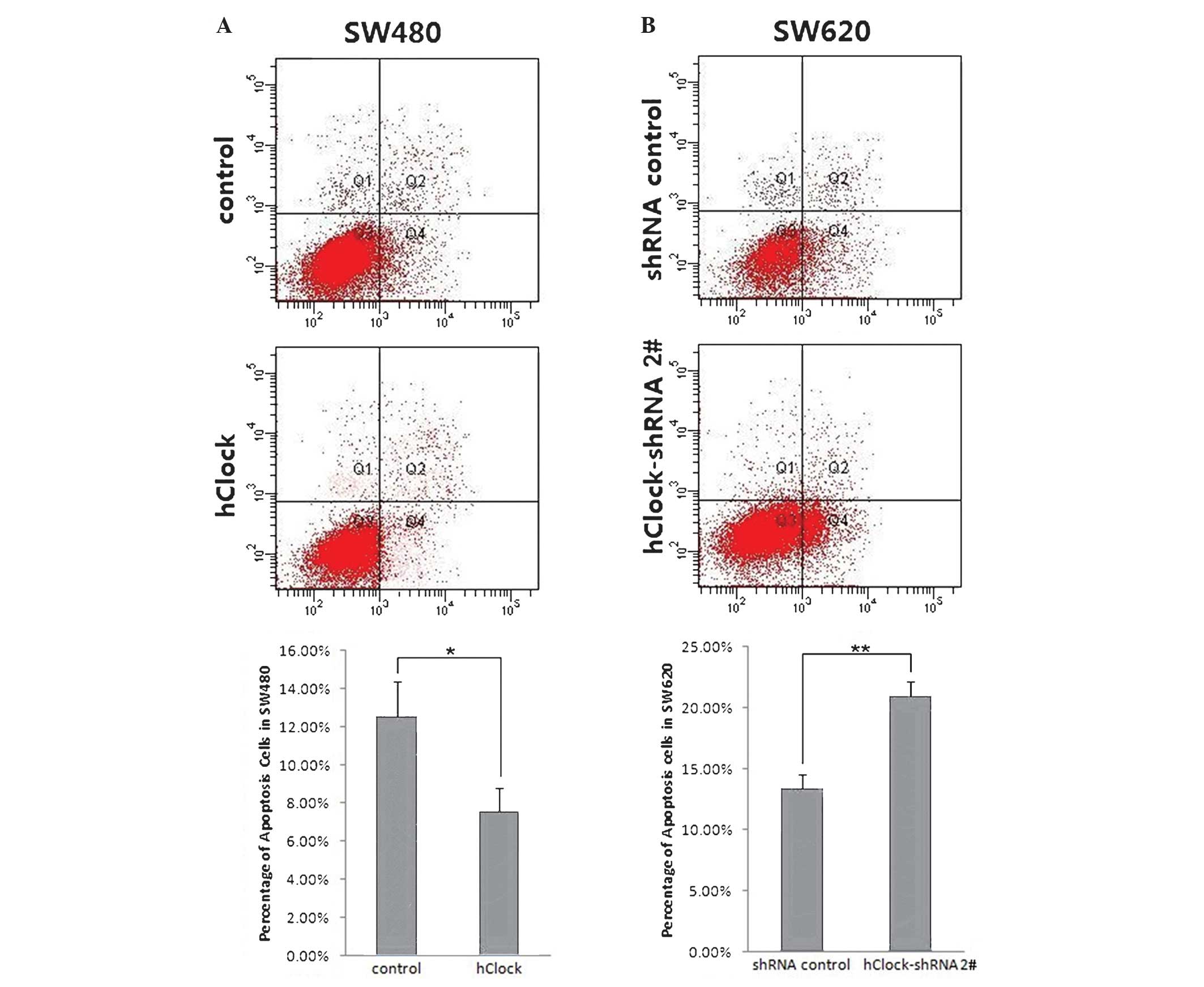
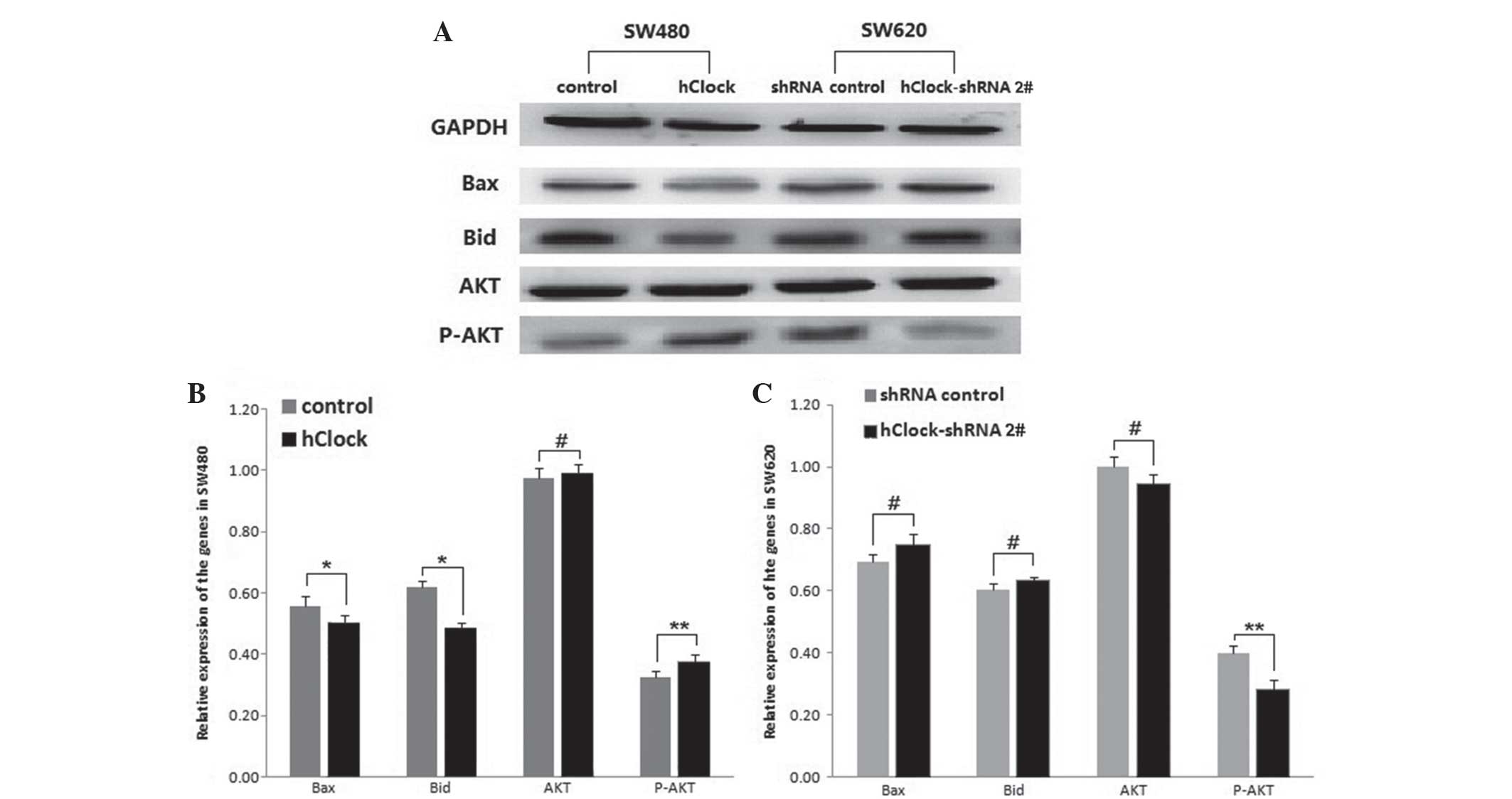
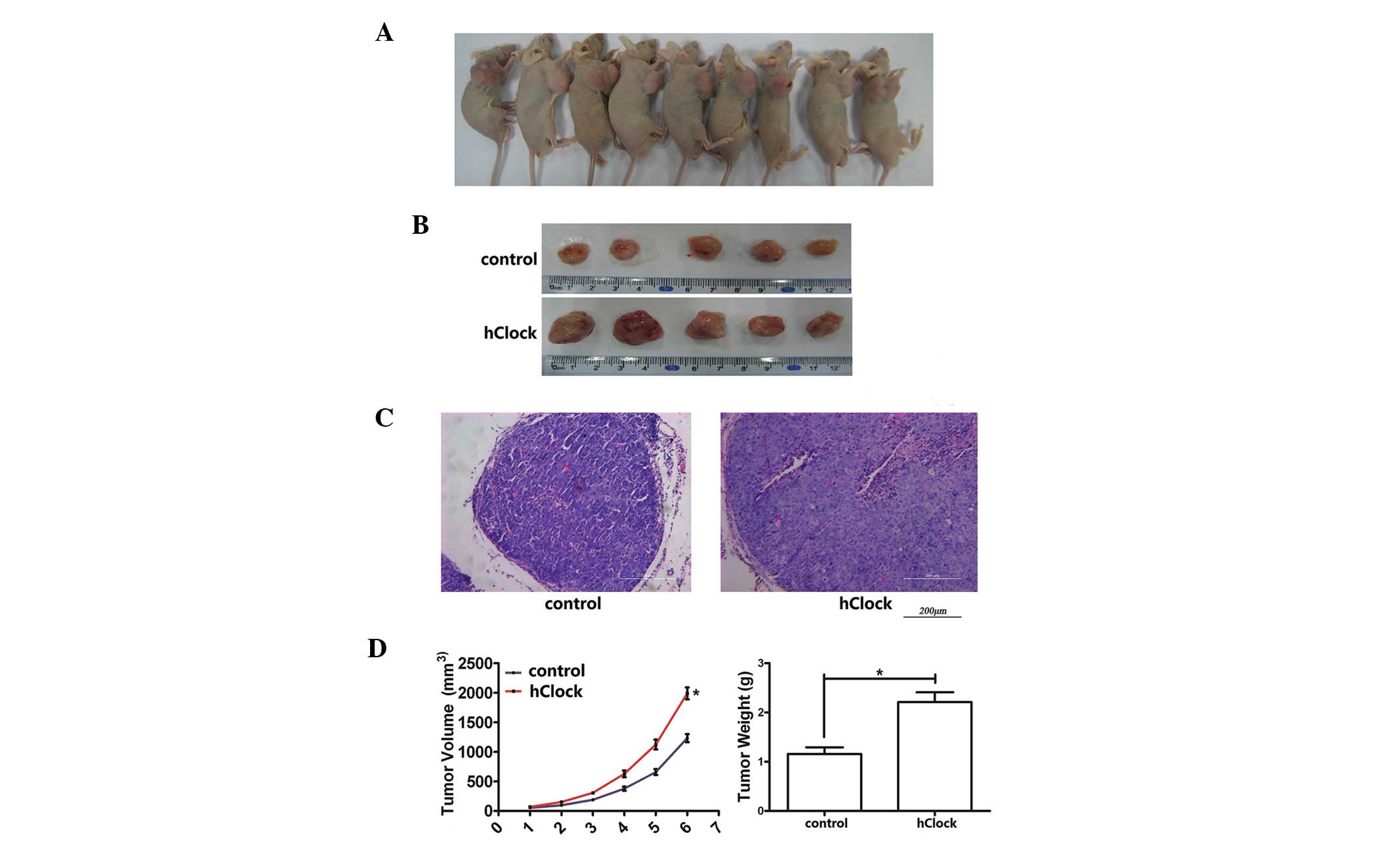
Colorectal carcinoma (CRC) is one of the most prevalent types of malignancy‑associated mortality worldwide. Previous studies have demonstrated that amplification and overexpression of the human circadian locomotor output cycles kaput gene (hClock) was closely associated with a high risk for CRC as well as poor prognosis in CRC patients. However, the underlying molecular mechanisms of CRC remain to be fully elucidated. In the present study, hClock was exogenously overexpressed in the CRC cell line SW480 via infection of a lentivirus vector expressing hClock; in addition, a lentivirus vector‑based RNA interference approach, using short hairpin RNA, was performed in order to knockdown hClock in SW620 cells. The results showed that upregulation of hClock promoted proliferation and inhibited apoptosis in SW480 cells in vitro and in vivo, while downregulation of hClock inhibited SW620 cell proliferation and accelerated apoptosis in vitro. Upregulation of hClock enhanced the activity of the anti‑apoptotic gene phosphorpylated (p‑)AKT and inhibited the expression of the pro‑apoptotic gene B cell lymphoma‑2 (Bcl‑2)‑associated X protein and Bcl‑2 homology 3 interacting domain death agonist. Furthermore, targeted inhibition of hClock activity reduced p‑AKT expression. In conclusion, the results of the present study suggested that the circadian gene hClock promoted CRC progression and inhibit tumor cell apoptosis in vitro and in vivo, while silencing hClock was able to reverse this effect.
View Figures

Figure 1

Figure 2

Figure 3

Figure 4

View References

1 

Dibner C, Schibler U and Albrecht U: The mammalian circadian timing system: organization and coordination of central and peripheral clocks. Ann Rev Physiol. 72:517–549. 2010. View Article : Google Scholar

2 

Chen-Goodspeed M and Lee CC: Tumor suppression and circadian function. J Biol Rhythms. 22:291–298. 2007. View Article : Google Scholar : PubMed/NCBI

3 

Ko CH and Takahashi JS: Molecular components of the mammalian circadian clock. Hum Mol Genet. 15(Spec No.2): R271–R277. 2006. View Article : Google Scholar : PubMed/NCBI

4 

Doi M, Hirayama J and Sassone-Corsi P: Circadian regulator CLOCK is a histone acetltransferase. Cell. 125:497–508. 2006. View Article : Google Scholar : PubMed/NCBI

5 

Rey G and Reddy AB: Connecting cellular metabolism to circadian clocks. Trends Cell Biol. 23:234–241. 2013. View Article : Google Scholar : PubMed/NCBI

6 

Savvidis C and Koutsilieris M: Circadian rhythm disruption in cancer biology. Mol Med. 18:1249–1260. 2012. View Article : Google Scholar : PubMed/NCBI

7 

Hoffman AE, Yi CH, Zheng T, et al: CLOCK in breast tumorigenesis: genetic, epigenetic and transcriptional profiling analyses. Cancer Res. 70:1459–1468. 2010. View Article : Google Scholar : PubMed/NCBI

8 

Chen ST, Choo KB, Hou MF, et al: Deregulated expression of the PER1, PER2 and PER3 genes in breast cancers. Carcinogenesis. 26:1241–1246. 2005. View Article : Google Scholar : PubMed/NCBI

9 

Lin YM, Chang JH, Yeh KT, et al: Disturbance of circadian gene expression in hepatocellular carcinoma. Mol Carcinog. 47:925–933. 2008. View Article : Google Scholar : PubMed/NCBI

10 

Mazzoccoli G, Piepoli A, Carella M, et al: Altered expression of the clock gene machinery in kidney cancer patients. Biomed Pharmacother. 66:175–179. 2012. View Article : Google Scholar : PubMed/NCBI

11 

Yeh KT, Yang MY, Liu TC, et al: Abnormal expression of period 1 (PER1) in endometrial carcinoma. J Pathol. 206:111–120. 2005. View Article : Google Scholar : PubMed/NCBI

12 

Chen Z, Liu P, Li C, et al: Deregulated expression of the clock genes in gliomas. Technol Cancer Res Treat. 12:91–97. 2013.

13 

Fu L, Pelicano H, Liu JS, et al: The circadian gene period2 plays an important role in tumor suppression and DNA damage response in vivo. Cell. 111:41–50. 2002. View Article : Google Scholar : PubMed/NCBI

14 

Soták M, Polidarová L, Ergang P, et al: An association between clock genes and clock-controlled cell cycle genes in murine colorectal tumors. Int J Cancer. 132:1032–1041. 2013. View Article : Google Scholar

15 

Jemal A, Bray F, Center MM, et al: Global cancer statistics. CA Cancer J Clin. 61:69–90. 2011. View Article : Google Scholar : PubMed/NCBI

16 

Fearon ER: Molecular genetics of colorectal cancer. Annu Rev Pathol. 6:479–507. 2011. View Article : Google Scholar

17 

Cancer Genome Altas Network: Comprehensive molecular characterization of human colon and rectal cancer. Nature. 487:330–337. 2012. View Article : Google Scholar : PubMed/NCBI

18 

Wang L, Chen B, Wang Y, et al: hClock gene expression in human colorectal carcinoma. Mol Med Rep. 8:2017–2022. 2013.

19 

Oshima T, Takenoshita S, Akaike M, et al: Expression of circadian genes correlates with liver metastasis and outcomes in colorectal cancer. Oncol Rep. 25:1439–1446. 2011. View Article : Google Scholar : PubMed/NCBI

20 

Karantanos T, Theodoropoulos G, Gazouli M, et al: Expression of clock genes in patients with colorectal cancer. Int J Biol Markers. 28:280–285. 2013. View Article : Google Scholar : PubMed/NCBI

21 

Alhopuro P, Björklund M, Sammalkorpi H, et al: Mutations in the circadian gene CLOCK in colorectal cancer. Mol Cancer Res. 8:952–960. 2010. View Article : Google Scholar : PubMed/NCBI

22 

Zhou F, He X, Lui H, et al: Functional polymorphisms of circadian positive feedback regulation genes and clinical outcome of Chinese patients with resected colorectal cancer. Cancer. 118:937–946. 2012. View Article : Google Scholar

23 

Storch KF, Lipan O, Leykin I, et al: Extensive and divergent circadian gene expression in liver and heart. Nature. 417:78–83. 2002. View Article : Google Scholar : PubMed/NCBI

24 

Bechtold DA, Gibbs JE and Loudon AS: Circadian dysfunction in disease. Trends Pharmacol Sci. 31:191–198. 2010. View Article : Google Scholar : PubMed/NCBI

25 

Levi F and Schibler U: Circadian rhythms: mechanisms and therapeutic implications. Annu Rev Pharmacol Toxicol. 47:593–628. 2007. View Article : Google Scholar : PubMed/NCBI

26 

Sahar S and Sassone-Corsi P: Circadian clock and breast cancer: a molecular link. Cell Cycle. 6:1329–1331. 2007. View Article : Google Scholar : PubMed/NCBI

27 

Spengler ML, Kuropatwinshki KK, Comas M, et al: Core circadian protein CLOCK is a positive regulator of NF-κB-mediated transcription. PNAS. 109:E2457–E2465. 2012. View Article : Google Scholar

28 

Fu L and Lee CC: The circadian clock: pacemaker and tumour suppressor. Nat Rev Cancer. 3:350–361. 2003. View Article : Google Scholar : PubMed/NCBI

29 

Ludwig JA and Weinstein JN: Biomarkers in cancer staging, prognosis and treatment selection. Nat Rev Cancer. 5:845–856. 2005. View Article : Google Scholar : PubMed/NCBI

30 

Gery S and Koeffler HP: The role of circadian regulation in cancer. Cold Spring Harb Symp Quant Biol. 72:459–464. 2007. View Article : Google Scholar

31 

Vivanco I and Sawyers CL: The phosphatidylinositol 3-Kinase AKT pathway in human cancer. Nat Rev Cancer. 2:489–501. 2002. View Article : Google Scholar : PubMed/NCBI

32 

Adams JM and Cory S: Life-or-death decisions by the Bcl-2 protein family. Trends Biochem Sci. 26:61–66. 2001. View Article : Google Scholar : PubMed/NCBI

33 

Kiefer MC, Brauer MJ, Powers VC, et al: Modulation of apoptosis by the widely distributed Bcl-2 homologue Bak. Nature. 374:736–739. 1995. View Article : Google Scholar : PubMed/NCBI

34 

Bellacosa A, Chan TO, Ahmed NN, et al: Akt activation by growth factors is a multiple-step process: the role of the PH domain. Oncogene. 17:313–325. 1998. View Article : Google Scholar : PubMed/NCBI

Related Articles

  • Abstract
  • View
  • Download
  • Twitter
Copy and paste a formatted citation
Spandidos Publications style
Wang Y, Qian R, Sun N, Lu C, Chen Z and Hua L: Circadian gene hClock enhances proliferation and inhibits apoptosis of human colorectal carcinoma cells in vitro and in vivo. Mol Med Rep 11: 4204-4210, 2015.
APA
Wang, Y., Qian, R., Sun, N., Lu, C., Chen, Z., & Hua, L. (2015). Circadian gene hClock enhances proliferation and inhibits apoptosis of human colorectal carcinoma cells in vitro and in vivo. Molecular Medicine Reports, 11, 4204-4210. https://doi.org/10.3892/mmr.2015.3247
MLA
Wang, Y., Qian, R., Sun, N., Lu, C., Chen, Z., Hua, L."Circadian gene hClock enhances proliferation and inhibits apoptosis of human colorectal carcinoma cells in vitro and in vivo". Molecular Medicine Reports 11.6 (2015): 4204-4210.
Chicago
Wang, Y., Qian, R., Sun, N., Lu, C., Chen, Z., Hua, L."Circadian gene hClock enhances proliferation and inhibits apoptosis of human colorectal carcinoma cells in vitro and in vivo". Molecular Medicine Reports 11, no. 6 (2015): 4204-4210. https://doi.org/10.3892/mmr.2015.3247
Copy and paste a formatted citation
x
Spandidos Publications style
Wang Y, Qian R, Sun N, Lu C, Chen Z and Hua L: Circadian gene hClock enhances proliferation and inhibits apoptosis of human colorectal carcinoma cells in vitro and in vivo. Mol Med Rep 11: 4204-4210, 2015.
APA
Wang, Y., Qian, R., Sun, N., Lu, C., Chen, Z., & Hua, L. (2015). Circadian gene hClock enhances proliferation and inhibits apoptosis of human colorectal carcinoma cells in vitro and in vivo. Molecular Medicine Reports, 11, 4204-4210. https://doi.org/10.3892/mmr.2015.3247
MLA
Wang, Y., Qian, R., Sun, N., Lu, C., Chen, Z., Hua, L."Circadian gene hClock enhances proliferation and inhibits apoptosis of human colorectal carcinoma cells in vitro and in vivo". Molecular Medicine Reports 11.6 (2015): 4204-4210.
Chicago
Wang, Y., Qian, R., Sun, N., Lu, C., Chen, Z., Hua, L."Circadian gene hClock enhances proliferation and inhibits apoptosis of human colorectal carcinoma cells in vitro and in vivo". Molecular Medicine Reports 11, no. 6 (2015): 4204-4210. https://doi.org/10.3892/mmr.2015.3247
Follow us
  • Twitter
  • LinkedIn
  • Facebook
About
  • Spandidos Publications
  • Careers
  • Cookie Policy
  • Privacy Policy
How can we help?
  • Help
  • Live Chat
  • Contact
  • Email to our Support Team