Spandidos Publications Logo
  • About
    • About Spandidos
    • Aims and Scopes
    • Abstracting and Indexing
    • Editorial Policies
    • Reprints and Permissions
    • Job Opportunities
    • Terms and Conditions
    • Contact
  • Journals
    • All Journals
    • Oncology Letters
      • Oncology Letters
      • Information for Authors
      • Editorial Policies
      • Editorial Board
      • Aims and Scope
      • Abstracting and Indexing
      • Bibliographic Information
      • Archive
    • International Journal of Oncology
      • International Journal of Oncology
      • Information for Authors
      • Editorial Policies
      • Editorial Board
      • Aims and Scope
      • Abstracting and Indexing
      • Bibliographic Information
      • Archive
    • Molecular and Clinical Oncology
      • Molecular and Clinical Oncology
      • Information for Authors
      • Editorial Policies
      • Editorial Board
      • Aims and Scope
      • Abstracting and Indexing
      • Bibliographic Information
      • Archive
    • Experimental and Therapeutic Medicine
      • Experimental and Therapeutic Medicine
      • Information for Authors
      • Editorial Policies
      • Editorial Board
      • Aims and Scope
      • Abstracting and Indexing
      • Bibliographic Information
      • Archive
    • International Journal of Molecular Medicine
      • International Journal of Molecular Medicine
      • Information for Authors
      • Editorial Policies
      • Editorial Board
      • Aims and Scope
      • Abstracting and Indexing
      • Bibliographic Information
      • Archive
    • Biomedical Reports
      • Biomedical Reports
      • Information for Authors
      • Editorial Policies
      • Editorial Board
      • Aims and Scope
      • Abstracting and Indexing
      • Bibliographic Information
      • Archive
    • Oncology Reports
      • Oncology Reports
      • Information for Authors
      • Editorial Policies
      • Editorial Board
      • Aims and Scope
      • Abstracting and Indexing
      • Bibliographic Information
      • Archive
    • Molecular Medicine Reports
      • Molecular Medicine Reports
      • Information for Authors
      • Editorial Policies
      • Editorial Board
      • Aims and Scope
      • Abstracting and Indexing
      • Bibliographic Information
      • Archive
    • World Academy of Sciences Journal
      • World Academy of Sciences Journal
      • Information for Authors
      • Editorial Policies
      • Editorial Board
      • Aims and Scope
      • Abstracting and Indexing
      • Bibliographic Information
      • Archive
    • International Journal of Functional Nutrition
      • International Journal of Functional Nutrition
      • Information for Authors
      • Editorial Policies
      • Editorial Board
      • Aims and Scope
      • Abstracting and Indexing
      • Bibliographic Information
      • Archive
    • International Journal of Epigenetics
      • International Journal of Epigenetics
      • Information for Authors
      • Editorial Policies
      • Editorial Board
      • Aims and Scope
      • Abstracting and Indexing
      • Bibliographic Information
      • Archive
    • Medicine International
      • Medicine International
      • Information for Authors
      • Editorial Policies
      • Editorial Board
      • Aims and Scope
      • Abstracting and Indexing
      • Bibliographic Information
      • Archive
  • Articles
  • Information
    • Information for Authors
    • Information for Reviewers
    • Information for Librarians
    • Information for Advertisers
    • Conferences
  • Language Editing
Spandidos Publications Logo
  • About
    • About Spandidos
    • Aims and Scopes
    • Abstracting and Indexing
    • Editorial Policies
    • Reprints and Permissions
    • Job Opportunities
    • Terms and Conditions
    • Contact
  • Journals
    • All Journals
    • Biomedical Reports
      • Information for Authors
      • Editorial Policies
      • Editorial Board
      • Aims and Scope
      • Abstracting and Indexing
      • Bibliographic Information
      • Archive
    • Experimental and Therapeutic Medicine
      • Information for Authors
      • Editorial Policies
      • Editorial Board
      • Aims and Scope
      • Abstracting and Indexing
      • Bibliographic Information
      • Archive
    • International Journal of Epigenetics
      • Information for Authors
      • Editorial Policies
      • Editorial Board
      • Aims and Scope
      • Abstracting and Indexing
      • Bibliographic Information
      • Archive
    • International Journal of Functional Nutrition
      • Information for Authors
      • Editorial Policies
      • Editorial Board
      • Aims and Scope
      • Abstracting and Indexing
      • Bibliographic Information
      • Archive
    • International Journal of Molecular Medicine
      • Information for Authors
      • Editorial Policies
      • Editorial Board
      • Aims and Scope
      • Abstracting and Indexing
      • Bibliographic Information
      • Archive
    • International Journal of Oncology
      • Information for Authors
      • Editorial Policies
      • Editorial Board
      • Aims and Scope
      • Abstracting and Indexing
      • Bibliographic Information
      • Archive
    • Medicine International
      • Information for Authors
      • Editorial Policies
      • Editorial Board
      • Aims and Scope
      • Abstracting and Indexing
      • Bibliographic Information
      • Archive
    • Molecular and Clinical Oncology
      • Information for Authors
      • Editorial Policies
      • Editorial Board
      • Aims and Scope
      • Abstracting and Indexing
      • Bibliographic Information
      • Archive
    • Molecular Medicine Reports
      • Information for Authors
      • Editorial Policies
      • Editorial Board
      • Aims and Scope
      • Abstracting and Indexing
      • Bibliographic Information
      • Archive
    • Oncology Letters
      • Information for Authors
      • Editorial Policies
      • Editorial Board
      • Aims and Scope
      • Abstracting and Indexing
      • Bibliographic Information
      • Archive
    • Oncology Reports
      • Information for Authors
      • Editorial Policies
      • Editorial Board
      • Aims and Scope
      • Abstracting and Indexing
      • Bibliographic Information
      • Archive
    • World Academy of Sciences Journal
      • Information for Authors
      • Editorial Policies
      • Editorial Board
      • Aims and Scope
      • Abstracting and Indexing
      • Bibliographic Information
      • Archive
  • Articles
  • Information
    • For Authors
    • For Reviewers
    • For Librarians
    • For Advertisers
    • Conferences
  • Language Editing
Login Register Submit
  • This site uses cookies
  • You can change your cookie settings at any time by following the instructions in our Cookie Policy. To find out more, you may read our Privacy Policy.

    I agree
Search articles by DOI, keyword, author or affiliation
Search
Advanced Search
presentation
Molecular Medicine Reports
Join Editorial Board Propose a Special Issue
Print ISSN: 1791-2997 Online ISSN: 1791-3004
Journal Cover
July-2015 Volume 12 Issue 1

Full Size Image

Sign up for eToc alerts
Recommend to Library

Journals

International Journal of Molecular Medicine

International Journal of Molecular Medicine

International Journal of Molecular Medicine is an international journal devoted to molecular mechanisms of human disease.

International Journal of Oncology

International Journal of Oncology

International Journal of Oncology is an international journal devoted to oncology research and cancer treatment.

Molecular Medicine Reports

Molecular Medicine Reports

Covers molecular medicine topics such as pharmacology, pathology, genetics, neuroscience, infectious diseases, molecular cardiology, and molecular surgery.

Oncology Reports

Oncology Reports

Oncology Reports is an international journal devoted to fundamental and applied research in Oncology.

Experimental and Therapeutic Medicine

Experimental and Therapeutic Medicine

Experimental and Therapeutic Medicine is an international journal devoted to laboratory and clinical medicine.

Oncology Letters

Oncology Letters

Oncology Letters is an international journal devoted to Experimental and Clinical Oncology.

Biomedical Reports

Biomedical Reports

Explores a wide range of biological and medical fields, including pharmacology, genetics, microbiology, neuroscience, and molecular cardiology.

Molecular and Clinical Oncology

Molecular and Clinical Oncology

International journal addressing all aspects of oncology research, from tumorigenesis and oncogenes to chemotherapy and metastasis.

World Academy of Sciences Journal

World Academy of Sciences Journal

Multidisciplinary open-access journal spanning biochemistry, genetics, neuroscience, environmental health, and synthetic biology.

International Journal of Functional Nutrition

International Journal of Functional Nutrition

Open-access journal combining biochemistry, pharmacology, immunology, and genetics to advance health through functional nutrition.

International Journal of Epigenetics

International Journal of Epigenetics

Publishes open-access research on using epigenetics to advance understanding and treatment of human disease.

Medicine International

Medicine International

An International Open Access Journal Devoted to General Medicine.

Journal Cover
July-2015 Volume 12 Issue 1

Full Size Image

Sign up for eToc alerts
Recommend to Library

  • Article
  • Citations
    • Cite This Article
    • Download Citation
    • Create Citation Alert
    • Remove Citation Alert
    • Cited By
  • Similar Articles
    • Related Articles (in Spandidos Publications)
    • Similar Articles (Google Scholar)
    • Similar Articles (PubMed)
  • Download PDF
  • Download XML
  • View XML
Article

Expression of the platelet-activating factor receptor enhances benzyl isothiocyanate-induced apoptosis in murine and human melanoma cells

  • Authors:
    • Ravi Prakash Sahu
  • View Affiliations / Copyright

    Affiliations: Department of Pathology and Laboratory Medicine, Indiana University School of Medicine, Indianapolis, IN 46202, USA
  • Pages: 394-400
    |
    Published online on: February 18, 2015
       https://doi.org/10.3892/mmr.2015.3371
  • Expand metrics +
Metrics: Total Views: 0 (Spandidos Publications: | PMC Statistics: )
Metrics: Total PDF Downloads: 0 (Spandidos Publications: | PMC Statistics: )
Cited By (CrossRef): 0 citations Loading Articles...

This article is mentioned in:


Abstract

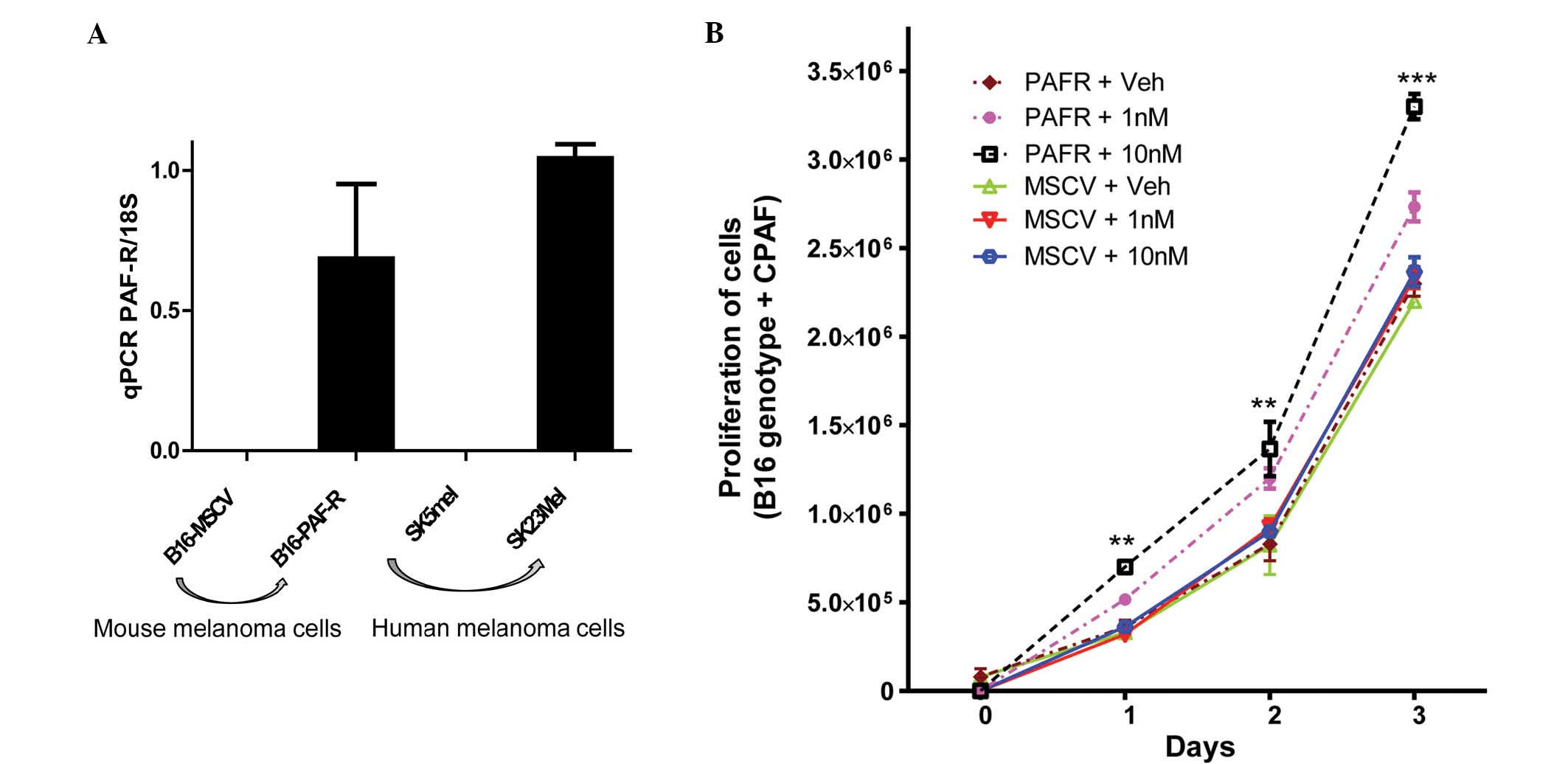
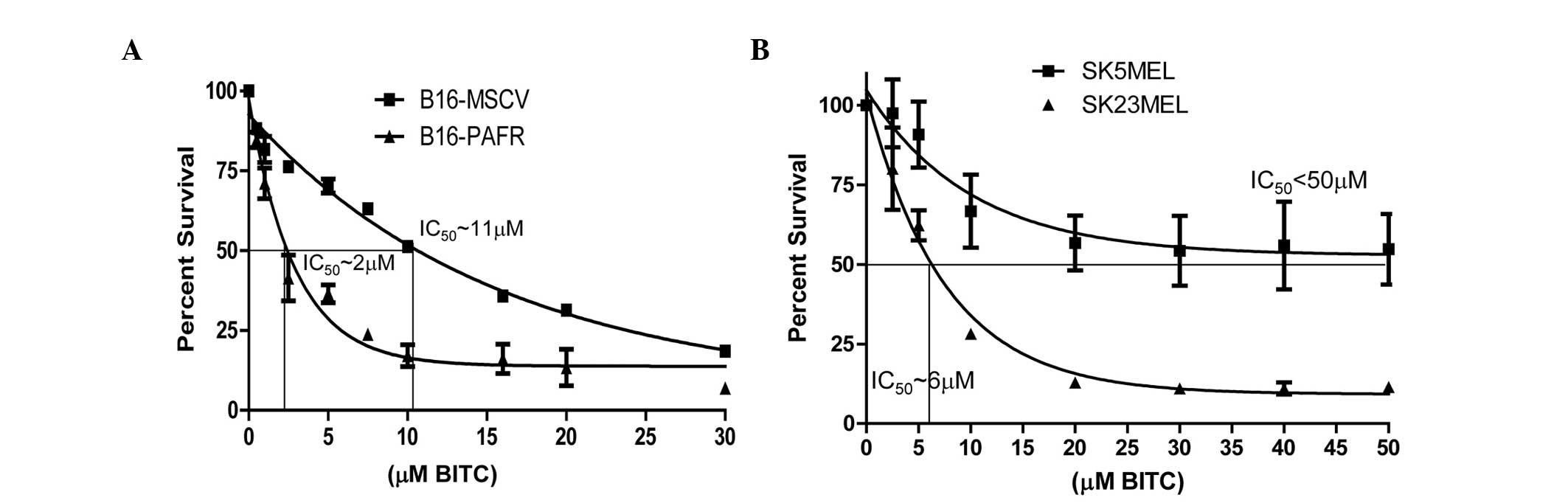
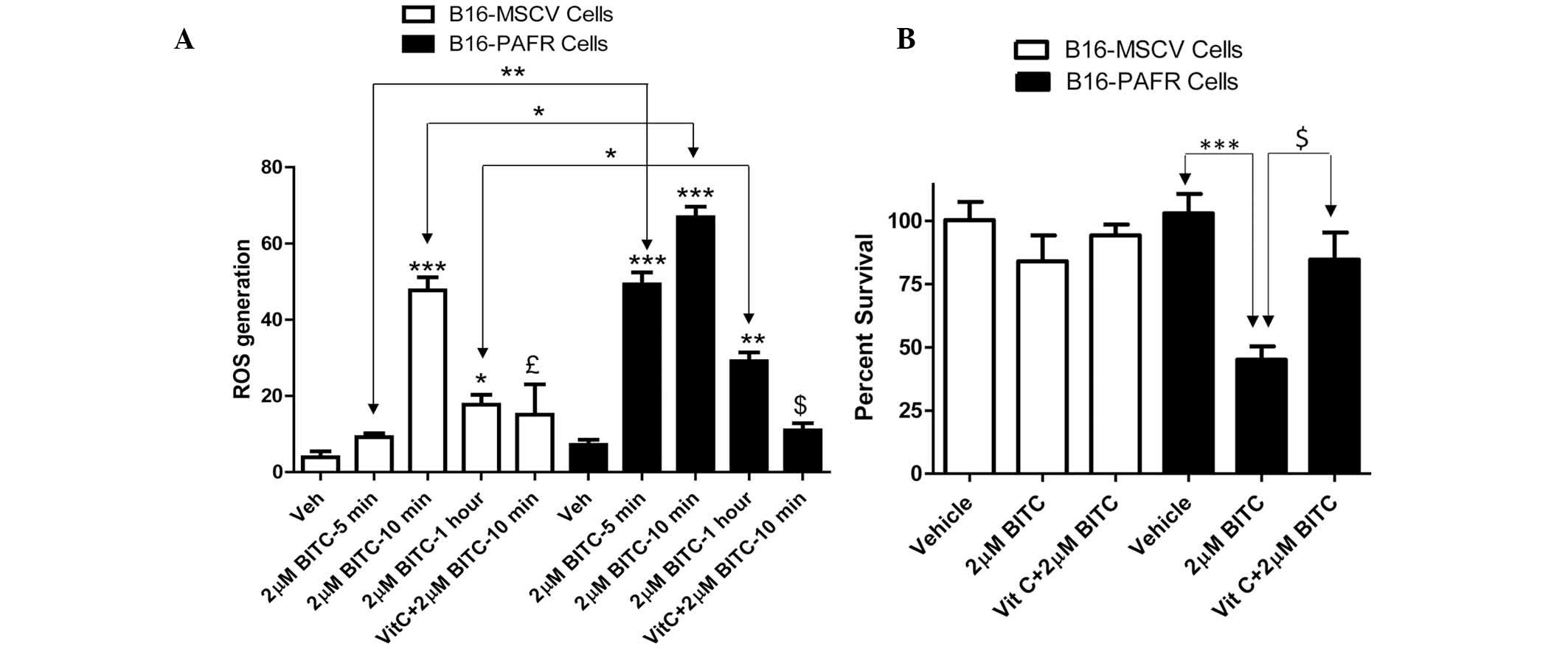
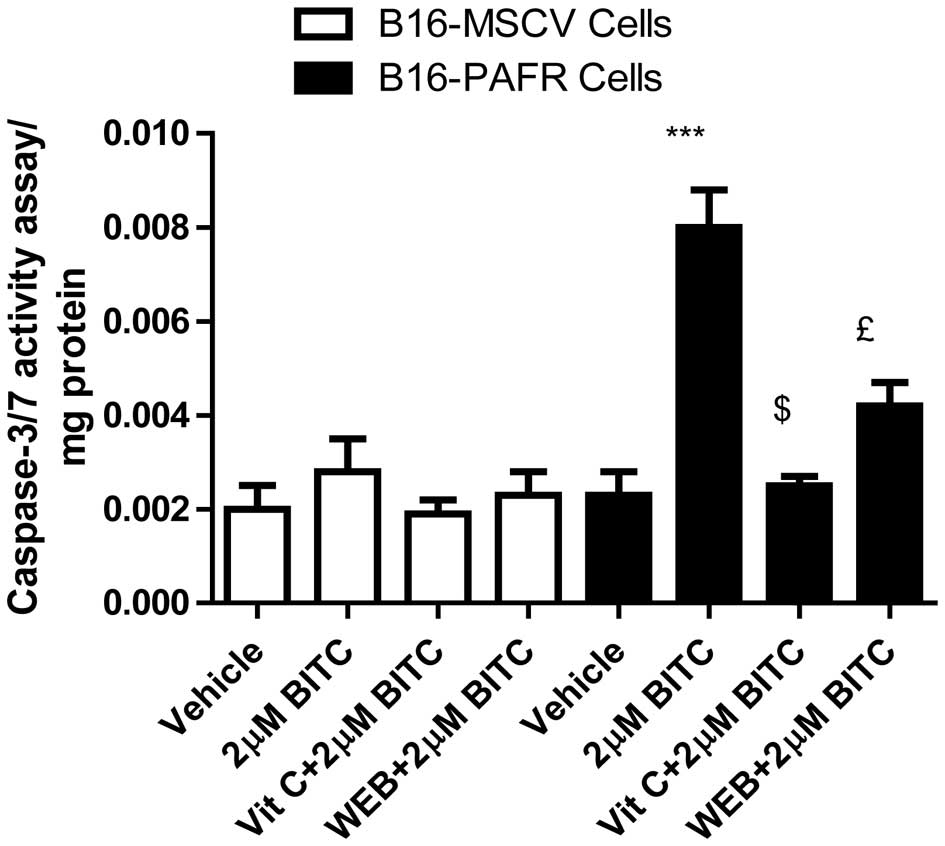
Melanoma cells often express platelet‑activating factor receptor (PAF‑R), which has been demonstrated to increase metastatic behavior. However, the effect of PAF‑R on the responsiveness of melanoma to naturally occurring cytotoxic agents remains to be elucidated. The present study aimed to determine the relative cytotoxicity and mechanism of benzyl isothiocyanate (BITC), a component of cruciferous vegetables, in melanoma cells expressing PAF‑R. To evaluate the importance of PAF‑R signaling in melanoma cell growth, PAF‑R‑negative murine B16F10 cells were transduced with a retrovirus containing the cDNA for PAF‑R to generate cells stably expressing PAF‑R (B16‑PAF‑R) or an empty vector (MSCV) to generate PAF‑R‑deficient B16‑MSCV control cells. Activation of PAF‑R, using the PAF‑R agonist, 1‑hexadecyl‑2‑N‑methylcarbamoyl‑3‑glycerophosphocholine, induced an increase in the proliferation of B16‑PAF‑R cells compared with the B16‑MSCV cells. Reverse transcription quantitative polymerase chain reaction revealed the presence of functional PAF‑R in human melanoma SK23MEL cells, but not in SK5MEL cells. The present study investigated the effect of BITC treatments on the survival of murine and human melanoma cells, in the presence or absence of functional PAF‑R. The results revealed that treatment with BITC decreased the survival rate of the PAF‑R‑positive and negative murine and human melanoma cells. However, the expression of PAF‑R substantially augmented BITC‑mediated cytotoxicity in the PAF‑R‑positive cells at lower concentrations compared with the PAF‑R‑negative cells. In order to determine the underlying mechanism, flow cytometric analysis was used, which demonstrated a significant increase in the generation of reactive oxygen species (ROS) in the B16‑PAF‑R cells compared with the B16‑MSCV cells, which enhanced apoptosis by BITC, as measured by increased caspase‑3/7 luminescence. Notably, the BITC‑mediated decreased cell survival rate, increased ROS and increased apoptosis in the B16‑PAF‑R cells were significantly attenuated by the antioxidant, vitamin C, indicating ROS involvement. Additionally, the WEB2086 PAF‑R antagonist, inhibited the BITC‑mediated enhancement of apoptosis in the B16‑PAF‑R cells, indicating a role for PAF‑R‑signaling in the BITC‑mediated effects. These findings indicated that the selectivity of BITC towards PAF‑R in melanoma offers a promising chemopreventive agent for PAF‑R‑positive melanoma treatment.
View Figures

Figure 1

Figure 2

Figure 3

Figure 4

View References

1 

Miller AJ and Mihm MC Jr: Melanoma. N Engl J Med. 355:51–65. 2006. View Article : Google Scholar : PubMed/NCBI

2 

National Cancer Institute: SEER Stat Fact Sheets: Melanoma of the Skin. http://seer.cancer.gov/statfacts/html/melan.html. Accessed January 21, 2015.

3 

Ishii S, Nagase T and Shimizu T: Platelet-activating factor receptor. Prostaglandins Other Lipid Mediat. 68:599–609. 2002. View Article : Google Scholar : PubMed/NCBI

4 

Zhuang Q, Bastien Y and Mazer BD: Activation via multiple signaling pathways induces down-regulation of platelet-activating factor receptors on human B lymphocytes. J Immunol. 165:2423–2431. 2000. View Article : Google Scholar : PubMed/NCBI

5 

Travers JB, Huff JC, Rola-Pleszczynski M, Gelfand EW, Morelli JG and Murphy RC: Identification of functional platelet-activating factor receptors on human keratinocytes. J Invest Dermatol. 105:816–823. 1995. View Article : Google Scholar : PubMed/NCBI

6 

Sahu RP, Kozman AA, Yao Y, DaSilva SC, Rezania S, Martel KC, Warren SJ, Travers JB and Konger RL: Loss of the platelet activating factor receptor in mice augments PMA-induced inflammation and cutaneous chemical carcinogenesis. Carcinogenesis. 33:694–701. 2012. View Article : Google Scholar : PubMed/NCBI

7 

Sahu RP, Petrache I, Van Demark MJ, Rashid BM, Ocana JA, Tang Y, Yi Q, Turner MJ, Konger RL and Travers JB: Cigarette smoke exposure inhibits contact hypersensitivity via the generation of platelet-activating factor agonists. J Immunol. 190:2447–2454. 2013. View Article : Google Scholar : PubMed/NCBI

8 

Hackler PC, Reuss S, Konger RL, Travers JB and Sahu RP: Systemic platelet-activating factor receptor activation augments experimental lung tumor growth and metastasis. Cancer Growth Metastasis. 19:27–32. 2014.

9 

Melnikova VO, Mourad-Zeidan AA, Lev DC and Bar-Eli M: Platelet-activating factor mediates MMP-2 expression and activation via phosphorylation of cAMP-response element-binding protein and contributes to melanoma metastasis. J Biol Chem. 281:2911–2922. 2006. View Article : Google Scholar

10 

Heon Seo K, Ko HM, Kim HA, Choi JH, Jun Park S, Kim KJ, Lee HK and Im SY: Platelet-activating factor induces upregulation of antiapoptotic factors in a melanoma cell line through nuclear factor-kappaB activation. Cancer Res. 66:4681–4686. 2006. View Article : Google Scholar : PubMed/NCBI

11 

Biancone L, Cantaluppi V, Del Sorbo L, Russo S, Tjoelker LW and Camussi G: Platelet-activating factor inactivation by local expression of platelet-activating factor acetyl-hydrolase modifies tumor vascularization and growth. Clin Cancer Res. 9:4214–4220. 2003.PubMed/NCBI

12 

de Oliveira SI, Andrade LN, Onuchic AC, Nonogaki S, Fernandes PD, Pinheiro MC, Rohde CB, Chammas R and Jancar S: Platelet-activating factor receptor (PAF-R)-dependent pathways control tumour growth and tumour response to chemotherapy. BMC Cancer. 10:2002010. View Article : Google Scholar : PubMed/NCBI

13 

Sahu RP, Turner MJ, DaSilva SC, Rashid BM, Ocana JA, Perkins SM, Konger RL, Touloukian CE, Kaplan MH and Travers JB: The environmental stressor ultraviolet B radiation inhibits murine antitumor immunity through its ability to generate platelet-activating factor agonists. Carcinogenesis. 33:1360–1367. 2012. View Article : Google Scholar : PubMed/NCBI

14 

Barber LA, Spandau DF, Rathman SC, Murphy RC, Johnson CA, Kelley SW, Hurwitz SA and Travers JB: Expression of the platelet-activating factor receptor results in enhanced ultraviolet B radiation-induced apoptosis in a human epidermal cell line. J Biol Chem. 273:18891–18897. 1998. View Article : Google Scholar : PubMed/NCBI

15 

Li T, Southall MD, Yi Q, Pei Y, Lewis D, Al-Hassani M, Spandau D and Travers JB: The epidermal platelet-activating factor receptor augments chemotherapy-induced apoptosis in human carcinoma cell lines. J Biol Chem. 278:16614–16621. 2003. View Article : Google Scholar : PubMed/NCBI

16 

Jilaveanu LB, Aziz SA and Kluger HM: Chemotherapy and biologic therapies for melanoma: Do they work? Clin Dermatol. 27:614–625. 2009. View Article : Google Scholar : PubMed/NCBI

17 

Block G, Patterson B and Subar A: Fruit, vegetables and cancer prevention: A review of the epidemiological evidence. Nutr Cancer. 18:1–29. 1992. View Article : Google Scholar

18 

Stoner GD and Morse MA: Isothiocyanates and plant polyphenols as inhibitors of lung and esophageal cancer. Cancer Lett. 114:113–119. 1997. View Article : Google Scholar : PubMed/NCBI

19 

Sahu RP and Srivastava SK: The role of STAT-3 in the induction of apoptosis in pancreatic cancer cells by benzyl isothiocyanate. J Natl Cancer Inst. 101:176–193. 2009. View Article : Google Scholar : PubMed/NCBI

20 

Warin R, Xiao D, Arlotti JA, Bommareddy A and Singh SV: Inhibition of human breast cancer xenograft growth by cruciferous vegetable constituent benzyl isothiocyanate. Mol Carcinog. 49:500–507. 2010. View Article : Google Scholar : PubMed/NCBI

21 

Wu CL, Huang AC, Yang JS, Liao CL, Lu HF, Chou ST, Ma CY, Hsia TC, Ko YC and Chung JG: Benzyl isothiocyanate (BITC) and phenethyl isothiocyanate (PEITC)-mediated generation of reactive oxygen species causes cell cycle arrest and induces apoptosis via activation of caspase-3, mitochondria dysfunction and nitric oxide (NO) in human osteogenic sarcoma U-2 OS cells. J Orthop Res. 29:1199–1209. 2011. View Article : Google Scholar : PubMed/NCBI

22 

Wu X, Zhu Y, Yan H, Liu B, Li Y, Zhou Q and Xu K: Isothiocyanates induce oxidative stress and suppress the metastasis potential of human non-small cell lung cancer cells. BMC Cancer. 10:2692010. View Article : Google Scholar : PubMed/NCBI

23 

Ni WY, Hsiao YP, Hsu SC, Hsueh SC, Chang CH, Ji BC, Yang JS, Lu HF and Chung JG: Oral administration of benzyl-isothiocyanate inhibits in vivo growth of subcutaneous xenograft tumors of human malignant melanoma A375.S2 cells. In Vivo. 27:623–626. 2013.PubMed/NCBI

24 

Huang SH, Wu LW, Huang AC, Yu CC, Lien JC, Huang YP, Yang JS, Yang JH, Hsiao YP, Wood WG, Yu CS and Chung JG: Benzyl isothiocyanate (BITC) induces G2/M phase arrest and apoptosis in human melanoma A375.S2 cells through reactive oxygen species (ROS) and both mitochondria-dependent and death receptor-mediated multiple signaling pathways. J Agric Food Chem. 60:665–675. 2012. View Article : Google Scholar

25 

Thejass P and Kuttan G: Allyl isothiocyanate (AITC) and phenyl isothiocyanate (PITC) inhibit tumour-specific angiogenesis by downregulating nitric oxide (NO) and tumour necrosis factor-alpha (TNF-alpha) production. Nitric Oxide. 16:247–257. 2007. View Article : Google Scholar

26 

Manesh C and Kuttan G: Effect of naturally occurring allyl and phenyl isothiocyanates in the inhibition of experimental pulmonary metastasis induced by B16F-10 melanoma cells. Fitoterapia. 74:355–363. 2003. View Article : Google Scholar : PubMed/NCBI

27 

Hamsa TP, Thejass P and Kuttan G: Induction of apoptosis by sulforaphane in highly metastatic B16F-10 melanoma cells. Drug Chem Toxicol. 34:332–340. 2011. View Article : Google Scholar : PubMed/NCBI

28 

Sahu RP, DaSilva SC, Rashid B, Martel KC, Jernigan D, Mehta SR, Mohamed DR, Rezania S, Bradish JR, Armstrong AB, Warren S and Konger RL: Mice lacking epidermal PPARγ exhibit a marked augmentation in photocarcinogenesis associated with increased UVB-induced apoptosis, inflammation and barrier dysfunction. Int J Cancer. 131:E1055–E1066. 2012. View Article : Google Scholar : PubMed/NCBI

29 

Sharma A, Sharma AK, Madhunapantula SV, Desai D, Huh SJ, Mosca P, Amin S and Robertson GP: Targeting Akt3 signaling in malignant melanoma using isoselenocyanates. Clin Cancer Res. 15:1674–1685. 2009. View Article : Google Scholar : PubMed/NCBI

30 

Sahu RP, Zhang R, Batra S, Shi Y and Srivastava SK: Benzyl isothiocyanate-mediated generation of reactive oxygen species causes cell cycle arrest and induces apoptosis via activation of MAPK in human pancreatic cancer cells. Carcinogenesis. 30:1744–1753. 2009. View Article : Google Scholar : PubMed/NCBI

31 

Xiao D, Powolny AA and Singh SV: Benzyl isothiocyanate targets mitochondrial respiratory chain to trigger reactive oxygen species-dependent apoptosis in human breast cancer cells. J Biol Chem. 283:30151–30163. 2008. View Article : Google Scholar : PubMed/NCBI

32 

Miyoshi N, Watanabe E, Osawa T, Okuhira M, Murata Y, Ohshima H and Nakamura Y: ATP depletion alters the mode of cell death induced by benzyl isothiocyanate. Biochim Biophys Acta. 1782:566–573. 2008. View Article : Google Scholar : PubMed/NCBI

33 

Doroshow JH: Redox modulation of chemotherapy-induced tumor cell killing and normal tissue toxicity. J Natl Cancer Inst. 98:223–235. 2006. View Article : Google Scholar : PubMed/NCBI

34 

Huang CS, Lin AH, Liu CT, Tsai CW, Chang IS, Chen HW and Lii CK: Isothiocyanates protect against oxidized LDL-induced endothelial dysfunction by upregulating Nrf2-dependent antioxidation and suppressing NFκB activation. Mol Nutr Food Res. 57:1918–1930. 2013. View Article : Google Scholar : PubMed/NCBI

35 

Miyoshi N, Takabayashi S, Osawa T and Nakamura Y: Benzyl isothiocyanate inhibits excessive superoxide generation in inflammatory leukocytes: implication for prevention against inflammation-related carcinogenesis. Carcinogenesis. 25:567–575. 2004. View Article : Google Scholar

36 

Marques SA, Dy LC, Southall MD, Yi Q, Smietana E, Kapur R, Marques M, Travers JB and Spandau DF: The platelet-activating factor receptor activates the extracellular signal-regulated kinase mitogen-activated protein kinase and induces proliferation of epidermal cells through an epidermal growth factor-receptor-dependent pathway. J Pharmacol Exp Ther. 300:1026–1035. 2002. View Article : Google Scholar : PubMed/NCBI

37 

Brandmaier AG, Leitner WW, Ha SP, Sidney J, Restifo NP and Touloukian CE: High-avidity autoreactive CD4+ T cells induce host CTL, overcome T(regs) and mediate tumor destruction. J Immunother. 32:677–688. 2009. View Article : Google Scholar : PubMed/NCBI

Related Articles

  • Abstract
  • View
  • Download
  • Twitter
Copy and paste a formatted citation
Spandidos Publications style
Sahu RP: Expression of the platelet-activating factor receptor enhances benzyl isothiocyanate-induced apoptosis in murine and human melanoma cells. Mol Med Rep 12: 394-400, 2015.
APA
Sahu, R.P. (2015). Expression of the platelet-activating factor receptor enhances benzyl isothiocyanate-induced apoptosis in murine and human melanoma cells. Molecular Medicine Reports, 12, 394-400. https://doi.org/10.3892/mmr.2015.3371
MLA
Sahu, R. P."Expression of the platelet-activating factor receptor enhances benzyl isothiocyanate-induced apoptosis in murine and human melanoma cells". Molecular Medicine Reports 12.1 (2015): 394-400.
Chicago
Sahu, R. P."Expression of the platelet-activating factor receptor enhances benzyl isothiocyanate-induced apoptosis in murine and human melanoma cells". Molecular Medicine Reports 12, no. 1 (2015): 394-400. https://doi.org/10.3892/mmr.2015.3371
Copy and paste a formatted citation
x
Spandidos Publications style
Sahu RP: Expression of the platelet-activating factor receptor enhances benzyl isothiocyanate-induced apoptosis in murine and human melanoma cells. Mol Med Rep 12: 394-400, 2015.
APA
Sahu, R.P. (2015). Expression of the platelet-activating factor receptor enhances benzyl isothiocyanate-induced apoptosis in murine and human melanoma cells. Molecular Medicine Reports, 12, 394-400. https://doi.org/10.3892/mmr.2015.3371
MLA
Sahu, R. P."Expression of the platelet-activating factor receptor enhances benzyl isothiocyanate-induced apoptosis in murine and human melanoma cells". Molecular Medicine Reports 12.1 (2015): 394-400.
Chicago
Sahu, R. P."Expression of the platelet-activating factor receptor enhances benzyl isothiocyanate-induced apoptosis in murine and human melanoma cells". Molecular Medicine Reports 12, no. 1 (2015): 394-400. https://doi.org/10.3892/mmr.2015.3371
Follow us
  • Twitter
  • LinkedIn
  • Facebook
About
  • Spandidos Publications
  • Careers
  • Cookie Policy
  • Privacy Policy
How can we help?
  • Help
  • Live Chat
  • Contact
  • Email to our Support Team