Introduction
The ABO blood group, which was discovered at the
beginning of the 20th century by Karl Landsteiner
remains the most important blood group clinically (1–3). In
1924, this blood group was classified into four antigens (A, B, O
and AB) and six genotypes (AA, AO, BB, BO, OO and AB). It is one of
the conventional blood group polymorphisms, which are important for
genetic markers in linkage analysis, blood transfusion, personal
identification and disease detection (4,5).
A range of techniques have been used for ABO
genotyping, including polymerase chain reaction (PCR)-restriction
fragment length polymorphism, PCR-single-strand conformation
polymorphism, allele-specific-PCR, PCR-amplified product length
polymorphism, reverse transcription-quantitative (RT-q)PCR and DNA
chip (3,6–8).
These methods are, however, time-consuming and disadvantageous due
to the requirement for labor-intensive post-amplification
procedures, including restriction electrophoresis and enzyme
cleavage, or the use of radioactive-labeled DNA probes. Therefore,
a simpler, quicker and more informative method for the genotyping
of the ABO alleles is required.
The present study aimed to improve the ABO
genotyping method, based on LAMP, which directly uses a one-step
isothermal reaction to determine the above-mentioned six genotypes.
The developed technique was a powerful innovative gene
amplification approach as a simple rapid tool for clinical
detection and identification.
Materials and methods
Samples and DNA extraction
Peripheral blood samples were collected from 101
unrelated Chinese volunteers into EDTA-coated tubes at the Shaanxi
Provincial People's Hospital (Xi'an, China) with informed consent.
The study was approved by the ethics committee of the College of
Life Sciences, Northwest University (Xi'an, China). The ABO
phenotypes of all blood samples were identified by serological
methods, based on the ABO blood group antigens present on red blood
cells and IgM antibodies present in the serum. The genomic DNA from
the volunteers was isolated from 1 ml blood using a Whole Blood
Genomic DNA Isolation kit (Xi'an GoldMag Nanobiotech Co., Ltd.,
Xi'an, China), according to the manufacturer's instructions.
Primer design and synthesis
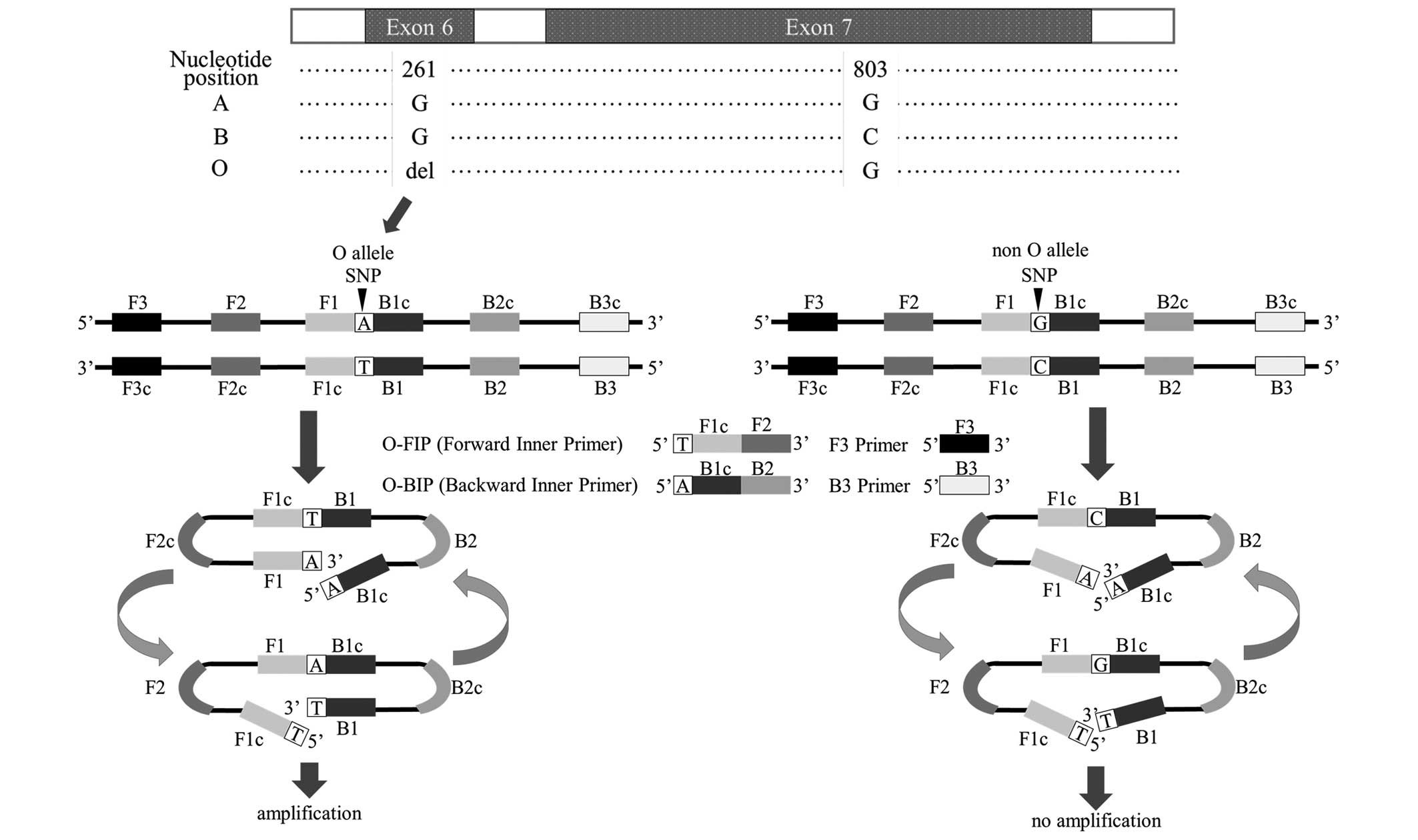
Two single nucleotide polymorphisms (SNPs) at
nucleotides 261 and 803, located on exons 6 and 7 of the ABO gene,
which cover the most polymorphic sites of the complete ABO
sequences, as shown in Fig. 1
(9), were selected. The primer set
for LAMP amplification includes a set of four primers, comprising
two outer and two internal primers, which recognize six distinct
regions on the target sequence, designated in Fig. 1. Table
I lists the sequences of the typing primers used for the LAMP
reaction. All oligonucleotide primers were synthesized by Beijing
Genomics Institute (BGI; Beijing, China).
 | Table ISequences of typing primers used for
real-time loop-mediated isothermal amplification reaction. |
Table I
Sequences of typing primers used for
real-time loop-mediated isothermal amplification reaction.
| Allele | Primer | Sequence (5′→3′) |
|---|
| nt 261 for O
test | O-F3 | TGTGCCAGAGGCGCAT |
| O-B3 |
TGATGGCAAACACAGTTAAC |
| O-FIP | TACCACGAGGACATCCTTCCTCCTGCCAGCTCCATGTGA |
| O-BIP | ACCCCTTGGCTGGCTCCTGGAGCCTGAACTGCTCGT |
| Non-O-FIP | CACCACGAGGACATCCTTCCTCCTGCCAGCTCCATGTGA |
| Non-O-BIP | GACCCCTTGGCTGGCTCCTGGAGCCTGAACTGCTCGT |
| nt 803 for B
test | B-F3 |
TGACTGGTTCGGCACCCT |
| B-B3 |
TGCCGTTGGCCTGGTCGAC |
| B-FIP | TGTAGTAGAAATCGCCCTTCACGGAAGCAGCCGGGA |
| B-BIP | CGTTCTTCGGGGGGTCGGTCCGGTACTACCA |
| Non-B-FIP | GGTAGTAGAAATCGCCCTTCACGGAAGCAGCCGGGA |
| Non-B-BIP | GGTTCTTCGGGGGGTCGGTCCGGTACTACCA |
Target amplification by LAMP
Each analysis was performed by subjecting samples of
prepared blood from each individual to four LAMP amplifications.
Two reactions used the O or B primer set and the other reactions
used the non-O or non-B primer set. Each reaction included a
forward/backward primer (F3/B3). The amplification was performed in
a final volume of 25 µl, containing 0.8 µM forward
inner primer and backward inner primer, 0.2 µM F3 and B3
primers, 15 µl Isothermal Master mix (IMM; OptiGene,
Horsham, UK) and 50 ng genomic DNA. The reaction conditions were
optimized to ensure that the amplifications were highly specific,
including assessment of primer concentration, preparation blood
concentration and reaction temperature. The LAMP assays were
performed in 8-well strips by incubation at 62°C for 40 min.
Simultaneously, the fluorescence intensity of the florescent dye,
contained in the IMM, was monitored using a Genie II system
(OptiGene).
Direct sequencing of the PCR
products
For the samples to be sequenced, a 200 bp fragment
for exon 6 and a 740 bp fragment for exon 7 were amplified using
the following two primer pairs synthesized by BGI: Exon 6, forward:
5′-TCCATGTGACCGCACGCCTC-3′ and reverse:
5′-GGGTCTCTACCCTCGGCCACC-3′; exon 7, forward:
5′-CCGTGTCCACTACTATGTCTTCACC-3′ and reverse:
5′-ACAACAGGACGGACAAAGGAAACAG-3′. The PCR products were sequenced by
the BGI.
Results and Discussion
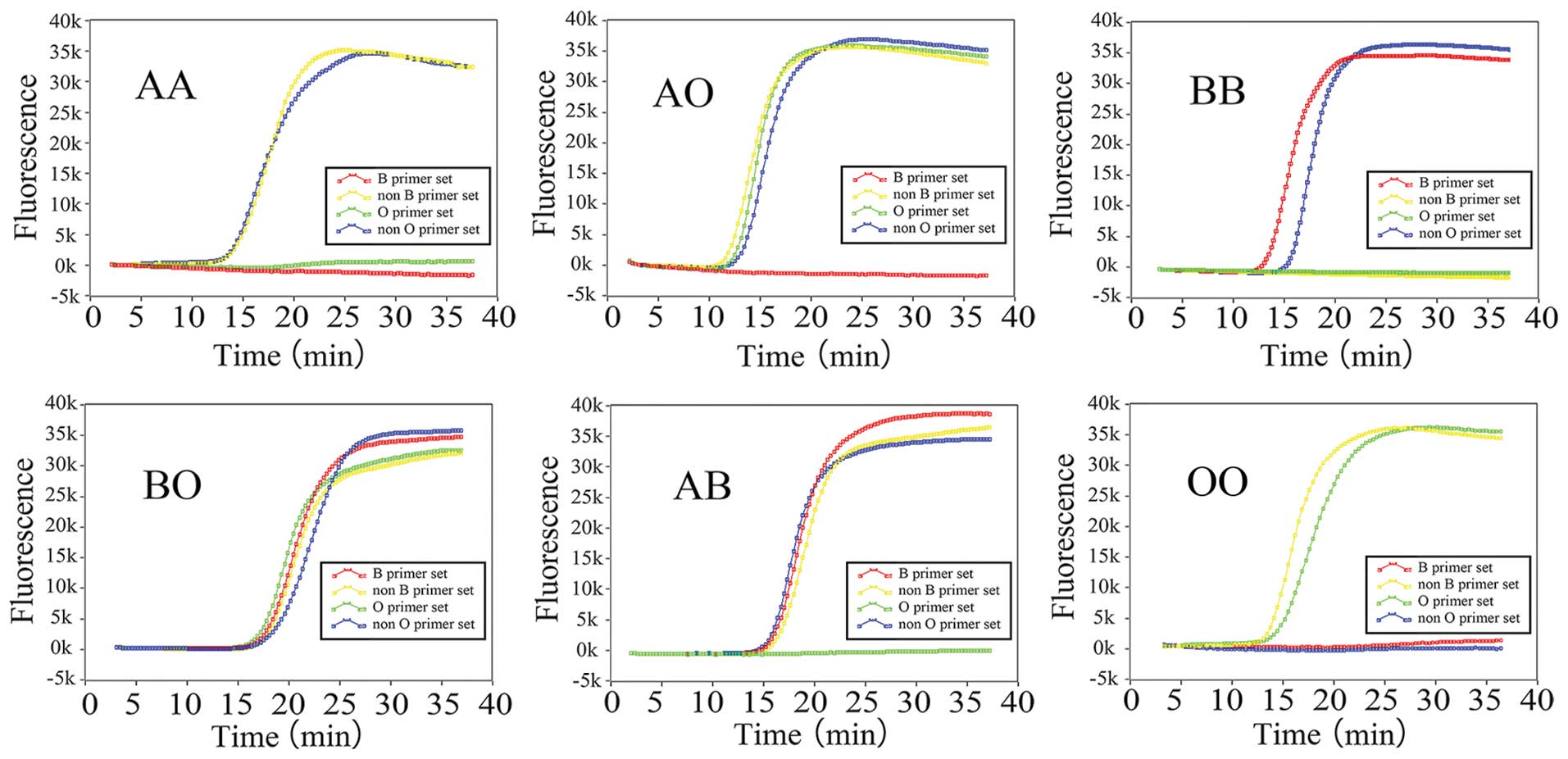
Using this method, base substitutions at two SNP
sites in the ABO gene (nucleotides 261 and 803) were detected
simultaneously by four primers, setting the extension reaction to
distinguish the six genotypes (AA, AO, BB, BO, OO and AB). In the
case of haplotypes, a positive allele-specific reaction excluded
the corresponding positive non-allele-specific reaction and vice
versa. Allele B was distinguished from the non-B primer at
nucleotide 803 and allele O was distinguished from the non-O at
nucleotide 261. A summary of all possible patterns are indicated in
Table II and representative data
are shown in Fig 2.
| Table IIPossible patterns detected with
real-time loop-mediated isothermal amplification and statistical
results of genotyping of the 101 selected individuals. |
Table II
Possible patterns detected with
real-time loop-mediated isothermal amplification and statistical
results of genotyping of the 101 selected individuals.
| Phenotype | Genotype | B primer set | non-B primer set | O primer set | non-O primer set | No. individuals
identified (n=101) | Calculated genotype
frequency (%) |
|---|
| A | AA | − | + | − | + | 6 | 5.94 |
| A | AO | − | + | + | + | 38 | 37.62 |
| B | BB | + | − | − | + | 12 | 11.88 |
| B | BO | + | + | + | + | 29 | 28.71 |
| AB | AB | + | + | − | + | 8 | 7.92 |
| O | OO | − | + | + | − | 8 | 7.92 |
A pool of 101 blood samples from Chinese donors was
assessed using LAMP. The detected genotypes, together with their
frequencies, are shown in Table
II. The observed allele frequencies were: 28.71, 30.20 and
41.09%, for A, B and O, respectively (Calculated from: A:
(AA+AO/2+AB/2)/101; B:(BB+BO/2+AB/2)/101; O: (AO/2+BO/2+OO)/101),
from which phenotype frequencies were calculated to be 43.56,
40.59, 7.92 and 7.92% for A, B, AB and O, respectively (Calculated
from: Phenotypes/101). The results were compared with the
phenotypes determined by serological assay and the genotypes
determined by direct sequencing, and no discrepancies were
observed.
The ABO blood group system was the first blood group
system to be identified and has been used extensively as a marker
in population studies, epidemiology, and forensic investigation
(10). The ABO blood group is
fundamental for transfusion medicine, as accurate testing of the
blood donor and recipient is essential for the prevention of
hemolytic transfusion reactions and hemolytic disease of the
newborn (11,12). The ABO blood group is also critical
for assessing the risk of developing certain malignancies (13,14)
and cardiovascular disorders (5,15).
To date, several methods have been reported for ABO genotyping,
which rely predominantly on differentiating A, B and O at specific
base substitutions.
However, technical errors and several clinical
conditions or diseases can lead to discrepancies between
erythrocytes and sera, resulting in an incorrect genotype being
determined (3,16–18).
An emerging novel approach, LAMP, is gaining attention as a result
of its practicality, speed and usefulness in laboratories and
clinical settings (19–21).
LAMP is a simple, rapid and accurate gene
amplification technique, using a set of four specially designed
primers to span six distinct regions on the target gene. The
amplification procedure is simple and rapid, wherein the whole
procedure can be completed in a single step by incubating all
reagents (samples, primers, DNA polymerase with strand displacement
activity and substrates) in a single tube under isothermal
conditions, which can be completed in <1 h, with the DNA being
amplified 10−9–10−10 times (22).
The primary characteristic of LAMP is its advantage
of reaction simplicity and higher amplification efficiency. In the
present study, the DNA amplification procedure was <40 min at a
constant temperature of 62°C, which allowed no time loss for
thermal change. The DNA polymerase provides high amplification
efficiency as a result of its high specificity and the presence of
the target gene sequence is easily detected by judging the presence
of amplified products. In addition, no denaturation of double
stranded DNA into a single stranded DNA is required. In addition,
the more sensitive signal detector instrument, GENIE II, assists in
the rapid processing of the data. It takes ~20 min to reach the
peak, followed by another 20 min to complete the entire reaction,
which is relatively quicker compared with normal PCR-based
assays.
The second characteristic of LAMP is its superior
specificity. It has been previously reported that the detection
limit of the LAMP assay was 10 times lower compared with RT-qPCR
and 104 times lower compared with conventional PCR
(22,23). However, LAMP systems with high
sensitivity may lead to false positive results. In the present
study, the blood samples from 101 Chinese individuals were
successfully genotyped using peripheral blood DNA and no false
positive reaction was observed, according to the direct
sequencing.
With the use of four primers designed to recognize
six distinct regions, only the target SNP is strictly and
specifically amplified, even in coexistence with its homologous
gene. The reaction is so specific that it can strictly discriminate
single nucleotide differences. These results demonstrated that the
four primer sets designed were extremely specific to the two SNP
sites in the ABO gene. Also, the application of IMM, including
florescent dye, reduced the risk of cross contamination due to the
reduction of lid opening.
In conclusion, the LAMP assay developed in the
present study has great potential for rapid ABO genotyping, which
can be applied in laboratories and clinical settings. It is also
envisioned that several other known SNPs may also be detected by
this method with corresponding primer sets. Considering the
advantages of rapid amplification, easy detection and simple
operation, LAMP may offer more applications for point-of-care
testing.
Acknowledgments
The present study was supported by the Project of
National Great New Drug Research and Development of China (no.
2012ZX09506001–001) and a grant from the National Institute of
Health (no. P20RR016457 from the INBRE Program of the National
Center for Research Resources).
References
|
1
|
Landsteiner K: Zur Kenntnis der
antifermentativen, lytischen und agglutinierenden Wirkungen des
Blutserums und der Lymphe. Zbl Bakt. 27:357–362. 1900.
|
|
2
|
Storry JR and Olsson ML: The ABO blood
group system revisited: A review and update. Immunohematology.
25:48–59. 2009.PubMed/NCBI
|
|
3
|
Franchini M and Liumbruno GM; ABO blood
group: Old dogma, new perspectives. Clin Chem Lab Med.
51:1545–1553. 2013.PubMed/NCBI
|
|
4
|
Sano R, Takahashi Y, Nakajima T, Yoshii M,
Kubo R, Takahashi K, Kominato Y, Takeshita H, Yasuda T, Tsuneyama
H, et al: ABO chimerism with a minor allele detected by the peptide
nucleic acid-mediated polymerase chain reaction clamping method.
Blood Transfus. 12:431–434. 2014.PubMed/NCBI
|
|
5
|
Dentali F, Sironi AP, Ageno W, Crestani S
and Franchini M: ABO blood group and vascular disease: An update.
Semin Thromb Hemost. 40:49–59. 2014.PubMed/NCBI
|
|
6
|
Flegel WA: ABO genotyping: The quest for
clinical applications. Blood Transfus. 11:62013.
|
|
7
|
Watanabe K, Ikegaya H, Hirayama K, Motani
H, Iwase H, Kaneko H, Fukushima H, Akutsu T and Sakurada K: A novel
method for ABO genotyping using a DNA chip. J Forensic Sci.
56(Suppl 1): S183–S187. 2011. View Article : Google Scholar : PubMed/NCBI
|
|
8
|
Watanabe G, Umetsu K, Yuasa I and Suzuki
T: Amplified product length polymorphism (APLP): A novel strategy
for genotyping the ABO blood group. Hum Genet. 99:34–37. 1997.
View Article : Google Scholar : PubMed/NCBI
|
|
9
|
Yamamoto F, McNeill PD and Hakomori S:
Genomic organization of human histo-blood group ABO genes.
Glycobiology. 5:51–58. 1995. View Article : Google Scholar : PubMed/NCBI
|
|
10
|
O'Keefe DS and Dobrovic A: A rapid and
reliable PCR method for genotyping the ABO blood group. Hum Mutat.
2:67–70. 1993. View Article : Google Scholar : PubMed/NCBI
|
|
11
|
Ross MB and de Alarcón P: Hemolytic
disease of the fetus and newborn. Neoreviews. 14:e83–e88. 2013.
View Article : Google Scholar
|
|
12
|
Daniels G: Human blood groups:
Introduction. Human Blood Groups. 3rd edition. Wiley-Blackwell;
Oxford, UK: pp. 1–10. 2013, View Article : Google Scholar
|
|
13
|
Xie J, Qureshi AA, Li Y and Han J: ABO
blood group and incidence of skin cancer. PLoS One. 5:e119722010.
View Article : Google Scholar : PubMed/NCBI
|
|
14
|
Iodice S, Maisonneuve P, Botteri E, Sandri
MT and Lowenfels AB: ABO blood group and cancer. Eur J Cancer.
46:3345–3350. 2010. View Article : Google Scholar : PubMed/NCBI
|
|
15
|
Franchini M, Rossi C, Mengoli C, Frattini
F, Crestani S, Giacomini I, Luppi M and Bonfanti C: ABO blood group
and risk of coronary artery disease. J Thromb Thrombolys.
36:286–287. 2013. View Article : Google Scholar
|
|
16
|
Olsson ML, Irshaid NM, Hosseini-Maaf B,
Hellberg A, Moulds MK, Sareneva H and Chester MA: Genomic analysis
of clinical samples with serologic ABO blood grouping
discrepancies: Identification of 15 novel A and B subgroup alleles.
Blood. 98:1585–1593. 2001. View Article : Google Scholar : PubMed/NCBI
|
|
17
|
Stratton F, Renton PH and Hancock JA: Red
cell agglutinability affected by disease. Nature. 181:62–63. 1958.
View Article : Google Scholar : PubMed/NCBI
|
|
18
|
Hoogstraten B, Rosenfield RE and Wasserman
LR: Change of ABO blood type in a patient with leukemia.
Transfusion. 1:32–35. 1961. View Article : Google Scholar : PubMed/NCBI
|
|
19
|
Notomi T, Okayama H, Masubuchi H, Yonekawa
T, Watanabe K, Amino N and Hase T: Loop-mediated isothermal
amplification of DNA. Nucleic Acids Res. 28:e632000. View Article : Google Scholar : PubMed/NCBI
|
|
20
|
Aonuma H, Badolo A, Okado K and Kanuka H:
Detection of mutation by allele-specific loop-mediated isothermal
amplification (AS-LAMP). Methods Mol Biol. 1039:121–127. 2013.
View Article : Google Scholar : PubMed/NCBI
|
|
21
|
Mitani Y, Lezhava A, Kawai Y, Kikuchi T,
Oguchi-Katayama A, Kogo Y, Itoh M, Miyagi T, Takakura H, Hoshi K,
et al: Rapid SNP diagnostics using asymmetric isothermal
amplification and a new mismatch-suppression technology. Nat
Methods. 4:257–262. 2007. View Article : Google Scholar : PubMed/NCBI
|
|
22
|
Parida M, Sannarangaiah S, Dash PK, Rao PV
and Morita K: Loop mediated isothermal amplification (LAMP): A new
generation of innovative gene amplification technique; perspectives
in clinical diagnosis of infectious diseases. Rev Med Virol.
18:407–421. 2008. View
Article : Google Scholar : PubMed/NCBI
|
|
23
|
He J, Shi X, Yu L, Zheng X, Lan W, Jia P,
Wang J and Liu H: Development and evaluation of a loop-mediated
isothermal amplification assay for diagnosis of Cyprinid
herpesvirus 2. J Virol Methods. 194:206–210. 2013. View Article : Google Scholar : PubMed/NCBI
|