Introduction
Health is a state of complete physical, mental and
social well-being, and not merely the absence of disease or
infirmity. The sub-health condition refers to a state in which the
patient experiences a reduction in his or her vitality and
adaptability, although no defined disease is diagnosed (1). It is also a state featuring a
deterioration in physiological function between health and illness
(2,3). The sub-health condition has emerged
as a life-threatening condition in China, which is prevalent among
senior and middle-level managers, clerks and other workers of high
educational attainment (4). The
causes are varied, including poor diet, lack of exercise and
chronic stress, which are all important in the development of the
sub-health condition. The condition can last for several months or
even years, and patients suffering from this condition often cannot
work efficiently, or cannot continue their work or studies, thereby
affecting their relationship with family members and society
(5). Certain experts have
summarized the characteristics of the condition as a deficit of
activity, reaction and adaptability. In addition, the sub-health
condition is characterized by an increase in the levels of blood
glucose, lipid and viscosity, and a decrease in immune function
(5). Few animal models have been
established to investigate the development of the sub-health
condition. The aim of the present study was to establish a novel
rat sub-health model, according to its causes, and to evaluate the
success of the model against the characteristics of the sub-health
condition.
Intestinal disorders, including constipation and
diarrhea, are the most common symptoms seen in individuals in
sub-health. Previous reports have demonstrated that abnormal
intestinal barrier function occurs in irritable bowel syndrome,
prolonged and high-intensity exercise, and with high levels of
dietary fat (6,7), and the mechanism contributes to their
intestinal symptoms of diarrhea and constipation. In addition,
individuals in sub-health exhibit a notable downregulation in the
expression of YWHAZ, which has protective effects on intestinal
barrier function (8). Therefore,
the present study performed experiments to characterize changes in
intestinal function in the novel sub-health rat model.
There remains controversy as to whether the
sub-health condition requires medical intervention, and it has been
suggested that removal of the causes, including the intake of
high-fat foods and physical stress, can cause sub-health symptoms
to disappear. In the present study, the sub-health model rats we
re-introduced their normal environment following establishment of
the model, following which the physiological index and expression
levels of YWHAZ were analyzed. The present study aimed to elucidate
possible underlying mechanisms of intestinal disorders.
Materials and methods
Sub-health rat model
The present study was approved by the Ethics
Committee of Xiangya Hospital (Changsha, China). A total of 18
healthy adult male Wistar rats (weighing 180–200 g) were purchased
from the animal facility of Central South University. The rats were
housed individually, provided with access to food and water ad
libitum and maintained under a 12 h light/dark cycle at a
temperature of 25±2°C. The rats were randomly divided into a
sub-health group (n=12) and a control group (n=6).
In the sub-health group, the rats were subjected to
high-fat and sugar diet (comprising 15% lard and 10% sucrose) in
their feed every day. At the same time, the rats were placed in a
restrictive space 24 h a day, which limited motion permitting the
rat to turn around. In addition, the rats were subjected to water
avoidance stress (WAS) every day. The procedure of WAS involved
placing the rat on a platform (8×6 cm) in the middle of a plastic
container (56×50 cm) filled with warm water (25°C) to 1 cm below
the height of the platform. The rats avoided the aversive stimulus
(water) by remaining on the platform for 1 h. The experimental
procedures were performed between 8:00 and 10:00 a.m. to minimize
the effect of their circadian rhythm (9). This series of experiments was
performed for 5 weeks in total. At the same time, the control group
of rats was fed a normal diet. After 5 weeks, six of the rats in
the sub-health group and the six control group rats were randomly
selected and sacrificed by decapitation, following which trunk
blood and 10 g feces samples, and organs were collected. The colon
was dissected and maintained on ice prior to weighing within 2–3 h
of collection. Whole blood was allowed to clot and centrifuged at
3,220 × g for 20 min at 4°C to collect the serum, which was stored
at −70°C. The remaining six sub-health group rats, were removed
from the sub-health condition and returned to their normal living
patterns, including a normal diet, suffi-ciently large cage and
lowered levels of stress. After 5 weeks, these rats were also
sacrificed and blood and feces samples and organs were
collected.
Glucose and lipid profile analysis
The serum was obtained and stored in 0.5 ml aliquots
at −70°C until use. The levels of glucose (GLU; cat. no. YZB/GER
3263-2014), triglycerides (TGs; cat. no. YZB/GER 3373-2014), total
cholesterol (T-Ch; cat. no. YZB/GER 3316-2014), high density
lipoprotein cholesterol (HDL-c; cat. no. YZB/GER 3394-2014) and low
density lipoprotein cholesterol (LDL-c; cat. no. YZB/GER 3364-2014)
were measured using the corresponding commercial kits (Autec
Diagnostica Co, Botzing, Germany) on an automatic biochemistry
analyzer (HITACHI 7170, Hitachi, Ltd., Tokyo, Japan).
Serum concentration analysis of
interferon (IFN)-γ and interleukin (IL)-4
The serum concentrations of INF-γ and IL-4 were
measured using a two-step sandwich enzyme-linked immunosorbent
assay (ELISA) method, with INF-γ and IL-4 assay kits, which were
purchased from Cusabio (Wuhan, China), in accordance with the
manufacturer's instructions.
Open field assessment
The rats were removed from their housing cages and
placed at the center of a wooden box measuring 100×100×40 cm, the
floor of which was divided by black lines into 25 equal squares.
The horizontal locomotion, vertical locomotion, time spent in the
central area of the apparatus and the number of defecations were
recorded for 5 min, to evaluate habituation, emotionality and motor
activity. The horizontal locomotor activity was characterized by
the total number of squares crossed during a 5 min assessment
session (square crossing), and the vertical locomotion was
determined by the number of rearings (standing on hind legs)
(10).
Determination of concentration of serum
D-lactic acid and activity of diamine oxidase (DAO)
The concentrations of serum D-lactic acid
concentration was measured using a two-step sandwich ELISA method,
with a D-lactic acid kit (Cusabio), according to the manufacturer's
instructions. Serum DAO activity was measured using a
spectrophotometric method, using D-lactic acid and DAO activity
assay kits (Jiancheng Bioengineering Institute, Nanjing, China) in
the HITACHI 7170 system.
Histological examination
Samples of the colon were fixed in 10% buffered
paraformaldehyde (Shanghai Qiangshun Chemical Reagents Co., Ltd.,
Shanghai, China), embedded in paraffin (Shanghai Qiangshun Chemical
Reagents Co., Ltd.), sectioned at 4 µm thickness, and
stained with hematoxylin and eosin (Shanghai Qiangshun Chemical
Reagents Co., Ltd.) A Bioquant image analysis system (Bioquant
Image Analysis Corporation, Nashville, TN, USA) attached to a Nikon
E800 microscope (Nikon Corporation, Tokyo, Japan) was used to
visualize the stained sections at three fields per section.
RNA extraction and reverse
transcription-quantitative polymerase chain reaction (RT-qPCR)
analysis
Total RNA was isolated from 100 mg samples of colon
tissue using TRIzol reagent (Invitrogen Life Technologies,
Carlsbad, CA, USA) and reverse-transcribed using a RevertAid First
Strand cDNA Synthesis kit (Thermo Fisher Scientific, Pittsburg, PA,
USA), according to the manufacturer's instructions. The qPCR
reaction was performed in a 20 µl reaction volume,
containing 1.6 µl of primer, using an Applied Biosystems
Max3000 sequence detection system and SYBR Green reagents (Takara
Bio Inc., Otsu, Japan). The thermocycling conditions were 95°C for
10 min, followed by 40 cycles of denaturation at 95°C for 35 sec
and annealing/elongation at 60°C for 20 sec. The oligonucleotide
primers (obtained from Shanghai Shenggong Biology Engineering
Technology Service, Ltd., Shanghai, China) used were as follows:
Rat YWHAZ, forward 5′-GCCTGCTCTCTTGCAAAAAC-3′ and reverse
5′-GGTATCCGATGTCCACAATG-3′; and Rat GAPDH, forward
5′-ATCACCATCTTCCAGGAGCG-3′ and reverse 5′-TTCTGAGTGGCAGTGAGGGC-3′.
Detection of the qPCR products was monitored by the increase in
fluorescence caused by the binding of SYBR Green to the
double-stranded DNA. To verify the homogenous nature of the qPCR
product, melting-point determinations were evaluated at the end of
each reaction. The change in cycle threshold was calculated to
compare the mRNA expression levels of each target gene, relative to
expression of the reference 'housekeeping' gene, GAPDH. ∆Ct
indicates the difference between the number of cycles required to
detect linear amplification of the PCR products for each protein
and that of GAPDH. The relative expression levels were analyzed
using the 2−∆Ct method.
Immunohistochemistry
The protein expression levels were evaluated using
immunohistochemistry. Sections were cut from the paraffin blocks (4
µm) and mounted onto silane-coated glass slides (Beijing
Zhongshan Jinqiao Biotechnology Co., Ltd., Beijing, China). The
sections were dewaxed in xylene (Beijing Zhongshan Jinqiao
Biotechnology Co., Ltd.) and rehydrated via a graded series of
alcohols. Antigen retrieval was performed using 10 mmol/l citrate
buffer (pH 6.0; Beijing Zhongshan Jinqiao Biotechnology Co., Ltd.)
and heat, with sections subjected to microwave irradiation at 700 W
and 45°C to produce staining. Endogenous peroxidases were inhibited
through incubation for 30 min at 25°C with 3%
H2O2 in methanol. The tissue sections were
incubated for 2 h at room temperature with 3% normal goat serum
prior to incubation with the primary rabbit monoclonal anti-rat
YWHAZ antibody (Santa Cruz Biotechnology, Inc., Santa Cruz, CA,
USA; cat. no. sc-1019) diluted 1:100 in PBS for 16–24 h at 4°C. The
bound antibodies were detected using biotin-substance P-conjugated
goat anti-rabbit IgG secondary antibody (1:500; Zhongshan Golden
Bridge Biotechnology, Beijing, China; ZLI-9022). The sections were
processed using a standard biotin-avidin-horseradish peroxidase
methodology. Diaminobenzidine tetrahydrochloride (Beijing Zhongshan
Jinqiao Biotechnology Co., Ltd.) was used as the chromogen, and
immunoreactivity appeared as brown staining. The nuclei were
counterstained with hematoxylin. Sections were examined using light
microscopy.
Statistical analysis
Data were expressed as the mean ± standard error of
the mean. Data were analyzed using SPSS 21 (IBM SPSS, Armonk, NY,
USA) and GraphPad Prism 6 (GraphPad Software, Inc., La Jolla, CA,
USA). Comparisons between groups were analyzed with appropriate
analyses of variance or t-tests. P<0.05 was considered to
indicate a statistically significant difference.
Results
Changes in growth, GLU and lipid
profile
The present study initially observed that body
weight of the rats in the sub-health group were similar to those of
the rats in the control group (data not shown), indicating that
chronic stress may affect the increase of weight regardless of a
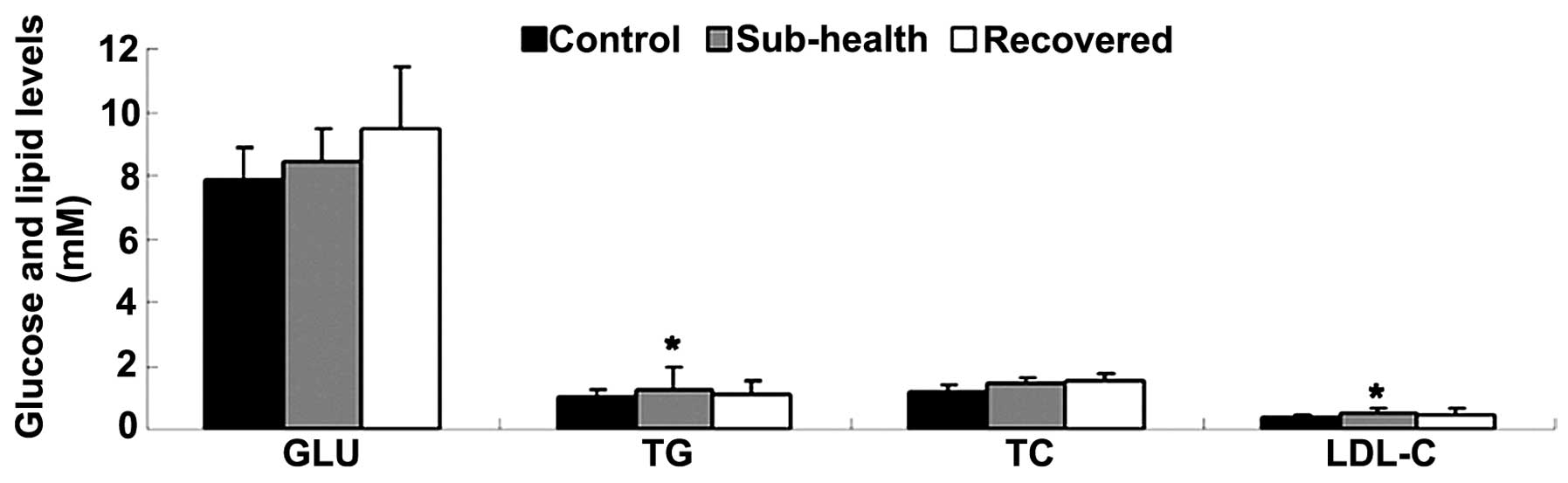
high-fat and sugar diet. As shown in Fig. 1, the GLU and lipid levels in the
sub-health rats increased marginally, compared with the control
rats, but without statistical significance. However, the levels of
TGs and LDL-c were significantly upregulated in the sub-health
rats, compared with the control group. In addition, in the
recovered group, the level of GLU and the lipid profile did not
return to normal.
Changes in IFN-γ and IL-4
concentrations
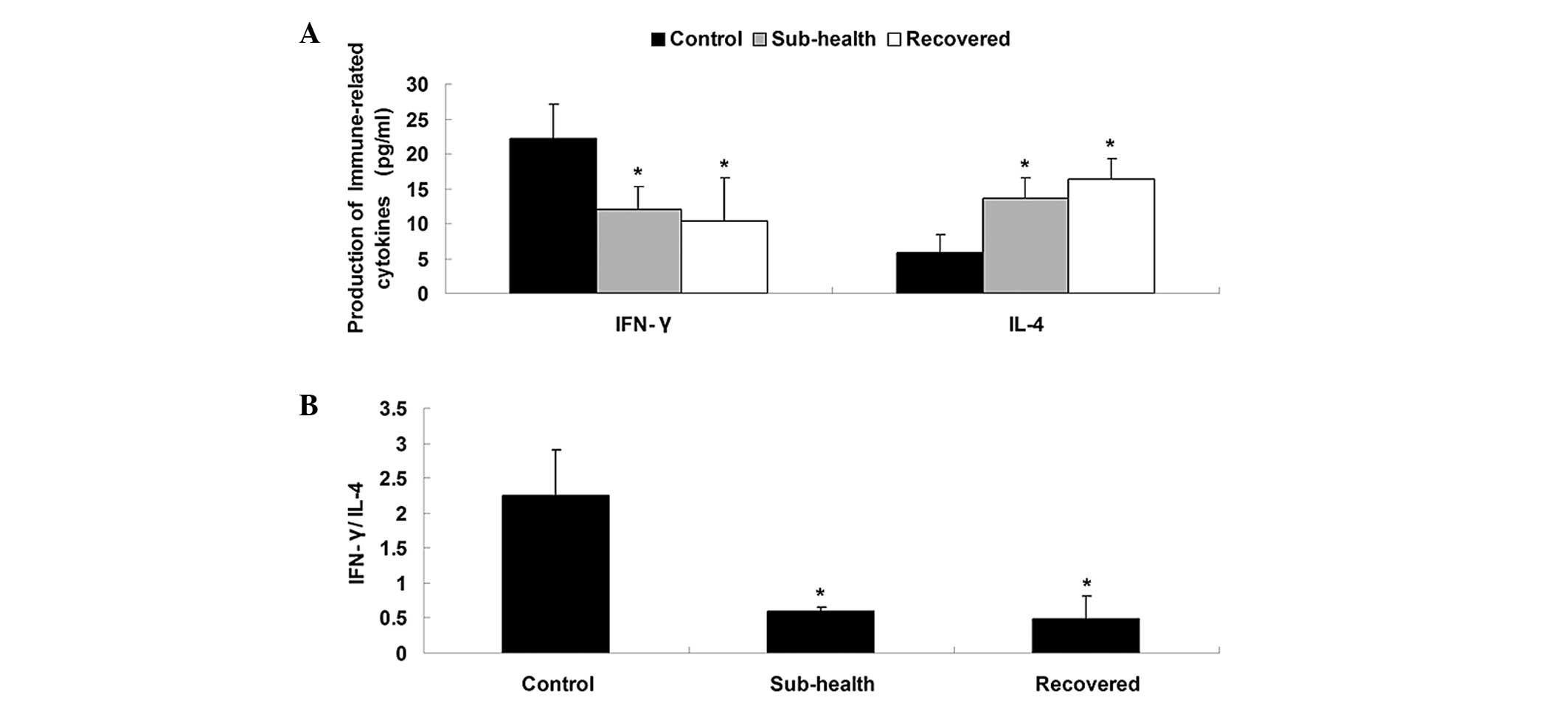
The serum concentrations of IFN-γ and IL-4 were
significantly decreased in the sub-health rats, compared with the
control group. Following recovery from the sub-health condition for
35 days, the levels of IFN-γ and IL-4 remained unchanged in the
recovered sub-health group (Fig.
2).
Behavioral investigation
The effects of the sub-health conditions on the
number of crossing responses and rearing responses (motor
activity), the duration spent in the central area (habituation) and
fecal boli (emotionality) in the open field task are presented in
Table I. An increased number of
boli is associated with the anxiety of the animal (11–13).
Statistical analysis demonstrated a significant reduction in the
number of crossings and rearings, and an increase in the time spent
in the central area, indicating deficits in motor activity and
habituation. The increase of fecal boli indicated that the
sub-health factors also affected the emotionality of the animals.
Following a return to normal living conditions, the behaviors of
the rats improved marginally.
 | Table IEffects on the duration spent in the
central area, number of rearings, crossings and fecal boli in the
open field assessment in rats exposed to sub-health conditions for
5 weeks and subsequent recovery. |
Table I
Effects on the duration spent in the
central area, number of rearings, crossings and fecal boli in the
open field assessment in rats exposed to sub-health conditions for
5 weeks and subsequent recovery.
| Variable | Control | Sub-health | Sub-health
recovery |
|---|
| Duration in central
area (sec) | 4.33±2.50 | 14.83±9.45a | 9.17±8.33 |
| Number of
rearings | 20.83±10.09 | 4.33±3.72a | 12.00±7.07 |
| Number of
crossing | 66.50±39.79 | 18.67±17.39a | 39.83±28.48 |
| Number of fecal
boli | 1.33±1.75 | 4.00±2.19a | 2.17±0.40 |
Changes in serum levels of D-lactic acid
and the activity of DAO
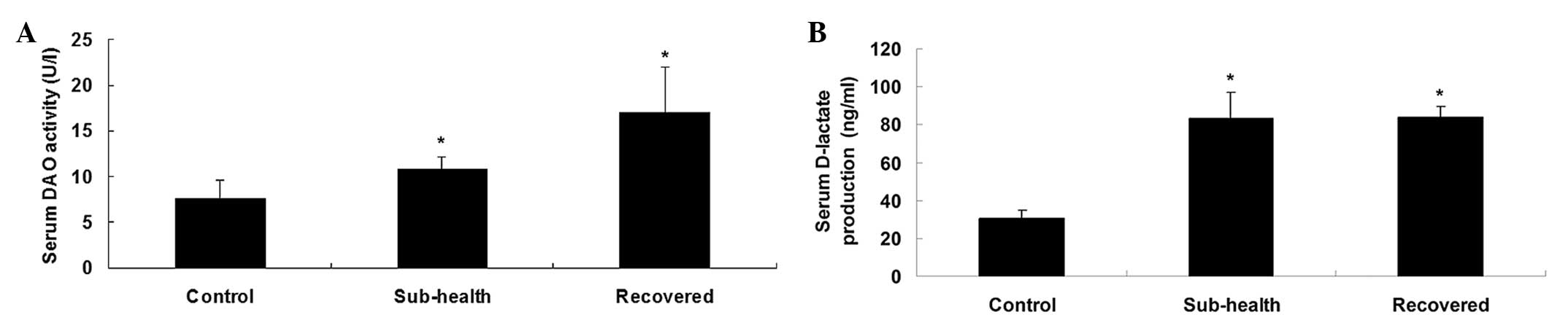
The results of the present study revealed that the
levels of serum D-lactate and the activity of DAO in the sub-health
group were significantly higher, compared with those of the control
group (P<0.001), however no significant change was observed in
the levels of D-lactate and activity of DAO in the recovered group,
compared with the sub-health group (Fig. 3).
Histological analyses
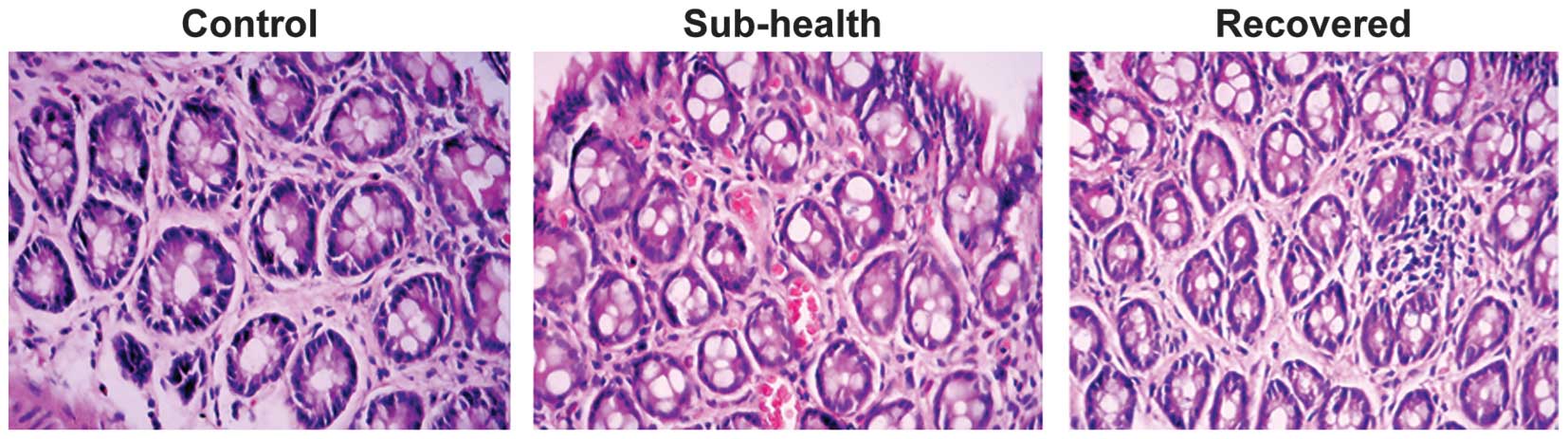
The histological architecture and cell proliferation
in the colon tissues from the rats were evaluated following
paraffin sectioning and hematoxylin and eosin staining. No
significant differences were observed in the histology of the colon
sections between the three groups (Fig. 4).
Change in the expression levels of
YWHAZ
To investigate the molecular changes of barrier
function damage in sub-health rats, the present study investigated
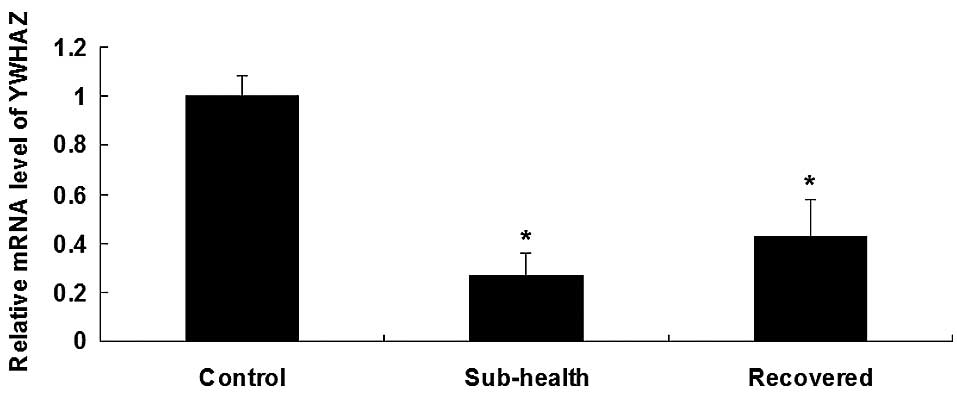
the expression levels of YWHAZ. RT-qPCR revealed a significant
decrease in the mRNA expression levels of YWHAZ in the rats treated
with sub-health factors, indicating the inhibitory effect of
sub-health factors on YWHAZ (Fig.
5). This suggested that sub-health factors contribute to the
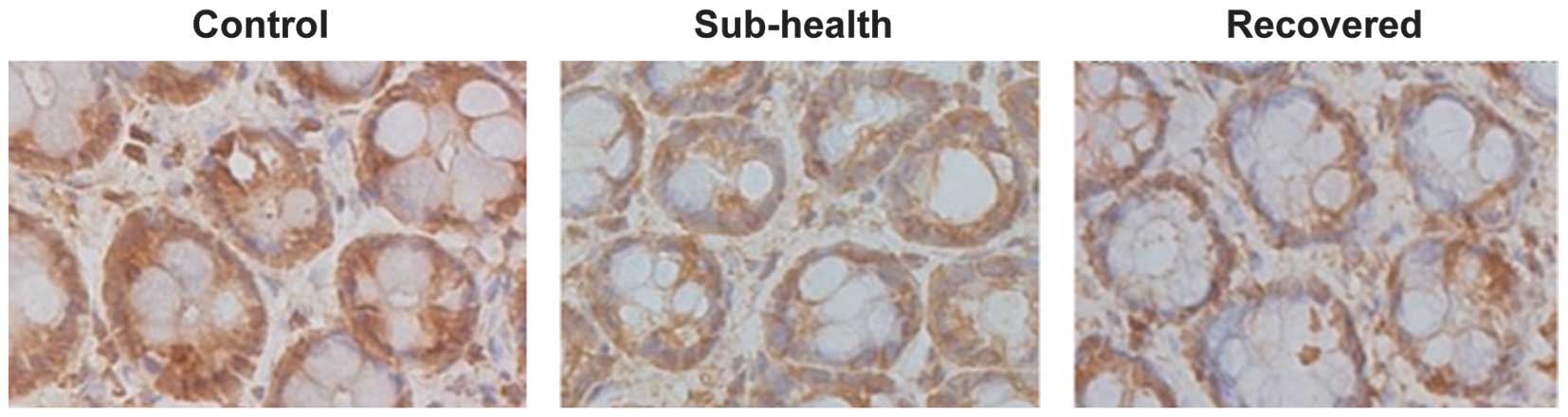
damage caused by the downregulation of YWHAZ. In addition, the
immunohistochemical data revealed a significant decrease in the
mRNA expression levels of YWHAZ in the rats treated with sub-health
factors. Following 5 weeks recovery, the expression of YWHAZ
remained at a low level (Fig. 6).
These results indicated that the sub-health factors had an
inhibitory effect on the expression of YWHAZ, and the return to
normal living conditions does not affect the level of YWHAZ.
Discussion
In the present study, a novel sub-health rat model
was established, which exhibited all the typical characteristics of
sub-health, including high levels of glucose and lipids, weak
immune function and deficits in activity, reaction and habituation.
The present study also indicated that there was abnormal intestinal
barrier function in the sub-health rat model. In addition,
returning to normal living and feeding conditions did not improve
mucosal barrier function.
Sub-health is defined by the World Health
Organization as a state between health and disease, when all
necessary physical and chemical indices have tested negative by
medical equipment, however, the individual experiences discomfort
and even pain (2). In the present
study, due to being provided with a high-fat and sugar diet, the
model rats had high levels of blood glucose and lipids, compared
with the control group, however, the level did not confirm the
presence of diabetes or hypercholesterolemia (14,15).
This is consistent with the characteristics of sub-health.
In sub-health conditions, the body has a weak immune
system, and pathogens may invade easily with serious consequences.
It has been established that exposure to various pathogens can
stimulate at least two patterns of cytokine production by
CD4-positive T cells (16).
Responses, which result in the secretion of IFN-γ, lymphotoxin and
IL-2 are classified as T-helper-1 (Th1 response, whereas
CD4+ T-cell production of IL-4, IL-5, IL-9, IL-10 and
IL-13 is termed a Th2 response (17). Differentiation of CD4+ T
cells into either Th1 or Th2 cells is determined according to the
cytokine milieu in which the initial antigen priming occurs. IFN-γ
is secreted at higher levels in splenic lymphocytes, which
indicates that a Th1 response is evoked through immunization.
Accordingly, the antigen-sensitized lymphocytes were present and
activated under the effect of IFN-γ (17). In addition, secretions of IL-4 at
higher levels are involved in combination with the induction of IgA
and the differentiation of B cells. Thus, the cytokines secreted
are relative to cell-mediated immune responses and humoral immune
responses (18,19). The results of the present study
revealed lower levels of IFN-γ and IL-4 in the model rats, compared
with the control rats, indicating that weak immune function is also
one of the characteristics of sub-health.
Lack of energy, depression, slow reactions and lack
of interest or listlessness are common symptoms of sub-health. Open
field assessment has been used widely to assess habituation,
emotionality and locomotor performance (20,21).
Upon exposure to a standard open field central zone, rats move
rapidly towards the walls of the field, a behavior known as
thigmotaxis. This behavior represents the propensity to avoid the
center of an arena and stay or move in close proximity to the
boundaries or walls of a novel environment (22). Activity in the central part of the
open field is considered to correlate with a degree of habituation,
whereas activity in the peripheral zone and along the walls of the
field is considered to reflect general activity (23). In the present study, the model rats
exhibited a deficit in activity and habituation. In addition, the
increase in the number of fecal boli indicated increased anxiety in
the model rats. These characteristics of the model rats
demonstrated that it was a suitable mode for investigating
sub-health.
Mucosal surfaces of the gastrointestinal tract are
continuously exposed to environmental stimuli. The intestinal
epithelium constitutes the largest and most important barrier
against external environmental agents and has two critical
functions: To prevent the entry of harmful intraluminal
microorganisms, antigens and toxins, and to enable the selective
translocation of dietary nutrients and electrolytes into the
circulation (24). Similar to
irritable bowel syndrome, prolonged and high-intensity exercise,
dietary fat and intestinal disorders in sub-health may also result
from abnormal intestinal barrier function. DAO, an intracellular
enzyme catalyzing the oxidation of diamines, including histamine,
putrescine and cadaverine, exist in high concentrations in the
intestinal mucosa, and the majority of DAO activity in the blood
comes from the intestine (25).
The serum activity of DAO is proportional to the level of
intestinal DAO; and is a reliable marker of intestinal mucosal
integrity (26). D-lactic acid is
a metabolic product of bacteria, present in the intestinal lumen.
The intact intestinal mucosa provides a barrier function to prevent
DAO and D-lactic acid infiltrating the portal blood, which are
indices of increase in permeability of the intestinal wall
(27). In the present study the
serum levels of DAO and D-lactic acid in the sub-health rats were
enhanced, which indicated that sub-health factors increased the
epithelial permeability, compromising the intestinal function.
Improved mucosal barrier function may be a target of therapy in
sub-health intestinal abnormality.
In our previous study (8), which aimed to identify the molecule
marker of the progress of proteomics in the colonic mucosa of
sub-healthy individuals, two-dimensional electrophoresis was used
to separate the total colonic mucosa proteins of sub-healthy
individuals and those of healthy volunteers, and further
confirmation of differentially expressed proteins was performed
using western blot analysis. It was found that the expression of
YWHAZ was downregulated in the colonic mucosa, which may be
associated with the pathogenesis of abnormal intestinal function.
YWHAZ is important role in a wide range of biologic processes
through a variety of regulatory mechanisms, by binding to
phosphorylated serine/threonine motifs in diverse partners, the
most important of which is its inhibitory effect on apoptosis
(28,29). Apoptosis can lead to defects in
intestinal barrier function, and the maintenance of intestinal
function is reliant on the rapid renewal of the intestinal mucosa
and cell proliferation (30,31).
Therefore, the downregulation in the expression of YWHAZ in the
colonic mucosa of sub-health rats may be involved in compromised
mucosa barrier function through the upregulation of apoptosis and
inhibition of cell proliferation.
There remains no consensus on whether sub-health
necessitates drug-based intervention. It has been suggested that
isolating and removing the causes of sub-health, as well as
environmental or psychological factors, would cause sub-health
symptoms to disappear (4). In the
present study, following rescue from pressure and limited space for
5 weeks, the adaptability and vitality of the sub-health rats
exhibited certain improvements. However, the levels of serum
glucose and lipids, as well as the immune function, did not
recover. In addition the intestinal mucosal permeability and the
protein expression of YWHAZ remained abnormal. Therefore, other
interventions may be necessary, possibly including fish oil
supplementation, exercise, music therapy and probiotics, which may
be useful (32–34).
References
|
1
|
World Health Organization: Preamble to the
constitution of the World Health Organization as adopted by the
International Health Conference; New York. 19–22 June, 1946; signed
on 22 July 1946 by the representatives of 61 states. Official
Record of the World Health Organization; 2. pp. 1001946
|
|
2
|
Yang ZM, Yang XB and Huang L: A literature
review on the conceptual framework of sub-health. Zhongguo Zhong Xi
Yi Jie He Za Zhi. 30:757–763. 2010.In Chinese. PubMed/NCBI
|
|
3
|
Zhang YJ, Wang TF, Xue XL, Wang JJ, Li GR
and Han P: Characteristics of traditional Chinese medicine
syndromes and their element distributions in sub-health status: A
modern literature review. Zhong Xi Yi Jie He Xue Bao. 6:1290–1293.
2008.In Chinese. View Article : Google Scholar : PubMed/NCBI
|
|
4
|
Zhou Y, You LM, Zhang JB and Guan NH:
Causes and prevention of sub-health. Chinese Journal of Health
Education. 18:714–715. 2002.In Chinese.
|
|
5
|
Xing L: Risk factors and nursing
intervention of sub-health. Medical Information. 28:2062015.In
Chinese.
|
|
6
|
Vazquez-Roque MI, Camilleri M, Smyrk T,
Murray JA, O'Neill J, Carlson P, Lamsam J, Eckert D, Janzow D,
Burton D, et al: Association of HLA-DQ gene with bowel transit,
barrier function and inflammation in irritable bowel syndrome with
diarrhea. Am J Physiol Gastrointest Liver Physiol. 303:G1262–G1269.
2012. View Article : Google Scholar : PubMed/NCBI
|
|
7
|
Zuhl M, Schneider S, Lanphere K, Conn C,
Dokladny K and Moseley P: Exercise regulation of intestinal tight
junction proteins. Br J Sports Med. 48:980–986. 2014. View Article : Google Scholar
|
|
8
|
Deng H, Zhang YL, Zhong BY, Liu WD, Yan Q,
Feng SS and Xiao ZQ: Clinical application and identification of
proteomics in colonic mucosa of sub-health people with
constipation. Progress in Biochemistry and Biophysics.
11:1043–1051. 2011.In Chinese. View Article : Google Scholar
|
|
9
|
Million M, Taché Y and Anton P:
Susceptibility of Lewis and Fischer rats to stress-induced
worsening of TNB-colitis: Protective role of brain CRF. Am J
Physiol. 276:G1027–G1036. 1999.PubMed/NCBI
|
|
10
|
Csabafi K, Jászberényi M, Bagosi Z, Lipták
N and Telegdy G: Effects of kisspeptin-13 on the
hypothalamic-pituitary-adrenal axis, thermoregulation, anxiety and
locomotor activity in rats. Behav Brain Res. 241:56–61. 2013.
View Article : Google Scholar
|
|
11
|
Hall CS: Emotional behavior in the rat. I.
Defacation and urination as measures of individual differences in
emotionality. J Comp Psychol. 18:385–403. 1934. View Article : Google Scholar
|
|
12
|
Whimbey AE and Denenberg VH: Two
independent behavioral dimensions in open-field performance. J Comp
Physiol Psychol. 63:500–504. 1967. View
Article : Google Scholar : PubMed/NCBI
|
|
13
|
Flint J, Corley R, DeFries JC, Fulker DW,
Gray JA, Miller S and Collins AC: A simple genetic basis for a
complex psychological trait in laboratory mice. Science.
269:1432–1435. 1995. View Article : Google Scholar : PubMed/NCBI
|
|
14
|
Toker H, Ozdemir H, Balci H and Ozer H:
N-acetylcysteine decreases alveolar bone loss on experimental
periodontitis in streptozotocin-induced diabetic rats. J
Periodontal Res. 47:793–799. 2012. View Article : Google Scholar : PubMed/NCBI
|
|
15
|
Füzi M, Palicz Z, Vincze J, Cseri J,
Szombathy Z, Kovács I, Oláh A, Szentesi P, Kertai P, Paragh G and
Csernoch L: Fluvastatin-induced alterations of skeletal muscle
function in hypercholesterolaemic rats. J Muscle Res Cell Motil.
32:391–401. 2012. View Article : Google Scholar
|
|
16
|
Luo J and Huang L: Research progress in
the identification and classification of sub-health state. Chinese
Medicine Modern Distance Education of China. 13:154–156. 2015.In
Chinese.
|
|
17
|
Ferrick DA, Schrenzel MD, Mulvania T,
Hsieh B, Ferlin WG and Lepper H: Differential production of
interferon-gamma and interleukin-4 in response to Th1- and
Th2-stimulating pathogens by gamma delta T cells in vivo. Nature.
373:255–257. 1995. View
Article : Google Scholar : PubMed/NCBI
|
|
18
|
Yao XY, Wang HM, Li DJ, Yuan MM, Wang XL,
Yu M, Wang MY, Zhu Y and Meng Y: Inoculation of Lactobacillus
expressing hCG beta in the vagina induces an anti-hCG beta antibody
response in murine vaginal mucosa. J Reprod Immunol. 63:111–122.
2004. View Article : Google Scholar : PubMed/NCBI
|
|
19
|
Liu G, Zhong J, Ni J, Chen M, Xiao H and
Huan L: Characteristics of the bovicin HJ50 gene cluster in
Streptococcus bovis HJ50. Microbiology. 155:584–593. 2009.
View Article : Google Scholar : PubMed/NCBI
|
|
20
|
Choleris E, Thomas AW, Kavaliers M and
Prato FS: A detailed ethological analysis of the mouse open field
test: Effects of diazepam, chlordiazepoxide and an extremely low
frequency pulsed magnetic field. Neurosci Biobehav Rev. 25:235–260.
2001. View Article : Google Scholar : PubMed/NCBI
|
|
21
|
Prut L and Belzung C: The open field as a
paradigm to measure the effects of drugs on anxiety-like behaviors:
A review. Eur J Pharmacol. 463:3–33. 2003. View Article : Google Scholar : PubMed/NCBI
|
|
22
|
Sharma S, Coombs S, Patton P and Burt de
Perera T: The function of wall-following behaviors in the Mexican
blind cavefish and a sighted relative, the Mexican tetra
(Astyanax). J Comp Physiol A Neuroethol Sens Neural Behav Physiol.
195:225–240. 2009. View Article : Google Scholar
|
|
23
|
Belzung C and Griebel G: Measuring normal
and pathological anxiety-like behaviour in mice: A review. Behav
Brain Res. 125:141–149. 2001. View Article : Google Scholar : PubMed/NCBI
|
|
24
|
McGhee JR and Fujihashi K: Inside the
mucosal immune system. PLoS Biol. 10:e1001397PubMed/NCBI
|
|
25
|
Kamiya S, Nagino M, Kanazawa H, Komatsu S,
Mayumi T, Takagi K, Asahara T, Nomoto K, Tanaka R and Nimura Y: The
value of bile replacement during external biliary drainage: An
analysis of intestinal permeability, integrity and microflora. Ann
Surg. 239:510–517. 2004. View Article : Google Scholar : PubMed/NCBI
|
|
26
|
Luk GD, Bayless TM and Baylin SB: Plasma
postheparin diamine oxidase. Sensitive provocative test for
quantitating length of acute intestinal mucosal injury in the rat.
J Clin Invest. 71:1308–1315. 1983. View Article : Google Scholar : PubMed/NCBI
|
|
27
|
Smith SM, Eng RH, Campos JM and Chmel H:
D-lactic acid measurements in the diagnosis of bacterial
infections. J Clin Microbiol. 27:385–388. 1989.PubMed/NCBI
|
|
28
|
Gardino AK and Yaffe MB: 14-3-3 proteins
as signaling integration points for cell cycle control and
apoptosis. Semin Cell Dev Biol. 22:688–695. 2011. View Article : Google Scholar : PubMed/NCBI
|
|
29
|
Masters SC and Fu H: 14-3-3 proteins
mediate an essential anti-apoptotic signal. J Biol Chem.
276:45193–45200. 2001. View Article : Google Scholar : PubMed/NCBI
|
|
30
|
Bharadwaj S, Vishnubhotla R, Shan S,
Chauhan C, Cho M and Glover SC: Higher molecular weight
polyethylene glycol increases cell proliferation while improving
barrier function in an in vitro colon cancer model. J Biomed
Biotechnol. 2011:5874702011. View Article : Google Scholar : PubMed/NCBI
|
|
31
|
Bojarski C, Bendfeldt K, Gitter AH,
Mankertz J, Fromm M, Wagner S, Riecken EO and Schulzke JD:
Apoptosis and intestinal barrier function. Ann N Y Acad Sci.
915:270–274. 2000. View Article : Google Scholar
|
|
32
|
Rachetti AL, Arida RM, Patti CL, Zanin KA,
Fernades-Santos L, Frussa-Filho R, Gomes da Silva S, Scorza FA and
Cysneiros RM: Fish oil supplementation and physical exercise
program: Distinct effects on different memory tasks. Behav Brain
Res. 237:283–289. 2013. View Article : Google Scholar
|
|
33
|
Jirillo E, Jirillo F and Magrone T:
Healthy effects exerted by prebiotics, probiotics and symbiotics
with special reference to their impact on the immune system. Int J
Vitam Nutr Res. 82:200–208. 2012. View Article : Google Scholar : PubMed/NCBI
|
|
34
|
Korhan EA, Uyar M, Eyigör C, Hakverdioğlu
Yönt G, Çelik S and Khorshid L: The effects of music therapy on
pain in patients with neuropathic pain. Pain Manag Nurs.
15:306–314. 2014. View Article : Google Scholar
|