Introduction
Osteosarcoma is the most common primary sarcoma of
the skeletal system in adolescents and young adults (1). It is a major death-causing disease in
adolescence, due to its rapid progression and poor prognosis. The
major causes of death are distant metastasis, particularly
pulmonary metastases. Due to lack of effective and efficient tumor
biomarkers for early diagnosis, despite the rapid development in
therapeutic methods, including surgery, chemotherapy, and radiation
therapy, there has been minimal change for patients with metastatic
disease and their long-term survival rate remains at 25–30%
(2), the prognosis remains poor
and the majority of patients die at the advanced stages. Although
many immunohistochemical markers and genetic proteins have been
studied, there is an urgent need to develop new targets for the
diagnosis, treatment and prognosis of osteosarcoma.
Regulated upon Activation Normal T cell Expressed
and Secreted also termed C-C motif chemokine ligand 5 (CCL5), was
initially described for its role in inflammatory diseases;
mediating chemotactic activity in T cells, natural killer cells,
monocytes, dendritic cells, eosinophils and basophils (3–8).
CCL5 is associated with chronic inflammatory disease and cancer
(9). The association between CCL5
expression and cancer has been reported in lung and prostate cancer
(10,11). CCL5 is a marker of poor outcomes in
patients with breast, cervical, prostate, gastric or pancreatic
cancer (11–15). Certain studies have indicated that
CCL5 is associated with cell migration and invasion in several
cancer cell lines (9,16).
However, the expression of CCL5 in human
osteosarcoma, and its clinicopathological and prognostic
significance has not been established. In the present study,
reverse transcription-quantitative polymerase chain reaction
(RT-qPCR) and immunohistochemistry (IHC) were used to examine the
expression of CCL5 in human osteosarcoma tissues. The correlations
between CCL5 expression and patient clinicopathologic and
prognostic significance were assessed to determine whether the
expression of CCL5 could be used as a metastasis or prognostic
biomarker for patients with osteosarcoma.
Materials and methods
Patients and tissue specimens
The study was approved by the ethics committee of
Renmin Hospital of Wuhan University (Wuhan, China). Written
informed consent was obtained from all patients prior to enrollment
in the present study. From January 2012 to January 2014, 28 fresh
osteosarcoma tissue samples were obtained from 15 patients with
primary osteosarcoma with no metastases and 13 patients with
metastases in Renmin Hospital of Wuhan University. No patients had
received anticancer treatment prior to surgery. Paraffin-embedded
pathological specimens taken from 90 patients with osteosarcoma
between January 2003 to January 2015 were obtained from the
Department of Orthopedics, Renmin Hospital of Wuhan University.
Clinicopathological characteristics for these patients, including
gender, age, histological subtype, Enneking staging and metastasis
are described in Table I. No
patient had received radiotherapy or chemotherapy before
surgery.
 | Table I.Association of CCL5 expression with
patient clinicopathological features in osteosarcoma. |
Table I.
Association of CCL5 expression with
patient clinicopathological features in osteosarcoma.
| Feature | Total (n=90) | CCL5 low expression
(n=50) (%) | CCL5 high expression
(n=40) (%) | P-value |
|---|
| Gender |
|
|
| 0.064 |
| Male | 51 | 24 (47.1) | 27 (52.9) |
|
|
Female | 39 | 26 (66.7) | 13 (33.3) |
|
| Age |
|
|
| 0.13 |
| <20
years | 46 | 22 (47.8) | 24 (52.2) |
|
| ≥20
years | 44 | 28 (63.6) | 16 (36.4) |
|
| Histological
subtype |
|
|
| 0.116 |
|
Special | 51 | 32 (62.7) | 19 (37.3) |
|
|
Conventional | 39 | 18 (46.2) | 21 (53.8) |
|
| Enneking staging |
|
|
| 0.002 |
| I,II | 39 | 29 (74.4) | 10 (25.6) |
|
| III | 51 | 21 (41.2) | 30 (58.8) |
|
| Metastasis |
|
|
| <0.001 |
| No | 60 | 44 (73.3) | 16 (26.7) |
|
| Yes | 30 | 6 (20) | 24 (80) |
|
RT-qPCR
Total RNA was extracted using TRIzol (Invitrogen;
Thermo Fisher Scientific, Inc., Waltham, MA, USA) following the
standard protocol and purified with the RNeasy Plus Mini kit
(Qiagen Gmbh, Hilden, Germany). SuperScript III kit (Invitrogen;
Thermo Fisher Scientific, Inc.) was used to reverse transcribe
cDNA. qPCR was performed using SYBR Green Reaction Mix (Applied
Biosystems; Thermo Fisher Scientific, Inc.) and the StepOnePlus
thermocycler (Applied Biosystems; Thermo Fisher Scientific, Inc.).
The CCL5 primer sequences used are as follows: Forward,
5′-TGCCCACATCAAGGAGTATTT-3′; and reverse,
5′-GATGTACTCCCGAACCCATTT-3′. The transcript level of 18S rRNA was
used as endogenous reference gene, with the primer sequences as
follows: Forward, 5′-GTAACCCGTTGAACCCCATT-3′; and reverse,
5′-CCATCCAATCGGTAGTAGCG-3′. Gene expression was analyzed by the
comparative Cq method (17).
Tissue microarray (TMA)
Tumor tissue samples from the 90 patients with
osteosarcoma were collected, fixed in formalin, and embedded in
paraffin. Hematoxylin and eosin-stained sections were used to
define representative tumor regions without spontaneous necrosis.
The formalin-fixed, paraffin-embedded two targeted core samples of
each specimen were obtained from these representative regions using
a tissue array instrument (MiniCore; ALPHELYS, Plaisir, France).
Tissue cylinders with a diameter of 1.5 mm were punched and arrayed
on a recipient paraffin block. Sections (5 µm) of the tissue array
(recipient) block were cut and placed on glass slides.
IHC
The tissue sections were deparaffinized in xylene
and rehydrated in a series of graded alcohols. Hydrogen peroxide
(3%) was used to block endogenous peroxidase activity for 10 min.
Slides were boiled in EDTA buffer (pH 8.0) in a pressure cooker for
15 min for antigen retrieval, and then blocked with 10% normal goat
serum for 30 min at room temperature. Subsequently, the sections
were immunostained with CCL5 primary antibody (1:100 dilution; cat
no. ab9679; Abcam, Cambridge, MA, USA) and incubated at 4°C
overnight. After rinsing with PBS three times for 5 min each, the
sections were incubated in goat anti-rabbit horseradish
peroxidase-conjugated secondary antibody (1:2,000 dilution; cat no.
ab205718; Abcam) for 30 min at room temperature and stained with
diaminobenzidine.
The staining results were determined using a
semi-quantitative method by assessing the intensity of staining and
the percentage of CCL5-positive cells. Staining intensity was
categorized as follows: Negative, 0; weak, 1, moderate, 2; and
strong, 3. The percentage of staining was scored as follows: 0, 0%
positive cells; 1, 1–25% positive cells; 2, 26–50% positive cells;
3, 51–75% positive cells; or 4, >75% positive cells; according
to the percentages of positively stained areas in relation to the
whole carcinoma area (or entire section for normal samples). The
sum of the staining intensity and extent scores was used as the
final staining scores (0–7). Tumors with a final staining score of
>3 were considered to be CCL5-positive. Cells were evaluated
using an Olympus CKX41 inverted microscope under ×200 magnification
(Olympus Corporation, Tokyo, Japan). Expression for CCL5 was scored
by two independent pathologists blinded to the clinicopathological
data.
Statistical analysis
SPSS version 13.0 (SPSS, Inc., Chicago, IL, USA) was
used for the analyses. The difference in CCL5 mRNA expression
levels between metastatic osteosarcoma group and non-metastatic
osteosarcoma group was analyzed using Student's t-test. The
correlation of CCL5 expression and clinicopathological was
evaluated by χ2 test. Univariate and multivariate
analyses were performed with the Cox proportional hazard regression
model to determine associations between clinicopathological
variables and cancer-associated mortality. Kaplan-Meier method and
log-rank test were used for survival analysis. P<0.05 was
considered to indicate a statistically significant difference.
Results
RT-qPCR analysis of CCL5 expression in
osteosarcoma
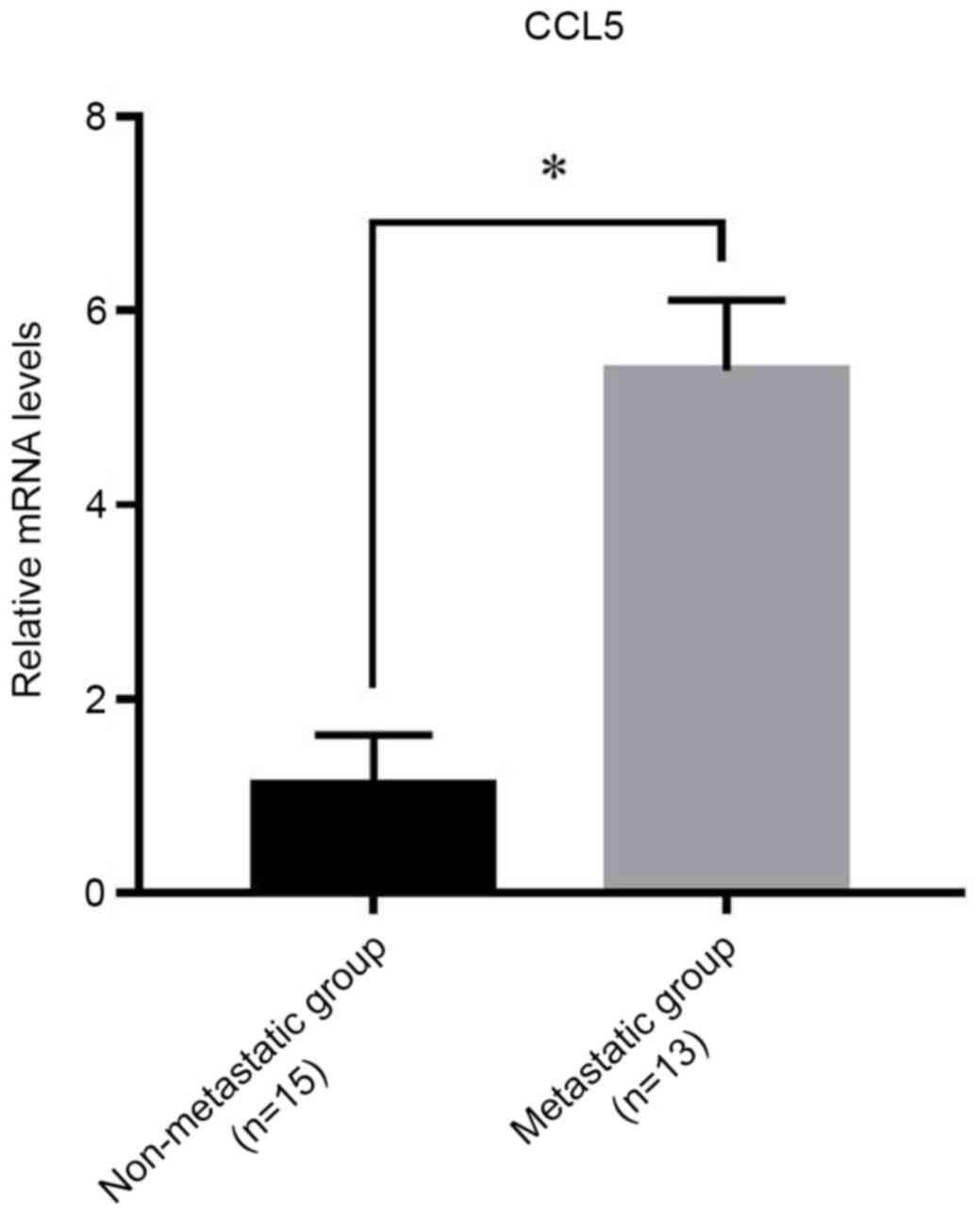
RT-qPCR analysis revealed that the gene expression
level of CCL5 was significantly increased in metastatic
osteosarcoma group compared with the non-metastatic osteosarcoma
group, indicating that CCL5 is highly active in osteosarcomas with
metastases (P<0.05; Fig.
1).
Association between CCL5 expression
and poor prognosis in patients with osteosarcoma
Immunohistochemistry was used to evaluate CCL5
expression in all 90 samples within the osteosarcoma TMA.
Expression of CCL5 was predominantly localized to the cytoplasm and
the membrane of cancer cells (Fig.
2). The high CCL5 expression rate in metastatic osteosarcomas
(80%; 24/30) was significantly higher than the high CCL5 expression
rate in non-metastatic osteosarcomas (26.7%; 16/60; P<0.001).
The high CCL5 expression rate in patients with Enneking staging I,
II (58.8%; 30/51) was significantly higher than the high CCL5
expression rate in Enneking staging III (25.6%; 10/39; P<0.05).
There were no significant associations between the expression of
CCL5 and gender, age or histological subtype (Table I).
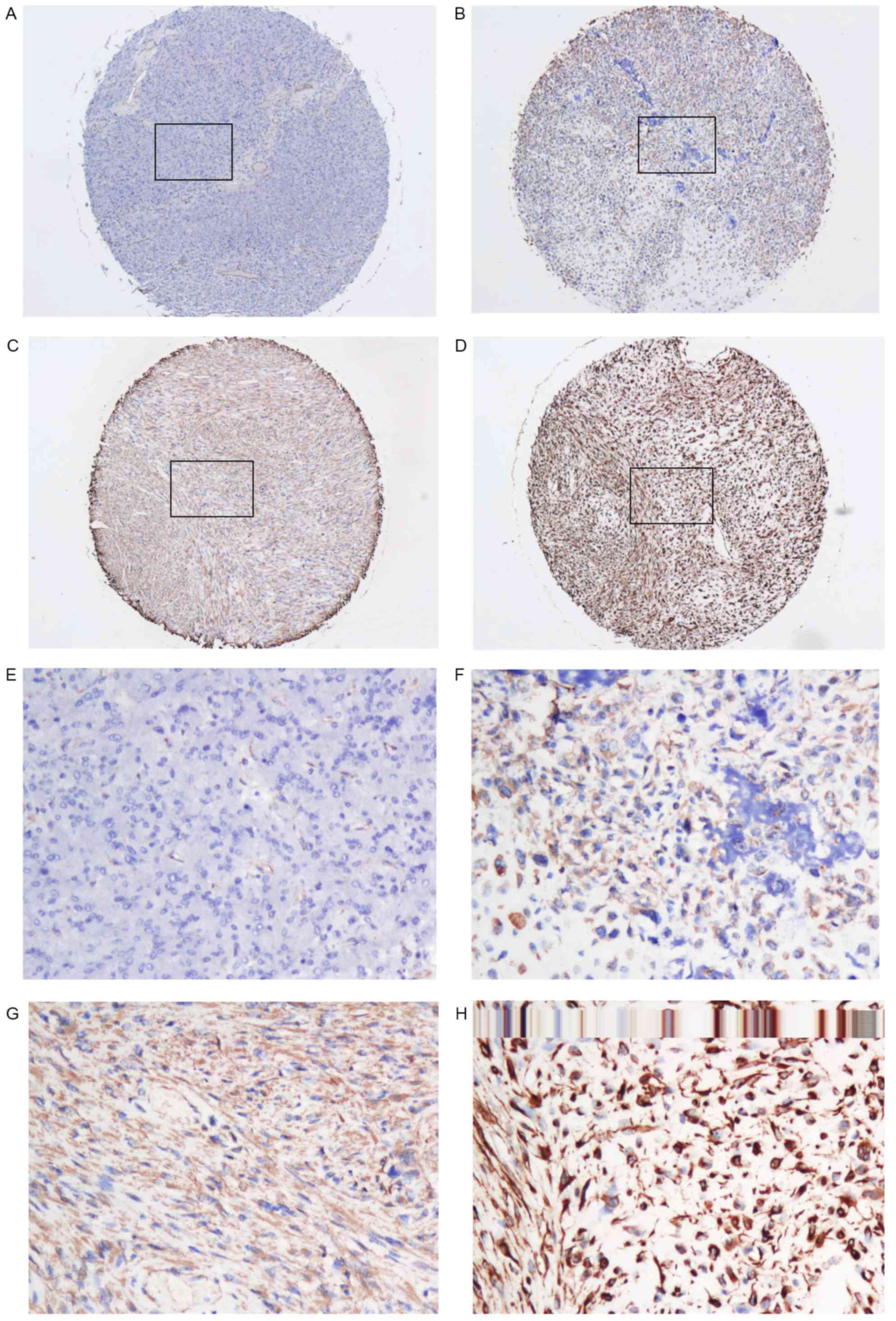 | Figure 2.Representative immunohistochemical
staining samples for negative, weak, moderate, strong CCL5
expression in osteosarcoma tissues. Upper panels: ×40 magnification
of tissue sections at staining intensity levels of (A) 0, (B) 1,
(C) 2, and (D) 3. Lower panels, ×200 magnification at staining
intensity levels of (E) 0, (F) 1, (G) 2, and (H) 3. The boxed area
in the upper ×40 panels are shown at ×200 in the lower panels.
CCL5, C-C motif chemokine ligand 5. |
Univariate analysis was performed to evaluate
associations between patient prognosis and several
clinicopathological factors including CCL5 expression, gender, age,
histological subtype (conventional: Osteoblastic, chondroblastic,
fibroblastic osteosarcomas), Enneking staging and metastasis. The
results indicated that CCL5 expression, Enneking staging and
metastasis were significantly associated with poorer prognosis
(Table II).
| Table II.Cox proportional hazards model
analysis of prognostic factors in patients with osteosarcoma. |
Table II.
Cox proportional hazards model
analysis of prognostic factors in patients with osteosarcoma.
| Feature | HR | 95% CI |
Unfavorable/favorable | P-value |
|---|
| Univariate
analysis |
|
|
|
|
| CCL5 | 2.894 | 1.504–5.571 | High/low | 0.001 |
|
Gender | 1.027 | 0.546–1.931 | Male/female | 0.934 |
| Age, | 0.756 | 0.402–1.423 | ≥20/<20 years | 0.386 |
|
Histological subtype | 0.826 | 0.436–1.565 |
Conventional/special | 0.558 |
| Enneking
staging | 2.245 | 1.130–4.461 | III/I,II | 0.021 |
|
Metastasis | 2.46 | 1.287–4.701 | Yes/no | 0.006 |
| Multivariate
analysis |
|
|
|
|
| CCL5 | 3.18 | 1.650–6.672 | High/low | 0.001 |
|
Gender | 1.589 | 0.808–3.127 | Male/female | 0.18 |
| Age | 0.764 | 0.404–1.444 | ≥20/<20 years | 0.40 |
|
Histologic subtype | 0.810 | 0.404–1.625 |
Conventional/special | 0.55 |
| Enneking
staging | 1.611 | 0.742–3.498 | III/I,II | 0.228 |
|
Metastasis | 1.421 | 0.615–3.285 | Yes/no | 0.411 |
Subsequently, multivariate analysis was performed to
further understand the association between the clinicopathological
factors and prognosis, indicated that CCL5 expression (P=0.001) was
found to be statistically significant independent of Enneking
staging and metastasisfor patients with osteosarcoma (Table II). The outcome indicated that
CCL5 is a potential biomarker for evaluation of the prognoses of
patients with osteosarcoma.
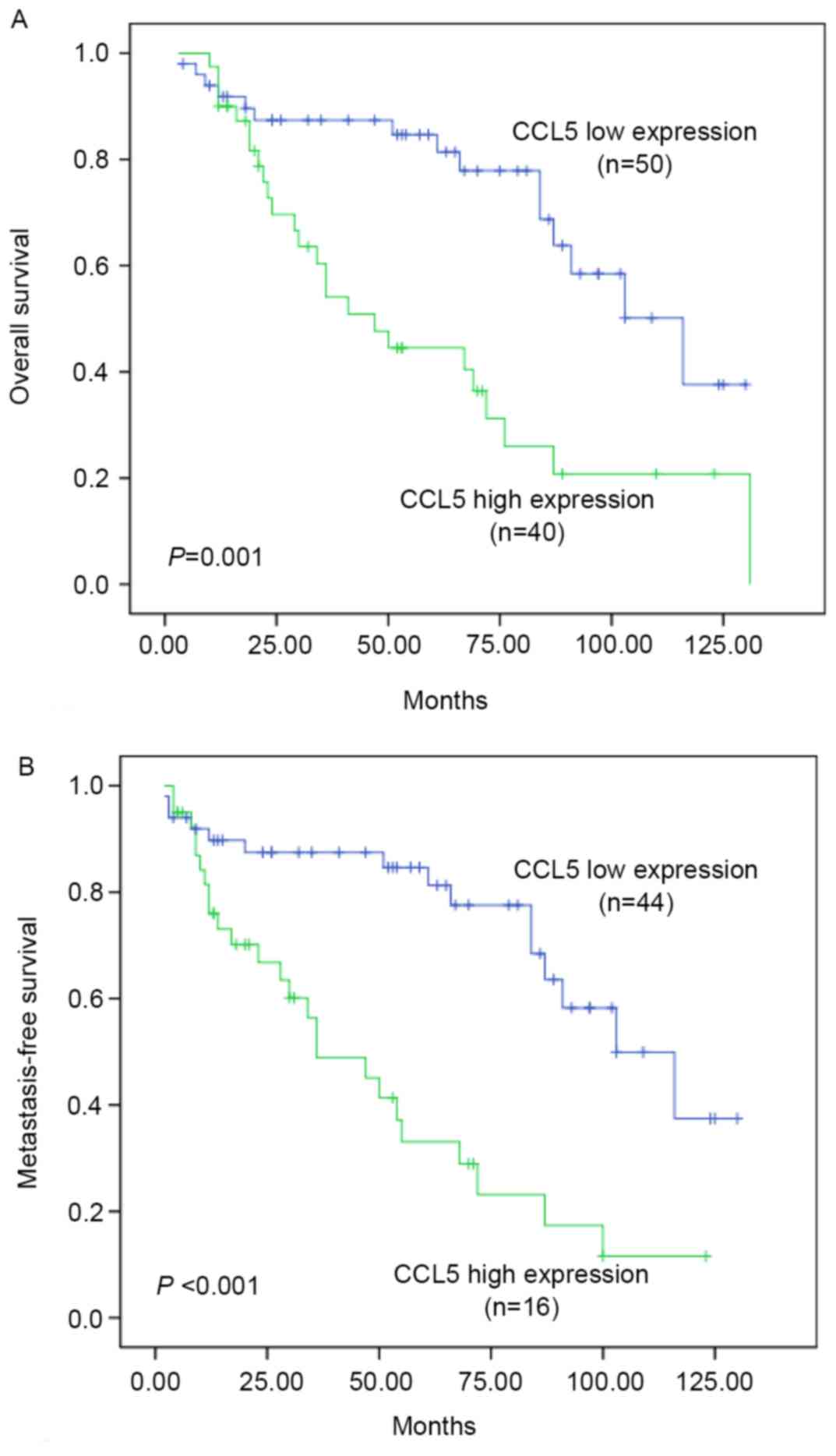
The overall survival (P=0.001) and the
metastasis-free survival (P<0.001) rates of the CCL5 low
expression group were significantly higher than the CCL5 high
expression group, as demonstrated by Kaplan-Meier analyses and the
log-rank test (Fig. 3).
Discussion
Osteosarcoma is the most common primary malignant
tumor of the skeletal system and is characterized by aggressive
clinical development and the high capacity for metastatic
potential, a major cause of mortality (18). Improvements in chemotherapy and
surgical advances have increased the 5-year overall survival rate
of patients with localized disease to between 60 and 70%; however,
the prognosis remains generally poor, particularly for patients
with metastasis, with the survival rate ranging from 11–20%. The
patients with metastasis have <20% chance of long-term survival
despite the use of advanced chemotherapeutic drugs (2). The clinical improvement appears to
have reached a bottleneck. Therefore, it is urgent to find suitable
metastasis and prognosis-associated biomarkers to evaluate the
prognoses of patients with osteosarcoma.
CCL5 is a chemokine, and the primary role has been
defined as a chemoattractant for immune cells. CCL5 was previously
observed to have a significant effect on migration of numerous
tumor types, and an important role in oncogenic processes (19). In prostate cancer, CCL5 may be part
of an autocrine loop to produce multiple signals that affect cancer
cell invasion and proliferation (11). In breast cancer, high CCL5
expression has been demonstrated to be demonstrated to have a role
in poor prognosis (12). In lung
cancer, a study suggested that CCL5 acts via phosphoinositide
3-kinase (PI3K)/Akt serine/threonine kinase, resulting in the
activation of αvβ3 integrin and facilitating the migration of human
lung cancer cells (20). Other
research has indicated that CCL5 is released by osteosarcoma cells
and promotes tumor cells proliferation, invasion and migration
(21). Wang et al (22) reported that there is a positive
association between the expression of CCL5 and vascular endothelial
growth factor (VEGF) in human osteosarcoma tissues, and the high
level of CCL5 expression is correlated strongly with VEGF
expression and tumor stage. The result of the previous study
suggested that CCL5 may have important role in promoting
VEGF-mediated tumor angiogenesis and metastatic progression of
human osteosarcoma. Additionally, Wang et al (23) reported that PI3K and Akt are
involved in CCL5-induced cell migration in osteosarcoma cells and
that CCL5 can enhance cell migration in human osteosarcoma cell
lines; the mechanisms involved an increase the expression of αvβ3
integrin and activation of CCR5 receptor via MEK, extracellular
signal-regulated kinase and nuclear factor-κB pathways. Matrix
metalloproteinases (MMPs) are correlated with metastasis; Stormes
et al (24) indicated that
inhibition of tumor-derived CCL5 correlates with inhibition of
metastasis and protease gene expression. The results indicated that
CCL5 promotes MMP production in tumor cells, and tumor-derived CCL5
contributes to the metastatic potential. Therefore, the metastasis
of tumor can be considered to be a final outcome of the cross
linking of multiple factors.
The present study used RT-qPCR to examine the
expression levels of CCL5 mRNA in metastatic osteosarcoma tissue
and non-metastatic osteosarcoma samples. The results indicated that
CCL5 mRNA expression was increased in the metastatic osteosarcoma
tissue when compared with non-metastatic osteosarcoma tissue. A TMA
of osteosarcoma tissues was used to investigate the correlation of
CCL5 protein expression and clinicopathological features by IHC.
The IHC results demonstrated that the expression of CCL5 in
non-metastatic osteosarcoma tissue was either absent or at low
levels; however, metastatic osteosarcoma tissues frequently
exhibited high expression of CCL5. The overall survival rates and
the metastasis-free survival rates in the CCL5 high expression
group were significantly lower than the CCL5 low expression group.
The current data demonstrates that high expression of CCL5 was
associated with metastatic potential of osteosarcoma and is an
independent predictor of poor prognosis. These results suggest that
CCL5 may have an important role in the malignant behavior of
osteosarcoma; however, the specific functional and molecular
mechanisms require further investigation. CCL5 may be useful as a
biomarker for osteosarcoma prognosis, and maybe a potential
molecular target for osteosarcoma therapy.
Acknowledgements
The present study was supported by the Hubei
Province Health and Family Planning Scientific Research Project
(grant no. WJ2017M058).
References
|
1
|
Mirabello L, Troisi RJ and Savage SA:
Osteosarcoma incidence and survival rates from 1973 to 2004: Data
from the surveillance, epidemiology, and end results program.
Cancer. 115:1531–1543. 2009. View Article : Google Scholar : PubMed/NCBI
|
|
2
|
Luetke A, Meyers PA, Lewis I and Juergens
H: Osteosarcoma treatment-where do we stand? A state of the art
review. Cancer Treat Rev. 40:523–532. 2014. View Article : Google Scholar : PubMed/NCBI
|
|
3
|
Schall TJ, Bacon K, Toy KJ and Goeddel DV:
Selective attraction of monocytes and T lymphocytes of the memory
phenotype by cytokine RANTES. Nature. 347:669–671. 1990. View Article : Google Scholar : PubMed/NCBI
|
|
4
|
Roth SJ, Carr MW and Springer TA: C-C
chemokines, but not the C-X-C chemokines interleukin-8 and
interferon-gamma inducible protein-10, stimulate transendothelial
chemotaxis of T lymphocytes. Eur J Immunol. 25:3482–3488. 1995.
View Article : Google Scholar : PubMed/NCBI
|
|
5
|
de la Rosa G, Longo N, Rodríguez-Fernández
JL, Puig-Kroger A, Pineda A, Corbí AL and Sánchez-Mateos P:
Migration of human blood dendritic cells across endothelial cell
monolayers: Adhesion molecules and chemokines involved in
subset-specific transmigration. J Leukoc Biol. 73:639–649. 2003.
View Article : Google Scholar : PubMed/NCBI
|
|
6
|
Taub DD, Sayers TJ, Carter CR and Ortaldo
JR: Alpha and beta chemokines induce NK cell migration and enhance
NK-mediated cytolysis. J Immunol. 155:3877–3888. 1995.PubMed/NCBI
|
|
7
|
Kameyoshi Y, Dörschner A, Mallet AI,
Christophers E and Schröder JM: Cytokine RANTES released by
thrombin-stimulated platelets is a potent attractant for human
eosinophils. J Exp Med. 176:587–592. 1992. View Article : Google Scholar : PubMed/NCBI
|
|
8
|
Conti P, Pang X, Boucher W, Letourneau R,
Reale M, Barbacane RC, Thibault J and Theoharides TC: RANTES is a
pro-inflammatory chemokine and chemoattracts basophil cells to
extravascular sites. J Pathol. 183:352–358. 1997. View Article : Google Scholar : PubMed/NCBI
|
|
9
|
Ben-Baruch A: Inflammation-associated
immune suppression in cancer: The roles played by cytokines,
chemokines and additional mediators. Semin Cancer Biol. 16:38–52.
2006. View Article : Google Scholar : PubMed/NCBI
|
|
10
|
Moran CJ, Arenberg DA, Huang CC, Giordano
TJ, Thomas DG, Misek DE, Chen G, Iannettoni MD, Orringer MB, Hanash
S and Beer DG: RANTES expression is a predictor of survival in
stage I lung adenocarcinoma. Clin Cancer Res. 8:3803–3812.
2002.PubMed/NCBI
|
|
11
|
Vaday GG, Peehl DM, Kadam PA and Lawrence
DM: Expression of CCL5 (RANTES) and CCR5 in prostate cancer.
Prostate. 66:124–134. 2006. View Article : Google Scholar : PubMed/NCBI
|
|
12
|
Niwa Y, Akamatsu H, Niwa H, Sumi H, Ozaki
Y and Abe A: Correlation of tissue and plasma RANTES levels with
disease course in patients with breast or cervical cancer. Clin
Cancer Res. 7:285–289. 2001.PubMed/NCBI
|
|
13
|
Kim HK, Song KS, Park YS, Kang YH, Lee YJ,
Lee KR, Kim HK, Ryu KW, Bae JM and Kim S: Elevated levels of
circulating platelet microparticles, VEGF, IL-6 and RANTES in
patients with gastric cancer: Possible role of a metastasis
predictor. Eur J Cancer. 39:184–191. 2003. View Article : Google Scholar : PubMed/NCBI
|
|
14
|
Sugasawa H, Ichikura T, Kinoshita M, Ono
S, Majima T, Tsujimoto H, Chochi K, Hiroi S, Takayama E, Saitoh D,
et al: Gastric cancer cells exploit CD4+ cell-derived
CCL5 for their growth and prevention of CD8+
cell-involved tumor elimination. Int J Cancer. 122:2535–2541. 2008.
View Article : Google Scholar : PubMed/NCBI
|
|
15
|
Duell EJ, Casella DP, Burk RD, Kelsey KT
and Holly EA: Inflammation, genetic polymorphisms in
proinflammatory genes TNF-A, RANTES, and CCR5, and risk of
pancreatic adenocarcinoma. Cancer Epidemiol Biomarkers Prev.
15:726–731. 2006. View Article : Google Scholar : PubMed/NCBI
|
|
16
|
Karnoub AE, Dash AB, Vo AP, Sullivan A,
Brooks MW, Bell GW, Richardson AL, Polyak K, Tubo R and Weinberg
RA: Mesenchymal stem cells within tumour stroma promote breast
cancer metastasis. Nature. 449:557–563. 2007. View Article : Google Scholar : PubMed/NCBI
|
|
17
|
Livak KJ and Schmittgen TD: Analysis of
relative gene expression data using real-time quantitative PCR and
the 2(-Delta Delta C(T)) method. Methods. 25:402–408. 2001.
View Article : Google Scholar : PubMed/NCBI
|
|
18
|
Arndt CA, Rose PS, Folpe AL and Laack NN:
Common musculoskeletal tumors of childhood and adolescence. Mayo
Clin Proc. 87:475–487. 2012; View Article : Google Scholar : PubMed/NCBI
|
|
19
|
Aldinucci D and Colombatti A: The
inflammatory chemokine CCL5 and cancer progression. Mediators
Inflamm. 2014:2923762014. View Article : Google Scholar : PubMed/NCBI
|
|
20
|
Huang CY, Fong YC, Lee CY, Chen MY, Tsai
HC, Hsu HC and Tang CH: CCL5 increases lung cancer migration via
PI3K, Akt and NF-kappaB pathways. Biochem Pharmacol. 77:794–803.
2009. View Article : Google Scholar : PubMed/NCBI
|
|
21
|
Borsig L, Wolf MJ, Roblek M, Lorentzen A
and Heikenwalder M: Inflammatory chemokines and metastasis-tracing
the accessory. Oncogene. 33:3217–3224. 2014. View Article : Google Scholar : PubMed/NCBI
|
|
22
|
Wang SW, Liu SC, Sun HL, Huang TY, Chan
CH, Yang CY, Yeh HI, Huang YL, Chou WY, Lin YM and Tang CH:
CCL5/CCR5 axis induces vascular endothelial growth factor-mediated
tumor angiogenesis in human osteosarcoma microenvironment.
Carcinogenesis. 36:104–114. 2015. View Article : Google Scholar : PubMed/NCBI
|
|
23
|
Wang SW, Wu HH, Liu SC, Wang PC, Ou WC,
Chou WY, Shen YS and Tang CH: CCL5 and CCR5 interaction promotes
cell motility in human osteosarcoma. PLoS One. 7:e351012012.
View Article : Google Scholar : PubMed/NCBI
|
|
24
|
Stormes KA, Lemken CA, Lepre JV, Marinucci
MN and Kurt RA: Inhibition of metastasis by inhibition of
tumor-derived CCL5. Breast Cancer Res Treat. 89:209–212. 2005.
View Article : Google Scholar : PubMed/NCBI
|