Introduction
Alzheimer's disease [AD, (MIM:104300)] is a complex
neurodegenerative disorder, affecting approximately 5% of the
population worldwide. The prevalence of AD increases markedly after
the age of 65 (1), and it accounts
for 65–75% of total dementia cases (2). The development of AD is a complex
process involving genetic (3,4),
physiological, and environmental factors. AD is thought to result
from the deposition of β-amyloid (Aβ) peptides and intraneuronal
neurofibrillary tangles (NFTs) in the brain (5,6). The
alterations in DNA methylation that result from both genetic and
environmental causes, have become an emerging topic of interest in
AD research (7–9).
The opioid receptor family includes three major
opioid receptors (κ-, δ- and µ-opioid receptors), and nociceptin,
an opioid receptor-like 1 (OPRL1) receptor. The previous
study conducted by our group demonstrated that increased
methylation in OPRK1 (κ-opioid receptor gene) and
OPRD1 (δ-opioid receptor gene) was associated with AD
(9). Furthermore, the mu-opioid
receptor, encoded by opioid receptor µ1 (OPRM1), is a major
molecular target of morphine and the primary target for its
neuropharmacological effects (10). OPRM1 was also found to be
linked with morphine-induced immunosuppression (11). It is interesting to note that the
mu-opioid receptor was shown to attenuate Aβ oligomer-induced
neurotoxicity by a recent study (12). The opioid related nociceptin
receptor 1 (OPRL1) is widely expressed in the central
nervous system, including the hippocampal dentate gyrus, cortical
areas, striatum, thalamus, and hypothalamus (13–15).
OPRL1 has been found to play an essential role in cognition
(16), and to modulate
inflammation and immune responses (17). In light of these findings, the
present study investigated the association of OPRM1 and
OPRL1 methylation with AD.
Materials and methods
Sample collection
A total of 51 sporadic AD patients and 63 normal
subjects were recruited from Ningbo No. 1 Hospital and Ningbo
Kangning Hospital, based on the ICD-10 diagnostic criteria
(18). All participants were Han
Chinese, and were living in Ningbo city of the Zhejiang province.
Their detailed information was collected as described previously
(7). The present study was
approved by the Ethics Committees of Ningbo No. 1 Hospital and
Ningbo Kangning Hospital, and all participants signed the informed
consent for their participation in the study. Each patient was
independently diagnosed by two experienced neurologists. The
details of patient screening and diagnosis, and the preparation of
samples were performed as described previously (7,9). The
concentration of blood metabolites, including triglycerides (TG),
total cholesterol (TC), homocysteine (Hcy), blood glucose (Glu),
high density lipoprotein (HDL), lipoprotein A (Lp(a)), and alkaline
phosphatase (ALP), were measured from each participant. The
biochemical parameters of the blood samples were detected using
previously described methods (7,19).
Bisulfite pyrosequencing assay.
DNA extraction from peripheral blood and subsequent
bisulfite conversion were performed as previously described
(7,9). DNA methylation was measured by
pyrosequencing technology (Pyromark Gold Q24 Reagents; Qiagen,
Dulce, Germany). The primer sequences were as follows:
5′-biotin-TAGTTAGGATTGGTTTTTGTAAGAAATAG-3′ for the OPRM1
forward primer, 5′-ATACCCCAAAACATCAATACAATTACTAAC-3′ for the
OPRM1 reverse primer, 5′-CTATACCAAATAACCAAAAACAC-3′ for the
OPRM1 sequencing primer,
5′-biotin-GTTTGTTTAGTTTGGGAAAGAGG-3′ for the OPRD1 forward
primer, 5′-ACACAAAAATCTCCCCCTTC-3′ for the OPRD1 reverse
primer, and 5′-ACCCCCCACAACACA-3′ for the OPRD1 sequencing
primer.
Dual-luciferase assays
OPRM1 and OPRL1 fragments
(OPRM1: From +123 to +677 bp; OPRL1: From +110 to
+500 bp) were synthesized and cloned into the pGL3-basic vector
(Sirui Biotech, Ningbo, China). HEK-293T cell culture and seeding
were conducted as previously described (9,20).
Transient transfections with pRL-SV40 vectors for transfection
efficiency control of both constructs were conducted according to
TransLipid® HL Transfection Reagent manufacturer
protocols (TransGen Biotech, Beijing, China). Following 18 to 72 h
of transfection, the activities of Renilla and firefly
luciferase were measured using the Dual-Luciferase®
Reporter Assay Systems (Promega, Madison, WI, USA). The
luminescence was quantified with a SpectraMax 190 (Sunnyvale, CA,
USA). The pGL3 Promoter Vector (Promega Corporation, Madison, WI,
USA), which comprised an SV40 promoter upstream of the luciferase
gene, was used as positive control. Three independent transfections
were conducted for each construct in triplicate.
Statistical analyses
SPSS software version 16.0 (SPSS, Inc, Chicago, IL,
USA) was used for all statistical calculations. The two tailed
independent samples t-test and one-way analysis of variance
followed by a Bonferroni post hoc test were used to assess
differences between continuous variables. Receiver operating
characteristic (ROC) analysis was employed to evaluate the
diagnostic value of gene methylation for AD. P<0.05 was
considered to indicate a statistically significant difference.
Results
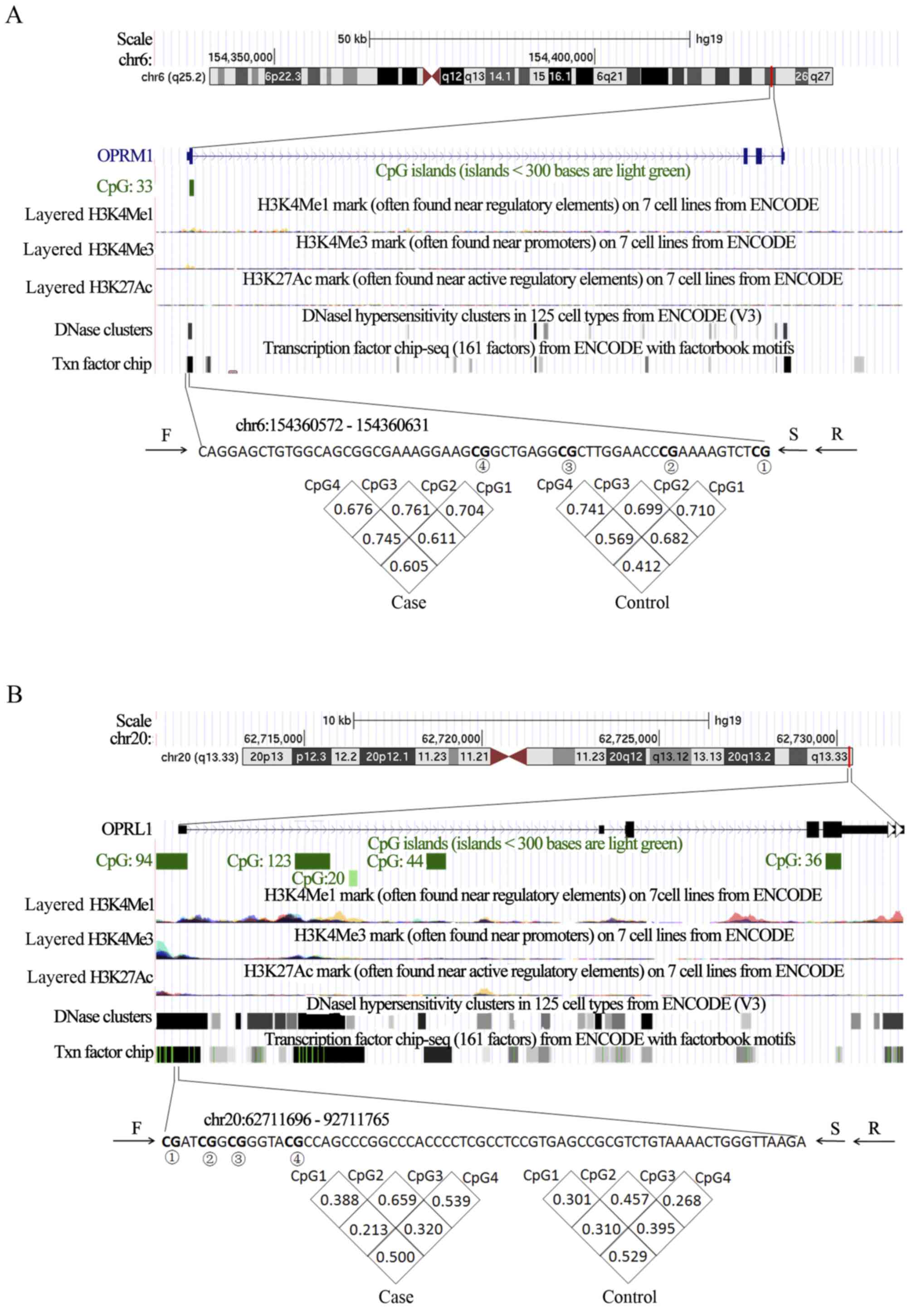
As shown in Fig. 1,
significant pairwise correlations between CpG sites of both genes
were identified (P<0.001). Therefore, the mean methylation of
each gene was used in the subsequent analyses. To evaluate the
potential role of OPRM1 and OPRL1 methylation in the
risk of AD, we carefully selected AD patient and control groups. No
significant differences in biological and/or physiological
characteristics were noted between the two groups, with the
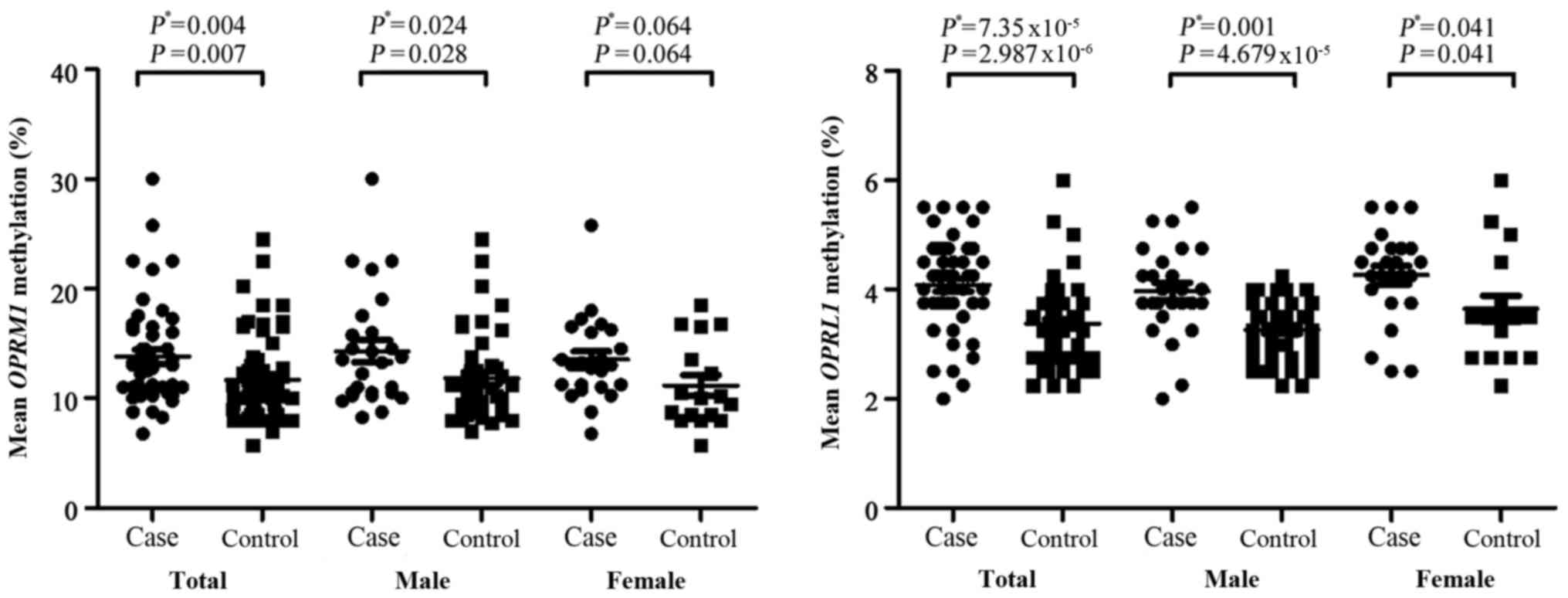
exception of the parameter smoking status (P=0.025; Table I) (21). The case-control comparisons
revealed significantly higher methylation levels of OPRM1
and OPRL1 in AD patients compared with healthy controls
(smoking-adjusted P<0.05, Table
I and Fig. 2). Subgroup
analyses by gender indicated that the methylation levels of
OPRM1 and OPRL1 were significantly and/or moderately
increased in AD patients compared with control subjects, in both
male and female participants (Table
I and Fig. 2). In addition, no
significant correlation between OPRM1 and OPRL1
methylation was noted (P>0.05, data not shown).
 | Table I.Comparison of the mean methylation
levels of OPRM1 and OPRL1 between AD cases and
control subjects. |
Table I.
Comparison of the mean methylation
levels of OPRM1 and OPRL1 between AD cases and
control subjects.
| Gene | Cases (n=51) | Controls
(n=63) | P-value | Adjusted
P-valuea |
|---|
| OPRM1
methylation (%), total | 13.86±4.56 | 11.67±3.88 | 0.007 | 0.004 |
| OPRM1
methylation (%), in males | 14.30±5.23 | 11.85±3.93 | 0.028 | 0.024 |
| OPRM1
methylation (%), in females | 13.50±3.84 | 11.18±3.84 | 0.064 | 0.064 |
| OPRM1
methylation (%), total | 4.08±0.85 | 3.37±0.70 |
2.987×10⁻⁶ |
7.35×10⁻⁵ |
| OPRM1
methylation (%), in males | 3.96±0.83 | 3.27±0.53 |
4.679×10⁻⁵ | 0.001 |
| OPRM1
methylation (%), in females | 4.26±0.85 | 3.65±1.00 | 0.041 | 0.041 |
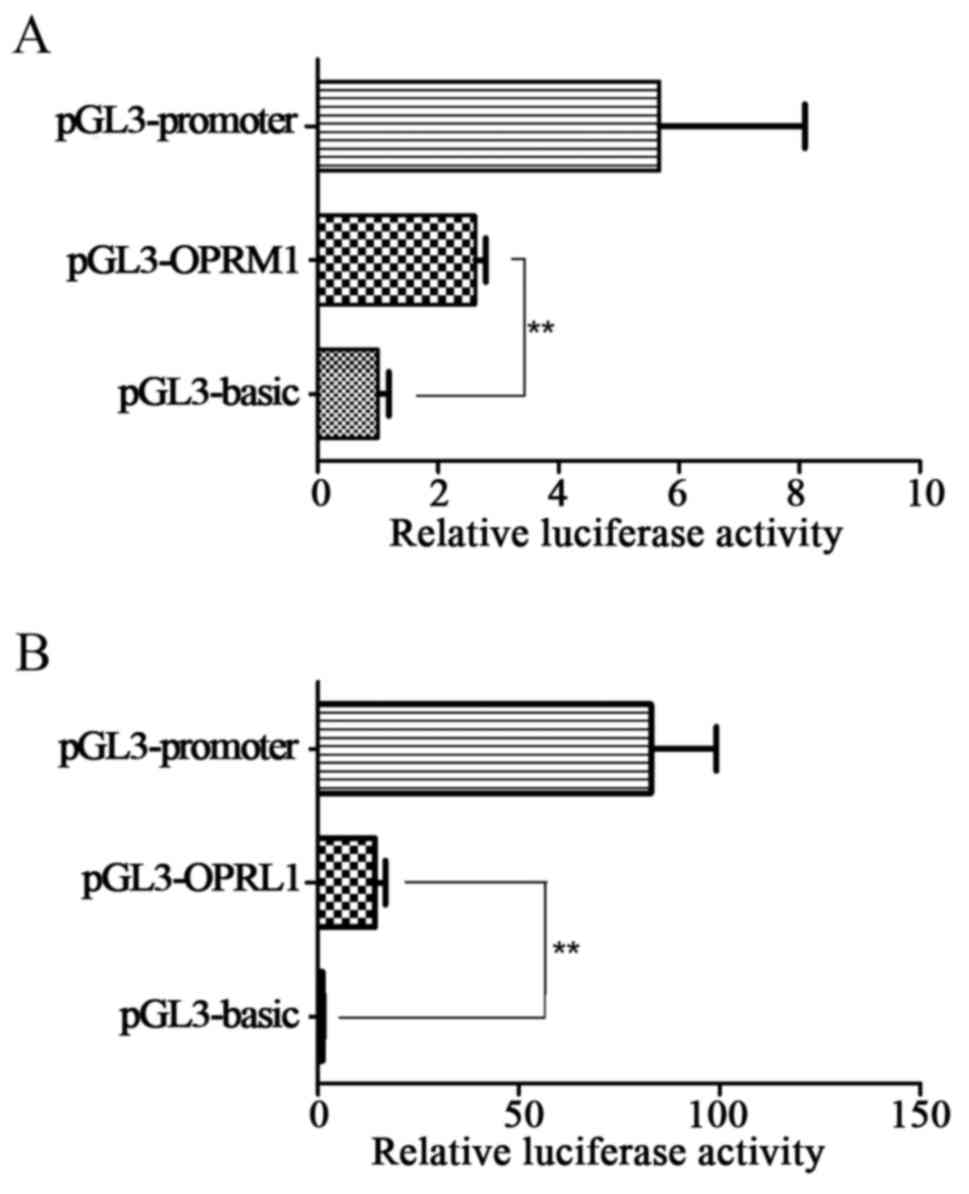
Functional activities of the target regions of
OPRM1 and OPRL1 were assessed with dual-luciferase
reporter gene assays. Both gene promoter fragments were able to
significantly increase luciferase expression levels (Fig. 3, OPRM1: Fold-change=2.616,
P=0.003, OPRL1: Fold-change=11.395, P=0.007).
Taken together, the data indicated that the four
opioid receptor genes (OPRK1, OPRM1, OPRD1 and OPRL1)
had higher methylation levels in AD patients compared with healthy
subjects. These conclusions were consistent with our previous
studies. ROC analyses were conducted for each gene and their
combined index was used to evaluate their diagnostic values for AD.
As expected, the combined index of methylation of all four genes
was more informative than that of each single gene (combined index:
AUC=0.843, OPRL1: AUC=0.765, OPRM1: AUC=0.652,
OPRK1: AUC=0.660, OPRD1: AUC=0.800, Fig. 4).
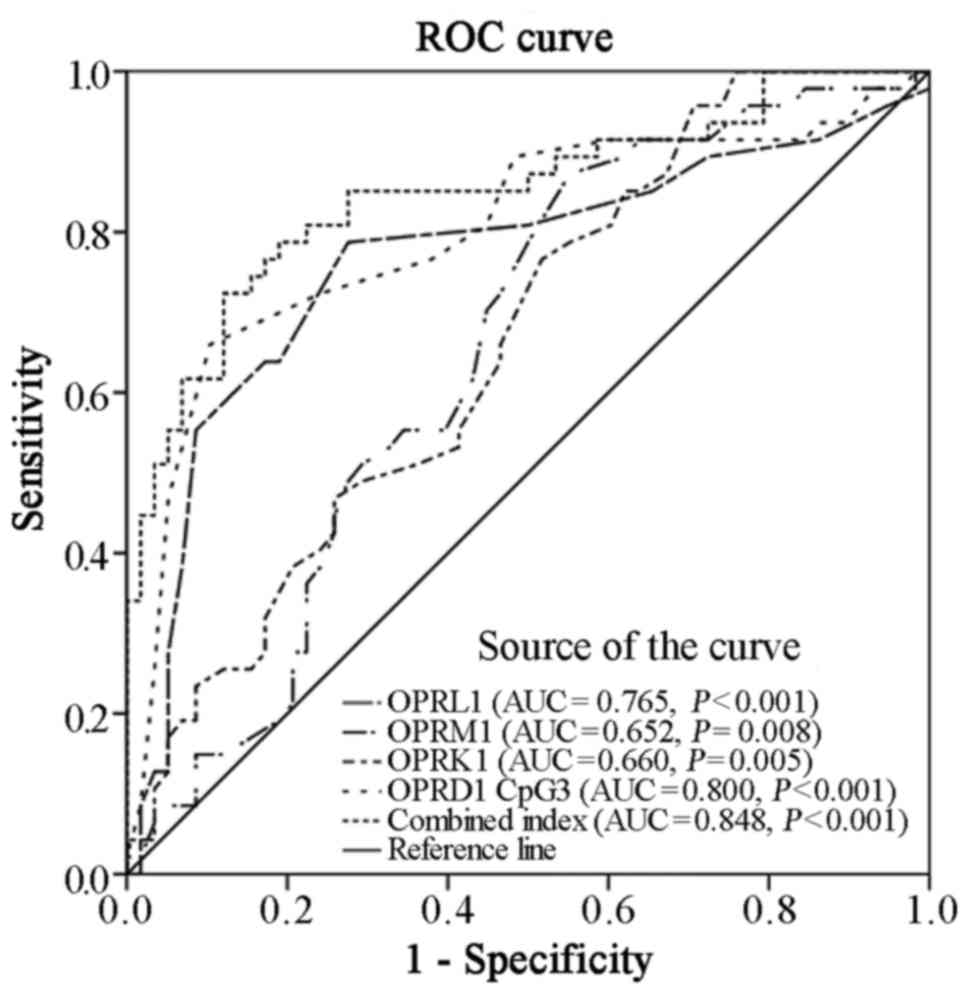 | Figure 4.ROC analyses of the methylation
levels of opioid receptor genes as diagnostic biomarkers for
Alzheimer's disease. ROC analyses were conducted to classify the
health status of individuals (OPRL1: AUC=0.765,
sensitivity=0.787, specificity=0.724, P<0.001; OPRM1:
AUC=0.652, sensitivity=0.872, specificity=0.448, P=0.008;
OPRK1: AUC=0.660, sensitivity=0.957, specificity=0.293,
P=0.005; OPRD1 CpG3: AUC=0.800, sensitivity=0.660,
specificity=0.897, P<0.001; Combined index: AUC=0.848,
sensitivity=0.723, specificity=0.879, P<0.001). The combined
index represented the composite methylation of 4 opioid receptor
genes. ROC, receiver operating characteristic; OPRM1, opioid
receptor µ1; OPRL1, opioid related nociceptin receptor 1;
OPRK1, opioid receptor κ1; OPRD1, opioid receptor
δ1. |
Discussion
The present study provides substantial evidence the
methylation levels of OPRM1 and OPRL1 are associated
with AD. Using a dual-luciferase assay, we demonstrated that the
promoter fragments with the tested CG sites could enhance gene
transcription, and that their hypermethylation could influence
their expression levels. Moreover, ROC analyses indicated a
significant contribution of opioid receptor gene methylation to the
prediction of AD risk.
Opioid receptors with their ligands comprise an
important signaling pathway in the central nervous system (20,22,23).
Considerable evidence supports their involvements in tau
hyperphosphorylation, Aβ production, and neuro-inflammation
(24), suggesting a connection
with AD pathogenesis. Promoter DNA methylation is well-known for
its function in gene expression, and aberrant regulation of opioid
receptors may play a role in disease pathologies, as shown by
previous studies conducted on methylation of opioid receptor genes
(25). For example,
hypermethylated OPRM1 was shown to inhibit the analgesic
effect of morphine in a mouse model of neuropathic pain, while its
demethylation restored morphine function (26). Similarly, OPRM1 was
hypermethylated in oral cancer, and demethylation of OPRM1
provided an analgesic effect similar to that noted by demethylating
drugs (27). Furthermore, opiate
addicts indicated higher OPRM1 methylation levels compared
with control subjects (28).
Previous results have further revealed increased methylation levels
for OPRL1 in patients with alcohol dependence as well as in
control subjects who experienced childhood adversity (29). In the present study,
hypermethylation of both OPRM1 and OPRL1 genes was
shown to be associated with AD. The results suggest that a low
density of opioid receptors is noted in AD. Moreover, previous
evidence indicated altered densities of opioid receptors in various
AD brain regions (24,30). However, the precise mechanism
involved in these alterations and its association with methylation
requires further research. It is important to note that the,
present data suggest a possible diagnostic application for AD by a
combinatorial approach. Opioid receptors have shown potential as
therapeutic targets in neuropsychiatric diseases as demonstrated by
previous studies (31,32). Given the wide distribution of
opioid receptor expression in the brain, and the absence of
previous blood-based studies on the association between opioid
receptor genes methylation and AD, further work is necessary to
confirm our findings and test the present hypothesis.
A few limitations are evident in the present study.
Firstly, the sample size was small, and additional, larger studies
will be necessary to confirm these findings. Secondly, the
OPRM1 and OPRL1 DNA fragments analyzed may not fully
represent the overall level of DNA methylation in both genes, and
thus their total contribution to AD may not be accurately
represented. In addition, since AD is a neurological disease,
future studies using brain tissue are required to confirm our
results.
In summary, the present findings on OPRM1 and
OPRL1 methylation together with our previous study on
OPRK1 and OPRD1, suggest an epigenetic involvement of
the opioid system in AD, and a potential diagnostic value of opioid
receptor methylation for AD.
Acknowledgements
The authors would like to thank Ningbo No. 1
Hospital and Ningbo Kangning Hospital (Ningbo, China) for providing
the samples.
Funding
The present study was supported by grants from the
National Natural Science Foundation of China (grant nos. U1503223,
81271209, 81070873 and 81371469), the Applied Research Project on
Nonprofit Technology of Zhejiang Province (grant no. 2015C33155),
the Natural Science Foundation of Zhejiang Province (grant nos.
LY15H090010, LR13H020003 and Y15H090032), the Ningbo Natural
Science Fund (grant no. 2014A610257), the Disciplinary Project of
Ningbo University (grant no. B01350104900), the K. C. Wong Magna
Fund in Ningbo University, Public Technology Research and Social
Development Project of Zhejiang Province (grant no. 2015C33155),
and the Excellent Paper Cultivated Fund of Ningbo University (grant
no. 014-F01660148000).
Availability of data and materials
The datasets used and/or analyzed during the current
study are available from the corresponding author on reasonable
request.
Authors' contributions
CX, GL and HJ performed the majority of the
experiments, data collection, statistical analysis, data
interpretation and wrote the manuscript. WHC, DD, ZC, DZ and LX
performed sample collection, the biochemical tests and collated the
data. HH, WC, LC, QZ and LL analyzed the data and revised the
manuscript. SD and QW revised the manuscript critically for
important intellectual content, designed the overall study,
supervised the experiments, analyzed the results and wrote the
paper.
Ethics approval and consent to
participate
The present study was approved by the Ethics
Committees of Ningbo No. 1 Hospital and Ningbo Kangning Hospital
(Zhejiang, China), and all participants provided written informed
consent for their participation in the study.
Patient consent for publication
Not applicable.
Competing interests
The authors declare that they have no competing
interests.
References
|
1
|
Ghebranious N, Mukesh B, Giampietro PF,
Glurich I, Mickel SF, Waring SC and McCarty CA: A pilot study of
gene/gene and gene/environment interactions in Alzheimer disease.
Clin Med Res. 9:17–25. 2011. View Article : Google Scholar : PubMed/NCBI
|
|
2
|
Adlard PA, Tran BA, Finkelstein DI,
Desmond PM, Johnston LA, Bush AI and Egan GF: A review of β-amyloid
neuroimaging in Alzheimer's disease. Front Neurosci. 8:3272014.
View Article : Google Scholar : PubMed/NCBI
|
|
3
|
Piaceri I, Nacmias B and Sorbi S: Genetics
of familial and sporadic Alzheimer's disease. Front Biosci (Elite
Ed). 5:167–177. 2013. View
Article : Google Scholar : PubMed/NCBI
|
|
4
|
Alonso Vilatela ME, Lopez-Lopez M and
Yescas-Gomez P: Genetics of Alzheimer's disease. Arch Med Res.
43:622–631. 2012. View Article : Google Scholar : PubMed/NCBI
|
|
5
|
Rao AT, Degnan AJ and Levy LM: Genetics of
Alzheimer disease. AJNR Am J Neuroradiol. 35:457–458. 2014.
View Article : Google Scholar : PubMed/NCBI
|
|
6
|
Armstrong RA: What causes Alzheimer's
disease? Folia Neuropathol. 51:169–188. 2013. View Article : Google Scholar : PubMed/NCBI
|
|
7
|
Chang L, Wang Y, Ji H, Dai D, Xu X, Jiang
D, Hong Q, Ye H, Zhang X, Zhou X, et al: Elevation of peripheral
BDNF promoter methylation links to the risk of Alzheimer's disease.
PLoS One. 9:e1107732014. View Article : Google Scholar : PubMed/NCBI
|
|
8
|
Deng Y and Yu G: The effect of DNA
methylation on β-amyloid accumulation in Alzheimer's disease. Yi
Chuan. 36:295–300. 2014.(In Chinese). PubMed/NCBI
|
|
9
|
Ji H, Wang Y, Liu G, Xu X, Dai D, Chen Z,
Zhou D, Zhou X, Han L, Li Y, et al: OPRK1 promoter hypermethylation
increases the risk of Alzheimer's disease. Neurosci Lett.
606:24–29. 2015. View Article : Google Scholar : PubMed/NCBI
|
|
10
|
Matthes HW, Maldonado R, Simonin F,
Valverde O, Slowe S, Kitchen I, Befort K, Dierich A, Le Meur M,
Dollé P, et al: Loss of morphine-induced analgesia, reward effect
and withdrawal symptoms in mice lacking the mu-opioid-receptor
gene. Nature. 383:819–823. 1996. View
Article : Google Scholar : PubMed/NCBI
|
|
11
|
Gaveriaux-Ruff C, Matthes HW, Peluso J and
Kieffer BL: Abolition of morphine-immunosuppression in mice lacking
the mu-opioid receptor gene. Proc Natl Acad Sci USA. 95:6326–6330.
1998. View Article : Google Scholar : PubMed/NCBI
|
|
12
|
Wang Y, Wang YX, Liu T, Law PY, Loh HH,
Qiu Y and Chen HZ: µ-Opioid receptor attenuates Aβ
oligomers-induced neurotoxicity through mTOR signaling. CNS
Neurosci Ther. 21:8–14. 2015. View Article : Google Scholar : PubMed/NCBI
|
|
13
|
Levran O, Yuferov V and Kreek MJ: The
genetics of the opioid system and specific drug addictions. Hum
Genet. 131:823–842. 2012. View Article : Google Scholar : PubMed/NCBI
|
|
14
|
Kuzmin A, Bazov I, Sheedy D, Garrick T,
Harper C and Bakalkin G: Expression of pronociceptin and its
receptor is downregulated in the brain of human alcoholics. Brain
Res. 1305 Suppl:S80–S85. 2009. View Article : Google Scholar : PubMed/NCBI
|
|
15
|
Peluso J, LaForge KS, Matthes HW, Kreek
MJ, Kieffer BL and Gaveriaux-Ruff C: Distribution of
nociceptin/orphanin FQ receptor transcript in human central nervous
system and immune cells. J Neuroimmunol. 81:1–192. 1998. View Article : Google Scholar : PubMed/NCBI
|
|
16
|
Zaveri N: Peptide and nonpeptide ligands
for the nociceptin/orphanin FQ receptor ORL1: Research tools and
potential therapeutic agents. Life Sci. 73:663–678. 2003.
View Article : Google Scholar : PubMed/NCBI
|
|
17
|
Kruger C, Köthe L, Struppert A, Pietruck
C, Simm A and Grond S: Expression und function of the ORL-1
receptor on human leukocytes. Schmerz. 20:509–518. 2006. View Article : Google Scholar : PubMed/NCBI
|
|
18
|
International Advisory Group for the
Revision of ICD-10 Mental and Behavioural Disorders, . A conceptual
framework for the revision of the ICD-10 classification of mental
and behavioural disorders. World Psychiatry. 10:86–92. 2011.
View Article : Google Scholar : PubMed/NCBI
|
|
19
|
Jiang D, Zheng D, Wang L, Huang Y, Liu H,
Xu L, Liao Q, Liu P, Shi X, Wang Z, et al: Elevated PLA2G7 gene
promoter methylation as a gender-specific marker of aging increases
the risk of coronary heart disease in females. PLoS One.
8:e597522013. View Article : Google Scholar : PubMed/NCBI
|
|
20
|
Xu X, Ji H, Liu G, Wang Q, Liu H, Shen W,
Li L, Xie X, Zhou W and Duan S: A significant association between
BDNF promoter methylation and the risk of drug addiction. Gene.
584:54–59. 2016. View Article : Google Scholar : PubMed/NCBI
|
|
21
|
Ji H, Wang Y, Liu G, Chang L, Chen Z, Zhou
D, Xu X, Cui W, Hong Q, Jiang L, et al: Elevated OPRD1 promoter
methylation in Alzheimer's disease patients. PLoS One.
12:e01723352017. View Article : Google Scholar : PubMed/NCBI
|
|
22
|
Conason AH and Sher L: Alcohol use in
adolescents with eating disorders. Int J Adolesc Med Health.
18:31–36. 2006. View Article : Google Scholar : PubMed/NCBI
|
|
23
|
Snyder SH and Childers SR: Opiate
receptors and opioid peptides. Annu Rev Neurosci. 2:35–64. 1979.
View Article : Google Scholar : PubMed/NCBI
|
|
24
|
Cai Z and Ratka A: Opioid system and
Alzheimer's disease. Neuromolecular Med. 14:91–111. 2012.
View Article : Google Scholar : PubMed/NCBI
|
|
25
|
Sun Y, Sahbaie P, Liang D, Li W, Shi X,
Kingery P and Clark JD: DNA methylation modulates nociceptive
sensitization after incision. PLoS One. 10:e01420462015. View Article : Google Scholar : PubMed/NCBI
|
|
26
|
Zhou XL, Yu LN, Wang Y, Tang LH, Peng YN,
Cao JL and Yan M: Increased methylation of the MOR gene proximal
promoter in primary sensory neurons plays a crucial role in the
decreased analgesic effect of opioids in neuropathic pain. Mol
Pain. 10:512014. View Article : Google Scholar : PubMed/NCBI
|
|
27
|
Viet CT, Dang D, Ye Y, Ono K, Campbell RR
and Schmidt BL: Demethylating drugs as novel analgesics for cancer
pain. Clin Cancer Res. 20:4882–4893. 2014. View Article : Google Scholar : PubMed/NCBI
|
|
28
|
Doehring A, Oertel BG, Sittl R and Lotsch
J: Chronic opioid use is associated with increased DNA methylation
correlating with increased clinical pain. Pain. 154:15–23. 2013.
View Article : Google Scholar : PubMed/NCBI
|
|
29
|
Zhang H, Wang F, Kranzler HR, Zhao H and
Gelernter J: Profiling of childhood adversity-associated DNA
methylation changes in alcoholic patients and healthy controls.
PLoS One. 8:e656482013. View Article : Google Scholar : PubMed/NCBI
|
|
30
|
Barg J, Belcheva M, Rowinski J, Ho A,
Burke WJ, Chung HD, Schmidt CA and Coscia CJ: Opioid receptor
density changes in Alzheimer amygdala and putamen. Brain Res.
632:209–215. 1993. View Article : Google Scholar : PubMed/NCBI
|
|
31
|
Butelman ER and Kreek MJ: Salvinorin A, a
kappa-opioid receptor agonist hallucinogen: Pharmacology and
potential template for novel pharmacotherapeutic agents in
neuropsychiatric disorders. Front Pharmacol. 6:1902015. View Article : Google Scholar : PubMed/NCBI
|
|
32
|
Cunningham CW, Rothman RB and Prisinzano
TE: Neuropharmacology of the naturally occurring kappa-opioid
hallucinogen salvinorin A. Pharmacol Rev. 63:316–347. 2011.
View Article : Google Scholar : PubMed/NCBI
|