Spandidos Publications Logo
  • About
    • About Spandidos
    • Aims and Scopes
    • Abstracting and Indexing
    • Editorial Policies
    • Reprints and Permissions
    • Job Opportunities
    • Terms and Conditions
    • Contact
  • Journals
    • All Journals
    • Oncology Letters
      • Oncology Letters
      • Information for Authors
      • Editorial Policies
      • Editorial Board
      • Aims and Scope
      • Abstracting and Indexing
      • Bibliographic Information
      • Archive
    • International Journal of Oncology
      • International Journal of Oncology
      • Information for Authors
      • Editorial Policies
      • Editorial Board
      • Aims and Scope
      • Abstracting and Indexing
      • Bibliographic Information
      • Archive
    • Molecular and Clinical Oncology
      • Molecular and Clinical Oncology
      • Information for Authors
      • Editorial Policies
      • Editorial Board
      • Aims and Scope
      • Abstracting and Indexing
      • Bibliographic Information
      • Archive
    • Experimental and Therapeutic Medicine
      • Experimental and Therapeutic Medicine
      • Information for Authors
      • Editorial Policies
      • Editorial Board
      • Aims and Scope
      • Abstracting and Indexing
      • Bibliographic Information
      • Archive
    • International Journal of Molecular Medicine
      • International Journal of Molecular Medicine
      • Information for Authors
      • Editorial Policies
      • Editorial Board
      • Aims and Scope
      • Abstracting and Indexing
      • Bibliographic Information
      • Archive
    • Biomedical Reports
      • Biomedical Reports
      • Information for Authors
      • Editorial Policies
      • Editorial Board
      • Aims and Scope
      • Abstracting and Indexing
      • Bibliographic Information
      • Archive
    • Oncology Reports
      • Oncology Reports
      • Information for Authors
      • Editorial Policies
      • Editorial Board
      • Aims and Scope
      • Abstracting and Indexing
      • Bibliographic Information
      • Archive
    • Molecular Medicine Reports
      • Molecular Medicine Reports
      • Information for Authors
      • Editorial Policies
      • Editorial Board
      • Aims and Scope
      • Abstracting and Indexing
      • Bibliographic Information
      • Archive
    • World Academy of Sciences Journal
      • World Academy of Sciences Journal
      • Information for Authors
      • Editorial Policies
      • Editorial Board
      • Aims and Scope
      • Abstracting and Indexing
      • Bibliographic Information
      • Archive
    • International Journal of Functional Nutrition
      • International Journal of Functional Nutrition
      • Information for Authors
      • Editorial Policies
      • Editorial Board
      • Aims and Scope
      • Abstracting and Indexing
      • Bibliographic Information
      • Archive
    • International Journal of Epigenetics
      • International Journal of Epigenetics
      • Information for Authors
      • Editorial Policies
      • Editorial Board
      • Aims and Scope
      • Abstracting and Indexing
      • Bibliographic Information
      • Archive
    • Medicine International
      • Medicine International
      • Information for Authors
      • Editorial Policies
      • Editorial Board
      • Aims and Scope
      • Abstracting and Indexing
      • Bibliographic Information
      • Archive
  • Articles
  • Information
    • Information for Authors
    • Information for Reviewers
    • Information for Librarians
    • Information for Advertisers
    • Conferences
  • Language Editing
Spandidos Publications Logo
  • About
    • About Spandidos
    • Aims and Scopes
    • Abstracting and Indexing
    • Editorial Policies
    • Reprints and Permissions
    • Job Opportunities
    • Terms and Conditions
    • Contact
  • Journals
    • All Journals
    • Biomedical Reports
      • Information for Authors
      • Editorial Policies
      • Editorial Board
      • Aims and Scope
      • Abstracting and Indexing
      • Bibliographic Information
      • Archive
    • Experimental and Therapeutic Medicine
      • Information for Authors
      • Editorial Policies
      • Editorial Board
      • Aims and Scope
      • Abstracting and Indexing
      • Bibliographic Information
      • Archive
    • International Journal of Epigenetics
      • Information for Authors
      • Editorial Policies
      • Editorial Board
      • Aims and Scope
      • Abstracting and Indexing
      • Bibliographic Information
      • Archive
    • International Journal of Functional Nutrition
      • Information for Authors
      • Editorial Policies
      • Editorial Board
      • Aims and Scope
      • Abstracting and Indexing
      • Bibliographic Information
      • Archive
    • International Journal of Molecular Medicine
      • Information for Authors
      • Editorial Policies
      • Editorial Board
      • Aims and Scope
      • Abstracting and Indexing
      • Bibliographic Information
      • Archive
    • International Journal of Oncology
      • Information for Authors
      • Editorial Policies
      • Editorial Board
      • Aims and Scope
      • Abstracting and Indexing
      • Bibliographic Information
      • Archive
    • Medicine International
      • Information for Authors
      • Editorial Policies
      • Editorial Board
      • Aims and Scope
      • Abstracting and Indexing
      • Bibliographic Information
      • Archive
    • Molecular and Clinical Oncology
      • Information for Authors
      • Editorial Policies
      • Editorial Board
      • Aims and Scope
      • Abstracting and Indexing
      • Bibliographic Information
      • Archive
    • Molecular Medicine Reports
      • Information for Authors
      • Editorial Policies
      • Editorial Board
      • Aims and Scope
      • Abstracting and Indexing
      • Bibliographic Information
      • Archive
    • Oncology Letters
      • Information for Authors
      • Editorial Policies
      • Editorial Board
      • Aims and Scope
      • Abstracting and Indexing
      • Bibliographic Information
      • Archive
    • Oncology Reports
      • Information for Authors
      • Editorial Policies
      • Editorial Board
      • Aims and Scope
      • Abstracting and Indexing
      • Bibliographic Information
      • Archive
    • World Academy of Sciences Journal
      • Information for Authors
      • Editorial Policies
      • Editorial Board
      • Aims and Scope
      • Abstracting and Indexing
      • Bibliographic Information
      • Archive
  • Articles
  • Information
    • For Authors
    • For Reviewers
    • For Librarians
    • For Advertisers
    • Conferences
  • Language Editing
Login Register Submit
  • This site uses cookies
  • You can change your cookie settings at any time by following the instructions in our Cookie Policy. To find out more, you may read our Privacy Policy.

    I agree
Search articles by DOI, keyword, author or affiliation
Search
Advanced Search
presentation
Molecular Medicine Reports
Join Editorial Board Propose a Special Issue
Print ISSN: 1791-2997 Online ISSN: 1791-3004
Journal Cover
January-2020 Volume 21 Issue 1

Full Size Image

Sign up for eToc alerts
Recommend to Library

Journals

International Journal of Molecular Medicine

International Journal of Molecular Medicine

International Journal of Molecular Medicine is an international journal devoted to molecular mechanisms of human disease.

International Journal of Oncology

International Journal of Oncology

International Journal of Oncology is an international journal devoted to oncology research and cancer treatment.

Molecular Medicine Reports

Molecular Medicine Reports

Covers molecular medicine topics such as pharmacology, pathology, genetics, neuroscience, infectious diseases, molecular cardiology, and molecular surgery.

Oncology Reports

Oncology Reports

Oncology Reports is an international journal devoted to fundamental and applied research in Oncology.

Experimental and Therapeutic Medicine

Experimental and Therapeutic Medicine

Experimental and Therapeutic Medicine is an international journal devoted to laboratory and clinical medicine.

Oncology Letters

Oncology Letters

Oncology Letters is an international journal devoted to Experimental and Clinical Oncology.

Biomedical Reports

Biomedical Reports

Explores a wide range of biological and medical fields, including pharmacology, genetics, microbiology, neuroscience, and molecular cardiology.

Molecular and Clinical Oncology

Molecular and Clinical Oncology

International journal addressing all aspects of oncology research, from tumorigenesis and oncogenes to chemotherapy and metastasis.

World Academy of Sciences Journal

World Academy of Sciences Journal

Multidisciplinary open-access journal spanning biochemistry, genetics, neuroscience, environmental health, and synthetic biology.

International Journal of Functional Nutrition

International Journal of Functional Nutrition

Open-access journal combining biochemistry, pharmacology, immunology, and genetics to advance health through functional nutrition.

International Journal of Epigenetics

International Journal of Epigenetics

Publishes open-access research on using epigenetics to advance understanding and treatment of human disease.

Medicine International

Medicine International

An International Open Access Journal Devoted to General Medicine.

Journal Cover
January-2020 Volume 21 Issue 1

Full Size Image

Sign up for eToc alerts
Recommend to Library

  • Article
  • Citations
    • Cite This Article
    • Download Citation
    • Create Citation Alert
    • Remove Citation Alert
    • Cited By
  • Similar Articles
    • Related Articles (in Spandidos Publications)
    • Similar Articles (Google Scholar)
    • Similar Articles (PubMed)
  • Download PDF
  • Download XML
  • View XML
Article Open Access

Iridoid glycosides from Radix Scrophulariae attenuates focal cerebral ischemia‑reperfusion injury via inhibiting endoplasmic reticulum stress‑mediated neuronal apoptosis in rats

  • Authors:
    • Yanyue Chen
    • Lei Zhang
    • Xueyuan Gong
    • Hengpei Gong
    • Rubin Cheng
    • Fengmei Qiu
    • Xiaoming Zhong
    • Zhen Huang
  • View Affiliations / Copyright

    Affiliations: Institute of Traditional Chinese Medicine Resources, College of Pharmaceutical Science, Zhejiang Chinese Medical University, Hangzhou, Zhejiang 311400, P.R. China
    Copyright: © Chen et al. This is an open access article distributed under the terms of Creative Commons Attribution License.
  • Pages: 131-140
    |
    Published online on: November 20, 2019
       https://doi.org/10.3892/mmr.2019.10833
  • Expand metrics +
Metrics: Total Views: 0 (Spandidos Publications: | PMC Statistics: )
Metrics: Total PDF Downloads: 0 (Spandidos Publications: | PMC Statistics: )
Cited By (CrossRef): 0 citations Loading Articles...

This article is mentioned in:


Abstract

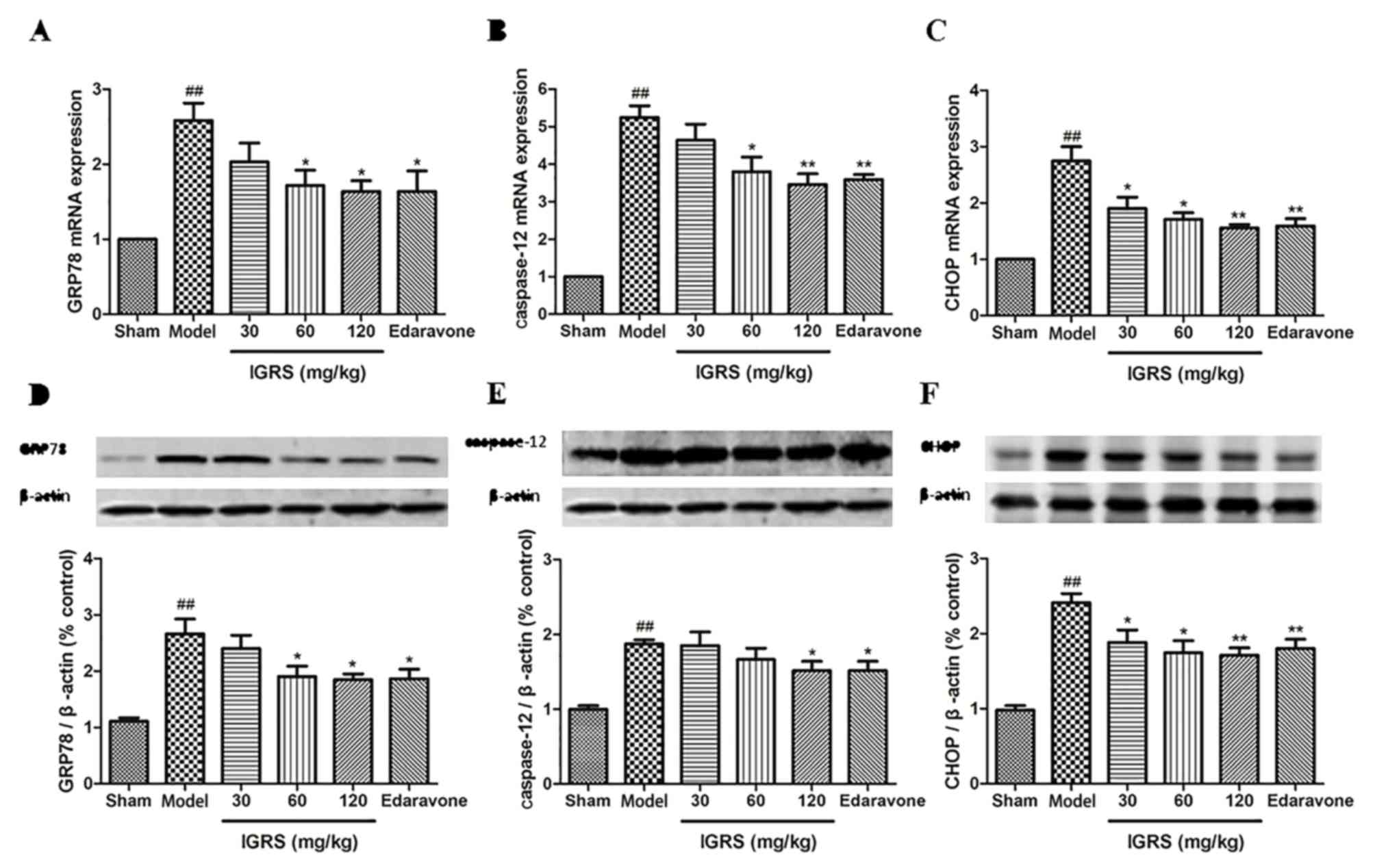
Iridoid glycosides of Radix Scrophulariae (IGRS) are a group of the major bioactive components from Radix Scrophulariae with extensive pharmacological activities. The present study investigated the effects of IGRS on cerebral ischemia‑reperfusion injury (CIRI) and explored its potential mechanisms of action. A CIRI model in rats was established by occlusion of the right middle cerebral artery for 90 min, followed by 24 h of reperfusion. Prior to surgery, 30, 60 or 120 mg/kg IGRS was administered to the rats once a day for 7 days. Then, the neurological scores, brain edema and volume of the cerebral infarction were measured. The apoptosis index was determined by terminal deoxynucleotidyl transferase mediated dUTP nick end labeling. The effects of IGRS on the histopathology of the cortex in brain tissues and the endoplasmic reticulum ultrastructure in the hippocampus were analyzed. Finally, the expression of endoplasmic reticulum stress (ERS)‑regulating mediators, endoplasmic reticulum chaperone BiP (GRP78), DNA damage‑inducible transcript 3 protein (CHOP) and caspase‑12, were detected by reverse transcription quantitative polymerase chain reaction (RT‑qPCR) and western blot analysis. The volume of cerebral infarction and brain water content in the IGRS‑treated groups treated at doses of 60 and 120 mg/kg were decreased significantly compared with the Model group. The neurological scores were also significantly decreased in the IGRS‑treated groups. IGRS treatment effectively decreased neuronal apoptosis resulting from CIRI‑induced neuron injury. In addition, the histopathological damage and the endoplasmic reticulum ultrastructure injury were partially improved in CIRI rats following IGRS treatment. RT‑qPCR and western blot analysis data indicated that IGRS significantly decreased the expression levels of GRP78, CHOP and caspase‑12 at both mRNA and protein levels. The results of the present study demonstrated that IGRS exerted a protective effect against CIRI in brain tissue via the inhibition of apoptosis and ERS.
View Figures

Figure 1

Figure 2

Figure 3

Figure 4

Figure 5

View References

1 

Sun K, Fan J and Han J: Ameliorating effects of traditional Chinese medicine preparation, Chinese materia medica and active compounds on ischemia/reperfusion-induced cerebral microcirculatory disturbances and neuron damage. Acta Pharm Sin B. 5:8–24. 2015. View Article : Google Scholar : PubMed/NCBI

2 

Chen HS, Qi SH and Shen JG: One-compound-multi-target: Combination prospect of natural compounds with thrombolytic therapy in acute ischemic stroke. Curr Neuropharmacol. 15:134–156. 2017. View Article : Google Scholar : PubMed/NCBI

3 

Cheng CY and Lee YC: Anti-inflammatory effects of traditional chinese medicines against ischemic injury in in vivo models of cerebral ischemia. Evid Based Complement Alternat Med. 2016:57394342016. View Article : Google Scholar : PubMed/NCBI

4 

Chen XM, Chen HS, Xu MJ and Shen JG: Targeting reactive nitrogen species: A promising therapeutic strategy for cerebral ischemia-reperfusion injury. Acta Pharmacol Sin. 34:67–77. 2013. View Article : Google Scholar : PubMed/NCBI

5 

Hu Y, Deng H, Xu S and Zhang J: MicroRNAs regulate mitochondrial function in cerebral ischemia-reperfusion injury. Int J Mol Sci. 16:24895–24917. 2015. View Article : Google Scholar : PubMed/NCBI

6 

Zhang HY, Wang ZG, Lu XH, Kong XX and Xiao J: Endoplasmic reticulum stress: Relevance and therapeutics in central nervous system diseases. Mol Neurobiol. 51:1343–1352. 2015. View Article : Google Scholar : PubMed/NCBI

7 

Li JQ, Yu JT, Jiang T and Tan L: Endoplasmic reticulum dysfunction in Alzheimer's disease. Mol Neurobiol. 51:383–395. 2015. View Article : Google Scholar : PubMed/NCBI

8 

Lee AS: The ER chaperone and signaling regulator GRP78/BIP as a monitor of endoplasmic reticulum stress. Methods. 35:373–381. 2005. View Article : Google Scholar : PubMed/NCBI

9 

Gong L, Tang Y, An R, Lin M, Chen L and Du J: RTN1-C mediates cerebral ischemia/reperfusion injury via ER stress and mitochondria-associated apoptosis pathways. Cell Death Dis. 8:e30802017. View Article : Google Scholar : PubMed/NCBI

10 

Cao G, Zhou H, Jiang N, Han Y, Hu Y, Zhang Y, Qi J, Kou J and Yu B: Yi Qi Fu Mai powder injection ameliorates cerebral ischemia by inhibiting endoplasmic reticulum stress-mediated neuronal apoptosis. Oxid Med Cell Longev. 2016:54932792016. View Article : Google Scholar : PubMed/NCBI

11 

Lin YW, Chen TY, Hung C, Tai SH, Huang SY, Chang CC, Hung HY and Lee EJ: Melatonin protects brain against ischemia/reperfusion injury by attenuating endoplasmic reticulum stress. Int J Mol Med. 42:182–192. 2018.PubMed/NCBI

12 

Chaudhari N, Talwar P, Parimisetty A, Lefebvre d'Hellencourt C and Ravanan P: A molecular web: Endoplasmic reticulum stress, inflammation, and oxidative stress. Front Cell Neurosci. 8:2132014. View Article : Google Scholar : PubMed/NCBI

13 

Li X, Fang D, Cong X, Cao G, Cai H and Cai B: Application of Fourier transform near-infrared spectroscopy combined with high-performance liquid chromatography in rapid and simultaneous determination of essential components in crude Radix Scrophulariae. AAPS PharmSciTech. 13:1428–1435. 2012. View Article : Google Scholar : PubMed/NCBI

14 

Zhang CC, Gu WL, Wu XM, Li YM, Chen CX and Huang XY: Active components from Radix Scrophulariae inhibits the ventricular remodeling induced by hypertension in rats. Springerplus. 5:3582016. View Article : Google Scholar : PubMed/NCBI

15 

Li YM, Zeng HW, He X, Jiang YY, Jiang SH and Zhu DY: Iridoid and phenylpropanoid glycosides of Scrophularia ningpoensis inhibit the formation of LTB (4) and platelet aggregation Ti Erh Chun i Ta Hsueh Pao. Acad J Sec Mil Med Univ. 2:301–303. 1999.

16 

Huang Q, Gong QY, Yao MH, Yu R and Shi NC: Protective effect of Scrophularia ningpoensis extracts on cerebral ischemia injury in rats. Chin J New Drugs Clini Remedies. 23:323–327. 2004.

17 

Kim A, Im M and Jin YM: SRVF, a novel herbal formula including scrophulariae radix and fructus viticis, disrupts focal adhesion and causes detachment-induced apoptosis in malignant cancer cells. Sci Rep. 7:127562017. View Article : Google Scholar : PubMed/NCBI

18 

Ying Xl, Zhong XM, Xu MD, Chen MJ, Xiao WX, Li GZ, Wang H and Huang Z: Neuro-protective effect of harpagide on acute cerebral ischemic injury in mice and its mechanism involving mitochondria. Chin Pharm J. 50:1026–1031. 2015.

19 

Kilkenny C, Browne WJ, Cuthill IC, Emerson M and Altman DG: Improving bioscience research reporting: The ARRIVE guidelines for reporting animal research. PLoS Biol. 8:e10004122010. View Article : Google Scholar : PubMed/NCBI

20 

Leary S, Underwood W, Anthony R, Cartner S, Corey D, Grandin T, Greenacre C, Gwaltney-Brant S, McCrackin MA, Meyer R, et al: AVMA guidelines for the euthanasia of animals: 2013 edition. Am Vet Med Assoc. 2013.

21 

Longa EZ, Weinstein PR, Carlson S and Cummins R: Reversible middle cerebral artery occlusion without craniectomy in rats. Stroke. 20:84–91. 1989. View Article : Google Scholar : PubMed/NCBI

22 

Lv MR, Li B, Wang MG, Meng FG, Yu JJ, Guo F and Li Y: Activation of the PI3K-Akt pathway promotes neuroprotection of the δ-opioid receptor agonist against cerebral ischemia-reperfusion injury in rat models. Biomed Pharmacother. 93:230–237. 2017. View Article : Google Scholar : PubMed/NCBI

23 

Zhai ZY and Feng J: Left-right asymmetry influenced the infarct volume and neurological dysfunction following focal middle cerebral artery occlusion in rats. Brain Behav. 8:e011662018. View Article : Google Scholar : PubMed/NCBI

24 

Liu F, Schafer DP and McCullough LD: TTC, fluoro-Jade B and NeuN staining confirm evolving phases of infarction induced by middle cerebral artery occlusion. J Neurosci Methods. 179:1–8. 2009. View Article : Google Scholar : PubMed/NCBI

25 

Swanson RA, Morton MT, Tsao-Wu G, Savalos RA, Davidson C and Sharp FR: A semiautomated method for measuring brain infarct volume. J Cereb Blood Flow Metab. 10:290–293. 1990. View Article : Google Scholar : PubMed/NCBI

26 

Ya BL, Li HF, Wang HY, Wu F, Xin Q, Cheng HJ, Li WJ, Lin N, Ba ZH, Zhang RJ, et al: 5-HMF attenuates striatum oxidative damage via Nrf2/ARE signaling pathway following transient global cerebral ischemia. Cell Stress Chaperones. 22:55–65. 2017. View Article : Google Scholar : PubMed/NCBI

27 

Tyagi N, Qipshidze N, Munjal C, Vacek JC, Metreveli N, Givvimani S and Tyagi SC: Tetrahydrocurcumin ameliorates homocysteinylated cytochrome-c mediated autophagy in hyperhomocysteinemia mice after cerebral ischemia. J Mol Neurosci. 47:128–138. 2012. View Article : Google Scholar : PubMed/NCBI

28 

Liu P, Yang X, Hei C, Meli Y, Niu J, Sun T and Li PA: Rapamycin reduced ischemic brain damage in diabetic animals is Associated with suppressions of mTOR and ERK1/2 signaling. Int J Biol Sci. 12:1032–1040. 2016. View Article : Google Scholar : PubMed/NCBI

29 

Li W, Yang Y, Hu Z, Ling S and Fang M: Neuroprotective effects of DAHP and Triptolide in focal cerebral ischemia via apoptosis inhibition and PI3K/Akt/mTOR pathway activation. Front Neuroanat. 9:482015. View Article : Google Scholar : PubMed/NCBI

30 

Jiang CJ, Wang ZJ, Zhao YJ, Zhang ZY, Tao JJ and Ma JY: Erythropoietin reduces apoptosis of brain tissue cells in rats after cerebral ischemia/reperfusion injury: A characteristic analysis using magnetic resonance imaging. Neural Regen Res. 11:1450–1455. 2016.PubMed/NCBI

31 

Janyou A, Wicha P, Jittiwat J, Suksamrarn A, Tocharus C and Tocharus J: Dihydrocapsaicin attenuates blood brain barrier and cerebral damage in focal cerebral ischemia/reperfusion via oxidative stress and inflammatory. Sci Rep. 7:105562017. View Article : Google Scholar : PubMed/NCBI

32 

Livak KJ and Schmittgen TD: Analysis of relative gene expression data using real-time quantitative PCR and the 2 (Delta Delta C(T)) method. Methods. 25:402–408. 2001. View Article : Google Scholar : PubMed/NCBI

33 

Villamil-Ortiz JG and Cardona-Gomez GP: Comparative analysis of autophagy and tauopathy related markers in cerebral ischemia and Alzheimer's disease animal models. Fron Aging Neurosci. 7:842015.

34 

Li XB, Ding MX, Ding CL, Li LL, Feng JZ and Yu XJ: Toll-Like receptor 4 promotes the phosphorylation of CRMP2 via the activation of Rho-kinase in MCAO rats. Mol Med Rep. 18:342–348. 2018.PubMed/NCBI

35 

Caltagirone C, Cisari C, Schievano C, Di Paola R, Cordaro M, Bruschetta G, Esposito E and Cuzzocrea S; Stroke Study Group, : Co-ultramicronized palmitoylethanolamide/luteolin in the treatment of cerebral ischemia: From rodent to man. Transl Stroke Res. 7:54–69. 2016. View Article : Google Scholar : PubMed/NCBI

36 

Ferlito M, Wang Q, Fulton WB, Colombani PM, Marchionni L, Fox-Talbot K, Paolocci N and Steenbergen C: Correction: Hydrogen sulfide increases survival during sepsis: Protective effect of CHOP inhibition. J Immunol. 192:1806–1814. 2014. View Article : Google Scholar : PubMed/NCBI

37 

Miao M, Yan X, Guo L and Shao S: Effects of the Rabdosia rubescens total flavonoids on focal cerebral ischemia reperfusion model in rats. Saudi Pharm J. 25:607–614. 2017. View Article : Google Scholar : PubMed/NCBI

38 

Jung SY, Kim KM, Cho S, Lim S, Lim C and Kim YK: Effects of pretreatment with methanol extract of Peucedani Radix on transient ischemic brain injury in mice. Chin Med. 12:30–40. 2017. View Article : Google Scholar : PubMed/NCBI

39 

Wang C, Liu M, Pan Y, Bai B and Chen J: Global gene expression profile of cerebral ischemia-reperfusion injury in rat MCAO model. Oncotarget. 8:74607–74622. 2017. View Article : Google Scholar : PubMed/NCBI

40 

Caprio FZ and Sorond FA: Cerebrovascular disease: Primary and secondary stroke prevention. Med Clin North Am. 103:295–308. 2019. View Article : Google Scholar : PubMed/NCBI

41 

Xiao B, Chai Y, Lv S, Ye M, Wu M, Xie L, Fan Y and Zhu X: Endothelial cell-derived exosomes protect SH-SY5Y nerve cells against ischemia/reperfusion injury. Int J Mol Med. 40:1201–1209. 2017. View Article : Google Scholar : PubMed/NCBI

42 

Zhao Q, Wang X, Chen A, Cheng X, Zhang G, Sun J, Zhao Y, Huang Y and Zhu Y: Rhein protects against cerebral ischemic-/reperfusion-induced oxidative stress and apoptosis in rats. Int J Mol Med. 41:2802–2812. 2018.PubMed/NCBI

43 

He F, Zhang N, Lv Y, Sun W and Chen H: Low-dose lipopolysaccharide inhibits neuronal apoptosis induced by cerebral ischemia/reperfusion injury via the PI3K/Akt/FoxO1 signaling pathway in rat. Mol Med Rep. 19:1443–1452. 2019.PubMed/NCBI

44 

Chen S, Sun M, Zhao X, Yang Z, Liu W, Cao J, Qiao Y, Luo X and Wen A: Neuroprotection of hydroxysafflor yellow A in experimental cerebral ischemia/reperfusion injury via metabolic inhibition of phenylalanine and mitochondrial biogenesis. Mol Med Rep. 19:3009–3020. 2019.PubMed/NCBI

45 

Hou Y, Wang Y, He Q, Li L, Xie H, Zhao Y and Zhao J: Nrf2 inhibits NLRP3 inflammasome activation through regulating Trx1/TXNIP complex in cerebral ischemia reperfusion injury. Behav Brain Res. 336:32–39. 2018. View Article : Google Scholar : PubMed/NCBI

46 

Su D, Ma J, Zhang Z, Tian Y and Shen B: Protective effects of UCF-101 on cerebral ischemia-reperfusion (CIR) is depended on the MAPK/p38/ERK signaling pathway. Cell Mol Neurobiol. 36:907–914. 2016. View Article : Google Scholar : PubMed/NCBI

47 

Shen X, Eichhorn T, Greten HJ and Efferth T: Effects of Scrophularia ningpoensis hemsl. On inhibition of proliferation, apoptosis induction and NF-κB signaling of immortalized and cancer cell lines. Pharmaceuticals (Basel). 5:189–208. 2012. View Article : Google Scholar : PubMed/NCBI

48 

Liang W, Lam WP, Tang HC, Leung PC and Yew DT: Current evidence of Chinese herbal constituents with effects on NMDA receptor blockade. Pharmaceuticals (Basel). 6:1039–1054. 2013. View Article : Google Scholar : PubMed/NCBI

49 

Zhang Q, An RD, Tian XC, Yang M, Li MH, Lou J, Xu L and Dong Z: β-Caryophyllene pretreatment alleviates focal cerebral ischemia-reperfusion injury by activating PI3K/Akt signaling pathway. Neurochem Res. 42:1459–1469. 2017. View Article : Google Scholar : PubMed/NCBI

50 

Gong G, Xiang L, Yuan L, Hu L, Wu W, Cai L, Yin L and Dong H: Protective effect of glycyrrhizin, a direct HMGB1 inhibitor, on focal cerebral ischemia/reperfusion-induced inflammation, oxidative stress, and apoptosis in rats. PLoS One. 9:e894502014. View Article : Google Scholar : PubMed/NCBI

51 

Wang Y, Ren QY, Zhang X, Lu HL and Chen J: Neuroprotective mechanisms of calycosin against focal cerebral ischemia and reperfusion injury in rats. Cell Physiol Biochem. 45:537–546. 2018. View Article : Google Scholar : PubMed/NCBI

52 

Liu B, Li F, Shi J, Yang D, Deng Y and Gong Q: Gastrodin ameliorates subacute phase cerebral ischemia-reperfusion injury by inhibiting inflammation and apoptosis in rats. Mol Med Rep. 14:4144–4152. 2016. View Article : Google Scholar : PubMed/NCBI

53 

Li X, Guo H, Zhao L, Wang B, Liu H, Yue L, Bai H, Jiang H, Gao L, Feng D and Qu Y: Adiponectin attenuates NADPH oxidase-mediated oxidative stress and neuronal damage induced by cerebral ischemia-reperfusion injury. Biochim Biophys Acta Mol Basis Dis. 1863:3265–3276. 2017. View Article : Google Scholar : PubMed/NCBI

54 

Song W, Guo F, Zhong H, Liu L, Yang R, Wang Q and Xiong L: Therapeutic window of globular adiponectin against cerebral ischemia in diabetic mice: The role of dynamic alteration of adiponectin/adiponectin receptor expression. Sci Rep. 5:173102015. View Article : Google Scholar : PubMed/NCBI

55 

Zhao Y, Fang Y, Zhao H, Li J and Luo Y: Chrysophanol inhibits endoplasmic reticulum stress in cerebral ischemia and reperfusion mice. Eur J Pharmacol. 818:1–9. 2018. View Article : Google Scholar : PubMed/NCBI

56 

Liu X, Zhao S, Liu F, Kang J, Xiao A, Li F, Zhang C, Yan F, Zhao H, Luo M, et al: Remote ischemic postconditioning alleviates cerebral ischemic injury by attenuating endoplasmic reticulum stress-mediated apoptosis. Transl Stroke Res. 5:692–700. 2014. View Article : Google Scholar : PubMed/NCBI

Related Articles

  • Abstract
  • View
  • Download
  • Twitter
Copy and paste a formatted citation
Spandidos Publications style
Chen Y, Zhang L, Gong X, Gong H, Cheng R, Qiu F, Zhong X and Huang Z: Iridoid glycosides from Radix Scrophulariae attenuates focal cerebral ischemia‑reperfusion injury via inhibiting endoplasmic reticulum stress‑mediated neuronal apoptosis in rats. Mol Med Rep 21: 131-140, 2020.
APA
Chen, Y., Zhang, L., Gong, X., Gong, H., Cheng, R., Qiu, F. ... Huang, Z. (2020). Iridoid glycosides from Radix Scrophulariae attenuates focal cerebral ischemia‑reperfusion injury via inhibiting endoplasmic reticulum stress‑mediated neuronal apoptosis in rats. Molecular Medicine Reports, 21, 131-140. https://doi.org/10.3892/mmr.2019.10833
MLA
Chen, Y., Zhang, L., Gong, X., Gong, H., Cheng, R., Qiu, F., Zhong, X., Huang, Z."Iridoid glycosides from Radix Scrophulariae attenuates focal cerebral ischemia‑reperfusion injury via inhibiting endoplasmic reticulum stress‑mediated neuronal apoptosis in rats". Molecular Medicine Reports 21.1 (2020): 131-140.
Chicago
Chen, Y., Zhang, L., Gong, X., Gong, H., Cheng, R., Qiu, F., Zhong, X., Huang, Z."Iridoid glycosides from Radix Scrophulariae attenuates focal cerebral ischemia‑reperfusion injury via inhibiting endoplasmic reticulum stress‑mediated neuronal apoptosis in rats". Molecular Medicine Reports 21, no. 1 (2020): 131-140. https://doi.org/10.3892/mmr.2019.10833
Copy and paste a formatted citation
x
Spandidos Publications style
Chen Y, Zhang L, Gong X, Gong H, Cheng R, Qiu F, Zhong X and Huang Z: Iridoid glycosides from Radix Scrophulariae attenuates focal cerebral ischemia‑reperfusion injury via inhibiting endoplasmic reticulum stress‑mediated neuronal apoptosis in rats. Mol Med Rep 21: 131-140, 2020.
APA
Chen, Y., Zhang, L., Gong, X., Gong, H., Cheng, R., Qiu, F. ... Huang, Z. (2020). Iridoid glycosides from Radix Scrophulariae attenuates focal cerebral ischemia‑reperfusion injury via inhibiting endoplasmic reticulum stress‑mediated neuronal apoptosis in rats. Molecular Medicine Reports, 21, 131-140. https://doi.org/10.3892/mmr.2019.10833
MLA
Chen, Y., Zhang, L., Gong, X., Gong, H., Cheng, R., Qiu, F., Zhong, X., Huang, Z."Iridoid glycosides from Radix Scrophulariae attenuates focal cerebral ischemia‑reperfusion injury via inhibiting endoplasmic reticulum stress‑mediated neuronal apoptosis in rats". Molecular Medicine Reports 21.1 (2020): 131-140.
Chicago
Chen, Y., Zhang, L., Gong, X., Gong, H., Cheng, R., Qiu, F., Zhong, X., Huang, Z."Iridoid glycosides from Radix Scrophulariae attenuates focal cerebral ischemia‑reperfusion injury via inhibiting endoplasmic reticulum stress‑mediated neuronal apoptosis in rats". Molecular Medicine Reports 21, no. 1 (2020): 131-140. https://doi.org/10.3892/mmr.2019.10833
Follow us
  • Twitter
  • LinkedIn
  • Facebook
About
  • Spandidos Publications
  • Careers
  • Cookie Policy
  • Privacy Policy
How can we help?
  • Help
  • Live Chat
  • Contact
  • Email to our Support Team