|
1
|
Giguère V, Yang N, Segui P and Evans RM:
Identification of a new class of steroid hormone receptors. Nature.
331:91–94. 1988. View
Article : Google Scholar : PubMed/NCBI
|
|
2
|
Wu Z, Puigserver P, Andersson U, Zhang C,
Adelmant G, Mootha V, Troy A, Cinti S, Lowell B, Scarpulla RC, et
al: Mechanisms controlling mitochondrial biogenesis and respiration
through the thermogenic coactivator PGC-1. Cell. 98:115–124. 1999.
View Article : Google Scholar : PubMed/NCBI
|
|
3
|
Mootha VK, Handschin C, Arlow D, Xie X, St
Pierre J, Sihag S, Yang W, Altshuler D, Puigserver P, Patterson N,
et al: Erralpha and Gabpa/b specify PGC-1alpha-dependent oxidative
phosphorylation gene expression that is altered in diabetic muscle.
Proc Natl Acad Sci USA. 101:6570–6575. 2004. View Article : Google Scholar : PubMed/NCBI
|
|
4
|
Huss JM, Torra IP, Staels B, Giguère V and
Kelly DP: Estrogen-related receptor alpha directs peroxisome
proliferator-activated receptor alpha signaling in the
transcriptional control of energy metabolism in cardiac and
skeletal muscle. Mol Cell Biol. 24:9079–9091. 2004. View Article : Google Scholar : PubMed/NCBI
|
|
5
|
Emmett MJ, Lim HW, Jager J, Richter HJ,
Adlanmerini M, Peed LC, Briggs ER, Steger DJ, Ma T, Sims CA, et al:
Histone deacetylase 3 prepares brown adipose tissue for acute
thermogenic challenge. Nature. 546:544–548. 2017. View Article : Google Scholar : PubMed/NCBI
|
|
6
|
Dufour CR, Levasseur MP, Pham NH, Eichner
LJ, Wilson BJ, Charest-Marcotte A, Duguay D, Poirier-Héon JF,
Cermakian N and Giguère V: Genomic convergence among ERRα, PROX1,
and BMAL1 in the control of metabolic clock outputs. PLoS Genet.
7:e10021432011. View Article : Google Scholar : PubMed/NCBI
|
|
7
|
Giguère V: To ERR in the estrogen pathway.
Trends Endocrinol Metab. 13:220–225. 2002. View Article : Google Scholar : PubMed/NCBI
|
|
8
|
Ranhotra HS: The estrogen-related receptor
alpha: The oldest, yet an energetic orphan with robust biological
functions. J Recept Signal Transduct Res. 30:193–205. 2010.
View Article : Google Scholar : PubMed/NCBI
|
|
9
|
Issemann I and Green S: Activation of a
member of the steroid hormone receptor superfamily by peroxisome
proliferators. Nature. 347:645–650. 1990. View Article : Google Scholar : PubMed/NCBI
|
|
10
|
Juge-Aubry C, Pernin A, Favez T, Burger
AG, Wahli W, Meier CA and Desvergne B: DNA binding properties of
peroxisome proliferator-activated receptor subtypes on various
natural peroxisome proliferator response elements. Importance of
the 5-flanking region. J Biol Chem. 272:25252–25259. 1997.
View Article : Google Scholar : PubMed/NCBI
|
|
11
|
Vamecq J and Latruffe N: Medical
significance of peroxisome proliferator-activated receptors.
Lancet. 354:141–148. 1999. View Article : Google Scholar : PubMed/NCBI
|
|
12
|
Chandra V, Huang P, Hamuro Y, Raghuram S,
Wang Y, Burris TP and Rastinejad F: Structure of the intact
PPAR-gamma-RXR- nuclear receptor complex on DNA. Nature.
456:350–356. 2008. View Article : Google Scholar : PubMed/NCBI
|
|
13
|
Burns KA and Vanden Heuvel JP: Modulation
of PPAR activity via phosphorylation. Biochim Biophys Acta.
1771:952–960. 2007. View Article : Google Scholar : PubMed/NCBI
|
|
14
|
Bookout AL, Jeong Y, Downes M, Yu RT,
Evans RM and Mangelsdorf DJ: Anatomical profiling of nuclear
receptor expression reveals a hierarchical transcriptional network.
Cell. 126:789–799. 2006. View Article : Google Scholar : PubMed/NCBI
|
|
15
|
Bonnelye E, Vanacker JM, Dittmar T, Begue
A, Desbiens X, Denhardt DT, Aubin JE, Laudet V and Fournier B: The
ERR-1 orphan receptor is a transcriptional activator expressed
during bone development. Mol Endocrinol. 11:905–916. 1997.
View Article : Google Scholar : PubMed/NCBI
|
|
16
|
Heard DJ, Norby PL, Holloway J and Vissing
H: Human ERRgamma, a third member of the estrogen receptor-related
receptor (ERR) subfamily of orphan nuclear receptors:
Tissue-specific isoforms are expressed during development and in
the adult. Mol Endocrinol. 14:382–392. 2000. View Article : Google Scholar : PubMed/NCBI
|
|
17
|
Bonnelye E, Vanacker JM, Spruyt N, Alric
S, Fournier B, Desbiens X and Laudet V: Expression of the
estrogen-related receptor 1 (ERR-1) orphan receptor during mouse
development. Mech Dev. 65:71–85. 1997. View Article : Google Scholar : PubMed/NCBI
|
|
18
|
Carnesecchi J and Vanacker JM:
Estrogen-related receptors and the control of bone cell fate. Mol
Cell Endocrinol. 432:37–43. 2016. View Article : Google Scholar : PubMed/NCBI
|
|
19
|
Likhite N, Yadav V, Milliman EJ,
Sopariwala DH, Lorca S, Narayana NP, Sheth M, Reineke EL, Giguère V
and Narkar V: Loss of estrogen-related receptor alpha facilitates
angiogenesis in endothelial cells. Mol Cell Biol. 39:392019.
View Article : Google Scholar
|
|
20
|
Sun P, Sehouli J, Denkert C, Mustea A,
Könsgen D, Koch I, Wei L and Lichtenegger W: Expression of estrogen
receptor-related receptors, a subfamily of orphan nuclear
receptors, as new tumor biomarkers in ovarian cancer cells. J Mol
Med (Berl). 83:457–467. 2005. View Article : Google Scholar : PubMed/NCBI
|
|
21
|
Johnston SD, Liu X, Zuo F, Eisenbraun TL,
Wiley SR, Kraus RJ and Mertz JE: Estrogen-related receptor alpha 1
functionally binds as a monomer to extended half-site sequences
including ones contained within estrogen-response elements. Mol
Endocrinol. 11:342–352. 1997. View Article : Google Scholar : PubMed/NCBI
|
|
22
|
Wende AR, Huss JM, Schaeffer PJ, Giguère V
and Kelly DP: PGC-1alpha coactivates PDK4 gene expression via the
orphan nuclear receptor ERRalpha: A mechanism for transcriptional
control of muscle glucose metabolism. Mol Cell Biol.
25:10684–10694. 2005. View Article : Google Scholar : PubMed/NCBI
|
|
23
|
Yoon JC, Puigserver P, Chen G, Donovan J,
Wu Z, Rhee J, Adelmant G, Stafford J, Kahn CR, Granner DK, et al:
Control of hepatic gluconeogenesis through the transcriptional
coactivator PGC-1. Nature. 413:131–138. 2001. View Article : Google Scholar : PubMed/NCBI
|
|
24
|
Kitamura K, Erlangga JS, Tsukamoto S,
Sakamoto Y, Mabashi-Asazuma H and Iida K: Daidzein promotes the
expression of oxidative phosphorylation- and fatty acid
oxidation-related genes via an estrogen-related receptor α pathway
to decrease lipid accumulation in muscle cells. J Nutr Biochem.
77:1083152020. View Article : Google Scholar : PubMed/NCBI
|
|
25
|
Cartoni R, Léger B, Hock MB, Praz M,
Crettenand A, Pich S, Ziltener JL, Luthi F, Dériaz O, Zorzano A, et
al: Mitofusins 1/2 and ERRalpha expression are increased in human
skeletal muscle after physical exercise. J Physiol. 567:349–358.
2005. View Article : Google Scholar : PubMed/NCBI
|
|
26
|
Soriano FX, Liesa M, Bach D, Chan DC,
Palacín M and Zorzano A: Evidence for a mitochondrial regulatory
pathway defined by peroxisome proliferator-activated receptor-gamma
coactivator-1 alpha, estrogen-related receptor-alpha, and mitofusin
2. Diabetes. 55:1783–1791. 2006. View Article : Google Scholar : PubMed/NCBI
|
|
27
|
Rangwala SM, Li X, Lindsley L, Wang X,
Shaughnessy S, Daniels TG, Szustakowski J, Nirmala NR, Wu Z and
Stevenson SC: Estrogen-related receptor alpha is essential for the
expression of antioxidant protection genes and mitochondrial
function. Biochem Biophys Res Commun. 357:231–236. 2007. View Article : Google Scholar : PubMed/NCBI
|
|
28
|
Herzog B, Cardenas J, Hall RK, Villena JA,
Budge PJ, Giguère V, Granner DK and Kralli A: Estrogen-related
receptor alpha is a repressor of phosphoenolpyruvate carboxykinase
gene transcription. J Biol Chem. 281:99–106. 2006. View Article : Google Scholar : PubMed/NCBI
|
|
29
|
Ranhotra HS: Estrogen-related receptor
alpha and mitochondria: Tale of the titans. J Recept Signal
Transduct Res. 35:386–390. 2015. View Article : Google Scholar : PubMed/NCBI
|
|
30
|
Vega RB and Kelly DP: A role for
estrogen-related receptor alpha in the control of mitochondrial
fatty acid beta-oxidation during brown adipocyte differentiation. J
Biol Chem. 272:31693–31699. 1997. View Article : Google Scholar : PubMed/NCBI
|
|
31
|
LeBleu VS, O'Connell JT, Gonzalez Herrera
KN, Wikman H, Pantel K, Haigis MC, Machado de Carvalho F, Damascena
A, Domingos Chinen LT, Rocha RM, et al: PGC-1α mediates
mitochondrial biogenesis and oxidative phosphorylation in cancer
cells to promote metastasis. Nat Cell Biol. 16:992–1003, 1001-1015.
2014. View Article : Google Scholar : PubMed/NCBI
|
|
32
|
Villena JA and Kralli A: ERRalpha: A
metabolic function for the oldest orphan. Trends Endocrinol Metab.
19:269–276. 2008. View Article : Google Scholar : PubMed/NCBI
|
|
33
|
Aprile M, Ambrosio MR, D'Esposito V,
Beguinot F, Formisano P, Costa V and Ciccodicola A: PPARG in human
adipogenesis: Differential contribution of canonical transcripts
and dominant negative isoforms. PPAR Res. 2014:5378652014.
View Article : Google Scholar : PubMed/NCBI
|
|
34
|
Salgia MM, Elix CC, Pal SK and Jones JO:
Different roles of peroxisome proliferator-activated receptor gamma
isoforms in prostate cancer. Am J Clin Exp Urol. 7:98–109.
2019.PubMed/NCBI
|
|
35
|
Braissant O, Foufelle F, Scotto C, Dauça M
and Wahli W: Differential expression of peroxisome
proliferator-activated receptors (PPARs): Tissue distribution of
PPAR-alpha, -beta, and -gamma in the adult rat. Endocrinology.
137:354–366. 1996. View Article : Google Scholar : PubMed/NCBI
|
|
36
|
Meirhaeghe A, Fajas L, Gouilleux F, Cottel
D, Helbecque N, Auwerx J and Amouyel P: A functional polymorphism
in a STAT5B site of the human PPAR gamma 3 gene promoter affects
height and lipid metabolism in a French population. Arterioscler
Thromb Vasc Biol. 23:289–294. 2003. View Article : Google Scholar : PubMed/NCBI
|
|
37
|
Martin H: Role of PPAR-gamma in
inflammation. Prospects for therapeutic intervention by food
components. Mutat Res. 669:1–7. 2009. View Article : Google Scholar : PubMed/NCBI
|
|
38
|
Tanis SP, Colca JR, Parker TT, Artman GD
III, Larsen SD, McDonald WG, Gadwood RC, Kletzien RF, Zeller JB,
Lee PH, et al: PPARγ-sparing thiazolidinediones as insulin
sensitizers. Design, synthesis and selection of compounds for
clinical development. Bioorg Med Chem. 26:5870–5884. 2018.
View Article : Google Scholar : PubMed/NCBI
|
|
39
|
Finch ER, Tukaramrao DB, Goodfield LL,
Quickel MD, Paulson RF and Prabhu KS: Activation of PPARγ by
endogenous prostaglandin J2 mediates the antileukemic effect of
selenium in murine leukemia. Blood. 129:1802–1810. 2017. View Article : Google Scholar : PubMed/NCBI
|
|
40
|
Michalik L, Desvergne B, Dreyer C,
Gavillet M, Laurini RN and Wahli W: PPAR expression and function
during vertebrate development. Int J Dev Biol. 46:105–114.
2002.PubMed/NCBI
|
|
41
|
Lapsys NM, Kriketos AD, Lim-Fraser M,
Poynten AM, Lowy A, Furler SM, Chisholm DJ and Cooney GJ:
Expression of genes involved in lipid metabolism correlate with
peroxisome proliferator-activated receptor gamma expression in
human skeletal muscle. J Clin Endocrinol Metab. 85:4293–4297. 2000.
View Article : Google Scholar : PubMed/NCBI
|
|
42
|
Iwata M, Haruta T, Usui I, Takata Y,
Takano A, Uno T, Kawahara J, Ueno E, Sasaoka T, Ishibashi O, et al:
Pioglitazone ameliorates tumor necrosis factor-alpha-induced
insulin resistance by a mechanism independent of adipogenic
activity of peroxisome proliferator - activated receptor-gamma.
Diabetes. 50:1083–1092. 2001. View Article : Google Scholar : PubMed/NCBI
|
|
43
|
Ricote M, Huang J, Fajas L, Li A, Welch J,
Najib J, Witztum JL, Auwerx J, Palinski W and Glass CK: Expression
of the peroxisome proliferator-activated receptor gamma (PPARgamma)
in human atherosclerosis and regulation in macrophages by colony
stimulating factors and oxidized low density lipoprotein. Proc Natl
Acad Sci USA. 95:7614–7619. 1998. View Article : Google Scholar : PubMed/NCBI
|
|
44
|
Jiang C, Ting AT and Seed B: PPAR-gamma
agonists inhibit production of monocyte inflammatory cytokines.
Nature. 391:82–86. 1998. View
Article : Google Scholar : PubMed/NCBI
|
|
45
|
Yamashita H, Kawasawa YI, Shuman L, Zheng
Z, Tran T, Walter V, Warrick JI, Chen G, Al-Ahmadie H, Kaag M, et
al: Repression of transcription factor AP-2 alpha by PPARγ reveals
a novel transcriptional circuit in basal-squamous bladder cancer.
Oncogenesis. 8:692019. View Article : Google Scholar : PubMed/NCBI
|
|
46
|
Fan W and Evans R: PPARs and ERRs:
Molecular mediators of mitochondrial metabolism. Curr Opin Cell
Biol. 33:49–54. 2015. View Article : Google Scholar : PubMed/NCBI
|
|
47
|
Teng CT, Li Y, Stockton P and Foley J:
Fasting induces the expression of PGC-1α and ERR isoforms in the
outer stripe of the outer medulla (OSOM) of the mouse kidney. PLoS
One. 6:e269612011. View Article : Google Scholar : PubMed/NCBI
|
|
48
|
Angajala A, Lim S, Phillips JB, Kim JH,
Yates C, You Z and Tan M: Diverse roles of mitochondria in immune
responses: novel insights into immuno-metabolism. Front Immunol.
9:16052018. View Article : Google Scholar : PubMed/NCBI
|
|
49
|
Wei W, Wang X, Yang M, Smith LC, Dechow
PC, Sonoda J, Evans RM and Wan Y: PGC1beta mediates PPARgamma
activation of osteoclastogenesis and rosiglitazone-induced bone
loss. Cell Metab. 11:503–516. 2010. View Article : Google Scholar : PubMed/NCBI
|
|
50
|
Scarpulla RC: Metabolic control of
mitochondrial biogenesis through the PGC-1 family regulatory
network. Biochim Biophys Acta. 1813:1269–1278. 2011. View Article : Google Scholar : PubMed/NCBI
|
|
51
|
Xia Y, Buja LM, Scarpulla RC and McMillin
JB: Electrical stimulation of neonatal cardiomyocytes results in
the sequential activation of nuclear genes governing mitochondrial
proliferation and differentiation. Proc Natl Acad Sci USA.
94:11399–11404. 1997. View Article : Google Scholar : PubMed/NCBI
|
|
52
|
Huss JM, Kopp RP and Kelly DP: Peroxisome
proliferator-activated receptor coactivator-1alpha (PGC-1alpha)
coactivates the cardiac-enriched nuclear receptors estrogen-related
receptor-alpha and -gamma. Identification of novel leucine-rich
interaction motif within PGC-1alpha. J Biol Chem. 277:40265–40274.
2002. View Article : Google Scholar : PubMed/NCBI
|
|
53
|
Fliegner D, Westermann D, Riad A, Schubert
C, Becher E, Fielitz J, Tschöpe C and Regitz-Zagrosek V:
Up-regulation of PPARgamma in myocardial infarction. Eur J Heart
Fail. 10:30–38. 2008. View Article : Google Scholar : PubMed/NCBI
|
|
54
|
Gandhi GR, Stalin A, Balakrishna K,
Ignacimuthu S, Paulraj MG and Vishal R: Insulin sensitization via
partial agonism of PPARγ and glucose uptake through translocation
and activation of GLUT4 in PI3K/p-Akt signaling pathway by embelin
in type 2 diabetic rats. Biochim Biophys Acta. 1830:2243–2255.
2013. View Article : Google Scholar : PubMed/NCBI
|
|
55
|
Xia H, Dufour CR and Giguère V: ERRα as a
bridge between transcription and function: Role in liver metabolism
and disease. Front Endocrinol (Lausanne). 10:2062019. View Article : Google Scholar : PubMed/NCBI
|
|
56
|
Mootha VK, Lindgren CM, Eriksson KF,
Subramanian A, Sihag S, Lehar J, Puigserver P, Carlsson E,
Ridderstråle M, Laurila E, et al: PGC-1alpha-responsive genes
involved in oxidative phosphorylation are coordinately
downregulated in human diabetes. Nat Genet. 34:267–273. 2003.
View Article : Google Scholar : PubMed/NCBI
|
|
57
|
Schreiber SN, Emter R, Hock MB, Knutti D,
Cardenas J, Podvinec M, Oakeley EJ and Kralli A: The
estrogen-related receptor alpha (ERRalpha) functions in PPARgamma
coactivator 1alpha (PGC-1alpha)-induced mitochondrial biogenesis.
Proc Natl Acad Sci USA. 101:6472–6477. 2004. View Article : Google Scholar : PubMed/NCBI
|
|
58
|
Rutanen J, Yaluri N, Modi S, Pihlajamäki
J, Vänttinen M, Itkonen P, Kainulainen S, Yamamoto H, Lagouge M,
Sinclair DA, et al: SIRT1 mRNA expression may be associated with
energy expenditure and insulin sensitivity. Diabetes. 59:829–835.
2010. View Article : Google Scholar : PubMed/NCBI
|
|
59
|
B'chir W, Dufour CR, Ouellet C, Yan M, Tam
IS, Andrzejewski S, Xia H, Nabata K, St-Pierre J and Giguère V:
Divergent role of estrogen-related receptor α in lipid- and
fasting-induced hepatic steatosis in mice. Endocrinology.
159:2153–2164. 2018. View Article : Google Scholar : PubMed/NCBI
|
|
60
|
Chaveroux C, Eichner LJ, Dufour CR,
Shatnawi A, Khoutorsky A, Bourque G, Sonenberg N and Giguère V:
Molecular and genetic crosstalks between mTOR and ERRα are key
determinants of rapamycin-induced nonalcoholic fatty liver. Cell
Metab. 17:586–598. 2013. View Article : Google Scholar : PubMed/NCBI
|
|
61
|
Sakamoto T, Matsuura TR, Wan S, Ryba DM,
Kim JU, Won KJ, Lai L, Petucci C, Petrenko N, Musunuru K, et al: A
Critical Role for Estrogen-Related Receptor Signaling in Cardiac
Maturation. Circ Res. 126:1685–1702. 2020. View Article : Google Scholar : PubMed/NCBI
|
|
62
|
Mitra MS, Schilling JD, Wang X, Jay PY,
Huss JM, Su X and Finck BN: Cardiac lipin 1 expression is regulated
by the peroxisome proliferator activated receptor γ coactivator
1α/estrogen related receptor axis. J Mol Cell Cardiol. 51:120–128.
2011. View Article : Google Scholar : PubMed/NCBI
|
|
63
|
Gomez-Arroyo J, Mizuno S, Szczepanek K,
Van Tassell B, Natarajan R, dos Remedios CG, Drake JI, Farkas L,
Kraskauskas D, Wijesinghe DS, et al: Metabolic gene remodeling and
mitochondrial dysfunction in failing right ventricular hypertrophy
secondary to pulmonary arterial hypertension. Circ Heart Fail.
6:136–144. 2013. View Article : Google Scholar : PubMed/NCBI
|
|
64
|
Watson PA, Birdsey N, Huggins GS, Svensson
E, Heppe D and Knaub L: Cardiac-specific overexpression of
dominant-negative CREB leads to increased mortality and
mitochondrial dysfunction in female mice. Am J Physiol Heart Circ
Physiol. 299:H2056–H2068. 2010. View Article : Google Scholar : PubMed/NCBI
|
|
65
|
Sun PM, Gao M, Wei LH, Mustea A, Wang JL,
Könsgen D, Lichtenegger W and Sehouli J: An estrogen receptor
alpha-dependent regulation of estrogen receptor-related receptor
alpha in the proliferation of endometrial carcinoma cells. Int J
Gynecol Cancer. 16 (Suppl 2):564–568. 2006. View Article : Google Scholar : PubMed/NCBI
|
|
66
|
Stein RA, Gaillard S and McDonnell DP:
Estrogen-related receptor alpha induces the expression of vascular
endothelial growth factor in breast cancer cells. J Steroid Biochem
Mol Biol. 114:106–112. 2009. View Article : Google Scholar : PubMed/NCBI
|
|
67
|
Cheung CP, Yu S, Wong KB, Chan LW, Lai FM,
Wang X, Suetsugi M, Chen S and Chan FL: Expression and functional
study of estrogen receptor-related receptors in human prostatic
cells and tissues. J Clin Endocrinol Metab. 90:1830–1844. 2005.
View Article : Google Scholar : PubMed/NCBI
|
|
68
|
Fujimoto J and Sato E: Clinical
implication of estrogen-related receptor (ERR) expression in
uterine endometrial cancers. J Steroid Biochem Mol Biol. 116:71–75.
2009. View Article : Google Scholar : PubMed/NCBI
|
|
69
|
Kraus RJ, Ariazi EA, Farrell ML and Mertz
JE: Estrogen-related receptor alpha 1 actively antagonizes estrogen
receptor-regulated transcription in MCF-7 mammary cells. J Biol
Chem. 277:24826–24834. 2002. View Article : Google Scholar : PubMed/NCBI
|
|
70
|
Ma JH, Qi J, Lin SQ, Zhang CY, Liu FY, Xie
WD and Li X: STAT3 targets ERR-α to promote epithelial-mesenchymal
transition, migration, and invasion in triple-negative breast
cancer cells. Mol Cancer Res. 17:2184–2195. 2019. View Article : Google Scholar : PubMed/NCBI
|
|
71
|
Fujimura T, Takahashi S, Urano T, Kumagai
J, Ogushi T, Horie-Inoue K, Ouchi Y, Kitamura T, Muramatsu M and
Inoue S: Increased expression of estrogen-related receptor alpha
(ERRalpha) is a negative prognostic predictor in human prostate
cancer. Int J Cancer. 120:2325–2330. 2007. View Article : Google Scholar : PubMed/NCBI
|
|
72
|
Hong F, Pan S, Guo Y, Xu P and Zhai Y:
PPARs as nuclear receptors for nutrient and energy metabolism.
Molecules. 24:25452019. View Article : Google Scholar
|
|
73
|
Fougerat A, Montagner A, Loiseau N,
Guillou H and Wahli W: Peroxisome proliferator-activated receptors
and their novel ligands as candidates for the treatment of
non-alcoholic fatty liver disease. Cells. 9:92020. View Article : Google Scholar
|
|
74
|
Shi Y, Zou Y, Shen Z, Xiong Y, Zhang W,
Liu C and Chen S: Trace elements, PPARs, and metabolic syndrome.
Int J Mol Sci. 21:212020. View Article : Google Scholar
|
|
75
|
Thangavel N, Al Bratty M, Akhtar Javed S,
Ahsan W and Alhazmi HA: Targeting peroxisome proliferator-activated
receptors using thiazolidinediones: Strategy for design of novel
antidiabetic drugs. Int J Med Chem. 2017:10697182017.PubMed/NCBI
|
|
76
|
Ribon V, Johnson JH, Camp HS and Saltiel
AR: Thiazolidinediones and insulin resistance: Peroxisome
proliferatoractivated receptor gamma activation stimulates
expression of the CAP gene. Proc Natl Acad Sci USA. 95:14751–14756.
1998. View Article : Google Scholar : PubMed/NCBI
|
|
77
|
Schinner S, Dellas C, Schroder M, Heinlein
CA, Chang C, Fischer J and Knepel W: Repression of glucagon gene
transcription by peroxisome proliferator-activated receptor gamma
through inhibition of Pax6 transcriptional activity. J Biol Chem.
277:1941–1948. 2002. View Article : Google Scholar : PubMed/NCBI
|
|
78
|
Tontonoz P, Nagy L, Alvarez JG, Thomazy VA
and Evans RM: PPARgamma promotes monocyte/macrophage
differentiation and uptake of oxidized LDL. Cell. 93:241–252. 1998.
View Article : Google Scholar : PubMed/NCBI
|
|
79
|
Maréchal L, Laviolette M, Rodrigue-Way A,
Sow B, Brochu M, Caron V and Tremblay A: The CD36-PPARγ pathway in
metabolic disorders. Int J Mol Sci. 19:192018. View Article : Google Scholar
|
|
80
|
Chawla A, Barak Y, Nagy L, Liao D,
Tontonoz P and Evans RM: PPAR-gamma dependent and independent
effects on macrophage-gene expression in lipid metabolism and
inflammation. Nat Med. 7:48–52. 2001. View
Article : Google Scholar : PubMed/NCBI
|
|
81
|
Chandra M, Miriyala S and Panchatcharam M:
PPARγ and its role in cardiovascular diseases. PPAR Res.
2017:64046382017. View Article : Google Scholar : PubMed/NCBI
|
|
82
|
Fukunaga Y, Itoh H, Doi K, Tanaka T,
Yamashita J, Chun TH, Inoue M, Masatsugu K, Sawada N, Saito T, et
al: Thiazolidinediones, peroxisome proliferator-activated receptor
gamma agonists, regulate endothelial cell growth and secretion of
vasoactive peptides. Atherosclerosis. 158:113–119. 2001. View Article : Google Scholar : PubMed/NCBI
|
|
83
|
Chang JS and Ha K: A truncated PPAR gamma
2 localizes to mitochondria and regulates mitochondrial respiration
in brown adipocytes. PLoS One. 13:e01950072018. View Article : Google Scholar : PubMed/NCBI
|
|
84
|
Dong JT: Anticancer activities of PPARγ in
breast cancer are context-dependent. Am J Pathol. 182:1972–1975.
2013. View Article : Google Scholar : PubMed/NCBI
|
|
85
|
Lin SJ, Lin CY, Yang DR, Izumi K, Yan E,
Niu X, Chang HC, Miyamoto H, Wang N, Li G, et al: The differential
effects of anti-diabetic thiazolidinedione on prostate cancer
progression are linked to the TR4 nuclear receptor expression
status. Neoplasia. 17:339–347. 2015. View Article : Google Scholar : PubMed/NCBI
|
|
86
|
Lakshmi SP, Reddy AT, Banno A and Reddy
RC: PPAR agonists for the prevention and treatment of lung cancer.
PPAR Res. 2017:82527962017. View Article : Google Scholar : PubMed/NCBI
|
|
87
|
Yousefnia S, Momenzadeh S, Seyed Forootan
F, Ghaedi K and Nasr Esfahani MH: The influence of peroxisome
proliferator-activated receptor γ (PPARγ) ligands on cancer cell
tumorigenicity. Gene. 649:14–22. 2018. View Article : Google Scholar : PubMed/NCBI
|
|
88
|
Holland CM, Saidi SA, Evans AL, Sharkey
AM, Latimer JA, Crawford RA, Charnock-Jones DS, Print CG and Smith
SK: Transcriptome analysis of endometrial cancer identifies
peroxisome proliferator-activated receptors as potential
therapeutic targets. Mol Cancer Ther. 3:993–1001. 2004.PubMed/NCBI
|
|
89
|
Zhang GY, Ahmed N, Riley C, Oliva K,
Barker G, Quinn MA and Rice GE: Enhanced expression of peroxisome
proliferator-activated receptor gamma in epithelial ovarian
carcinoma. Br J Cancer. 92:113–119. 2005. View Article : Google Scholar : PubMed/NCBI
|
|
90
|
Davidson B, Hadar R, Stavnes HT, Trope' CG
and Reich R: Expression of the peroxisome proliferator-activated
receptors-alpha, -beta, and -gamma in ovarian carcinoma effusions
is associated with poor chemoresponse and shorter survival. Hum
Pathol. 40:705–713. 2009. View Article : Google Scholar : PubMed/NCBI
|
|
91
|
Luo S, Wang J, Ma Y, Yao Z and Pan H:
PPARγ inhibits ovarian cancer cells proliferation through
upregulation of miR-125b. Biochem Biophys Res Commun. 462:85–90.
2015. View Article : Google Scholar : PubMed/NCBI
|
|
92
|
Ogino S, Shima K, Baba Y, Nosho K, Irahara
N, Kure S, Chen L, Toyoda S, Kirkner GJ, Wang YL, et al: Colorectal
cancer expression of peroxisome proliferator-activated receptor
gamma (PPARG, PPARgamma) is associated with good prognosis.
Gastroenterology. 136:1242–1250. 2009. View Article : Google Scholar : PubMed/NCBI
|
|
93
|
Reka AK, Kurapati H, Narala VR, Bommer G,
Chen J, Standiford TJ and Keshamouni VG: Peroxisome
proliferator-activated receptor-gamma activation inhibits tumor
metastasis by antagonizing Smad3-mediated epithelial-mesenchymal
transition. Mol Cancer Ther. 9:3221–3232. 2010. View Article : Google Scholar : PubMed/NCBI
|
|
94
|
Dong YW, Wang XP and Wu K: Suppression of
pancreatic carcinoma growth by activating peroxisome
proliferator-activated receptor gamma involves angiogenesis
inhibition. World J Gastroenterol. 15:441–448. 2009. View Article : Google Scholar : PubMed/NCBI
|
|
95
|
He Q, Pang R, Song X, Chen J, Chen H, Chen
B, Hu P and Chen M: Rosiglitazone suppresses the growth and
invasiveness of SGC-7901 gastric cancer cells and angiogenesis in
vitro via PPARgamma dependent and independent mechanisms. PPAR Res.
2008:6498082008. View Article : Google Scholar : PubMed/NCBI
|
|
96
|
Wang YX: PPARs: Diverse regulators in
energy metabolism and metabolic diseases. Cell Res. 20:124–137.
2010. View Article : Google Scholar : PubMed/NCBI
|
|
97
|
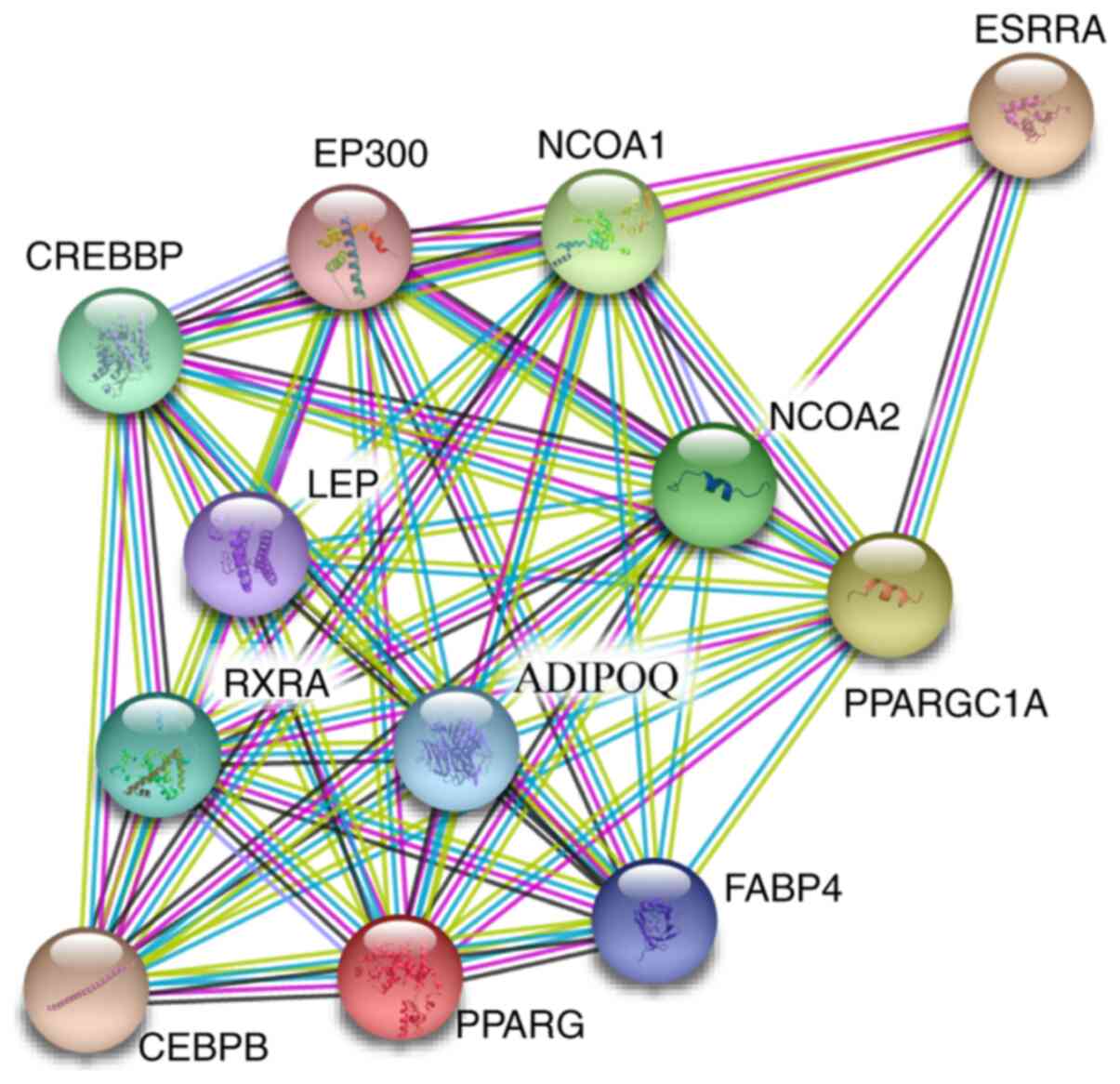
Szklarczyk D, Gable AL, Lyon D, Junge A,
Wyder S, Huerta-Cepas J, Simonovic M, Doncheva NT, Morris JH, Bork
P, et al: STRING v11: Protein-protein association networks with
increased coverage, supporting functional discovery in genome-wide
experimental datasets. Nucleic Acids Res. 47:D607–D613. 2019.
View Article : Google Scholar : PubMed/NCBI
|
|
98
|
Ijichi N, Ikeda K, Horie-Inoue K, Yagi K,
Okazaki Y and Inoue S: Estrogen-related receptor alpha modulates
the expression of adipogenesis-related genes during adipocyte
differentiation. Biochem Biophys Res Commun. 358:813–818. 2007.
View Article : Google Scholar : PubMed/NCBI
|
|
99
|
Prabhu DS and Rajeswari VD: PPAR-Gamma as
putative gene target involved in Butein mediated anti-diabetic
effect. Mol Biol Rep. 47:5273–5283. 2020. View Article : Google Scholar : PubMed/NCBI
|
|
100
|
Lebovitz HE: Thiazolidinediones: The
forgotten diabetes medications. Curr Diab Rep. 19:1512019.
View Article : Google Scholar : PubMed/NCBI
|
|
101
|
Heneka MT, Sastre M, Dumitrescu-Ozimek L,
Hanke A, Dewachter I, Kuiperi C, O'Banion K, Klockgether T, Van
Leuven F and Landreth GE: Acute treatment with the PPARgamma
agonist pioglitazone and ibuprofen reduces glial inflammation and
Abeta1-42 levels in APPV717I transgenic mice. Brain. 128:1442–1453.
2005. View Article : Google Scholar : PubMed/NCBI
|
|
102
|
Wuertz BR, Darrah L, Wudel J and Ondrey
FG: Thiazolidinediones abrogate cervical cancer growth. Exp Cell
Res. 353:63–71. 2017. View Article : Google Scholar : PubMed/NCBI
|
|
103
|
Sanghvi M, Moaddel R, Frazier C, Gandhari
M and Wainer IW: Abstract 5500: Biochromatography for the screening
of new drugs for the estrogen related receptors. Cancer Res.
70:55002010.
|