Spandidos Publications Logo
  • About
    • About Spandidos
    • Aims and Scopes
    • Abstracting and Indexing
    • Editorial Policies
    • Reprints and Permissions
    • Job Opportunities
    • Terms and Conditions
    • Contact
  • Journals
    • All Journals
    • Oncology Letters
      • Oncology Letters
      • Information for Authors
      • Editorial Policies
      • Editorial Board
      • Aims and Scope
      • Abstracting and Indexing
      • Bibliographic Information
      • Archive
    • International Journal of Oncology
      • International Journal of Oncology
      • Information for Authors
      • Editorial Policies
      • Editorial Board
      • Aims and Scope
      • Abstracting and Indexing
      • Bibliographic Information
      • Archive
    • Molecular and Clinical Oncology
      • Molecular and Clinical Oncology
      • Information for Authors
      • Editorial Policies
      • Editorial Board
      • Aims and Scope
      • Abstracting and Indexing
      • Bibliographic Information
      • Archive
    • Experimental and Therapeutic Medicine
      • Experimental and Therapeutic Medicine
      • Information for Authors
      • Editorial Policies
      • Editorial Board
      • Aims and Scope
      • Abstracting and Indexing
      • Bibliographic Information
      • Archive
    • International Journal of Molecular Medicine
      • International Journal of Molecular Medicine
      • Information for Authors
      • Editorial Policies
      • Editorial Board
      • Aims and Scope
      • Abstracting and Indexing
      • Bibliographic Information
      • Archive
    • Biomedical Reports
      • Biomedical Reports
      • Information for Authors
      • Editorial Policies
      • Editorial Board
      • Aims and Scope
      • Abstracting and Indexing
      • Bibliographic Information
      • Archive
    • Oncology Reports
      • Oncology Reports
      • Information for Authors
      • Editorial Policies
      • Editorial Board
      • Aims and Scope
      • Abstracting and Indexing
      • Bibliographic Information
      • Archive
    • Molecular Medicine Reports
      • Molecular Medicine Reports
      • Information for Authors
      • Editorial Policies
      • Editorial Board
      • Aims and Scope
      • Abstracting and Indexing
      • Bibliographic Information
      • Archive
    • World Academy of Sciences Journal
      • World Academy of Sciences Journal
      • Information for Authors
      • Editorial Policies
      • Editorial Board
      • Aims and Scope
      • Abstracting and Indexing
      • Bibliographic Information
      • Archive
    • International Journal of Functional Nutrition
      • International Journal of Functional Nutrition
      • Information for Authors
      • Editorial Policies
      • Editorial Board
      • Aims and Scope
      • Abstracting and Indexing
      • Bibliographic Information
      • Archive
    • International Journal of Epigenetics
      • International Journal of Epigenetics
      • Information for Authors
      • Editorial Policies
      • Editorial Board
      • Aims and Scope
      • Abstracting and Indexing
      • Bibliographic Information
      • Archive
    • Medicine International
      • Medicine International
      • Information for Authors
      • Editorial Policies
      • Editorial Board
      • Aims and Scope
      • Abstracting and Indexing
      • Bibliographic Information
      • Archive
  • Articles
  • Information
    • Information for Authors
    • Information for Reviewers
    • Information for Librarians
    • Information for Advertisers
    • Conferences
  • Language Editing
Spandidos Publications Logo
  • About
    • About Spandidos
    • Aims and Scopes
    • Abstracting and Indexing
    • Editorial Policies
    • Reprints and Permissions
    • Job Opportunities
    • Terms and Conditions
    • Contact
  • Journals
    • All Journals
    • Biomedical Reports
      • Information for Authors
      • Editorial Policies
      • Editorial Board
      • Aims and Scope
      • Abstracting and Indexing
      • Bibliographic Information
      • Archive
    • Experimental and Therapeutic Medicine
      • Information for Authors
      • Editorial Policies
      • Editorial Board
      • Aims and Scope
      • Abstracting and Indexing
      • Bibliographic Information
      • Archive
    • International Journal of Epigenetics
      • Information for Authors
      • Editorial Policies
      • Editorial Board
      • Aims and Scope
      • Abstracting and Indexing
      • Bibliographic Information
      • Archive
    • International Journal of Functional Nutrition
      • Information for Authors
      • Editorial Policies
      • Editorial Board
      • Aims and Scope
      • Abstracting and Indexing
      • Bibliographic Information
      • Archive
    • International Journal of Molecular Medicine
      • Information for Authors
      • Editorial Policies
      • Editorial Board
      • Aims and Scope
      • Abstracting and Indexing
      • Bibliographic Information
      • Archive
    • International Journal of Oncology
      • Information for Authors
      • Editorial Policies
      • Editorial Board
      • Aims and Scope
      • Abstracting and Indexing
      • Bibliographic Information
      • Archive
    • Medicine International
      • Information for Authors
      • Editorial Policies
      • Editorial Board
      • Aims and Scope
      • Abstracting and Indexing
      • Bibliographic Information
      • Archive
    • Molecular and Clinical Oncology
      • Information for Authors
      • Editorial Policies
      • Editorial Board
      • Aims and Scope
      • Abstracting and Indexing
      • Bibliographic Information
      • Archive
    • Molecular Medicine Reports
      • Information for Authors
      • Editorial Policies
      • Editorial Board
      • Aims and Scope
      • Abstracting and Indexing
      • Bibliographic Information
      • Archive
    • Oncology Letters
      • Information for Authors
      • Editorial Policies
      • Editorial Board
      • Aims and Scope
      • Abstracting and Indexing
      • Bibliographic Information
      • Archive
    • Oncology Reports
      • Information for Authors
      • Editorial Policies
      • Editorial Board
      • Aims and Scope
      • Abstracting and Indexing
      • Bibliographic Information
      • Archive
    • World Academy of Sciences Journal
      • Information for Authors
      • Editorial Policies
      • Editorial Board
      • Aims and Scope
      • Abstracting and Indexing
      • Bibliographic Information
      • Archive
  • Articles
  • Information
    • For Authors
    • For Reviewers
    • For Librarians
    • For Advertisers
    • Conferences
  • Language Editing
Login Register Submit
  • This site uses cookies
  • You can change your cookie settings at any time by following the instructions in our Cookie Policy. To find out more, you may read our Privacy Policy.

    I agree
Search articles by DOI, keyword, author or affiliation
Search
Advanced Search
presentation
Oncology Letters
Join Editorial Board Propose a Special Issue
Print ISSN: 1792-1074 Online ISSN: 1792-1082
Journal Cover
March 2013 Volume 5 Issue 3

Full Size Image

Sign up for eToc alerts
Recommend to Library

Journals

International Journal of Molecular Medicine

International Journal of Molecular Medicine

International Journal of Molecular Medicine is an international journal devoted to molecular mechanisms of human disease.

International Journal of Oncology

International Journal of Oncology

International Journal of Oncology is an international journal devoted to oncology research and cancer treatment.

Molecular Medicine Reports

Molecular Medicine Reports

Covers molecular medicine topics such as pharmacology, pathology, genetics, neuroscience, infectious diseases, molecular cardiology, and molecular surgery.

Oncology Reports

Oncology Reports

Oncology Reports is an international journal devoted to fundamental and applied research in Oncology.

Experimental and Therapeutic Medicine

Experimental and Therapeutic Medicine

Experimental and Therapeutic Medicine is an international journal devoted to laboratory and clinical medicine.

Oncology Letters

Oncology Letters

Oncology Letters is an international journal devoted to Experimental and Clinical Oncology.

Biomedical Reports

Biomedical Reports

Explores a wide range of biological and medical fields, including pharmacology, genetics, microbiology, neuroscience, and molecular cardiology.

Molecular and Clinical Oncology

Molecular and Clinical Oncology

International journal addressing all aspects of oncology research, from tumorigenesis and oncogenes to chemotherapy and metastasis.

World Academy of Sciences Journal

World Academy of Sciences Journal

Multidisciplinary open-access journal spanning biochemistry, genetics, neuroscience, environmental health, and synthetic biology.

International Journal of Functional Nutrition

International Journal of Functional Nutrition

Open-access journal combining biochemistry, pharmacology, immunology, and genetics to advance health through functional nutrition.

International Journal of Epigenetics

International Journal of Epigenetics

Publishes open-access research on using epigenetics to advance understanding and treatment of human disease.

Medicine International

Medicine International

An International Open Access Journal Devoted to General Medicine.

Journal Cover
March 2013 Volume 5 Issue 3

Full Size Image

Sign up for eToc alerts
Recommend to Library

  • Article
  • Citations
    • Cite This Article
    • Download Citation
    • Create Citation Alert
    • Remove Citation Alert
    • Cited By
  • Similar Articles
    • Related Articles (in Spandidos Publications)
    • Similar Articles (Google Scholar)
    • Similar Articles (PubMed)
  • Download PDF
  • Download XML
  • View XML
Article

Rapid long-lasting biochemical and radiological response to sorafenib in a case of advanced hepatocellular carcinoma

  • Authors:
    • Assunta Maria Teresa Gerardi
    • Luca Pio Stoppino
    • Arcangelo Liso
    • Luca Macarini
    • Matteo Landriscina
  • View Affiliations / Copyright

    Affiliations: Unit of Clinical Oncology, Department of Medical and Surgical Sciences, University of Foggia, Foggia I-71100, Italy, Unit of Radiology, Department of Medical and Surgical Sciences, University of Foggia, Foggia I-71100, Italy, Unit of Hematology, Department of Medical and Surgical Sciences, University of Foggia, Foggia I-71100, Italy
  • Pages: 975-977
    |
    Published online on: January 11, 2013
       https://doi.org/10.3892/ol.2013.1131
  • Expand metrics +
Metrics: Total Views: 0 (Spandidos Publications: | PMC Statistics: )
Metrics: Total PDF Downloads: 0 (Spandidos Publications: | PMC Statistics: )
Cited By (CrossRef): 0 citations Loading Articles...

This article is mentioned in:


Abstract

The multikinase inhibitor sorafenib has demonstrated an overall survival benefit in phase III hepatocellular carcinoma (HCC) trials and has become the new standard of care for advanced stages of this disease. However, in clinical practice, the vast majority of patients obtain disease stabilization and occasionally tumor shrinkage. Furthermore, the appropriate timing of sorafenib therapy initiation, in order to maximize its clinical activity, remains under debate. We report a case of 4‑year sorafenib treatment in a patient with an advanced hepatitis C virus (HCV)‑related HCC with extensive infiltration of the inferior vena cava. Sorafenib treatment induced a rapid complete biochemical response and a long-term favorable outcome. Additionally, no major toxicities or detrimental effects on quality of life were observed. Thus, it is likely that a subgroup of human HCC may be highly sensitive to sorafenib; new molecular determinants are required to select those patients who may benefit from this therapy. Furthermore, a prompt initiation of treatment when the hepatic function is not compromised is a prerequisite for maximizing the clinical activity of sorafenib.

Introduction

Sorafenib is an oral multikinase inhibitor that is clinically active in advanced hepatocellular carcinoma (HCC) and is the present standard of care in the advanced stage of this particular malignancy. The analysis of sorafenib activity in two phase III placebo-controlled clinical trials undertaken in patients with advanced HCC in Western countries (the Sharp trial) and in the Asia-Pacific area, demonstrated that sorafenib induces an overall survival benefit that typically involves disease stabilization, whereas objective responses are rare (1–2). Herein, we report a case of an advanced hepatitis C virus (HCV)-related HCC with extensive infiltration of the inferior vena cava (BCLC stage C), which demonstrated a rapid complete biochemical response and a long-term favorable outcome with prolonged sorafenib treatment. Written informed consent was obtained from the patient.

Case report

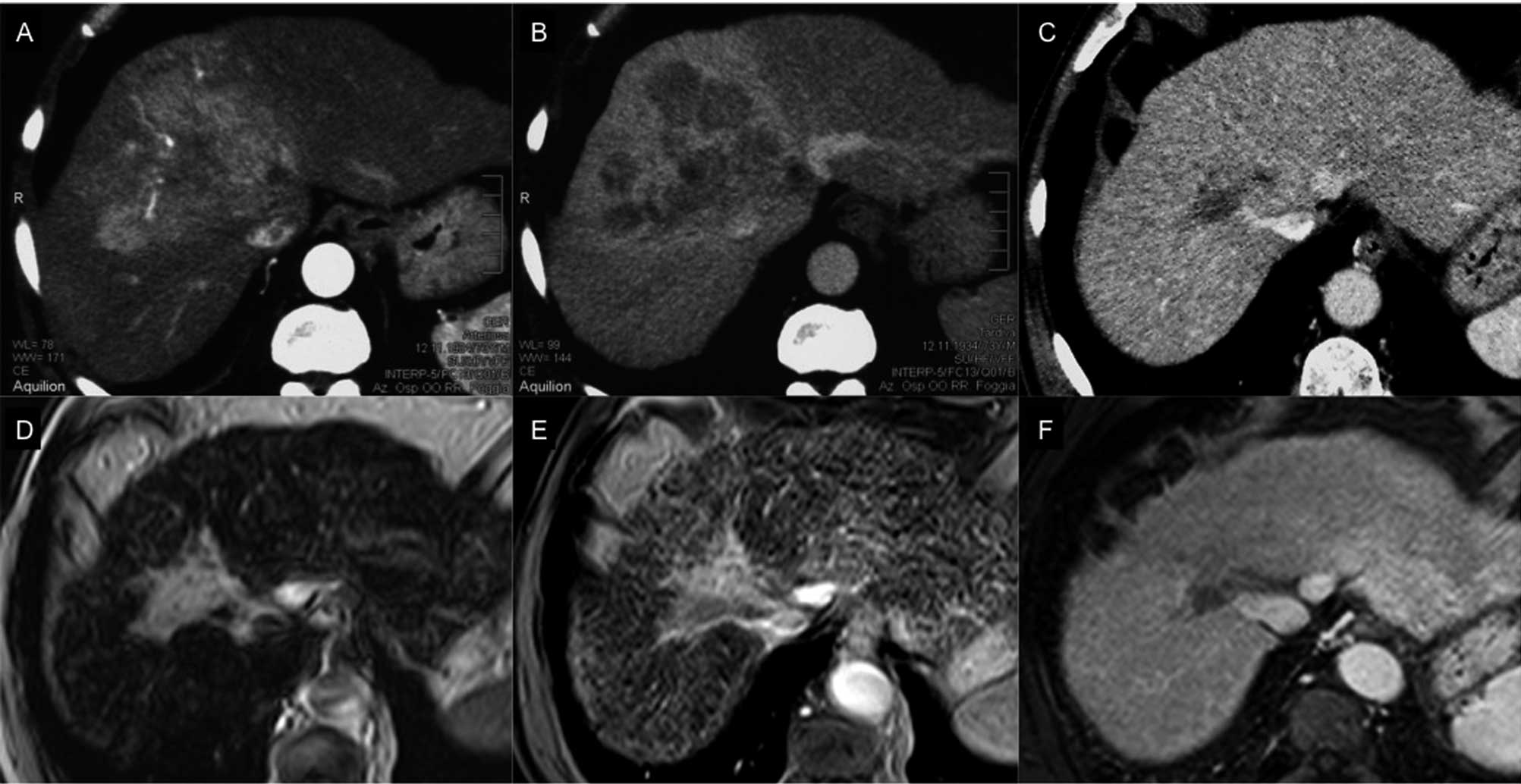
In January 2007, a 72-year-old man with a clinical history of HCV-related hepatopathy was diagnosed with HCC. A computed tomography (CT) scan revealed a lesion of 1.5 cm in diameter in hepatic segment VIII with contrast enhancement in arterial phase (BCLC stage A, Child-Pugh A). Additionally, the patient’s α-fetoprotein (αFP) serum level was 487.3 ng/ml. Between March and November 2007, the patient was treated with 4 courses of percutaneous ethanol injections, which demonstrated an initial, but transitory, clinical benefit. In February 2008, the patient was referred to the Unit of Clinical Oncology, Department of Medical and Surgical Sciences (Foggia, Italy) due to rapid progression of the disease. The CT scan revealed a large mass (8.6 cm in diameter) in hepatic segment VIII, which was formed by multiple confluent nodules, infiltrating the inferior vena cava, altering the liver border and exhibiting typical arterial contrast enhancement (Figs. 1A and B). A chest CT scan did not detect extrahepatic metastasis. Based on these features, the malignancy was classified as BCLC stage C. The hepatic function was well-retained, with no clinical signs of liver dysfunction (Child-Pugh A) and an αFP serum level of 179.674 ng/ml.

Figure 1

(A and B) Axial computed tomography (CT) scans at the baseline in arterial (A) and delayed (B) phases revealing a hypervascular mass in hepatic segment VIII. (C) Axial CT scan following 30 months of sorafenib therapy in the portal venous phase, revealing a hypodense lesion with a significant size reduction. (D and E) Double-contrast MRI scan following 35 months of sorafenib therapy, revealing a barely hyperintense lesion in a T2-weighted image after hepato-specific superparamagnetic iron oxide (SPIO) contrast agent administration (D) and a homogeneous lesion enhancement in a T1-weighted image after gadolinium administration (E), resembling fibrotic tissue. (F) MRI performed after 48 months of therapy, revealing substantial stability of the disease in a T1-weighted image following gadolinium administration.

As it was not possible to further use locoregional therapies, treatment with sorafenib (400 mg twice a day) was inititated. Notably, a rapid and sustained decrease in αFP serum level was observed with a normalization of the serum value (6.1 ng/ml) evident within 3 months of therapy. By contrast, the liver imaging showed an initial disease stabilization and, thereafter, a slow but progressive tumor shrinkage. Upon hepatic ultrasonography and CT scan the neoplastic lesion measured 7.4 cm in October 2008 (following 6 months of therapy), 5.3 cm in June 2009 and 4.0 cm in September 2010 (Fig. 1C). A double-contrast magnetic resonance imaging (MRI) scan with sequential use of hepato-specific superparamagnetic iron oxide (SPIO) and paramagnetic (gadolinium) contrast agents was performed in February 2011, revealing an area with slight signs of vascularization in hepatic segment VIII that resembled fibrotic tissue (Figs. 1D and E). Sorafenib was well-tolerated and the patient only presented with a grade 2 (NCI-CTCAE v3.0) hand-foot skin reaction, which was managed with urea cream; a grade 1–2 asthenia and occasional grade 2 hematological toxicities (leucopenia and thrombocytopenia), which were managed by 1–2 weeks of drug interruption. After 4 years, the patient has remained under sorafenib therapy, while αFP serum levels have remained within the normal range and radiological imaging has not exhibited any signs of disease progression (Fig. 1F).

Discussion

Two issues are of particular significance in the present case report: i) the rapid biochemical complete response, followed by a slow but progressive and long-lasting tumor shrinkage; and ii) the lack of major toxicities, despite 4 years of essentially uninterrupted treatment. Sorafenib is the only molecular-targeted agent that has demonstrated a clinical benefit in phase III studies in advanced HCC (1–2). However, under sorafenib therapy, the majority of patients demonstrate disease stabilization, while tumor shrinkage is a less commom occurrence. Complete responses have not been noted in phase III clinical trials (1–2), while a number of recent studies have described major responses to sorafenib (3–7). Concordant with recent literature, the present case report suggests that a subset of HCCs may be particularly responsive to sorafenib and may undergo long-lasting tumor shrinkage. Thus, molecular determinants of susceptibility to sorafenib are required, in order to select patients that are more likely to benefit from this molecular-targeted agent and prolonged treatment. In this regard, we hypothesize that a rapid normalization of αFP serum levels may represent a surrogate marker of sensitivity to sorafenib. This hypothesis is concordant with recent reports demonstrating that the αFP response is a statistically significant prognostic factor for survival in HCC patients treated with sorafenib (8–9). Thus, early evaluation of αFP may be regarded as a reliable alternative to response evaluation criteria in solid tumors (RECIST) to capture sorafenib activity in HCC.

Notably, no major life-threatening toxicities or detrimental effects on quality of life were observed in the present case report, despite the 4 years of essentially uninterrupted treatment. This result is even more significant considering that the median duration of treatment in the phase III Sharp trial was 5.3 months (range 0.2–16.1) (1). A prompt initiation of sorafenib therapy, when the hepatic function has not yet been compromised, and an optimal management of side effects represent two prerequisites to allow a safe and, in the case of demonstrated efficacy, prolonged treatment for HCC patients. Consistently, recent studies have highlighted the importance of prolonged sorafenib administration, even at reduced doses, and personalized toxicity management to achieve tumor responses to sorafenib therapy (10).

References

1 

Llovet JM, Ricci S, Mazzaferro V, Hilgard P, Gane E, Blanc JF, de Oliveira AC, Santoro A, Raoul JL, Forner A, Schwartz M, et al SHARP Investigators Study Group: Sorafenib in advanced hepatocellular carcinoma. N Engl J Med. 359:378–390. 2008. View Article : Google Scholar : PubMed/NCBI

2 

Cheng AL, Kang YK, Chen Z, Tsao CJ, Qin S, Kim JS, Luo R, Feng J, Ye S, Yang TS, Xu J, et al: Efficacy and safety of sorafenib in patients in the Asia-Pacific region with advanced hepatocellular carcinoma: a phase III randomised, double-blind, placebo-controlled trial. Lancet Oncol. 10:25–34. 2009. View Article : Google Scholar : PubMed/NCBI

3 

Nakazawa T, Hidaka H, Shibuya A and Koizumi W: Rapid regression of advanced hepatocellular carcinoma associated with elevation of des-gamma-carboxy prothrombin after short-term treatment with sorafenib - a report of two cases. Case Rep Oncol. 3:298–303. 2010. View Article : Google Scholar

4 

Di Lorenzo G, Imbimbo M, Leopardo D, Marciano R, Federico P, Buonerba C, Salvatore B, Marinelli A and Palmieri G: A long-lasting response to sorafenib treatment in an advanced hepatocellular carcinoma patient. Int J Immunopathol Pharmacol. 23:951–954. 2010.PubMed/NCBI

5 

Chelis L, Ntinos N, Souftas V, Deftereos S, Xenidis N, Chamalidou E, Maltezos E and Kakolyris S: Complete response after sorafenib therapy for hepatocellular carcinoma in an HIV-HBV co-infected patient: Possible synergy with HAART? A case report Med Oncol. 28:S165–S168. 2010.PubMed/NCBI

6 

Inuzuka T, Nishikawa H, Sekikawa A, Takeda H, Henmi S, Sakamoto A, Saito S, Kita R, Kimura T, Osaki Y and Kudo M: Complete response of advanced hepatocellular carcinoma with multiple lung metastases treated with sorafenib: a case report. Oncology. 81:152–157. 2011. View Article : Google Scholar : PubMed/NCBI

7 

Sacco R, Bargellini I, Gianluigi G, Bertini M, Bozzi E, Altomare E, Battaglia V, Romano A, Bertoni M, Capria A, Bresci G, et al: Complete response for advanced liver cancer during sorafenib therapy: case report. BMC Gastroenterol. 11:42011. View Article : Google Scholar : PubMed/NCBI

8 

Yau T, Yao TJ, Chan P, Wong H, Pang R, Fan ST and Poon RT: The significance of early α-fetoprotein level changes in predicting clinical and survival benefits in advanced hepatocellular carcinoma patients receiving sorafenib. Oncologist. 16:1270–1279. 2011.

9 

Personeni N, Bozzarelli S, Pressiani T, Rimassa L, Tronconi MC, Sclafani F, Carnaghi C, Pedicini V, Giordano L and Santoro A: Usefulness of alpha-fetoprotein response in patients treated with sorafenib for advanced hepatocellular carcinoma. J Hepatol. 57:101–107. 2012. View Article : Google Scholar : PubMed/NCBI

10 

Abbadessa G, Rimassa L, Pressiani T, Carrillo-Infante C, Cucchi E and Santoro A: Optimized management of advanced hepatocellular carcinoma: four long-lasting responses to sorafenib. World J Gastroenterol. 17:2450–2453. 2011. View Article : Google Scholar : PubMed/NCBI

Related Articles

  • Abstract
  • View
  • Download
  • Twitter
Copy and paste a formatted citation
Spandidos Publications style
Gerardi AM, Stoppino LP, Liso A, Macarini L and Landriscina M: Rapid long-lasting biochemical and radiological response to sorafenib in a case of advanced hepatocellular carcinoma. Oncol Lett 5: 975-977, 2013.
APA
Gerardi, A.M., Stoppino, L.P., Liso, A., Macarini, L., & Landriscina, M. (2013). Rapid long-lasting biochemical and radiological response to sorafenib in a case of advanced hepatocellular carcinoma. Oncology Letters, 5, 975-977. https://doi.org/10.3892/ol.2013.1131
MLA
Gerardi, A. M., Stoppino, L. P., Liso, A., Macarini, L., Landriscina, M."Rapid long-lasting biochemical and radiological response to sorafenib in a case of advanced hepatocellular carcinoma". Oncology Letters 5.3 (2013): 975-977.
Chicago
Gerardi, A. M., Stoppino, L. P., Liso, A., Macarini, L., Landriscina, M."Rapid long-lasting biochemical and radiological response to sorafenib in a case of advanced hepatocellular carcinoma". Oncology Letters 5, no. 3 (2013): 975-977. https://doi.org/10.3892/ol.2013.1131
Copy and paste a formatted citation
x
Spandidos Publications style
Gerardi AM, Stoppino LP, Liso A, Macarini L and Landriscina M: Rapid long-lasting biochemical and radiological response to sorafenib in a case of advanced hepatocellular carcinoma. Oncol Lett 5: 975-977, 2013.
APA
Gerardi, A.M., Stoppino, L.P., Liso, A., Macarini, L., & Landriscina, M. (2013). Rapid long-lasting biochemical and radiological response to sorafenib in a case of advanced hepatocellular carcinoma. Oncology Letters, 5, 975-977. https://doi.org/10.3892/ol.2013.1131
MLA
Gerardi, A. M., Stoppino, L. P., Liso, A., Macarini, L., Landriscina, M."Rapid long-lasting biochemical and radiological response to sorafenib in a case of advanced hepatocellular carcinoma". Oncology Letters 5.3 (2013): 975-977.
Chicago
Gerardi, A. M., Stoppino, L. P., Liso, A., Macarini, L., Landriscina, M."Rapid long-lasting biochemical and radiological response to sorafenib in a case of advanced hepatocellular carcinoma". Oncology Letters 5, no. 3 (2013): 975-977. https://doi.org/10.3892/ol.2013.1131
Follow us
  • Twitter
  • LinkedIn
  • Facebook
About
  • Spandidos Publications
  • Careers
  • Cookie Policy
  • Privacy Policy
How can we help?
  • Help
  • Live Chat
  • Contact
  • Email to our Support Team