Introduction
Tongue squamous cell carcinoma (TSCC) is
significantly more aggressive compared with other forms of oral
cancer, with a propensity for rapid local invasion and spread, and
a high recurrence rate (1). TSCC is
characterized by genetic instabilities, including frequent loss of
heterozygosity (LOH) at the chromosomal region 8p21.3-p22 (2). Microtubule-associated tumor suppressor
gene (MTUS1) is one of the candidate tumor suppressor genes that
reside in this chromosomal region. In our previous study using
single-nucleotide polymorphism (SNP) array-based LOH profiling on a
large panel of oral cancer cell lines, a frequent LOH region was
identified at 8p22-p21.3, a region containing the MTUS1 gene, which
was initially identified as a potential tumor suppressor gene in
pancreatic cancer (2).
MTUS1 has been identified as an 8p22 candidate tumor
suppressor gene encoding a family of angiotensin II type 2 (AT2)
receptor-interacting proteins (ATIPs). Alternative exon utilization
of this gene leads to five known transcript variants that code for
five different protein isoforms, namely ATIP1, ATIP2, ATIP3a,
ATIP3b and ATIP4 (3,4). The ATIP polypeptides exhibit distinct
motifs in the amino-terminus for localization to the cytosol,
nucleus or cell membrane (ATIP1, ATIP3 and ATIP4, respectively),
suggesting that MTUS1 gene products may be involved in a variety of
intracellular functions in an AT2-dependent and -independent manner
(3,4).
The downregulation of the MTUS1 gene has been
documented in a number of cancer types (5–10); among
the five isoforms, ATIP1 and ATIP3a have been found to have a tumor
suppressor function (6,7). Xiao et al (11) found that MTUS1 expression was
correlated with tumor grade, stage, size and number in bladder
cancer, and patients with low levels of MTUS1 mRNA expression had a
poor prognosis compared with those exhibiting high MTUS1
expression. Our previous study also suggested that downregulation
of MTUS1/ATIP was a frequent event in TSCC and premalignant
lesions, e.g., leukoplakia. The downregulation of MTUS1/ATIP was
also correlated with poor differentiation and reduced overall
survival (12,13). ATIP1 and ATIP3a were found to be the
major isoforms produced by the MTUS1 gene in epithelial cells of
the tongue and were significantly downregulated in TSCC tissues
(13). Restoration of ATIP1
expression led to G1 arrest, apoptosis and reduced cell
proliferation in TSCC cell lines (13).
The present study further investigated the role of
ATIP3a in TSCC. First, the antiproliferative effect of ATIP3a in
TSCC was observed. Subsequently, the role of ATIP3a in the
migration and invasion of TSCC cells and the involvement of
extracellular signal-regulated kinase 1/2 (ERK1/2)-Snai2 signaling
induced by ATIP3a was investigated. The aim of this study was to
elucidate the role of MTUS1/ATIP3a in the suppression of
proliferation, migration and invasion of TSCC cells via the
ERK1/2-Snai2 pathway. The current study was approved by the Medical
Ethics Committee of the First Affiliated Hospital of Sun Yat-Sen
University (Guangzhou, China).
Materials and methods
Cell culture and transfections
Human TSCC cell lines (UM1 and UM2) were provided by
Dr. Tomohiro Matsumura (Department of Oral and Maxillofacial
Surgery II, Okayama University Dental School, Okayama, Japan). The
cells were maintained in Dulbecco's modified Eagle's medium/F12
(Gibco; Thermo Fisher Scientific, Grand Island, NY, USA) containing
10% fetal bovine serum, 1,000 U/ml penicillin and 500 µg/ml
streptomycin [all obtained from (Gibco) Thermo Fisher Scientific]
in a 37°C incubator with 5% CO2. UM1 and UM2 are paired
cell lines from a single TSCC patient, with UM1 being more
aggressive compared with UM2 in terms of cell migration and
invasion (14). The expression vector
containing the coding sequence of human ATIP3a was a gift from Dr.
Clara (Cochin Institute, University Paris Descartes, Paris, France)
(7). For functional analyses, the
ATIP3a expression vector or empty vector (pCDNA3; Invitrogen;
Thermo Fisher Scientific), gene-specific small interfering RNA
(siRNA) for ATIP3a and control non-targeting siRNA (GenePharma Co.,
Ltd., Shanghai, China) were transfected into the appropriate cells
using Lipofectamine® Transfection Reagent (Invitrogen; Thermo
Fisher Scientific) according to the manufacturer's protocol. The
three sequences of the ATIP3a siRNA are presented in Table I.
 | Table I.Sequences of siRNA used for
transfection. |
Table I.
Sequences of siRNA used for
transfection.
| Type of siRNA | Sequence |
|---|
| ATIP3a siRNA |
|
| No.
1 |
|
|
Sense |
5′-GGGUAAUCGAGGGCUUAAATT-3′ |
|
Antisense |
5′-UUUAAGCCCUCCAUUACCCTT-3′ |
| No.
2 |
|
|
Sense |
5′-GCCCAAGACAUGACUUACATT-3′ |
|
Antisense |
5′-UGUAAGUCAUGUCUUGGGCTT-3′ |
| No.
3 |
|
|
Sense |
5′-GGUGUUAGAUAUGCAUAAATT-3′ |
|
Antisense |
5′-UUUAUGCAUAUCUAACACCTT-3′ |
| Control siRNA |
|
|
Sense |
5′-UUCUUCGAACGUGUCACGUTT-3′ |
|
Antisense |
5′-ACGUGACACGUUCGGAGAATT-3′ |
Cell proliferation assays
Proliferation was measured using an MTT assay, as
previously described (13). In brief,
the cells were seeded in 96-well plates at a density of
5×10³ cells per well. Cell proliferation was analyzed
after 24 or 48 h by incubating the cells with 1 mg/ml MTT
tetrazolium salt (Sigma-Aldrich, St. Louis, MO, USA). Absorbance
(A) at 570 nm was measured and the cell inhibition rate was
calculated as follows: (1-Atreated/Acontrol)
× 100%.
Cell migration assay
Cell migration was measured using a Transwell® assay
as previously described (14) with BD
BioCoat Control Cell Culture Inserts containing an 8.0-µm
polyethylene terephthalate membrane without matrix (BD Biosciences,
Bedford, MA, USA). In brief, the cells were seeded in the upper
chamber of the Transwell® plates. After 24 h, the cells on the
lower surface of the membrane were fixed and stained with DAPI
solution in the dark. Three random fields were captured under a
light microscope (magnification, ×20; DMI3000B; Leica, Wetzlar,
Germany) and the number of cells on the bottom surface was compared
between the groups.
Cell invasion assay
Cell invasion was measured by the Transwell® assay
as previously described (14), using
BD BioCoat BD Matrigel™ Invasion Chamber containing a layer of BD
Matrigel™ Basement Membrane Matrix (BD Biosciences). In brief, the
cells were seeded in the upper Boyden chambers of the cell culture
inserts. After 24 h of incubation, cells remaining in the upper
chamber or on the upper membrane were carefully removed. Cells
adhering to the lower membrane were stained with DAPI solution.
Three random fields were captured under a light microscope
(magnification, ×20; DMI3000B; Leica) and the number of cells on
the bottom surface was compared between the groups.
Western blot analysis
Western blot analysis was performed to detect the
levels of ERK1/2 [mouse anti-human monoclonal antibody (mAb);
1:1,000; cat. no. 4396], phosphorylated-ERK1/2 (p-ERK1/2; rabbit
anti-human mAb; 1:1,000; cat. no. 4376), Snai2 (rabbit anti-human
mAb; 1,000; cat. no. 9858), vimentin (mouse anti-human mAb;
1:1,000; cat. no. 3390), E-cadherin (rabbit anti-human mAb; 1,000;
cat. no. 3195), GAPDH (rabbit anti-human mAb; 1:1,000; cat. no.
5174) (all from Cell Signaling Technology, Beverly, MA, USA), and
MTUS1 (mouse anti-human mAb; 1:1,000; cat. no. H00057509-M01;
Abnova, Taipei, Taiwan) in TSCC cells. The cells were lysed with a
radioimmunoprecipitation assay lysis buffer (Santa Cruz
Biotechnology, Inc., Santa Cruz, CA, USA). Aliquots (30–50 µg) of
cellular proteins were resolved by 10% SDS-PAGE, electrotransferred
onto polyvinylidene difluoride membranes and immunoprobed. The
protein/antibody complexes were detected by chemiluminescence (CSPD
chemiluminescent substrate; Tropix, Bedford, MA, USA) according to
the manufacturer's protocol. The same blots were used for analysis
of the loading control, GAPDH, following stripping of the
membrane.
Statistical analysis
All the experiments were performed in triplicate,
and the data are presented as means ± standard deviation. Student's
t-tests were used to compare the differences between the groups.
For all the statistical analyses, P<0.05 was considered to
indicate statistically significant differences.
Results
ATIP3a inhibits the proliferation of
TSCC cells
The MTT assay was employed to evaluate the
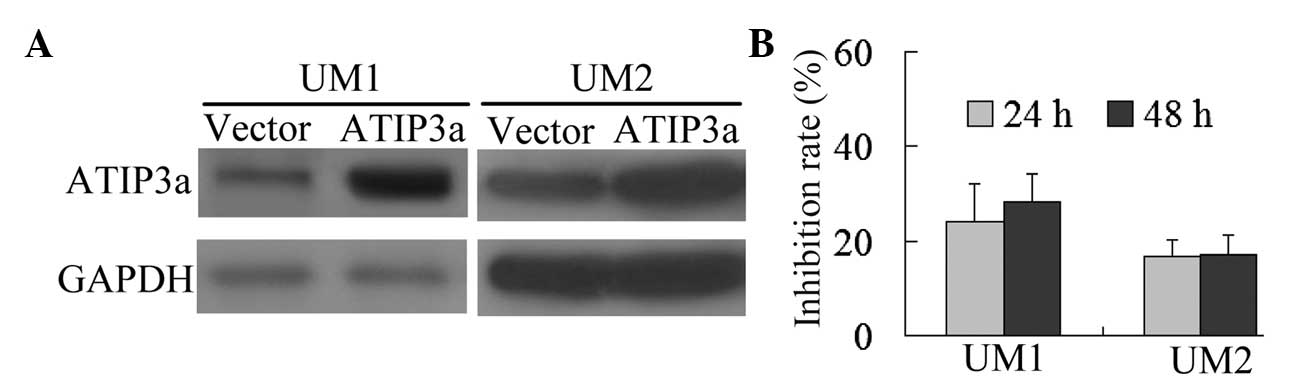
antiproliferative effect of ATIP3a in TSCC. As shown in Fig. 1A, ATIP3a was overexpressed in UM1 and
UM2 cells following transfection. When UM1 or UM2 cells were
transfected with ATIP3a expression vector, a statistically
significant inhibition in cell proliferation was observed when
compared with the cells transfected with the empty vector (Fig. 1B). The inhibition rate of ATIP3a was
~24.1% (24 h) and 28.3% (48 h) in UM1 cells, and ~16.9% (24 h) and
17.1% (48 h) in UM2 cells. The antiproliferative effect of ATIP3a
did not differ between 24 and 48 h of transfection. These results
suggest that ATIP3a possesses significant antiproliferative
activity against TSCC.
ATIP3a is associated with inhibition
of migration and invasion of TSCC cells
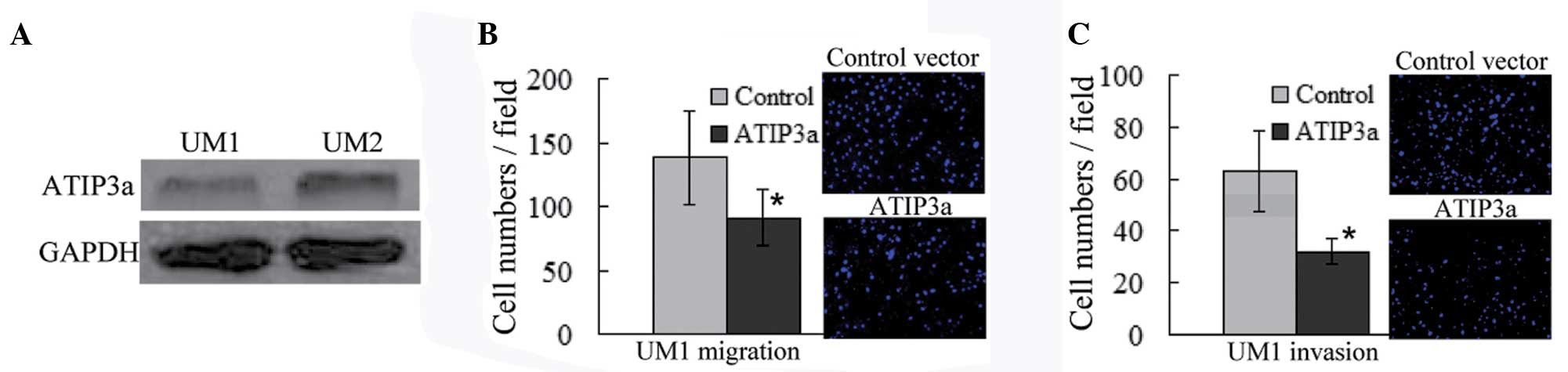
As shown in Fig. 2A,
the protein levels of ATIP3a in UM2 cells were higher compared with
those of UM1 cells, which normally have a higher migration and
invasion ability compared with UM2 cells (14,15). To
evaluate the association between ATIP3a and the migration and
invasion ability of TSCC cells, UM1 cells were first transfected
with ATIP3a. As shown in Fig. 2B and
C, the migration and invasion ability of the UM1 cells was
significantly inhibited following transfection with ATIP3a. ATIP3a
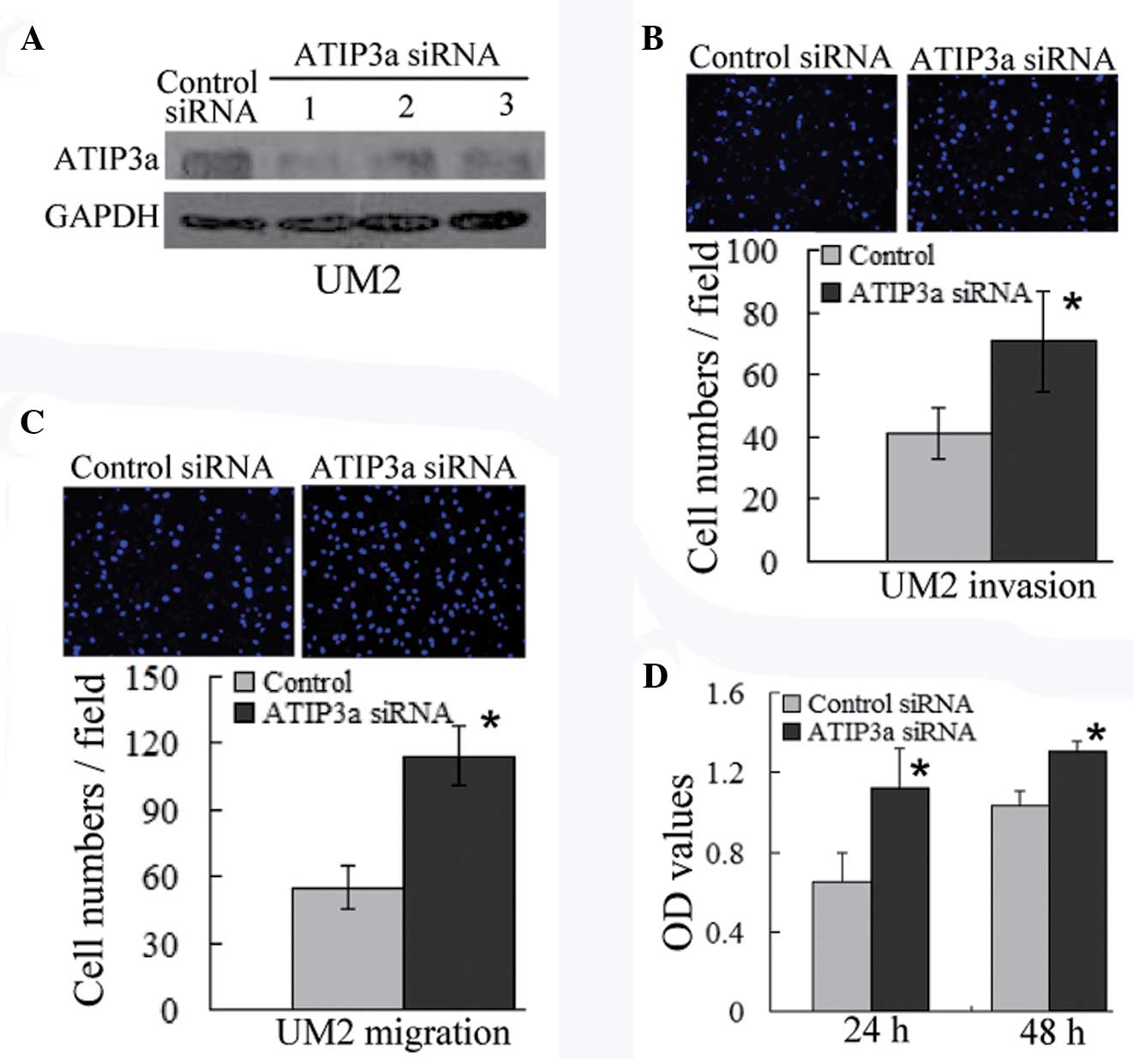
was subsequently knocked down by RNA interference in UM2 cells. As
shown in Fig. 3A, the protein level
of ATIP3a in UM2 cells was significantly decreased following
transfection with ATIP3a siRNA. Among the three sequences of ATIP3a
siRNA, sequence no. 1 exhibited the greatest silencing effect
(Fig. 3A); therefore this sequence
was selected for the following experiment. UM2 cells transfected
with ATIP3a siRNA displayed significantly increased migration and
invasion ability compared with the control siRNA-transfected UM2
cells (Fig. 3B and C). Furthermore,
it was observed that ATIP3a siRNA promoted the proliferation of UM2
cells (Fig. 3D). These results
indicate that ATIP3a is associated with inhibition of migration and
invasion of TSCC cells.
ATIP3a regulates the ERK-Snai2 pathway
in TSCC cells
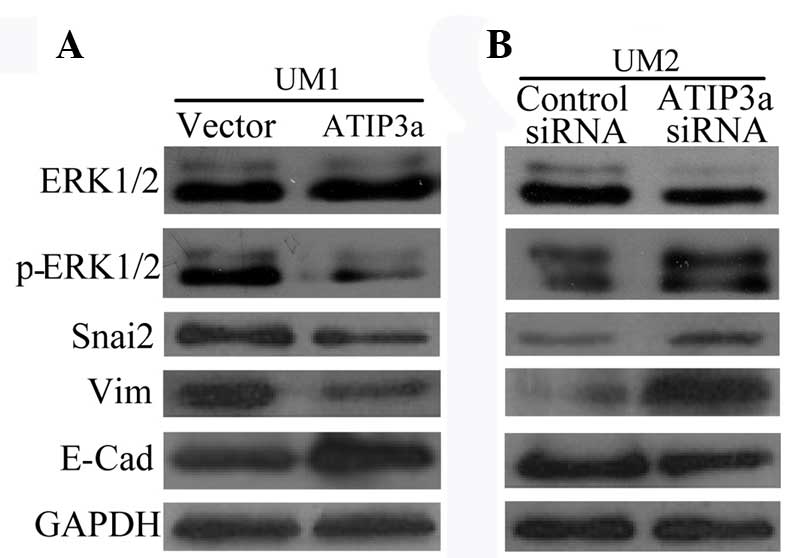
As shown in Fig. 4A,
the ectopic expression of ATIP3a in UM1 cells led to an increase in
ERK1/2 and E-cadherin and a notable decrease in p-ERK1/2, Snai2 and
vimentin. However, following knockdown of ATIP3a in UM2 cells, the
protein levels of p-ERK1/2, Snai2 and vimentin were markedly
increased and the protein levels of ERK1/2 and E-cadherin were
markedly decreased (Fig. 4B). These
results indicate that the ERK1/2-Snai2 pathway contributes to
ATIP3a-induced inhibition of proliferation, migration and invasion
of TSCC cells.
Discussion
MTUS1/ATIP is one of the candidate tumor suppressor
genes located in the chromosomal region 8p22-p21.3, which was
identified in our previous study as one of the most frequent LOH
(87.9%) sites in oral cancer (2).
Numerous studies have demonstrated that the deregulation of
MTUS1/ATIP is associated with several types of cancer (5–11,13), including hepatocellular, bladder,
breast, colon, prostate and head and neck cancer. Our previous
studies also demonstrated that the reduction of MTUS1 expression
was associated with the development and prognosis of TSCC (2,12,13) and revealed that ATIP1 and ATIP3a were
the major isoforms of MTUS1 and were significantly decreased in
TSCC. Restoring ATIP1 expression in TSCC cell lines induced
G1/G0 arrest and reduced cell
proliferation.
ATIP3a polypeptides contain a nuclear localization
signal in their amino-terminus and may not colocalize with the
seven-transmembrane domain AT2 receptor inside the cell, suggesting
AT2-independent roles for ATIP3 proteins in the majority of
tissues. Rodrigues-Ferreira et al (7) found that restoring ATIP3 expression in
breast cancer led to reduced cancer cell proliferation,
clonogenicity and anchorage-independent growth and reduced the
incidence and size of xenografts grown in vivo. Molina et
al (16) also found that ATIP3a
was associated with reduced cancer cell proliferation and
metastasis. ATIP3a silencing promoted breast cancer cell migration,
whereas ATIP3a expression significantly reduced cell motility and
directionality. The present study also demonstrated that ATIP3a
overexpression in TSCC cells significantly inhibited their
proliferation and that ATIP3a overexpression suppressed the
migration and invasion ability of UM1 cells, whereas knockdown of
ATIP3a promoted the migration and invasion ability of UM2 cells.
All these results indicate that ATIP3a plays an important role in
the proliferation, migration and invasion of TSCC cells.
ATIP3a has been shown to be associated with the
microtubule cytoskeleton and localizes at the centrosomes, mitotic
spindle and intercellular bridge during cell division. ATIP3a
expression alters the progression of cell division by promoting
prolonged metaphase, thereby leading to a reduced number of cells
undergoing active mitosis (7). To
date, the knowledge of ATIP-regulated molecular pathways is
relatively limited. The ERK signaling pathway has been found to
play a crucial role in almost all cell functions (17). ERK2⁄ERK1 are two isoforms of ERK that
belong to the family of mitogen-activated protein kinases (MAPKs).
ATIP1 was previously shown to be involved in the inhibition of the
ERK pathway (6,13,18,19). The
present study also demonstrated that ATIP3a is involved in the
inhibition of ERK1/2 activity. The protein level of p-ERK1/2 was
found to be significantly reduced in UM1 cells following
transfection with ATIP3a, and increased in ATIP3a siRNA-transfected
UM2 cells.
It was recently reported that hundreds of proteins
are under ERK-dependent control (20). Snai2 belongs to the Snail family of
zinc-finger transcription factors, and is a well-established
downstream target of the MAPK/ERK pathway in a number of cell types
(21,22). Our previous study (23) demonstrated that the MAPK-Snai2 pathway
played an important role in salivary adenoid cystic carcinoma
(SACC) metastasis. Snai2 is a downstream target of MAPK1 (ERK2);
siRNA-mediated ERK2-knockdown suppressed Snai2 gene promoter
activity and reduced the Snai2 protein level in SACC cells
(23). Snail family genes are also
best known for their role in epithelial-to-mesenchymal transition
(EMT) (24). In several types of
human cancer, there is an inverse association between E-cadherin
and Snail gene family expression (22,25,26). Wang
et al (27) confirmed that
Snai2 overexpression was correlated with reduced E-cadherin
expression and enhanced vimentin expression in two independent
cohorts of TSCC patients. In vitro, knockdown of Snai2
suppressed cell invasion and migration; by contrast, ectopic
transfection of Snai2 led to enhanced cell invasion and migration
(27). Our previous studies (14,15) also
revealed that p-ERK1/2, Snai2 and vimentin exhibited higher
expression levels and E-cadherin lower expression levels in UM1
cells compared with UM2 cells. The present study demonstrated that
the overexpression of ATIP3a in UM1 cells led to an increase in
ERK1/2 and E-cadherin and a notable decrease in p-ERK1/2, Snai2 and
vimentin. However, following ATIP3a knockdown in UM2 cells, the
protein levels of p-ERK1/2, Snai2 and vimentin were markedly
increased, whereas the protein levels of ERK1/2 and E-cadherin were
markedly decreased. These results indicate that ERK1/2-Snai2
signaling contributes to ATIP3a-induced suppression of
proliferation, migration and invasion of TSCC cells.
In conclusion, MTUS1/ATIP3a exerted a notable
antiproliferative effect and inhibited the migration and invasion
of TSCC cells via regulation of the ERK-Snai2 pathway. Thus,
MTUS1/ATIP3a may be a novel therapeutic target for TSCC.
Acknowledgements
This study was supported in part by grants from the
National Natural Science Foundation of China (nos. NSFC81072228 and
NSFC81272953), the Guangdong Natural Science Foundation (no.
S2011020002325), the research fund for the doctoral program of the
Ministry of Education (no. 20120171110050), the Fundamental
Research Funds for the Central Universities (no. 11ykzd09), the
Program for New Century Excellent Talents in University (no.
NCET-10-0857), the Project of Science and Technology of Guangdong
Province (no. 2012B031800080) and the National Institutes of Health
PHS (no. CA139596).
References
|
1
|
Wang A, Liu X, Sheng S, et al:
Dysregulation of heat shock protein 27 expression in oral tongue
squamous cell carcinoma. BMC Cancer. 9:1672009. View Article : Google Scholar : PubMed/NCBI
|
|
2
|
Ye H, Pungpravat N, Huang BL, et al:
Genomic assessments of the frequent loss of heterozygosity region
on 8p21.3-p22 in head and neck squamous cell carcinoma. Cancer
Genet Cytogenet. 176:100–106. 2007. View Article : Google Scholar : PubMed/NCBI
|
|
3
|
Di Benedetto M, Bièche I, Deshayes F, et
al: Structural organization and expression of human MTUS1, a
candidate 8p22 tumor suppressor gene encoding a family of
angiotensin II AT2 receptor-interacting proteins, ATIP. Gene.
380:127–136. 2006. View Article : Google Scholar : PubMed/NCBI
|
|
4
|
Yu J, Liu X, Ye H and Zhou X: Genomic
characterization of the human mitochondrial tumor suppressor gene 1
(MTUS1): 5′ cloning and preliminary analysis of the multiple gene
promoters. BMC Res Notes. 2:1092009. View Article : Google Scholar : PubMed/NCBI
|
|
5
|
Di Benedetto M, Pineau P, Nouet S, et al:
Mutation analysis of the 8p22 candidate tumor suppressor gene
ATIP/MTUS1 in hepatocellular carcinoma. Mol Cell Endocrinol.
252:207–215. 2006. View Article : Google Scholar : PubMed/NCBI
|
|
6
|
Seibold S, Rudroff C, Weber M, Galle J,
Wanner C and Marx M: Identification of a new tumor suppressor gene
located at chromosome 8p21.3–22. FASEB J. 17:1180–1182.
2003.PubMed/NCBI
|
|
7
|
Rodrigues-Ferreira S, Di Tommaso A,
Dimitrov A, et al: 8p22 MTUS1 gene product ATIP3 is a novel
anti-mitotic protein underexpressed in invasive breast carcinoma of
poor prognosis. PLoS One. 4:e72392009. View Article : Google Scholar : PubMed/NCBI
|
|
8
|
Zuern C, Heimrich J, Kaufmann R, et al:
Down-regulation of MTUS1 in human colon tumors. Oncol Rep.
23:183–189. 2010.PubMed/NCBI
|
|
9
|
Louis SN, Chow L, Rezmann L, et al:
Expression and function of ATIP/MTUS1 in human prostate cancer cell
lines. Prostate. 70:1563–1574. 2010. View Article : Google Scholar : PubMed/NCBI
|
|
10
|
Bacolod MD and Barany F: Gene
dysregulations driven by somatic copy number aberrations -
biological and clinical implications in colon tumors: A paper from
the 2009 William Beaumont Hospital Symposium on Molecular
Pathology. J Mol Diagn. 12:552–561. 2010. View Article : Google Scholar : PubMed/NCBI
|
|
11
|
Xiao J, Chen JX, Zhu YP, Zhou LY, Shu QA
and Chen LW: Reduced expression of MTUS1 mRNA is correlated with
poor prognosis in bladder cancer. Oncol Lett. 4:113–118.
2012.PubMed/NCBI
|
|
12
|
Zhou X, Temam S, Oh M, et al: Global
expression-based classification of lymph node metastasis and
extracapsular spread of oral tongue squamous cell carcinoma.
Neoplasia. 8:925–932. 2006. View Article : Google Scholar : PubMed/NCBI
|
|
13
|
Ding X, Zhang N, Cai Y, et al:
Down-regulation of tumor suppressor MTUS1/ATIP is associated with
enhanced proliferation, poor differentiation and poor prognosis in
oral tongue squamous cell carcinoma. Mol Oncol. 6:73–80. 2012.
View Article : Google Scholar : PubMed/NCBI
|
|
14
|
Liu Z, Li S, Cai Y, et al: Manganese
superoxide dismutase induces migration and invasion of tongue
squamous cell carcinoma via H2O2-dependent
Snail signaling. Free Radic Biol Med. 53:44–50. 2012. View Article : Google Scholar : PubMed/NCBI
|
|
15
|
Zhou Z, Zheng C, Li S, et al: AFM
nanoindentation detection of the elastic modulus of tongue squamous
carcinoma cells with different metastatic potentials. Nanomedicine.
9:864–874. 2013. View Article : Google Scholar : PubMed/NCBI
|
|
16
|
Molina A, Velot L, Ghouinem L, et al:
ATIP3, a novel prognostic marker of breast cancer patient survival,
limits cancer cell migration and slows metastatic progression by
regulating microtubule dynamics. Cancer Res. 73:2905–2915. 2013.
View Article : Google Scholar : PubMed/NCBI
|
|
17
|
Deschênes-Simard X, Kottakis F, Meloche S
and Ferbeyre G: ERKs in cancer: friends or foes? Cancer Res.
74:412–419. 2014. View Article : Google Scholar : PubMed/NCBI
|
|
18
|
Nouet S, Amzallag N, Li JM, et al:
Trans-inactivation of receptor tyrosine kinases by novel
angiotensin II AT2 receptor-interacting protein, ATIP. J Biol Chem.
279:28989–28997. 2004. View Article : Google Scholar : PubMed/NCBI
|
|
19
|
Wruck CJ, Funke-Kaiser H, Pufe T, et al:
Regulation of transport of the angiotensin AT2 receptor by a novel
membrane-associated Golgi protein. Arterioscler Thromb Vasc Biol.
25:57–64. 2005.PubMed/NCBI
|
|
20
|
von Kriegsheim A, Baiocchi D, Birtwistle
M, et al: Cell fate decisions are specified by the dynamic ERK
interactome. Nat Cell Biol. 11:1458–1464. 2009. View Article : Google Scholar : PubMed/NCBI
|
|
21
|
Chen H, Zhu G, Li Y, et al: Extracellular
signal-regulated kinase signaling pathway regulates breast cancer
cell migration by maintaining slug expression. Cancer Res.
69:9228–9235. 2009. View Article : Google Scholar : PubMed/NCBI
|
|
22
|
Joseph MJ, Dangi-Garimella S, Shields MA,
et al: Slug is a downstream mediator of transforming growth
factor-beta1-induced matrix metalloproteinase-9 expression and
invasion of oral cancer cells. J Cell Biochem. 108:726–736. 2009.
View Article : Google Scholar : PubMed/NCBI
|
|
23
|
He Q, Zhou X, Li S, et al: MicroRNA-181a
suppresses salivary adenoid cystic carcinoma metastasis by
targeting MAPK-Snai2 pathway. Biochim Biophys Acta. 1830:5258–5266.
2013. View Article : Google Scholar : PubMed/NCBI
|
|
24
|
Cobaleda C, Pérez-Caro M, Vicente-Dueñas C
and Sánchez-García I: Function of the zinc-finger transcription
factor SNAI2 in cancer and development. Annu Rev Genet. 41:41–61.
2007. View Article : Google Scholar : PubMed/NCBI
|
|
25
|
Hardy RG, Vicente-Dueñas C,
González-Herrero I, et al: Snail family transcription factors are
implicated in thyroid carcinogenesis. Am J Pathol. 171:1037–1046.
2007. View Article : Google Scholar : PubMed/NCBI
|
|
26
|
Al Saleh S, Sharaf LH and Luqmani YA:
Signalling pathways involved in endocrine resistance in breast
cancer and associations with epithelial to mesenchymal transition
(Review). Int J Oncol. 38:1197–1217. 2011.PubMed/NCBI
|
|
27
|
Wang C, Liu X, Huang H, et al:
Deregulation of Snai2 is associated with metastasis and poor
prognosis in tongue squamous cell carcinoma. Int J Cancer.
130:2249–2258. 2012. View Article : Google Scholar : PubMed/NCBI
|