Case Report
Prevertebral space effusion caused by the breaking of swollen lymphonodi retropharynici in nasopharyngeal carcinoma: A case report
- Authors:
- Lian‑Hua Liu
- Xiao‑Feng Yang
-
View Affiliations / Copyright
Affiliations:
Department of Radiotherapy, The Linyi Cancer Hospital, Linyi, Shandong 276000, P.R. China, Department of Emergency, The Linyi People's Hospital, Linyi, Shandong 276001, P.R. China
-
Pages:
3766-3768
|
Published online on:
April 19, 2016
https://doi.org/10.3892/ol.2016.4473
- Expand metrics +
Metrics:
Total
Views: 0
(Spandidos Publications: | PMC Statistics:
)
Metrics:
Total PDF Downloads: 0
(Spandidos Publications: | PMC Statistics:
)
This article is mentioned in:
Abstract
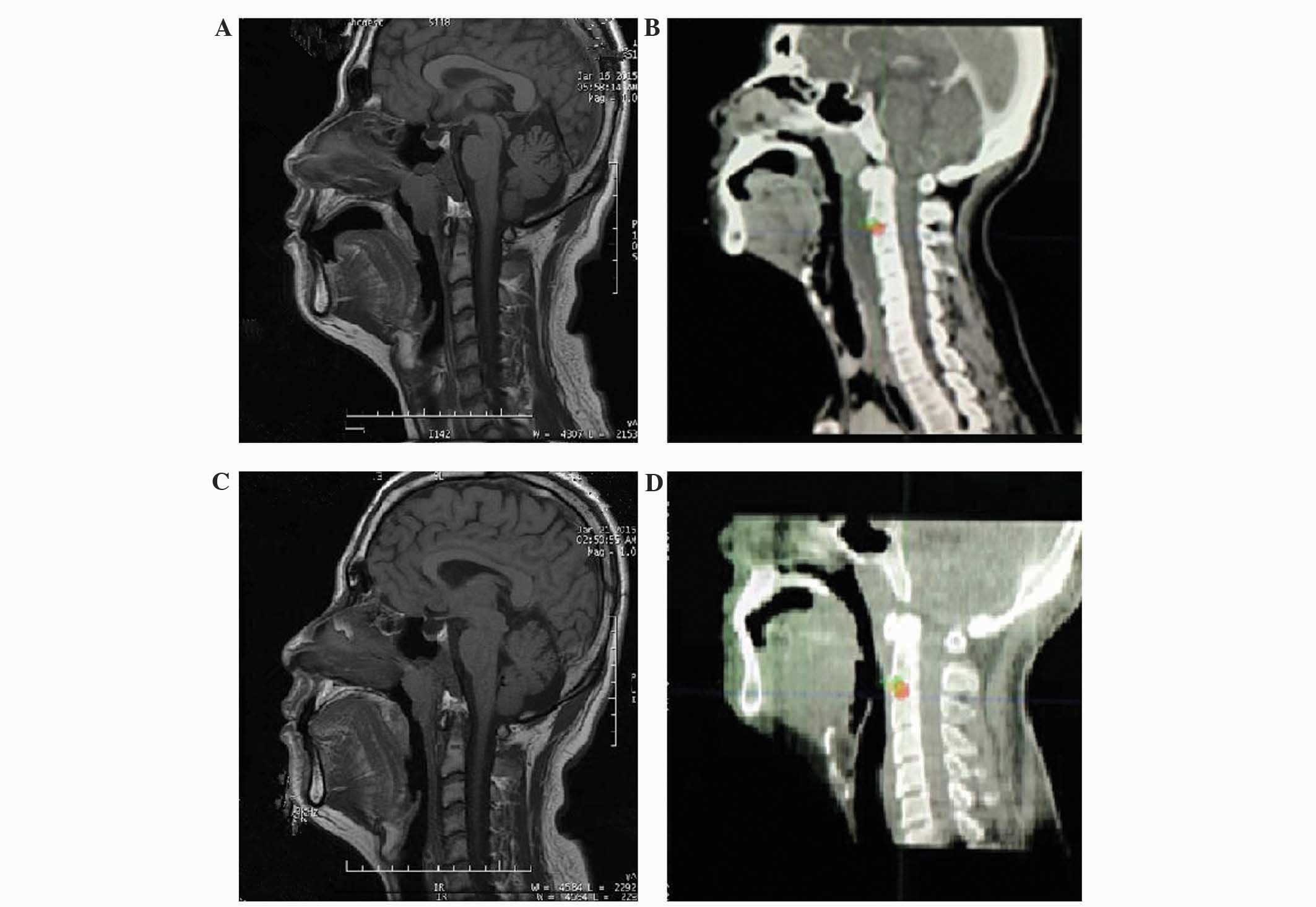
A 20-year-old male presented to hospital with blood in the mucus, which had occurred for 6 months, and was diagnosed with nasopharyngeal carcinoma (NPC). Due to passive smoking, the patient developed a constant and violent cough, pain behind the right ear and swelling of the retropharynx. The results of a computed tomography scan, which was performed during re‑examination of the patient, revealed that the right lymphonodi retropharynici had decreased in size and the hypodense shadow of the prevertebral space had become clear. Therefore, the retropharyngeal pressure was suspected to be increased due to the violent cough. Consequently, the increased pressure may have caused the swollen lymph nodes on the right side of the pharynx to break, which allowed the necrotic liquid to seep into the prevertebral space and result in effusion. Subsequent to 5 days of treatment with methylprednisolone (40 mg ivgtt qd, d1‑5), the results from the cone bean computed tomography examination, which had been performed prior to radiotherapy, indicated that the retropharyngeal swelling had improved and the prevertebral space had returned to normal. To the best of our knowledge, the present study is the first reported case of effusion in the prevertebral space caused by the breaking of swollen lymphonodi retropharynici in NPC. The present study acts as a reminder of the possible delays in the treatments for head and neck tumor patients that demonstrate swollen retropharyngeal lymph nodes due to the occurrence of effusion in the prevertebral space.
View References
|
1
|
Wu TT, Chen C, Chen SM, Xu Y, Wang Y, Chen
Z, Wang F, Xiao BK and Tao ZZ: Nuclear translocation of telomerase
reverse transcriptase is a critical process in lymphatic metastasis
of nasopharyngeal carcinoma. Oncol Lett. 9:265–269. 2015.PubMed/NCBI
|
|
2
|
Wong EY, Wong SC, Chan CM, Lam EK, Ho LY,
Lau CP, Au TC, Chan AK, Tsang CM, Tsao SW, et al: TP53-induced
glycolysis and apoptosis regulator promotes proliferation and
invasiveness of nasopharyngeal carcinoma cells. Oncol Lett.
9:569–574. 2015.PubMed/NCBI
|
|
3
|
Mills MK and Shah LM: Imaging of the
perivertebral space. Radiol Clin North Am. 53:163–180. 2015.
View Article : Google Scholar : PubMed/NCBI
|
|
4
|
Regueiro Villarín S, Vázquez Barro JC and
Herranz González-Botas J: Deep neck infections: Etiology,
bacteriology and treatment. Acta Otorrinolaringol Esp. 57:342–348.
2006.(In Spanish).
|
|
5
|
Liao XB, Mao YP, Liu LZ, Tang LL, Sun Y,
Wang Y, Lin AH, Cui CY, Li L and Ma J: How does magnetic resonance
imaging influence staging according to AJCC staging system for
nasopharyngeal carcinoma compared with computed tomography? Int J
Radiat Oncol Biol Phys. 72:1368–1377. 2008. View Article : Google Scholar : PubMed/NCBI
|
|
6
|
Zhou GQ, Mao YP, Chen L, Li WF, Liu LZ,
Sun Y, Chen Y, Tian L, Lin AH, Li L and Ma J: Prognostic value of
prevertebral space involvement in nasopharyngeal carcinoma based on
intensity-modulated radiotherapy. Int J Radiat Oncol Biol Phys.
82:1090–1097. 2012. View Article : Google Scholar : PubMed/NCBI
|