Spandidos Publications Logo
  • About
    • About Spandidos
    • Aims and Scopes
    • Abstracting and Indexing
    • Editorial Policies
    • Reprints and Permissions
    • Job Opportunities
    • Terms and Conditions
    • Contact
  • Journals
    • All Journals
    • Oncology Letters
      • Oncology Letters
      • Information for Authors
      • Editorial Policies
      • Editorial Board
      • Aims and Scope
      • Abstracting and Indexing
      • Bibliographic Information
      • Archive
    • International Journal of Oncology
      • International Journal of Oncology
      • Information for Authors
      • Editorial Policies
      • Editorial Board
      • Aims and Scope
      • Abstracting and Indexing
      • Bibliographic Information
      • Archive
    • Molecular and Clinical Oncology
      • Molecular and Clinical Oncology
      • Information for Authors
      • Editorial Policies
      • Editorial Board
      • Aims and Scope
      • Abstracting and Indexing
      • Bibliographic Information
      • Archive
    • Experimental and Therapeutic Medicine
      • Experimental and Therapeutic Medicine
      • Information for Authors
      • Editorial Policies
      • Editorial Board
      • Aims and Scope
      • Abstracting and Indexing
      • Bibliographic Information
      • Archive
    • International Journal of Molecular Medicine
      • International Journal of Molecular Medicine
      • Information for Authors
      • Editorial Policies
      • Editorial Board
      • Aims and Scope
      • Abstracting and Indexing
      • Bibliographic Information
      • Archive
    • Biomedical Reports
      • Biomedical Reports
      • Information for Authors
      • Editorial Policies
      • Editorial Board
      • Aims and Scope
      • Abstracting and Indexing
      • Bibliographic Information
      • Archive
    • Oncology Reports
      • Oncology Reports
      • Information for Authors
      • Editorial Policies
      • Editorial Board
      • Aims and Scope
      • Abstracting and Indexing
      • Bibliographic Information
      • Archive
    • Molecular Medicine Reports
      • Molecular Medicine Reports
      • Information for Authors
      • Editorial Policies
      • Editorial Board
      • Aims and Scope
      • Abstracting and Indexing
      • Bibliographic Information
      • Archive
    • World Academy of Sciences Journal
      • World Academy of Sciences Journal
      • Information for Authors
      • Editorial Policies
      • Editorial Board
      • Aims and Scope
      • Abstracting and Indexing
      • Bibliographic Information
      • Archive
    • International Journal of Functional Nutrition
      • International Journal of Functional Nutrition
      • Information for Authors
      • Editorial Policies
      • Editorial Board
      • Aims and Scope
      • Abstracting and Indexing
      • Bibliographic Information
      • Archive
    • International Journal of Epigenetics
      • International Journal of Epigenetics
      • Information for Authors
      • Editorial Policies
      • Editorial Board
      • Aims and Scope
      • Abstracting and Indexing
      • Bibliographic Information
      • Archive
    • Medicine International
      • Medicine International
      • Information for Authors
      • Editorial Policies
      • Editorial Board
      • Aims and Scope
      • Abstracting and Indexing
      • Bibliographic Information
      • Archive
  • Articles
  • Information
    • Information for Authors
    • Information for Reviewers
    • Information for Librarians
    • Information for Advertisers
    • Conferences
  • Language Editing
Spandidos Publications Logo
  • About
    • About Spandidos
    • Aims and Scopes
    • Abstracting and Indexing
    • Editorial Policies
    • Reprints and Permissions
    • Job Opportunities
    • Terms and Conditions
    • Contact
  • Journals
    • All Journals
    • Biomedical Reports
      • Information for Authors
      • Editorial Policies
      • Editorial Board
      • Aims and Scope
      • Abstracting and Indexing
      • Bibliographic Information
      • Archive
    • Experimental and Therapeutic Medicine
      • Information for Authors
      • Editorial Policies
      • Editorial Board
      • Aims and Scope
      • Abstracting and Indexing
      • Bibliographic Information
      • Archive
    • International Journal of Epigenetics
      • Information for Authors
      • Editorial Policies
      • Editorial Board
      • Aims and Scope
      • Abstracting and Indexing
      • Bibliographic Information
      • Archive
    • International Journal of Functional Nutrition
      • Information for Authors
      • Editorial Policies
      • Editorial Board
      • Aims and Scope
      • Abstracting and Indexing
      • Bibliographic Information
      • Archive
    • International Journal of Molecular Medicine
      • Information for Authors
      • Editorial Policies
      • Editorial Board
      • Aims and Scope
      • Abstracting and Indexing
      • Bibliographic Information
      • Archive
    • International Journal of Oncology
      • Information for Authors
      • Editorial Policies
      • Editorial Board
      • Aims and Scope
      • Abstracting and Indexing
      • Bibliographic Information
      • Archive
    • Medicine International
      • Information for Authors
      • Editorial Policies
      • Editorial Board
      • Aims and Scope
      • Abstracting and Indexing
      • Bibliographic Information
      • Archive
    • Molecular and Clinical Oncology
      • Information for Authors
      • Editorial Policies
      • Editorial Board
      • Aims and Scope
      • Abstracting and Indexing
      • Bibliographic Information
      • Archive
    • Molecular Medicine Reports
      • Information for Authors
      • Editorial Policies
      • Editorial Board
      • Aims and Scope
      • Abstracting and Indexing
      • Bibliographic Information
      • Archive
    • Oncology Letters
      • Information for Authors
      • Editorial Policies
      • Editorial Board
      • Aims and Scope
      • Abstracting and Indexing
      • Bibliographic Information
      • Archive
    • Oncology Reports
      • Information for Authors
      • Editorial Policies
      • Editorial Board
      • Aims and Scope
      • Abstracting and Indexing
      • Bibliographic Information
      • Archive
    • World Academy of Sciences Journal
      • Information for Authors
      • Editorial Policies
      • Editorial Board
      • Aims and Scope
      • Abstracting and Indexing
      • Bibliographic Information
      • Archive
  • Articles
  • Information
    • For Authors
    • For Reviewers
    • For Librarians
    • For Advertisers
    • Conferences
  • Language Editing
Login Register Submit
  • This site uses cookies
  • You can change your cookie settings at any time by following the instructions in our Cookie Policy. To find out more, you may read our Privacy Policy.

    I agree
Search articles by DOI, keyword, author or affiliation
Search
Advanced Search
presentation
Oncology Letters
Join Editorial Board Propose a Special Issue
Print ISSN: 1792-1074 Online ISSN: 1792-1082
Journal Cover
November-2017 Volume 14 Issue 5

Full Size Image

Sign up for eToc alerts
Recommend to Library

Journals

International Journal of Molecular Medicine

International Journal of Molecular Medicine

International Journal of Molecular Medicine is an international journal devoted to molecular mechanisms of human disease.

International Journal of Oncology

International Journal of Oncology

International Journal of Oncology is an international journal devoted to oncology research and cancer treatment.

Molecular Medicine Reports

Molecular Medicine Reports

Covers molecular medicine topics such as pharmacology, pathology, genetics, neuroscience, infectious diseases, molecular cardiology, and molecular surgery.

Oncology Reports

Oncology Reports

Oncology Reports is an international journal devoted to fundamental and applied research in Oncology.

Experimental and Therapeutic Medicine

Experimental and Therapeutic Medicine

Experimental and Therapeutic Medicine is an international journal devoted to laboratory and clinical medicine.

Oncology Letters

Oncology Letters

Oncology Letters is an international journal devoted to Experimental and Clinical Oncology.

Biomedical Reports

Biomedical Reports

Explores a wide range of biological and medical fields, including pharmacology, genetics, microbiology, neuroscience, and molecular cardiology.

Molecular and Clinical Oncology

Molecular and Clinical Oncology

International journal addressing all aspects of oncology research, from tumorigenesis and oncogenes to chemotherapy and metastasis.

World Academy of Sciences Journal

World Academy of Sciences Journal

Multidisciplinary open-access journal spanning biochemistry, genetics, neuroscience, environmental health, and synthetic biology.

International Journal of Functional Nutrition

International Journal of Functional Nutrition

Open-access journal combining biochemistry, pharmacology, immunology, and genetics to advance health through functional nutrition.

International Journal of Epigenetics

International Journal of Epigenetics

Publishes open-access research on using epigenetics to advance understanding and treatment of human disease.

Medicine International

Medicine International

An International Open Access Journal Devoted to General Medicine.

Journal Cover
November-2017 Volume 14 Issue 5

Full Size Image

Sign up for eToc alerts
Recommend to Library

  • Article
  • Citations
    • Cite This Article
    • Download Citation
    • Create Citation Alert
    • Remove Citation Alert
    • Cited By
  • Similar Articles
    • Related Articles (in Spandidos Publications)
    • Similar Articles (Google Scholar)
    • Similar Articles (PubMed)
  • Download PDF
  • Download XML
  • View XML
Article Open Access

High expression of monocarboxylate transporter 4 predicts poor prognosis in patients with lung adenocarcinoma

  • Authors:
    • Yushu Ruan
    • Fanjun Zeng
    • Zhiqiang Cheng
    • Xianda Zhao
    • Pin Fu
    • Honglei Chen
  • View Affiliations / Copyright

    Affiliations: Department of Respiratory Medicine, First College of Clinical Medical Sciences, China Three Gorges University, Yichang, Hubei 443003, P.R. China, Department of Pathology, Shenzhen People's Hospital, Shenzhen, Guangdong 518020, P.R. China, Department of Pathology, School of Basic Medical Science, Wuhan University, Wuhan, Hubei 430071, P.R. China
    Copyright: © Ruan et al. This is an open access article distributed under the terms of Creative Commons Attribution License.
  • Pages: 5727-5734
    |
    Published online on: September 15, 2017
       https://doi.org/10.3892/ol.2017.6964
  • Expand metrics +
Metrics: Total Views: 0 (Spandidos Publications: | PMC Statistics: )
Metrics: Total PDF Downloads: 0 (Spandidos Publications: | PMC Statistics: )
Cited By (CrossRef): 0 citations Loading Articles...

This article is mentioned in:


Abstract

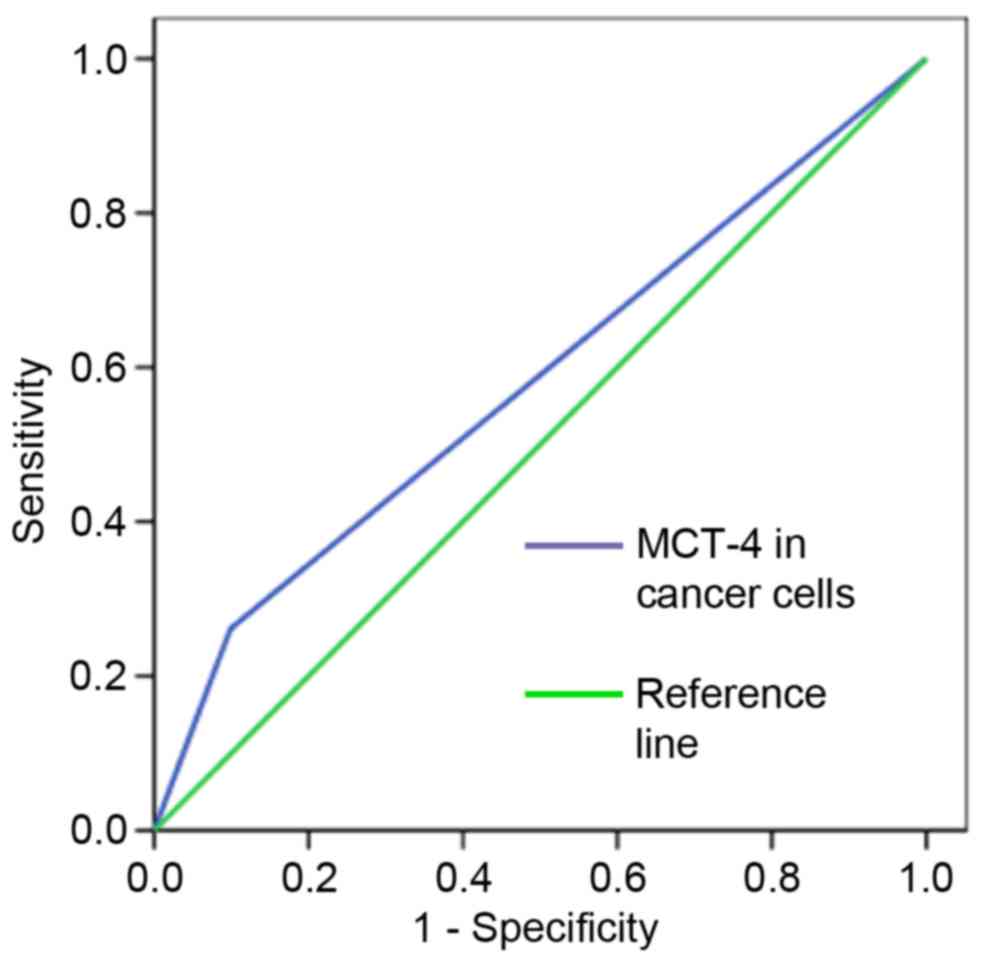
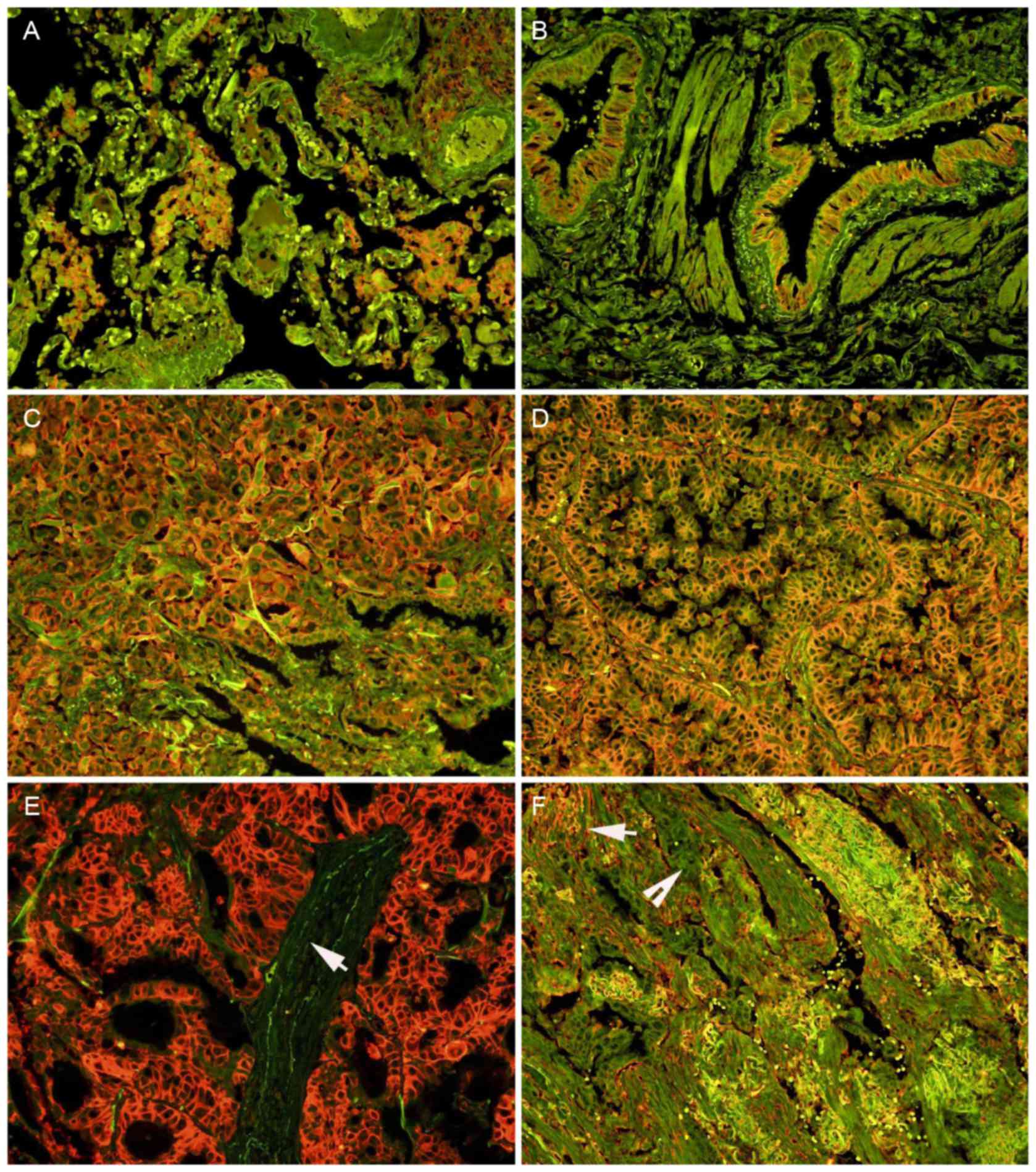
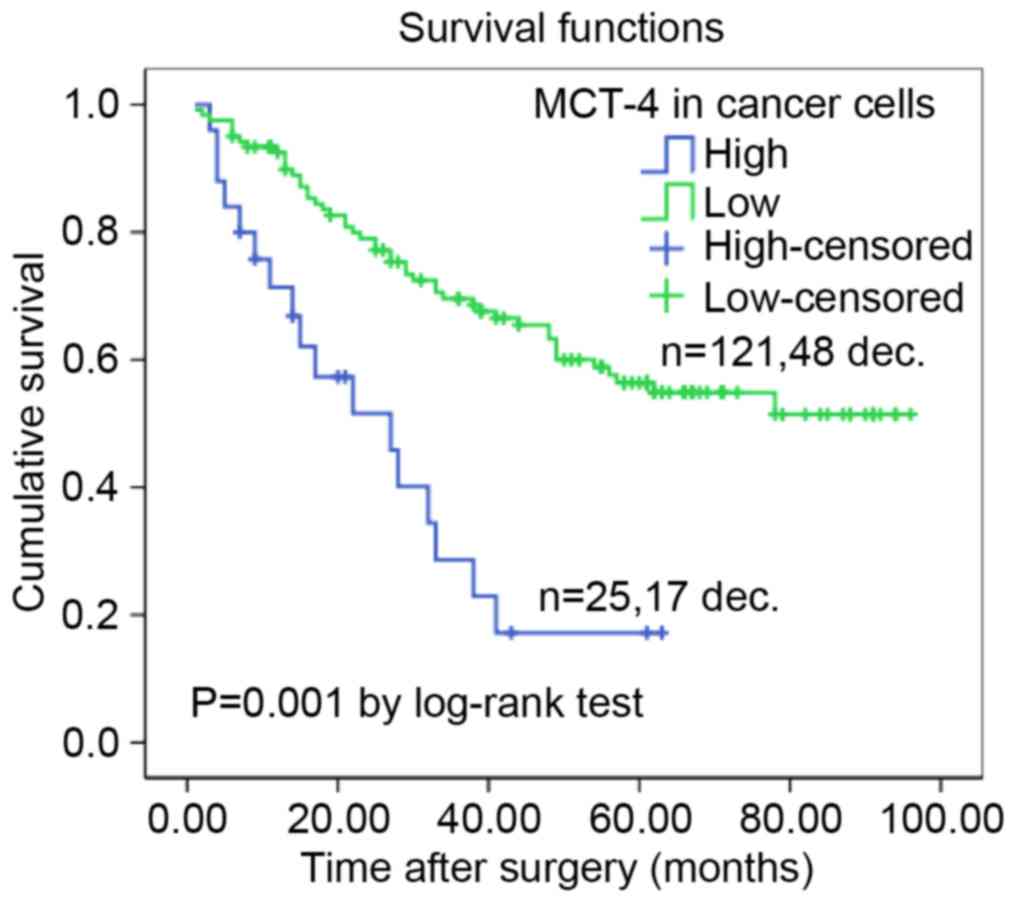
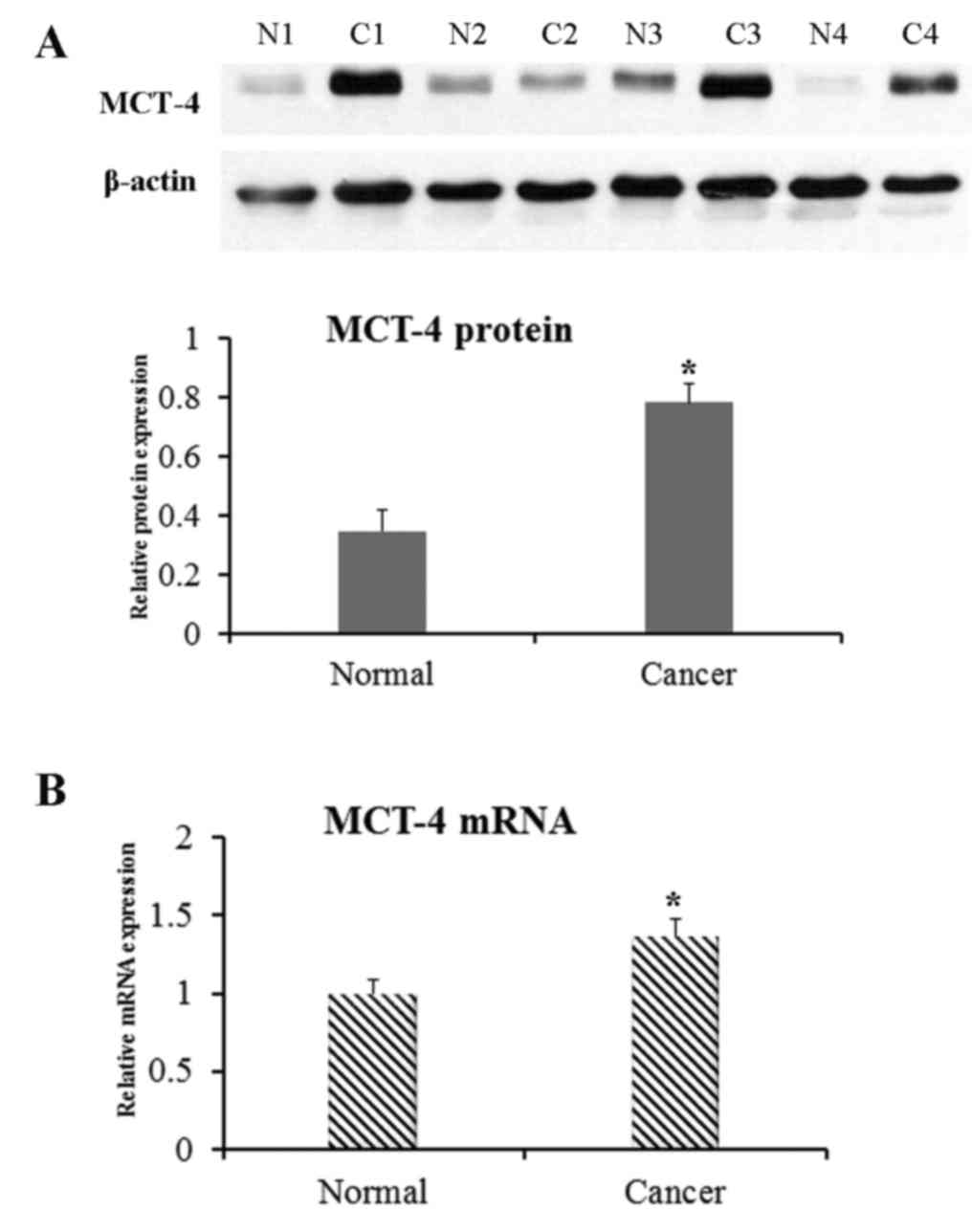
Monocarboxylate transporter 4 (MCT‑4) serves a key function in transporting lactate across the plasma membrane in various types of human cancer. Evidence indicates that MCT‑4 expression is associated with non‑small cell lung cancer; however, the distribution and clinical significance of MCT‑4 in the lung adenocarcinoma (AC) subtype remain unknown. Thus, the aim of the present study was to explore the clinicopathological significance and prognostic values of MCT‑4 expression in lung AC. Quantum dots‑based immunofluorescence histochemistry was performed to observe the expression of MCT‑4 in 146 specimens of lung AC and corresponding normal lung tissues. MCT‑4 protein and mRNA were detected by western blotting and reverse transcription‑quantitative polymerase chain reaction from 30 fresh samples of lung AC and corresponding normal lung tissues. Of the 146 samples, 25 (17.1%) exhibited high and 121 (82.9%) exhibited low MCT‑4 expression. MCT‑4, at the protein and mRNA level, was significantly increased in tumor specimens compared with corresponding normal lung tissue (P<0.05). MCT‑4 protein expression was significantly associated with depth of invasion (P=0.034). A survival curve analysis indicated that high MCT‑4 expression in lung AC was associated with a decreased overall survival rate (P=0.001). Multivariate analysis demonstrated that high MCT‑4 level was an independent prognostic factor (hazard ratio, 3.192; 95% confidence interval, 1.804‑5.646; P=0.001) for patients with lung AC. The results have demonstrated that high MCT‑4 expression is significantly associated with the poor prognosis and disease progression of patients with lung AC. Therefore, MCT‑4 may be a candidate therapeutic target in lung AC.
View Figures

Figure 1

Figure 2

Figure 3

Figure 4

View References

1 

Siegel RL, Miller KD and Jemal A: Cancer statistics, 2015. CA A Cancer J Clin. 65:5–29. 2015. View Article : Google Scholar

2 

Thomas A, Liu SV, Subramaniam DS and Giaccone G: Refining the treatment of NSCLC according to histological and molecular subtypes. Nat Rev Clin Oncol. 12:511–526. 2015. View Article : Google Scholar : PubMed/NCBI

3 

Sica G, Yoshizawa A, Sima CS, Azzoli CG, Downey RJ, Rusch VW, Travis WD and Moreira A: A grading system of lung adenocarcinomas based on histologic pattern is predictive of disease recurrence in stage I tumors. Am J Surg Patho. 34:1155–1162. 2010. View Article : Google Scholar

4 

Alberg AJ, Ford JG and Samet JM: American College of Chest Physicians: Epidemiology of lung cancer: ACCP evidence-based clinical practice guidelines. Chest. 132:29S–55S. 2007. View Article : Google Scholar : PubMed/NCBI

5 

Travis WD, Brambilla E, Noguchi M, Nicholson AG, Geisinger K, Yatabe Y, Powell CA, Beer D, Riely G, Garg K, et al: International Association for the Study of Lung Cancer/American Thoracic Society/European Respiratory Society: International multidisciplinary classification of lung adenocarcinoma: executive summary. Proc Am Thorac Soc. 8:381–385. 2011. View Article : Google Scholar : PubMed/NCBI

6 

Sterlacci W, Savic S, Schmid T, Oberaigner W, Auberger J, Fiegl M and Tzankov A: Tissue-sparing application of the newly proposed IASLC/ATS/ERS classification of adenocarcinoma of the lung shows practical diagnostic and prognostic impact. Am J Clin Pathol. 137:946–956. 2012. View Article : Google Scholar : PubMed/NCBI

7 

Bissell MJ and Radisky D: Putting tumours in context. Nat Rev Cancer. 1:46–54. 2001. View Article : Google Scholar : PubMed/NCBI

8 

Mueller MM and Fusenig NE: Friends or foes-bipolar effects of the tumour stroma in cancer. Nat Rev Cancer. 4:839–849. 2004. View Article : Google Scholar : PubMed/NCBI

9 

Dvorak HF, Weaver VM, Tlsty TD and Bergers G: Tumor microenvironment and progression. J Surg Oncol. 103:468–474. 2011. View Article : Google Scholar : PubMed/NCBI

10 

Vaupel P, Kallinowski F and Okunieff P: Blood flow, oxygen and nutrient supply and metabolic microenvironment of human tumors: A review. Cancer Res. 49:6449–6465. 1989.PubMed/NCBI

11 

Izumi H, Torigoe T, Ishiguchi H, Uramoto H, Yoshida Y, Tanabe M, Ise T, Murakami T, Yoshida T, Nomoto M and Kohno K: Cellular pH regulators: Potentially promising molecular targets for cancer chemotherapy. Cancer Treat Rev. 29:541–549. 2003. View Article : Google Scholar : PubMed/NCBI

12 

Pinheiro C, Longatto-Filho A, Azevedo-Silva J, Casal M, Schmitt FC and Baltazar F: Role of monocarboxylate transporters in human cancers: State of the art. J Bioenerg Biomembr. 44:127–139. 2012. View Article : Google Scholar : PubMed/NCBI

13 

Halestrap AP and Price NT: The proton-linked monocarboxylate transporter (MCT) family: Structure, function and regulation. Biochem J. 343:281–299. 1999. View Article : Google Scholar : PubMed/NCBI

14 

Broer S, Bröer A, Schneider H, Stegen C, Halestrap A and Deitmer J: Characterization of the high-affinity monocarboxylate transporter MCT2 in Xenopus laevis oocytes. Biochem J. 341:529–535. 1999. View Article : Google Scholar : PubMed/NCBI

15 

Grollman EF, Philp NJ, McPhie P, Ward RD and Sauer B: Determination of transport kinetics of chick MCT3 monocarboxylate transporter from retinal pigment epithelium by expression in genetically modified yeast. Biochemistry. 39:9351–9357. 2000. View Article : Google Scholar : PubMed/NCBI

16 

Dimmer KS, Friedrich B, Lang F, Deitmer JW and Bröer S: The low-affinity monocarboxylate transporter MCT4 is adapted to the export of lactate in highly glycolytic cells. Biochem J. 350:219–227. 2000. View Article : Google Scholar : PubMed/NCBI

17 

Fox JEM, Meredith D and Halestrap AP: Characterisation of human monocarboxylate transporter 4 substantiates its role in lactic acid efflux from skeletal muscle. J Physiol. 529:285–293. 2000. View Article : Google Scholar : PubMed/NCBI

18 

Koukourakis MI, Giatromanolaki A, Harris AL and Sivridis E: Comparison of metabolic pathways between cancer cells and stromal cells in colorectal carcinomas: A metabolic survival role for tumor-associated stroma. Cancer Res. 66:632–637. 2006. View Article : Google Scholar : PubMed/NCBI

19 

Lin RY, Vera JC, Chaganti RS and Golde DW: Human monocarboxylate transporter 2 (MCT2) is a high affinity pyruvate transporter. J Biol Chem. 273:28959–28965. 1998. View Article : Google Scholar : PubMed/NCBI

20 

Lambert DW, Wood IS, Ellis A and Shirazi-Beechey S: Molecular changes in the expression of human colonic nutrient transporters during the transition from normality to malignancy. Br J Cancer. 86:1262–1269. 2002. View Article : Google Scholar : PubMed/NCBI

21 

Pinheiro C, Longatto-Filho A, Scapulatempo C, Ferreira L, Martins S, Pellerin L, Rodrigues M, Alves VA, Schmitt F and Baltazar F: Increased expression of monocarboxylate transporters 1, 2 and 4 in colorectal carcinomas. Virchows Archiv. 452:139–146. 2008. View Article : Google Scholar : PubMed/NCBI

22 

Juel C and Halestrap AP: Lactate transport in skeletal muscle-role and regulation of the monocarboxylate transporter. J Physiol. 517:633–642. 1999. View Article : Google Scholar : PubMed/NCBI

23 

Pinheiro C, Reis RM, Ricardo S, Longatto-Filho A, Schmitt F and Baltazar F: Expression of monocarboxylate transporters 1, 2 and 4 in human tumours and their association with CD147 and CD44. J Biomed Biotechnol. 2010:4276942010. View Article : Google Scholar : PubMed/NCBI

24 

Nakayama Y, Torigoe T, Inoue Y, Minagawa N, Izumi H, Kohno K and Yamaguchi K: Prognostic significance of monocarboxylate transporter 4 expression in patients with colorectal cancer. Exp Ther Med. 3:25–30. 2012. View Article : Google Scholar : PubMed/NCBI

25 

Kim MJ, Kim DH, Jung WH and Koo JS: Expression of metabolism-related proteins in triple-negative breast cancer. Int J Clin Exp Pathol. 7:301–312. 2013.PubMed/NCBI

26 

Zhu J, Wu YN, Zhang W, Zhang XM, Ding X, Li HQ, Geng M, Xie ZQ and Wu HM: Monocarboxylate transporter 4 facilitates cell proliferation and migration and is associated with poor prognosis in oral squamous cell carcinoma patients. PLoS One. 9:e879042014. View Article : Google Scholar : PubMed/NCBI

27 

Pértega-Gomes N, Vizcaíno JR, Miranda-Gonçalves V, Pinheiro C, Silva J, Pereira H, Monteiro P, Henrique RM, Reis RM, Lopes C and Baltazar F: Monocarboxylate transporter 4 (MCT4) and CD147 overexpression is associated with poor prognosis in prostate cancer. BMC Cancer. 11:3122011. View Article : Google Scholar : PubMed/NCBI

28 

Sobin LH, Gospodarowicz MK and Wittekind C: International Union against CancerTNM classification of malignant tumours. 7th. Chichester, Hoboken NJ: Wiley-Blackwell; 2010

29 

Kononen J, Bubendorf L, Kallionimeni A, Bärlund M, Schraml P, Leighton S, Torhorst J, Mihatsch MJ, Sauter G and Kallioniemi OP: Tissue microarrays for high-throughput molecular profiling of tumor specimens. Nat Med. 4:844–847. 1998. View Article : Google Scholar : PubMed/NCBI

30 

Li M, Chen H, Diao L, Zhang Y, Xia C and Yang F: Caveolin-1 and VEGF-C promote lymph node metastasis in the absence of intratumoral lymphangiogenesis in non-small cell lung cancer. Tumori. 96:7342010.PubMed/NCBI

31 

Chen H, Xue J, Zhang Y, Zhu X, Gao J and Yu B: Comparison of quantum dots immunofluorescence histochemistry and conventional immunohistochemistry for the detection of caveolin-1 and PCNA in the lung cancer tissue microarray. J Mol Histol. 40:261–268. 2009. View Article : Google Scholar : PubMed/NCBI

32 

Zhao X, He Y, Gao J, Fan L, Li Z, Yang G and Chen H: Caveolin-1 expression level in cancer associated fibroblasts predicts outcome in gastric cancer. PLoS One. 8:e591022013. View Article : Google Scholar : PubMed/NCBI

33 

Livak KJ and Schmittgen TD: Analysis of relative gene expression data using real-time quantitative PCR and the 2(-Delta Delta C(T)) method. Methods. 25:402–408. 2001. View Article : Google Scholar : PubMed/NCBI

34 

Meijer TW, Schuurbiers OC, Kaanders JH, Looijen-Salamon MG, de Geus-Oei LF, Verhagen AF, Lok J, van der Heijden HF, Rademakers SE, Span PN and Bussink J: Differences in metabolism between adeno-and squamous cell non-small cell lung carcinomas: Spatial distribution and prognostic value of GLUT1 and MCT4. Lung Cancer. 76:316–323. 2012. View Article : Google Scholar : PubMed/NCBI

35 

Mathupala SP, Parajuli P and Sloan AE: Silencing of monocarboxylate transporters via small interfering ribonucleic acid inhibits glycolysis and induces cell death in malignant glioma: An in vitro study. Neurosurgery. 55:1410–1419. 2004. View Article : Google Scholar : PubMed/NCBI

36 

Sonveaux P, Végran F, Schroeder T, Wergin MC, Verrax J, Rabbani ZN, De Saedeleer CJ, Kennedy KM, Diepart C, Jordan BF, et al: Targeting lactate-fueled respiration selectively kills hypoxic tumor cells in mice. J Clin Invest. 118:3930–3942. 2008.PubMed/NCBI

37 

Eilertsen M, Andersen S, Al-Saad S, Kiselev Y, Donnem T, Stenvold H, Pettersen I, Al-Shibli K, Richardsen E, Busund LT and Bremnes RM: Monocarboxylate transporters 1–4 in NSCLC: MCT1 is an independent prognostic marker for survival. PLoS One. 9:e1050382014. View Article : Google Scholar : PubMed/NCBI

38 

Garcia CK, Goldstein JL, Pathak RK, Anderson RG and Brown MS: Molecular characterization of a membrane transporter for lactate, pyruvate and other monocarboxylates: Implications for the Cori cycle. Cell. 76:865–873. 1994. View Article : Google Scholar : PubMed/NCBI

39 

Izumi H, Takahashi M, Uramoto H, Nakayama Y, Oyama T, Wang KY, Sasaguri Y, Nishizawa S and Kohno K: Monocarboxylate transporters 1 and 4 are involved in the invasion activity of human lung cancer cells. Cancer Sci. 102:1007–1013. 2011. View Article : Google Scholar : PubMed/NCBI

40 

Lorusso G and Rüegg C: The tumor microenvironment and its contribution to tumor evolution toward metastasis. Histochem Cell Biol. 130:1091–1103. 2008. View Article : Google Scholar : PubMed/NCBI

41 

Zhao Z, Han F, He Y, Yang S, Hua L, Wu J and Zhan W: Stromal-epithelial metabolic coupling in gastric cancer: Stromal MCT4 and mitochondrial TOMM20 as poor prognostic factors. Eur J Surg Oncol. 40:1361–1368. 2014. View Article : Google Scholar : PubMed/NCBI

42 

Andersen S, Solstad Ø, Moi L, Donnem T, Eilertsen M, Nordby Y, Ness N, Richardsen E, Busund LT and Bremnes RM: Organized metabolic crime in prostate cancer: The coexpression of MCT1 in tumor and MCT4 in stroma is an independent prognosticator for biochemical failure. Urol Oncol. 33:338.e9–17. 2015. View Article : Google Scholar

43 

Sanità P, Capulli M, Teti A, Galatioto GP, Vicentini C, Chiarugi P, Bologna M and Angelucci A: Tumor-stroma metabolic relationship based on lactate shuttle can sustain prostate cancer progression. BMC Cancer. 14:154–167. 2014. View Article : Google Scholar : PubMed/NCBI

44 

San-Millán I and Brooks GA: Reexamining cancer metabolism: Lactate production for carcinogenesis could be the purpose and explanation of the Warburg Effect. Carcinogenesis. 38:119–133. 2017.PubMed/NCBI

Related Articles

  • Abstract
  • View
  • Download
  • Twitter
Copy and paste a formatted citation
Spandidos Publications style
Ruan Y, Zeng F, Cheng Z, Zhao X, Fu P and Chen H: High expression of monocarboxylate transporter 4 predicts poor prognosis in patients with lung adenocarcinoma. Oncol Lett 14: 5727-5734, 2017.
APA
Ruan, Y., Zeng, F., Cheng, Z., Zhao, X., Fu, P., & Chen, H. (2017). High expression of monocarboxylate transporter 4 predicts poor prognosis in patients with lung adenocarcinoma. Oncology Letters, 14, 5727-5734. https://doi.org/10.3892/ol.2017.6964
MLA
Ruan, Y., Zeng, F., Cheng, Z., Zhao, X., Fu, P., Chen, H."High expression of monocarboxylate transporter 4 predicts poor prognosis in patients with lung adenocarcinoma". Oncology Letters 14.5 (2017): 5727-5734.
Chicago
Ruan, Y., Zeng, F., Cheng, Z., Zhao, X., Fu, P., Chen, H."High expression of monocarboxylate transporter 4 predicts poor prognosis in patients with lung adenocarcinoma". Oncology Letters 14, no. 5 (2017): 5727-5734. https://doi.org/10.3892/ol.2017.6964
Copy and paste a formatted citation
x
Spandidos Publications style
Ruan Y, Zeng F, Cheng Z, Zhao X, Fu P and Chen H: High expression of monocarboxylate transporter 4 predicts poor prognosis in patients with lung adenocarcinoma. Oncol Lett 14: 5727-5734, 2017.
APA
Ruan, Y., Zeng, F., Cheng, Z., Zhao, X., Fu, P., & Chen, H. (2017). High expression of monocarboxylate transporter 4 predicts poor prognosis in patients with lung adenocarcinoma. Oncology Letters, 14, 5727-5734. https://doi.org/10.3892/ol.2017.6964
MLA
Ruan, Y., Zeng, F., Cheng, Z., Zhao, X., Fu, P., Chen, H."High expression of monocarboxylate transporter 4 predicts poor prognosis in patients with lung adenocarcinoma". Oncology Letters 14.5 (2017): 5727-5734.
Chicago
Ruan, Y., Zeng, F., Cheng, Z., Zhao, X., Fu, P., Chen, H."High expression of monocarboxylate transporter 4 predicts poor prognosis in patients with lung adenocarcinoma". Oncology Letters 14, no. 5 (2017): 5727-5734. https://doi.org/10.3892/ol.2017.6964
Follow us
  • Twitter
  • LinkedIn
  • Facebook
About
  • Spandidos Publications
  • Careers
  • Cookie Policy
  • Privacy Policy
How can we help?
  • Help
  • Live Chat
  • Contact
  • Email to our Support Team