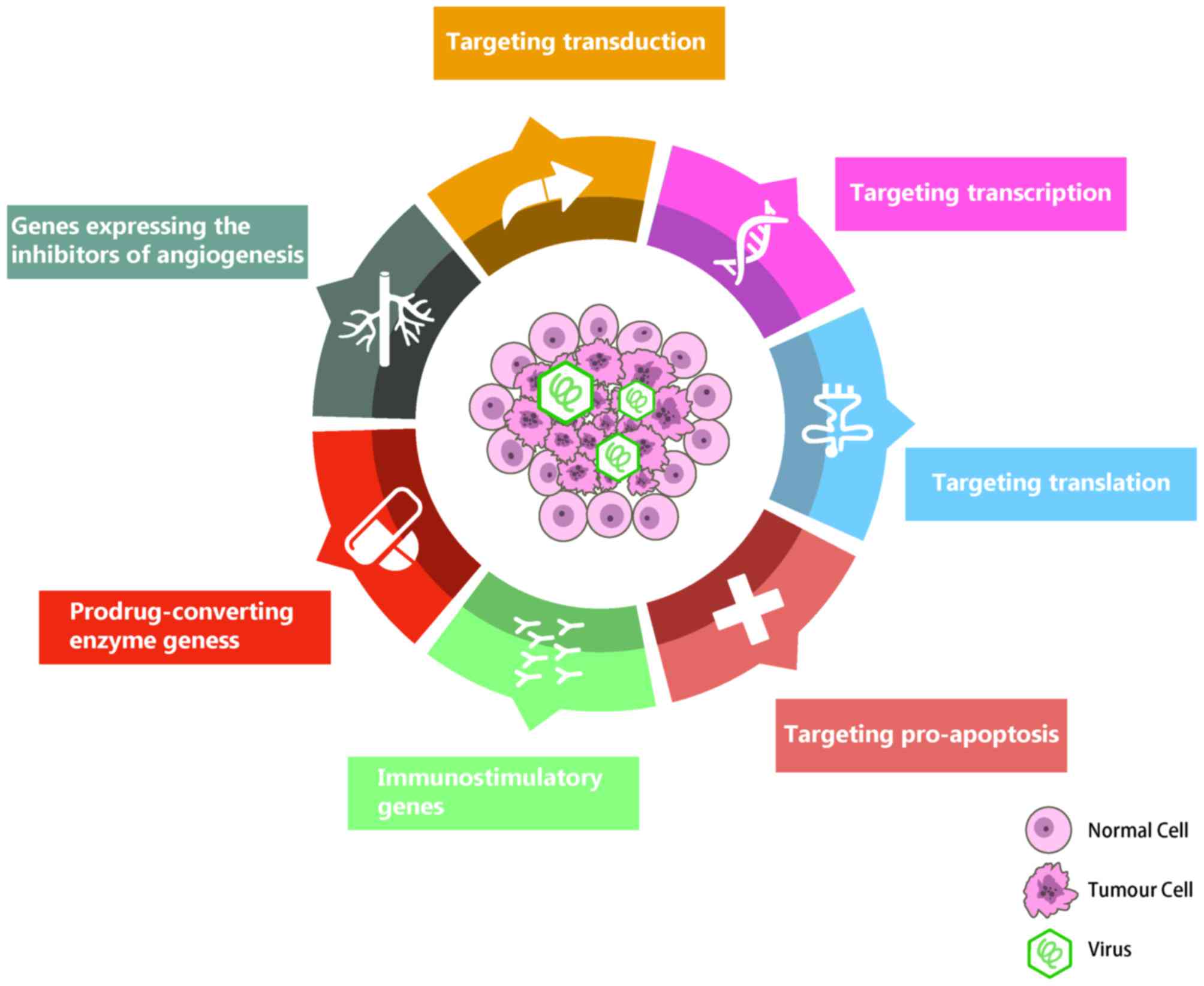
|
1
|
Bell J and McFadden G: Viruses for tumor
therapy. Cell Host Microbe. 15:260–265. 2014. View Article : Google Scholar : PubMed/NCBI
|
|
2
|
Fukuhara H, Ino Y and Todo T: Oncolytic
virus therapy: A new era of cancer treatment at dawn. Cancer Sci.
107:1373–1379. 2016. View Article : Google Scholar : PubMed/NCBI
|
|
3
|
Liu TC, Galanis E and Kirn D: Clinical
trial results with oncolytic virotherapy: A century of promise, a
decade of progress. Nat Clin Pract Oncol. 4:101–117. 2007.
View Article : Google Scholar : PubMed/NCBI
|
|
4
|
Nemunaitis J, Ganly I, Khuri F, Arseneau
J, Kuhn J, McCarty T, Landers S, Maples P, Romel L, Randlev B, et
al: Selective replication and oncolysis in p53 mutant tumors with
ONYX-015, an E1B-55kD gene-deleted adenovirus, in patients with
advanced head and neck cancer: A phase II trial. Cancer Res.
60:6359–6366. 2000.PubMed/NCBI
|
|
5
|
Ruf B and Lauer UM: Assessment of current
virotherapeutic application schemes: ‘Hit hard and early’ versus
‘killing softly’? Mol Ther Oncolytics. 4:150182015. View Article : Google Scholar
|
|
6
|
Breitbach CJ, Lichty BD and Bell JC:
Oncolytic viruses: Therapeutics with an identity crisis.
EBioMedicine. 9:31–36. 2016. View Article : Google Scholar : PubMed/NCBI
|
|
7
|
Cross D and Burmester JK: Gene therapy for
cancer treatment: Past, present and future. Clini Med Res.
4:218–227. 2006. View Article : Google Scholar
|
|
8
|
Liu TC and Kirn D: Gene therapy progress
and prospects cancer: Oncolytic viruses. Gene Ther. 15:877–884.
2008. View Article : Google Scholar : PubMed/NCBI
|
|
9
|
Russell SJ, Peng KW and Bell JC: Oncolytic
virotherapy. Nat Biotechnol. 30:658–670. 2012. View Article : Google Scholar : PubMed/NCBI
|
|
10
|
Galanis E, Atherton PJ, Maurer MJ, Knutson
KL, Dowdy SC, Cliby WA, Haluska P Jr, Long HJ, Oberg A, Aderca I,
et al: Oncolytic measles virus expressing the sodium iodide
symporter to treat drug-resistant ovarian cancer. Cancer Res.
75:22–30. 2015. View Article : Google Scholar : PubMed/NCBI
|
|
11
|
Hanahan D and Weinberg RA: The hallmarks
of cancer. Cell. 100:57–70. 2000. View Article : Google Scholar : PubMed/NCBI
|
|
12
|
Ilkow CS, Swift SL, Bell JC and Diallo JS:
From scourge to cure: Tumour-selective viral pathogenesis as a new
strategy against cancer. PLoS Pathog. 10:e10038362014. View Article : Google Scholar : PubMed/NCBI
|
|
13
|
Cattaneo R, Miest T, Shashkova EV and
Barry MA: Reprogrammed viruses as cancer therapeutics: Targeted,
armed and shielded. Nature Rev Microbiol. 6:529–540. 2008.
View Article : Google Scholar
|
|
14
|
Gromeier M, Lachmann S, Rosenfeld MR,
Gutin PH and Wimmer E: Intergeneric poliovirus recombinants for the
treatment of malignant glioma. Proc Natl Acad Sci the USA. 97:pp.
6803–6808. 2000; View Article : Google Scholar
|
|
15
|
Merrill MK, Bernhardt G, Sampson JH,
Wikstrand CJ, Bigner DD and Gromeier M: Poliovirus receptor
CD155-targeted oncolysis of glioma. Neuro Oncol. 6:208–217. 2004.
View Article : Google Scholar : PubMed/NCBI
|
|
16
|
Blasi F and Carmeliet P: uPAR: A versatile
signalling orchestrator. Nat Rev Mol Cell Biol. 3:932–943. 2002.
View Article : Google Scholar : PubMed/NCBI
|
|
17
|
Lester RD, Jo M, Montel V, Takimoto S and
Gonias SL: uPAR induces epithelial-mesenchymal transition in
hypoxic breast cancer cells. J Cell Biol. 178:425–436. 2007.
View Article : Google Scholar : PubMed/NCBI
|
|
18
|
Jing Y, Zaias J, Duncan R, Russell SJ and
Merchan JR: In vivo safety, biodistribution and antitumor effects
of uPAR retargeted oncolytic measles virus in syngeneic cancer
models. Gene Ther. 21:289–297. 2014. View Article : Google Scholar : PubMed/NCBI
|
|
19
|
Sato D, Kurihara Y, Kondo S, Shirota T,
Urata Y, Fujiwara T and Shintani S: Antitumor effects of
telomerase-specific replication-selective oncolytic viruses for
adenoid cystic carcinoma cell lines. Oncol Rep. 30:2659–2664. 2013.
View Article : Google Scholar : PubMed/NCBI
|
|
20
|
Longo SL, Griffith C, Glass A, Shillitoe
EJ and Post DE: Development of an oncolytic herpes simplex virus
using a tumor-specific HIF-responsive promoter. Cancer Gene Ther.
18:123–134. 2011. View Article : Google Scholar : PubMed/NCBI
|
|
21
|
Lu Y, Zhang Y, Chang G and Zhang J:
Comparison of prostate-specific promoters and the use of PSP-driven
virotherapy for prostate cancer. Biomed Res Int. 2013:6246322013.
View Article : Google Scholar : PubMed/NCBI
|
|
22
|
Zhang KJ, Zhang J, Wu YM, Qian J, Liu XJ,
Yan LC, Zhou XM, Xiao RJ, Wang YG, Cao X, et al: Complete
eradication of hepatomas using an oncolytic adenovirus containing
AFP promoter controlling E1A and an E1B deletion to drive IL-24
expression. Cancer Gene Ther. 19:619–629. 2012. View Article : Google Scholar : PubMed/NCBI
|
|
23
|
Verdun RE and Karlseder J: Replication and
protection of telomeres. Nature. 447:924–931. 2007. View Article : Google Scholar : PubMed/NCBI
|
|
24
|
Giandomenico V, Thirlwell C and Essand M:
Other Novel Therapies: Biomarkers, microRNAs and microRNA
inhibitors, DNA methylation, epigenetics, immunotherapy and
virotherapy. Front Horm Res. 44:248–262. 2015. View Article : Google Scholar : PubMed/NCBI
|
|
25
|
Ruiz AJ and Russell SJ: MicroRNAs and
oncolytic viruses. Curr Opin Virol. 13:40–48. 2015. View Article : Google Scholar : PubMed/NCBI
|
|
26
|
Yao W, Guo G, Zhang Q, Fan L, Wu N and Bo
Y: The application of multiple miRNA response elements enables
oncolytic adenoviruses to possess specificity to glioma cells.
Virology. 458–459, 1-82. 2014.
|
|
27
|
Negrini M, Ferracin M, Sabbioni S and
Croce CM: MicroRNAs in human cancer: From research to therapy. J
Cell Sci. 120:1833–1840. 2007. View Article : Google Scholar : PubMed/NCBI
|
|
28
|
Murakami Y, Yasuda T, Saigo K, Urashima T,
Toyoda H, Okanoue T and Shimotohno K: Comprehensive analysis of
microRNA expression patterns in hepatocellular carcinoma and
non-tumorous tissues. Oncogene. 25:2537–2545. 2006. View Article : Google Scholar : PubMed/NCBI
|
|
29
|
Callegari E, Elamin BK, D'Abundo L,
Falzoni S, Donvito G, Moshiri F, Milazzo M, Altavilla G, Giacomelli
L, Fornari F, et al: Anti-tumor activity of a miR-199-dependent
oncolytic adenovirus. PLoS One. 8:e739642013. View Article : Google Scholar : PubMed/NCBI
|
|
30
|
Indraccolo S: Interferon-alpha as
angiogenesis inhibitor: Learning from tumor models. Autoimmunity.
43:244–247. 2010. View Article : Google Scholar : PubMed/NCBI
|
|
31
|
Kotredes KP and Gamero AM: Interferons as
inducers of apoptosis in malignant cells. J Interferon Cytokine
Res. 33:162–170. 2013. View Article : Google Scholar : PubMed/NCBI
|
|
32
|
Balachandran S and Barber GN: Vesicular
stomatitis virus (VSV) therapy of tumors. IUBMB Life. 50:135–138.
2000. View Article : Google Scholar : PubMed/NCBI
|
|
33
|
Ahmed M, Cramer SD and Lyles DS:
Sensitivity of prostate tumors to wild type and M protein mutant
vesicular stomatitis viruses. Virology. 330:34–49. 2004. View Article : Google Scholar : PubMed/NCBI
|
|
34
|
Stewart JH IV, Ahmed M, Northrup SA,
Willingham M and Lyles DS: Vesicular stomatitis virus as a
treatment for colorectal cancer. Cancer Gene Ther. 18:837–849.
2011. View Article : Google Scholar : PubMed/NCBI
|
|
35
|
Bradner JE: Cancer: An essential passenger
with p53. Nature. 520:626–627. 2015. View Article : Google Scholar : PubMed/NCBI
|
|
36
|
Liu J, Zhang C and Feng Z: Tumor
suppressor p53 and its gain-of-function mutants in cancer. Acta
Biochim Biophys Sin (Shanghai). 46:170–179. 2014. View Article : Google Scholar : PubMed/NCBI
|
|
37
|
Duffy MJ, Synnott NC, McGowan PM, Crown J,
O'Connor D and Gallagher WM: p53 as a target for the treatment of
cancer. Cancer Treat Rev. 40:1153–1160. 2014. View Article : Google Scholar : PubMed/NCBI
|
|
38
|
Bischoff JR, Kirn DH, Williams A, Heise C,
Horn S, Muna M, Ng L, Nye JA, Sampson-Johannes A, Fattaey A and
McCormick F: An adenovirus mutant that replicates selectively in
p53-deficient human tumor cells. Science. 274:373–376. 1996.
View Article : Google Scholar : PubMed/NCBI
|
|
39
|
Garber K: China approves world's first
oncolytic virus therapy for cancer treatment. J Natl Cancer Inst.
98:298–300. 2006. View Article : Google Scholar : PubMed/NCBI
|
|
40
|
Cheng PH, Wechman SL, McMasters KM and
Zhou HS: Oncolytic replication of E1b-Deleted adenoviruses.
Viruses. 7:5767–5779. 2015. View Article : Google Scholar : PubMed/NCBI
|
|
41
|
Song X, Zhou Y, Jia R, Xu X, Wang H, Hu J,
Ge S and Fan X: Inhibition of retinoblastoma in vitro and in vivo
with conditionally replicating oncolytic adenovirus H101. Invest
Ophthalmol Vis Sci. 51:2626–2635. 2010. View Article : Google Scholar : PubMed/NCBI
|
|
42
|
Yu W and Fang H: Clinical trials with
oncolytic adenovirus in China. Curr Cancer Drug Targets. 7:141–148.
2007. View Article : Google Scholar : PubMed/NCBI
|
|
43
|
Kaneda Y: A non-replicating oncolytic
vector as a novel therapeutic tool against cancer. BMB Rep.
43:773–780. 2010. View Article : Google Scholar : PubMed/NCBI
|
|
44
|
Gil-Farina I, Di Scala M, Vanrell L,
Olagüe C, Vales A, High KA, Prieto J, Mingozzi F and
Gonzalez-Aseguinolaza G: IL12-mediated liver inflammation reduces
the formation of AAV transcriptionally active forms but has no
effect over preexisting AAV transgene expression. PLoS One.
8:e677482013. View Article : Google Scholar : PubMed/NCBI
|
|
45
|
Guse K, Sloniecka M, Diaconu I,
Ottolino-Perry K, Tang N, Ng C, Le Boeuf F, Bell JC, McCart JA,
Ristimäki A, et al: Antiangiogenic arming of an oncolytic vaccinia
virus enhances antitumor efficacy in renal cell cancer models. J
Virol. 84:856–866. 2010. View Article : Google Scholar : PubMed/NCBI
|
|
46
|
Jeyaretna DS and Kuroda T: Recent advances
in the development of oncolytic HSV-1 vectors: ‘Arming’ of HSV-1
vectors and application of bacterial artificial chromosome
technology for their construction. Curr Opin Mol Ther. 9:447–466.
2007.PubMed/NCBI
|
|
47
|
Tsun A, Miao XN, Wang CM and Yu DC:
Oncolytic immunotherapy for treatment of cancer. Adv Exp Med Biol.
909:241–283. 2016. View Article : Google Scholar : PubMed/NCBI
|
|
48
|
Grossardt C, Engeland CE, Bossow S, Halama
N, Zaoui K, Leber MF, Springfeld C, Jaeger D, von Kalle C and
Ungerechts G: Granulocyte-macrophage colony-stimulating
factor-armed oncolytic measles virus is an effective therapeutic
cancer vaccine. Hum Gene Ther. 24:644–654. 2013. View Article : Google Scholar : PubMed/NCBI
|
|
49
|
Choi IK, Lee JS, Zhang SN, Park J, Sonn
CH, Lee KM and Yun CO: Oncolytic adenovirus co-expressing IL-12 and
IL-18 improves tumor-specific immunity via differentiation of T
cells expressing IL-12Rβ2 or IL-18Rα. Gene Ther. 18:898–909. 2011.
View Article : Google Scholar : PubMed/NCBI
|
|
50
|
van Rikxoort M, Michaelis M, Wolschek M,
Muster T, Egorov A, Seipelt J, Doerr HW and Cinatl J Jr: Oncolytic
effects of a novel influenza A virus expressing interleukin-15 from
the NS reading frame. PLoS One. 7:e365062012. View Article : Google Scholar : PubMed/NCBI
|
|
51
|
Li H, Peng KW, Dingli D, Kratzke RA and
Russell SJ: Oncolytic measles viruses encoding interferon beta and
the thyroidal sodium iodide symporter gene for mesothelioma
virotherapy. Cancer Gene Ther. 17:550–558. 2010. View Article : Google Scholar : PubMed/NCBI
|
|
52
|
Wang CJ, Xiao CW, You TG, Zheng YX, Gao W,
Zhou ZQ, Chen J, Xue XB, Fan J and Zhang H: Interferon-α enhances
antitumor activities of oncolytic adenovirus-mediated IL-24
expression in hepatocellular carcinoma. Mol Cancer. 11:312012.
View Article : Google Scholar : PubMed/NCBI
|
|
53
|
Cao L, Zeng Q, Xu C, Shi S, Zhang Z and
Sun X: Enhanced antitumor response mediated by the codelivery of
paclitaxel and adenoviral vector expressing IL-12. Mol Pharm.
10:1804–1814. 2013. View Article : Google Scholar : PubMed/NCBI
|
|
54
|
Gollob JA, Mier JW, Veenstra K, McDermott
DF, Clancy D, Clancy M and Atkins MB: Phase I trial of twice-weekly
intravenous interleukin 12 in patients with metastatic renal cell
cancer or malignant melanoma: Ability to maintain IFN-gamma
induction is associated with clinical response. Clin Cancer Res.
6:1678–1692. 2000.PubMed/NCBI
|
|
55
|
Lasek W, Zagożdżon R and Jakobisiak M:
Interleukin 12: Still a promising candidate for tumor
immunotherapy? Cancer Immunol Immunother. 63:419–435. 2014.
View Article : Google Scholar : PubMed/NCBI
|
|
56
|
Tomura M, Zhou XY, Maruo S, Ahn HJ,
Hamaoka T, Okamura H, Nakanishi K, Tanimoto T, Kurimoto M and
Fujiwara H: A critical role for IL-18 in the proliferation and
activation of NK1.1+ CD3-cells. J Immunol. 160:4738–4746.
1998.PubMed/NCBI
|
|
57
|
Chen C, Fang H, Han Z, Ye F, Ji T, Gong D,
Li F, Zhou J, Ma D and Gao Q: Novel permissive murine
immunocompetent orthotopic colon carcinoma model for comparison of
the antitumoral and safety profiles of three Adv-TKs. Gene Ther.
22:702015. View Article : Google Scholar : PubMed/NCBI
|
|
58
|
Graepler F, Lemken ML, Wybranietz WA,
Schmidt U, Smirnow I, Gross CD, Spiegel M, Schenk A, Graf H, Lauer
UA, et al: Bifunctional chimeric SuperCD suicide gene-YCD: YUPRT
fusion is highly effective in a rat hepatoma model. World J
Gastroenterol. 11:6910–6919. 2005. View Article : Google Scholar : PubMed/NCBI
|
|
59
|
Lampe J, Bossow S, Weiland T, Smirnow I,
Lehmann R, Neubert W, Bitzer M and Lauer UM: An armed oncolytic
measles vaccine virus eliminates human hepatoma cells independently
of apoptosis. Gene Ther. 20:1033–1041. 2013. View Article : Google Scholar : PubMed/NCBI
|
|
60
|
Moriuchi S, Wolfe D, Tamura M, Yoshimine
T, Miura F, Cohen JB and Glorioso JC: Double suicide gene therapy
using a replication defective herpes simplex virus vector reveals
reciprocal interference in a malignant glioma model. Gene Ther.
9:584–591. 2002. View Article : Google Scholar : PubMed/NCBI
|
|
61
|
Yamada S, Kuroda T, Fuchs BC, He X, Supko
JG, Schmitt A, McGinn CM, Lanuti M and Tanabe KK: Oncolytic herpes
simplex virus expressing yeast cytosine deaminase: Relationship
between viral replication, transgene expression, prodrug
bioactivation. Cancer Gene Ther. 19:160–170. 2012. View Article : Google Scholar : PubMed/NCBI
|
|
62
|
Redaelli M, Franceschi V, Capocefalo A,
D'Avella D, Denaro L, Cavirani S, Mucignat-Caretta C and Donofrio
G: Herpes simplex virus type 1 thymidine kinase-armed bovine
herpesvirus type 4-based vector displays enhanced oncolytic
properties in immunocompetent orthotopic syngenic mouse and rat
glioma models. Neuro Oncol. 14:288–301. 2012. View Article : Google Scholar : PubMed/NCBI
|
|
63
|
Elion GB, Furman PA, Fyfe JA, de Miranda
P, Beauchamp L and Schaeffer HJ: Selectivity of action of an
antiherpetic agent, 9-(2-hydroxyethoxymethyl) guanine. Proc Natl
Acad Sci USA. 74:pp. 5716–5720. 1977; View Article : Google Scholar : PubMed/NCBI
|
|
64
|
Boucher PD, Ostruszka LJ and Shewach DS:
Synergistic enhancement of herpes simplex virus thymidine
kinase/ganciclovir-mediated cytoxicity by hydroxyurea. Cancer Res.
60:1631–1636. 2000.PubMed/NCBI
|
|
65
|
Freeman SM, Abboud CN, Whartenby KA,
Packman CH, Koeplin DS, Moolten FL and Abraham GN: The ‘bystander
effect’: Tumor regression when a fraction of the tumor mass is
genetically modified. Cancer Res. 53:5274–5283. 1993.PubMed/NCBI
|
|
66
|
Hong JS, Waud WR, Levasseur DN, Townes TM,
Wen H, McPherson SA, Moore BA, Bebok Z, Allan PW, Secrist JA III,
et al: Excellent in vivo bystander activity of fludarabine
phosphate against human glioma xenografts that express the
escherichia coli purine nucleoside phosphorylase gene. Cancer Res.
64:6610–6615. 2004. View Article : Google Scholar : PubMed/NCBI
|
|
67
|
Leveille S, Samuel S, Goulet ML and
Hiscott J: Enhancing VSV oncolytic activity with an improved
cytosine deaminase suicide gene strategy. Cancer Gene Ther.
18:435–443. 2011. View Article : Google Scholar : PubMed/NCBI
|
|
68
|
Folkman J: Tumor angiogenesis: Therapeutic
implications. N Engl J Med. 285:1182–1186. 1971. View Article : Google Scholar : PubMed/NCBI
|
|
69
|
Folkman J: What is the evidence that
tumors are angiogenesis dependent? J Natl Cancer Inst. 82:4–6.
1990. View Article : Google Scholar : PubMed/NCBI
|
|
70
|
Wang Z, Dabrosin C, Yin X, Fuster MM,
Arreola A, Rathmell WK, Generali D, Nagaraju GP, El-Rayes B,
Ribatti D, et al: Broad targeting of angiogenesis for cancer
prevention and therapy. Semin Cancer Biol. 35 Suppl:S224–S243.
2015. View Article : Google Scholar : PubMed/NCBI
|
|
71
|
O'Reilly MS, Boehm T, Shing Y, Fukai N,
Vasios G, Lane WS, Flynn E, Birkhead JR, Olsen BR and Folkman J:
Endostatin: An endogenous inhibitor of angiogenesis and tumor
growth. Cell. 88:277–285. 1997. View Article : Google Scholar : PubMed/NCBI
|
|
72
|
O'Reilly MS, Holmgren L, Shing Y, Chen C,
Rosenthal RA, Cao Y, Moses M, Lane WS, Sage EH and Folkman J:
Angiostatin: A circulating endothelial cell inhibitor that
suppresses angiogenesis and tumor growth. Cold Spring Harb Symp
Quant Biol. 59:471–482. 1994. View Article : Google Scholar : PubMed/NCBI
|
|
73
|
Hutzen B, Bid HK, Houghton PJ, Pierson CR,
Powell K, Bratasz A, Raffel C and Studebaker AW: Treatment of
medulloblastoma with oncolytic measles viruses expressing the
angiogenesis inhibitors endostatin and angiostatin. BMC Cancer.
14:2062014. View Article : Google Scholar : PubMed/NCBI
|
|
74
|
Shin SU, Cho HM, Merchan J, Zhang J,
Kovacs K, Jing Y, Ramakrishnan S and Rosenblatt JD: Targeted
delivery of an antibody-mutant human endostatin fusion protein
results in enhanced antitumor efficacy. Mol Cancer Ther.
10:603–614. 2011. View Article : Google Scholar : PubMed/NCBI
|
|
75
|
Refaat A, Abd-Rabou A and Reda A: TRAIL
combinations: The new ‘trail’ for cancer therapy (Review). Oncol
Lett. 7:1327–1332. 2014. View Article : Google Scholar : PubMed/NCBI
|
|
76
|
Lichty BD, Breitbach CJ, Stojdl DF and
Bell JC: Going viral with cancer immunotherapy. Nat Rev Cancer.
14:559–567. 2014. View Article : Google Scholar : PubMed/NCBI
|
|
77
|
Hao C, Song JH, Hsi B, Lewis J, Song DK,
Petruk KC, Tyrrell DL and Kneteman NM: TRAIL inhibits tumor growth
but is nontoxic to human hepatocytes in chimeric mice. Cancer Res.
64:8502–8506. 2004. View Article : Google Scholar : PubMed/NCBI
|
|
78
|
Poutou J, Bunuales M, Gonzalez-Aparicio M,
Garcia-Aragoncillo E, Quetglas JI, Casado R, Bravo-Perez C,
Alzuguren P and Hernandez-Alcoceba R: Safety and antitumor effect
of oncolytic and helper-dependent adenoviruses expressing
interleukin-12 variants in a hamster pancreatic cancer model. Gene
Ther. 22:696–706. 2015. View Article : Google Scholar : PubMed/NCBI
|
|
79
|
El-Shemi AG, Ashshi AM, Na Y, Li Y,
Basalamah M, Al-Allaf FA, Oh E, Jung BK and Yun CO: Combined
therapy with oncolytic adenoviruses encoding TRAIL and IL-12 genes
markedly suppressed human hepatocellular carcinoma both in vitro
and in an orthotopic transplanted mouse model. J Exp Clin Cancer
Res. 35:742016. View Article : Google Scholar : PubMed/NCBI
|
|
80
|
Cai Y, Liu X, Huang W and Liu XY:
Synergistic antitumor effect of TRAIL and IL-24 with complete
eradication of hepatoma in the CTGVT-DG strategy. Acta Biochim
Biophys Sin (Shanghai). 44:535–543. 2012. View Article : Google Scholar : PubMed/NCBI
|
|
81
|
Han Z, Lee S, Je S, Eom CY, Choi HJ, Song
JJ and Kim JH: Survivin silencing and TRAIL expression using
oncolytic adenovirus increase anti-tumorigenic activity in
gemcitabine-resistant pancreatic cancer cells. Apoptosis.
21:351–364. 2016. View Article : Google Scholar : PubMed/NCBI
|
|
82
|
Liu X, Cao X, Wei R, Cai Y, Li H, Gui J,
Zhong D, Liu XY and Huang K: Gene-viro-therapy targeting liver
cancer by a dual-regulated oncolytic adenoviral vector harboring
IL-24 and TRAIL. Cancer Gene Ther. 19:49–57. 2012. View Article : Google Scholar : PubMed/NCBI
|
|
83
|
Gao Y, Zhu Y, Huang X, Ai K, Zheng Q and
Yuan Z: Gene therapy targeting hepatocellular carcinoma by a
dual-regulated oncolytic adenovirus harboring the focal adhesion
kinase shRNA. Int J Oncol. 47:668–678. 2015. View Article : Google Scholar : PubMed/NCBI
|
|
84
|
Lawler SE, Speranza MC, Cho CF and Chiocca
EA: Oncolytic viruses in cancer treatment: A review. JAMA Oncol.
3:841–849. 2017. View Article : Google Scholar : PubMed/NCBI
|
|
85
|
Warner SG, O'Leary MP and Fong Y:
Therapeutic oncolytic viruses: Clinical advances and future
directions. Curr Opin Oncol. 29:359–365. 2017. View Article : Google Scholar : PubMed/NCBI
|