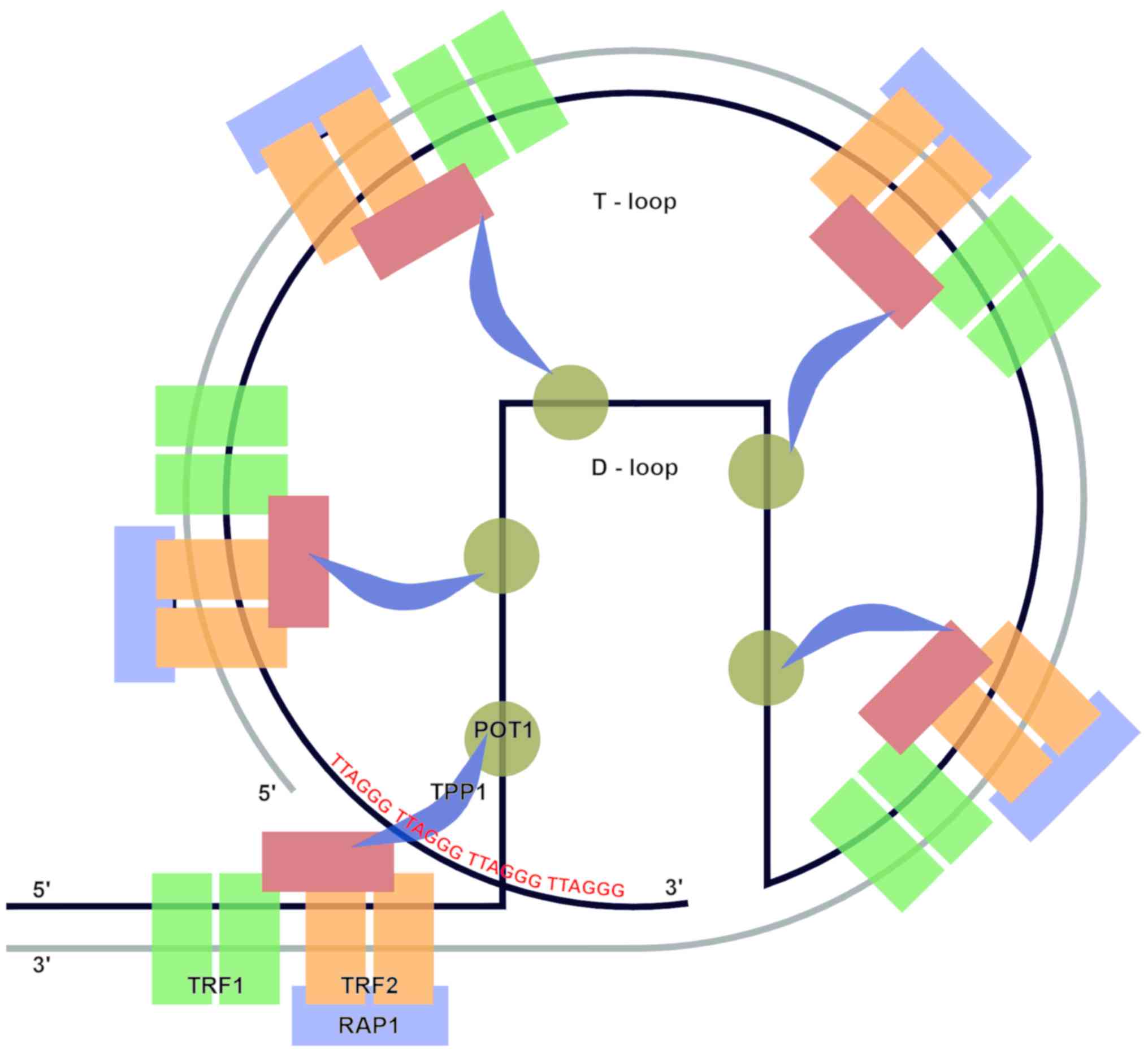
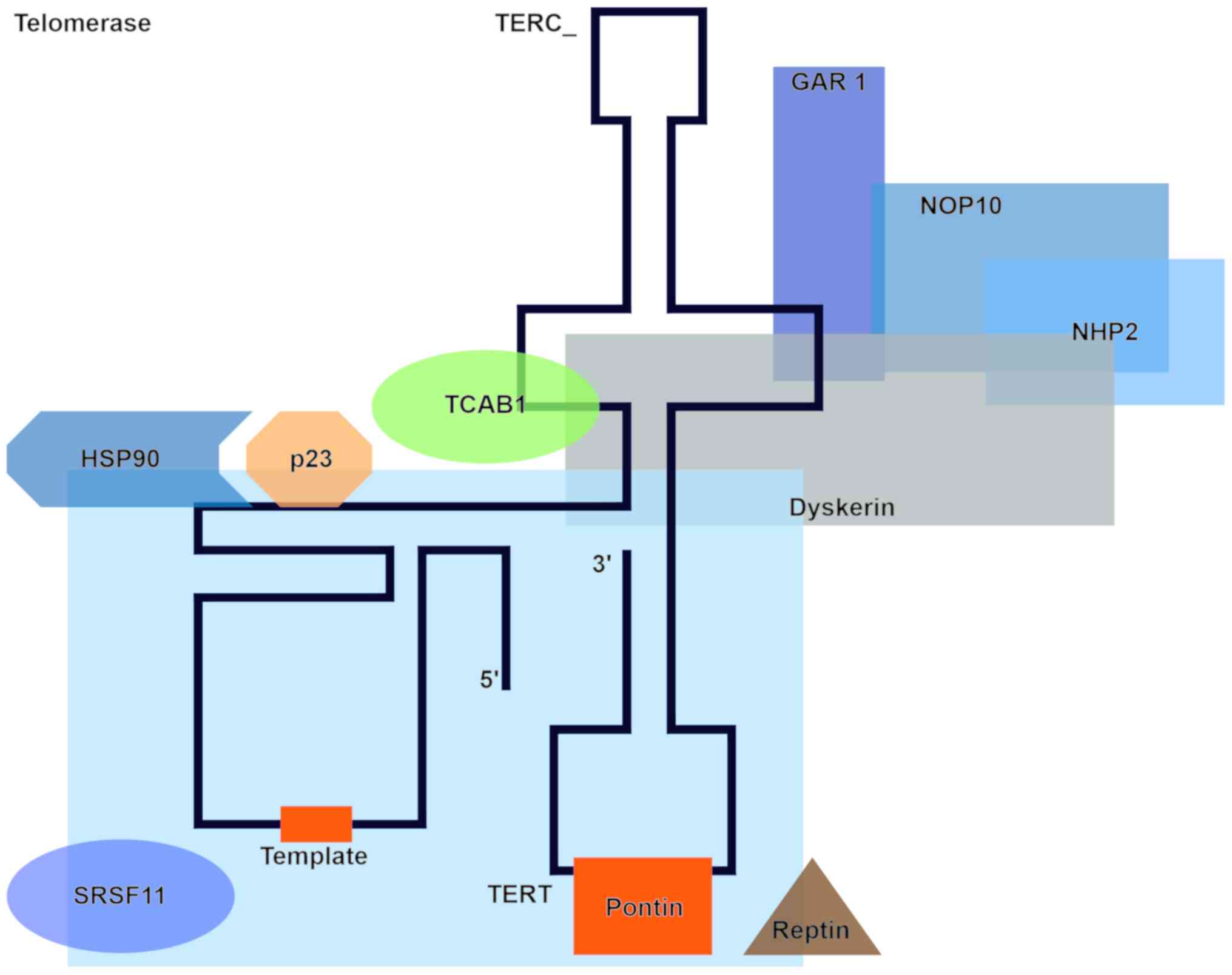
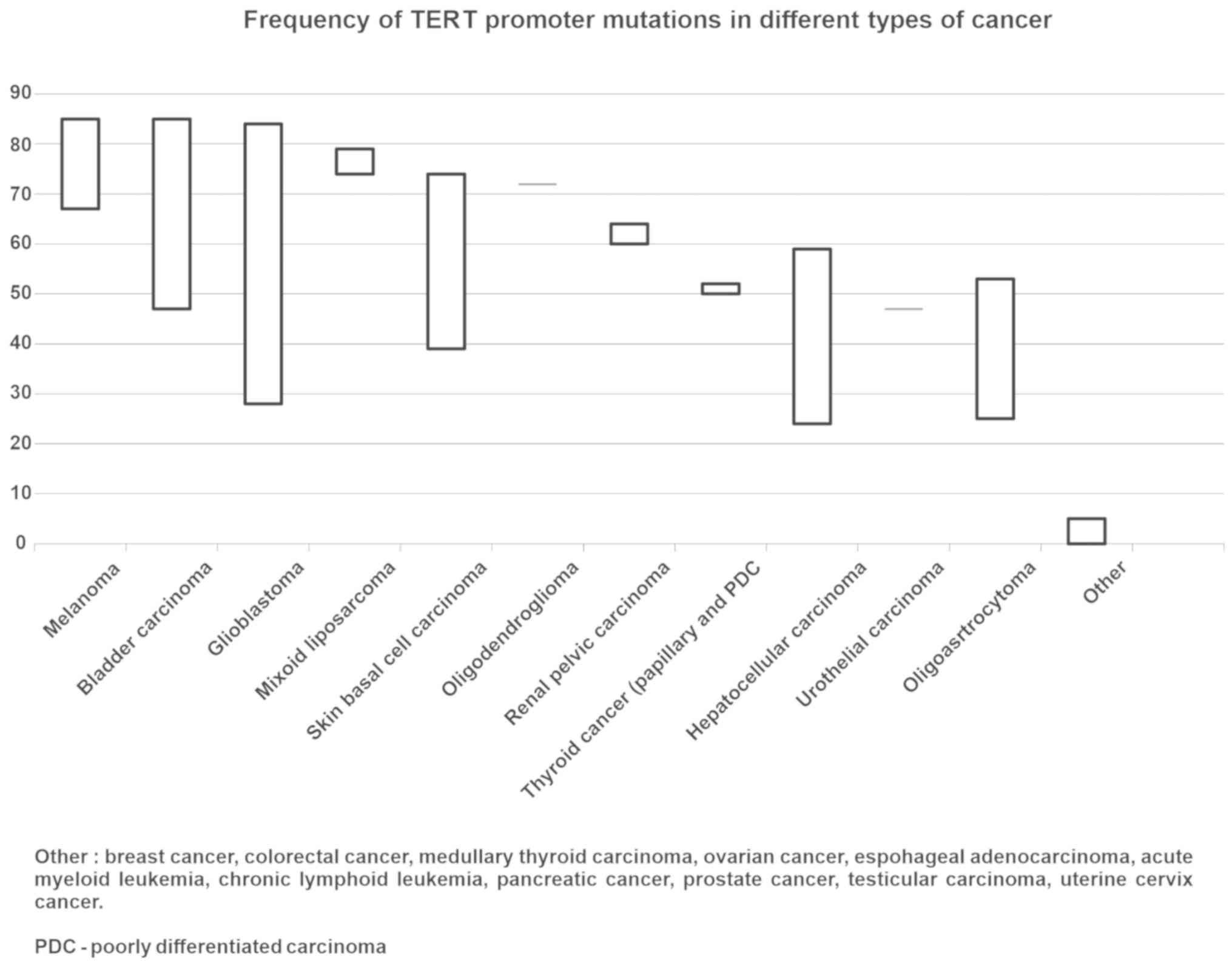
|
1
|
WHO: Cancer, .
|
|
2
|
Seluanov A, Gladyshev VN, Vijg J and
Gorbunova V: Mechanisms of cancer resistance in long-lived mammals.
Nat Rev Cancer. 18:433–441. 2018. View Article : Google Scholar : PubMed/NCBI
|
|
3
|
Shay JW and Wright WE: Telomeres and
telomerase: Three decades of progress. Nat Rev Genet. 20:299–309.
2019. View Article : Google Scholar : PubMed/NCBI
|
|
4
|
Liu T, Yuan X and Xu D: Cancer-specific
telomerase reverse transcriptase (TERT) promoter mutations:
Biological and clinical implications. Genes (Basel). 7(pii):
E382016. View Article : Google Scholar : PubMed/NCBI
|
|
5
|
Yuan X, Larsson C and Xu D: Mechanisms
underlying the activation of TERT transcription and telomerase
activity in human cancer: Old actors and new players. Oncogene.
38:6172–6183. 2019. View Article : Google Scholar : PubMed/NCBI
|
|
6
|
Dilley RL and Greenberg RA: ALTernative
telomere maintenance and cancer. Trends Cancer. 1:145–156. 2015.
View Article : Google Scholar : PubMed/NCBI
|
|
7
|
Hayflick L: The limited in vitro lifetime
of human diploid cell strains. Exp Cell Res. 37:614–636. 1965.
View Article : Google Scholar : PubMed/NCBI
|
|
8
|
Olovnikov AM: A theory of marginotomy. The
incomplete copying of template margin in enzymic synthesis of
polynucleotides and biological significance of the phenomenon. J
Theor Biol. 41:181–190. 1973. View Article : Google Scholar : PubMed/NCBI
|
|
9
|
Szostak JW and Blackburn EH: Cloning yeast
telomeres on linear plasmid vectors. Cell. 29:245–255. 1982.
View Article : Google Scholar : PubMed/NCBI
|
|
10
|
Blackburn EH: Structure and function of
telomeres. Nature. 350:569–573. 1991. View Article : Google Scholar : PubMed/NCBI
|
|
11
|
Greider CW: Telomerase is processive. Mol
Cell Biol. 11:4572–4580. 1991. View Article : Google Scholar : PubMed/NCBI
|
|
12
|
Moyzis RK, Buckingham JM, Cram LS, Dani M,
Deaven LL, Jones MD, Meyne J, Ratliff RL and Wu JR: A highly
conserved repetitive DNA sequence, (TTAGGG)n, present at the
telomeres of human chromosomes. Proc Natl Acad Sci USA.
85:6622–6626. 1988. View Article : Google Scholar : PubMed/NCBI
|
|
13
|
Makarov VL, Hirose Y and Langmore JP: Long
G tails at both ends of human chromosomes suggest a C strand
degradation mechanism for telomere shortening. Cell. 88:657–666.
1997. View Article : Google Scholar : PubMed/NCBI
|
|
14
|
Wellinger RJ and Sen D: The DNA structures
at the ends of eukaryotic chromosomes. Eur J Cancer. 33:735–749.
1997. View Article : Google Scholar : PubMed/NCBI
|
|
15
|
Blackburn EH: Switching and signaling at
the telomere. Cell. 106:661–673. 2001. View Article : Google Scholar : PubMed/NCBI
|
|
16
|
Greider CW and Blackburn EH: A telomeric
sequence in the RNA of Tetrahymena telomerase required for telomere
repeat synthesis. Nature. 337:331–337. 1989. View Article : Google Scholar : PubMed/NCBI
|
|
17
|
Lendvay TS, Morris DK, Sah J,
Balasubramanian B and Lundblad V: Senescence mutants of
Saccharomyces cerevisiae with a defect in telomere replication
identify three additional EST genes. Genetics. 144:1399–1412.
1996.PubMed/NCBI
|
|
18
|
Lingner J and Cech TR: Purification of
telomerase from Euplotes aediculatus: Requirement of a primer 3′
overhang. Proc Natl Acad Sci USA. 93:10712–10717. 1996. View Article : Google Scholar : PubMed/NCBI
|
|
19
|
Liu L, Lai S, Andrews LG and Tollefsbol
TO: Genetic and epigenetic modulation of telomerase activity in
development and disease. Gene. 340:1–10. 2004. View Article : Google Scholar : PubMed/NCBI
|
|
20
|
Kim NW, Piatyszek MA, Prowse KR, Harley
CB, West MD, Ho PL, Coviello GM, Wright WE, Weinrich SL and Shay
JW: Specific association of human telomerase activity with immortal
cells and cancer. Science. 266:2011–2015. 1994. View Article : Google Scholar : PubMed/NCBI
|
|
21
|
Shay JW and Bacchetti S: A survey of
telomerase activity in human cancer. Eur J Cancer. 33:787–791.
1997. View Article : Google Scholar : PubMed/NCBI
|
|
22
|
Horn S, Figl A, Rachakonda PS, Fischer C,
Sucker A, Gast A, Kadel S, Moll I, Nagore E, Hemminki K, et al:
TERT promoter mutations in familial and sporadic melanoma. Science.
339:959–961. 2013. View Article : Google Scholar : PubMed/NCBI
|
|
23
|
Huang FW, Hodis E, Xu MJ, Kryukov GV, Chin
L and Garraway LA: Highly recurrent TERT promoter mutations in
human melanoma. Science. 339:957–959. 2013. View Article : Google Scholar : PubMed/NCBI
|
|
24
|
Zimmermann M, Kibe T, Kabir S and de Lange
T: TRF1 negotiates TTAGGG repeat-associated replication problems by
recruiting the BLM helicase and the TPP1/POT1 repressor of ATR
signaling. Genes Dev. 28:2477–2491. 2014. View Article : Google Scholar : PubMed/NCBI
|
|
25
|
Arnoult N and Karlseder J: Complex
interactions between the DNA-damage response and mammalian
telomeres. Nat Struct Mol Biol. 22:859–866. 2015. View Article : Google Scholar : PubMed/NCBI
|
|
26
|
Denchi EL and de Lange T: Protection of
telomeres through independent control of ATM and ATR by TRF2 and
POT1. Nature. 448:1068–1071. 2007. View Article : Google Scholar : PubMed/NCBI
|
|
27
|
Janoušková E, Nečasová I, Pavloušková J,
Zimmermann M, Hluchý M, Marini V, Nováková M and Hofr C: Human Rap1
modulates TRF2 attraction to telomeric DNA. Nucleic Acids Res.
43:2691–2700. 2015. View Article : Google Scholar : PubMed/NCBI
|
|
28
|
Frescas D and de Lange T: TRF2-tethered
TIN2 can mediate telomere protection by TPP1/POT1. Mol Cell Biol.
34:1349–1362. 2014. View Article : Google Scholar : PubMed/NCBI
|
|
29
|
Stewart JA, Chaiken MF, Wang F and Price
CM: Maintaining the end: Roles of telomere proteins in
end-protection, telomere replication and length regulation. Mutat
Res. 730:12–19. 2012. View Article : Google Scholar : PubMed/NCBI
|
|
30
|
Martínez P and Blasco MA: Telomeric and
extra-telomeric roles for telomerase and the telomere-binding
proteins. Nat Rev Cancer. 11:161–176. 2011. View Article : Google Scholar : PubMed/NCBI
|
|
31
|
Kowalska A and Kowalik A: Telomeres and
telomerase in oncogenesis. Contemp Oncol (Pozn). 10:485–496.
2006.
|
|
32
|
Shore D and Bianchi A: Telomere length
regulation: Coupling DNA end processing to feedback regulation of
telomerase. EMBO J. 28:2309–2322. 2009. View Article : Google Scholar : PubMed/NCBI
|
|
33
|
Bourgeron T, Xu Z, Doumic M and Teixeira
MT: The asymmetry of telomere replication contributes to
replicative senescence heterogeneity. Sci Rep. 5:153262015.
View Article : Google Scholar : PubMed/NCBI
|
|
34
|
Hemann MT, Strong MA, Hao LY and Greider
CW: The shortest telomere, not average telomere length, is critical
for cell viability and chromosome stability. Cell. 107:67–77. 2001.
View Article : Google Scholar : PubMed/NCBI
|
|
35
|
Pedram M, Sprung CN, Gao Q, Lo AWI,
Reynolds GE and Murnane JP: Telomere position effect and silencing
of transgenes near telomeres in the mouse. Mol Cell Biol.
26:1865–1878. 2006. View Article : Google Scholar : PubMed/NCBI
|
|
36
|
Robin JD, Ludlow AT, Batten K, Magdinier
F, Stadler G, Wagner KR, Shay JW and Wright WE: Telomere position
effect: Regulation of gene expression with progressive telomere
shortening over long distances. Genes Dev. 28:2464–2476. 2014.
View Article : Google Scholar : PubMed/NCBI
|
|
37
|
Jafri MA, Ansari SA, Alqahtani MH and Shay
JW: Roles of telomeres and telomerase in cancer, and advances in
telomerase-targeted therapies. Genome Med. 8:692016. View Article : Google Scholar : PubMed/NCBI
|
|
38
|
Kyo S, Takakura M, Fujiwara T and Inoue M:
Understanding and exploiting hTERT promoter regulation for
diagnosis and treatment of human cancers. Cancer Sci. 99:1528–1538.
2008. View Article : Google Scholar : PubMed/NCBI
|
|
39
|
Kang SS, Kwon T, Kwon DY and Do SI: Akt
protein kinase enhances human telomerase activity through
phosphorylation of telomerase reverse transcriptase subunit. J Biol
Chem. 274:13085–13090. 1999. View Article : Google Scholar : PubMed/NCBI
|
|
40
|
Broccoli D, Young JW and de Lange T:
Telomerase activity in normal and malignant hematopoietic cells.
Proc Natl Acad Sci USA. 92:9082–9086. 1995. View Article : Google Scholar : PubMed/NCBI
|
|
41
|
Härle-Bachor C and Boukamp P: Telomerase
activity in the regenerative basal layer of the epidermis inhuman
skin and in immortal and carcinoma-derived skin keratinocytes. Proc
Natl Acad Sci USA. 93:6476–6481. 1996. View Article : Google Scholar : PubMed/NCBI
|
|
42
|
Kyo S, Takakura M, Kohama T and Inoue M:
Telomerase activity in human endometrium. Cancer Res. 57:610–614.
1997.PubMed/NCBI
|
|
43
|
Hiyama K, Hirai Y, Kyoizumi S, Akiyama M,
Hiyama E, Piatyszek MA, Shay JW, Ishioka S and Yamakido M:
Activation of telomerase in human lymphocytes and hematopoietic
progenitor cells. J Immunol. 155:3711–3715. 1995.PubMed/NCBI
|
|
44
|
Ramirez RD, Wright WE, Shay JW and Taylor
RS: Telomerase activity concentrates in the mitotically active
segments of human hair follicles. J Invest Dermatol. 108:113–117.
1997. View Article : Google Scholar : PubMed/NCBI
|
|
45
|
Cesare AJ and Reddel RR: Alternative
lengthening of telomeres: Models, mechanisms and implications. Nat
Rev Genet. 11:319–330. 2010. View Article : Google Scholar : PubMed/NCBI
|
|
46
|
Heaphy CM, de Wilde RF, Jiao Y, Klein AP,
Edil BH, Shi C, Bettegowda C, Rodriguez FJ, Eberhart CG, Hebbar S,
et al: Altered telomeres in tumors with ATRX and DAXX mutations.
Science. 333:4252011. View Article : Google Scholar : PubMed/NCBI
|
|
47
|
Henson JD, Hannay JA, McCarthy SW, Royds
JA, Yeager TR, Robinson RA, Wharton SB, Jellinek DA, Arbuckle SM,
Yoo J, et al: A robust assay for alternative lengthening of
telomeres in tumors shows the significance of alternative
lengthening of telomeres in sarcomas and astrocytomas. Clin Cancer
Res. 11:217–225. 2005.PubMed/NCBI
|
|
48
|
Im E, Yoon JB, Lee HW and Chung KC: Human
telomerase reverse transcriptase (hTERT) positively regulates 26s
proteasome activity. J Cell Physiol. 232:2083–2093. 2017.
View Article : Google Scholar : PubMed/NCBI
|
|
49
|
Hu C, Ni Z, Li BS, Yong X, Yang X, Zhang
JW, Zhang D, Qin Y, Jie MM, Dong H, et al: hTERT promotes the
invasion of gastric cancer cells by enhancing FOXO3a ubiquitination
and subsequent ITGB1 upregulation. Gut. 66:31–42. 2017. View Article : Google Scholar : PubMed/NCBI
|
|
50
|
Saretzki G: Extra-telomeric functions of
human telomerase: Cancer, mitochondria and oxidative stress. Curr
Pharm Des. 20:6386–6403. 2014. View Article : Google Scholar : PubMed/NCBI
|
|
51
|
Masutomi K, Possemato R, Wong JM, Currier
JL, Tothova Z, Manola JB, Ganesan S, Lansdorp PM, Collins K and
Hahn WC: The telomerase reverse transcriptase regulates chromatin
state and DNA damage responses. Proc Natl Acad Sci USA.
102:8222–8227. 2005. View Article : Google Scholar : PubMed/NCBI
|
|
52
|
Liu Z, Li Q, Li K, Chen L, Li W, Hou M,
Liu T, Yang J, Lindvall C, Björkholm M, et al: Telomerase reverse
transcriptase promotes epithelial-mesenchymal transition and stem
cell-like traits in cancer cells. Oncogene. 32:4203–4213. 2013.
View Article : Google Scholar : PubMed/NCBI
|
|
53
|
Zhang K, Guo Y, Wang X, Zhao H, Ji Z,
Cheng C, Li L, Fang Y, Xu D, Zhu HH and Gao WQ: WNT/β-catenin
directs self-renewal symmetric cell division of hTERThigh prostate
cancer stem cells. Cancer Res. 77:2534–2547. 2017. View Article : Google Scholar : PubMed/NCBI
|
|
54
|
Ding D, Xi P, Zhou J, Wang M and Cong YS:
Human telomerase reverse transcriptase regulates MMP expression
independently of telomerase activity via NF-κB-dependent
transcription. FASEB J. 27:4375–4383. 2013. View Article : Google Scholar : PubMed/NCBI
|
|
55
|
Lassmann T, Maida Y, Tomaru Y, Yasukawa M,
Ando Y, Kojima M, Kasim V, Simon C, Daub CO, Carninci P, et al:
Telomerase reverse transcriptase regulates microRNAs. Int J Mol
Sci. 16:1192–1208. 2015. View Article : Google Scholar : PubMed/NCBI
|
|
56
|
Drevytska TI, Nagibin VS, Gurianova VL,
Kedlyan VR, Moibenko AA and Dosenko VE: Silencing of TERT decreases
levels of miR-1, miR-21, miR-29a and miR-208a in cardiomyocytes.
Cell Biochem Funct. 32:565–570. 2014. View Article : Google Scholar : PubMed/NCBI
|
|
57
|
Koh CM, Khattar E, Leow SC, Liu CY, Muller
J, Ang WX, Li Y, Franzoso G, Li S, Guccione E and Tergaonkar V:
Telomerase regulates MYC-driven oncogenesis independent of its
reverse transcriptase activity. J Clin Invest. 125:2109–2122. 2015.
View Article : Google Scholar : PubMed/NCBI
|
|
58
|
Mattiussi M, Tilman G, Lenglez S and
Decottignies A: Human telomerase represses ROS-dependent cellular
responses to tumor necrosis factor-α without affecting NF-κB
activation. Cell Signal. 24:708–717. 2012. View Article : Google Scholar : PubMed/NCBI
|
|
59
|
Ghosh A, Saginc G, Leow SC, Khattar E,
Shin EM, Yan TD, Wong M, Zhang Z, Li G, Sung WK, et al: Telomerase
directly regulates NF-κB-dependent transcription. Nat Cell Biol.
14:1270–1281. 2012. View Article : Google Scholar : PubMed/NCBI
|
|
60
|
Zhang Y, Toh L, Lau P and Wang X: Human
telomerase reverse transcriptase (hTERT) is a novel target of the
Wnt/β-catenin pathway in human cancer. J Biol Chem.
287:32494–32511. 2012. View Article : Google Scholar : PubMed/NCBI
|
|
61
|
Cong YS, Wen J and Bacchetti S: The human
telomerase catalytic subunit hTERT: Organization of the gene and
characterization of the promoter. Hum Mol Genet. 8:137–142. 1999.
View Article : Google Scholar : PubMed/NCBI
|
|
62
|
Lee DD, Leão R, Komosa M, Gallo M, Zhang
CH, Lipman T, Remke M, Heidari A, Nunes NM, Apolónio JD, et al: DNA
hypermethylation within TERT promoter upregulates TERT expression
in cancer. J Clin Invest. 129:223–229. 2019. View Article : Google Scholar : PubMed/NCBI
|
|
63
|
Casillas MA, Brotherton SL, Andrews LG,
Ruppert JM and Tollefsbol TO: Induction of endogenous telomerase
(hTERT) by c-Myc in WI-38 fibroblasts transformed with specific
genetic elements. Gene. 316:57–65. 2003. View Article : Google Scholar : PubMed/NCBI
|
|
64
|
Bellon M and Nicot C: Regulation of
telomerase and telomeres: Human tumor viruses take control. J Natl
Cancer Inst. 100:98–108. 2008. View Article : Google Scholar : PubMed/NCBI
|
|
65
|
Barthel FP, Wei W, Tang M,
Martinez-Ledesma E, Hu X, Amin SB, Akdemir KC, Seth S, Song X, Wang
Q, et al: Systematic analysis of telomere length and somatic
alterations in 31 cancer types. Nat Genet. 49:349–357. 2017.
View Article : Google Scholar : PubMed/NCBI
|
|
66
|
Killela PJ, Reitman ZJ, Jiao Y, Bettegowda
C, Agrawal N, Diaz LA Jr, Friedman AH, Friedman H, Gallia GL,
Giovanella BC, et al: TERT promoter mutations occur frequently in
gliomas and a subset of tumors derived from cells with low rates of
self-renewal. Proc Natl Acad Sci USA. 110:6021–6026. 2013.
View Article : Google Scholar : PubMed/NCBI
|
|
67
|
Rachakonda PS, Hosen I, de Verdier PJ,
Fallah M, Heidenreich B, Ryk C, Wiklund NP, Steineck G, Schadendorf
D, Hemminki K and Kumar R: TERT promoter mutations in bladder
cancer affect patient survival and disease recurrence through
modification by a common polymorphism. Proc Natl Acad Sci USA.
110:17426–17431. 2013. View Article : Google Scholar : PubMed/NCBI
|
|
68
|
Wang K, Liu T, Liu L, Liu J, Liu C, Wang
C, Ge N, Ren H, Yan K, Hu S, et al: TERT promoter mutations in
renal cell carcinomas and upper tract urothelial carcinomas.
Oncotarget. 5:1829–1836. 2014. View Article : Google Scholar : PubMed/NCBI
|
|
69
|
Cevik D, Yildiz G and Ozturk M: Common
telomerase reverse transcriptase promoter mutations in
hepatocellular carcinomas from different geographical locations.
World J Gastroenterol. 21:311–317. 2015. View Article : Google Scholar : PubMed/NCBI
|
|
70
|
Liu X, Bishop J, Shan Y, Pai S, Liu D,
Murugan AK, Sun H, El-Naggar AK and Xing M: Highly prevalent TERT
promoter mutations in aggressive thyroid cancers. Endocr Relat
Cancer. 20:603–610. 2013. View Article : Google Scholar : PubMed/NCBI
|
|
71
|
Koelsche C, Renner M, Hartmann W, Brandt
R, Lehner B, Waldburger N, Alldinger I, Schmitt T, Egerer G, Penzel
R, et al: TERT promoter hotspot mutations are recurrent in myxoid
liposarcomas but rare in other soft tissue sarcoma entities. J Exp
Clin Cancer Res. 33:332014. View Article : Google Scholar : PubMed/NCBI
|
|
72
|
Vinagre J, Pinto V, Celestino R, Reis M,
Pópulo H, Boaventura P, Melo M, Catarino T, Lima J, Lopes JM, et
al: Telomerase promoter mutations in cancer: An emerging molecular
biomarker? Virchows Arch. 465:119–133. 2014. View Article : Google Scholar : PubMed/NCBI
|
|
73
|
Bell RJA, Rube HT, Kreig A, Mancini A,
Fouse SD, Nagarajan RP, Choi S, Hong C, He D, Pekmezci M, et al:
Cancer. The transcription factor GABP selectively binds and
activates the mutant TERT promoter in cancer. Science.
348:1036–1039. 2015. View Article : Google Scholar : PubMed/NCBI
|
|
74
|
Chen X, Kost J, Sulovari A, Wong N, Liang
WS, Cao J and Li D: A virome-wide clonal integration analysis
platform for discovering cancer viral etiology. Genome Res.
29:819–830. 2019. View Article : Google Scholar : PubMed/NCBI
|
|
75
|
Strååt K, Liu C, Rahbar A, Zhu Q, Liu L,
Wolmer-Solberg N, Lou F, Liu Z, Shen J, Jia J, et al: Activation of
telomerase by human cytomegalovirus. J Natl Cancer Inst.
101:488–497. 2009. View Article : Google Scholar : PubMed/NCBI
|
|
76
|
Labgaa I, Villacorta-Martin C, D'Avola D,
Craig AJ, von Felden J, Martins-Filho SN, Sia D, Stueck A, Ward SC
and Fiel MI: A pilot study of ultra-deep targeted sequencing of
plasma DNA identifies driver mutations in hepatocellular carcinoma.
Oncogene. 37:3740–3752. 2018. View Article : Google Scholar : PubMed/NCBI
|
|
77
|
Hurst CD, Platt FM and Knowles MA:
Comprehensive mutation analysis of the TERT promoter in bladder
cancer and detection of mutations in voided urine. Eur Urol.
65:367–369. 2014. View Article : Google Scholar : PubMed/NCBI
|
|
78
|
Juratli TA, Stasik S, Zolal A, Schuster C,
Richter S, Daubner D, Juratli MA, Thowe R, Hennig S, Makina M, et
al: TERT promoter mutation detection in cell-free tumor-derived DNA
in patients with IDH wild-type glioblastomas: A pilot prospective
study. Clin Cancer Res. 24:5282–5291. 2018. View Article : Google Scholar : PubMed/NCBI
|
|
79
|
Liu L, Liu C, Fotouhi O, Fan Y, Wang K,
Xia C, Shi B, Zhang G, Wang K, Kong F, et al: TERT promoter
hypermethylation in gastrointestinal cancer: A potential stool
biomarker. Oncologist. 22:1178–1188. 2017. View Article : Google Scholar : PubMed/NCBI
|
|
80
|
Bougel S, Lhermitte B, Gallagher G, de
Flaugergues JC, Janzer RC and Benhattar J: Methylation of the hTERT
promoter: A novel cancer biomarker for leptomeningeal metastasis
detection in cerebrospinal fluids. Clin Cancer Res. 19:2216–2223.
2013. View Article : Google Scholar : PubMed/NCBI
|
|
81
|
Bianchi F, Nicassio F, Marzi M, Belloni E,
Dall'olio V, Bernard L, Pelosi G, Maisonneuve P, Veronesi G and Di
Fiore PP: A serum circulating miRNA diagnostic test to identify
asymptomatic high-risk individuals with early stage lung cancer.
EMBO Mol Med. 3:495–503. 2011. View Article : Google Scholar : PubMed/NCBI
|
|
82
|
Nagore E, Heidenreich B, Rachakonda S,
Garcia-Casado Z, Requena C, Soriano V, Frank C, Traves V, Quecedo
E, Sanjuan-Gimenez J, et al: TERT promoter mutations in melanoma
survival. Int J Cancer. 139:75–84. 2016. View Article : Google Scholar : PubMed/NCBI
|
|
83
|
Yuan Y, Qi C, Maling G, Xiang W, Yanhui L,
Ruofei L, Yunhe M, Jiewen L and Qing M: TERT mutation in glioma:
Frequency, prognosis and risk. J Clin Neurosci. 26:57–62. 2016.
View Article : Google Scholar : PubMed/NCBI
|
|
84
|
Melo M, da Rocha AG, Vinagre J, Batista R,
Peixoto J, Tavares C, Celestino R, Almeida A, Salgado C, Eloy C, et
al: TERT promoter mutations are a major indicator of poor outcome
in differentiated thyroid carcinomas. J Clin Endocrinol Metab.
99:E754–765. 2014. View Article : Google Scholar : PubMed/NCBI
|
|
85
|
Liu R and Xing M: TERT promoter mutations
in thyroid cancer. Endocr Relat Cancer. 23:R143–R155. 2016.
View Article : Google Scholar : PubMed/NCBI
|
|
86
|
Castelo-Branco P, Choufani S, Mack S,
Gallagher D, Zhang C, Lipman T, Zhukova N, Walker EJ, Martin D,
Merino D, et al: Methylation of the TERT promoter and risk
stratification of childhood brain tumours: An integrative genomic
and molecular study. Lancet Oncol. 14:534–542. 2013. View Article : Google Scholar : PubMed/NCBI
|
|
87
|
Svahn F, Paulsson JO, Stenman A, Fotouhi
O, Mu N, Murtha TD, Korah R, Carling T, Bäckdahl M, Wang N, et al:
TERT promoter hypermethylation is associated with poor prognosis in
adrenocortical carcinoma. Int J Mol Med. 42:1675–1683.
2018.PubMed/NCBI
|
|
88
|
Liu X, Qu S, Liu R, Sheng C, Shi X, Zhu G,
Murugan AK, Guan H, Yu H, Wang Y, et al: TERT promoter mutations
and their association with BRAF V600E mutation and aggressive
clinicopathological characteristics of thyroid cancer. J Clin
Endocrinol Metab. 99:E1130–E1136. 2014. View Article : Google Scholar : PubMed/NCBI
|
|
89
|
Macerola E, Loggini B, Giannini R,
Garavello G, Giordano M, Proietti A, Niccoli C, Basolo F and
Fontanini G: Coexistence of TERT promoter and BRAF mutations in
cutaneous melanoma is associated with more clinicopathological
features of aggressiveness. Virchows Arch. 467:177–184. 2015.
View Article : Google Scholar : PubMed/NCBI
|
|
90
|
Liu R, Zhang T, Zhu G and Xing M:
Regulation of mutant TERT by BRAF V600E/MAP kinase pathway through
FOS/GABP in human cancer. Nat Commun. 9:5792018. View Article : Google Scholar : PubMed/NCBI
|
|
91
|
Liu W, Yin Y, Wang J, Shi B, Zhang L, Qian
D, Li C, Zhang H, Wang S, Zhu J, et al: Kras mutations increase
telomerase activity and targeting telomerase is a promising
therapeutic strategy for Kras-mutant NSCLC. Oncotarget. 8:179–190.
2017. View Article : Google Scholar : PubMed/NCBI
|
|
92
|
Meeker AK, Hicks JL, Platz EA, March GE,
Bennett CJ, Delannoy MJ and De Marzo AM: Telomere shortening is an
early somatic DNA alteration in human prostate tumorigenesis.
Cancer Res. 62:6405–6409. 2002.PubMed/NCBI
|
|
93
|
Pestana A, Vinagre J, Sobrinho-Simões M
and Soares P: TERT biology and function in cancer: Beyond
immortalisation. J Mol Endocrinol. 58:R129–R146. 2017. View Article : Google Scholar : PubMed/NCBI
|
|
94
|
Frink RE, Peyton M, Schiller JH, Gazdar
AF, Shay JW and Minna JD: Telomerase inhibitor imetelstat has
preclinical activity across the spectrum of non-small cell lung
cancer oncogenotypes in a telomere length dependent manner.
Oncotarget. 7:31639–31651. 2016. View Article : Google Scholar : PubMed/NCBI
|
|
95
|
Chiappori AA, Kolevska T, Spigel DR, Hager
S, Rarick M, Gadgeel S, Blais N, Von Pawel J, Hart L, Reck M, et
al: A randomized phase II study of the telomerase inhibitor
imetelstat as maintenance therapy for advanced non-small-cell lung
cancer. Ann Oncol. 26:354–362. 2015. View Article : Google Scholar : PubMed/NCBI
|
|
96
|
Burchett KM, Yan Y and Ouellette MM:
Telomerase inhibitor Imetelstat (GRN163L) limits the lifespan of
human pancreatic cancer cells. PLoS One. 9:e851552014. View Article : Google Scholar : PubMed/NCBI
|
|
97
|
Shammas MA, Koley H, Bertheau RC, Neri P,
Fulciniti M, Tassone P, Blotta S, Protopopov A, Mitsiades C, Batchu
RB, et al: Telomerase inhibitor GRN163L inhibits myeloma cell
growth in vitro and in vivo. Leukemia. 22:1410–1418. 2008.
View Article : Google Scholar : PubMed/NCBI
|
|
98
|
Dikmen ZG, Gellert GC, Jackson S, Gryaznov
S, Tressler R, Dogan P, Wright WE and Shay JW: In vivo inhibition
of lung cancer by GRN163L: A novel human telomerase inhibitor.
Cancer Res. 65:7866–7873. 2005. View Article : Google Scholar : PubMed/NCBI
|
|
99
|
Tokcaer-Keskin Z, Dikmen ZG,
Ayaloglu-Butun F, Gultekin S, Gryaznov SM and Akcali KC: The effect
of telomerase template antagonist GRN163L on bone-marrow-derived
rat mesenchymal stem cells is reversible and associated with
altered expression of cyclin d1, cdk4 and cdk6. Stem Cell Rev Rep.
6:224–233. 2010. View Article : Google Scholar : PubMed/NCBI
|
|
100
|
Burchett KM, Etekpo A, Batra SK, Yan Y and
Ouellette MM: Inhibitors of telomerase and poly(ADP-ribose)
polymerases synergize to limit the lifespan of pancreatic cancer
cells. Oncotarget. 8:83754–83767. 2017. View Article : Google Scholar : PubMed/NCBI
|
|
101
|
Koziel JE and Herbert BS: The telomerase
inhibitor imetelstat alone, and in combination with trastuzumab,
decreases the cancer stem cell population and self-renewal of HER2+
breast cancer cells. Breast Cancer Res Treat. 149:607–618. 2015.
View Article : Google Scholar : PubMed/NCBI
|
|
102
|
Wu X, Zhang J, Yang S, Kuang Z, Tan G,
Yang G, Wei Q and Guo Z: Telomerase antagonist imetelstat increases
radiation sensitivity in esophageal squamous cell carcinoma.
Oncotarget. 8:13600–13619. 2017. View Article : Google Scholar : PubMed/NCBI
|
|
103
|
Chhabra G, Wojdyla L, Frakes M, Schrank Z,
Leviskas B, Ivancich M, Vinay P, Ganapathy R, Ramirez BE and Puri
N: Mechanism of action of G-quadruplex-forming oligonucleotide
homologous to the telomere overhang in melanoma. J Invest Dermatol.
138:903–910. 2018. View Article : Google Scholar : PubMed/NCBI
|
|
104
|
Schrank Z, Khan N, Osude C, Singh S,
Miller RJ, Merrick C, Mabel A, Kuckovic A and Puri N:
Oligonucleotides targeting telomeres and telomerase in cancer.
Molecules. 23(pii): E22672018. View Article : Google Scholar : PubMed/NCBI
|
|
105
|
Pitman RT, Wojdyla L and Puri N: Mechanism
of DNA damage responses induced by exposure to an oligonucleotide
homologous to the telomere overhang in melanoma. Oncotarget.
4:761–771. 2013. View Article : Google Scholar : PubMed/NCBI
|
|
106
|
Puri N, Pitman RT, Mulnix RE, Erickson T,
Iness AN, Vitali C, Zhao Y and Salgia R: Non-small cell lung cancer
is susceptible to induction of DNA damage responses and inhibition
of angiogenesis by telomere overhang oligonucleotides. Cancer Lett.
343:14–23. 2014. View Article : Google Scholar : PubMed/NCBI
|
|
107
|
Wojdyla L, Stone AL, Sethakorn N, Uppada
SB, Devito JT, Bissonnette M and Puri N: T-oligo as an anticancer
agent in colorectal cancer. Biochem Biophys Res Commun.
446:596–601. 2014. View Article : Google Scholar : PubMed/NCBI
|
|
108
|
Weng D, Cunin MC, Song B, Price BD, Eller
MS, Gilchrest BA, Calderwood SK and Gong J: Radiosensitization of
mammary carcinoma cells by telomere homolog oligonucleotide
pretreatment. Breast Cancer Res. 12:R712010. View Article : Google Scholar : PubMed/NCBI
|
|
109
|
Guzman H, Sanders K, Idica A, Bochnakian
A, Jury D, Daugaard I, Zisoulis DG and Pedersen IM: miR-128
inhibits telomerase activity by targeting TERT mRNA. Oncotarget.
9:13244–13253. 2018. View Article : Google Scholar : PubMed/NCBI
|
|
110
|
Zhou N, Fei D, Zong S, Zhang M and Yue Y:
MicroRNA-138 inhibits proliferation, migration and invasion through
targeting hTERT in cervical cancer. Oncol Lett. 12:3633–3639. 2016.
View Article : Google Scholar : PubMed/NCBI
|
|
111
|
Mitomo S, Maesawa C, Ogasawara S, Iwaya T,
Shibazaki M, Yashima-Abo A, Kotani K, Oikawa H, Sakurai E, Izutsu
N, et al: Downregulation of miR-138 is associated with
overexpression of human telomerase reverse transcriptase protein in
human anaplastic thyroid carcinoma cell lines. Cancer Sci.
99:280–286. 2008. View Article : Google Scholar : PubMed/NCBI
|
|
112
|
Zhang D, Xiao YF, Zhang JW, Xie R, Hu CJ,
Tang B, Wang SM, Wu YY, Hao NB and Yang SM: miR-1182 attenuates
gastric cancer proliferation and metastasis by targeting the open
reading frame of hTERT. Cancer Lett. 360:151–159. 2015. View Article : Google Scholar : PubMed/NCBI
|
|
113
|
Melnik BC: miR-21: An environmental driver
of malignant melanoma? J Transl Med. 13:2022015. View Article : Google Scholar : PubMed/NCBI
|
|
114
|
Yang Y, Yang JJ, Tao H and Jin WS:
MicroRNA-21 controls hTERT via PTEN in human colorectal cancer cell
proliferation. J Physiol Biochem. 71:59–68. 2015. View Article : Google Scholar : PubMed/NCBI
|
|
115
|
Nguyen DD and Chang S: Development of
novel therapeutic agents by inhibition of oncogenic microRNAs. Int
J Mol Sci. 19(pii): E652017. View Article : Google Scholar : PubMed/NCBI
|
|
116
|
Mizukoshi E and Kaneko S:
Telomerase-targeted cancer immunotherapy. Int J Mol Sci. 20(pii):
E18232019. View Article : Google Scholar : PubMed/NCBI
|
|
117
|
Staff C, Mozaffari F, Frödin JE, Mellstedt
H and Liljefors M: Telomerase (GV1001) vaccination together with
gemcitabine in advanced pancreatic cancer patients. Int J Oncol.
45:1293–1303. 2014. View Article : Google Scholar : PubMed/NCBI
|
|
118
|
Fenoglio D, Traverso P, Parodi A,
Tomasello L, Negrini S, Kalli F, Battaglia F, Ferrera F, Sciallero
S, Murdaca G, et al: A multi-peptide, dual-adjuvant telomerase
vaccine (GX301) is highly immunogenic in patients with prostate and
renal cancer. Cancer Immunol Immunother. 62:1041–1052. 2013.
View Article : Google Scholar : PubMed/NCBI
|
|
119
|
Fenoglio D, Parodi A, Lavieri R, Kalli F,
Ferrera F, Tagliamacco A, Guastalla A, Lamperti MG, Giacomini M and
Filaci G: Immunogenicity of GX301 cancer vaccine: Four (telomerase
peptides) are better than one. Hum Vaccin Immunother. 11:838–850.
2015. View Article : Google Scholar : PubMed/NCBI
|
|
120
|
Lilleby W, Gaudernack G, Brunsvig PF,
Vlatkovic L, Schulz M, Mills K, Hole KH and Inderberg EM: Phase
I/IIa clinical trial of a novel hTERT peptide vaccine in men with
metastatic hormone-naive prostate cancer. Cancer Immunol
Immunother. 66:891–901. 2017. View Article : Google Scholar : PubMed/NCBI
|
|
121
|
Kotsakis A, Papadimitraki E, Vetsika EK,
Aggouraki D, Dermitzaki EK, Hatzidaki D, Kentepozidis N, Mavroudis
D and Georgoulias V: A phase II trial evaluating the clinical and
immunologic response of HLA-A2(+) non-small cell lung cancer
patients vaccinated with an hTERT cryptic peptide. Lung Cancer.
86:59–66. 2014. View Article : Google Scholar : PubMed/NCBI
|
|
122
|
Su Z, Dannull J, Yang BK, Dahm P, Coleman
D, Yancey D, Sichi S, Niedzwiecki D, Boczkowski D, Gilboa E and
Vieweg J: Telomerase mRNA-transfected dendritic cells stimulate
antigen-specific CD8+ and CD4+ T cell responses in patients with
metastatic prostate cancer. J Immunol. 174:3798–3807. 2005.
View Article : Google Scholar : PubMed/NCBI
|
|
123
|
Khoury HJ, Collins RH Jr, Blum W, Stiff
PS, Elias L, Lebkowski JS, Reddy A, Nishimoto KP, Sen D, Wirth ED
III, et al: Immune responses and long-term disease recurrence
status after telomerase-based dendritic cell immunotherapy in
patients with acute myeloid leukemia. Cancer. 123:3061–3072. 2017.
View Article : Google Scholar : PubMed/NCBI
|
|
124
|
Galati D and Zanotta S: Empowering
dendritic cell cancer vaccination: The role of combinatorial
strategies. Cytotherapy. 20:1309–1323. 2018. View Article : Google Scholar : PubMed/NCBI
|
|
125
|
Salazar-Onfray F, Pereda C, Reyes D and
López MN: TAPCells, the Chilean dendritic cell vaccine against
melanoma and prostate cancer. Biol Res. 46:431–440. 2013.
View Article : Google Scholar : PubMed/NCBI
|
|
126
|
Thalmensi J, Pliquet E, Liard C, Escande
M, Bestetti T, Julithe M, Kostrzak A, Pailhes-Jimenez AS, Bourges
E, Loustau M, et al: Anticancer DNA vaccine based on human
telomerase reverse transcriptase generates a strong and specific T
cell immune response. Oncoimmunology. 5:e10836702016. View Article : Google Scholar : PubMed/NCBI
|
|
127
|
Yan J, Pankhong P, Shin TH, Obeng-Adjei N,
Morrow MP, Walters JN, Khan AS, Sardesai NY and Weiner DB: Highly
optimized DNA vaccine targeting human telomerase reverse
transcriptase stimulates potent antitumor immunity. Cancer Immunol
Res. 1:179–189. 2013. View Article : Google Scholar : PubMed/NCBI
|
|
128
|
Ohta R, Demachi-Okamura A, Akatsuka Y,
Fujiwara H and Kuzushima K: Improving TCR affinity on 293T cells. J
Immunol Methods. 466:1–8. 2019. View Article : Google Scholar : PubMed/NCBI
|
|
129
|
Jordheim LP, Durantel D, Zoulim F and
Dumontet C: Advances in the development of nucleoside and
nucleotide analogues for cancer and viral diseases. Nat Rev Drug
Discov. 12:447–464. 2013. View Article : Google Scholar : PubMed/NCBI
|
|
130
|
Pascolo E, Wenz C, Lingner J, Hauel N,
Priepke H, Kauffmann I, Garin-Chesa P, Rettig WJ, Damm K and
Schnapp A: Mechanism of human telomerase inhibition by BIBR1532, a
synthetic, non-nucleosidic drug candidate. J Biol Chem.
277:15566–15572. 2002. View Article : Google Scholar : PubMed/NCBI
|
|
131
|
Kim MY, Vankayalapati H, Shin-Ya K,
Wierzba K and Hurley LH: Telomestatin, a potent telomerase
inhibitor that interacts quite specifically with the human
telomeric intramolecular g-quadruplex. J Am Chem Soc.
124:2098–2099. 2002. View Article : Google Scholar : PubMed/NCBI
|
|
132
|
Gomez DL, Armando RG, Cerrudo CS,
Ghiringhelli PD and Gomez DE: Telomerase as a cancer target.
Development of new molecules. Curr Top Med Chem. 16:2432–2440.
2016. View Article : Google Scholar : PubMed/NCBI
|
|
133
|
Nemunaitis J, Tong AW, Nemunaitis M,
Senzer N, Phadke AP, Bedell C, Adams N, Zhang YA, Maples PB, Chen
S, et al: A phase I study of telomerase-specific replication
competent oncolytic adenovirus (telomelysin) for various solid
tumors. Mol Ther. 18:429–434. 2010. View Article : Google Scholar : PubMed/NCBI
|
|
134
|
Schepelmann S, Ogilvie LM, Hedley D,
Friedlos F, Martin J, Scanlon I, Chen P, Marais R and Springer CJ:
Suicide gene therapy of human colon carcinoma xenografts using an
armed oncolytic adenovirus expressing carboxypeptidase G2. Cancer
Res. 67:4949–4955. 2007. View Article : Google Scholar : PubMed/NCBI
|
|
135
|
Picard D: Intracellular dynamics of the
Hsp90 co-chaperone p23 is dictated by Hsp90. Exp Cell Res.
312:198–204. 2006. View Article : Google Scholar : PubMed/NCBI
|
|
136
|
Ning X, Yang S, Wang R, Zhang R, Guo L,
Tie J, Cheng Y, Wang G, Wan S and Fang D: POT1 deficiency alters
telomere length and telomere-associated gene expression in human
gastric cancer cells. Eur J Cancer Prev. 19:345–351. 2010.
View Article : Google Scholar : PubMed/NCBI
|
|
137
|
Ganesan K and Xu B: Telomerase inhibitors
from natural products and their anticancer potential. Int J Mol
Sci. 19(pii): E132017. View Article : Google Scholar : PubMed/NCBI
|
|
138
|
Mizushina Y, Takeuchi T, Sugawara F and
Yoshida H: Anti-cancer targeting telomerase inhibitors:
β-rubromycin and oleic acid. Mini Rev Med Chem. 12:1135–1143. 2012.
View Article : Google Scholar : PubMed/NCBI
|
|
139
|
Smith S: Telomerase can't handle the
stress. Genes Dev. 32:597–599. 2018. View Article : Google Scholar : PubMed/NCBI
|