|
1
|
Lau H, Kranenburg O, Xiao H and Yu J:
Organoid models of gastrointestinal cancers in basic and
translational research. Nat Rev Gastroenterol Hepatol. 17:203–222.
2020. View Article : Google Scholar : PubMed/NCBI
|
|
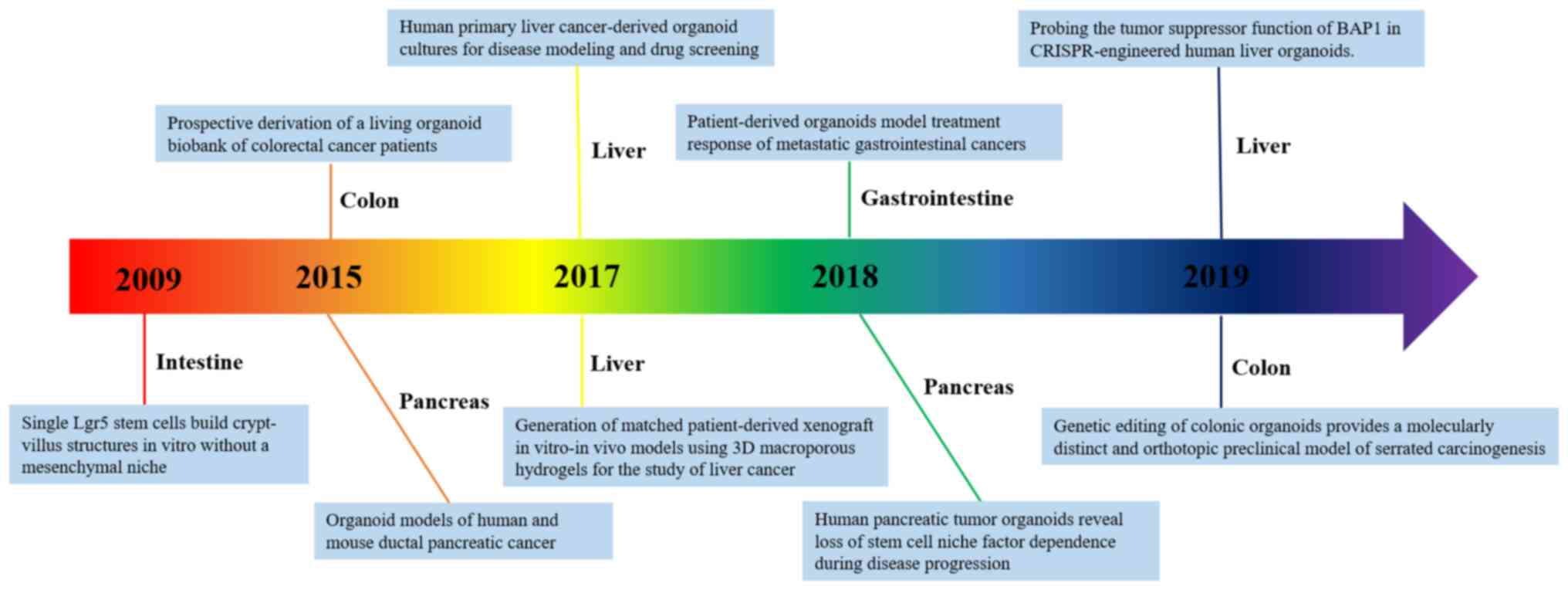
2
|
Wei W, Zeng H, Zheng R, Zhang S, An L,
Chen R, Wang S, Sun K, Matsuda T, Bray F and He J: Cancer
registration in China and its role in cancer prevention and
control. Lancet Oncol. 21:e342–e349. 2020. View Article : Google Scholar : PubMed/NCBI
|
|
3
|
Gähwiler BH, Capogna M, Debanne D,
McKinney RA and Thompson SM: Organotypic slice cultures: A
technique has come of age. Trends Neurosci. 20:471–477. 1997.
View Article : Google Scholar : PubMed/NCBI
|
|
4
|
Fatehullah A, Tan SH and Barker N:
Organoids as an in vitro model of human development and disease.
Nat Cell Biol. 18:246–254. 2016. View
Article : Google Scholar : PubMed/NCBI
|
|
5
|
Clevers H: Modeling development and
disease with organoids. Cell. 165:1586–1597. 2016. View Article : Google Scholar : PubMed/NCBI
|
|
6
|
Dutta D, Heo I and Clevers H: Disease
modeling in stem cell-derived 3D organoid systems. Trends Mol Med.
23:393–410. 2017. View Article : Google Scholar : PubMed/NCBI
|
|
7
|
Chen J, Lau BT, Andor N, Grimes SM, Handy
C, Wood-Bouwens C and Ji HP: Single-cell transcriptome analysis
identifies distinct cell types and niche signaling in a primary
gastric organoid model. Sci Rep. 9:45362019. View Article : Google Scholar : PubMed/NCBI
|
|
8
|
Hartl L, Huelsz-Prince G, van Zon J and
Tans SJ: Apical constriction is necessary for crypt formation in
small intestinal organoids. Dev Biol. 450:76–81. 2019. View Article : Google Scholar : PubMed/NCBI
|
|
9
|
Artegiani B, van Voorthuijsen L, Lindeboom
RGH, Seinstra D, Heo I, Tapia P, López-Iglesias C, Postrach D,
Dayton T, Oka R, et al: Probing the tumor suppressor function of
BAP1 in CRISPR-engineered human liver organoids. Cell Stem Cell.
24:927–943.e6. 2019. View Article : Google Scholar : PubMed/NCBI
|
|
10
|
Matsuura T, Maru Y, Izumiya M, Hoshi D,
Kato S, Ochiai M, Hori M, Yamamoto S, Tatsuno K, Imai T, et al:
Organoid-based ex vivo reconstitution of Kras-driven pancreatic
ductal carcinogenesis. Carcinogenesis. 41:490–501. 2020. View Article : Google Scholar : PubMed/NCBI
|
|
11
|
Shu Y and Chua CW: An organoid assay for
long-term maintenance and propagation of mouse prostate luminal
epithelial progenitors and cancer cells. Methods Mol Biol.
1940:231–254. 2019. View Article : Google Scholar : PubMed/NCBI
|
|
12
|
Gao D and Chen Y: Organoid development in
cancer genome discovery. Curr Opin Genet Dev. 30:42–48. 2015.
View Article : Google Scholar : PubMed/NCBI
|
|
13
|
Schumacher D, Andrieux G, Boehnke K, Keil
M, Silvestri A, Silvestrov M, Keilholz U, Haybaeck J, Erdmann G,
Sachse C, et al: Heterogeneous pathway activation and drug response
modelled in colorectal-tumor-derived 3D cultures. PLoS Genet.
15:e10080762019. View Article : Google Scholar : PubMed/NCBI
|
|
14
|
Corrò C, Novellasdemunt L and Li VSW: A
brief history of organoids. Am J Physiol Cell Physiol.
319:C151–C165. 2020. View Article : Google Scholar : PubMed/NCBI
|
|
15
|
Sato T, Vries RG, Snippert HJ, van de
Wetering M, Barker N, Stange DE, van Es JH, Abo A, Kujala P, Peters
PJ and Clevers H: Single Lgr5 stem cells build crypt-villus
structures in vitro without a mesenchymal niche. Nature.
459:262–265. 2009. View Article : Google Scholar : PubMed/NCBI
|
|
16
|
Neal J, Li X, Zhu J, Giangarra V,
Grzeskowiak CL, Ju J, Liu IH, Chiou SH, Salahudeen AA, Smith AR, et
al: Organoid modeling of the tumor immune microenvironment. Cell.
175:1972–1988.e16. 2018. View Article : Google Scholar : PubMed/NCBI
|
|
17
|
Wild CP, Weiderpass E and Stewart BW:
World Cancer Report: Cancer Research for Cancer Prevention. World
Health Organisation; Geneva, Switzerland: pp. 23–33. 2020,
PubMed/NCBI
|
|
18
|
Liu HD, Xia BR, Jin MZ and Lou G: Organoid
of ovarian cancer: genomic analysis and drug screening. Clinical
and Translational Oncology. 22:1240–1251. 2020. View Article : Google Scholar : PubMed/NCBI
|
|
19
|
Bartfeld S, Bayram T, van de Wetering M,
Huch M, Begthel H, Kujala P, Vries R, Peters PJ and Clevers H: In
vitro expansion of human gastric epithelial stem cells and their
responses to bacterial infection. Gastroenterology. 148:126–136.e6.
2015. View Article : Google Scholar : PubMed/NCBI
|
|
20
|
Bertaux-Skeirik N, Centeno J, Gao J, Gabre
J and Zavros Y: Oncogenic transformation of human-derived gastric
organoids. Methods Mol Biol. 1576:205–213. 2019. View Article : Google Scholar : PubMed/NCBI
|
|
21
|
Nagle PW, Plukker JTM, Muijs CT, van Luijk
P and Coppes RP: Patient-derived tumor organoids for prediction of
cancer treatment response. Semin Cancer Biol. 53:258–264. 2018.
View Article : Google Scholar : PubMed/NCBI
|
|
22
|
Wenzel C, Riefke B, Gründemann S, Krebs A,
Christian S, Prinz F, Osterland M, Golfier S, Räse S, Ansari N, et
al: 3D high-content screening for the identification of compounds
that target cells in dormant tumor spheroid regions. Exp Cell Res.
323:131–143. 2014. View Article : Google Scholar : PubMed/NCBI
|
|
23
|
Arena S, Corti G, Durinikova E, Montone M,
Reilly NM, Russo M, Lorenzato A, Arcella P, Lazzari L, Rospo G, et
al: A subset of colorectal cancers with cross-sensitivity to
olaparib and oxaliplatin. Clin Cancer Res. 26:1372–1384. 2020.
View Article : Google Scholar : PubMed/NCBI
|
|
24
|
Yao Y, Xu X, Yang L, Zhu J, Wan J, Shen L,
Xia F, Fu G, Deng Y, Pan M, et al: Patient-derived organoids
predict chemoradiation responses of locally advanced rectal cancer.
Cell Stem Cell. 26:17–26.e6. 2020. View Article : Google Scholar : PubMed/NCBI
|
|
25
|
Skardal A, Shupe T and Atala A:
Organoid-on-a-chip and body-on-a-chip systems for drug screening
and disease modeling. Drug Discov Today. 21:1399–1411. 2016.
View Article : Google Scholar : PubMed/NCBI
|
|
26
|
Saito Y: Establishment of an organoid bank
of biliary tract and pancreatic cancers and its application for
personalized therapy and future treatment. J Gastroenterol Hepatol.
34:1906–1910. 2019. View Article : Google Scholar : PubMed/NCBI
|
|
27
|
van de Wetering M, Francies HE, Francis
JM, Bounova G, Iorio F, Pronk A, van Houdt W, van Gorp J,
Taylor-Weiner A, Kester L, et al: Prospective derivation of a
living organoid biobank of colorectal cancer patients. Cell.
161:933–945. 2015. View Article : Google Scholar : PubMed/NCBI
|
|
28
|
Kondo J and Inoue MJC: Application of
cancer organoid model for drug screening and personalized therapy.
Cells. 8:4702019. View Article : Google Scholar
|
|
29
|
Broutier L, Mastrogiovanni G, Verstegen
MM, Francies HE, Gavarró LM, Bradshaw CR, Allen GE, Arnes-Benito R,
Sidorova O, Gaspersz MP, et al: Human primary liver cancer-derived
organoid cultures for disease modeling and drug screening. Nat Med.
23:1424–1435. 2017. View Article : Google Scholar : PubMed/NCBI
|
|
30
|
Fong ELS, Toh TB, Lin QXX, Liu Z, Hooi L,
Mohd Abdul Rashid MB, Benoukraf T, Chow EK, Huynh TH and Yu H:
Generation of matched patient-derived xenograft in vitro-in vivo
models using 3D macroporous hydrogels for the study of liver
cancer. Biomaterials. 159:229–240. 2018. View Article : Google Scholar : PubMed/NCBI
|
|
31
|
Siegel RL, Miller KD and Jemal A: Cancer
statistics, 2016. CA Cancer J Clin. 66:7–30. 2016. View Article : Google Scholar : PubMed/NCBI
|
|
32
|
Zhang HC and Kuo CJ: Personalizing
pancreatic cancer organoids with hPSCs. Nat Med. 21:1249–1251.
2015. View Article : Google Scholar : PubMed/NCBI
|
|
33
|
Boj SF, Hwang CI, Baker LA, Chio II, Engle
DD, Corbo V, Jager M, Ponz-Sarvise M, Tiriac H, Spector MS, et al:
Organoid models of human and mouse ductal pancreatic cancer. Cell.
160:324–338. 2015. View Article : Google Scholar : PubMed/NCBI
|
|
34
|
Patman G: Pancreatic cancer: From normal
to metastases-a whole gamut of pancreatic organoids. Nat Rev
Gastroenterol Hepatol. 12:612015. View Article : Google Scholar : PubMed/NCBI
|
|
35
|
Huang L, Holtzinger A, Jagan I, BeGora M,
Lohse I, Ngai N, Nostro C, Wang R, Muthuswamy LB, Crawford HC, et
al: Ductal pancreatic cancer modeling and drug screening using
human pluripotent stem cell- and patient-derived tumor organoids.
Nat Med. 21:1364–1371. 2015. View Article : Google Scholar : PubMed/NCBI
|
|
36
|
Chio IIC, Jafarnejad SM, Ponz-Sarvise M,
Park Y, Rivera K, Palm W, Wilson J, Sangar V, Hao Y, Öhlund D, et
al: NRF2 promotes tumor maintenance by modulating mRNA translation
in pancreatic cancer. Cell. 166:963–976. 2016. View Article : Google Scholar : PubMed/NCBI
|
|
37
|
Öhlund D, Handly-Santana A, Biffi G,
Elyada E, Almeida AS, Ponz-Sarvise M, Corbo V, Oni TE, Hearn SA,
Lee EJ, et al: Distinct populations of inflammatory fibroblasts and
myofibroblasts in pancreatic cancer. J Exp Med. 214:579–596. 2017.
View Article : Google Scholar : PubMed/NCBI
|
|
38
|
Lesina M, Kurkowski MU, Ludes K, Rose-John
S, Treiber M, Klöppel G, Yoshimura A, Reindl W, Sipos B, Akira S,
et al: Stat3/Socs3 activation by IL-6 transsignaling promotes
progression of pancreatic intraepithelial neoplasia and development
of pancreatic cancer. Cancer Cell. 19:456–469. 2011. View Article : Google Scholar : PubMed/NCBI
|
|
39
|
Roe JS, Hwang CI, Somerville TDD, Milazzo
JP, Lee EJ, Da Silva B, Maiorino L, Tiriac H, Young CM, Miyabayashi
K, et al: Enhancer reprogramming promotes pancreatic cancer
metastasis. Cell. 170:875–888.e20. 2017. View Article : Google Scholar : PubMed/NCBI
|
|
40
|
Tiriac H, Bucobo J, Tzimas D, Grewel S,
Lacomb JF, Rowehl LM, Nagula S, Wu M, Kim J, Sasson A, et al:
Successful creation of pancreatic cancer organoids by means of
EUS-guided fine-needle biopsy sampling for personalized cancer
treatment. Gastrointest Endosc. 87:1474–1480. 2018. View Article : Google Scholar : PubMed/NCBI
|
|
41
|
Seino T, Kawasaki S, Shimokawa M, Tamagawa
H, Toshimitsu K, Fujii M, Ohta Y, Matano M, Nanki K, Kawasaki K, et
al: Human pancreatic tumor organoids reveal loss of stem cell niche
factor dependence during disease progression. Cell Stem Cell.
22:454–467. 2018. View Article : Google Scholar : PubMed/NCBI
|
|
42
|
Frappart PO, Walter K, Gout J, Beutel AK,
Morawe M, Arnold F, Breunig M, Barth TF, Marienfeld R, Schulte L,
et al: Pancreatic cancer-derived organoids-a disease modeling tool
to predict drug response. United European Gastroenterol J.
8:594–606. 2020. View Article : Google Scholar : PubMed/NCBI
|
|
43
|
Múnera JO, Sundaram N, Rankin SA, Hill D,
Watson C, Mahe M, Vallance JE, Shroyer NF, Sinagoga KL,
Zarzoso-Lacoste A, et al: Differentiation of human pluripotent stem
cells into colonic organoids via transient activation of BMP
signaling. Cell Stem Cell. 21:51–64. 2017. View Article : Google Scholar : PubMed/NCBI
|
|
44
|
Webber JP, Spary LK, Sanders AJ, Chowdhury
R, Jiang WG, Steadman R, Wymant J, Jones AT, Kynaston H, Mason MD,
et al: Differentiation of tumour-promoting stromal myofibroblasts
by cancer exosomes. Oncogene. 34:290–302. 2015. View Article : Google Scholar : PubMed/NCBI
|
|
45
|
Usui T, Sakurai M, Enjoji S, Kawasaki H,
Umata K, Ohama T, Fujiwara N, Yabe R, Tsuji S, Yamawaki H, et al:
Establishment of a novel model for anticancer drug resistance in
three-dimensional primary culture of tumor microenvironment. Stem
Cells Int. 2016:70538722016. View Article : Google Scholar : PubMed/NCBI
|
|
46
|
Lannagan TRM, Lee YK, Wang T, Roper J,
Bettington ML, Fennell L, Vrbanac L, Jonavicius L, Somashekar R,
Gieniec K, et al: Genetic editing of colonic organoids provides a
molecularly distinct and orthotopic preclinical model of serrated
carcinogenesis. Gut. 68:684–692. 2019. View Article : Google Scholar : PubMed/NCBI
|
|
47
|
Nadauld LD, Garcia S, Natsoulis G, Bell
JM, Miotke L, Hopmans ES, Xu H, Pai RK, Palm C, Regan JF, et al:
Metastatic tumor evolution and organoid modeling implicate TGFBR2
as a cancer driver in diffuse gastric cancer. Genome Biol.
15:4282014. View Article : Google Scholar : PubMed/NCBI
|
|
48
|
Li X, Nadauld L, Ootani A, Corney DC, Pai
RK, Gevaert O, Cantrell MA, Rack PG, Neal JT, Chan CW, et al:
Oncogenic transformation of diverse gastrointestinal tissues in
primary organoid culture. Nat Med. 20:769–777. 2014. View Article : Google Scholar : PubMed/NCBI
|
|
49
|
Seidlitz T, Merker SR, Rothe A, Zakrzewski
F, von Neubeck C, Grützmann K, Sommer U, Schweitzer C, Schölch S,
Uhlemann H, et al: Human gastric cancer modelling using organoids.
Gut. 68:207–217. 2019. View Article : Google Scholar : PubMed/NCBI
|
|
50
|
Vlachogiannis G, Hedayat S, Vatsiou A,
Jamin Y, Fernández-Mateos J, Khan K, Lampis A, Eason K, Huntingford
I, Burke R, et al: Patient-derived organoids model treatment
response of metastatic gastrointestinal cancers. Science.
359:920–926. 2018. View Article : Google Scholar : PubMed/NCBI
|
|
51
|
Singh A, Poling HM, Spence JR, Wells JM
and Helmrath MA: Gastrointestinal organoids: A next-generation tool
for modeling human development. Am J Physiol Gastrointest Liver
Physiol. 319:G375–G381. 2020. View Article : Google Scholar : PubMed/NCBI
|
|
52
|
Xu H, Lyu X, Yi M, Zhao W, Song Y and Wu
K: Organoid technology and applications in cancer research. J
Hematol Oncol. 11:1162018. View Article : Google Scholar : PubMed/NCBI
|
|
53
|
Foulke-Abel J, In J, Kovbasnjuk O, Zachos
NC, Ettayebi K, Blutt SE, Hyser JM, Zeng XL, Crawford SE, Broughman
JR, et al: Human enteroids as an ex-vivo model of host-pathogen
interactions in the gastrointestinal tract. Exp Biol Med (Maywood).
239:1124–1134. 2014. View Article : Google Scholar : PubMed/NCBI
|
|
54
|
Sachs N, Tsukamoto Y, Kujala P, Peters PJ
and Clevers H: Intestinal epithelial organoids fuse to form
self-organizing tubes in floating collagen gels. Development.
144:1107–1112. 2017. View Article : Google Scholar : PubMed/NCBI
|
|
55
|
Fong EL, Wan X, Yang J, Morgado M, Mikos
AG, Harrington DA, Navone NM and Farach-Carson MC: A 3D in vitro
model of patient-derived prostate cancer xenograft for controlled
interrogation of in vivo tumor-stromal interactions. Biomaterials.
77:164–172. 2016. View Article : Google Scholar : PubMed/NCBI
|
|
56
|
Zhang S, Wan Z and Kamm RD: Vascularized
organoids on a chip: Strategies for engineering organoids with
functional vasculature. Lab Chip. 21:473–488. 2021. View Article : Google Scholar : PubMed/NCBI
|
|
57
|
Zhang C, Jin M, Zhao J, Chen J and Jin W:
Organoid models of glioblastoma: Advances, applications and
challenges. Am J Cancer Res. 10:2242–2257. 2020.PubMed/NCBI
|
|
58
|
Date S and Sato T: Mini-gut organoids:
Reconstitution of the stem cell niche. Annu Rev Cell Dev Biol.
31:269–289. 2015. View Article : Google Scholar : PubMed/NCBI
|
|
59
|
Kim J, Koo BK and Knoblich JA: Human
organoids: Model systems for human biology and medicine. Nat Rev
Mol Cell Biol. 21:571–584. 2020. View Article : Google Scholar : PubMed/NCBI
|