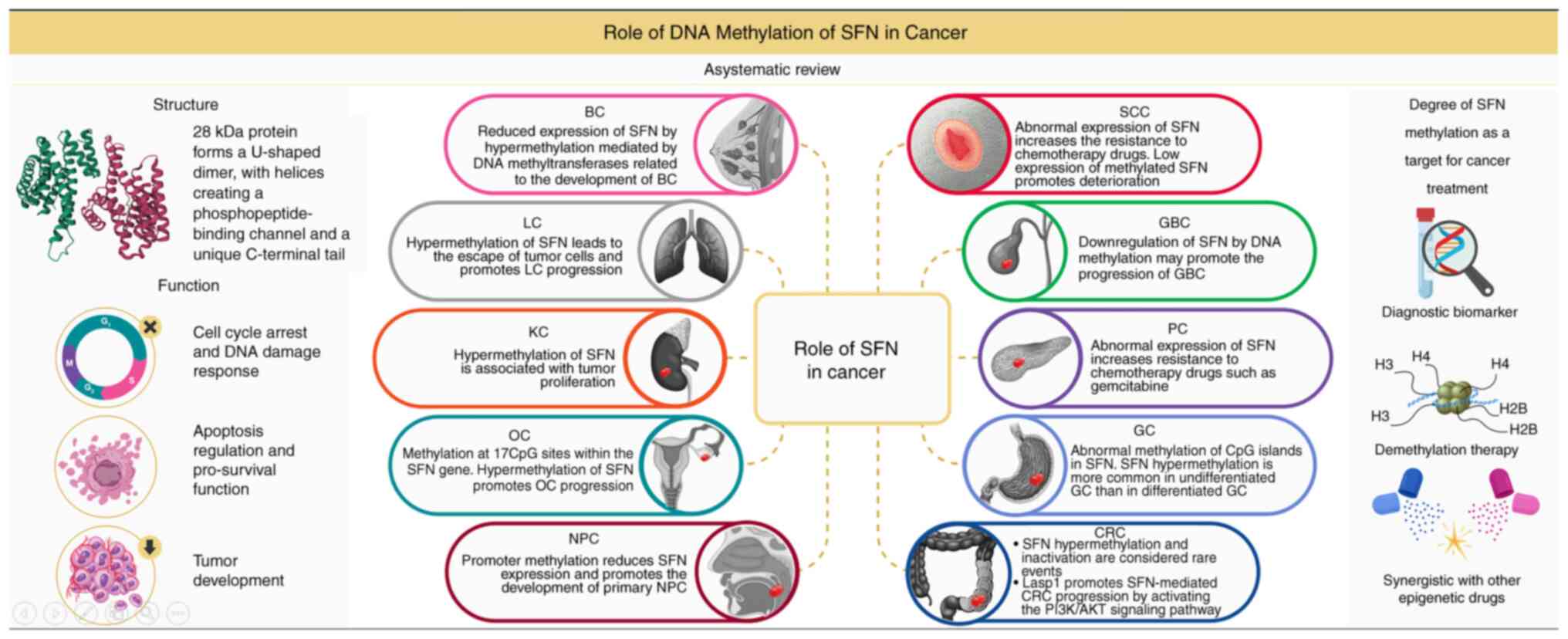
|
1
|
de Visser KE and Joyce JA: The evolving
tumor microenvironment: From cancer initiation to metastatic
outgrowth. Cancer Cell. 41:374–403. 2023. View Article : Google Scholar : PubMed/NCBI
|
|
2
|
Arafeh R, Shibue T, Dempster JM, Hahn WC
and Vazquez F: The present and future of the cancer dependency map.
Nat Rev Cancer. 25:59–73. 2025. View Article : Google Scholar : PubMed/NCBI
|
|
3
|
Mathers JC, Strathdee G and Relton CL:
Induction of epigenetic alterations by dietary and other
environmental factors. Adv Genet. 71:3–39. 2010. View Article : Google Scholar : PubMed/NCBI
|
|
4
|
Gupta MK, Peng H, Li Y and Xu CJ: The role
of DNA methylation in personalized medicine for immune-related
diseases. Pharmacol Ther. 250:1085082023. View Article : Google Scholar : PubMed/NCBI
|
|
5
|
Bergstedt J, Azzou SAK, Tsuo K,
Jaquaniello A, Urrutia A, Rotival M, Lin DTS, MacIsaac JL, Kobor
MS, Albert ML, et al: The immune factors driving DNA methylation
variation in human blood. Nat Commun. 13:58952022. View Article : Google Scholar : PubMed/NCBI
|
|
6
|
Zeng Y and Chen T: DNA methylation
reprogramming during mammalian development. Genes (Basel).
10:2572019. View Article : Google Scholar : PubMed/NCBI
|
|
7
|
Tolmacheva EN, Vasilyev SA and Lebedev IN:
Aneuploidy and DNA methylation as mirrored features of early human
embryo development. Genes (Basel). 11:10842020. View Article : Google Scholar : PubMed/NCBI
|
|
8
|
Klutstein M, Nejman D, Greenfield R and
Cedar H: DNA methylation in cancer and aging. Cancer Res.
76:3446–3450. 2016. View Article : Google Scholar : PubMed/NCBI
|
|
9
|
Huang Y, Yang M and Huang W: 14-3-3 σ: A
potential biomolecule for cancer therapy. Clin Chim Acta.
511:50–58. 2020. View Article : Google Scholar : PubMed/NCBI
|
|
10
|
Iwahori S, Umaña AC, Kalejta RF and Murata
T: Serine 13 of the human cytomegalovirus viral cyclin-dependent
kinase UL97 is required for regulatory protein 14-3-3 binding and
UL97 stability. J Biol Chem. 298:1025132022. View Article : Google Scholar : PubMed/NCBI
|
|
11
|
Suárez-Bonnet A, Lara-Garcia A, Stoll AL,
Carvalho S and Priestnall SL: 14-3-3σ protein expression in canine
renal cell carcinomas. Vet Pathol. 55:233–240. 2018. View Article : Google Scholar : PubMed/NCBI
|
|
12
|
Gu Q, Cuevas E, Raymick J, Kanungo J and
Sarkar S: Downregulation of 14-3-3 proteins in Alzheimer's disease.
Mol Neurobiol. 57:32–40. 2020. View Article : Google Scholar : PubMed/NCBI
|
|
13
|
Obsil T, Ghirlando R, Klein DC, Ganguly S
and Dyda F: Crystal structure of the 14-3-3zeta:serotonin
N-acetyltransferase complex. A role for scaffolding in enzyme
regulation. Cell. 105:257–267. 2001. View Article : Google Scholar : PubMed/NCBI
|
|
14
|
Mhawech P: 14-3-3 proteins-an update. Cell
Res. 15:228–236. 2005. View Article : Google Scholar : PubMed/NCBI
|
|
15
|
Hermeking H and Benzinger A: 14-3-3
Proteins in cell cycle regulation. Semin Cancer Biol. 16:183–192.
2006. View Article : Google Scholar : PubMed/NCBI
|
|
16
|
Henry RE, Andrysik Z, Paris R, Galbraith
MD and Espinosa JM: A DR4:tBID axis drives the p53 apoptotic
response by promoting oligomerization of poised BAX. EMBO J.
31:1266–1278. 2012. View Article : Google Scholar : PubMed/NCBI
|
|
17
|
Pozuelo-Rubio M: 14-3-3 Proteins are
regulators of autophagy. Cells. 1:754–773. 2012. View Article : Google Scholar : PubMed/NCBI
|
|
18
|
Lodygin D and Hermeking H: The role of
epigenetic inactivation of 14-3-3sigma in human cancer. Cell Res.
15:237–246. 2005. View Article : Google Scholar : PubMed/NCBI
|
|
19
|
Raychaudhuri K, Chaudhary N, Gurjar M,
D'Souza R, Limzerwala J, Maddika S and Dalal SN: 14-3-3σ gene loss
leads to activation of the epithelial to mesenchymal transition due
to the stabilization of c-Jun protein. J Biol Chem.
291:16068–16081. 2016. View Article : Google Scholar : PubMed/NCBI
|
|
20
|
Sun L, Zhang H and Gao P: Metabolic
reprogramming and epigenetic modifications on the path to cancer.
Protein Cell. 13:877–919. 2022. View Article : Google Scholar : PubMed/NCBI
|
|
21
|
Meng H, Cao Y, Qin J, Song X, Zhang Q, Shi
Y and Cao L: DNA methylation, its mediators and genome integrity.
Int J Biol Sci. 11:604–617. 2015. View Article : Google Scholar : PubMed/NCBI
|
|
22
|
Dai X, Ren T, Zhang Y and Nan N:
Methylation multiplicity and its clinical values in cancer. Expert
Rev Mol Med. 23:e22021. View Article : Google Scholar : PubMed/NCBI
|
|
23
|
Suo XG, Wang JN, Zhu Q, Zhang MM, Ge QL,
Peng LJ, Wang YY, Ji ML, Ou YM, Yu JT, et al: METTL3 mediated m6A
modification of HKDC1 promotes renal injury and inflammation in
lead nephropathy. Int J Biol Sci. 21:3755–3775. 2025. View Article : Google Scholar : PubMed/NCBI
|
|
24
|
Nishiyama A and Nakanishi M: Navigating
the DNA methylation landscape of cancer. Trends Genet.
37:1012–1027. 2021. View Article : Google Scholar : PubMed/NCBI
|
|
25
|
Kulis M and Esteller M: DNA methylation
and cancer. Adv Genet. 70:27–56. 2010. View Article : Google Scholar : PubMed/NCBI
|
|
26
|
Ku JL, Jeon YK and Park JG:
Methylation-specific PCR. Methods Mol Biol. 791:23–32. 2011.
View Article : Google Scholar : PubMed/NCBI
|
|
27
|
Horie-Inoue K and Inoue S: Epigenetic and
proteolytic inactivation of 14-3-3sigma in breast and prostate
cancers. Semin Cancer Biol. 16:235–239. 2006. View Article : Google Scholar : PubMed/NCBI
|
|
28
|
Jayaprakash C, Radhakrishnan R, Ray S and
Satyamoorthy K: Promoter methylation of MGMT in oral carcinoma: A
population-based study and meta-analysis. Arch Oral Biol.
80:197–208. 2017. View Article : Google Scholar : PubMed/NCBI
|
|
29
|
Liang WW, Lu RJ, Jayasinghe RG, Foltz SM,
Porta-Pardo E, Geffen Y, Wendl MC, Lazcano R, Kolodziejczak I, Song
Y, et al: Integrative multi-omic cancer profiling reveals DNA
methylation patterns associated with therapeutic vulnerability and
cell-of-origin. Cancer Cell. 41:1567–1585.e7. 2023. View Article : Google Scholar : PubMed/NCBI
|
|
30
|
Barzaman K, Karami J, Zarei Z,
Hosseinzadeh A, Kazemi MH, Moradi-Kalbolandi S, Safari E and
Farahmand L: Breast cancer: Biology, biomarkers, and treatments.
Int Immunopharmacol. 84:1065352020. View Article : Google Scholar : PubMed/NCBI
|
|
31
|
Gheibi A, Kazemi M, Baradaran A, Akbari M
and Salehi M: Study of promoter methylation pattern of 14-3-3 sigma
gene in normal and cancerous tissue of breast: A potential
biomarker for detection of breast cancer in patients. Adv Biomed
Res. 1:802012. View Article : Google Scholar : PubMed/NCBI
|
|
32
|
Luo J, Feng J, Lu J, Wang Y, Tang X, Xie F
and Li W: Aberrant methylation profile of 14-3-3 sigma and its
reduced transcription/expression levels in Chinese sporadic female
breast carcinogenesis. Med Oncol. 27:791–797. 2010. View Article : Google Scholar : PubMed/NCBI
|
|
33
|
Umbricht CB, Evron E, Gabrielson E,
Ferguson A, Marks J and Sukumar S: Hypermethylation of 14-3-3 sigma
(stratifin) is an early event in breast cancer. Oncogene.
20:3348–3353. 2001. View Article : Google Scholar : PubMed/NCBI
|
|
34
|
Lodygin D and Hermeking H: Epigenetic
silencing of 14-3-3sigma in cancer. Semin Cancer Biol. 16:214–224.
2006. View Article : Google Scholar : PubMed/NCBI
|
|
35
|
Zurita M, Lara PC, del Moral R, Torres B,
Linares-Fernández JL, Arrabal SR, Martínez-Galán J, Oliver FJ and
Ruiz de Almodóvar JM: Hypermethylated 14-3-3-sigma and ESR1 gene
promoters in serum as candidate biomarkers for the diagnosis and
treatment efficacy of breast cancer metastasis. BMC Cancer.
10:2172010. View Article : Google Scholar : PubMed/NCBI
|
|
36
|
Ko S, Kim JY, Jeong J, Lee JE, Yang WI and
Jung WH: The role and regulatory mechanism of 14-3-3 sigma in human
breast cancer. J Breast Cancer. 17:207–218. 2014. View Article : Google Scholar : PubMed/NCBI
|
|
37
|
Thai AA, Solomon BJ, Sequist LV, Gainor JF
and Heist RS: Lung cancer. Lancet. 398:535–554. 2021. View Article : Google Scholar : PubMed/NCBI
|
|
38
|
Petrella F, Rizzo S, Attili I, Passaro A,
Zilli T, Martucci F, Bonomo L, Del Grande F, Casiraghi M, De
Marinis F and Spaggiari L: Stage III non-small-cell lung cancer: An
overview of treatment options. Curr Oncol. 30:3160–3175. 2023.
View Article : Google Scholar : PubMed/NCBI
|
|
39
|
Giaccone G and He Y: Current knowledge of
small cell lung cancer transformation from non-small cell lung
cancer. Semin Cancer Biol. 94:1–10. 2023. View Article : Google Scholar : PubMed/NCBI
|
|
40
|
Ansari J, Shackelford RE and El-Osta H:
Epigenetics in non-small cell lung cancer: From basics to
therapeutics. Transl Lung Cancer Res. 5:155–171. 2016. View Article : Google Scholar : PubMed/NCBI
|
|
41
|
Raungrut P, Petjaroen P, Geater SL,
Keeratichananont W, Phukaoloun M, Suwiwat S and Thongsuksai P:
Methylation of 14-3-3σ gene and prognostic significance of 14-3-3σ
expression in non-small cell lung cancer. Oncol Lett. 14:5257–5264.
2017.PubMed/NCBI
|
|
42
|
Qin X, Qiu F and Zou Z: TRIM25 is
associated with cisplatin resistance in non-small-cell lung
carcinoma A549 cell line via downregulation of 14-3-3σ. Biochem
Biophys Res Commun. 493:568–572. 2017. View Article : Google Scholar : PubMed/NCBI
|
|
43
|
Radhakrishnan VM, Jensen TJ, Cui H,
Futscher BW and Martinez JD: Hypomethylation of the 14-3-3σ
promoter leads to increased expression in non-small cell lung
cancer. Genes Chromosomes Cancer. 50:830–836. 2011. View Article : Google Scholar : PubMed/NCBI
|
|
44
|
Bahadoram S, Davoodi M, Hassanzadeh S,
Bahadoram M, Barahman M and Mafakher L: Renal cell carcinoma: An
overview of the epidemiology, diagnosis, and treatment. G Ital
Nefrol. 39:2022–vol3. 2022.PubMed/NCBI
|
|
45
|
Cirillo L, Innocenti S and Becherucci F:
Global epidemiology of kidney cancer. Nephrol Dial Transplant.
39:920–928. 2024. View Article : Google Scholar : PubMed/NCBI
|
|
46
|
Bukavina L, Bensalah K, Bray F, Carlo M,
Challacombe B, Karam JA, Kassouf W, Mitchell T, Montironi R,
O'Brien T, et al: Epidemiology of renal cell carcinoma: 2022
Update. Eur Urol. 82:529–542. 2022. View Article : Google Scholar : PubMed/NCBI
|
|
47
|
Chow WH, Dong LM and Devesa SS:
Epidemiology and risk factors for kidney cancer. Nat Rev Urol.
7:245–257. 2010. View Article : Google Scholar : PubMed/NCBI
|
|
48
|
Hancock SB and Georgiades CS: Kidney
cancer. Cancer J. 22:387–392. 2016. View Article : Google Scholar : PubMed/NCBI
|
|
49
|
Liang S, Xu Y, Shen G, Zhao X, Zhou J, Li
X, Gong F, Ling B, Fang L, Huang C and Wei Y: Gene expression and
methylation status of 14-3-3sigma in human renal carcinoma tissues.
IUBMB Life. 60:534–540. 2008. View
Article : Google Scholar : PubMed/NCBI
|
|
50
|
Vasko R, Mueller GA, von Jaschke AK, Asif
AR and Dihazi H: Impact of cisplatin administration on protein
expression levels in renal cell carcinoma: A proteomic analysis.
Eur J Pharmacol. 670:50–57. 2011. View Article : Google Scholar : PubMed/NCBI
|
|
51
|
Penny SM: Ovarian cancer: An overview.
Radiol Technol. 91:561–575. 2020.PubMed/NCBI
|
|
52
|
Konstantinopoulos PA and Matulonis UA:
Clinical and translational advances in ovarian cancer therapy. Nat
Cancer. 4:1239–1257. 2023. View Article : Google Scholar : PubMed/NCBI
|
|
53
|
O'Shea AS: Clinical staging of ovarian
cancer. Methods Mol Biol. 2424:3–10. 2022. View Article : Google Scholar : PubMed/NCBI
|
|
54
|
Thi HV, Ngo AD and Chu DT: Epigenetic
regulation in ovarian cancer. Int Rev Cell Mol Biol. 387:77–98.
2024. View Article : Google Scholar : PubMed/NCBI
|
|
55
|
Mhawech P, Benz A, Cerato C, Greloz V,
Assaly M, Desmond JC, Koeffler HP, Lodygin D, Hermeking H, Herrmann
F and Schwaller J: Downregulation of 14-3-3sigma in ovary, prostate
and endometrial carcinomas is associated with CpG island
methylation. Mod Pathol. 18:340–348. 2005. View Article : Google Scholar : PubMed/NCBI
|
|
56
|
Dee EC, Wang S, Ho FDV, Patel RR, Lapen K,
Wu Y, Yang F, Patel TA, Feliciano EJG, McBride SM and Lee NY:
Nasopharynx cancer in the United States: Racial and ethnic
disparities in stage at presentation. Laryngoscope. 135:1113–1119.
2025. View Article : Google Scholar : PubMed/NCBI
|
|
57
|
Su ZY, Siak PY, Lwin YY and Cheah SC:
Epidemiology of nasopharyngeal carcinoma: Current insights and
future outlook. Cancer Metastasis Rev. 43:919–939. 2024. View Article : Google Scholar : PubMed/NCBI
|
|
58
|
Chan SY, To KF, Leung SF, Yip WW, Mak MK,
Chung GT and Lo KW: 14-3-3 sigma expression as a prognostic marker
in undifferentiated nasopharyngeal carcinoma. Oncol Rep.
24:949–955. 2010.PubMed/NCBI
|
|
59
|
Xie L, Jiang T, Cheng A, Zhang T, Huang P,
Li P, Wen G, Lei F, Huang Y, Tang X, et al: MiR-597 targeting
14-3-3σ enhances cellular invasion and EMT in nasopharyngeal
carcinoma cells. Curr Mol Pharmacol. 12:105–114. 2019. View Article : Google Scholar : PubMed/NCBI
|
|
60
|
Zhang T, Lei F, Jiang T, Xie L, Huang P,
Li P, Huang Y, Tang X, Gong J, Lin Y, et al: H19/miR-675-5p
targeting SFN enhances the invasion and metastasis of
nasalpharyngeal cancer cells. Curr Mol Pharmacol. 12:324–333. 2019.
View Article : Google Scholar : PubMed/NCBI
|
|
61
|
Huang WG, Cheng AL, Chen ZC, Peng F, Zhang
PF, Li MY, Li F, Li JL, Li C, Yi H, et al: Targeted proteomic
analysis of 14-3-3sigma in nasopharyngeal carcinoma. Int J Biochem
Cell Biol. 42:137–147. 2010. View Article : Google Scholar : PubMed/NCBI
|
|
62
|
Nakajima T, Shimooka H, Weixa P, Segawa A,
Motegi A, Jian Z, Masuda N, Ide M, Sano T, Oyama T, et al:
Immunohistochemical demonstration of 14-3-3 sigma protein in normal
human tissues and lung cancers, and the preponderance of its strong
expression in epithelial cells of squamous cell lineage. Pathol
Int. 53:353–360. 2003. View Article : Google Scholar : PubMed/NCBI
|
|
63
|
Wang Z, Tropè CG, Suo Z, Trøen G, Yang G,
Nesland JM and Holm R: The clinicopathological and prognostic
impact of 14-3-3 sigma expression on vulvar squamous cell
carcinomas. BMC Cancer. 8:3082008. View Article : Google Scholar : PubMed/NCBI
|
|
64
|
Gasco M, Sullivan A, Repellin C, Brooks L,
Farrell PJ, Tidy JA, Dunne B, Gusterson B, Evans DJ and Crook T:
Coincident inactivation of 14-3-3sigma and p16INK4a is an early
event in vulval squamous neoplasia. Oncogene. 21:1876–1881. 2002.
View Article : Google Scholar : PubMed/NCBI
|
|
65
|
Okumura H, Kita Y, Yokomakura N, Uchikado
Y, Setoyama T, Sakurai H, Omoto I, Matsumoto M, Owaki T, Ishigami S
and Natsugoe S: Nuclear expression of 14-3-3 sigma is related to
prognosis in patients with esophageal squamous cell carcinoma.
Anticancer Res. 30:5175–5179. 2010.PubMed/NCBI
|
|
66
|
Qi YJ, Wang M, Liu RM, Wei H, Chao WX,
Zhang T, Lou Q, Li XM, Ma J, Zhu H, et al: Downregulation of
14-3-3σ correlates with multistage carcinogenesis and poor
prognosis of esophageal squamous cell carcinoma. PLoS One.
9:e953862014. View Article : Google Scholar : PubMed/NCBI
|
|
67
|
Lai KKY, Chan KT, Choi MY, Wang HK, Fung
EYM, Lam HY, Tan W, Tung LN, Tong DKH, Sun RWY, et al: 14-3-3σ
confers cisplatin resistance in esophageal squamous cell carcinoma
cells via regulating DNA repair molecules. Tumour Biol.
37:2127–2136. 2016. View Article : Google Scholar : PubMed/NCBI
|
|
68
|
Hayashi E, Kuramitsu Y, Fujimoto M, Zhang
X, Tanaka T, Uchida K, Fukuda T, Furumoto H, Ueyama Y and Nakamura
K: Proteomic profiling of differential display analysis for human
oral squamous cell carcinoma: 14-3-3 σ protein is upregulated in
human oral squamous cell carcinoma and dependent on the
differentiation level. Proteomics Clin Appl. 3:1338–1347. 2009.
View Article : Google Scholar : PubMed/NCBI
|
|
69
|
Laimer K, Blassnig N, Spizzo G, Kloss F,
Rasse M, Obrist P, Schäfer G, Perathoner A, Margreiter R and
Amberger A: Prognostic significance of 14-3-3sigma expression in
oral squamous cell carcinoma (OSCC). Oral Oncol. 45:127–134. 2009.
View Article : Google Scholar : PubMed/NCBI
|
|
70
|
Wang S, Zheng R, Li J, Zeng H, Li L, Chen
R, Sun K, Han B, Bray F, Wei W and He J: Global, regional, and
national lifetime risks of developing and dying from
gastrointestinal cancers in 185 countries: A population-based
systematic analysis of GLOBOCAN. Lancet Gastroenterol Hepatol.
9:229–237. 2024. View Article : Google Scholar : PubMed/NCBI
|
|
71
|
Hu Z, Wang X, Zhang X, Sun W and Mao J: An
analysis of the global burden of gallbladder and biliary tract
cancer attributable to high BMI in 204 countries and territories:
1990-2021. Front Nutr. 11:15217702024. View Article : Google Scholar : PubMed/NCBI
|
|
72
|
Sirivatanauksorn V, Dumronggittigule W,
Dulnee B, Srisawat C, Sirivatanauksorn Y, Pongpaibul A, Masaratana
P, Somboonyosdech C, Sripinitchai S, Kositamongkol P, et al: Role
of stratifin (14-3-3 sigma) in adenocarcinoma of gallbladder: A
novel prognostic biomarker. Surg Oncol. 32:57–62. 2020. View Article : Google Scholar : PubMed/NCBI
|
|
73
|
Sharma A, Sharma KL, Gupta A, Yadav A and
Kumar A: Gallbladder cancer epidemiology, pathogenesis and
molecular genetics: Recent update. World J Gastroenterol.
23:3978–3998. 2017. View Article : Google Scholar : PubMed/NCBI
|
|
74
|
Nakaoka T, Saito Y and Saito H: Aberrant
DNA methylation as a biomarker and a therapeutic target of
cholangiocarcinoma. Int J Mol Sci. 18:11112017. View Article : Google Scholar : PubMed/NCBI
|
|
75
|
Singh TD, Gupta S, Shrivastav BR and
Tiwari PK: Epigenetic profiling of gallbladder cancer and gall
stone diseases: Evaluation of role of tumour associated genes.
Gene. 576:743–752. 2016. View Article : Google Scholar : PubMed/NCBI
|
|
76
|
Li Z, Dong Z, Myer D, Yip-Schneider M, Liu
J, Cui P, Schmidt CM and Zhang JT: Role of 14-3-3σ in poor
prognosis and in radiation and drug resistance of human pancreatic
cancers. BMC Cancer. 10:5982010. View Article : Google Scholar : PubMed/NCBI
|
|
77
|
Rodriguez JA, Li M, Yao Q, Chen C and
Fisher WE: Gene overexpression in pancreatic adenocarcinoma:
Diagnostic and therapeutic implications. World J Surg. 29:297–305.
2005. View Article : Google Scholar : PubMed/NCBI
|
|
78
|
Qin L, Dong Z and Zhang JT: Reversible
epigenetic regulation of 14-3-3σ expression in acquired gemcitabine
resistance by uhrf1 and DNA methyltransferase 1. Mol Pharmacol.
86:561–569. 2014. View Article : Google Scholar : PubMed/NCBI
|
|
79
|
Dim DC, Jiang F, Qiu Q, Li T, Darwin P,
Rodgers WH and Peng HQ: The usefulness of S100P, mesothelin,
fascin, prostate stem cell antigen, and 14-3-3 sigma in diagnosing
pancreatic adenocarcinoma in cytological specimens obtained by
endoscopic ultrasound guided fine-needle aspiration. Diagn
Cytopathol. 42:193–199. 2014. View Article : Google Scholar : PubMed/NCBI
|
|
80
|
Qin L, Dong Z and Zhang JT: 14-3-3σ
regulation of and interaction with YAP1 in acquired gemcitabine
resistance via promoting ribonucleotide reductase expression.
Oncotarget. 7:17726–17736. 2016. View Article : Google Scholar : PubMed/NCBI
|
|
81
|
Venneman K, Huybrechts I, Gunter MJ,
Vandendaele L, Herrero R and Van Herck K: The epidemiology of
Helicobacter pylori infection in Europe and the impact of lifestyle
on its natural evolution toward stomach cancer after infection: A
systematic review. Helicobacter. 23:e124832018. View Article : Google Scholar : PubMed/NCBI
|
|
82
|
Zhu Y, Jeong S, Wu M, Zhou JY, Jin ZY, Han
RQ, Yang J, Zhang XF, Wang XS, Liu AM, et al: Index-based dietary
patterns and stomach cancer in a Chinese population. Eur J Cancer
Prev. 30:448–456. 2021. View Article : Google Scholar : PubMed/NCBI
|
|
83
|
Zhang Y, Li Y, Lin C, Ding J, Liao G and
Tang B: Aberrant upregulation of 14-3-3σ and EZH2 expression serves
as an inferior prognostic biomarker for hepatocellular carcinoma.
PLoS One. 9:e1072512014. View Article : Google Scholar : PubMed/NCBI
|
|
84
|
Kim W, Kidambi T, Lin J and Idos G:
Genetic syndromes associated with gastric cancer. Gastrointest
Endosc Clin N Am. 32:147–162. 2022. View Article : Google Scholar : PubMed/NCBI
|
|
85
|
Chen YZ, Guo F, Sun HW, Kong HR, Dai SJ,
Huang SH, Zhu WW, Yang WJ and Zhou MT: Association between XPG
polymorphisms and stomach cancer susceptibility in a Chinese
population. J Cell Mol Med. 20:903–908. 2016. View Article : Google Scholar : PubMed/NCBI
|
|
86
|
Muhlmann G, Ofner D, Zitt M, Müller HM,
Maier H, Moser P, Schmid KW, Zitt M and Amberger A: 14-3-3 Sigma
and p53 expression in gastric cancer and its clinical applications.
Dis Markers. 29:21–29. 2010. View Article : Google Scholar : PubMed/NCBI
|
|
87
|
Jung JY, Koh SA, Lee KH and Kim JR: 14-3-3
Sigma protein contributes to hepatocyte growth factor-mediated cell
proliferation and invasion via matrix metalloproteinase-1
regulation in human gastric cancer. Anticancer Res. 42:519–530.
2022. View Article : Google Scholar : PubMed/NCBI
|
|
88
|
Nagappan A, Park HS, Park KI, Hong GE,
Yumnam S, Lee HJ, Kim MK, Kim EH, Lee WS, Lee WJ, et al:
Helicobacter pylori infection combined with DENA revealed altered
expression of p53 and 14-3-3 isoforms in Gulo-/- mice. Chem Biol
Interact. 206:143–152. 2013. View Article : Google Scholar : PubMed/NCBI
|
|
89
|
Suzuki H, Itoh F, Toyota M, Kikuchi T,
Kakiuchi H and Imai K: Inactivation of the 14-3-3 sigma gene is
associated with 5′ CpG island hypermethylation in human cancers.
Cancer Res. 60:4353–4357. 2000.PubMed/NCBI
|
|
90
|
Li YL, Liu L, Xiao Y, Zeng T and Zeng C:
14-3-3σ is an independent prognostic biomarker for gastric cancer
and is associated with apoptosis and proliferation in gastric
cancer. Oncol Lett. 9:290–294. 2015. View Article : Google Scholar : PubMed/NCBI
|
|
91
|
Young GM, Radhakrishnan VM, Centuori SM,
Gomes CJ and Martinez JD: Comparative analysis of 14-3-3 isoform
expression and epigenetic alterations in colorectal cancer. BMC
Cancer. 15:8262015. View Article : Google Scholar : PubMed/NCBI
|
|
92
|
Winter M, Rokavec M and Hermeking H:
14-3-3σ functions as an intestinal tumor suppressor. Cancer Res.
81:3621–3634. 2021. View Article : Google Scholar : PubMed/NCBI
|
|
93
|
Shao Q, Duong TN, Park I, Orr LM and
Nomura DK: Targeted protein localization by covalent 14-3-3
recruitment. J Am Chem Soc. 146:24788–24799. 2024. View Article : Google Scholar : PubMed/NCBI
|
|
94
|
Shao Z, Cai Y, Xu L, Yao X, Shi J, Zhang
F, Luo Y, Zheng K, Liu J, Deng F, et al: Loss of the 14-3-3σ is
essential for LASP1-mediated colorectal cancer progression via
activating PI3K/AKT signaling pathway. Sci Rep. 6:256312016.
View Article : Google Scholar : PubMed/NCBI
|
|
95
|
Lonare A, Raychaudhuri K, Shah S, Madhu G,
Sachdeva A, Basu S, Thorat R, Gupta S and Dalal SN: 14-3-3σ
restricts YY1 to the cytoplasm, promoting therapy resistance, and
tumor progression in colorectal cancer. Int J Cancer. 156:623–637.
2025. View Article : Google Scholar : PubMed/NCBI
|
|
96
|
Ide M, Nakajima T, Asao T and Kuwano H:
Inactivation of 14-3-3sigma by hypermethylation is a rare event in
colorectal cancers and its expression may correlate with cell cycle
maintenance at the invasion front. Cancer Lett. 207:241–249. 2004.
View Article : Google Scholar : PubMed/NCBI
|
|
97
|
Ben-Moshe S and Itzkovitz S: Spatial
heterogeneity in the mammalian liver. Nat Rev Gastroenterol
Hepatol. 16:395–410. 2019. View Article : Google Scholar : PubMed/NCBI
|
|
98
|
Postwala H, Shah Y, Parekh PS and
Chorawala MR: Unveiling the genetic and epigenetic landscape of
colorectal cancer: New insights into pathogenic pathways. Med
Oncol. 40:3342023. View Article : Google Scholar : PubMed/NCBI
|
|
99
|
Klemm SL, Shipony Z and Greenleaf WJ:
Chromatin accessibility and the regulatory epigenome. Nat Rev
Genet. 20:207–220. 2019. View Article : Google Scholar : PubMed/NCBI
|
|
100
|
Deng J, Gao G, Wang L, Wang T, Yu J and
Zhao Z: Stratifin expression is a novel prognostic factor in human
gliomas. Pathol Res Pract. 207:674–679. 2011. View Article : Google Scholar : PubMed/NCBI
|
|
101
|
Ito K, Suzuki T, Akahira J, Sakuma M,
Saitou S, Okamoto S, Niikura H, Okamura K, Yaegashi N, Sasano H and
Inoue S: 14-3-3sigma in endometrial cancer-a possible prognostic
marker in early-stage cancer. Clin Cancer Res. 11:7384–7391. 2005.
View Article : Google Scholar : PubMed/NCBI
|
|
102
|
Liang S, Shen G, Liu Q, Xu Y, Zhou L, Xiao
S, Xu Z, Gong F, You C and Wei Y: Isoform-specific expression and
characterization of 14-3-3 proteins in human glioma tissues
discovered by stable isotope labeling with amino acids in cell
culture-based proteomic analysis. Proteomics Clin Appl. 3:743–753.
2009. View Article : Google Scholar : PubMed/NCBI
|
|
103
|
Iavazzo C, Gkegkes ID and Vrachnis N:
Early recurrence of early stage endometrioid endometrial carcinoma:
Possible etiologic pathways and management options. Maturitas.
78:155–159. 2014. View Article : Google Scholar : PubMed/NCBI
|
|
104
|
Nakayama H, Sano T, Motegi A, Oyama T and
Nakajima T: Increasing 14-3-3 sigma expression with declining
estrogen receptor alpha and estrogen-responsive finger protein
expression defines malignant progression of endometrial carcinoma.
Pathol Int. 55:707–715. 2005. View Article : Google Scholar : PubMed/NCBI
|
|
105
|
Evren S, Dermen A, Lockwood G, Fleshner N
and Sweet J: mTOR-RAPTOR and 14-3-3σ immunohistochemical expression
in high grade prostatic intraepithelial neoplasia and prostatic
adenocarcinomas: A tissue microarray study. J Clin Pathol.
64:683–688. 2011. View Article : Google Scholar : PubMed/NCBI
|
|
106
|
Lodygin D, Diebold J and Hermeking H:
Prostate cancer is characterized by epigenetic silencing of
14-3-3sigma expression. Oncogene. 23:9034–9041. 2004. View Article : Google Scholar : PubMed/NCBI
|
|
107
|
Chu DT, Ngo AD and Wu CC: Epigenetics in
cancer development, diagnosis and therapy. Prog Mol Biol Transl
Sci. 198:73–92. 2023. View Article : Google Scholar : PubMed/NCBI
|
|
108
|
Devailly G, Grandin M, Perriaud L, Mathot
P, Delcros JG, Bidet Y, Morel AP, Bignon JY, Puisieux A, Mehlen P
and Dante R: Dynamics of MBD2 deposition across methylated DNA
regions during malignant transformation of human mammary epithelial
cells. Nucleic Acids Res. 43:5838–5854. 2015. View Article : Google Scholar : PubMed/NCBI
|
|
109
|
Feng L, Pan M, Sun J, Lu H, Shen Q, Zhang
S, Jiang T, Liu L, Jin W, Chen Y, et al: Histone deacetylase 3
inhibits expression of PUMA in gastric cancer cells. J Mol Med
(Berl). 91:49–58. 2013. View Article : Google Scholar : PubMed/NCBI
|
|
110
|
Ye M, Huang T, Ying Y, Li J, Yang P, Ni C,
Zhou C and Chen S: Detection of 14-3-3 sigma (σ) promoter
methylation as a noninvasive biomarker using blood samples for
breast cancer diagnosis. Oncotarget. 8:9230–9242. 2017. View Article : Google Scholar : PubMed/NCBI
|
|
111
|
Sakai A, Otani M, Miyamoto A, Yoshida H,
Furuya E and Tanigawa N: Identification of phosphorylated serine-15
and −82 residues of HSPB1 in 5-fluorouracil-resistant colorectal
cancer cells by proteomics. J Proteomics. 75:806–818. 2012.
View Article : Google Scholar : PubMed/NCBI
|
|
112
|
Balch C, Naegeli K, Nam S, Ballard B,
Hyslop A, Melki C, Reilly E, Hur MW and Nephew KP: A unique histone
deacetylase inhibitor alters microRNA expression and signal
transduction in chemoresistant ovarian cancer cells. Cancer Biol
Ther. 13:681–693. 2012. View Article : Google Scholar : PubMed/NCBI
|
|
113
|
Li Y, Geng P, Jiang W, Wang Y, Yao J, Lin
X, Liu J, Huang L, Su B and Chen H: Enhancement of radiosensitivity
by 5-Aza-CdR through activation of G2/M checkpoint response and
apoptosis in osteosarcoma cells. Tumour Biol. 35:4831–4839. 2014.
View Article : Google Scholar : PubMed/NCBI
|
|
114
|
Wang L, Zhang Y, Li R, Chen Y, Pan X, Li
G, Dai F and Yang J: 5-aza-2′-Deoxycytidine enhances the
radiosensitivity of breast cancer cells. Cancer Biother Radiopharm.
28:34–44. 2013.PubMed/NCBI
|
|
115
|
Schultz J, Ibrahim SM, Vera J and Kunz M:
14-3-3sigma gene silencing during melanoma progression and its role
in cell cycle control and cellular senescence. Mol Cancer.
8:532009. View Article : Google Scholar : PubMed/NCBI
|
|
116
|
Yang Z, Chu B, Tu Y, Li L, Chen D, Huang
S, Huang W, Fan W, Li Q, Zhang C, et al: Dual inhibitors of DNMT
and HDAC remodels the immune microenvironment of colorectal cancer
and enhances the efficacy of anti-PD-L1 therapy. Pharmacol Res.
206:1072712024. View Article : Google Scholar : PubMed/NCBI
|
|
117
|
Huang W, Zhu Q, Shi Z, Tu Y, Li Q, Zheng
W, Yuan Z, Li L, Zu X, Hao Y, et al: Dual inhibitors of DNMT and
HDAC induce viral mimicry to induce antitumour immunity in breast
cancer. Cell Death Discov. 10:1432024. View Article : Google Scholar : PubMed/NCBI
|
|
118
|
Liu S, Guo R, Xu H, Yang J, Luo H, Yeung
SJ, Li K, Lee MH and Yang R: 14-3-3σ-NEDD4L axis promotes
ubiquitination and degradation of HIF-1α in colorectal cancer. Cell
Rep. 42:1128702023. View Article : Google Scholar : PubMed/NCBI
|
|
119
|
Bai J, Zhao Y, Shi K, Fan Y, Ha Y, Chen Y,
Luo B, Lu Y, Jie W and Shen Z: HIF-1α-mediated LAMC1 overexpression
is an unfavorable predictor of prognosis for glioma patients:
Evidence from pan-cancer analysis and validation experiments. J
Transl Med. 22:3912024. View Article : Google Scholar : PubMed/NCBI
|
|
120
|
Parker WB and Thottassery JV:
5-Aza-4′-thio-2′-deoxycytidine, a new orally bioavailable nontoxic
‘best-in-class’: DNA methyltransferase 1-depleting agent in
clinical development. J Pharmacol Exp Ther. 379:211–222. 2021.
View Article : Google Scholar : PubMed/NCBI
|
|
121
|
Traube FR, Brás NF, Roos WP, Sommermann
CC, Diehl T, Mayer RJ, Ofial AR, Müller M, Zipse H and Carell T:
Epigenetic anti-cancer treatment with a stabilized carbocyclic
decitabine analogue. Chemistry. 28:e2022006402022. View Article : Google Scholar : PubMed/NCBI
|