Spandidos Publications Logo
  • About
    • About Spandidos
    • Aims and Scopes
    • Abstracting and Indexing
    • Editorial Policies
    • Reprints and Permissions
    • Job Opportunities
    • Terms and Conditions
    • Contact
  • Journals
    • All Journals
    • Oncology Letters
      • Oncology Letters
      • Information for Authors
      • Editorial Policies
      • Editorial Board
      • Aims and Scope
      • Abstracting and Indexing
      • Bibliographic Information
      • Archive
    • International Journal of Oncology
      • International Journal of Oncology
      • Information for Authors
      • Editorial Policies
      • Editorial Board
      • Aims and Scope
      • Abstracting and Indexing
      • Bibliographic Information
      • Archive
    • Molecular and Clinical Oncology
      • Molecular and Clinical Oncology
      • Information for Authors
      • Editorial Policies
      • Editorial Board
      • Aims and Scope
      • Abstracting and Indexing
      • Bibliographic Information
      • Archive
    • Experimental and Therapeutic Medicine
      • Experimental and Therapeutic Medicine
      • Information for Authors
      • Editorial Policies
      • Editorial Board
      • Aims and Scope
      • Abstracting and Indexing
      • Bibliographic Information
      • Archive
    • International Journal of Molecular Medicine
      • International Journal of Molecular Medicine
      • Information for Authors
      • Editorial Policies
      • Editorial Board
      • Aims and Scope
      • Abstracting and Indexing
      • Bibliographic Information
      • Archive
    • Biomedical Reports
      • Biomedical Reports
      • Information for Authors
      • Editorial Policies
      • Editorial Board
      • Aims and Scope
      • Abstracting and Indexing
      • Bibliographic Information
      • Archive
    • Oncology Reports
      • Oncology Reports
      • Information for Authors
      • Editorial Policies
      • Editorial Board
      • Aims and Scope
      • Abstracting and Indexing
      • Bibliographic Information
      • Archive
    • Molecular Medicine Reports
      • Molecular Medicine Reports
      • Information for Authors
      • Editorial Policies
      • Editorial Board
      • Aims and Scope
      • Abstracting and Indexing
      • Bibliographic Information
      • Archive
    • World Academy of Sciences Journal
      • World Academy of Sciences Journal
      • Information for Authors
      • Editorial Policies
      • Editorial Board
      • Aims and Scope
      • Abstracting and Indexing
      • Bibliographic Information
      • Archive
    • International Journal of Functional Nutrition
      • International Journal of Functional Nutrition
      • Information for Authors
      • Editorial Policies
      • Editorial Board
      • Aims and Scope
      • Abstracting and Indexing
      • Bibliographic Information
      • Archive
    • International Journal of Epigenetics
      • International Journal of Epigenetics
      • Information for Authors
      • Editorial Policies
      • Editorial Board
      • Aims and Scope
      • Abstracting and Indexing
      • Bibliographic Information
      • Archive
    • Medicine International
      • Medicine International
      • Information for Authors
      • Editorial Policies
      • Editorial Board
      • Aims and Scope
      • Abstracting and Indexing
      • Bibliographic Information
      • Archive
  • Articles
  • Information
    • Information for Authors
    • Information for Reviewers
    • Information for Librarians
    • Information for Advertisers
    • Conferences
  • Language Editing
Spandidos Publications Logo
  • About
    • About Spandidos
    • Aims and Scopes
    • Abstracting and Indexing
    • Editorial Policies
    • Reprints and Permissions
    • Job Opportunities
    • Terms and Conditions
    • Contact
  • Journals
    • All Journals
    • Biomedical Reports
      • Information for Authors
      • Editorial Policies
      • Editorial Board
      • Aims and Scope
      • Abstracting and Indexing
      • Bibliographic Information
      • Archive
    • Experimental and Therapeutic Medicine
      • Information for Authors
      • Editorial Policies
      • Editorial Board
      • Aims and Scope
      • Abstracting and Indexing
      • Bibliographic Information
      • Archive
    • International Journal of Epigenetics
      • Information for Authors
      • Editorial Policies
      • Editorial Board
      • Aims and Scope
      • Abstracting and Indexing
      • Bibliographic Information
      • Archive
    • International Journal of Functional Nutrition
      • Information for Authors
      • Editorial Policies
      • Editorial Board
      • Aims and Scope
      • Abstracting and Indexing
      • Bibliographic Information
      • Archive
    • International Journal of Molecular Medicine
      • Information for Authors
      • Editorial Policies
      • Editorial Board
      • Aims and Scope
      • Abstracting and Indexing
      • Bibliographic Information
      • Archive
    • International Journal of Oncology
      • Information for Authors
      • Editorial Policies
      • Editorial Board
      • Aims and Scope
      • Abstracting and Indexing
      • Bibliographic Information
      • Archive
    • Medicine International
      • Information for Authors
      • Editorial Policies
      • Editorial Board
      • Aims and Scope
      • Abstracting and Indexing
      • Bibliographic Information
      • Archive
    • Molecular and Clinical Oncology
      • Information for Authors
      • Editorial Policies
      • Editorial Board
      • Aims and Scope
      • Abstracting and Indexing
      • Bibliographic Information
      • Archive
    • Molecular Medicine Reports
      • Information for Authors
      • Editorial Policies
      • Editorial Board
      • Aims and Scope
      • Abstracting and Indexing
      • Bibliographic Information
      • Archive
    • Oncology Letters
      • Information for Authors
      • Editorial Policies
      • Editorial Board
      • Aims and Scope
      • Abstracting and Indexing
      • Bibliographic Information
      • Archive
    • Oncology Reports
      • Information for Authors
      • Editorial Policies
      • Editorial Board
      • Aims and Scope
      • Abstracting and Indexing
      • Bibliographic Information
      • Archive
    • World Academy of Sciences Journal
      • Information for Authors
      • Editorial Policies
      • Editorial Board
      • Aims and Scope
      • Abstracting and Indexing
      • Bibliographic Information
      • Archive
  • Articles
  • Information
    • For Authors
    • For Reviewers
    • For Librarians
    • For Advertisers
    • Conferences
  • Language Editing
Login Register Submit
  • This site uses cookies
  • You can change your cookie settings at any time by following the instructions in our Cookie Policy. To find out more, you may read our Privacy Policy.

    I agree
Search articles by DOI, keyword, author or affiliation
Search
Advanced Search
presentation
Oncology Reports
Join Editorial Board Propose a Special Issue
Print ISSN: 1021-335X Online ISSN: 1791-2431
Journal Cover
May 2013 Volume 29 Issue 5

Full Size Image

Sign up for eToc alerts
Recommend to Library

Journals

International Journal of Molecular Medicine

International Journal of Molecular Medicine

International Journal of Molecular Medicine is an international journal devoted to molecular mechanisms of human disease.

International Journal of Oncology

International Journal of Oncology

International Journal of Oncology is an international journal devoted to oncology research and cancer treatment.

Molecular Medicine Reports

Molecular Medicine Reports

Covers molecular medicine topics such as pharmacology, pathology, genetics, neuroscience, infectious diseases, molecular cardiology, and molecular surgery.

Oncology Reports

Oncology Reports

Oncology Reports is an international journal devoted to fundamental and applied research in Oncology.

Experimental and Therapeutic Medicine

Experimental and Therapeutic Medicine

Experimental and Therapeutic Medicine is an international journal devoted to laboratory and clinical medicine.

Oncology Letters

Oncology Letters

Oncology Letters is an international journal devoted to Experimental and Clinical Oncology.

Biomedical Reports

Biomedical Reports

Explores a wide range of biological and medical fields, including pharmacology, genetics, microbiology, neuroscience, and molecular cardiology.

Molecular and Clinical Oncology

Molecular and Clinical Oncology

International journal addressing all aspects of oncology research, from tumorigenesis and oncogenes to chemotherapy and metastasis.

World Academy of Sciences Journal

World Academy of Sciences Journal

Multidisciplinary open-access journal spanning biochemistry, genetics, neuroscience, environmental health, and synthetic biology.

International Journal of Functional Nutrition

International Journal of Functional Nutrition

Open-access journal combining biochemistry, pharmacology, immunology, and genetics to advance health through functional nutrition.

International Journal of Epigenetics

International Journal of Epigenetics

Publishes open-access research on using epigenetics to advance understanding and treatment of human disease.

Medicine International

Medicine International

An International Open Access Journal Devoted to General Medicine.

Journal Cover
May 2013 Volume 29 Issue 5

Full Size Image

Sign up for eToc alerts
Recommend to Library

  • Article
  • Citations
    • Cite This Article
    • Download Citation
    • Create Citation Alert
    • Remove Citation Alert
    • Cited By
  • Similar Articles
    • Related Articles (in Spandidos Publications)
    • Similar Articles (Google Scholar)
    • Similar Articles (PubMed)
  • Download PDF
  • Download XML
  • View XML
Article

Indirubin-3'-monoxime promotes autophagic and apoptotic death in JM1 human acute lymphoblastic leukemia cells and K562 human chronic myelogenous leukemia cells

  • Authors:
    • Ming-Yang Lee
    • Yi-Wen Liu
    • Ming-Ho Chen
    • Jin-Yi Wu
    • Hsing‑Ying  Ho
    • Qwa-Fun Wang
    • Jing-Jing Chuang
  • View Affiliations / Copyright

    Affiliations: Department of Hematology and Oncology, Ditmanson Medical Foundation Chia‑Yi Christian Hospital, Chiayi, Taiwan, R.O.C., Department of Microbiology, Immunology and Biopharmaceuticals, National Chiayi University, Chiayi, Taiwan, R.O.C., Department of Chinese Medicine, Ditmanson Medical Foundation Chia‑Yi Christian Hospital, Chiayi, Taiwan, R.O.C.
  • Pages: 2072-2078
    |
    Published online on: March 6, 2013
       https://doi.org/10.3892/or.2013.2334
  • Expand metrics +
Metrics: Total Views: 0 (Spandidos Publications: | PMC Statistics: )
Metrics: Total PDF Downloads: 0 (Spandidos Publications: | PMC Statistics: )
Cited By (CrossRef): 0 citations Loading Articles...

This article is mentioned in:


Abstract

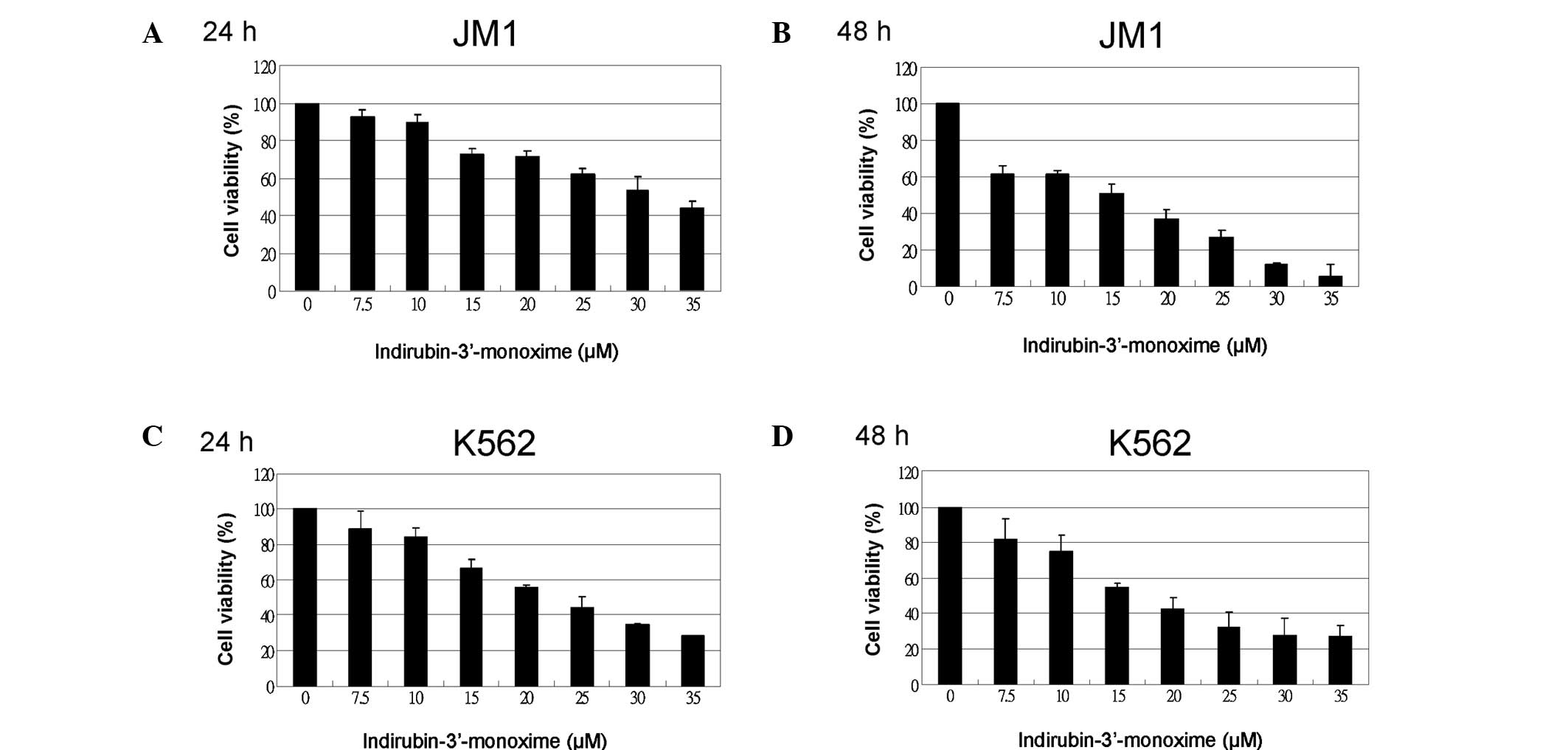
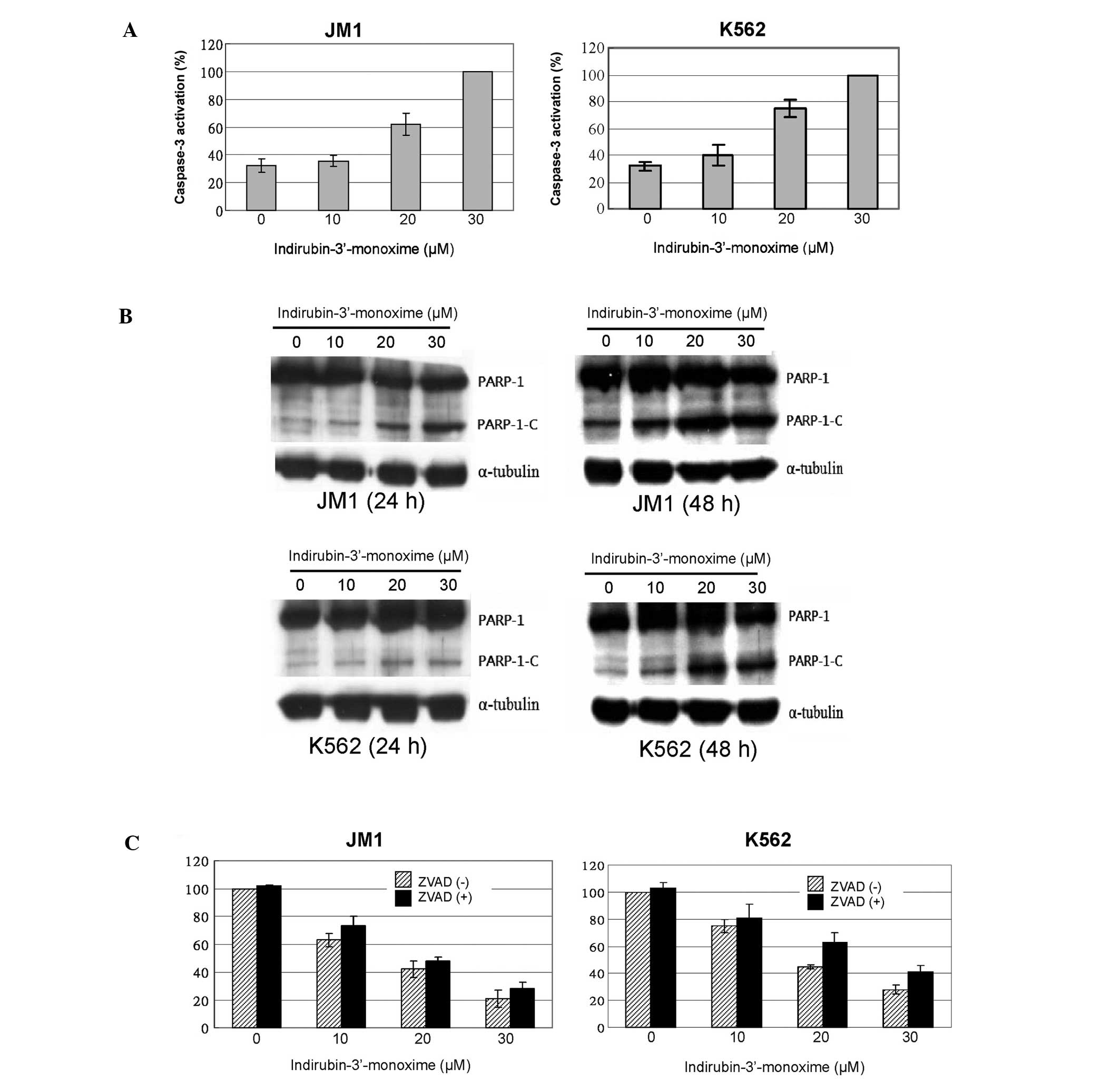
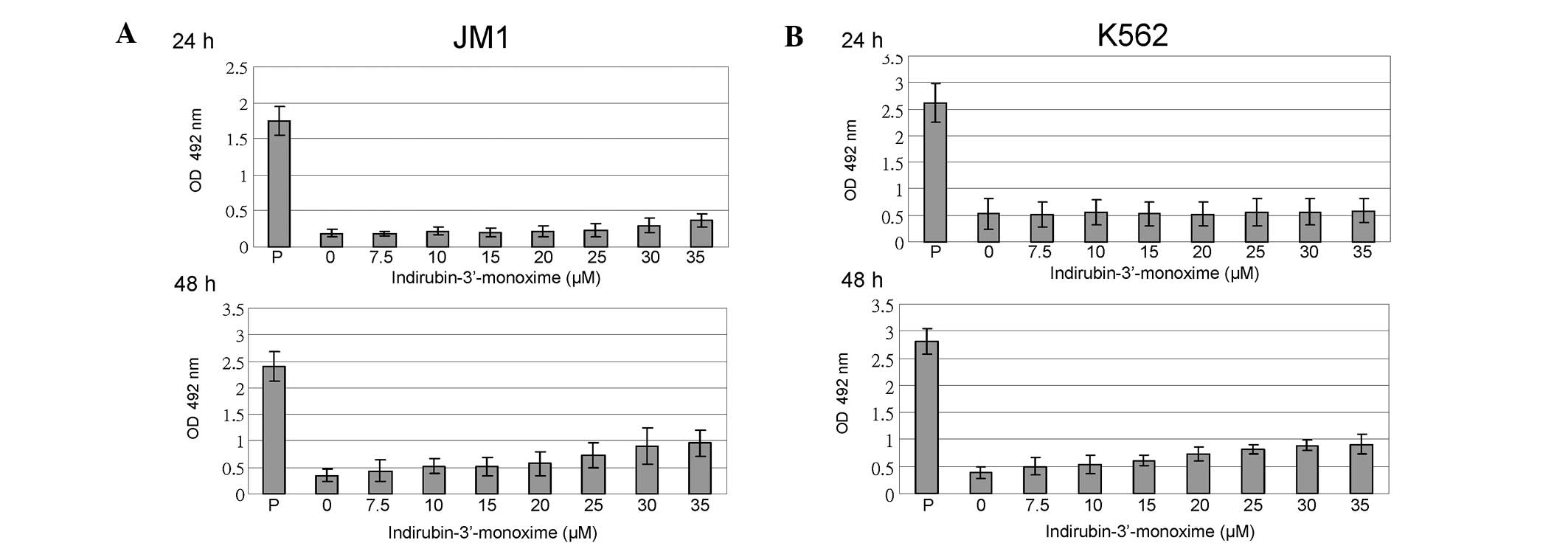
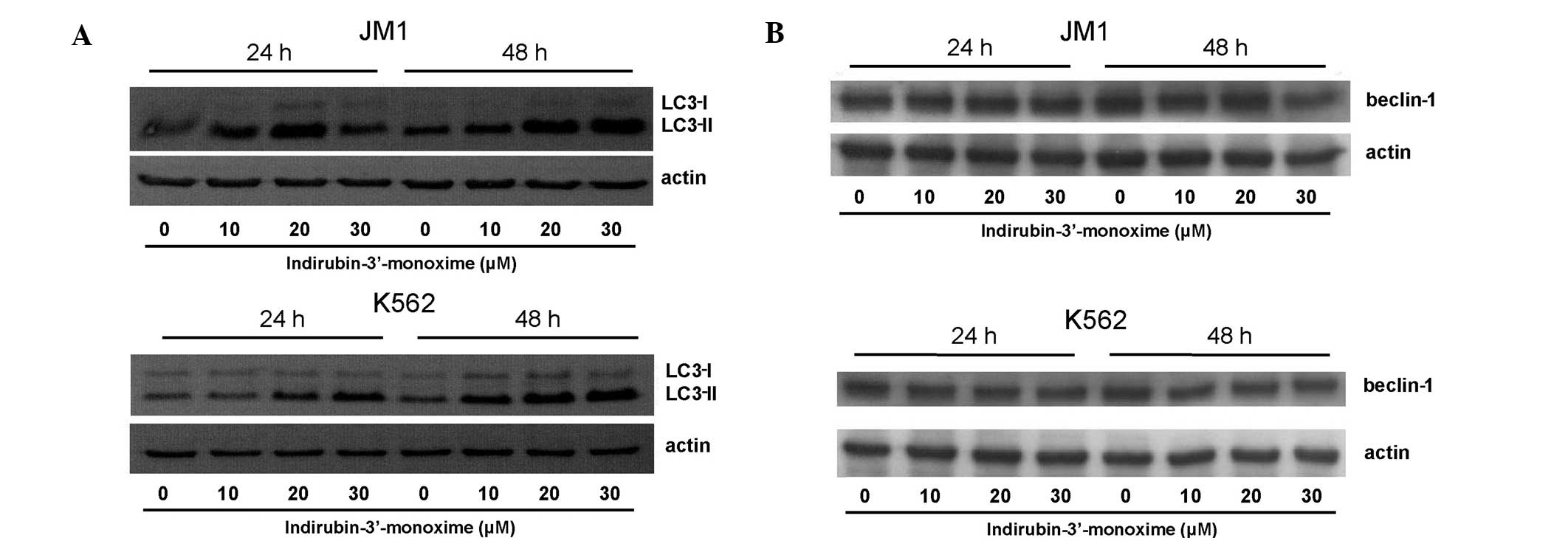
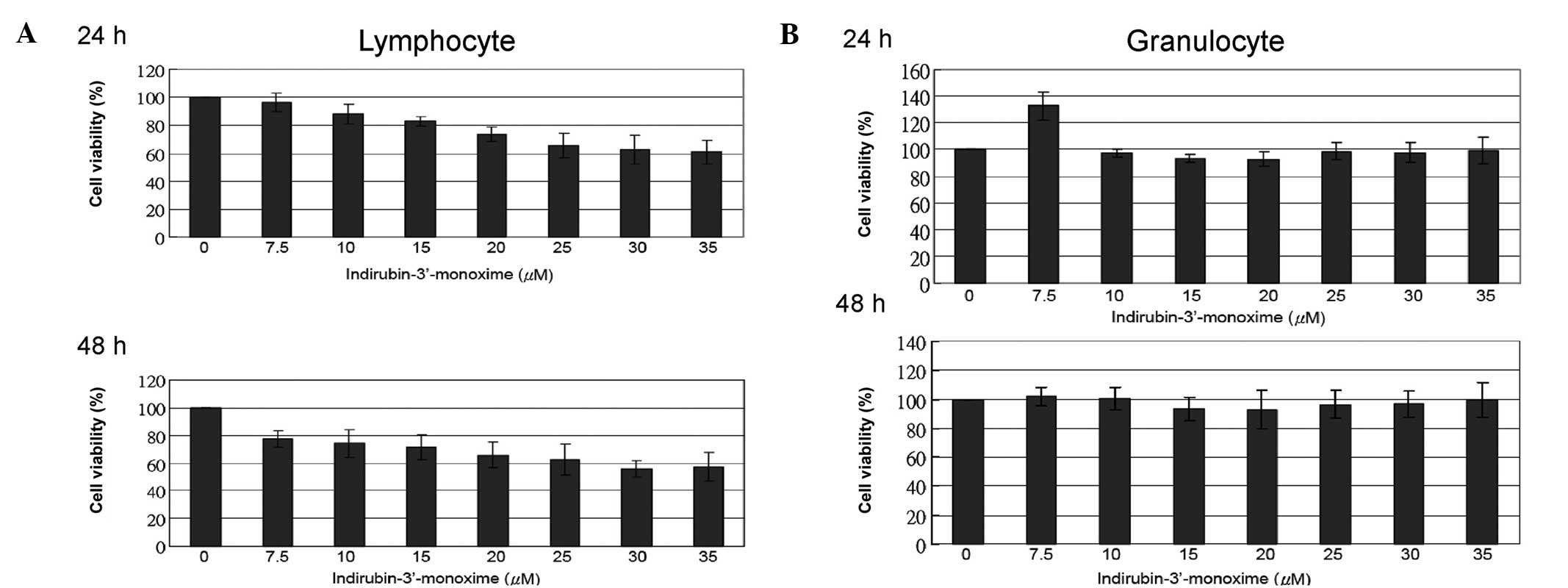
Indirubin is the active component of Dang gui Long hui Wan, a traditional Chinese herbal medicine used as therapy for chronic myelogenous leukemia (CML). In clinical studies, indirubin seldom caused major side-effects. However, the functional effect of indirubin on acute lymphoblastic leukemia (ALL) is unclear. Therefore, we investigated the effects of indirubin-3'-monoxime (I3M) on the ALL cell line JM1 and the CML cell line K562 (control). The anti-leukemia effects and mechanisms of I3M were similar on ALL and CML cells. I3M significantly and dose-dependently decreased cell viability. The G2/M cell cycle phase was arrested and the sub-G1 proportion was relatively increased. In addition, caspase-3 activation led to poly(ADP-ribose) polymerase (PARP)-1 cleavage and the progression of apoptosis. Notably, I3M induced autophagy. However, I3M had no effect on necrosis in either cell line. We specifically found that I3M only marginally affected the survival of primary mature lymphocytes, and was not cytotoxic to granulocytes. Since I3M induced apoptosis and autophagy in human lymphocytic leukemia cells and caused few side-effects in healthy lymphocytes and granulocytes, I3M may be useful for clinical anti-ALL therapy.
View Figures

Figure 1

Figure 2

Figure 3

Figure 4

Figure 5

Figure 6

View References

1 

Pui CH and Evans WE: Treatment of acute lymphoblastic leukemia. N Engl J Med. 354:166–178. 2006. View Article : Google Scholar : PubMed/NCBI

2 

Fielding AK, Richards SM, Chopra R, et al: Outcome of 609 adults after relapse of acute lymphoblastic leukemia (ALL); an MRC UKALL12/ECOG 2993 study. Blood. 109:944–950. 2007. View Article : Google Scholar : PubMed/NCBI

3 

Tavernier E, Boiron JM, Huguet F, et al: Outcome of treatment after first relapse in adults with acute lymphoblastic leukemia initially treated by the LALA-94 trial. Leukemia. 21:1907–1914. 2007. View Article : Google Scholar : PubMed/NCBI

4 

Hoessel R, Leclerc S, Endicott JA, et al: Indirubin, the active constituent of a Chinese antileukemia medicine, inhibits cyclin-dependent kinases. Nat Cell Biol. 1:60–67. 1999.PubMed/NCBI

5 

Institute of Haematology, Chinese Academy of Medical Sciences. Experimental and clinical studies of indirubin in the treatment of CML. Chinese J Intern Med. 18:83–88. 1979.

6 

Cooperative Group of Clinical Therapy of Indirubin. Clinical studies of 314 cases of CML treated with indirubin. Chinese J Intern Med. 1:132–135. 1980.

7 

Marko D, Schatzle S, Friedel A, Genzlinger A, Zankl H, Meijer L and Eisenbrand G: Inhibition of cyclin-dependent kinase 1 (CDK1) by indirubin derivatives in human tumour cells. Br J Cancer. 84:283–289. 2001. View Article : Google Scholar : PubMed/NCBI

8 

Jautelat R, Brumby T, Schäfer M, Briem H, Eisenbrand G, Schwahn S, Krüger M, Lücking U, Prien O and Siemeister G: From the insoluble dye indirubin towards highly active, soluble CDK2-inhibitors. Chembiochem. 6:531–540. 2005. View Article : Google Scholar : PubMed/NCBI

9 

Kim SA, Kim SW, Chang S, Yoon JH and Ahn SG: 5′-nitro-indirubinoxime induces G2/M cell cycle arrest and apoptosis in human KB oral carcinoma cells. Cancer Lett. 274:72–77. 2009.

10 

Yoon JH, Kim SA, Kwon SM, Park JH, Park HS, Kim YC, Yoon JH and Ahn SG: 5′-Nitro-indirubinoxime induces G1 cell cycle arrest and apoptosis in salivary gland adenocarcinoma cells through the inhibition of Notch-1 signaling. Biochim Biophys Acta. 1800:352–358. 2010.

11 

Shi R, Li W, Zhang X, Zhang Y, Peng H, Xie Y, Fan D, Liu R, Liu X and Xiong D: A novel indirubin derivative PHII-7 potentiates adriamycin cytotoxicity via inhibiting P-glycoprotein expression in human breast cancer MCF-7/ADR cells. Eur J Pharmacol. 669:38–44. 2011. View Article : Google Scholar : PubMed/NCBI

12 

Kunz M, Driller KM, Hein M, Hohensee I, Ramer R, Hinz B, Berger A, Eberle J and Langer P: Synthesis of thia-analogous indirubin N-Glycosides and their influence on melanoma cell growth and apoptosis. ChemMedChem. 5:534–539. 2010.PubMed/NCBI

13 

Berger A, Quast SA, Plötz M, Hein M, Kunz M, Langer P and Eberle J: Sensitization of melanoma cells for death ligand-induced apoptosis by an indirubin derivative. Enhancement of both extrinsic and intrinsic apoptosis pathways. Biochem Pharmacol. 81:71–81. 2011. View Article : Google Scholar

14 

Kameswaran TR and Ramanibai R: Indirubin-3-monooxime induced cell cycle arrest and apoptosis in Hep-2 human laryngeal carcinoma cells. Biomed Pharmacother. 63:146–154. 2009. View Article : Google Scholar : PubMed/NCBI

15 

Suzuki K, Adachi R, Hirayama A, Watanabe H, Otani S, Watanabe Y and Kasahara T: Indirubin, a Chinese anti-leukaemia drug, promotes neutrophilic differentiation of human myelocytic leukemia HL-60 cells. Br J Haematol. 130:681–690. 2005. View Article : Google Scholar : PubMed/NCBI

16 

Okada H and Mak TW: Pathways of apoptotic and non-apoptotic death in tumour cells. Nat Rev Cancer. 4:592–603. 2004. View Article : Google Scholar : PubMed/NCBI

17 

Ribas J, Bettayeb K, Ferandin Y, et al: 7-Bromoindirubin-3′-oxime induces caspase-independent cell death. Oncogene. 25:6304–6318. 2006.

18 

Ribas J, Yuste VJ, Garrofé-Ochoa X, Meijer L, Esquerda JE and Boix J: 7-Bromoindirubin-3′-oxime uncovers a serine protease-mediated paradigm of necrotic cell death. Biochem Pharmacol. 76:39–52. 2008.

19 

Kondo Y, Kanzawa T, Sawaya R and Kondo S: The role of autophagy in cancer development and response to therapy. Nat Rev Cancer. 5:726–734. 2005. View Article : Google Scholar : PubMed/NCBI

20 

Yoshioka A, Miyata H, Doki Y, Yamasaki M, Sohma I, Gotoh K, Takiguchi S, Fujiwara Y, Uchiyama Y and Monden M: LC3, an autophagosome marker, is highly expressed in gastrointestinal cancers. Int J Oncol. 33:461–468. 2008.PubMed/NCBI

21 

Kabeya Y, Mizushima N, Ueno T, Yamamoto A, Kirisako T, Noda T, Kominami E, Ohsumi Y and Yoshimori T: LC3, a mammalian homologue of yeast Apg8p, is localized in autophagosome membranes after processing. EMBO J. 19:5720–5728. 2000. View Article : Google Scholar : PubMed/NCBI

22 

Wang J: Beclin 1 bridges autophagy, apoptosis and differentiation. Autophagy. 4:947–948. 2008. View Article : Google Scholar : PubMed/NCBI

23 

Zhu JH, Horbinski C, Guo F, Watkins S, Uchiyama Y and Chu CT: Regulation of autophagy by extracellular signal-regulated protein kinases during 1-methyl-4-phenylpyridinium-induced cell death. Am J Pathol. 170:75–86. 2007. View Article : Google Scholar : PubMed/NCBI

24 

Kim I, Rodriguez-Enriquez S and Lemasters JJ: Selective degradation of mitochondria by mitophagy. Arch Biochem Biophys. 462:245–253. 2007. View Article : Google Scholar : PubMed/NCBI

25 

Mordier S, Deval C, Béchet D, Tassa A and Ferrara M: Leucine limitation induces autophagy and activation of lysosome-dependent proteolysis in C2C12 myotubes through a mammalian target of rapamycin-dependent signaling pathway. J Biol Chem. 275:29900–29906. 2000. View Article : Google Scholar

26 

Kanazawa T, Taneike I, Akaishi R, Yoshizawa F, Furuya N, Fujimura S and Kadowaki M: Amino acids and insulin control autophagic proteolysis through different signaling pathways in relation to mTOR in isolated rat hepatocytes. J Biol Chem. 279:8452–8459. 2004. View Article : Google Scholar

27 

Kagialis-Girard S, Mialou V, Chebel A, Chien WW, Tigaud I, Mokdad F, Badiou C and Ffrench M: Inhibition of normal lymphocyte proliferation by indirubin-3′-monoxime: a multifactorial process. Leuk Lymphoma. 48:605–615. 2007.PubMed/NCBI

Related Articles

  • Abstract
  • View
  • Download
  • Twitter
Copy and paste a formatted citation
Spandidos Publications style
Lee M, Liu Y, Chen M, Wu J, Ho HY, Wang Q and Chuang J: Indirubin-3'-monoxime promotes autophagic and apoptotic death in JM1 human acute lymphoblastic leukemia cells and K562 human chronic myelogenous leukemia cells. Oncol Rep 29: 2072-2078, 2013.
APA
Lee, M., Liu, Y., Chen, M., Wu, J., Ho, H., Wang, Q., & Chuang, J. (2013). Indirubin-3'-monoxime promotes autophagic and apoptotic death in JM1 human acute lymphoblastic leukemia cells and K562 human chronic myelogenous leukemia cells. Oncology Reports, 29, 2072-2078. https://doi.org/10.3892/or.2013.2334
MLA
Lee, M., Liu, Y., Chen, M., Wu, J., Ho, H., Wang, Q., Chuang, J."Indirubin-3'-monoxime promotes autophagic and apoptotic death in JM1 human acute lymphoblastic leukemia cells and K562 human chronic myelogenous leukemia cells". Oncology Reports 29.5 (2013): 2072-2078.
Chicago
Lee, M., Liu, Y., Chen, M., Wu, J., Ho, H., Wang, Q., Chuang, J."Indirubin-3'-monoxime promotes autophagic and apoptotic death in JM1 human acute lymphoblastic leukemia cells and K562 human chronic myelogenous leukemia cells". Oncology Reports 29, no. 5 (2013): 2072-2078. https://doi.org/10.3892/or.2013.2334
Copy and paste a formatted citation
x
Spandidos Publications style
Lee M, Liu Y, Chen M, Wu J, Ho HY, Wang Q and Chuang J: Indirubin-3'-monoxime promotes autophagic and apoptotic death in JM1 human acute lymphoblastic leukemia cells and K562 human chronic myelogenous leukemia cells. Oncol Rep 29: 2072-2078, 2013.
APA
Lee, M., Liu, Y., Chen, M., Wu, J., Ho, H., Wang, Q., & Chuang, J. (2013). Indirubin-3'-monoxime promotes autophagic and apoptotic death in JM1 human acute lymphoblastic leukemia cells and K562 human chronic myelogenous leukemia cells. Oncology Reports, 29, 2072-2078. https://doi.org/10.3892/or.2013.2334
MLA
Lee, M., Liu, Y., Chen, M., Wu, J., Ho, H., Wang, Q., Chuang, J."Indirubin-3'-monoxime promotes autophagic and apoptotic death in JM1 human acute lymphoblastic leukemia cells and K562 human chronic myelogenous leukemia cells". Oncology Reports 29.5 (2013): 2072-2078.
Chicago
Lee, M., Liu, Y., Chen, M., Wu, J., Ho, H., Wang, Q., Chuang, J."Indirubin-3'-monoxime promotes autophagic and apoptotic death in JM1 human acute lymphoblastic leukemia cells and K562 human chronic myelogenous leukemia cells". Oncology Reports 29, no. 5 (2013): 2072-2078. https://doi.org/10.3892/or.2013.2334
Follow us
  • Twitter
  • LinkedIn
  • Facebook
About
  • Spandidos Publications
  • Careers
  • Cookie Policy
  • Privacy Policy
How can we help?
  • Help
  • Live Chat
  • Contact
  • Email to our Support Team