Spandidos Publications Logo
  • About
    • About Spandidos
    • Aims and Scopes
    • Abstracting and Indexing
    • Editorial Policies
    • Reprints and Permissions
    • Job Opportunities
    • Terms and Conditions
    • Contact
  • Journals
    • All Journals
    • Oncology Letters
      • Oncology Letters
      • Information for Authors
      • Editorial Policies
      • Editorial Board
      • Aims and Scope
      • Abstracting and Indexing
      • Bibliographic Information
      • Archive
    • International Journal of Oncology
      • International Journal of Oncology
      • Information for Authors
      • Editorial Policies
      • Editorial Board
      • Aims and Scope
      • Abstracting and Indexing
      • Bibliographic Information
      • Archive
    • Molecular and Clinical Oncology
      • Molecular and Clinical Oncology
      • Information for Authors
      • Editorial Policies
      • Editorial Board
      • Aims and Scope
      • Abstracting and Indexing
      • Bibliographic Information
      • Archive
    • Experimental and Therapeutic Medicine
      • Experimental and Therapeutic Medicine
      • Information for Authors
      • Editorial Policies
      • Editorial Board
      • Aims and Scope
      • Abstracting and Indexing
      • Bibliographic Information
      • Archive
    • International Journal of Molecular Medicine
      • International Journal of Molecular Medicine
      • Information for Authors
      • Editorial Policies
      • Editorial Board
      • Aims and Scope
      • Abstracting and Indexing
      • Bibliographic Information
      • Archive
    • Biomedical Reports
      • Biomedical Reports
      • Information for Authors
      • Editorial Policies
      • Editorial Board
      • Aims and Scope
      • Abstracting and Indexing
      • Bibliographic Information
      • Archive
    • Oncology Reports
      • Oncology Reports
      • Information for Authors
      • Editorial Policies
      • Editorial Board
      • Aims and Scope
      • Abstracting and Indexing
      • Bibliographic Information
      • Archive
    • Molecular Medicine Reports
      • Molecular Medicine Reports
      • Information for Authors
      • Editorial Policies
      • Editorial Board
      • Aims and Scope
      • Abstracting and Indexing
      • Bibliographic Information
      • Archive
    • World Academy of Sciences Journal
      • World Academy of Sciences Journal
      • Information for Authors
      • Editorial Policies
      • Editorial Board
      • Aims and Scope
      • Abstracting and Indexing
      • Bibliographic Information
      • Archive
    • International Journal of Functional Nutrition
      • International Journal of Functional Nutrition
      • Information for Authors
      • Editorial Policies
      • Editorial Board
      • Aims and Scope
      • Abstracting and Indexing
      • Bibliographic Information
      • Archive
    • International Journal of Epigenetics
      • International Journal of Epigenetics
      • Information for Authors
      • Editorial Policies
      • Editorial Board
      • Aims and Scope
      • Abstracting and Indexing
      • Bibliographic Information
      • Archive
    • Medicine International
      • Medicine International
      • Information for Authors
      • Editorial Policies
      • Editorial Board
      • Aims and Scope
      • Abstracting and Indexing
      • Bibliographic Information
      • Archive
  • Articles
  • Information
    • Information for Authors
    • Information for Reviewers
    • Information for Librarians
    • Information for Advertisers
    • Conferences
  • Language Editing
Spandidos Publications Logo
  • About
    • About Spandidos
    • Aims and Scopes
    • Abstracting and Indexing
    • Editorial Policies
    • Reprints and Permissions
    • Job Opportunities
    • Terms and Conditions
    • Contact
  • Journals
    • All Journals
    • Biomedical Reports
      • Information for Authors
      • Editorial Policies
      • Editorial Board
      • Aims and Scope
      • Abstracting and Indexing
      • Bibliographic Information
      • Archive
    • Experimental and Therapeutic Medicine
      • Information for Authors
      • Editorial Policies
      • Editorial Board
      • Aims and Scope
      • Abstracting and Indexing
      • Bibliographic Information
      • Archive
    • International Journal of Epigenetics
      • Information for Authors
      • Editorial Policies
      • Editorial Board
      • Aims and Scope
      • Abstracting and Indexing
      • Bibliographic Information
      • Archive
    • International Journal of Functional Nutrition
      • Information for Authors
      • Editorial Policies
      • Editorial Board
      • Aims and Scope
      • Abstracting and Indexing
      • Bibliographic Information
      • Archive
    • International Journal of Molecular Medicine
      • Information for Authors
      • Editorial Policies
      • Editorial Board
      • Aims and Scope
      • Abstracting and Indexing
      • Bibliographic Information
      • Archive
    • International Journal of Oncology
      • Information for Authors
      • Editorial Policies
      • Editorial Board
      • Aims and Scope
      • Abstracting and Indexing
      • Bibliographic Information
      • Archive
    • Medicine International
      • Information for Authors
      • Editorial Policies
      • Editorial Board
      • Aims and Scope
      • Abstracting and Indexing
      • Bibliographic Information
      • Archive
    • Molecular and Clinical Oncology
      • Information for Authors
      • Editorial Policies
      • Editorial Board
      • Aims and Scope
      • Abstracting and Indexing
      • Bibliographic Information
      • Archive
    • Molecular Medicine Reports
      • Information for Authors
      • Editorial Policies
      • Editorial Board
      • Aims and Scope
      • Abstracting and Indexing
      • Bibliographic Information
      • Archive
    • Oncology Letters
      • Information for Authors
      • Editorial Policies
      • Editorial Board
      • Aims and Scope
      • Abstracting and Indexing
      • Bibliographic Information
      • Archive
    • Oncology Reports
      • Information for Authors
      • Editorial Policies
      • Editorial Board
      • Aims and Scope
      • Abstracting and Indexing
      • Bibliographic Information
      • Archive
    • World Academy of Sciences Journal
      • Information for Authors
      • Editorial Policies
      • Editorial Board
      • Aims and Scope
      • Abstracting and Indexing
      • Bibliographic Information
      • Archive
  • Articles
  • Information
    • For Authors
    • For Reviewers
    • For Librarians
    • For Advertisers
    • Conferences
  • Language Editing
Login Register Submit
  • This site uses cookies
  • You can change your cookie settings at any time by following the instructions in our Cookie Policy. To find out more, you may read our Privacy Policy.

    I agree
Search articles by DOI, keyword, author or affiliation
Search
Advanced Search
presentation
Oncology Reports
Join Editorial Board Propose a Special Issue
Print ISSN: 1021-335X Online ISSN: 1791-2431
Journal Cover
August 2013 Volume 30 Issue 2

Full Size Image

Sign up for eToc alerts
Recommend to Library

Journals

International Journal of Molecular Medicine

International Journal of Molecular Medicine

International Journal of Molecular Medicine is an international journal devoted to molecular mechanisms of human disease.

International Journal of Oncology

International Journal of Oncology

International Journal of Oncology is an international journal devoted to oncology research and cancer treatment.

Molecular Medicine Reports

Molecular Medicine Reports

Covers molecular medicine topics such as pharmacology, pathology, genetics, neuroscience, infectious diseases, molecular cardiology, and molecular surgery.

Oncology Reports

Oncology Reports

Oncology Reports is an international journal devoted to fundamental and applied research in Oncology.

Experimental and Therapeutic Medicine

Experimental and Therapeutic Medicine

Experimental and Therapeutic Medicine is an international journal devoted to laboratory and clinical medicine.

Oncology Letters

Oncology Letters

Oncology Letters is an international journal devoted to Experimental and Clinical Oncology.

Biomedical Reports

Biomedical Reports

Explores a wide range of biological and medical fields, including pharmacology, genetics, microbiology, neuroscience, and molecular cardiology.

Molecular and Clinical Oncology

Molecular and Clinical Oncology

International journal addressing all aspects of oncology research, from tumorigenesis and oncogenes to chemotherapy and metastasis.

World Academy of Sciences Journal

World Academy of Sciences Journal

Multidisciplinary open-access journal spanning biochemistry, genetics, neuroscience, environmental health, and synthetic biology.

International Journal of Functional Nutrition

International Journal of Functional Nutrition

Open-access journal combining biochemistry, pharmacology, immunology, and genetics to advance health through functional nutrition.

International Journal of Epigenetics

International Journal of Epigenetics

Publishes open-access research on using epigenetics to advance understanding and treatment of human disease.

Medicine International

Medicine International

An International Open Access Journal Devoted to General Medicine.

Journal Cover
August 2013 Volume 30 Issue 2

Full Size Image

Sign up for eToc alerts
Recommend to Library

  • Article
  • Citations
    • Cite This Article
    • Download Citation
    • Create Citation Alert
    • Remove Citation Alert
    • Cited By
  • Similar Articles
    • Related Articles (in Spandidos Publications)
    • Similar Articles (Google Scholar)
    • Similar Articles (PubMed)
  • Download PDF
  • Download XML
  • View XML
Article

A detailed immunohistochemical analysis of the PI3K/AKT/mTOR pathway in lung cancer: Correlation with PIK3CA, AKT1, K-RAS or PTEN mutational status and clinicopathological features

  • Authors:
    • Eleni Andriana Trigka
    • Georgia Levidou
    • Angelica A. Saetta
    • Ilenia Chatziandreou
    • Periklis Tomos
    • Nikolaos Thalassinos
    • Nikolaos Anastasiou
    • Eleftherios Spartalis
    • Nikolaos Kavantzas
    • Efstratios Patsouris
    • Penelope Korkolopoulou
  • View Affiliations / Copyright

    Affiliations: First Department of Pathology, University of Athens Medical School, Laiko General Hospital, 11527 Athens, Greece, Second Department of Propaedeutic Surgery, University of Athens Medical School, Laiko General Hospital, 11527 Athens, Greece, Department of Thoracic Surgery, 1st IKA Hospital, 15127 Athens, Greece
  • Pages: 623-636
    |
    Published online on: May 31, 2013
       https://doi.org/10.3892/or.2013.2512
  • Expand metrics +
Metrics: Total Views: 0 (Spandidos Publications: | PMC Statistics: )
Metrics: Total PDF Downloads: 0 (Spandidos Publications: | PMC Statistics: )
Cited By (CrossRef): 0 citations Loading Articles...

This article is mentioned in:


Abstract

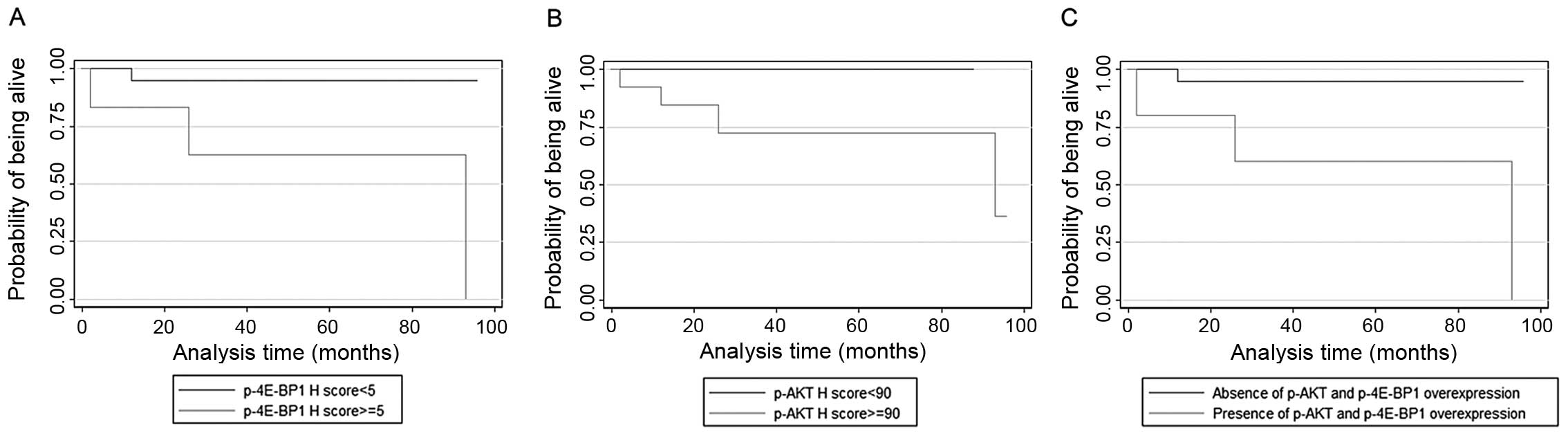
The phosphoinositide 3-kinase (PI3K)/v-akt murine thymoma viral oncogene homolog (AKT)/mammalian target of rapamycin (mTOR) pathway is upregulated in a number of human cancers, including non-small cell lung cancer (NSCLC). Its potential role in NSCLC progression provides an attractive target for anticancer therapy. The expression of phosphorylated mTOR (p-mTOR), phosphorylated AKT (p-AKT), p85α and p110γ subunits of PI3K, phosphorylated p70S6K (p-p70S6K), phosphatase and tensin homolog (PTEN) and phosphorylated 4E-BP1 (p‑4E‑BP1) was examined by immunohistochemistry in 102 NSCLC specimens. The results were correlated with clinicopathological features. We also examined 61 of our cases for the presence of PIK3CA, AKT1, PTEN and K-RAS mutations. A common PIK3CA mutation was detected at exon 9 in 2 samples (p.E545K), whereas another sample displayed a rare mutation (p.D1018N). Furthermore, 10 out of 54 cases (18.5%) had a K-RAS mutation at codon 12, 5 had a PTEN mutation (exons 7 and 8) and 1 case had an AKT1 mutation (p.E17K). PTEN mutations were associated with nodal metastases. The expression of p-mTOR positively correlated with that of p-AKT and p-p70S6K and was higher in adenocarcinomas along with nuclear p110γPI3K expression, whereas p-4E-BP1 expression was higher in squamous cell carcinomas. We also established a positive association between p85αPI3K or p110γPI3K and cytoplasmic p-AKT and its downstream effectors. An inverse correlation was noted between p-4E-BP1 immunoexpression and tumour status and nuclear p-AKT expression as regards tumour stage. Univariate survival analysis demonstrated that p-4E-BP1 expression, either alone or in combination with cytoplasmic p-AKT expression had an adverse prognostic significance in adenocarcinomas. The combination of p-4E‑BP1 and cytoplasmic p-AKT expression remained significant in the multivariate analysis as a function of their interaction with histological type. Our data demonstrate the significance of p‑4E‑BP1 immunoexpression as a molecular marker of prognostic value in adenocarcinomas, particularly when combined with p-AKT.
View Figures

Figure 1

View References

1 

Travis WD; IASLC Staging Committee. Reporting lung cancer pathology specimens. Impact of the anticipated 7th edition TNM classification based on recommendations of the IASLC Staging Committee. Histopathology. 54:3–11. 2009. View Article : Google Scholar : PubMed/NCBI

2 

Jemal A, Siegel R, Ward E, et al: Cancer statistics: 2007. CA Cancer J Clin. 57:43–66. 2007. View Article : Google Scholar

3 

Vivanco I and Sawyers CL: The phosphatidyloinositol 3-kinase AKT pathway in human cancer. Nat Rev Cancer. 2:489–501. 2002. View Article : Google Scholar : PubMed/NCBI

4 

Sarbassov DD, Ali SM and Sabatini DM: Growing roles for the mTOR pathway. Curr Opin Cell Biol. 17:596–603. 2005. View Article : Google Scholar : PubMed/NCBI

5 

Sarbassov DD, Ali SM, Kim DH, et al: Rictor, a novel binding pattern of mTOR, defines a rapamycin-insensitive and raptor-independent pathway that regulates the cytoskeleton. Curr Biol. 14:1296–1302. 2004. View Article : Google Scholar : PubMed/NCBI

6 

Hay N and Sonenberg N: Upstream and downstream of mTOR. Genes Dev. 18:1926–1945. 2004. View Article : Google Scholar

7 

Gingras AC, Gypi SP, Raught B, et al: Regulation of 4E-BP1 phosphorylation: a novel two-step mechanism. Genes Dev. 13:1422–1437. 1999. View Article : Google Scholar : PubMed/NCBI

8 

Bjornsti MA and Houghton PJ: The TOR pathway: a target for cancer therapy. Nat Rev Cancer. 4:335–348. 2004. View Article : Google Scholar : PubMed/NCBI

9 

Yu J, Zhang Y, McIlroy J, et al: Regulation of the p85/p110 phosphstidyloinositol 3′-kinase: stabilization and inhibition of the p110alpha catalytic subunit by the p85 regulatory subunit. Mol Cell Biol. 18:1379–1387. 1998.

10 

Miled N, Yan Y, Hon WC, et al: Mechanism of two classes of cancer mutations in the phosphoinositide 3-kinase catalytic subunit. Science. 317:239–242. 2007. View Article : Google Scholar : PubMed/NCBI

11 

Yamamoto H, Hisayuki S, Masaharu N, et al: PI3KCA mutations and copy number gains in human lung cancer. Cancer Res. 68:693–621. 2008. View Article : Google Scholar

12 

Scrima M, De Marco C, Fabiani F, et al: Signaling networks associated with AKT activation in non-small cell lung cancer (NSCLC): new insights on the role of phosphatidyl-inositol-3 kinase. PLoS One. 7:e304272012. View Article : Google Scholar : PubMed/NCBI

13 

Marti A and Felip E: PI3K pathway in NSCLC. Front Oncol. 1:552012.

14 

Stambolic V, Suzuki A, de la Pompa JL, et al: Negative regulation of PKB/Akt-dependent cell survival by the tumor suppressor PTEN. Cell. 95:29–39. 1998. View Article : Google Scholar : PubMed/NCBI

15 

Wangpaichitr M, Wu C, You M, et al: Inhibition of mTOR restores cisplatin sensitivity through down-regulation of growth and anti-apoptotic proteins. Eur J Pharmacol. 591:124–127. 2008. View Article : Google Scholar : PubMed/NCBI

16 

Balsara BR, Pei J, Mitsuuchi Y, et al: Frequent activation of AKT in non-small cell lung carcinomas and preneoplastic bronchial lesions. Carcinogenesis. 25:2053–2059. 2004. View Article : Google Scholar : PubMed/NCBI

17 

Okudela K, Suzuki M, Kageyama S, et al: PIK3CA mutation and amplification in human lung cancer. Pathol Int. 57:664–671. 2007. View Article : Google Scholar : PubMed/NCBI

18 

Yoshizawa A, Fukuoka J, Shimizu S, et al: Overexpression of phospho-eIF4E is associated with survival through AKT pathway in non-small cell lung cancer. Clin Cancer Res. 16:240–248. 2010. View Article : Google Scholar : PubMed/NCBI

19 

Anagnostou VK, Bepler G, Syrigos KN, et al: High expression of mammalian target of rapamycin is associated with better outcome for patients with early stage lung adenocarcinoma. Clin Cancer Res. 15:4157–4164. 2009. View Article : Google Scholar : PubMed/NCBI

20 

Tang JM, He QY, Guo RX, et al: Phosphorylated AKT overexpression and loss of PTEN expression in non-small cell lung cancer confers poor prognosis. Lung Cancer. 51:181–191. 2006. View Article : Google Scholar : PubMed/NCBI

21 

Liu D, Huang Y, Chen B, et al: Activation of mammalian target of rapamycin pathway confers adverse outcome in nonsmall cell lung carcinoma. Cancer. 117:3763–3673. 2011. View Article : Google Scholar : PubMed/NCBI

22 

Dobashi Y, Suzuki S, Matsubara H, et al: Critical and diverse involvement of Akt/mammalian target of rapamycin signaling in human lung carcinomas. Cancer. 115:107–118. 2009. View Article : Google Scholar : PubMed/NCBI

23 

McDonald JM, Pelloski CE, Ledoux A, et al: Elevated phospho-S6 expression is associated with metastasis in adenocarcinoma of the lung. Clin Cancer Res. 14:7832–7837. 2008. View Article : Google Scholar : PubMed/NCBI

24 

Khoury T, Alrawi S, Ramnath N, et al: Eukaryotic initiation factor-4E and cyclin D1 expression associated with patient survival in lung cancer. Clin Lung Cancer. 10:58–66. 2009. View Article : Google Scholar : PubMed/NCBI

25 

Wang R, Genng J, Wang JH, et al: Overexpression of eukaryotic initiation factor 4E (eIF4E) ad its clinical significance in lung adenocarcinoma. Lung Cancer. 66:237–244. 2009. View Article : Google Scholar : PubMed/NCBI

26 

Oh MH, Lee HJ, Yoo SB, et al: Clinicopathological correlations of mTOR and pAkt expression in non-small cell lung cancer. Virchows Arch. 460:601–609. 2012. View Article : Google Scholar : PubMed/NCBI

27 

Zito CR, Jilaveanu LB, Anagnostou V, et al: Multi-level targeting of the phosphatidyloinositol-3-kinase pathway in non-small cell lung cancer cells. PLoS One. 7:e313312012. View Article : Google Scholar : PubMed/NCBI

28 

Gately K, Al-Alao B, Dhillon T, et al: Overexpression of the mammalian target of rapamycin (mTOR) and angioinvasion are poor prognostic factors in early stage NSCLC: a verification study. Lung Cancer. 75:217–222. 2012. View Article : Google Scholar : PubMed/NCBI

29 

Dhillon T, Mauri FA, Belezza G, et al: Overexpression of the mammalian target of rapamycin: a novel biomarker for poor survival in resected early stage non-small cell lung cancer. J Thorac Oncol. 5:314–319. 2010. View Article : Google Scholar : PubMed/NCBI

30 

Lim WT, Zhang WH, Miller CR, et al: PTEN and phosphorylated AKT expression and prognosis in early- and late-stage non-small cell lung cancer. Oncol Rep. 17:853–857. 2007.PubMed/NCBI

31 

Shi Y, Chen L, Li J, et al: Prognostic and predictive values of pERK1/2 and pAkt-1 expression in non-small cell lung cancer patients treated with adjuvant chemotherapy. Tumour Biol. 32:381–389. 2011. View Article : Google Scholar : PubMed/NCBI

32 

David O, Jett J, LeBeau H, et al: Phospho-Akt overexpression in non-small cell lung cancer confers significant stage-independent survival disadvantage. Clin Cancer Res. 10:6865–6871. 2004. View Article : Google Scholar

33 

Korkolopoulou P, Levidou G, Trigka EA, et al: A comprehensive immunohistochemical and molecular approach to the PI3K/AKT/mTOR (phosphoinositide 3-kinase/v-akt murine thymoma viral oncogene/mammalian target of rapamycin) pathway in bladder urothelial carcinoma. BJU Int. E1237–E1248. 2012. View Article : Google Scholar

34 

Levidou G, Saetta AA, Gigelou F, et al: ERK/pERK expression and B-raf mutations in colon adenocarcinomas: correlation with clinicopathological characteristics. World J Surg Oncol. 10:472012. View Article : Google Scholar : PubMed/NCBI

35 

Rojo F, Najera L, Lirola J, et al: 4E-binding protein 1, a cell signaling hallmark in breast cancer that correlates with pathologic grade and prognosis. Clin Cancer Res. 13:81–89. 2007. View Article : Google Scholar : PubMed/NCBI

36 

Fujisaka Y, Yamada Y, Yamamoto N, et al: A phase 1 clinical study of temsirolimus (CCI-779) in Japanese patients with advanced solid tumors. Jpn J Clin Oncol. 40:732–738. 2010. View Article : Google Scholar : PubMed/NCBI

37 

Pal SK, Figlin RA and Reckamp KL: The role of targeting mammalian target of rapamycin in lung cancer. Clin Lung Cancer. 9:340–345. 2008. View Article : Google Scholar : PubMed/NCBI

38 

An SJ, Chen ZH, Su J, et al: Identification of enriched driver gene alterations in subgroups of non-small cell lung cancer patients based on histology and smoking status. PLoS One. 7:e401092012. View Article : Google Scholar : PubMed/NCBI

39 

Thomas G: The S6 kinase signaling pathway in the control of development and growth. Biol Res. 35:305–313. 2002. View Article : Google Scholar : PubMed/NCBI

40 

Riemenschneider MJ, Betensky RA, Pasedag SM, et al: AKT activation in human glioblastomas enhances proliferation via TSC1 and S6 kinase signaling. Cancer Res. 66:5618–5623. 2006. View Article : Google Scholar : PubMed/NCBI

41 

Han S, Khuri FR and Roman J: Fibronectin stimulates non-small cell lung cancinoma cell growth through activation of Akt/mammalian target of rapamycin/S6 kinase and inactivation of LKB1/AMP-activated protein kinase signal pathways. Cancer Res. 66:315–323. 2006. View Article : Google Scholar : PubMed/NCBI

42 

Johnson SM, Gulhati P, Rampy BA, et al: Novel expression patterns of PI3K/Akt/mTOR signaling pathway components in colorectal cancer. J Am Coll Surg. 210:767–778. 2010. View Article : Google Scholar : PubMed/NCBI

43 

Bose S, Chandran S, Mirocha JM and Bose N: The Akt pathway in human breast cancer: a tissue-array-based analysis. Mod Pathol. 19:238–245. 2009. View Article : Google Scholar : PubMed/NCBI

44 

Pantuck AJ, Seligson DB, Klatte T, et al: Prognostic relevance of the mTOR pathway in renal cell carcinoma: implications for molecular patient selection for targeted therapy. Cancer. 109:2257–2267. 2007. View Article : Google Scholar : PubMed/NCBI

45 

Sun CH, Chang YH and Pan CC: Activation of the PI3K/Akt/mTOR pathway correlates with tumour progression and reduced survival in patients with urothelial carcinoma of the urinary bladder. Histopathology. 58:1054–1063. 2011. View Article : Google Scholar : PubMed/NCBI

46 

Liliental J, Moon SY, Lesche R, et al: Genetic deletion of the Pten tumor suppressor gene promotes cell motility by activation of Rac1 and Cdc42 GTPases. Curr Biol. 10:401–404. 2000. View Article : Google Scholar : PubMed/NCBI

47 

Dai B, Kong YY, Ye DW, et al: Activation of the mammalian target of rapamycin signaling pathway in prostate cancer and its association with patient clinicopathological characteristics. BJU Int. 104:1009–1016. 2009. View Article : Google Scholar : PubMed/NCBI

48 

Seki N, Takasu T, Mandai K, et al: Expression of eukaryotic initiation factor 4E in atypical adenomatous hyperplasia and adenocarcinoma of the human peripheral lung. Clic Cancer Res. 8:3046–3053. 2002.PubMed/NCBI

49 

Rosenwald IB, Hutzler MJ, Wang S, et al: Expression of eukaryotic translation initiation factors 4E and 2alpha is increased frequently in bronchioalveolar but not in squamous cell carcinomas of the lung. Cancer. 92:2164–2171. 2001. View Article : Google Scholar : PubMed/NCBI

50 

Sun SY, Rosenberg LM, Wang X, et al: Activation of Akt and eIF4E survival pathways by rapamycin-mediated mammalian target of rapamycin inhibition. Cancer Res. 65:7052–7058. 2005. View Article : Google Scholar : PubMed/NCBI

51 

Armengol G, Rojo F, Castellvi J, et al: 4E-binding protein 1: a key molecular ‘funnel factor’ in human cancer with clinical implications. Cancer Res. 67:7551–7555. 2007.

52 

Dumstorf CA, Konicek BW, McNulty AM, et al: Modulation of 4E-BP1 function as a critical determinant of enzastaurin-induced apoptosis. Mol Cancer Ther. 9:3158–3163. 2010. View Article : Google Scholar : PubMed/NCBI

Related Articles

  • Abstract
  • View
  • Download
  • Twitter
Copy and paste a formatted citation
Spandidos Publications style
Trigka EA, Levidou G, Saetta AA, Chatziandreou I, Tomos P, Thalassinos N, Anastasiou N, Spartalis E, Kavantzas N, Patsouris E, Patsouris E, et al: A detailed immunohistochemical analysis of the PI3K/AKT/mTOR pathway in lung cancer: Correlation with PIK3CA, AKT1, K-RAS or PTEN mutational status and clinicopathological features. Oncol Rep 30: 623-636, 2013.
APA
Trigka, E.A., Levidou, G., Saetta, A.A., Chatziandreou, I., Tomos, P., Thalassinos, N. ... Korkolopoulou, P. (2013). A detailed immunohistochemical analysis of the PI3K/AKT/mTOR pathway in lung cancer: Correlation with PIK3CA, AKT1, K-RAS or PTEN mutational status and clinicopathological features. Oncology Reports, 30, 623-636. https://doi.org/10.3892/or.2013.2512
MLA
Trigka, E. A., Levidou, G., Saetta, A. A., Chatziandreou, I., Tomos, P., Thalassinos, N., Anastasiou, N., Spartalis, E., Kavantzas, N., Patsouris, E., Korkolopoulou, P."A detailed immunohistochemical analysis of the PI3K/AKT/mTOR pathway in lung cancer: Correlation with PIK3CA, AKT1, K-RAS or PTEN mutational status and clinicopathological features". Oncology Reports 30.2 (2013): 623-636.
Chicago
Trigka, E. A., Levidou, G., Saetta, A. A., Chatziandreou, I., Tomos, P., Thalassinos, N., Anastasiou, N., Spartalis, E., Kavantzas, N., Patsouris, E., Korkolopoulou, P."A detailed immunohistochemical analysis of the PI3K/AKT/mTOR pathway in lung cancer: Correlation with PIK3CA, AKT1, K-RAS or PTEN mutational status and clinicopathological features". Oncology Reports 30, no. 2 (2013): 623-636. https://doi.org/10.3892/or.2013.2512
Copy and paste a formatted citation
x
Spandidos Publications style
Trigka EA, Levidou G, Saetta AA, Chatziandreou I, Tomos P, Thalassinos N, Anastasiou N, Spartalis E, Kavantzas N, Patsouris E, Patsouris E, et al: A detailed immunohistochemical analysis of the PI3K/AKT/mTOR pathway in lung cancer: Correlation with PIK3CA, AKT1, K-RAS or PTEN mutational status and clinicopathological features. Oncol Rep 30: 623-636, 2013.
APA
Trigka, E.A., Levidou, G., Saetta, A.A., Chatziandreou, I., Tomos, P., Thalassinos, N. ... Korkolopoulou, P. (2013). A detailed immunohistochemical analysis of the PI3K/AKT/mTOR pathway in lung cancer: Correlation with PIK3CA, AKT1, K-RAS or PTEN mutational status and clinicopathological features. Oncology Reports, 30, 623-636. https://doi.org/10.3892/or.2013.2512
MLA
Trigka, E. A., Levidou, G., Saetta, A. A., Chatziandreou, I., Tomos, P., Thalassinos, N., Anastasiou, N., Spartalis, E., Kavantzas, N., Patsouris, E., Korkolopoulou, P."A detailed immunohistochemical analysis of the PI3K/AKT/mTOR pathway in lung cancer: Correlation with PIK3CA, AKT1, K-RAS or PTEN mutational status and clinicopathological features". Oncology Reports 30.2 (2013): 623-636.
Chicago
Trigka, E. A., Levidou, G., Saetta, A. A., Chatziandreou, I., Tomos, P., Thalassinos, N., Anastasiou, N., Spartalis, E., Kavantzas, N., Patsouris, E., Korkolopoulou, P."A detailed immunohistochemical analysis of the PI3K/AKT/mTOR pathway in lung cancer: Correlation with PIK3CA, AKT1, K-RAS or PTEN mutational status and clinicopathological features". Oncology Reports 30, no. 2 (2013): 623-636. https://doi.org/10.3892/or.2013.2512
Follow us
  • Twitter
  • LinkedIn
  • Facebook
About
  • Spandidos Publications
  • Careers
  • Cookie Policy
  • Privacy Policy
How can we help?
  • Help
  • Live Chat
  • Contact
  • Email to our Support Team