Spandidos Publications Logo
  • About
    • About Spandidos
    • Aims and Scopes
    • Abstracting and Indexing
    • Editorial Policies
    • Reprints and Permissions
    • Job Opportunities
    • Terms and Conditions
    • Contact
  • Journals
    • All Journals
    • Oncology Letters
      • Oncology Letters
      • Information for Authors
      • Editorial Policies
      • Editorial Board
      • Aims and Scope
      • Abstracting and Indexing
      • Bibliographic Information
      • Archive
    • International Journal of Oncology
      • International Journal of Oncology
      • Information for Authors
      • Editorial Policies
      • Editorial Board
      • Aims and Scope
      • Abstracting and Indexing
      • Bibliographic Information
      • Archive
    • Molecular and Clinical Oncology
      • Molecular and Clinical Oncology
      • Information for Authors
      • Editorial Policies
      • Editorial Board
      • Aims and Scope
      • Abstracting and Indexing
      • Bibliographic Information
      • Archive
    • Experimental and Therapeutic Medicine
      • Experimental and Therapeutic Medicine
      • Information for Authors
      • Editorial Policies
      • Editorial Board
      • Aims and Scope
      • Abstracting and Indexing
      • Bibliographic Information
      • Archive
    • International Journal of Molecular Medicine
      • International Journal of Molecular Medicine
      • Information for Authors
      • Editorial Policies
      • Editorial Board
      • Aims and Scope
      • Abstracting and Indexing
      • Bibliographic Information
      • Archive
    • Biomedical Reports
      • Biomedical Reports
      • Information for Authors
      • Editorial Policies
      • Editorial Board
      • Aims and Scope
      • Abstracting and Indexing
      • Bibliographic Information
      • Archive
    • Oncology Reports
      • Oncology Reports
      • Information for Authors
      • Editorial Policies
      • Editorial Board
      • Aims and Scope
      • Abstracting and Indexing
      • Bibliographic Information
      • Archive
    • Molecular Medicine Reports
      • Molecular Medicine Reports
      • Information for Authors
      • Editorial Policies
      • Editorial Board
      • Aims and Scope
      • Abstracting and Indexing
      • Bibliographic Information
      • Archive
    • World Academy of Sciences Journal
      • World Academy of Sciences Journal
      • Information for Authors
      • Editorial Policies
      • Editorial Board
      • Aims and Scope
      • Abstracting and Indexing
      • Bibliographic Information
      • Archive
    • International Journal of Functional Nutrition
      • International Journal of Functional Nutrition
      • Information for Authors
      • Editorial Policies
      • Editorial Board
      • Aims and Scope
      • Abstracting and Indexing
      • Bibliographic Information
      • Archive
    • International Journal of Epigenetics
      • International Journal of Epigenetics
      • Information for Authors
      • Editorial Policies
      • Editorial Board
      • Aims and Scope
      • Abstracting and Indexing
      • Bibliographic Information
      • Archive
    • Medicine International
      • Medicine International
      • Information for Authors
      • Editorial Policies
      • Editorial Board
      • Aims and Scope
      • Abstracting and Indexing
      • Bibliographic Information
      • Archive
  • Articles
  • Information
    • Information for Authors
    • Information for Reviewers
    • Information for Librarians
    • Information for Advertisers
    • Conferences
  • Language Editing
Spandidos Publications Logo
  • About
    • About Spandidos
    • Aims and Scopes
    • Abstracting and Indexing
    • Editorial Policies
    • Reprints and Permissions
    • Job Opportunities
    • Terms and Conditions
    • Contact
  • Journals
    • All Journals
    • Biomedical Reports
      • Information for Authors
      • Editorial Policies
      • Editorial Board
      • Aims and Scope
      • Abstracting and Indexing
      • Bibliographic Information
      • Archive
    • Experimental and Therapeutic Medicine
      • Information for Authors
      • Editorial Policies
      • Editorial Board
      • Aims and Scope
      • Abstracting and Indexing
      • Bibliographic Information
      • Archive
    • International Journal of Epigenetics
      • Information for Authors
      • Editorial Policies
      • Editorial Board
      • Aims and Scope
      • Abstracting and Indexing
      • Bibliographic Information
      • Archive
    • International Journal of Functional Nutrition
      • Information for Authors
      • Editorial Policies
      • Editorial Board
      • Aims and Scope
      • Abstracting and Indexing
      • Bibliographic Information
      • Archive
    • International Journal of Molecular Medicine
      • Information for Authors
      • Editorial Policies
      • Editorial Board
      • Aims and Scope
      • Abstracting and Indexing
      • Bibliographic Information
      • Archive
    • International Journal of Oncology
      • Information for Authors
      • Editorial Policies
      • Editorial Board
      • Aims and Scope
      • Abstracting and Indexing
      • Bibliographic Information
      • Archive
    • Medicine International
      • Information for Authors
      • Editorial Policies
      • Editorial Board
      • Aims and Scope
      • Abstracting and Indexing
      • Bibliographic Information
      • Archive
    • Molecular and Clinical Oncology
      • Information for Authors
      • Editorial Policies
      • Editorial Board
      • Aims and Scope
      • Abstracting and Indexing
      • Bibliographic Information
      • Archive
    • Molecular Medicine Reports
      • Information for Authors
      • Editorial Policies
      • Editorial Board
      • Aims and Scope
      • Abstracting and Indexing
      • Bibliographic Information
      • Archive
    • Oncology Letters
      • Information for Authors
      • Editorial Policies
      • Editorial Board
      • Aims and Scope
      • Abstracting and Indexing
      • Bibliographic Information
      • Archive
    • Oncology Reports
      • Information for Authors
      • Editorial Policies
      • Editorial Board
      • Aims and Scope
      • Abstracting and Indexing
      • Bibliographic Information
      • Archive
    • World Academy of Sciences Journal
      • Information for Authors
      • Editorial Policies
      • Editorial Board
      • Aims and Scope
      • Abstracting and Indexing
      • Bibliographic Information
      • Archive
  • Articles
  • Information
    • For Authors
    • For Reviewers
    • For Librarians
    • For Advertisers
    • Conferences
  • Language Editing
Login Register Submit
  • This site uses cookies
  • You can change your cookie settings at any time by following the instructions in our Cookie Policy. To find out more, you may read our Privacy Policy.

    I agree
Search articles by DOI, keyword, author or affiliation
Search
Advanced Search
presentation
Oncology Reports
Join Editorial Board Propose a Special Issue
Print ISSN: 1021-335X Online ISSN: 1791-2431
Journal Cover
January-2016 Volume 35 Issue 1

Full Size Image

Sign up for eToc alerts
Recommend to Library

Journals

International Journal of Molecular Medicine

International Journal of Molecular Medicine

International Journal of Molecular Medicine is an international journal devoted to molecular mechanisms of human disease.

International Journal of Oncology

International Journal of Oncology

International Journal of Oncology is an international journal devoted to oncology research and cancer treatment.

Molecular Medicine Reports

Molecular Medicine Reports

Covers molecular medicine topics such as pharmacology, pathology, genetics, neuroscience, infectious diseases, molecular cardiology, and molecular surgery.

Oncology Reports

Oncology Reports

Oncology Reports is an international journal devoted to fundamental and applied research in Oncology.

Experimental and Therapeutic Medicine

Experimental and Therapeutic Medicine

Experimental and Therapeutic Medicine is an international journal devoted to laboratory and clinical medicine.

Oncology Letters

Oncology Letters

Oncology Letters is an international journal devoted to Experimental and Clinical Oncology.

Biomedical Reports

Biomedical Reports

Explores a wide range of biological and medical fields, including pharmacology, genetics, microbiology, neuroscience, and molecular cardiology.

Molecular and Clinical Oncology

Molecular and Clinical Oncology

International journal addressing all aspects of oncology research, from tumorigenesis and oncogenes to chemotherapy and metastasis.

World Academy of Sciences Journal

World Academy of Sciences Journal

Multidisciplinary open-access journal spanning biochemistry, genetics, neuroscience, environmental health, and synthetic biology.

International Journal of Functional Nutrition

International Journal of Functional Nutrition

Open-access journal combining biochemistry, pharmacology, immunology, and genetics to advance health through functional nutrition.

International Journal of Epigenetics

International Journal of Epigenetics

Publishes open-access research on using epigenetics to advance understanding and treatment of human disease.

Medicine International

Medicine International

An International Open Access Journal Devoted to General Medicine.

Journal Cover
January-2016 Volume 35 Issue 1

Full Size Image

Sign up for eToc alerts
Recommend to Library

  • Article
  • Citations
    • Cite This Article
    • Download Citation
    • Create Citation Alert
    • Remove Citation Alert
    • Cited By
  • Similar Articles
    • Related Articles (in Spandidos Publications)
    • Similar Articles (Google Scholar)
    • Similar Articles (PubMed)
  • Download PDF
  • Download XML
  • View XML
Article

The clinical significance of transforming acidic coiled-coil protein 3 expression in non-small cell lung cancer

  • Authors:
    • Feng Jiang
    • Bohua Kuang
    • Yi Que
    • Zhirui Lin
    • Li Yuan
    • Wei Xiao
    • Ruiqing Peng
    • Xiaoshi Zhang
    • Xing Zhang
  • View Affiliations / Copyright

    Affiliations: State Key Laboratory of Oncology in South China; Collaborative Innovation Center for Cancer Medicine, Sun Yat-sen University Cancer Center, Guangzhou 510060, P.R. China
  • Pages: 436-446
    |
    Published online on: November 2, 2015
       https://doi.org/10.3892/or.2015.4373
  • Expand metrics +
Metrics: Total Views: 0 (Spandidos Publications: | PMC Statistics: )
Metrics: Total PDF Downloads: 0 (Spandidos Publications: | PMC Statistics: )
Cited By (CrossRef): 0 citations Loading Articles...

This article is mentioned in:


Abstract

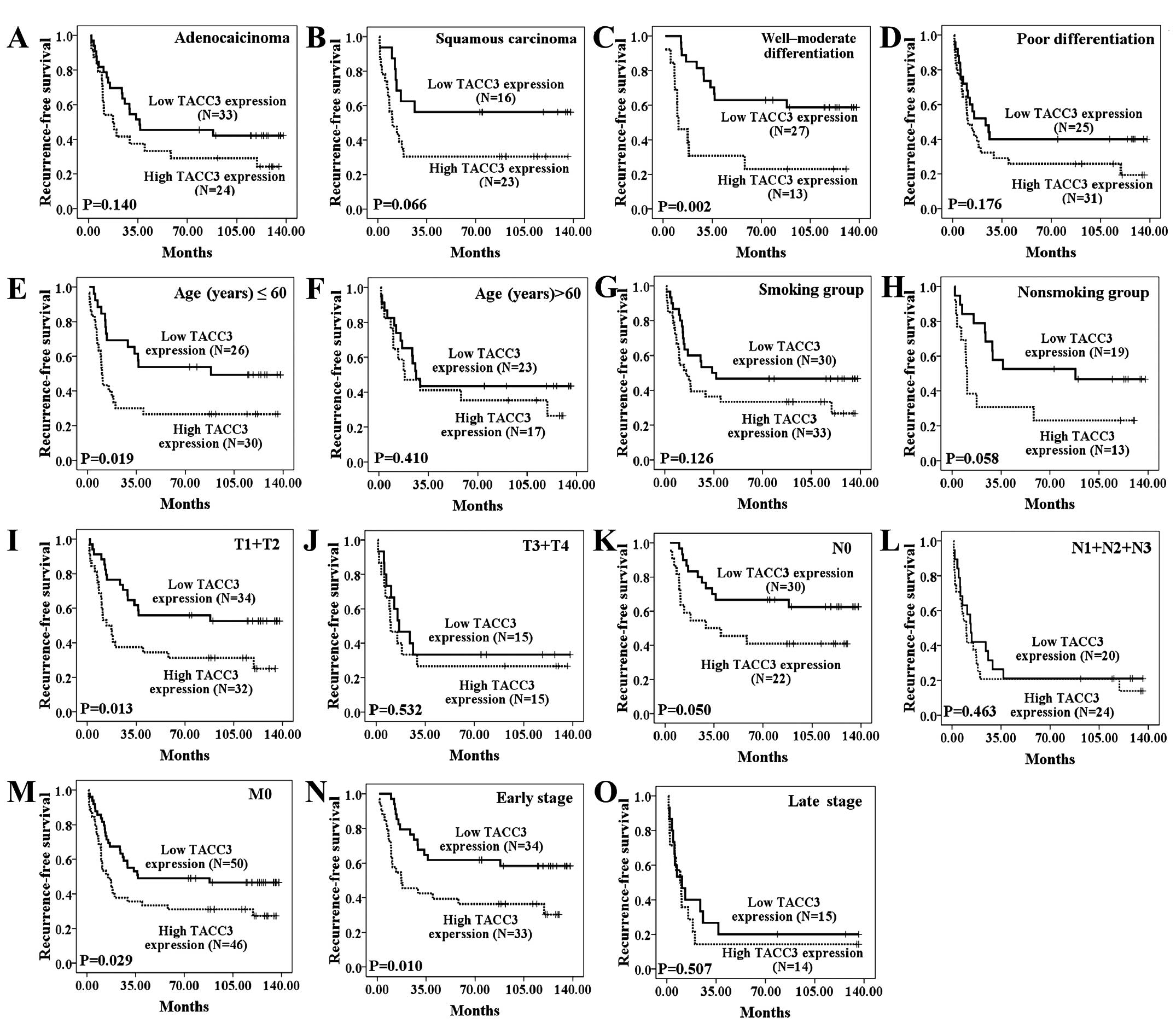
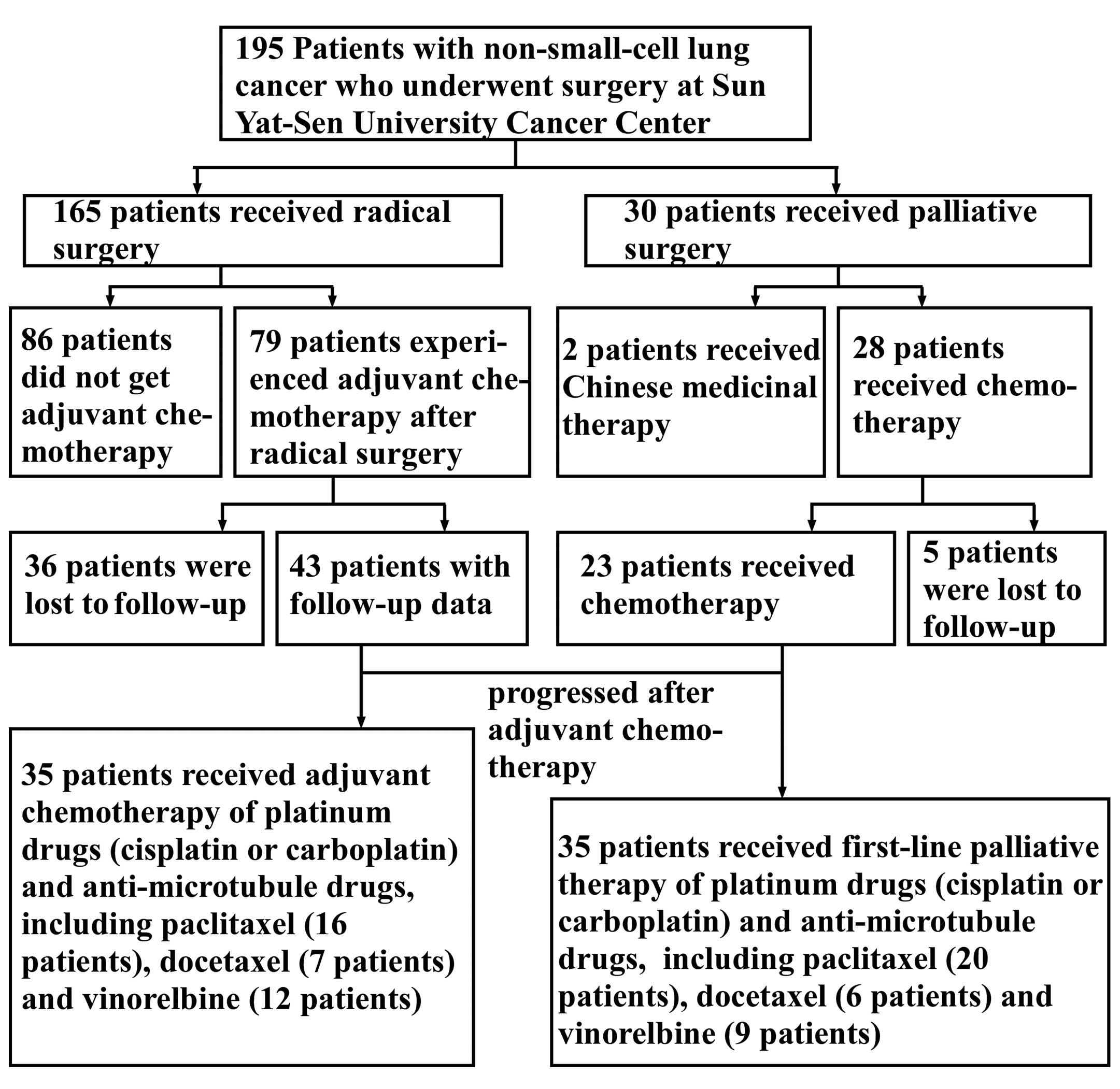
The relationship between TACC3, a member of the transforming acidic coiled-coil proteins (TACCs) family, and lung carcinoma remains unclear. The present study was designed to explore the prognostic and clinical significance of TACC3 in non-small cell lung cancer (NSCLC). An immunohistochemistry (IHC) assay was performed to analyze the expression of TACC3 in 195 lung cancer cases. The mRNA and protein levels of TACC3 were examined by quantitative reverse transcription-PCR or western blotting. The correlation between TACC3 expression and clinicopathological factors was analyzed by χ2 analysis and Fisher's exact test. Kaplan‑Meier analysis and the Cox proportional hazards model were used to examine the correlation of prognostic outcomes with TACC3. The results showed that the levels of TACC3 mRNA and total protein were higher in lung cancer lesions than paired non-cancerous tissues. IHC analysis revealed that TACC3 was highly expressed in 94 (48.2%) cases. The expression of TACC3 was strongly correlated with smoking status, histological classification, differentiation, cytokeratin 19 fragment levels, T stage and the clinical stage of NSCLC patients. Univariate and multivariate analyses demonstrated that TACC3 is a useful biomarker for NSCLC prognosis. The low TACC3 expression group exhibited better progression-free survival (PFS) among patients who received anti-microtubule chemotherapy. In conclusion, the results showed that a high level of TACC3 expression was correlated with advanced clinicopathological classifications, poor overall survival (OS) and poor recurrence‑free survival (RFS) in NSCLC patients. Our findings indicate that TACC3 is a potential prognostic marker and therapeutic target for NSCLC.
View Figures

Figure 1

Figure 2

Figure 3

Figure 4

Figure 5

Figure 6

View References

1 

Siegel R, Ma J, Zou Z and Jemal A: Cancer statistics, 2014. CA Cancer J Clin. 64:9–29. 2014. View Article : Google Scholar : PubMed/NCBI

2 

Gergely F: Centrosomal TACCtics. BioEssays. 24:915–925. 2002. View Article : Google Scholar : PubMed/NCBI

3 

Peset I and Vernos I: The TACC proteins: TACC-ling microtubule dynamics and centrosome function. Trends Cell Biol. 18:379–388. 2008. View Article : Google Scholar : PubMed/NCBI

4 

Ha GH, Kim JL and Breuer EK: Transforming acidic coiled-coil proteins (TACCs) in human cancer. Cancer Lett. 336:24–33. 2013. View Article : Google Scholar : PubMed/NCBI

5 

Albee AJ and Wiese C: Xenopus TACC3/maskin is not required for microtubule stability but is required for anchoring microtubules at the centrosome. Mol Biol Cell. 19:3347–3356. 2008. View Article : Google Scholar : PubMed/NCBI

6 

van der Vaart B, Akhmanova A and Straube A: Regulation of microtubule dynamic instability. Biochem Soc Trans. 37:1007–1013. 2009. View Article : Google Scholar : PubMed/NCBI

7 

Duensing S, Lee BH, Dal Cin P and Münger K: Excessive centro-some abnormalities without ongoing numerical chromosome instability in a Burkitt's lymphoma. Mol Cancer. 2:30–36. 2003. View Article : Google Scholar

8 

Trachana V, van Wely KH, Guerrero AA, Fütterer A and Martínez-A C: Dido disruption leads to centrosome amplification and mitotic checkpoint defects compromising chromosome stability. Proc Natl Acad Sci USA. 104:2691–2696. 2007. View Article : Google Scholar : PubMed/NCBI

9 

Gergely F, Karlsson C, Still I, Cowell J, Kilmartin J and Raff JW: The TACC domain identifies a family of centrosomal proteins that can interact with microtubules. Proc Natl Acad Sci USA. 97:14352–14357. 2000. View Article : Google Scholar : PubMed/NCBI

10 

Raff JW: Centrosomes and cancer: Lessons from a TACC. Trends Cell Biol. 12:222–225. 2002. View Article : Google Scholar : PubMed/NCBI

11 

Still IH, Vince P and Cowell JK: The third member of the transforming acidic coiled coil-containing gene family, TACC3, maps in 4p16, close to translocation breakpoints in multiple myeloma, and is upregulated in various cancer cell lines. Genomics. 58:165–170. 1999. View Article : Google Scholar : PubMed/NCBI

12 

Still IH, Hamilton M, Vince P, Wolfman A and Cowell JK: Cloning of TACC1, an embryonically expressed, potentially transforming coiled coil containing gene, from the 8p11 breast cancer amplicon. Oncogene. 18:4032–4038. 1999. View Article : Google Scholar : PubMed/NCBI

13 

Cheng S, Douglas-Jones A, Yang X, Mansel RE and Jiang WG: Transforming acidic coiled-coil-containing protein 2 (TACC2) in human breast cancer, expression pattern and clinical/prognostic relevance. Cancer Genomics Proteomics. 7:67–73. 2010.PubMed/NCBI

14 

Conte N, Delaval B, Ginestier C, Ferrand A, Isnardon D, Larroque C, Prigent C, Séraphin B, Jacquemier J and Birnbaum D: TACC1-chTOG-Aurora A protein complex in breast cancer. Oncogene. 22:8102–8116. 2003. View Article : Google Scholar : PubMed/NCBI

15 

Line A, Slucka Z, Stengrevics A, Li G and Rees RC: Altered splicing pattern of TACC1 mRNA in gastric cancer. Cancer Genet Cytogenet. 139:78–83. 2002. View Article : Google Scholar

16 

Dhanasekaran SM, Barrette TR, Ghosh D, Shah R, Varambally S, Kurachi K, Pienta KJ, Rubin MA and Chinnaiyan AM: Delineation of prognostic biomarkers in prostate cancer. Nature. 412:822–826. 2001. View Article : Google Scholar : PubMed/NCBI

17 

Sadek CM, Pelto-Huikko M, Tujague M, Steffensen KR, Wennerholm M and Gustafsson JA: TACC3 expression is tightly regulated during early differentiation. Gene Expr Patterns. 3:203–211. 2003. View Article : Google Scholar : PubMed/NCBI

18 

Conte N, Charafe-Jauffret E, Delaval B, Adélaïde J, Ginestier C, Geneix J, Isnardon D, Jacquemier J and Birnbaum D: Carcinogenesis and translational controls: TACC1 is down-regulated in human cancers and associates with mRNA regulators. Oncogene. 21:5619–5630. 2002. View Article : Google Scholar : PubMed/NCBI

19 

Ma XJ, Salunga R, Tuggle JT, Gaudet J, Enright E, McQuary P, Payette T, Pistone M, Stecker K, Zhang BM, et al: Gene expression profiles of human breast cancer progression. Proc Natl Acad Sci USA. 100:5974–5979. 2003. View Article : Google Scholar : PubMed/NCBI

20 

Lauffart B, Vaughan MM, Eddy R, Chervinsky D, DiCioccio RA, Black JD and Still IH: Aberrations of TACC1 and TACC3 are associated with ovarian cancer. BMC Womens Health. 5:8–17. 2005. View Article : Google Scholar : PubMed/NCBI

21 

Peters DG, Kudla DM, Deloia JA, Chu TJ, Fairfull L, Edwards RP and Ferrell RE: Comparative gene expression analysis of ovarian carcinoma and normal ovarian epithelium by serial analysis of gene expression. Cancer Epidemiol Biomarkers Prev. 14:1717–1723. 2005. View Article : Google Scholar : PubMed/NCBI

22 

Arlot-Bonnemains Y, Baldini E, Martin B, Delcros JG, Toller M, Curcio F, Ambesi-Impiombato FS, D'Armiento M and Ulisse S: Effects of the Aurora kinase inhibitor VX-680 on anaplastic thyroid cancer-derived cell lines. Endocr Relat Cancer. 15:559–568. 2008. View Article : Google Scholar : PubMed/NCBI

23 

Duncan CG, Killela PJ, Payne CA, Lampson B, Chen WC, Liu J, Solomon D, Waldman T, Towers AJ, Gregory SG, et al: Integrated genomic analyses identify ERRFI1 and TACC3 as glioblastoma-targeted genes. Oncotarget. 1:265–277. 2010. View Article : Google Scholar : PubMed/NCBI

24 

Stewart JP, Thompson A, Santra M, Barlogie B, Lappin TR and Shaughnessy J Jr: Correlation of TACC3, FGFR3, MMSET and p21 expression with the t(4;14)(p16.3;q32) in multiple myeloma. Br J Haematol. 126:72–76. 2004. View Article : Google Scholar : PubMed/NCBI

25 

Jung CK, Jung JH, Park GS, Lee A, Kang CS and Lee KY: Expression of transforming acidic coiled-coil containing protein 3 is a novel independent prognostic marker in non-small cell lung cancer. Pathol Int. 56:503–509. 2006. View Article : Google Scholar : PubMed/NCBI

26 

McShane LM, Altman DG, Sauerbrei W, Taube SE, Gion M and Clark GM; Statistics Subcommittee of the NCI-EORTC Working Group on Cancer Diagnostics: Reporting recommendations for tumor marker prognostic studies (REMARK). J Natl Cancer Inst. 97:1180–1184. 2005. View Article : Google Scholar : PubMed/NCBI

27 

Kuang BH, Zhang MQ, Xu LH, Hu LJ, Wang HB, Zhao WF, Du Y and Zhang X: Proline-rich tyrosine kinase 2 and its phosphorylated form pY881 are novel prognostic markers for non-small-cell lung cancer progression and patients' overall survival. Br J Cancer. 109:1252–1263. 2013. View Article : Google Scholar : PubMed/NCBI

28 

Gangisetty O, Lauffart B, Sondarva GV, Chelsea DM and Still IH: The transforming acidic coiled coil proteins interact with nuclear histone acetyltransferases. Oncogene. 23:2559–2563. 2004. View Article : Google Scholar : PubMed/NCBI

29 

Piekorz RP, Hoffmeyer A, Duntsch CD, McKay C, Nakajima H, Sexl V, Snyder L, Rehg J and Ihle JN: The centrosomal protein TACC3 is essential for hematopoietic stem cell function and genetically interfaces with p53-regulated apoptosis. EMBO J. 21:653–664. 2002. View Article : Google Scholar : PubMed/NCBI

30 

Richter JD and Theurkauf WE: Development. The message is in the translation. Science. 293:60–62. 2001. View Article : Google Scholar : PubMed/NCBI

31 

Hood FE and Royle SJ: Pulling it together: The mitotic function of TACC3. BioArchitecture. 1:105–109. 2011. View Article : Google Scholar : PubMed/NCBI

32 

Ha GH, Park JS and Breuer EK: TACC3 promotes epithelial-mesenchymal transition (EMT) through the activation of PI3K/Akt and ERK signaling pathways. Cancer Lett. 332:63–73. 2013. View Article : Google Scholar : PubMed/NCBI

33 

Ha GH, Kim JL and Breuer EK: TACC3 is essential for EGF-mediated EMT in cervical cancer. PLoS One. 8:e703532013. View Article : Google Scholar : PubMed/NCBI

34 

Sadek CM, Jalaguier S, Feeney EP, Aitola M, Damdimopoulos AE, Pelto-Huikko M and Gustafsson JA: Isolation and characterization of AINT: A novel ARNT interacting protein expressed during murine embryonic development. Mech Dev. 97:13–26. 2000. View Article : Google Scholar : PubMed/NCBI

35 

McKeveney PJ, Hodges VM, Mullan RN, Maxwell P, Simpson D, Thompson A, Winter PC, Lappin TR and Maxwell AP: Characterization and localization of expression of an erythropoietin-induced gene, ERIC-1/TACC3, identified in erythroid precursor cells. Br J Haematol. 112:1016–1024. 2001. View Article : Google Scholar : PubMed/NCBI

36 

LeRoy PJ, Hunter JJ, Hoar KM, Burke KE, Shinde V, Ruan J, Bowman D, Galvin K and Ecsedy JA: Localization of human TACC3 to mitotic spindles is mediated by phosphorylation on Ser558 by Aurora A: A novel pharmacodynamic method for measuring Aurora A activity. Cancer Res. 67:5362–5370. 2007. View Article : Google Scholar : PubMed/NCBI

37 

Yim EK, Tong SY, Ho EM, Bae JH, Um SJ and Park JS: Anticancer effects on TACC3 by treatment of paclitaxel in HPV-18 positive cervical carcinoma cells. Oncol Rep. 21:549–557. 2009.PubMed/NCBI

38 

Schneider L, Essmann F, Kletke A, Rio P, Hanenberg H, Schulze-Osthoff K, Nürnberg B and Piekorz RP: TACC3 depletion sensitizes to paclitaxel-induced cell death and overrides p21WAF-mediated cell cycle arrest. Oncogene. 27:116–125. 2008. View Article : Google Scholar

39 

Schmidt S, Schneider L, Essmann F, Cirstea IC, Kuck F, Kletke A, Jänicke RU, Wiek C, Hanenberg H, Ahmadian MR, et al: The centrosomal protein TACC3 controls paclitaxel sensitivity by modulating a premature senescence program. Oncogene. 29:6184–6192. 2010. View Article : Google Scholar : PubMed/NCBI

Related Articles

  • Abstract
  • View
  • Download
  • Twitter
Copy and paste a formatted citation
Spandidos Publications style
Jiang F, Kuang B, Que Y, Lin Z, Yuan L, Xiao W, Peng R, Zhang X and Zhang X: The clinical significance of transforming acidic coiled-coil protein 3 expression in non-small cell lung cancer. Oncol Rep 35: 436-446, 2016.
APA
Jiang, F., Kuang, B., Que, Y., Lin, Z., Yuan, L., Xiao, W. ... Zhang, X. (2016). The clinical significance of transforming acidic coiled-coil protein 3 expression in non-small cell lung cancer. Oncology Reports, 35, 436-446. https://doi.org/10.3892/or.2015.4373
MLA
Jiang, F., Kuang, B., Que, Y., Lin, Z., Yuan, L., Xiao, W., Peng, R., Zhang, X., Zhang, X."The clinical significance of transforming acidic coiled-coil protein 3 expression in non-small cell lung cancer". Oncology Reports 35.1 (2016): 436-446.
Chicago
Jiang, F., Kuang, B., Que, Y., Lin, Z., Yuan, L., Xiao, W., Peng, R., Zhang, X., Zhang, X."The clinical significance of transforming acidic coiled-coil protein 3 expression in non-small cell lung cancer". Oncology Reports 35, no. 1 (2016): 436-446. https://doi.org/10.3892/or.2015.4373
Copy and paste a formatted citation
x
Spandidos Publications style
Jiang F, Kuang B, Que Y, Lin Z, Yuan L, Xiao W, Peng R, Zhang X and Zhang X: The clinical significance of transforming acidic coiled-coil protein 3 expression in non-small cell lung cancer. Oncol Rep 35: 436-446, 2016.
APA
Jiang, F., Kuang, B., Que, Y., Lin, Z., Yuan, L., Xiao, W. ... Zhang, X. (2016). The clinical significance of transforming acidic coiled-coil protein 3 expression in non-small cell lung cancer. Oncology Reports, 35, 436-446. https://doi.org/10.3892/or.2015.4373
MLA
Jiang, F., Kuang, B., Que, Y., Lin, Z., Yuan, L., Xiao, W., Peng, R., Zhang, X., Zhang, X."The clinical significance of transforming acidic coiled-coil protein 3 expression in non-small cell lung cancer". Oncology Reports 35.1 (2016): 436-446.
Chicago
Jiang, F., Kuang, B., Que, Y., Lin, Z., Yuan, L., Xiao, W., Peng, R., Zhang, X., Zhang, X."The clinical significance of transforming acidic coiled-coil protein 3 expression in non-small cell lung cancer". Oncology Reports 35, no. 1 (2016): 436-446. https://doi.org/10.3892/or.2015.4373
Follow us
  • Twitter
  • LinkedIn
  • Facebook
About
  • Spandidos Publications
  • Careers
  • Cookie Policy
  • Privacy Policy
How can we help?
  • Help
  • Live Chat
  • Contact
  • Email to our Support Team