Introduction
Colorectal cancer (CRC) is the fifth most common
malignant tumor and the fifth cause of cancer-related deaths in
China (1). As the major treatment
for CRC, chemotherapy fails in most cases due to chemoresistance,
and this is the major cause of cancer-related death. Understanding
of the detailed mechanisms behind CRC chemoresistance is important
for improving the prognosis of CRC.
As one of the 10 hallmarks of cancer (2), aerobic glycolysis plays an important
role in cancer proliferation, metastasis and angiogenesis (3–9).
Moreover, aerobic glycolysis is elevated in chemoresistant cancer
cells compared with wild-type cancer cells and glycolytically
derived ATP is crucial for the maintenance of chemoresistance
(10,11). Compared with oxidative
phosphorylation in normal cells, aerobic glycolysis in cancer cells
consumes more glucose. Cancer cells do this by upregulating glucose
transporters, notably glucose transporter 1 (GLUT1), which
substantially increases glucose import into the cytoplasm (2,12,13).
Intracellular Ca2+ [(Ca2+i)]
is involved in almost all cellular functions. The
Ca2+-permeable transient receptor potential canonical
(TrpC) family of channel proteins has received increasing attention
in cancer research (14,15). For example, TrpC1 and TrpC3 are
involved in the proliferation of breast and ovarian cancer cells,
respectively (16,17), while TrpC6 is involved in the
proliferation of liver and prostate tumor cells (18,19).
Previously, we found that TrpC5-mediated Ca2+-entry
induced chemoresistance in CRC via activating the Wnt/β-catenin
signaling pathway (20), and the
latter was demonstrated to upregulate glycolysis in CRC (21). To date, there is still no study
concerning the role of Ca2+ signaling in the regulation
of glycolysis, and the detailed mechanism by which TrpC5 induces
chemoresistance also deserves exploration. In the present study, we
designed experiments to explore the possible involvement of TrpC5
in regulating GLUT1 expression.
Materials and methods
Cells and cell culture
The human CRC cell line HCT-8 and 5-fluorouracil
(5-Fu)-resistant HCT-8 cells (HCT-8/5-Fu) were purchased from
KeyGen Biotech Co. Ltd. (Nanjing, Jiangsu, China). HCT-8 cells were
cultured in RPMI-1640 medium supplemented with 10% inactivated
fetal calf serum. HCT-8/5-Fu cells were cultured in RMPI-1640
medium supplemented with 15 mg/l 5-Fu.
Antibodies, siRNA and reagents
Anti-TrpC5 (ACC-020) was purchased from Alomone Labs
(Jerusalem, Israel) and anti-glucose transporter 1 (GLUT1)
(ab115730) and anti-c-Myc (ab32) were purchased from Abcam
Biotechnology (Cambridge, MA, USA), and anti-histone (AH433) and
anti-β-actin (AA128) were from Beyotime Biotechnology (Nantong,
Jiangsu, China). The secondary antibodies, a goat anti-rabbit IgG
(A0208) and a goat anti-mouse IgG (A0216), were purchased from
Beyotime Biotechnology. The Nuclear and Cytoplasmic Protein
Extraction kit (P0027) was purchased from Beyotime Biotechnology.
TRIzol (10296–010) and Lipofectamine 2000 (11668–019) were
purchased from Invitrogen (Camarillo, CA, USA). TrpC5-shRNA
(sc-42670) was purchased from Santa Cruz Biotechnology (Dallas, TX,
USA). Dimethyl sulfoxide (DMSO), 3-BrPA,
3-(4,5-dimethylthiazol-2-yl)-2,5-diphenyl tetrazolium bromide (MTT)
and XAV939 were purchased from Sigma Chemical Co. (St. Louis, MO,
USA). 5-Fu was purchased from Jinyao Amino Acid Co., Ltd. (Tianjin,
China).
Cell transfection
When the cells reached 50–70% confluency, the
HCT-8/5-Fu cells were treated with a TrpC5-shRNA (indicated as
HCT-8/5-Fu/RNAi) (scrambled siRNA was used as a control and was
indicated as HCT-8/5-Fu/scrambled). XAV939 (an inhibitor of the
canonical Wnt/β-catenin signaling pathway) was used in the present
study. HCT-8/5-Fu cells were treated with XAV939 (10 µM, overnight)
(indicated as HCT-8/5-Fu/XAV939) (DMSO was used as a control and
was indicated as HCT-8/5-Fu/DMSO). Real-time PCR and western
blotting were used to determine the expression of TrpC5, GLUT1 and
c-Myc.
Western blotting
The whole-cell protein lysate was obtained using
RIPA buffer containing 1 mM phenylmethylsulphonyl fluoride (PMSF).
The nuclear proteins were isolated using a Nuclear and Cytoplasmic
Protein Extraction kit. The same quantity of total proteins was
electrophoresed on a 10% polyacrylamide gel containing 0.1% SDS.
The resolved proteins were semi-dry-transferred to a polyvinylidene
difluoride (PVDF) membrane. The primary antibodies, anti-TrpC5
(1:500), anti-GLUT1 (1:1,000) and anti-c-Myc (1:500), were used to
detect the expression of the proteins of interest. β-actin and
histone were the internal references. The antigen-antibody
complexes were visualized by an enhanced chemiluminescent reaction.
The protein bands were analyzed using ImageJ software (NIH,
Bethesda, MD, USA).
Real-time PCR
Total RNA was extracted from the cells using TRIzol.
The procedure for the real-time PCR was previously reported
(20). The primer pairs are listed
in Table I.
 | Table I.Real-time PCR primers. |
Table I.
Real-time PCR primers.
| Gene | Forward primer
sequence (5′-3′) | Reverse primer
sequence (5′-3′) |
|---|
| β-actin |
GCCCTTGCTCCTTCCACTATC |
CCGGACTCTTCGTACTCATCCT |
| TrpC5 |
CCACCAGCTATCAGATAAGG |
CGAAACAAGCCACTTATACC |
| GLUT1 |
CTTTGTGGCCTTCTTTGAAGT |
CCACACAGTTGCTCCACAT |
MTT assay
Briefly, 104 cells (200 µl) were seeded
into 96-well plates. Twelve hours later, the cells were treated
with medium containing different concentrations of 5-Fu for 48 h.
Then, the medium in each well was replaced with 200 µl of fresh
RPMI-1640 containing 5 mg/ml MTT for 4 h. DMSO (150 µl) was added
to each well and then, the absorbance was determined at 490 nm.
Patients and tumor specimens
We retrospectively screened advanced CRC patients
with unresectable metastasis who underwent a biopsy and/or surgery
for a primary lesion at the Affiliated Hospital of Jiangnan
University (The Fourth People's Hospital of Wuxi) from January 2009
to December 2014. Patients who postoperatively received 5-Fu-based
first-line systematic chemotherapy were enrolled in the present
study. The following were the exclusion criteria: i) patients
receiving a localized treatment to the target lesions, such as
radiotherapy or radiofrequency ablation; ii) patients receiving
preoperative cytotoxic treatment, such as radiation or
chemotherapy; iii) patients with a diameter of the maximum target
lesion was <1 cm by CT-scan; and iv) patients receiving
postoperative systematic chemotherapy for <2 cycles. Tumor
assessment was performed after every 2 cycles of chemotherapy
according to the Response Evaluation Criteria in Solid Tumors 1.1
(RECIST 1.1) criteria (22), and
the assessment was classified as a complete response (CR), a
partial response (PR), stable disease (SD) and progressive disease
(PD). Ethical permission was obtained from the Ethics Committee at
the Affiliated Hospital of Jiangnan University (The Fourth People's
Hospital of Wuxi).
Immunohistochemical staining
CRC tissue slides were de-paraffinized with xylene
and rehydrated through a graded alcohol series. After incubation
with 10% bovine serum albumin, the slides were then incubated with
the primary antibodies [TrpC5 (1:2,000) and GLUT1 (1:100)]
overnight at 4°C in a humidified chamber and were subsequently
incubated with the secondary antibodies. The results of
immunostaining were assessed by two pathologists, respectively.
Five visual fields were selected from each slide. The results were
judged according to the German semi-quantitative scoring system
(23) (no staining, 0; weak
staining, 1; moderate staining, 2; and strong staining, 3), and the
extent of stained cells (0%=0; 1–24%=1; 25–49%=2; 50–74%=3; and
75–100%=4). The final immunoreactive score was determined by
multiplying the intensity score with the extent of score of the
stained cells, ranging from 0 (the minimum score) to 12 (the
maximum score) and was defined as follows: ± (0–3), + (3.1–6), ++
(6.1–9) and +++ (9.1–12). Each grade of TrpC5 and GLUT1 was from
the same sample. The expression levels were categorized as low (±
and +) or high (++ and +++).
Statistical analyses
The results are presented as the mean ± standard
error. Statistical significance was determined by a Student's
t-test and a Pearson's Chi-squared test as applicable. A value of
p<0.05 was considered to indicate a statistically significant
result.
Results
Upregulated expression of TrpC5 and
GLUT1 in 5-Fu chemoresistant human CRC cells
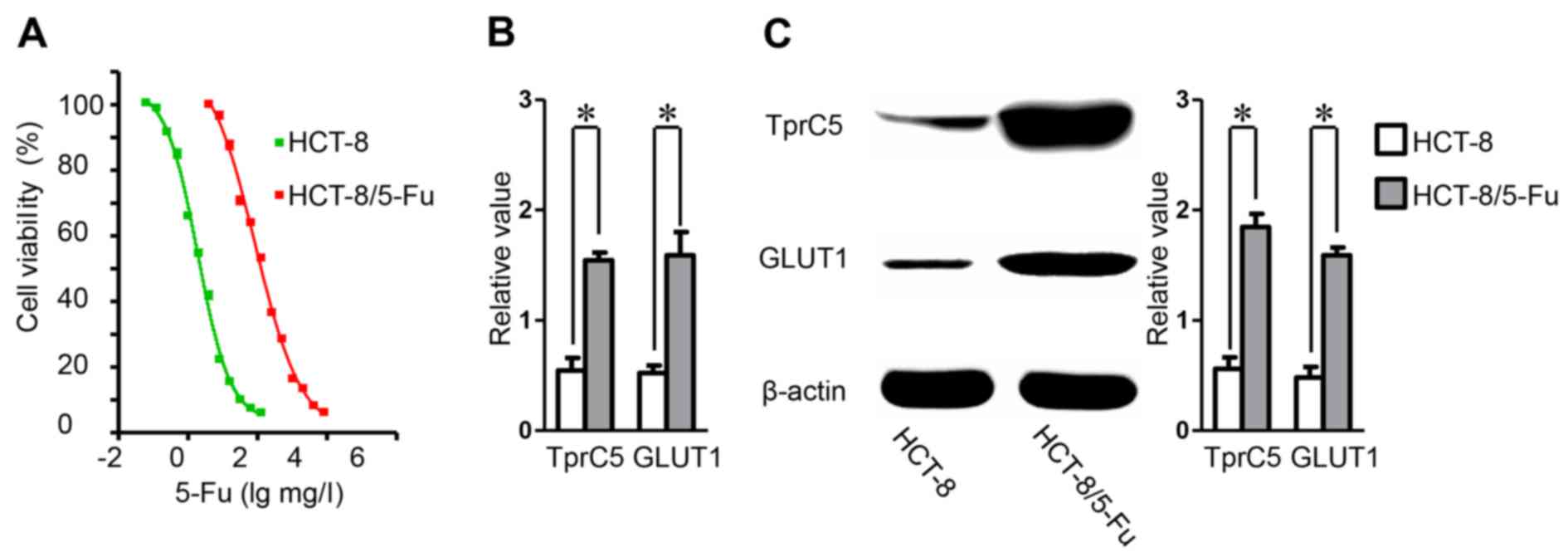
In the present study, GLUT1 expression was examined
to represent the glycolytic level. 5-Fu-resistant human CRC cells
(HCT-8/5-Fu) and HCT-8 parental cell lines were used in the present
study. An MTT assay revealed that the half maximal inhibitory
concentration of 5-Fu (5-Fu IC50) for the HCT-8/5-Fu and
HCT-8 cells was 86.0 mg/l [95% confidence interval (CI), 72.2–102.5
mg/l] and 1.9 mg/l (95% CI, 1.8–2.1 mg/l) (p<0.05), respectively
(Fig. 1A). Real-time PCR analysis
showed that the expression of both TrpC5 and GLUT1 at the mRNA
level in the HCT-8/5-Fu cells was higher than the levels in the
HCT-8 cells (Fig. 1B). This finding
was validated by western blotting. The protein expression of TrpC5
and GLUT1 was higher in the HCT-8/5-Fu cells, whereas only a low
level was detected in the HCT-8 parental cell line (Fig. 1C).
Effect of TrpC5 suppression on GLUT1
expression
The possible role of TrpC5 in controlling GLUT1
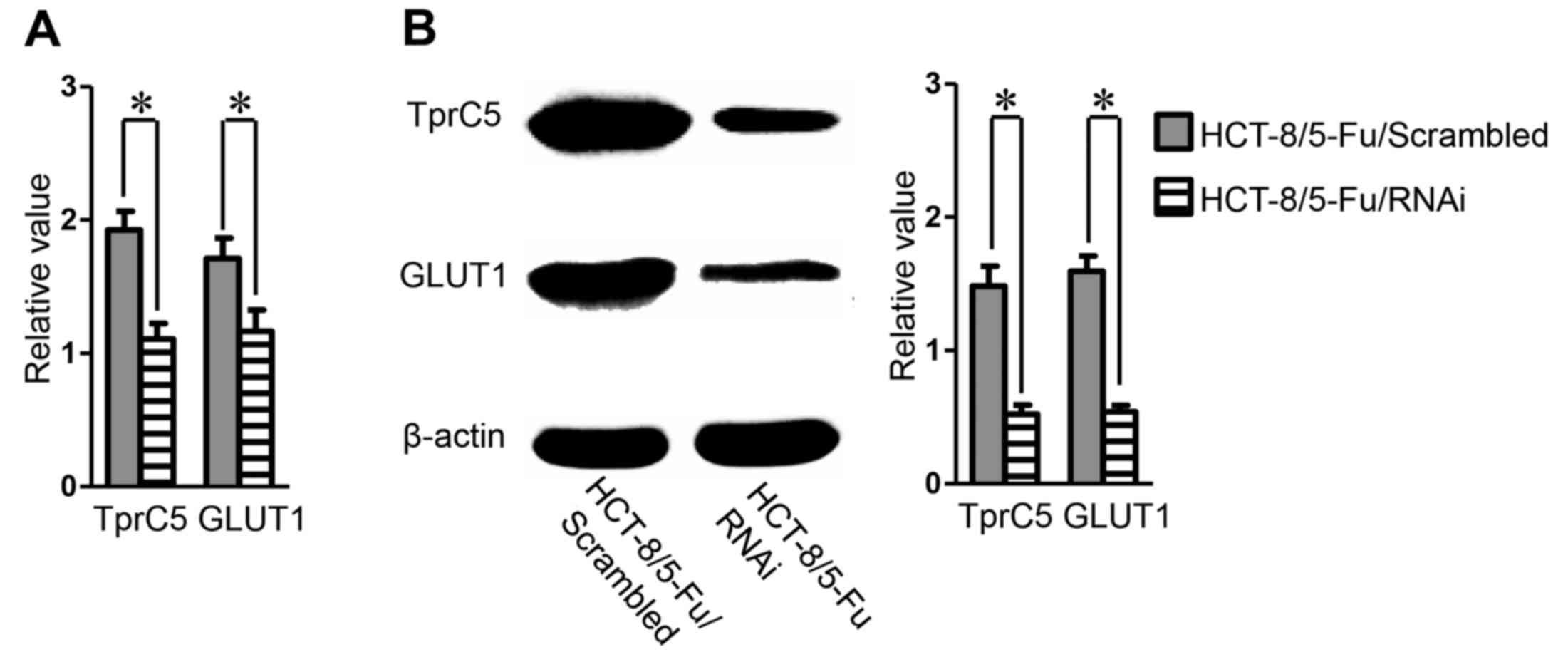
expression was explored. The real-time PCR analysis demonstrated
that, when the HCT-8/5-Fu cells were treated with TrpC5-siRNA, the
TrpC5 and GLUT1 mRNA levels were both reduced compared with the
cells treated with the scrambled siRNA (Fig. 2A). Furthermore, a western blot assay
gave similar results. The TrpC5 and GLUT1 protein expression levels
in the HCT-8/5-Fu/RNAi group were significantly lower than these
levels in the HCT-8/5-Fu/scrambled cells (Fig. 2B).
The Wnt/β-catenin signaling pathway is
involved in the regulation of GLUT1 by TrpC5
In our previously study, upregulated expression of
TrpC5 in human CRC cells activated the Wnt/β-catenin signaling
pathway (20), and the latter was
demonstrated to regulate GLUT1 expression through its target gene
c-Myc (24,25). We next explored the mechanism of the
Wnt/β-catenin signaling pathway and how it is involved in the
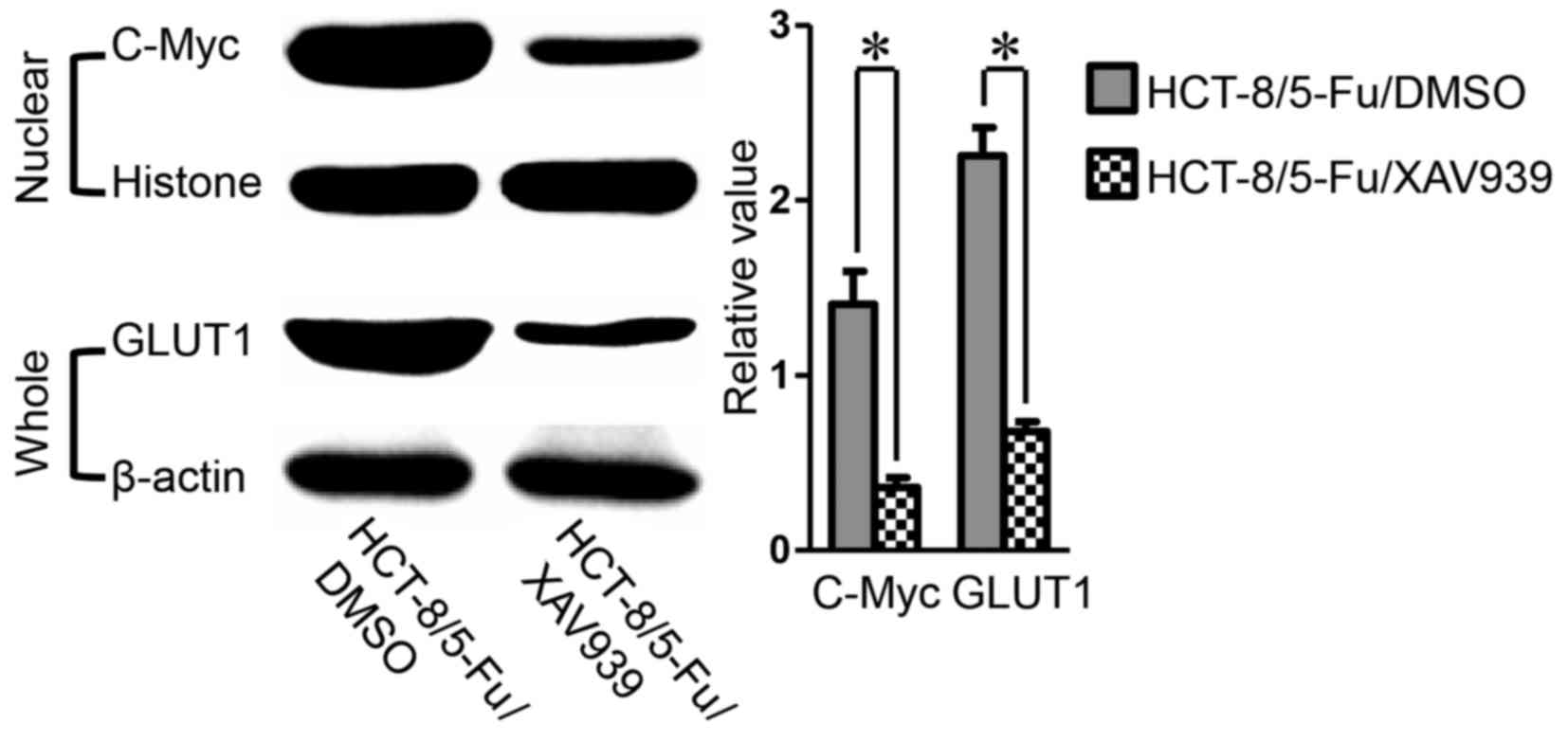
regulation of GLUT1 by TrpC5. The Wnt/β-catenin signaling pathway
was found to be activated in HCT-8/5-Fu cells (20), and in the present study, XAV939 was
used to inhibit the Wnt/β-catenin pathway in the HCT-8/5-Fu cells.
Western blot analysis showed decreased nuclear c-Myc expression and
a markedly decreased GLUT1 expression in the HCT-8/5-Fu cells
treated with XAV939 (Fig. 3).
Elevated TrpC5 and GLUT1 expression is
associated with chemotherapy failure in advanced CRC patients
Table II shows the
clinical and pathological characteristics of the 72 CRC patients
enrolled in the present study. After the first 2 cycles of 5-Fu
chemotherapy, 28 patients achieved CR or PR (these were considered
responders) and the remaining 44 patients achieved SD or PD (these
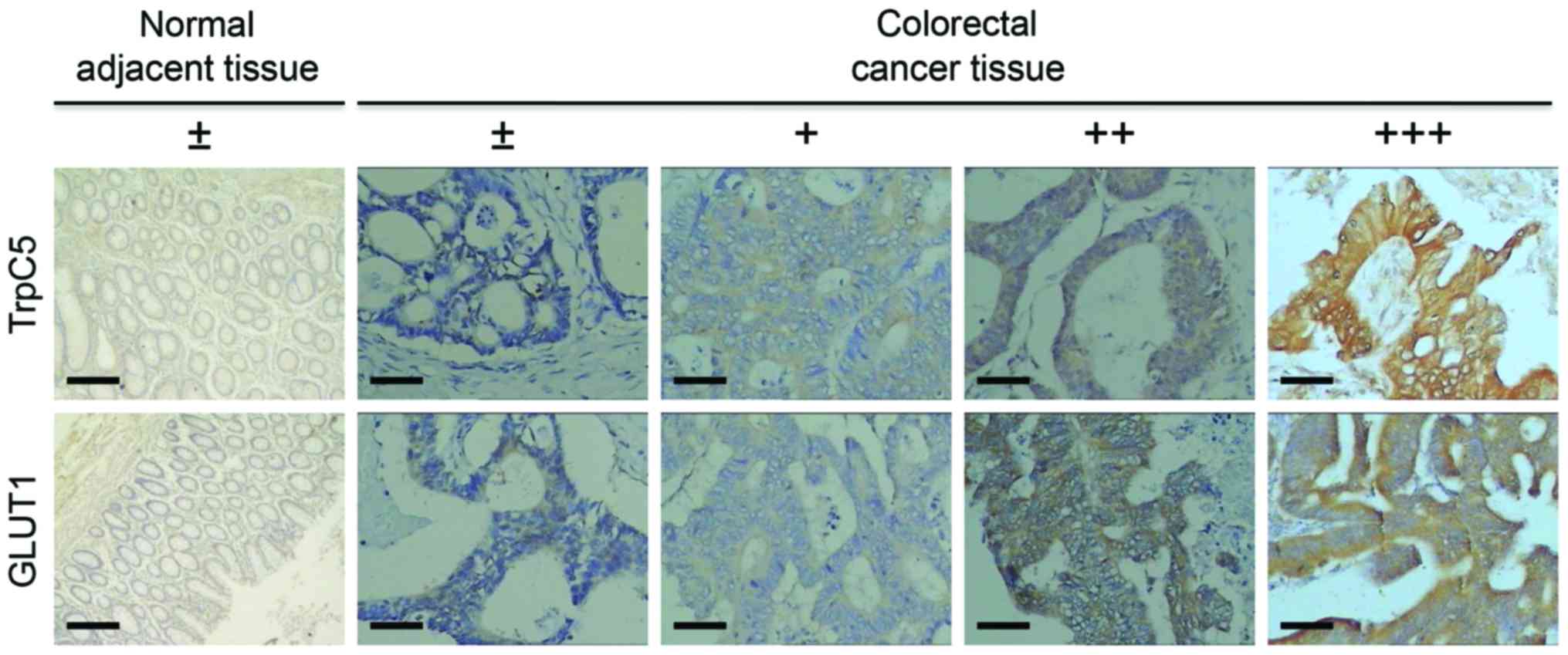
were considered non-responders). The immunostaining showed that
TrpC5 and GLUT1 were mostly localized near the cell surface
(Fig. 4). TrpC5 and GLUT1 were
found to be highly co-expressed in 21 of the 44 non-responders and
in only 4 of the 28 responders. A Pearson's Chi-squared test showed
a significant correlation between TrpC5 expression and GLUT1
expression (Table III), and a
higher TrpC5/GLUT1 expression was closely related with chemotherapy
failure in the advanced CRC patients (Table IV).
| Table II.Clinicopathological characteristics
of the 72 CRC patients. |
Table II.
Clinicopathological characteristics
of the 72 CRC patients.
|
Characteristics |
| n | (%) |
|---|
| Age (years) |
|
|
|
| Mean ± SD | 60.2±8.9 |
|
|
|
≤60 |
| 37 | (51.4) |
|
>60 |
| 35 | (48.6) |
| Gender |
|
|
|
|
Male |
| 43 | (59.7) |
|
Female |
| 29 | (40.3) |
| Primary tumor
location |
|
|
|
| Colon
cancer |
| 39 | (54.2) |
| Rectal
cancer |
| 33 | (45.8) |
| Tumor
differentiation |
|
|
|
| Well or
moderate |
| 48 | (66.7) |
|
Poor |
| 24 | (33.3) |
| Outcome of
chemotherapya |
|
|
|
| CR |
| 0 | (0.0) |
| PR |
| 28 | (38.9) |
| SD |
| 19 | (26.4) |
| PD |
| 25 | (34.7) |
| Table III.Relationship between TrpC5 and GLUT1
expression level in CRC tissues. |
Table III.
Relationship between TrpC5 and GLUT1
expression level in CRC tissues.
|
| GLUT1a |
|
|
|---|
|
|
|
|
|
|---|
| TrpC5a | High | Low | Wald |
P-valueb |
|---|
| High | 25 | 15 | 13.9 | <0.01 |
| Low | 6 | 26 |
|
|
| Table IV.Characteristics of the CRC patients
according to TrpC5/GLUT1 expression status. |
Table IV.
Characteristics of the CRC patients
according to TrpC5/GLUT1 expression status.
|
| TrpC5a | GLUT1a |
|---|
|
|
|
|
|---|
|
Characteristics | High (n=40) | Low (n=32) |
P-valueb | High (n=31) | Low (n=41) |
P-valueb |
| Age (years) |
|
| 0.09 |
|
| 0.66 |
|
≤60 | 17 | 20 |
| 15 | 22 |
|
|
>60 | 23 | 12 |
| 16 | 19 |
|
| Gender |
|
| 0.96 |
|
| <0.01 |
|
Male | 24 | 19 |
| 13 | 30 |
|
|
Female | 16 | 13 |
| 18 | 11 |
|
| Primary tumor
location |
|
| 0.87 |
|
| 0.29 |
| Colon
cancer | 22 | 17 |
| 19 | 20 |
|
| Rectal
cancer | 18 | 15 |
| 12 | 21 |
|
| Tumor
differentiation |
|
| 0.50 |
|
| 0.40 |
| Well or
moderate | 28 | 20 |
| 19 | 29 |
|
|
Poor | 12 | 12 |
| 12 | 12 |
|
| Chemotherapy
outcome |
|
| <0.01 |
|
| <0.01 |
|
Responders | 9 | 19 |
| 6 | 22 |
|
|
Non-responders | 31 | 13 |
| 25 | 19 |
|
Discussion
Warburg first observed the reprogramming of energy
metabolism in cancer cells, such that cancer cells consume glucose
avidly and prefer to metabolize glucose by glycolysis even in the
presence of sufficient oxygen (aerobic glycolysis), and thus
phenomenon is referred to as the Warburg effect (26). It is believed that aerobic
glycolysis provides metabolic intermediates that serve as
precursors for anabolic biosynthesis (27–29)
and adenosine triphosphate (ATP) (28,29)
required by the rapidly proliferating cancer cells. The essential
role of glycolysis in the regulation and progression of cancer
makes it a promising target.
In addition to the postulation that increased
aerobic glycolysis is a compensatory mechanism for the
mitochondrial defects observed in cancer to drive tumorigenesis
(30), accumulating evidence
indicates that activated oncogenes or inactivated tumor suppressors
upregulate aerobic glycolysis in cancer (2,9,31–35).
For example, the aberrant activation of Wnt/β-catenin signaling,
which is observed in many human cancers, was identified to promote
glycolysis through its target gene c-Myc, which upregulates GLUT1
expression (21).
Ca2+ signaling is important for
maintaining the physiological functions of all living cells.
Studies linking Ca2+ signaling to non-malignant tumors
have emerged over the years (36,37).
Recently, increasing studies concerning Ca2+ signaling
in malignant tumors have demonstrated that it plays an important
role in cancer. Among these, Trp channels have received the most
attention. The abnormal expression of Trp channels contributes to
the abnormal biological behavior of cancer cells, including
invasion (38) and proliferation.
In contrast, little is known concerning the involvement of
Ca2+ signaling in the regulation of aerobic
glycolysis.
In the present study, we found overexpression of
TrpC5 in chemoresistant human CRC cells, which was in accordance
with our previous study (20). In
addition, GLUT1, the key glucose transporter for elevated aerobic
glycolysis in cancer cells, was also overexpressed in
chemoresistant CRC cells. Further studies using clinical specimens
validated these results. Both TrpC5 and GLUT1 protein levels in CRC
tissues were positively correlated with chemoresistance in advanced
CRC patients, and the expression of TrpC5 and GLUT1 was
significantly higher in non-responders compared to responders. We
next knocked down TrpC5 expression in the HCT-8/5-Fu cells using a
TrpC5-shRNA. As a result, the mRNA and protein levels of GLUT1 were
significantly decreased. Immunochemical analysis of the clinical
specimens showed similar results. TrpC5 and GLUT1 were found to be
highly co-expressed in 25 patients and lowly co-expressed in 26
patients, while inconsistently co-expressed in only 21 patients. A
Pearson's Chi-squared test revealed a positive correlation between
TrpC5 and GLUT1 protein levels. These results suggest that GLUT1 is
regulated by TrpC5 in human CRC.
The detailed mechanism by which TrpC5 regulates
GLUT1 was further investigated. In the present study, XAV939 was
used to inhibit the Wnt/β-catenin signaling pathway, which is
activated in chemoresistant cancer cells (20). Western blotting showed that nuclear
c-Myc expression was decreased, and importantly, we found the GLUT1
expression was also significantly decreased.
To cope with cytotoxic pressure, various molecular
events are essential for chemoresistant cancer cells, which include
mutation of survival-related genes, increased expression of
anti-apoptotic genes and/or activation of intracellular survival
signaling (41). In spite of the
numerous findings regarding the mechanism of chemoresistance,
little is known concerning the initial step. As sensors for a wide
variety of factors, the functional Trp channels enable the body to
react and adapt to different forms of environmental changes
(42). Recently, TrpC5, one member
of the Trp superfamily, was found to act as a novel sensor in
cancer. The increased expression of TrpC5 in cancer cells was
determined to ‘sense’ the cytotoxic pressure from chemotherapeutics
and subsequently, activate different intracellular survival
signaling pathways to enable the cancer cells to adapt to the
extracellular cytotoxic pressure (20,43–45).
In the present study, we identified a novel mechanism related to
TrpC5. Glycolysis, which is essential for chemoresistance
maintenance, was found to be involved in TrpC5-induced
chemoresistance.
In conclusion, the abnormal expression of Trp
channels results in the remodeling of the calcium homeostasis of
the cell, and this is linked to many abnormal processes in cancer
cells. In the present study, we demonstrated that TrpC5 regulates
GLUT1 expression in chemoresistant CRC cells. The underlying
mechanism involved activation of the Wnt/β-catenin signaling
pathway. These findings contribute to the understanding of the
complicated underlying mechanism of chemoresistance induced by
TrpC5.
Acknowledgements
The present study was supported by the National
Natural Science Foundation of China (no. 81541156), the Natural
Science Foundation of Jiangsu Province of China (no. BK20150162),
the Scientific and Technological Development Fund from Wuxi Science
and Technology Bureau (no. CSE31N1419), the Jiangsu Province
Clinical Medical Science and Technology Specialized Research Fund
(no. BL2014019), Key Program from Wuxi Health Bureau (no. Z201401);
and Key Program from Wuxi Hospital management center (no.
YGZXG1406).
References
|
1
|
Chen W, Zheng R, Baade PD, Zhang S, Zeng
H, Bray F, Jemal A, Yu XQ and He J: Cancer statistics in China,
2015. CA Cancer J Clin. 66:115–132. 2016. View Article : Google Scholar : PubMed/NCBI
|
|
2
|
Hanahan D and Weinberg RA: Hallmarks of
cancer: The next generation. Cell. 144:646–674. 2011. View Article : Google Scholar : PubMed/NCBI
|
|
3
|
Hussain A, Qazi AK, Mupparapu N, Guru SK,
Kumar A, Sharma PR, Singh SK, Singh P, Dar MJ, Bharate SB, et al:
Modulation of glycolysis and lipogenesis by novel PI3K selective
molecule represses tumor angiogenesis and decreases colorectal
cancer growth. Cancer Lett. 374:250–260. 2016. View Article : Google Scholar : PubMed/NCBI
|
|
4
|
Saha S, Ghosh M and Dutta SK: Role of
metabolic modulator Bet-CA in altering mitochondrial
hyperpolarization to suppress cancer associated angiogenesis and
metastasis. Sci Rep. 6:235522016. View Article : Google Scholar : PubMed/NCBI
|
|
5
|
Leung CO, Wong CC, Fan DN, Kai AK, Tung
EK, Xu IM, Ng IO and Lo RC: PIM1 regulates glycolysis and promotes
tumor progression in hepatocellular carcinoma. Oncotarget.
6:10880–10892. 2015. View Article : Google Scholar : PubMed/NCBI
|
|
6
|
Liu Y, Cao Y, Zhang W, Bergmeier S, Qian
Y, Akbar H, Colvin R, Ding J, Tong L, Wu S, et al: A small-molecule
inhibitor of glucose transporter 1 downregulates glycolysis,
induces cell-cycle arrest, and inhibits cancer cell growth in vitro
and in vivo. Mol Cancer Ther. 11:1672–1682. 2012. View Article : Google Scholar : PubMed/NCBI
|
|
7
|
Talekar M, Boreddy SR, Singh A and Amiji
M: Tumor aerobic glycolysis: New insights into therapeutic
strategies with targeted delivery. Expert Opin Biol Ther.
14:1145–1159. 2014. View Article : Google Scholar : PubMed/NCBI
|
|
8
|
Kaplon J, Zheng L, Meissl K, Chaneton B,
Selivanov VA, Mackay G, van der Burg SH, Verdegaal EM, Cascante M,
Shlomi T, et al: A key role for mitochondrial gatekeeper pyruvate
dehydrogenase in oncogene-induced senescence. Nature. 498:109–112.
2013. View Article : Google Scholar : PubMed/NCBI
|
|
9
|
Doherty JR, Yang C, Scott KE, Cameron MD,
Fallahi M, Li W, Hall MA, Amelio AL, Mishra JK, Li F, et al:
Blocking lactate export by inhibiting the Myc target MCT1 disables
glycolysis and glutathione synthesis. Cancer Res. 74:908–920. 2014.
View Article : Google Scholar : PubMed/NCBI
|
|
10
|
Zhou Y, Tozzi F, Chen J, Fan F, Xia L,
Wang J, Gao G, Zhang A, Xia X, Brasher H, et al: Intracellular ATP
levels are a pivotal determinant of chemoresistance in colon cancer
cells. Cancer Res. 72:304–314. 2012. View Article : Google Scholar : PubMed/NCBI
|
|
11
|
Lu CW, Lin SC, Chen KF, Lai YY and Tsai
SJ: Induction of pyruvate dehydrogenase kinase-3 by
hypoxia-inducible factor-1 promotes metabolic switch and drug
resistance. J Biol Chem. 283:28106–28114. 2008. View Article : Google Scholar : PubMed/NCBI
|
|
12
|
Hsu PP and Sabatini DM: Cancer cell
metabolism: Warburg and beyond. Cell. 134:703–707. 2008. View Article : Google Scholar : PubMed/NCBI
|
|
13
|
DeBerardinis RJ, Lum JJ, Hatzivassiliou G
and Thompson CB: The biology of cancer: Metabolic reprogramming
fuels cell growth and proliferation. Cell Metab. 7:11–20. 2008.
View Article : Google Scholar : PubMed/NCBI
|
|
14
|
Lehen'kyi V and Prevarskaya N: Oncogenic
TRP channels. Adv Exp Med Biol. 704:929–945. 2011. View Article : Google Scholar : PubMed/NCBI
|
|
15
|
Ding X, He Z, Zhou K, Cheng J, Yao H, Lu
D, Cai R, Jin Y, Dong B, Xu Y, et al: Essential role of TRPC6
channels in G2/M phase transition and development of human glioma.
J Natl Cancer Inst. 102:1052–1068. 2010. View Article : Google Scholar : PubMed/NCBI
|
|
16
|
El Hiani Y, Ahidouch A, Lehen'kyi V, Hague
F, Gouilleux F, Mentaverri R, Kamel S, Lassoued K, Brûlé G and
Ouadid-Ahidouch H: Extracellular signal-regulated kinases 1 and 2
and TRPC1 channels are required for calcium-sensing
receptor-stimulated MCF-7 breast cancer cell proliferation. Cell
Physiol Biochem. 23:335–346. 2009. View Article : Google Scholar : PubMed/NCBI
|
|
17
|
Yang SL, Cao Q, Zhou KC, Feng YJ and Wang
YZ: Transient receptor potential channel C3 contributes to the
progression of human ovarian cancer. Oncogene. 28:1320–1328. 2009.
View Article : Google Scholar : PubMed/NCBI
|
|
18
|
El Boustany C, Bidaux G, Enfissi A,
Delcourt P, Prevarskaya N and Capiod T: Capacitative calcium entry
and transient receptor potential canonical 6 expression control
human hepatoma cell proliferation. Hepatology. 47:2068–2077. 2008.
View Article : Google Scholar : PubMed/NCBI
|
|
19
|
Thebault S, Flourakis M, Vanoverberghe K,
Vandermoere F, Roudbaraki M, Lehen'kyi V, Slomianny C, Beck B,
Mariot P, Bonnal JL, et al: Differential role of transient receptor
potential channels in Ca2+ entry and proliferation of
prostate cancer epithelial cells. Cancer Res. 66:2038–2047. 2006.
View Article : Google Scholar : PubMed/NCBI
|
|
20
|
Wang T, Chen Z, Zhu Y, Pan Q, Liu Y, Qi X,
Jin L, Jin J, Ma X and Hua D: Inhibition of transient receptor
potential channel 5 reverses 5-Fluorouracil resistance in human
colorectal cancer cells. J Biol Chem. 290:448–456. 2015. View Article : Google Scholar : PubMed/NCBI
|
|
21
|
Osthus RC, Shim H, Kim S, Li Q, Reddy R,
Mukherjee M, Xu Y, Wonsey D, Lee LA and Dang CV: Deregulation of
glucose transporter 1 and glycolytic gene expression by c-Myc. J
Biol Chem. 275:21797–21800. 2000. View Article : Google Scholar : PubMed/NCBI
|
|
22
|
Eisenhauer EA, Therasse P, Bogaerts J,
Schwartz LH, Sargent D, Ford R, Dancey J, Arbuck S, Gwyther S,
Mooney M, et al: New response evaluation criteria in solid tumours:
Revised RECIST guideline (version 1.1). Eur J Cancer. 45:228–247.
2009. View Article : Google Scholar : PubMed/NCBI
|
|
23
|
Koo CL, Kok LF, Lee MY, Wu TS, Cheng YW,
Hsu JD, Ruan A, Chao KC and Han CP: Scoring mechanisms of
p16INK4a immunohistochemistry based on either
independent nucleic stain or mixed cytoplasmic with nucleic
expression can significantly signal to distinguish between
endocervical and endometrial adenocarcinomas in a tissue microarray
study. J Transl Med. 7:252009. View Article : Google Scholar : PubMed/NCBI
|
|
24
|
Pate KT, Stringari C, Sprowl-Tanio S, Wang
K, TeSlaa T, Hoverter NP, McQuade MM, Garner C, Digman MA, Teitell
MA, et al: Wnt signaling directs a metabolic program of glycolysis
and angiogenesis in colon cancer. EMBO J. 33:1454–1473.
2014.PubMed/NCBI
|
|
25
|
Xu X, Li J, Sun X, Guo Y, Chu D, Wei L, Li
X, Yang G, Liu X, Yao L, et al: Tumor suppressor NDRG2 inhibits
glycolysis and glutaminolysis in colorectal cancer cells by
repressing c-Myc expression. Oncotarget. 6:26161–26176. 2015.
View Article : Google Scholar : PubMed/NCBI
|
|
26
|
Warburg O: On the origin of cancer cells.
Science. 123:309–314. 1956. View Article : Google Scholar : PubMed/NCBI
|
|
27
|
Kroemer G and Pouyssegur J: Tumor cell
metabolism: Cancer's Achilles' heel. Cancer Cell. 13:472–482. 2008.
View Article : Google Scholar : PubMed/NCBI
|
|
28
|
Heiden MG Vander, Cantley LC and Thompson
CB: Understanding the Warburg effect: The metabolic requirements of
cell proliferation. Science. 324:1029–1033. 2009. View Article : Google Scholar : PubMed/NCBI
|
|
29
|
Ward PS and Thompson CB: Metabolic
reprogramming: A cancer hallmark even warburg did not anticipate.
Cancer Cell. 21:297–308. 2012. View Article : Google Scholar : PubMed/NCBI
|
|
30
|
Oronsky BT, Oronsky N, Fanger GR, Parker
CW, Caroen SZ, Lybeck M and Scicinski JJ: Follow the ATP: tumor
energy production: a perspective. Anticancer Agents Med Chem.
14:1187–1198. 2014. View Article : Google Scholar : PubMed/NCBI
|
|
31
|
Levine AJ and Puzio-Kuter AM: The control
of the metabolic switch in cancers by oncogenes and tumor
suppressor genes. Science. 330:1340–1344. 2010. View Article : Google Scholar : PubMed/NCBI
|
|
32
|
Muñoz-Pinedo C, El Mjiyad N and Ricci JE:
Cancer metabolism: Current perspectives and future directions. Cell
Death Dis. 3:e2482012. View Article : Google Scholar : PubMed/NCBI
|
|
33
|
Ganapathy-Kanniappan S and Geschwind JF:
Tumor glycolysis as a target for cancer therapy: Progress and
prospects. Mol Cancer. 12:1522013. View Article : Google Scholar : PubMed/NCBI
|
|
34
|
Jones RG and Thompson CB: Tumor
suppressors and cell metabolism: A recipe for cancer growth. Genes
Dev. 23:537–548. 2009. View Article : Google Scholar : PubMed/NCBI
|
|
35
|
Robey RB and Hay N: Is Akt the ‘Warburg
kinase’? - Akt-energy metabolism interactions and oncogenesis.
Semin Cancer Biol. 19:25–31. 2009. View Article : Google Scholar : PubMed/NCBI
|
|
36
|
Bush EW, Hood DB, Papst PJ, Chapo JA,
Minobe W, Bristow MR, Olson EN and McKinsey TA: Canonical transient
receptor potential channels promote cardiomyocyte hypertrophy
through activation of calcineurin signaling. J Biol Chem.
281:33487–33496. 2006. View Article : Google Scholar : PubMed/NCBI
|
|
37
|
Vennekens R, Menigoz A and Nilius B: TRPs
in the Brain. Rev Physiol Biochem Pharmacol. 163:27–64.
2012.PubMed/NCBI
|
|
38
|
Lehen'kyi V, Flourakis M, Skryma R and
Prevarskaya N: TRPV6 channel controls prostate cancer cell
proliferation via Ca2+/NFAT-dependent pathways.
Oncogene. 26:7380–7385. 2007. View Article : Google Scholar : PubMed/NCBI
|
|
39
|
Jiang HN, Zeng B, Zhang Y, Daskoulidou N,
Fan H, Qu JM and Xu SZ: Involvement of TRPC channels in lung cancer
cell differentiation and the correlation analysis in human
non-small cell lung cancer. PLoS One. 8:e676372013. View Article : Google Scholar : PubMed/NCBI
|
|
40
|
Pla A Fiorio, Avanzato D, Munaron L and
Ambudkar IS: Ion channels and transporters in cancer. 6.
Vascularizing the tumor: TRP channels as molecular targets. Am J
Physiol Cell Physiol. 302:C9–C15. 2012. View Article : Google Scholar : PubMed/NCBI
|
|
41
|
Longley DB and Johnston PG: Molecular
mechanisms of drug resistance. J Pathol. 205:275–292. 2005.
View Article : Google Scholar : PubMed/NCBI
|
|
42
|
Numata T, Ogawa N, Takahashi N and Mori Y:
TRP channels as sensors of oxygen availability. Pflugers Arch.
465:1075–1085. 2013. View Article : Google Scholar : PubMed/NCBI
|
|
43
|
Ma X, Cai Y, He D, Zou C, Zhang P, Lo CY,
Xu Z, Chan FL, Yu S, Chen Y, et al: Transient receptor potential
channel TRPC5 is essential for P-glycoprotein induction in
drug-resistant cancer cells. Proc Natl Acad Sci USA.
109:16282–16287. 2012. View Article : Google Scholar : PubMed/NCBI
|
|
44
|
Ma X, Chen Z, Hua D, He D, Wang L, Zhang
P, Wang J, Cai Y, Gao C, Zhang X, et al: Essential role for
TrpC5-containing extracellular vesicles in breast cancer with
chemotherapeutic resistance. Proc Natl Acad Sci USA. 111:6389–6394.
2014. View Article : Google Scholar : PubMed/NCBI
|
|
45
|
Zhu Y, Pan Q, Meng H, Jiang Y, Mao A, Wang
T, Hua D, Yao X, Jin J and Ma X: Enhancement of vascular
endothelial growth factor release in long-term drug-treated breast
cancer via transient receptor potential channel
5-Ca2+-hypoxia-inducible factor 1α pathway. Pharmacol
Res. 93:36–42. 2015. View Article : Google Scholar : PubMed/NCBI
|