Spandidos Publications Logo
  • About
    • About Spandidos
    • Aims and Scopes
    • Abstracting and Indexing
    • Editorial Policies
    • Reprints and Permissions
    • Job Opportunities
    • Terms and Conditions
    • Contact
  • Journals
    • All Journals
    • Oncology Letters
      • Oncology Letters
      • Information for Authors
      • Editorial Policies
      • Editorial Board
      • Aims and Scope
      • Abstracting and Indexing
      • Bibliographic Information
      • Archive
    • International Journal of Oncology
      • International Journal of Oncology
      • Information for Authors
      • Editorial Policies
      • Editorial Board
      • Aims and Scope
      • Abstracting and Indexing
      • Bibliographic Information
      • Archive
    • Molecular and Clinical Oncology
      • Molecular and Clinical Oncology
      • Information for Authors
      • Editorial Policies
      • Editorial Board
      • Aims and Scope
      • Abstracting and Indexing
      • Bibliographic Information
      • Archive
    • Experimental and Therapeutic Medicine
      • Experimental and Therapeutic Medicine
      • Information for Authors
      • Editorial Policies
      • Editorial Board
      • Aims and Scope
      • Abstracting and Indexing
      • Bibliographic Information
      • Archive
    • International Journal of Molecular Medicine
      • International Journal of Molecular Medicine
      • Information for Authors
      • Editorial Policies
      • Editorial Board
      • Aims and Scope
      • Abstracting and Indexing
      • Bibliographic Information
      • Archive
    • Biomedical Reports
      • Biomedical Reports
      • Information for Authors
      • Editorial Policies
      • Editorial Board
      • Aims and Scope
      • Abstracting and Indexing
      • Bibliographic Information
      • Archive
    • Oncology Reports
      • Oncology Reports
      • Information for Authors
      • Editorial Policies
      • Editorial Board
      • Aims and Scope
      • Abstracting and Indexing
      • Bibliographic Information
      • Archive
    • Molecular Medicine Reports
      • Molecular Medicine Reports
      • Information for Authors
      • Editorial Policies
      • Editorial Board
      • Aims and Scope
      • Abstracting and Indexing
      • Bibliographic Information
      • Archive
    • World Academy of Sciences Journal
      • World Academy of Sciences Journal
      • Information for Authors
      • Editorial Policies
      • Editorial Board
      • Aims and Scope
      • Abstracting and Indexing
      • Bibliographic Information
      • Archive
    • International Journal of Functional Nutrition
      • International Journal of Functional Nutrition
      • Information for Authors
      • Editorial Policies
      • Editorial Board
      • Aims and Scope
      • Abstracting and Indexing
      • Bibliographic Information
      • Archive
    • International Journal of Epigenetics
      • International Journal of Epigenetics
      • Information for Authors
      • Editorial Policies
      • Editorial Board
      • Aims and Scope
      • Abstracting and Indexing
      • Bibliographic Information
      • Archive
    • Medicine International
      • Medicine International
      • Information for Authors
      • Editorial Policies
      • Editorial Board
      • Aims and Scope
      • Abstracting and Indexing
      • Bibliographic Information
      • Archive
  • Articles
  • Information
    • Information for Authors
    • Information for Reviewers
    • Information for Librarians
    • Information for Advertisers
    • Conferences
  • Language Editing
Spandidos Publications Logo
  • About
    • About Spandidos
    • Aims and Scopes
    • Abstracting and Indexing
    • Editorial Policies
    • Reprints and Permissions
    • Job Opportunities
    • Terms and Conditions
    • Contact
  • Journals
    • All Journals
    • Biomedical Reports
      • Information for Authors
      • Editorial Policies
      • Editorial Board
      • Aims and Scope
      • Abstracting and Indexing
      • Bibliographic Information
      • Archive
    • Experimental and Therapeutic Medicine
      • Information for Authors
      • Editorial Policies
      • Editorial Board
      • Aims and Scope
      • Abstracting and Indexing
      • Bibliographic Information
      • Archive
    • International Journal of Epigenetics
      • Information for Authors
      • Editorial Policies
      • Editorial Board
      • Aims and Scope
      • Abstracting and Indexing
      • Bibliographic Information
      • Archive
    • International Journal of Functional Nutrition
      • Information for Authors
      • Editorial Policies
      • Editorial Board
      • Aims and Scope
      • Abstracting and Indexing
      • Bibliographic Information
      • Archive
    • International Journal of Molecular Medicine
      • Information for Authors
      • Editorial Policies
      • Editorial Board
      • Aims and Scope
      • Abstracting and Indexing
      • Bibliographic Information
      • Archive
    • International Journal of Oncology
      • Information for Authors
      • Editorial Policies
      • Editorial Board
      • Aims and Scope
      • Abstracting and Indexing
      • Bibliographic Information
      • Archive
    • Medicine International
      • Information for Authors
      • Editorial Policies
      • Editorial Board
      • Aims and Scope
      • Abstracting and Indexing
      • Bibliographic Information
      • Archive
    • Molecular and Clinical Oncology
      • Information for Authors
      • Editorial Policies
      • Editorial Board
      • Aims and Scope
      • Abstracting and Indexing
      • Bibliographic Information
      • Archive
    • Molecular Medicine Reports
      • Information for Authors
      • Editorial Policies
      • Editorial Board
      • Aims and Scope
      • Abstracting and Indexing
      • Bibliographic Information
      • Archive
    • Oncology Letters
      • Information for Authors
      • Editorial Policies
      • Editorial Board
      • Aims and Scope
      • Abstracting and Indexing
      • Bibliographic Information
      • Archive
    • Oncology Reports
      • Information for Authors
      • Editorial Policies
      • Editorial Board
      • Aims and Scope
      • Abstracting and Indexing
      • Bibliographic Information
      • Archive
    • World Academy of Sciences Journal
      • Information for Authors
      • Editorial Policies
      • Editorial Board
      • Aims and Scope
      • Abstracting and Indexing
      • Bibliographic Information
      • Archive
  • Articles
  • Information
    • For Authors
    • For Reviewers
    • For Librarians
    • For Advertisers
    • Conferences
  • Language Editing
Login Register Submit
  • This site uses cookies
  • You can change your cookie settings at any time by following the instructions in our Cookie Policy. To find out more, you may read our Privacy Policy.

    I agree
Search articles by DOI, keyword, author or affiliation
Search
Advanced Search
presentation
Oncology Reports
Join Editorial Board Propose a Special Issue
Print ISSN: 1021-335X Online ISSN: 1791-2431
Journal Cover
October-2017 Volume 38 Issue 4

Full Size Image

Sign up for eToc alerts
Recommend to Library

Journals

International Journal of Molecular Medicine

International Journal of Molecular Medicine

International Journal of Molecular Medicine is an international journal devoted to molecular mechanisms of human disease.

International Journal of Oncology

International Journal of Oncology

International Journal of Oncology is an international journal devoted to oncology research and cancer treatment.

Molecular Medicine Reports

Molecular Medicine Reports

Covers molecular medicine topics such as pharmacology, pathology, genetics, neuroscience, infectious diseases, molecular cardiology, and molecular surgery.

Oncology Reports

Oncology Reports

Oncology Reports is an international journal devoted to fundamental and applied research in Oncology.

Experimental and Therapeutic Medicine

Experimental and Therapeutic Medicine

Experimental and Therapeutic Medicine is an international journal devoted to laboratory and clinical medicine.

Oncology Letters

Oncology Letters

Oncology Letters is an international journal devoted to Experimental and Clinical Oncology.

Biomedical Reports

Biomedical Reports

Explores a wide range of biological and medical fields, including pharmacology, genetics, microbiology, neuroscience, and molecular cardiology.

Molecular and Clinical Oncology

Molecular and Clinical Oncology

International journal addressing all aspects of oncology research, from tumorigenesis and oncogenes to chemotherapy and metastasis.

World Academy of Sciences Journal

World Academy of Sciences Journal

Multidisciplinary open-access journal spanning biochemistry, genetics, neuroscience, environmental health, and synthetic biology.

International Journal of Functional Nutrition

International Journal of Functional Nutrition

Open-access journal combining biochemistry, pharmacology, immunology, and genetics to advance health through functional nutrition.

International Journal of Epigenetics

International Journal of Epigenetics

Publishes open-access research on using epigenetics to advance understanding and treatment of human disease.

Medicine International

Medicine International

An International Open Access Journal Devoted to General Medicine.

Journal Cover
October-2017 Volume 38 Issue 4

Full Size Image

Sign up for eToc alerts
Recommend to Library

  • Article
  • Citations
    • Cite This Article
    • Download Citation
    • Create Citation Alert
    • Remove Citation Alert
    • Cited By
  • Similar Articles
    • Related Articles (in Spandidos Publications)
    • Similar Articles (Google Scholar)
    • Similar Articles (PubMed)
  • Download PDF
  • Download XML
  • View XML
Article Open Access

TP63 mutations are frequent in cutaneous melanoma, support UV etiology, but their role in melanomagenesis is unclear

  • Authors:
    • Paola Monti
    • Paola Ghiorzo
    • Paola Menichini
    • Giorgia Foggetti
    • Paola Queirolo
    • Alberto Izzotti
    • Gilberto Fronza
  • View Affiliations / Copyright

    Affiliations: UOC Mutagenesis, Ospedale Policlinico San Martino, I-16132 Genova, Italy, Department of Internal Medicine and Medical Specialties, University of Genova, I-16132 Genova, Italy, Medical Oncology Unit, Ospedale Policlinico San Martino, I-16132 Genova, Italy
    Copyright: © Monti et al. This is an open access article distributed under the terms of Creative Commons Attribution License.
  • Pages: 1985-1994
    |
    Published online on: August 14, 2017
       https://doi.org/10.3892/or.2017.5903
  • Expand metrics +
Metrics: Total Views: 0 (Spandidos Publications: | PMC Statistics: )
Metrics: Total PDF Downloads: 0 (Spandidos Publications: | PMC Statistics: )
Cited By (CrossRef): 0 citations Loading Articles...

This article is mentioned in:


Abstract

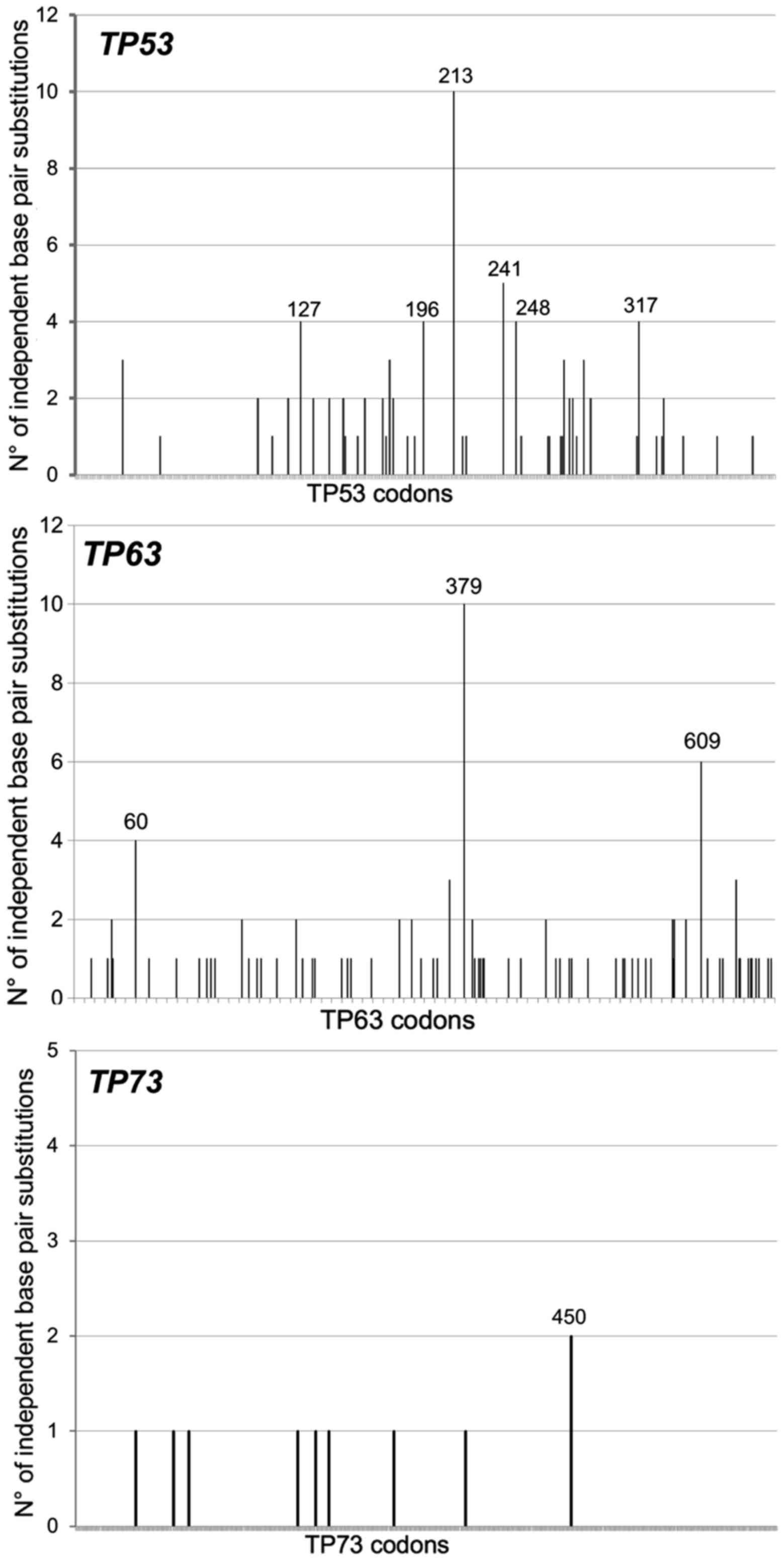
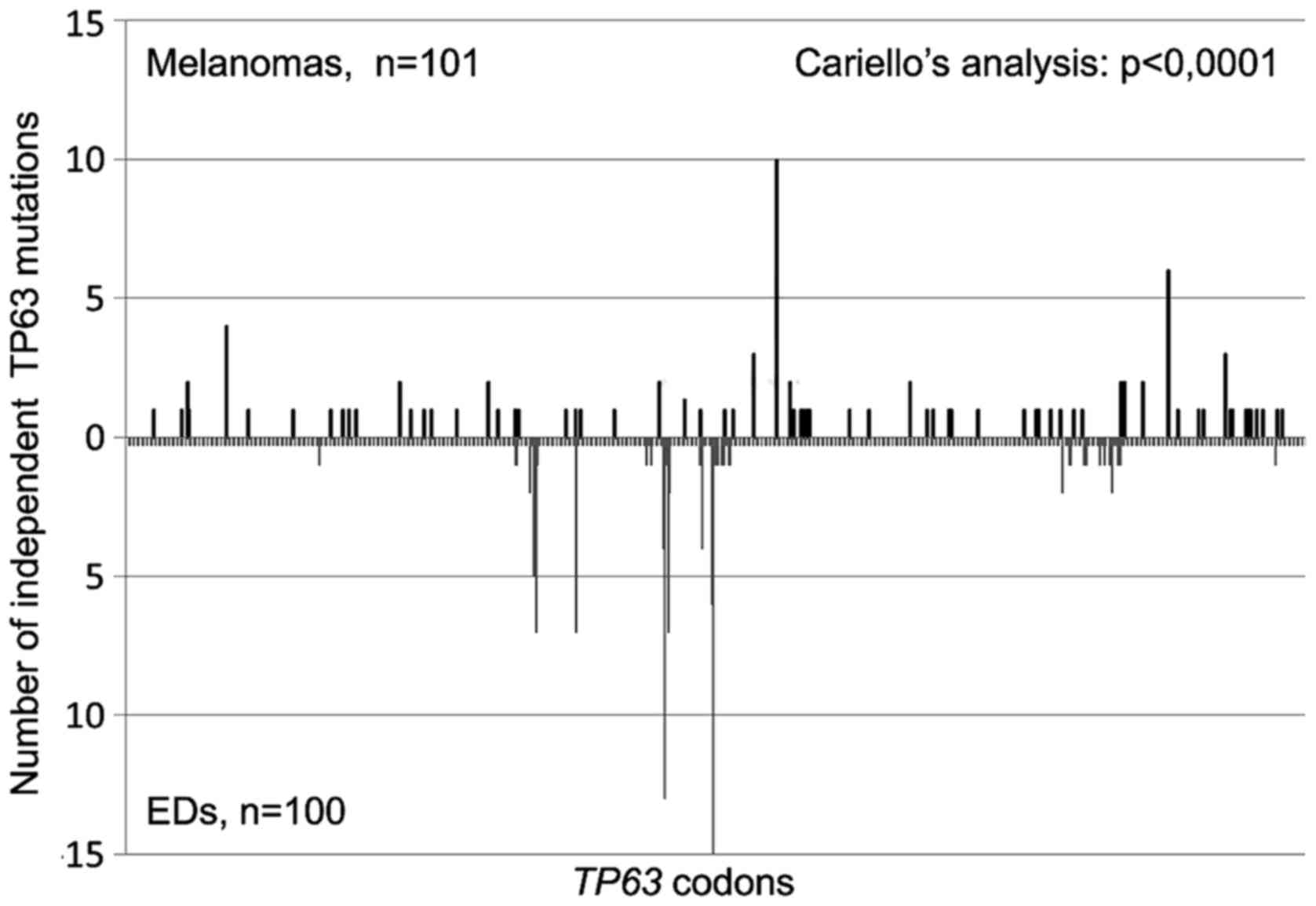
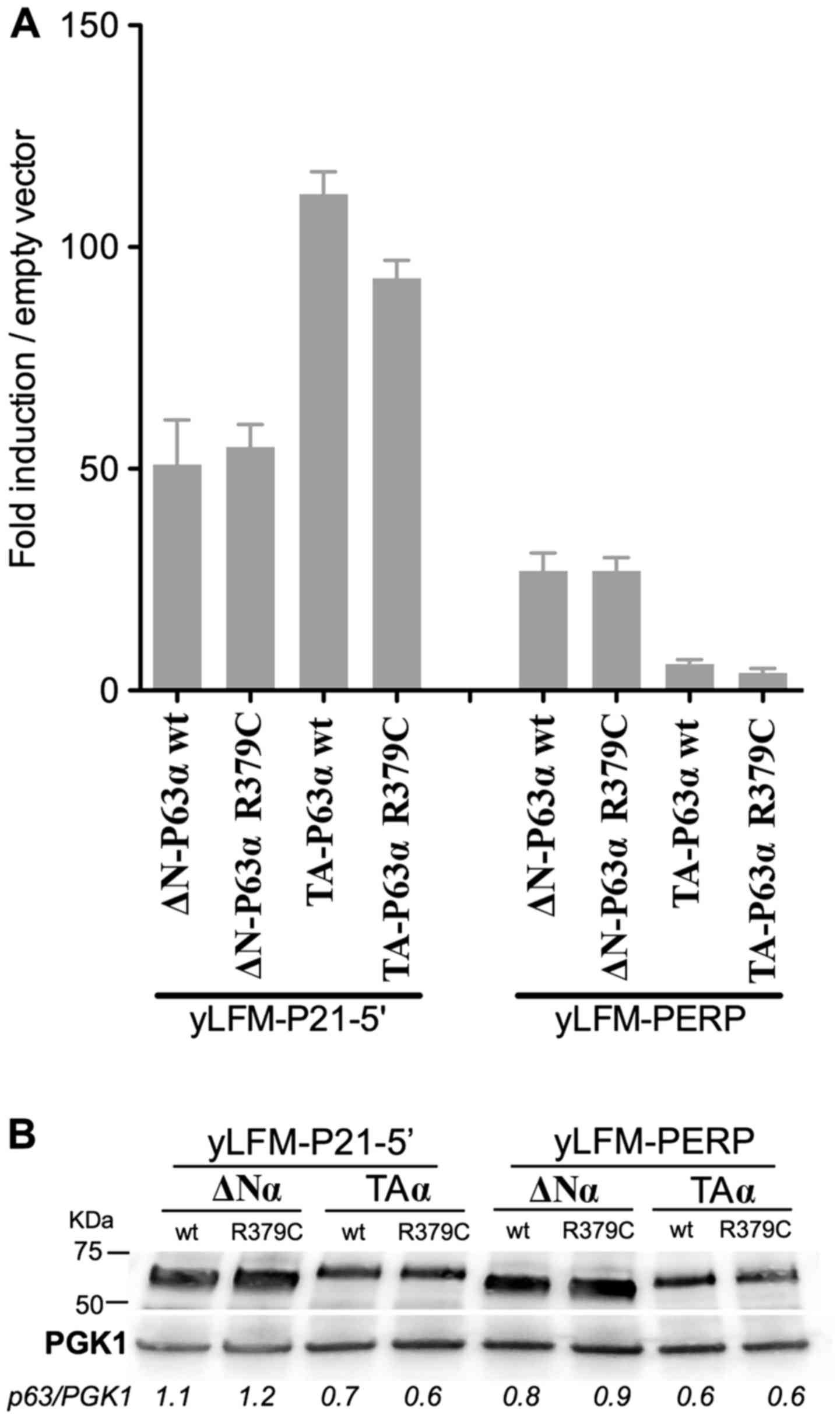
In contrast to TP53, cancer development is rarely associated with mutations in the TP63 and TP73 genes. Recently, next generation sequencing analysis revealed that TP63 mutations are frequent, specifically in cutaneous melanomas. Cutaneous melanoma represents 4% of skin cancers but it is responsible for 80% of skin cancer related deaths. In the present study, we first determined whether all three members of the P53 family of transcription factors were found mutated in cutaneous melanomas by retrieving all TP53, TP63 and TP73 mutations from cBioPortal (http://www.cbioportal.org/). TP53 and TP63 were frequently mutated [15.0% (91/605) and 14.7% (89/605), respectively], while TP73 [1.5% (9/605)] was more rarely mutated (p<0.0001). A UV-mutation fingerprint was recognized for TP63 and TP73 genes. Then, we tried to evaluate the potential role of TP63 mutations as drivers or passengers in the tumorigenic process. In the former case, the amino acid substitutions should cause significant functional consequences on the main biochemical activity of the P63 protein, namely transactivation. The predicted effects of specific amino acid substitutions by two bioinformatics tools were rather different. Using a yeast-based functional assay, the observed hotspot mutant R379CP63 protein exhibited a substantial residual activity compared to the wild-type (>70%). This result does not support a major role of the mutant P63 protein in melanomagenesis while it is still consistent with the TP63 gene being a recorder of UV exposure. The TP63 mutation spectrum from cutaneous melanomas, when compared with that observed at the germinal level in patients affected by P63-associated diseases [ectodermal dysplasia syndromes, (EDs)], revealed significant differences. The TP63 mutations were more frequent at CpGs sites (p<0.0001) in EDs and at PyPy sites (p<0.0001) in cutaneous melanomas. The two spectra differed significantly (p<0.0001). We conclude that TP63 mutations are frequent in cutaneous melanoma, support UV etiology, but their role in melanomagenesis is unclear.
View Figures

Figure 1

Figure 2

Figure 3

View References

1 

Lane DP and Crawford LV: T antigen is bound to a host protein in SV40-transformed cells. Nature. 278:261–263. 1979. View Article : Google Scholar : PubMed/NCBI

2 

Kaghad M, Bonnet H, Yang A, Creancier L, Biscan JC, Valent A, Minty A, Chalon P, Lelias JM, Dumont X, et al: Monoallelically expressed gene related to p53 at 1p36, a region frequently deleted in neuroblastoma and other human cancers. Cell. 90:809–819. 1997. View Article : Google Scholar : PubMed/NCBI

3 

Yang A, Kaghad M, Wang Y, Gillett E, Fleming MD, Dötsch V, Andrews NC, Caput D and McKeon F: p63, a p53 homolog at 3q27-29, encodes multiple products with transactivating, death-inducing, and dominant-negative activities. Mol Cell. 2:305–316. 1998. View Article : Google Scholar : PubMed/NCBI

4 

Bisio A, Ciribilli Y, Fronza G, Inga A and Monti P: TP53 mutants in the tower of babel of cancer progression. Hum Mutat. 35:689–701. 2014. View Article : Google Scholar : PubMed/NCBI

5 

Collavin L, Lunardi A and Del Sal G: p53-family proteins and their regulators: Hubs and spokes in tumor suppression. Cell Death Differ. 17:901–911. 2010. View Article : Google Scholar : PubMed/NCBI

6 

Wei J, Zaika E and Zaika A: p53 family: Role of protein isoforms in human cancer. J Nucleic Acids. 2012:6873592012. View Article : Google Scholar : PubMed/NCBI

7 

Malkin D: Li-fraumeni syndrome. Genes Cancer. 2:475–484. 2011. View Article : Google Scholar : PubMed/NCBI

8 

Monti P, Ciribilli Y, Jordan J, Menichini P, Umbach DM, Resnick MA, Luzzatto L, Inga A and Fronza G: Transcriptional functionality of germ line p53 mutants influences cancer phenotype. Clin Cancer Res. 13:3789–3795. 2007. View Article : Google Scholar : PubMed/NCBI

9 

Monti P, Perfumo C, Bisio A, Ciribilli Y, Menichini P, Russo D, Umbach DM, Resnick MA, Inga A and Fronza G: Dominant-negative features of mutant TP53 in germline carriers have limited impact on cancer outcomes. Mol Cancer Res. 9:271–279. 2011. View Article : Google Scholar : PubMed/NCBI

10 

Yang A, Walker N, Bronson R, Kaghad M, Oosterwegel M, Bonnin J, Vagner C, Bonnet H, Dikkes P, Sharpe A, et al: p73-deficient mice have neurological, pheromonal and inflammatory defects but lack spontaneous tumours. Nature. 404:99–103. 2000. View Article : Google Scholar : PubMed/NCBI

11 

Mills AA, Zheng B, Wang XJ, Vogel H, Roop DR and Bradley A: p63 is a p53 homologue required for limb and epidermal morphogenesis. Nature. 398:708–713. 1999. View Article : Google Scholar : PubMed/NCBI

12 

Rufini A, Agostini M, Grespi F, Tomasini R, Sayan BS, Niklison-Chirou MV, Conforti F, Velletri T, Mastino A, Mak TW, et al: p73 in Cancer. Genes Cancer. 2:491–502. 2011. View Article : Google Scholar : PubMed/NCBI

13 

Rinne T, Brunner HG and van Bokhoven H: p63-associated disorders. Cell Cycle. 6:262–268. 2007. View Article : Google Scholar : PubMed/NCBI

14 

Monti P, Russo D, Bocciardi R, Foggetti G, Menichini P, Divizia MT, Lerone M, Graziano C, Wischmeijer A, Viadiu H, et al: EEC- and ADULT-associated TP63 mutations exhibit functional heterogeneity toward P63 responsive sequences. Hum Mutat. 34:894–904. 2013. View Article : Google Scholar : PubMed/NCBI

15 

Flores ER, Sengupta S, Miller JB, Newman JJ, Bronson R, Crowley D, Yang A, McKeon F and Jacks T: Tumor predisposition in mice mutant for p63 and p73: Evidence for broader tumor suppressor functions for the p53 family. Cancer Cell. 7:363–373. 2005. View Article : Google Scholar : PubMed/NCBI

16 

Jacks T, Remington L, Williams BO, Schmitt EM, Halachmi S, Bronson RT and Weinberg RA: Tumor spectrum analysis in p53-mutant mice. Curr Biol. 4:1–7. 1994. View Article : Google Scholar : PubMed/NCBI

17 

Vogelstein B and Kinzler KW: Carcinogens leave fingerprints. Nature. 355:209–210. 1992. View Article : Google Scholar : PubMed/NCBI

18 

Harris CC: p53: At the crossroads of molecular carcinogenesis and risk assessment. Science. 262:1980–1981. 1993. View Article : Google Scholar : PubMed/NCBI

19 

Fronza G, Inga A, Monti P, Scott G, Campomenosi P, Menichini P, Ottaggio L, Viaggi S, Burns PA, Gold B, et al: The yeast p53 functional assay: A new tool for molecular epidemiology. Hopes and facts. Mutat Res. 462:293–301. 2000. View Article : Google Scholar : PubMed/NCBI

20 

Leroy B, Fournier JL, Ishioka C, Monti P, Inga A, Fronza G and Soussi T: The TP53 website: An integrative resource centre for the TP53 mutation database and TP53 mutant analysis. Nucleic Acids Res. 41(D1): D962–D969. 2013. View Article : Google Scholar : PubMed/NCBI

21 

Greenblatt MS, Bennett WP, Hollstein M and Harris CC: Mutations in the p53 tumor suppressor gene: Clues to cancer etiology and molecular pathogenesis. Cancer Res. 54:4855–4878. 1994.PubMed/NCBI

22 

International Agency for Research on Cancer (IARC): IARC Monographs on the Evaluation of Carcinogenic Risk of Chemicals to Humans: Solar and Ultraviolet Radiation. 55. IARC; Lyon, France: 1992, http://monographs.iarc.fr/ENG/Monographs/vol55

23 

Clingen PH, Arlett CF, Roza L, Mori T, Nikaido O and Green MH: Induction of cyclobutane pyrimidine dimers, pyrimidine(6–4)pyrimidone photoproducts, and Dewar valence isomers by natural sunlight in normal human mononuclear cells. Cancer Res. 55:2245–2248. 1995.PubMed/NCBI

24 

Cadet J, Sage E and Douki T: Ultraviolet radiation-mediated damage to cellular DNA. Mutat Res. 571:3–17. 2005. View Article : Google Scholar : PubMed/NCBI

25 

Vogelstein B and Kinzler KW: Cancer genes and the pathways they control. Nat Med. 10:789–799. 2004. View Article : Google Scholar : PubMed/NCBI

26 

Parmigiani G, Boca S, Lin J, Kinzler KW, Velculescu V and Vogelstein B: Design and analysis issues in genome-wide somatic mutation studies of cancer. Genomics. 93:17–21. 2009. View Article : Google Scholar : PubMed/NCBI

27 

Carter H, Chen S, Isik L, Tyekucheva S, Velculescu VE, Kinzler KW, Vogelstein B and Karchin R: Cancer-specific high-throughput annotation of somatic mutations: Computational prediction of driver missense mutations. Cancer Res. 69:6660–6667. 2009. View Article : Google Scholar : PubMed/NCBI

28 

Youn A and Simon R: Identifying cancer driver genes in tumor genome sequencing studies. Bioinformatics. 27:175–181. 2011. View Article : Google Scholar : PubMed/NCBI

29 

Vogelstein B and Kinzler KW: The path to cancer - three strikes and you're out. N Engl J Med. 373:1895–1898. 2015. View Article : Google Scholar : PubMed/NCBI

30 

Tomasetti C, Marchionni L, Nowak MA, Parmigiani G and Vogelstein B: Only three driver gene mutations are required for the development of lung and colorectal cancers. Proc Natl Acad Sci USA. 112:118–123. 2015. View Article : Google Scholar : PubMed/NCBI

31 

Miller AJ and Mihm MC Jr: Melanoma. N Engl J Med. 355:51–65. 2006. View Article : Google Scholar : PubMed/NCBI

32 

Marks R: Epidemiology of melanoma. Clin Exp Dermatol. 25:459–463. 2000. View Article : Google Scholar : PubMed/NCBI

33 

Pleasance ED, Cheetham RK, Stephens PJ, McBride DJ, Humphray SJ, Greenman CD, Varela I, Lin ML, Ordóñez GR, Bignell GR, et al: A comprehensive catalogue of somatic mutations from a human cancer genome. Nature. 463:191–196. 2010. View Article : Google Scholar : PubMed/NCBI

34 

Hodis E, Watson IR, Kryukov GV, Arold ST, Imielinski M, Theurillat JP, Nickerson E, Auclair D, Li L, Place C, et al: A landscape of driver mutations in melanoma. Cell. 150:251–263. 2012. View Article : Google Scholar : PubMed/NCBI

35 

Shain AH, Yeh I, Kovalyshyn I, Sriharan A, Talevich E, Gagnon A, Dummer R, North J, Pincus L, Ruben B, et al: The genetic evolution of melanoma from precursor lesions. N Engl J Med. 373:1926–1936. 2015. View Article : Google Scholar : PubMed/NCBI

36 

Shain AH and Bastian BC: From melanocytes to melanomas. Nat Rev Cancer. 16:345–358. 2016. View Article : Google Scholar : PubMed/NCBI

37 

Romano RA and Sinha S: Family matters: Sibling rivalry and bonding between p53 and p63 in cancer. Exp Dermatol. 23:238–239. 2014. View Article : Google Scholar : PubMed/NCBI

38 

Gao J, Aksoy BA, Dogrusoz U, Dresdner G, Gross B, Sumer SO, Sun Y, Jacobsen A, Sinha R, Larsson E, et al: Integrative analysis of complex cancer genomics and clinical profiles using the cBioPortal. Sci Signal. 6:pl12013. View Article : Google Scholar : PubMed/NCBI

39 

Cerami E, Gao J, Dogrusoz U, Gross BE, Sumer SO, Aksoy BA, Jacobsen A, Byrne CJ, Heuer ML, Larsson E, et al: The cBio cancer genomics portal: An open platform for exploring multidimensional cancer genomics data. Cancer Discov. 2:401–404. 2012. View Article : Google Scholar : PubMed/NCBI

40 

Berger MF, Hodis E, Heffernan TP, Deribe YL, Lawrence MS, Protopopov A, Ivanova E, Watson IR, Nickerson E, Ghosh P, et al: Melanoma genome sequencing reveals frequent PREX2 mutations. Nature. 485:502–506. 2012.PubMed/NCBI

41 

Krauthammer M, Kong Y, Ha BH, Evans P, Bacchiocchi A, McCusker JP, Cheng E, Davis MJ, Goh G, Choi M, et al: Exome sequencing identifies recurrent somatic RAC1 mutations in melanoma. Nat Genet. 44:1006–1014. 2012. View Article : Google Scholar : PubMed/NCBI

42 

Rinne T, Bolat E, Meijer R, Scheffer H and van Bokhoven H: Spectrum of p63 mutations in a selected patient cohort affected with ankyloblepharon-ectodermal defects-cleft lip/palate syndrome (AEC). Am J Med Genet A. 149A:1948–1951. 2009. View Article : Google Scholar : PubMed/NCBI

43 

Clements SE, Techanukul T, Coman D, Mellerio JE and McGrath JA: Molecular basis of EEC (ectrodactyly, ectodermal dysplasia, clefting) syndrome: Five new mutations in the DNA-binding domain of the TP63 gene and genotype-phenotype correlation. Br J Dermatol. 162:201–207. 2010. View Article : Google Scholar : PubMed/NCBI

44 

Adams WT and Skopek TR: Statistical test for the comparison of samples from mutational spectra. J Mol Biol. 194:391–396. 1987. View Article : Google Scholar : PubMed/NCBI

45 

Cariello NF, Piegorsch WW, Adams WT and Skopek TR: Computer program for the analysis of mutational spectra: Application to p53 mutations. Carcinogenesis. 15:2281–2285. 1994. View Article : Google Scholar : PubMed/NCBI

46 

Andreotti V, Ciribilli Y, Monti P, Bisio A, Lion M, Jordan J, Fronza G, Menichini P, Resnick MA and Inga A: p53 transactivation and the impact of mutations, cofactors and small molecules using a simplified yeast-based screening system. PLoS One. 6:e206432011. View Article : Google Scholar : PubMed/NCBI

47 

Kushnirov VV: Rapid and reliable protein extraction from yeast. Yeast. 16:857–860. 2000. View Article : Google Scholar : PubMed/NCBI

48 

Vogelstein B, Papadopoulos N, Velculescu VE, Zhou S, Diaz LA Jr and Kinzler KW: Cancer genome landscapes. Science. 339:1546–1558. 2013. View Article : Google Scholar : PubMed/NCBI

49 

Adorno M, Cordenonsi M, Montagner M, Dupont S, Wong C, Hann B, Solari A, Bobisse S, Rondina MB, Guzzardo V, et al: A Mutant-p53/Smad complex opposes p63 to empower TGFbeta-induced metastasis. Cell. 137:87–98. 2009. View Article : Google Scholar : PubMed/NCBI

50 

Perrot CY, Javelaud D and Mauviel A: Insights into the transforming growth factor-β signaling pathway in cutaneous melanoma. Ann Dermatol. 25:135–144. 2013. View Article : Google Scholar : PubMed/NCBI

51 

Matin RN, Chikh A, Chong SL, Mesher D, Graf M, Sanza' P, Senatore V, Scatolini M, Moretti F, Leigh IM, et al: p63 is an alternative p53 repressor in melanoma that confers chemoresistance and a poor prognosis. J Exp Med. 210:581–603. 2013. View Article : Google Scholar : PubMed/NCBI

52 

Rossi D, Khiabanian H, Spina V, Ciardullo C, Bruscaggin A, Famà R, Rasi S, Monti S, Deambrogi C, De Paoli L, et al: Clinical impact of small TP53 mutated subclones in chronic lymphocytic leukemia. Blood. 123:2139–2147. 2014. View Article : Google Scholar : PubMed/NCBI

Related Articles

  • Abstract
  • View
  • Download
  • Twitter
Copy and paste a formatted citation
Spandidos Publications style
Monti P, Ghiorzo P, Menichini P, Foggetti G, Queirolo P, Izzotti A and Fronza G: TP63 mutations are frequent in cutaneous melanoma, support UV etiology, but their role in melanomagenesis is unclear. Oncol Rep 38: 1985-1994, 2017.
APA
Monti, P., Ghiorzo, P., Menichini, P., Foggetti, G., Queirolo, P., Izzotti, A., & Fronza, G. (2017). TP63 mutations are frequent in cutaneous melanoma, support UV etiology, but their role in melanomagenesis is unclear. Oncology Reports, 38, 1985-1994. https://doi.org/10.3892/or.2017.5903
MLA
Monti, P., Ghiorzo, P., Menichini, P., Foggetti, G., Queirolo, P., Izzotti, A., Fronza, G."TP63 mutations are frequent in cutaneous melanoma, support UV etiology, but their role in melanomagenesis is unclear". Oncology Reports 38.4 (2017): 1985-1994.
Chicago
Monti, P., Ghiorzo, P., Menichini, P., Foggetti, G., Queirolo, P., Izzotti, A., Fronza, G."TP63 mutations are frequent in cutaneous melanoma, support UV etiology, but their role in melanomagenesis is unclear". Oncology Reports 38, no. 4 (2017): 1985-1994. https://doi.org/10.3892/or.2017.5903
Copy and paste a formatted citation
x
Spandidos Publications style
Monti P, Ghiorzo P, Menichini P, Foggetti G, Queirolo P, Izzotti A and Fronza G: TP63 mutations are frequent in cutaneous melanoma, support UV etiology, but their role in melanomagenesis is unclear. Oncol Rep 38: 1985-1994, 2017.
APA
Monti, P., Ghiorzo, P., Menichini, P., Foggetti, G., Queirolo, P., Izzotti, A., & Fronza, G. (2017). TP63 mutations are frequent in cutaneous melanoma, support UV etiology, but their role in melanomagenesis is unclear. Oncology Reports, 38, 1985-1994. https://doi.org/10.3892/or.2017.5903
MLA
Monti, P., Ghiorzo, P., Menichini, P., Foggetti, G., Queirolo, P., Izzotti, A., Fronza, G."TP63 mutations are frequent in cutaneous melanoma, support UV etiology, but their role in melanomagenesis is unclear". Oncology Reports 38.4 (2017): 1985-1994.
Chicago
Monti, P., Ghiorzo, P., Menichini, P., Foggetti, G., Queirolo, P., Izzotti, A., Fronza, G."TP63 mutations are frequent in cutaneous melanoma, support UV etiology, but their role in melanomagenesis is unclear". Oncology Reports 38, no. 4 (2017): 1985-1994. https://doi.org/10.3892/or.2017.5903
Follow us
  • Twitter
  • LinkedIn
  • Facebook
About
  • Spandidos Publications
  • Careers
  • Cookie Policy
  • Privacy Policy
How can we help?
  • Help
  • Live Chat
  • Contact
  • Email to our Support Team