Introduction
Breast cancer is the most commonly diagnosed cancer
and the first leading cause of cancer-related death among women
worldwide, with an estimated 1.7 million cases and 521,900 deaths
in 2012. Breast cancer alone accounts for 25% of all cancer cases
and 15% of all cancer-related deaths among women (1). The main reason for breast
cancer-related deaths is tumor metastasis. Thus, it is of great
significance that much effort should be paid to fully understand
the mechanism of breast cancer metastasis and to establish an
effective method to inhibit tumor metastasis.
TG-interacting factor (TGIF) is a transcriptional
repressor, which is involved in the signaling pathways of retinoic
acid (RA) and transforming growth factor β (TGF-β) (2,3).
Increasing evidence suggests that TGIF is associated to the
initiation, development and progression of several kinds of tumors,
including leukemia (4,5), esophageal carcinoma and gastric
carcinoma (6,7), hepatocellular carcinoma (8), lung cancer (9,10) and
upper tract urothelial carcinoma (11,12).
Recently, Zhang et al reported that TGIF drove mammary
tumorigenesis and the elevated TGIF expression was correlated with
high Wnt signaling and poor survival of triple-negative breast
cancer (TNBC) patients (13). Kwon
et al reported that targeted interference of SIN3A-TGIF
function by SID decoy treatment inhibits Wnt signaling and the
abilities of invasion in TNBC cells (14). However, it is not fully clear what
the potential function of TGIF is in the metastasis of human breast
cancer.
To address the potential function of TGIF in the
metastasis of human breast cancer, we explored the effects of
silencing TGIF on the migration, invasion and metastasis of the
human breast cancer cell line of MDA-MB-231 using in vitro
and in vivo experiments in the present study. We also
investigated the pattern of TGIF protein expression in metastatic
human breast cancer samples and non-metastatic human breast cancer
samples.
Materials and methods
Cell culture
MDA-MB-231 cell line was obtained from the Cell
Resource Center, Peking Union Medical College (which is the
headquarters of National Infrastructure of Cell Line Resource,
NSTI) and was cultured in DMEM supplemented with 2 mM of
L-glutamine, 10% of fetal bovine serum (FBS), streptomycin (100
µg/ml) and penicillin (100 U/ml) at 37°C in a humidified atmosphere
containing 5% CO2. For infection, control shRNA
lentiviral particles-A (sc-108080) and TGIF shRNA (h) lentiviral
particles (sc-36659-V) were purchased from Santa Cruz
Biotechnology, Inc. (Dallas, TX, USA). MDA-MB-231 cells were
infected with lentiviral particles in accordance with the
manufacturer's instructions and were selected with 10 µg/ml of
puromycin for 28 days (Gibco; Thermo Fisher Scientific, Inc.,
Waltham, MA, USA). MDA-MB-231 cells that were successfully infected
with control shRNA lentiviral particles and TGIF shRNA (h)
lentiviral particles were termed MDA-MB-231-control-shRNA cell and
MDA-MB-231-TGIF-shRNA cell, respectively.
Biological samples
Sixty-six breast cancer tissue samples were
collected at the First Affiliated Hospital of Zhengzhou University
from October 2013 to December 2014. Written informed consent was
obtained from individual patients. The Ethics Committee of the
First Affiliated Hospital of Zhengzhou University approved this
study.
Measurement of cell proliferation
MDA-MB-231-TGIF-shRNA cells (4×10⁴) and
MDA-MB-231-control-shRNA cells were seeded in 12-well plates. Cells
were counted using a CASY Cell Counter (Scharfe System, Germany) at
24, 48, 72 and 96 h, respectively (15).
Wound healing assay
The wound healing assay was performed according to
our previous report (16). Cells
were wounded by scratching the surface of a 6-well plate with a
200-µl pipette tip. Floating cells were removed through washing
with PBS. The cells were maintained at 37°C for 48 h. The
photographic images were taken by using a Leica DM IL LED inverted
microscope at different time-points. The healing width was
calculated according to our previous report (16).
Transwell invasion assay
The cell invasion assay was performed in accordance
with the manufacturer's instructions (Corning Inc., Corning, NY,
USA). MDA-MB-231-TGIF-shRNA cells (5×10⁴) and
MDA-MB-231-control-shRNA cells were plated into the upper chamber
of a 24-well Transwell chamber with an 8-µm pore size insert
(Corning Inc.) with Matrigel (BD Biosciences, Franklin Lakes, NJ,
USA). The lower chambers were filled with 600 µl of DMEM containing
10% FBS. After 24 h of incubation at 37°C, the cells on the upper
side of the membrane were removed, and the membranes were fixed in
methanol and stained with crystal violent (Sigma-Aldrich, St.
Louis, MO, USA). The cells on the lower surfaces were photographed
and five randomly selected fields were counted (16).
Tail vein metastatic assay
The Ethics Committee of Henan Center for Disease
Control and Prevention approved this study. All of the animal
experiments were conducted in accordance with the guidelines for
the Care and Use of Laboratory Animals. Female BALB/c nude mice
aged 28 days were purchased from Vital River Laboratory Animal
Technology Co., Ltd. (Beijing, China). MDA-MB-231-TGIF-shRNA cells
and MDA-MB-231-control-shRNA cells were detached by trypsinization,
washed with PBS, and then re-suspended in PBS. Cells
(6×10⁵) in 200 µl PBS were injected to each mouse (ten
mice per group) by tail vein. The mice were sacrificed at 12 weeks
post-injection. The lungs were examined for tumor metastasis
(17,18).
Quantitative real-time polymerase
chain reaction (qRT-PCR)
The detailed methods of total RNA extraction, cDNA
synthesis and quantitative real-time PCR were performed as
previously described (9).
Western blot assay
Soluble cell lysates (30 µg protein) were loaded and
separated in 10% SDS-PAGE gel. Proteins were transferred to
nitrocellulose (NC) membranes (Pall Life Sciences, Port Washington,
NY, USA). The membranes were blocked with 5% bovine serum albumin
(BSA), and then incubated with primary antibodies overnight at 4°C.
TGIF (sc-9084), MMP2 (sc-10736), N-cadherin (sc-7939), β-catenin
(sc-7199) and β-actin (sc-8432) were purchased from Santa Cruz
Biotechnology Inc. Snail1 (#3879S) and vimentin (#5741S) were
purchased from Cell Signaling Technology. The membranes were washed
with Tris-buffered saline-Tween-20 (TBST) and further incubated for
1 h at room temperature with corresponding horseradish
peroxidase-coupled secondary antibodies (ZSGB-BIO, Beijing, China).
Signals were detected by ECL kit (Bio-Rad, Hercules, CA, USA).
Immunohistochemistry
Immunohistochemistry analysis was performed
according to the manufacturer's instructions (CW2069; Beijing
ComWin Biotech Co., Ltd). The primary antibody of TGIF (sc-17800)
was obtained from Santa Cruz Biotechnology. The intensity of TGIF
staining was scored and the scores of positive cell percentage were
assigned in line with a published report (19).
Statistical analysis
SPSS 13.0 software (SPSS, Inc., Chicago, IL, USA)
was used to estimate the statistical significance. Student's t-test
and Chi-square were performed. P-value <0.05 was considered to
indicate statistical significance.
Results
The effects of silencing TGIF on
MDA-MB-231 cell proliferation
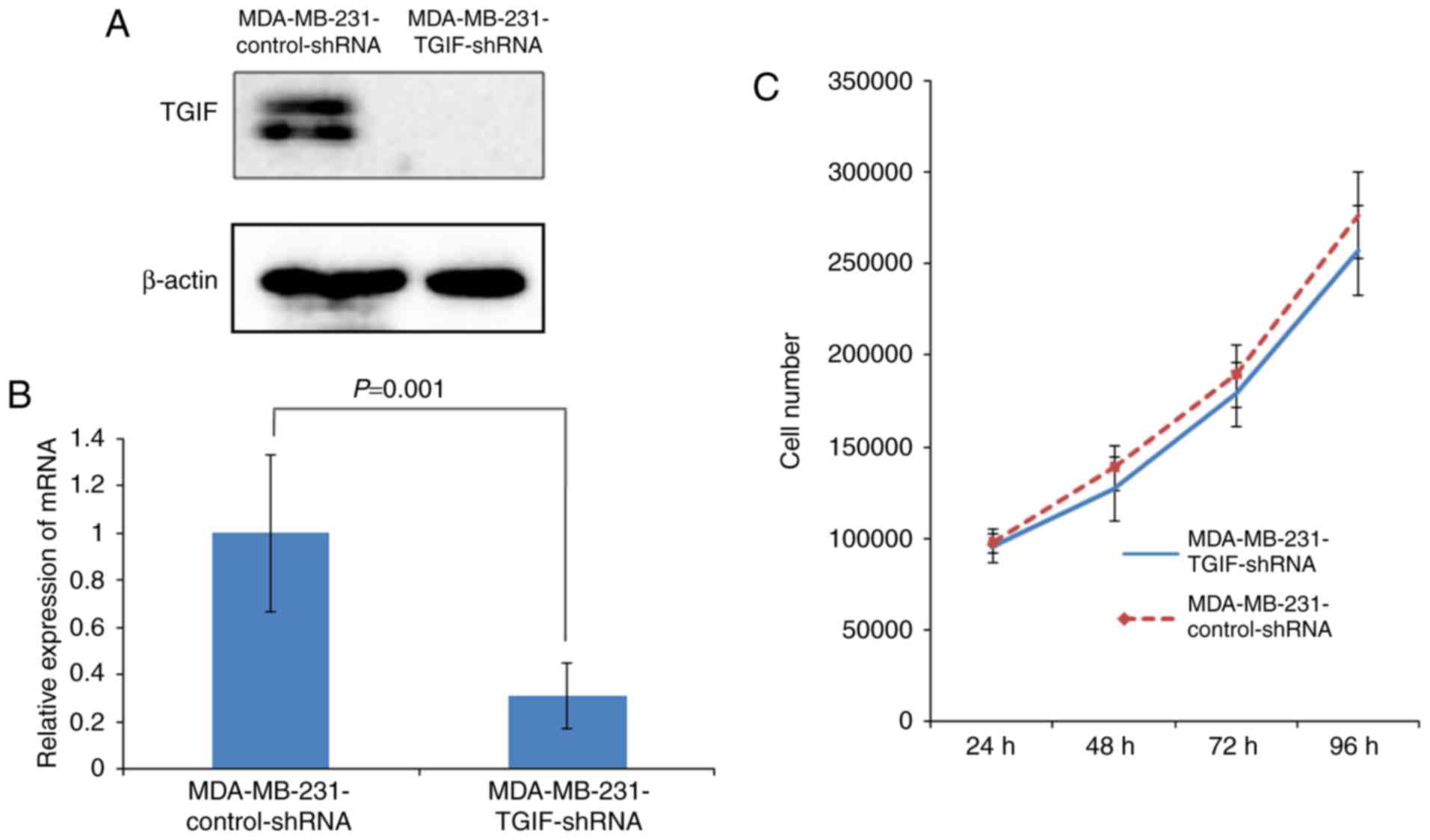
Fig. 1 presented the
silencing efficiency of the shRNA lentiviruses by determining the
levels of mRNA and protein expression in the MDA-MB-231 human
breast cancer cells. Our data indicated that the lower levels of
protein (Fig. 1A) and mRNA
(Fig. 1B) of TGIF expression were
observed in MDA-MB-231-TGIF-shRNA cells compared to that in
MDA-MB-231-control-shRNA cells, suggesting that a stable
TGIF-silenced MDA-MB-231 cell line was successfully
established.
Fig. 1C demonstrates
the effects of silencing TGIF on the proliferation of MDA-MB-231
cells. Our results showed that no significant difference was
observed in the cell growth speed between the MDA-MB-231-TGIF-shRNA
cells and the MDA-MB-231-control-shRNA cells at the indicated
time-points.
The effects of silencing TGIF on the
migration and invasion of MDA-MB-231 cells
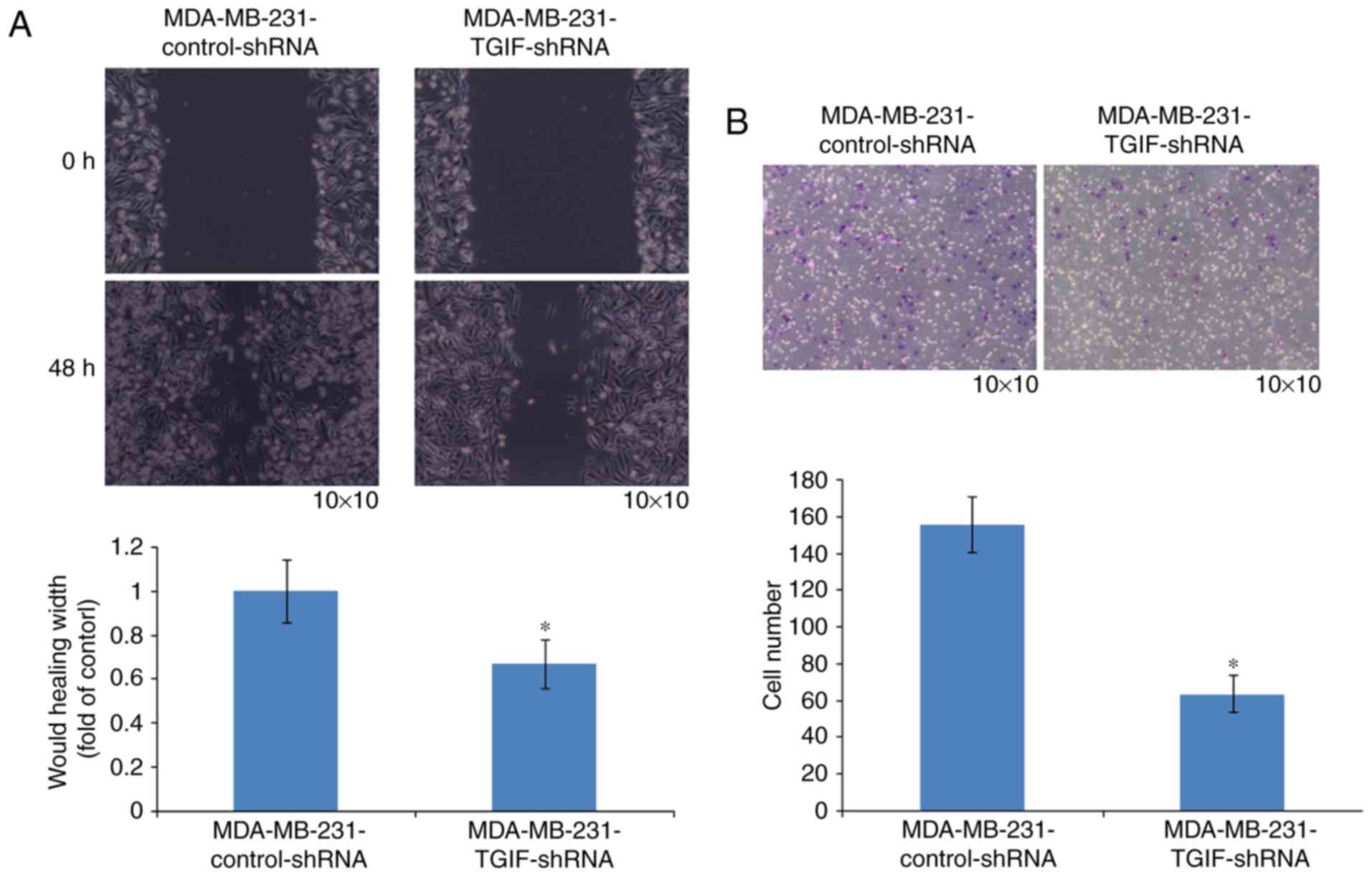
Data on the effects of silencing TGIF on migration
and invasion of MDA-MB-231 cells are presented in Fig. 2. Our results indicated that the
MDA-MB-231-TGIF-shRNA cells migrated less quickly to close the
scratched wounds than the MDA-MB-231-control-shRNA cells (Fig. 2A). Fig.
2B showed that the decreased number of cells invading through
the Matrigel was observed in the MDA-MB-231-TGIF-shRNA cells
compared with the MDA-MB-231-control-shRNA cells. Taken together,
our findings suggested that silencing TGIF was able to inhibit
migration and invasion of human breast cancer cell line of
MDA-MB-231 in in vitro experiments.
The effects of silencing TGIF on
MDA-MB-231 cell metastasis in vivo
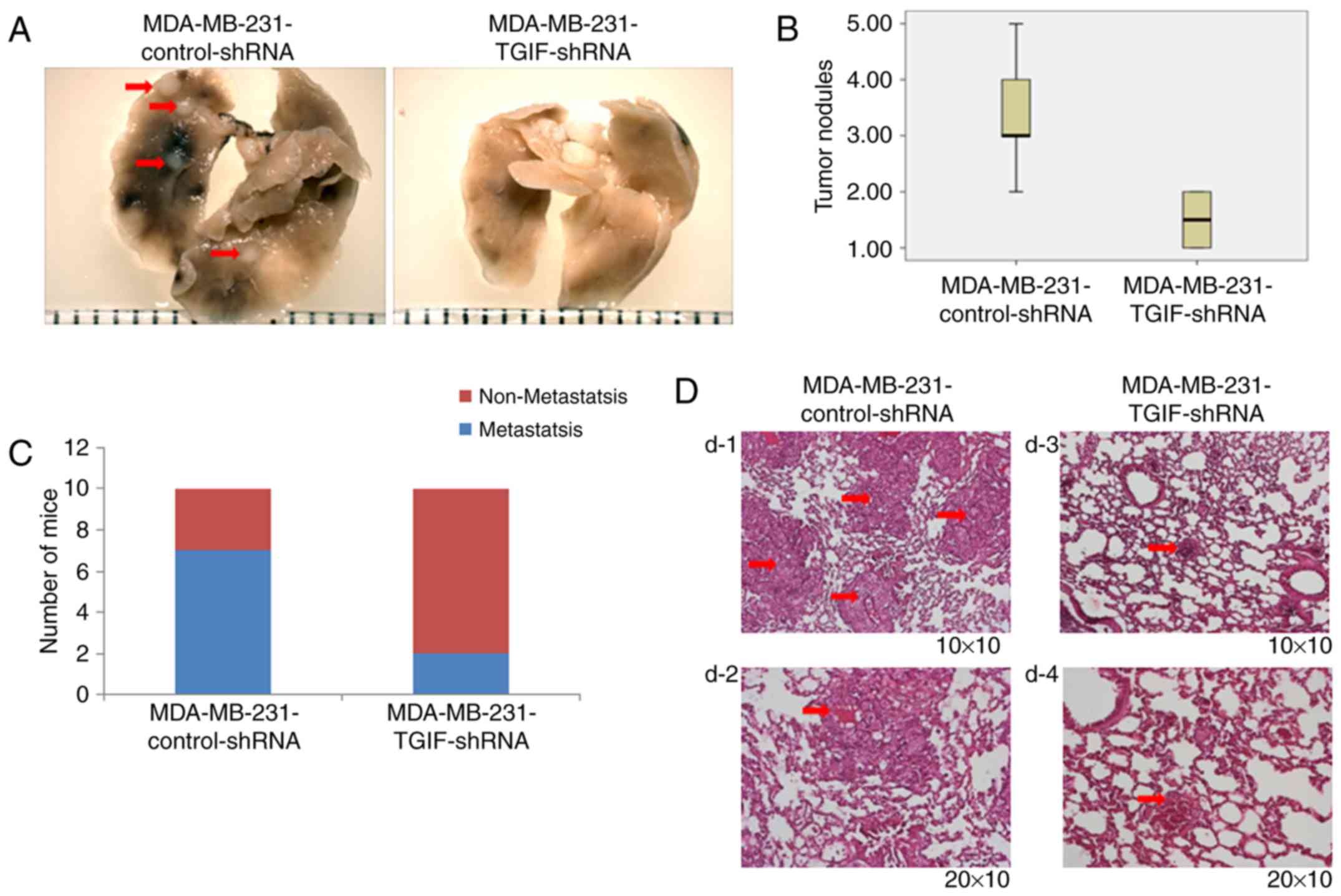
Fig. 3 shows the
effects of silencing TGIF on MDA-MB-231 cell metastasis in
vivo. The representative images of tumor nodules are
demonstrated in Fig. 3A. Our data
indicated that the significantly reduced number of metastatic lung
nodules was observed in the group of MDA-MB-231-TGIF-shRNA cells
compared with the control group (Fig.
3B). The mice injected with MDA-MB-231-TGIF-shRNA cells had
markedly decreased incidence of lung metastasis compared with those
injected with MDA-MB-231-control-shRNA cells (P=0.029; Fig. 3C). The representative images of
histological examinations are shown in Fig. 3D.
Silencing TGIF downregulates the
expression of Snail1, MMP2 and β-catenin
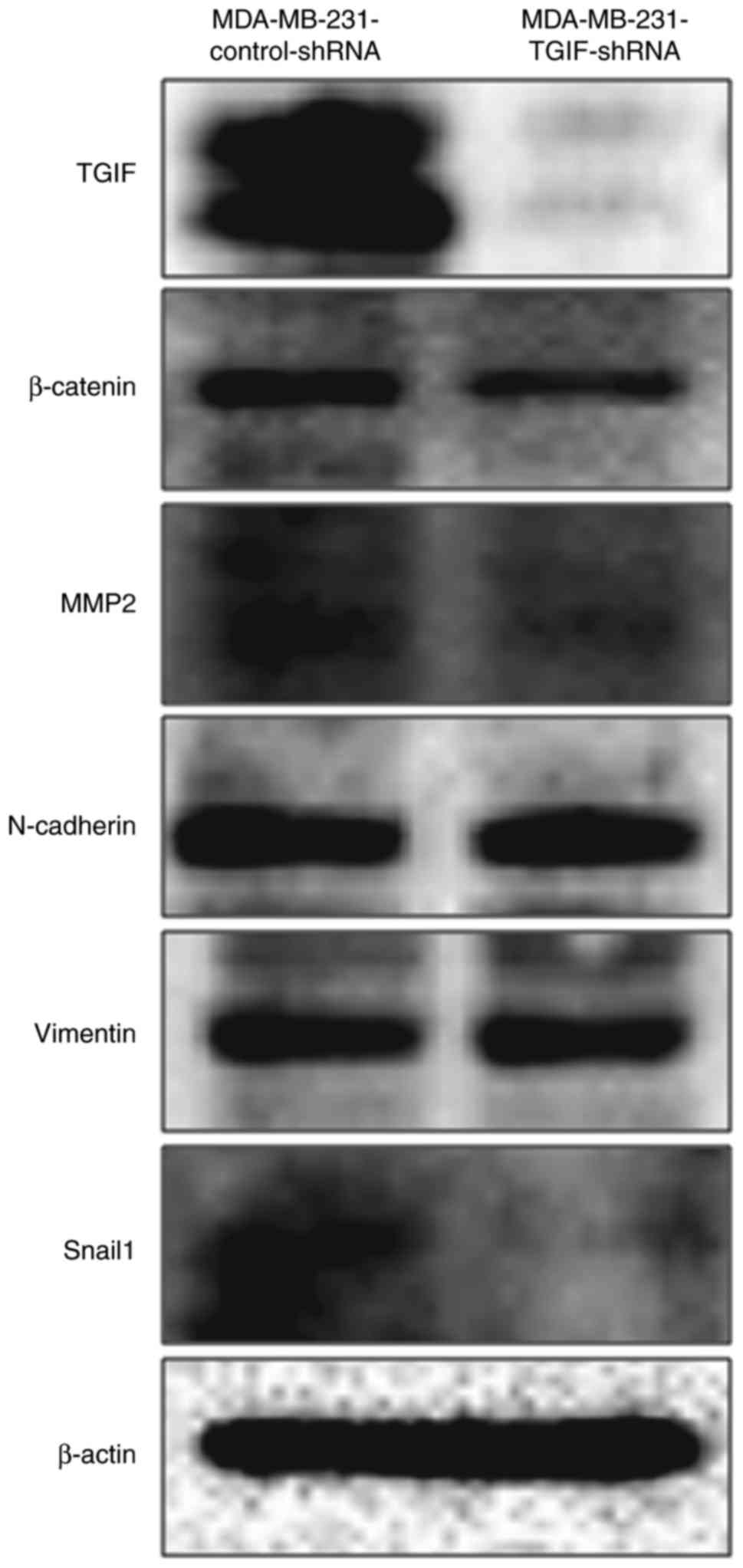
Since the proteins such as MMP2, Snail1, N-cadherin,
vimentin and β-catenin are involved in the progression and
metastasis of human breast cancer (20–24),
we tentatively sought to observe whether silencing TGIF could
affect the protein expression of Snail1, MMP2, N-cadherin, vimentin
and β-catenin. Western blot analysis indicated that the obviously
decreased levels of Snail1, MMP2 and β-catenin protein expression
were observed in MDA-MB-231-TGIF-shRNA cells compared with
MDA-MB-231-control-shRNA cells (Fig.
4).
TGIF expression in human breast cancer
tissues
The main clinical characteristics of human breast
cancer patients are listed in Table
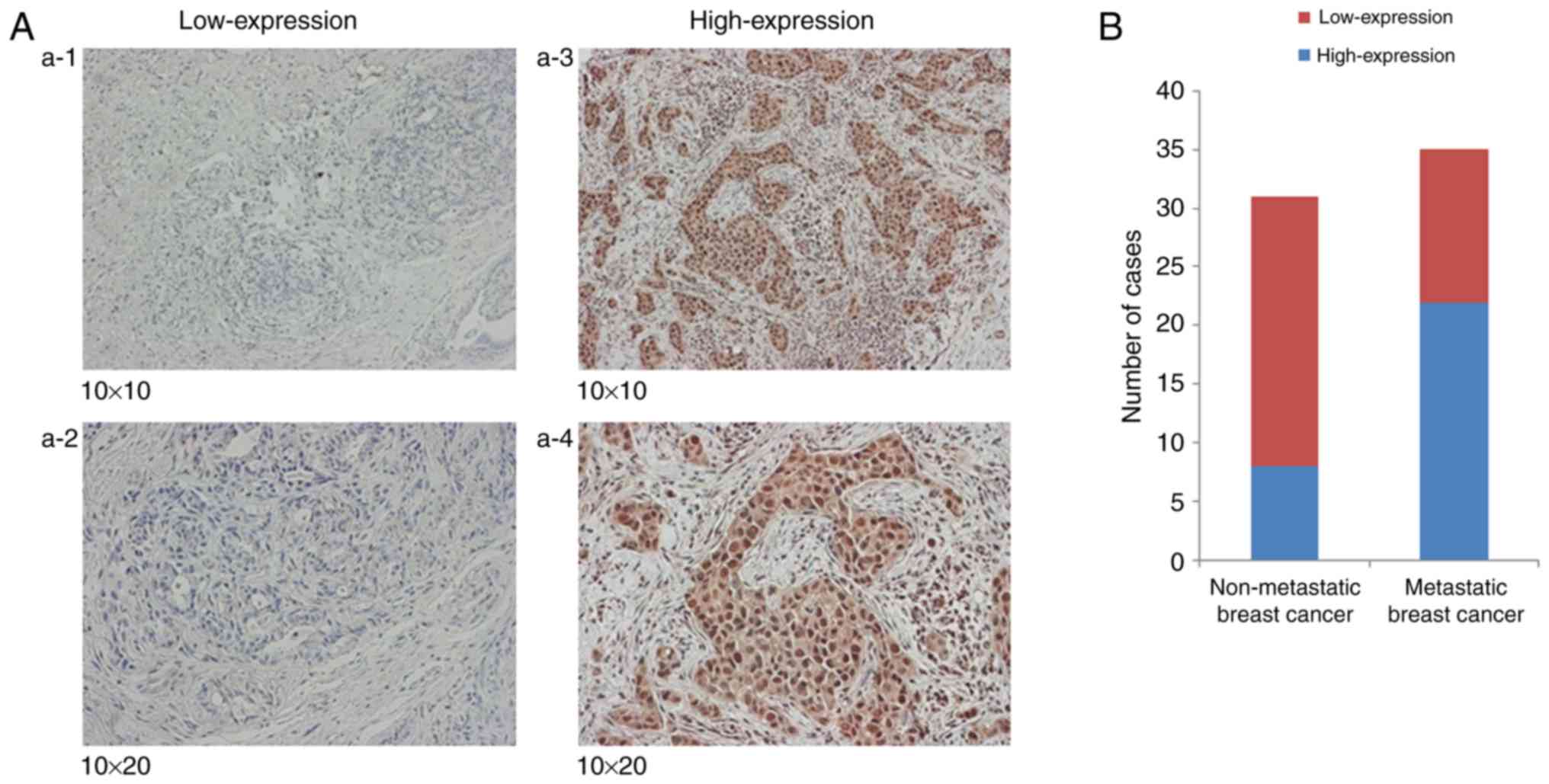
I. Fig. 5 demonstrates the
difference of TGIF expression between metastatic human breast
cancer samples and non-metastatic human breast cancer samples. The
representative images of TGIF low-expression (a-1, 10×10; a-2,
10×20) and TGIF high-expression (a-3, 10×10; a-4, 10×20) are shown
in Fig. 5A. Our results indicated
that the significantly higher percentage of TGIF high-expression
was observed in metastatic human breast cancer (62.9%, 22 of 35)
than that in non-metastatic human breast cancer (25.8%, 8 of 31)
(P=0.003, Fig. 5B).
 | Table I.The main clinical characteristics of
human breast cancer. |
Table I.
The main clinical characteristics of
human breast cancer.
|
| No. |
|---|
| Age (years) |
|
|
≤45 | 22 |
|
>45 | 44 |
| Histology type |
|
| Ductal
carcinoma | 11 |
|
Invasive carcinoma | 55 |
| TNM stage |
|
| I | 11 |
| II | 40 |
|
III | 15 |
| Metastasis |
|
|
Yes | 35 |
| No | 31 |
Discussion
To our knowledge, previous studies have shown that
overexpression of TGIF is correlated to metastasis and worse
progression in non-small cell lung cancer (NSCLC) (10) and upper urinary tract urothelial
carcinoma (11,12). Xiang et al reported that
overexpression of TGIF increased the ability of migration of NSCLC
cells, while suppressing TGIF expression inhibited the ability of
migration of NSCLC cells. Moreover, knocking down TGIF impaired
metastasis of NSCLC cells (10).
Yeh et al reported that overexpression of TGIF could
significantly increase the capabilities of migration and invasion
of RT4 cells and TSGH8301 cells, on the contrary, knocking down
TGIF inhibited the ability of invasion of T24 cells (11).
In this study, we investigated the effects of
silencing TGIF on the migration and invasion of the human breast
cancer cell line MDA-MB-231 in vitro. Our findings indicated
that silencing TGIF inhibited the migration and invasion of
MDA-MB-231 cells in wound healing assay and Transwell invasion
assay, which suggested that TGIF might be involved in the
metastasis of human breast cancer. Our results are consistent with
data of a previous report, Kwon et al reported that a marked
80% reduction of cell invasion was observed in
MDA-MB-231-luc-D3H2LN cells transfected with TGIF-targeting siRNA,
compared with control cells (14).
Our findings also indicated that silencing TGIF inhibited
metastasis of MDA-MB-231 cells to lung in vivo, which
verified the potential role of TGIF in the metastasis of breast
cancer in the animal model. Furthermore, we observed the rate of
TGIF high-expression in metastatic human breast cancer samples was
significantly higher than that in non-metastatic human breast
cancer samples, which supported the notion that TGIF was involved
in breast cancer metastasis in the population level.
In the present study, we observed that silencing
TGIF reduced the MMP2 protein expression in the human breast cancer
cell line MDA-MB-231. Previous reports suggested that TGIF could
regulate the MMP2 expression in urothelial carcinoma cell lines
(11,12). Together, these studies supported
that TGIF could regulate the MMP2 expression in different types of
cell lines. MMP2 is one of the matrix-degrading enzymes, which
plays a key role in the invasion and metastasis of breast cancer
(25,26). Published reports showed that the
elevated MMP2 expression was related to poor prognostic clinical
pathological factors in breast cancer (25,27–29).
Pei et al reported that plantamajoside (PMS) inhibited the
metastasis of breast cancer by decreasing the activity of MMP2
(30). Ni et al reported
that downregulation of miR-106b induced breast cancer cell invasion
and motility in association with overexpression of MMP2 (31). Accompanied with previous studies,
our data suggested that TGIF silencing might inhibit metastasis of
breast cancer via regulating MMP2. However, the underlying
molecular mechanism should be explored in detail in future
studies.
Snail1 is a zinc-finger transcription factor, which
plays a significant role in the progression and metastasis of
breast cancer (32,33). Moody et al reported that the
higher levels of Snail1 expression predicted decreased relapse-free
survival of breast cancer patients and Snail1 was sufficient to
promote mammary tumor recurrence in vivo (34). Geradts et al reported that
nuclear Snail1 expression in early stage breast lesions might
predict future development of invasive breast cancer (35). Results from Tran et al study
showed that Snail1 expression in primary human breast cancer
correlated with higher rates of metastasis (36). Zhang et al found the collagen
receptor discoidin domain receptor 2 stabilized Snail1 protein to
promote the metastasis of human breast cancer (37). Tran et al reported that
transient overexpression of Snail1 in primary breast tumors
increased breast cancer metastasis in MMTV-NeuNT mice (38). In this study, we observed that
silencing TGIF repressed Snail1 protein expression in the human
breast cancer cell line of MDA-MB-231, which suggested that the
reduced abilities of the migration and invasion of human breast
cancer cell line of MDA-MB-231 induced by silencing TGIF might be
through partially downregulating Snail1 protein expression. The
inference should be verified in further studies through
constructing TGIF-overexpressed and Snail-silenced cell models.
Xiang et al observed that silencing TGIF reduced Snail1
expression in NSCLC cells (10).
However, the molecular mechanism of TGIF regulating the expression
of Snail1 was not addressed in this study, which should be a focus
of future study.
β-catenin plays a significant role as a key mediator
in the Wnt/β-catenin signaling pathway, which is involved in the
progression and metastasis of human breast cancer (22,39,40)
and modulates the sensitivity of breast cancer to ionizing
radiation (41). Li et al
reported that aberrant β-catenin expression was related to a poor
clinical outcome in invasive human breast cancer (42). Lin et al reported that the
elevated activity of β-catenin was significantly associated with
poor prognosis of the breast cancer patients and was an independent
prognostic factor (43). The higher
levels of β-catenin expression had a significantly decreased
overall survival of breast cancer patients (44). SiRNA-medicated decrease in the
levels of β-catenin protein expression resulted in a significant
inhibition of migration and invasion in the MDA-MB-231 cells
(39). Stably knocking down
β-catenin significantly suppressed the ability of migration of
breast cancer cells compared to its corresponding control cells
(45). In this study, silencing
TGIF repressed the expression of β-catenin protein in the human
breast cancer cell line MDA-MB-231, which suggested that TGIF
silencing might suppress cell migration and invasion of breast
cancer partially by repressing Wnt/β-catenin signaling pathway. Two
previous reports indicated that TGIF regulated the β-catenin
expression in NSCLC cells and breast cancer cells (10,13).
The molecular mechanism of TGIF regulating the expression of
β-catenin was reported showing TGIF was associated with and
diverted Axin1 and Axin2 from the β-catenin destruction complex,
therefore allowing β-catenin accrual (13). Together, these studies verified the
regulation of β-catenin expression by TGIF.
In conclusion, our results suggest that silencing
TGIF inhibited migration, invasion and metastasis of the human
breast cancer cell line of MDA-MB-231 in vitro and in
vivo. Therefore, this study extends our knowledge of the
progression of breast cancer and suggests that TGIF might be a
potential therapeutic target for human breast cancer.
Acknowledgements
This study was supported by grants from the National
Natural Science Foundation of China (U1404815) and the Henan
Collaborative Innovation Center of Molecular Diagnosis and
Laboratory Medicine (XTCX-2015-PY7). The authors greatly thank Dr
Wenlong Zhai and Dr Zhe Fu (Department of General Surgery, the
First Affiliated Hospital of Zhengzhou University, Zhengzhou,
China) for collecting the human breast cancer samples.
References
|
1
|
Torre LA, Bray F, Siegel RL, Ferlay J,
Lortet-Tieulent J and Jemal A: Global cancer statistics, 2012. CA
Cancer J Clin. 65:87–108. 2015. View Article : Google Scholar : PubMed/NCBI
|
|
2
|
Wotton D, Lo RS, Lee S and Massagué J: A
Smad transcriptional corepressor. Cell. 97:29–39. 1999. View Article : Google Scholar : PubMed/NCBI
|
|
3
|
Bartholin L, Powers SE, Melhuish TA, Lasse
S, Weinstein M and Wotton D: TGIF inhibits retinoid signaling. Mol
Cell Biol. 26:990–1001. 2006. View Article : Google Scholar : PubMed/NCBI
|
|
4
|
Hamid R and Brandt SJ: Transforming
growth-interacting factor (TGIF) regulates proliferation and
differentiation of human myeloid leukemia cells. Mol Oncol.
3:451–463. 2009. View Article : Google Scholar : PubMed/NCBI
|
|
5
|
Willer A, Jakobsen JS, Ohlsson E, Rapin N,
Waage J, Billing M, Bullinger L, Karlsson S and Porse BT: TGIF1 is
a negative regulator of MLL-rearranged acute myeloid leukemia.
Leukemia. 29:1018–1031. 2015. View Article : Google Scholar : PubMed/NCBI
|
|
6
|
Nakakuki K, Imoto I, Pimkhaokham A, Fukuda
Y, Shimada Y, Imamura M, Amagasa T and Inazawa J: Novel targets for
the 18p11.3 amplification frequently observed in esophageal
squamous cell carcinomas. Carcinogenesis. 23:19–24. 2002.
View Article : Google Scholar : PubMed/NCBI
|
|
7
|
Hu ZL, Wen JF, Xiao DS, Zhen H and Fu CY:
Effects of transforming growth interacting factor on biological
behaviors of gastric carcinoma cells. World J Gastroenterol.
11:84–88. 2005. View Article : Google Scholar : PubMed/NCBI
|
|
8
|
Liu ZM, Tseng HY, Tsai HW, Su FC and Huang
HS: Transforming growth factor β-interacting factor-induced
malignant progression of hepatocellular carcinoma cells depends on
superoxide production from Nox4. Free Radic Biol Med. 84:54–64.
2015. View Article : Google Scholar : PubMed/NCBI
|
|
9
|
Wang Y, Wang H, Gao H, Xu B, Zhai W, Li J
and Zhang C: Elevated expression of TGIF is involved in lung
carcinogenesis. Tumour Biol. 36:9223–9231. 2015. View Article : Google Scholar : PubMed/NCBI
|
|
10
|
Xiang G, Yi Y, Weiwei H and Weiming W:
TGIF1 promoted the growth and migration of cancer cells in nonsmall
cell lung cancer. Tumour Biol. 36:9303–9310. 2015. View Article : Google Scholar : PubMed/NCBI
|
|
11
|
Yeh BW, Wu WJ, Li WM, Li CC, Huang CN,
Kang WY, Liu ZM and Huang HS: Overexpression of TG-interacting
factor is associated with worse prognosis in upper urinary tract
urothelial carcinoma. Am J Pathol. 181:1044–1055. 2012. View Article : Google Scholar : PubMed/NCBI
|
|
12
|
Huang HS, Liu ZM, Chen PC, Tseng HY and
Yeh BW: TG-interacting factor-induced superoxide production from
NADPH oxidase contributes to the migration/invasion of urothelial
carcinoma. Free Radic Biol Med. 53:769–778. 2012. View Article : Google Scholar : PubMed/NCBI
|
|
13
|
Zhang MZ, Ferrigno O, Wang Z, Ohnishi M,
Prunier C, Levy L, Razzaque M, Horne WC, Romero D, Tzivion G, et
al: TGIF governs a feed-forward network that empowers Wnt signaling
to drive mammary tumorigenesis. Cancer Cell. 27:547–560. 2015.
View Article : Google Scholar : PubMed/NCBI
|
|
14
|
Kwon YJ, Leibovitch BA, Bansal N, Pereira
L, Chung CY, Ariztia EV, Zelent A, Farias EF and Waxman S: Targeted
interference of SIN3A-TGIF1 function by SID decoy treatment
inhibits Wnt signaling and invasion in triple negative breast
cancer cells. Oncotarget. 8:88421–88436. 2017.PubMed/NCBI
|
|
15
|
Wang Y, Pan T, Wang H, Li L, Li J, Zhang C
and Yang H: Silencing of TGIF attenuates the tumorigenicity of A549
cells in vitro and in vivo. Tumour Biol. 37:12725–12730. 2016.
View Article : Google Scholar : PubMed/NCBI
|
|
16
|
Wang Y, Zhai W, Wang H, Xia X and Zhang C:
Benzo(a)pyrene promotes A549 cell migration and invasion through
up-regulating Twist. Arch Toxicol. 89:451–458. 2015. View Article : Google Scholar : PubMed/NCBI
|
|
17
|
Zhang Z, Liu X, Feng B, Liu N, Wu Q, Han
Y, Nie Y, Wu K, Shi Y and Fan D: STIM1, a direct target of
microRNA-185, promotes tumor metastasis and is associated with poor
prognosis in colorectal cancer. Oncogene. 34:4808–4820. 2015.
View Article : Google Scholar : PubMed/NCBI
|
|
18
|
Glondu M, Liaudet-Coopman E, Derocq D,
Platet N, Rochefort H and Garcia M: Down-regulation of cathepsin-D
expression by antisense gene transfer inhibits tumor growth and
experimental lung metastasis of human breast cancer cells.
Oncogene. 21:5127–5134. 2002. View Article : Google Scholar : PubMed/NCBI
|
|
19
|
Hui L, Zhang S, Dong X, Tian D, Cui Z and
Qiu X: Prognostic significance of twist and N-cadherin expression
in NSCLC. PLoS One. 8:e621712013. View Article : Google Scholar : PubMed/NCBI
|
|
20
|
Lu X, Yan C, Huang Y, Shi D, Fu Z, Qiu J
and Yin Y: Mouse double minute 2 (MDM2) upregulates Snail
expression and induces epithelial-to-mesenchymal transition in
breast cancer cells in vitro and in vivo. Oncotarget.
7:37177–37191. 2016. View Article : Google Scholar : PubMed/NCBI
|
|
21
|
Castillo LF, Tascón R, Lago Huvelle MR,
Novack G, Llorens MC, Dos Santos AF, Shortrede J, Cabanillas AM,
Bal de Kier Joffé E, Labriola L, et al: Glypican-3 induces a
mesenchymal to epithelial transition in human breast cancer cells.
Oncotarget. 7:60133–60154. 2016. View Article : Google Scholar : PubMed/NCBI
|
|
22
|
De P, Carlson JH, Wu H, Marcus A,
Leyland-Jones B and Dey N: Wnt-beta-catenin pathway signals
metastasis-associated tumor cell phenotypes in triple negative
breast cancers. Oncotarget. 7:43124–43149. 2016. View Article : Google Scholar : PubMed/NCBI
|
|
23
|
Byun HJ, Darvin P, Kang DY, Sp N, Joung
YH, Park JH, Kim SJ and Yang YM: Silibinin downregulates MMP2
expression via Jak2/STAT3 pathway and inhibits the migration and
invasive potential in MDA-MB-231 cells. Oncol Rep. 37:3270–3278.
2017. View Article : Google Scholar : PubMed/NCBI
|
|
24
|
Xu X, Yan Q, Wang Y and Dong X: NTN4 is
associated with breast cancer metastasis via regulation of
EMT-related biomarkers. Oncol Rep. 37:449–457. 2017. View Article : Google Scholar : PubMed/NCBI
|
|
25
|
Min KW, Kim DH, Do SI, Kim K, Lee HJ, Chae
SW, Sohn JH, Pyo JS, Oh YH, Kim WS, et al: Expression patterns of
stromal MMP-2 and tumoural MMP-2 and −9 are significant prognostic
factors in invasive ductal carcinoma of the breast. APMIS.
122:1196–1206. 2014. View Article : Google Scholar : PubMed/NCBI
|
|
26
|
Kim D and Rhee S: Matrix
metalloproteinase-2 regulates MDA-MB-231 breast cancer cell
invasion induced by active mammalian diaphanous-related formin 1.
Mol Med Rep. 14:277–282. 2016. View Article : Google Scholar : PubMed/NCBI
|
|
27
|
Sullu Y, Demirag GG, Yildirim A, Karagoz F
and Kandemir B: Matrix metalloproteinase-2 (MMP-2) and MMP-9
expression in invasive ductal carcinoma of the breast. Pathol Res
Pract. 207:747–753. 2011. View Article : Google Scholar : PubMed/NCBI
|
|
28
|
Zheng L, Zhang YM, Zhan YZ and Liu CX:
Momordica cochinchinensis seed extracts suppress migration and
invasion of human breast cancer ZR-75-30 cells via down-regulating
MMP-2 and MMP-9. Asian Pac J Cancer Prev. 15:1105–1110. 2014.
View Article : Google Scholar : PubMed/NCBI
|
|
29
|
Chen Y, Wang X, Chen G, Dong C and Zhang
D: The impact of matrix metalloproteinase 2 on prognosis and
clinicopathology of breast cancer patients: A systematic
meta-analysis. PLoS One. 10:e01214042015. View Article : Google Scholar : PubMed/NCBI
|
|
30
|
Pei S, Yang X, Wang H, Zhang H, Zhou B,
Zhang D and Lin D: Plantamajoside, a potential anti-tumor herbal
medicine inhibits breast cancer growth and pulmonary metastasis by
decreasing the activity of matrix metalloproteinase-9 and −2. BMC
Cancer. 15:9652015. View Article : Google Scholar : PubMed/NCBI
|
|
31
|
Ni X, Xia T, Zhao Y, Zhou W, Wu N, Liu X,
Ding Q, Zha X, Sha J and Wang S: Downregulation of miR-106b induced
breast cancer cell invasion and motility in association with
overexpression of matrix metalloproteinase 2. Cancer Sci.
105:18–25. 2014. View Article : Google Scholar : PubMed/NCBI
|
|
32
|
Zhang YF, Yu Y, Song WZ, Zhang RM, Jin S,
Bai JW, Kang HB, Wang X and Cao XC: miR-410-3p suppresses breast
cancer progression by targeting Snail. Oncol Rep. 36:480–486. 2016.
View Article : Google Scholar : PubMed/NCBI
|
|
33
|
Ma SY, Park JH, Jung H, Ha SM, Kim Y, Park
DH, Lee DH, Lee S, Chu IH, Jung SY, et al: Snail maintains
metastatic potential, cancer stem-like properties, and
chemoresistance in mesenchymal mouse breast cancer TUBO-P2J cells.
Oncol Rep. 38:1867–1876. 2017.PubMed/NCBI
|
|
34
|
Moody SE, Perez D, Pan TC, Sarkisian CJ,
Portocarrero CP, Sterner CJ, Notorfrancesco KL, Cardiff RD and
Chodosh LA: The transcriptional repressor Snail promotes mammary
tumor recurrence. Cancer Cell. 8:197–209. 2005. View Article : Google Scholar : PubMed/NCBI
|
|
35
|
Geradts J, de Herreros AG, Su Z, Burchette
J, Broadwater G and Bachelder RE: Nuclear Snail1 and nuclear ZEB1
protein expression in invasive and intraductal human breast
carcinomas. Hum Pathol. 42:1125–1131. 2011. View Article : Google Scholar : PubMed/NCBI
|
|
36
|
Tran DD, Corsa CA, Biswas H, Aft RL and
Longmore GD: Temporal and spatial cooperation of Snail1 and Twist1
during epithelial-mesenchymal transition predicts for human breast
cancer recurrence. Mol Cancer Res. 9:1644–1657. 2011. View Article : Google Scholar : PubMed/NCBI
|
|
37
|
Zhang K, Corsa CA, Ponik SM, Prior JL,
Piwnica-Worms D, Eliceiri KW, Keely PJ and Longmore GD: The
collagen receptor discoidin domain receptor 2 stabilizes SNAIL1 to
facilitate breast cancer metastasis. Nat Cell Biol. 15:677–687.
2013. View Article : Google Scholar : PubMed/NCBI
|
|
38
|
Tran HD, Luitel K, Kim M, Zhang K,
Longmore GD and Tran DD: Transient SNAIL1 expression is necessary
for metastatic competence in breast cancer. Cancer Res.
74:6330–6340. 2014. View Article : Google Scholar : PubMed/NCBI
|
|
39
|
Dey N, Barwick BG, Moreno CS,
Ordanic-Kodani M, Chen Z, Oprea-Ilies G, Tang W, Catzavelos C,
Kerstann KF, Sledge GW Jr, et al: Wnt signaling in triple negative
breast cancer is associated with metastasis. BMC Cancer.
13:5372013. View Article : Google Scholar : PubMed/NCBI
|
|
40
|
Tan Z, Zheng H, Liu X, Zhang W, Zhu J, Wu
G, Cao L, Song J, Wu S, Song L, et al: MicroRNA-1229 overexpression
promotes cell proliferation and tumorigenicity and activates
Wnt/β-catenin signaling in breast cancer. Oncotarget.
7:24076–24087. 2016. View Article : Google Scholar : PubMed/NCBI
|
|
41
|
Yin L, Gao Y, Zhang X, Wang J, Ding D,
Zhang Y, Zhang J and Chen H: Niclosamide sensitizes triple-negative
breast cancer cells to ionizing radiation in association with the
inhibition of Wnt/β-catenin signaling. Oncotarget. 7:42126–42138.
2016. View Article : Google Scholar : PubMed/NCBI
|
|
42
|
Li S, Li S, Sun Y and Li L: The expression
of β-catenin in different subtypes of breast cancer and its
clinical significance. Tumour Biol. 35:7693–7698. 2014. View Article : Google Scholar : PubMed/NCBI
|
|
43
|
Lin SY, Xia W, Wang JC, Kwong KY, Spohn B,
Wen Y, Pestell RG and Hung MC: Beta-catenin, a novel prognostic
marker for breast cancer: Its roles in cyclin D1 expression and
cancer progression. Proc Natl Acad Sci USA. 97:pp. 4262–4266. 2000;
View Article : Google Scholar : PubMed/NCBI
|
|
44
|
Khramtsov AI, Khramtsova GF, Tretiakova M,
Huo D, Olopade OI and Goss KH: Wnt/beta-catenin pathway activation
is enriched in basal-like breast cancers and predicts poor outcome.
Am J Pathol. 176:2911–2920. 2010. View Article : Google Scholar : PubMed/NCBI
|
|
45
|
Xu J, Prosperi JR, Choudhury N, Olopade OI
and Goss KH: β-catenin is required for the tumorigenic behavior of
triple-negative breast cancer cells. PLoS One. 10:e01170972015.
View Article : Google Scholar : PubMed/NCBI
|