Spandidos Publications Logo
  • About
    • About Spandidos
    • Aims and Scopes
    • Abstracting and Indexing
    • Editorial Policies
    • Reprints and Permissions
    • Job Opportunities
    • Terms and Conditions
    • Contact
  • Journals
    • All Journals
    • Oncology Letters
      • Oncology Letters
      • Information for Authors
      • Editorial Policies
      • Editorial Board
      • Aims and Scope
      • Abstracting and Indexing
      • Bibliographic Information
      • Archive
    • International Journal of Oncology
      • International Journal of Oncology
      • Information for Authors
      • Editorial Policies
      • Editorial Board
      • Aims and Scope
      • Abstracting and Indexing
      • Bibliographic Information
      • Archive
    • Molecular and Clinical Oncology
      • Molecular and Clinical Oncology
      • Information for Authors
      • Editorial Policies
      • Editorial Board
      • Aims and Scope
      • Abstracting and Indexing
      • Bibliographic Information
      • Archive
    • Experimental and Therapeutic Medicine
      • Experimental and Therapeutic Medicine
      • Information for Authors
      • Editorial Policies
      • Editorial Board
      • Aims and Scope
      • Abstracting and Indexing
      • Bibliographic Information
      • Archive
    • International Journal of Molecular Medicine
      • International Journal of Molecular Medicine
      • Information for Authors
      • Editorial Policies
      • Editorial Board
      • Aims and Scope
      • Abstracting and Indexing
      • Bibliographic Information
      • Archive
    • Biomedical Reports
      • Biomedical Reports
      • Information for Authors
      • Editorial Policies
      • Editorial Board
      • Aims and Scope
      • Abstracting and Indexing
      • Bibliographic Information
      • Archive
    • Oncology Reports
      • Oncology Reports
      • Information for Authors
      • Editorial Policies
      • Editorial Board
      • Aims and Scope
      • Abstracting and Indexing
      • Bibliographic Information
      • Archive
    • Molecular Medicine Reports
      • Molecular Medicine Reports
      • Information for Authors
      • Editorial Policies
      • Editorial Board
      • Aims and Scope
      • Abstracting and Indexing
      • Bibliographic Information
      • Archive
    • World Academy of Sciences Journal
      • World Academy of Sciences Journal
      • Information for Authors
      • Editorial Policies
      • Editorial Board
      • Aims and Scope
      • Abstracting and Indexing
      • Bibliographic Information
      • Archive
    • International Journal of Functional Nutrition
      • International Journal of Functional Nutrition
      • Information for Authors
      • Editorial Policies
      • Editorial Board
      • Aims and Scope
      • Abstracting and Indexing
      • Bibliographic Information
      • Archive
    • International Journal of Epigenetics
      • International Journal of Epigenetics
      • Information for Authors
      • Editorial Policies
      • Editorial Board
      • Aims and Scope
      • Abstracting and Indexing
      • Bibliographic Information
      • Archive
    • Medicine International
      • Medicine International
      • Information for Authors
      • Editorial Policies
      • Editorial Board
      • Aims and Scope
      • Abstracting and Indexing
      • Bibliographic Information
      • Archive
  • Articles
  • Information
    • Information for Authors
    • Information for Reviewers
    • Information for Librarians
    • Information for Advertisers
    • Conferences
  • Language Editing
Spandidos Publications Logo
  • About
    • About Spandidos
    • Aims and Scopes
    • Abstracting and Indexing
    • Editorial Policies
    • Reprints and Permissions
    • Job Opportunities
    • Terms and Conditions
    • Contact
  • Journals
    • All Journals
    • Biomedical Reports
      • Information for Authors
      • Editorial Policies
      • Editorial Board
      • Aims and Scope
      • Abstracting and Indexing
      • Bibliographic Information
      • Archive
    • Experimental and Therapeutic Medicine
      • Information for Authors
      • Editorial Policies
      • Editorial Board
      • Aims and Scope
      • Abstracting and Indexing
      • Bibliographic Information
      • Archive
    • International Journal of Epigenetics
      • Information for Authors
      • Editorial Policies
      • Editorial Board
      • Aims and Scope
      • Abstracting and Indexing
      • Bibliographic Information
      • Archive
    • International Journal of Functional Nutrition
      • Information for Authors
      • Editorial Policies
      • Editorial Board
      • Aims and Scope
      • Abstracting and Indexing
      • Bibliographic Information
      • Archive
    • International Journal of Molecular Medicine
      • Information for Authors
      • Editorial Policies
      • Editorial Board
      • Aims and Scope
      • Abstracting and Indexing
      • Bibliographic Information
      • Archive
    • International Journal of Oncology
      • Information for Authors
      • Editorial Policies
      • Editorial Board
      • Aims and Scope
      • Abstracting and Indexing
      • Bibliographic Information
      • Archive
    • Medicine International
      • Information for Authors
      • Editorial Policies
      • Editorial Board
      • Aims and Scope
      • Abstracting and Indexing
      • Bibliographic Information
      • Archive
    • Molecular and Clinical Oncology
      • Information for Authors
      • Editorial Policies
      • Editorial Board
      • Aims and Scope
      • Abstracting and Indexing
      • Bibliographic Information
      • Archive
    • Molecular Medicine Reports
      • Information for Authors
      • Editorial Policies
      • Editorial Board
      • Aims and Scope
      • Abstracting and Indexing
      • Bibliographic Information
      • Archive
    • Oncology Letters
      • Information for Authors
      • Editorial Policies
      • Editorial Board
      • Aims and Scope
      • Abstracting and Indexing
      • Bibliographic Information
      • Archive
    • Oncology Reports
      • Information for Authors
      • Editorial Policies
      • Editorial Board
      • Aims and Scope
      • Abstracting and Indexing
      • Bibliographic Information
      • Archive
    • World Academy of Sciences Journal
      • Information for Authors
      • Editorial Policies
      • Editorial Board
      • Aims and Scope
      • Abstracting and Indexing
      • Bibliographic Information
      • Archive
  • Articles
  • Information
    • For Authors
    • For Reviewers
    • For Librarians
    • For Advertisers
    • Conferences
  • Language Editing
Login Register Submit
  • This site uses cookies
  • You can change your cookie settings at any time by following the instructions in our Cookie Policy. To find out more, you may read our Privacy Policy.

    I agree
Search articles by DOI, keyword, author or affiliation
Search
Advanced Search
presentation
Molecular Medicine Reports
Join Editorial Board Propose a Special Issue
Print ISSN: 1791-2997 Online ISSN: 1791-3004
Journal Cover
May-2017 Volume 15 Issue 5

Full Size Image

Sign up for eToc alerts
Recommend to Library

Journals

International Journal of Molecular Medicine

International Journal of Molecular Medicine

International Journal of Molecular Medicine is an international journal devoted to molecular mechanisms of human disease.

International Journal of Oncology

International Journal of Oncology

International Journal of Oncology is an international journal devoted to oncology research and cancer treatment.

Molecular Medicine Reports

Molecular Medicine Reports

Covers molecular medicine topics such as pharmacology, pathology, genetics, neuroscience, infectious diseases, molecular cardiology, and molecular surgery.

Oncology Reports

Oncology Reports

Oncology Reports is an international journal devoted to fundamental and applied research in Oncology.

Experimental and Therapeutic Medicine

Experimental and Therapeutic Medicine

Experimental and Therapeutic Medicine is an international journal devoted to laboratory and clinical medicine.

Oncology Letters

Oncology Letters

Oncology Letters is an international journal devoted to Experimental and Clinical Oncology.

Biomedical Reports

Biomedical Reports

Explores a wide range of biological and medical fields, including pharmacology, genetics, microbiology, neuroscience, and molecular cardiology.

Molecular and Clinical Oncology

Molecular and Clinical Oncology

International journal addressing all aspects of oncology research, from tumorigenesis and oncogenes to chemotherapy and metastasis.

World Academy of Sciences Journal

World Academy of Sciences Journal

Multidisciplinary open-access journal spanning biochemistry, genetics, neuroscience, environmental health, and synthetic biology.

International Journal of Functional Nutrition

International Journal of Functional Nutrition

Open-access journal combining biochemistry, pharmacology, immunology, and genetics to advance health through functional nutrition.

International Journal of Epigenetics

International Journal of Epigenetics

Publishes open-access research on using epigenetics to advance understanding and treatment of human disease.

Medicine International

Medicine International

An International Open Access Journal Devoted to General Medicine.

Journal Cover
May-2017 Volume 15 Issue 5

Full Size Image

Sign up for eToc alerts
Recommend to Library

  • Article
  • Citations
    • Cite This Article
    • Download Citation
    • Create Citation Alert
    • Remove Citation Alert
    • Cited By
  • Similar Articles
    • Related Articles (in Spandidos Publications)
    • Similar Articles (Google Scholar)
    • Similar Articles (PubMed)
  • Download PDF
  • Download XML
  • View XML
Article

Nationwide survey of Baller‑Gerold syndrome in Japanese population

  • Authors:
    • Hideo Kaneko
    • Rie Izumi
    • Hirotsugu Oda
    • Osamu Ohara
    • Kiyoko Sameshima
    • Hidenori Ohnishi
    • Toshiyuki Fukao
    • Michinori Funato
  • View Affiliations / Copyright

    Affiliations: Department of Clinical Research, National Hospital Organization Nagara Medical Center, Gifu 502‑8558, Japan, Niigata Prefecture Hamagumi Medical Rehabilitation Center for Children, Niigata 951‑8121, Japan, Laboratory for Integrative Genomics, RIKEN Center for Integrative Medical Sciences (RIKEN‑IMS), Yokohama, Kanagawa 230‑0045, Japan, Department of Technology Development, Kazusa DNA Research Institute, Kisarazu, Chiba 292‑0818, Japan, Division of Medical Genetics, Gunma Children's Medical Center, Shibukawa, Gunma 377‑8577, Japan, Department of Pediatrics, Graduate School of Medicine, Gifu University, Gifu 501‑1194, Japan
  • Pages: 3222-3224
    |
    Published online on: March 28, 2017
       https://doi.org/10.3892/mmr.2017.6408
  • Expand metrics +
Metrics: Total Views: 0 (Spandidos Publications: | PMC Statistics: )
Metrics: Total PDF Downloads: 0 (Spandidos Publications: | PMC Statistics: )
Cited By (CrossRef): 0 citations Loading Articles...

This article is mentioned in:


Abstract

Baller-Gerold syndrome (BGS) is a rare autosomal genetic disorder characterized by radial aplasia/hypoplasia and craniosynostosis. The causative gene for BGS encodes RECQL4, which belongs to the RecQ helicase family. To understand BGS patients in Japan, a nationwide survey was conducted, which identified 2 families and 3 patients affected by the syndrome. All the three patients showed radial defects and craniosynostosis. In one patient who showed a dislocated joint of the hip and flexion contracture of both the elbow joints and wrists at birth, a homozygous large deletion in the RECQL4 gene was identified. This is the first reported case of BGS in Japan caused by RECQL4 gene mutation.

Introduction

There are five human RecQ-like proteins (RECQL1, BLM, WRN, RECQL4 and RECQ5), each having 3′ to 5′ DNA helicase activity but little sequence similarity outside the helicase motifs (1). Three of these helicases encode causative genes for Bloom syndrome (BLM), Werner syndrome (WRN) and Rothmund-Thomson syndrome (RECQL4), respectively. These three syndromes show genomic instability and cancer susceptibility, but each also has distinctive features (2). RECQL4 is the causative gene for Rothmund-Thomson syndrome (OMIM 266280) characterized by poikiloderma and skeletal defects. Homozyogous mutations or compound heterozygous mutations of the RECQL4 gene causes Rothmund-Thomson syndrome (3,4).

However, mutations in the RECQL4 gene have been associated with two other recessive disorders: One is RAPADILINO syndrome (OMIM 266280) which is characterized by radial hypoplasia, patella hypoplasia and arched plate, diarrhoea and dislocated joints, little size and limb malformation, slender nose and normal intelligence (4). The other is Baller-Gerold syndrome (BGS) (OMIM 218600) characterized by radial aplasia/hypoplasia and craniosynostosis (5). Three syndromes have overlapping features, such as short stature and radial ray abnormalities (6).

In Japan there have been no reports on BGS. We have performed a nationwide questionnaire based study of BGS. Three BGS patients were identified: one was the sporadic case with BGS, and the remaining two were brothers. In this patient, we found for the first time a homozygous large deletion in the RECQL4 gene in Japan.

Materials and methods

Patients and questionnaire

From 2012 to 2014, a preliminary questionnaire for soliciting information about BGS patients was sent to 1,407 Departments of 515 Pediatrics, 515 Dermatology Departments and 377 Cancer Hospitals in Japan. The response rate was 83, 68 and 36%, respectively. Parents of the three patients suspected of having GBS were requested to fill out more extensive questionnaire to obtain detailed information on the three patients. The analyses were approved by the ethics committee of Nagara Medical Center, and written informed consent was obtained from the patients and/or their parents.

Genetic analysis

Peripheral blood monocytes cells (PBMCs) were separated using Ficoll-Paque (Amersham Bioscience, Uppsala, Sweden). Genomic DNA from PBMCs of the patient and his parents were prepared using a Sepa Gene kit (Sankyo Jyunyaku, Tokyo, Japan). Amplification of the full-length RECQL4 gene region was performed using PrimeSTAR GXL DNA polymerase (Takara Bio, Inc., Shiga, Japan), using primers 5′-ATTGGCTGCTTGTCCGAG-3′ and 5′-GCCTGGAATATGTGATGTGC-3′. The PCR products were electrophoresed on 0.7% agarose gel, and were also sequenced using Big Dye Terminator v3.1 (Thermo Fisher Scientific, Waltham, MA, USA), using primers 5′-GGTGAGCCATATGTGAACTGG-3′ and 5′-CACTGCATCCACAGAGCAAG-3′.

Results

Three patients in two families were identified to be affected by BGS by the questionnaire-based survey in Japan. One family had a 3-year-old older brother (case 1) and a 1-year-old younger brother (case 2) with BGS. The older brother showed craniosynostosis, thumb hypoplasia, radial ray defects and imperforate anus and nasolacrimal duct malposition. Operations were performed for craniosynostosis, imperforate anus and nasolacrimal duct malposition. The younger brother showed left ptosis and was diagnosed as having BGS on the basis of his clinical features and the finding of the X-ray examination of the systemic bone. Their RECQL4 genes were not analyzed because informed consents were not obtained.

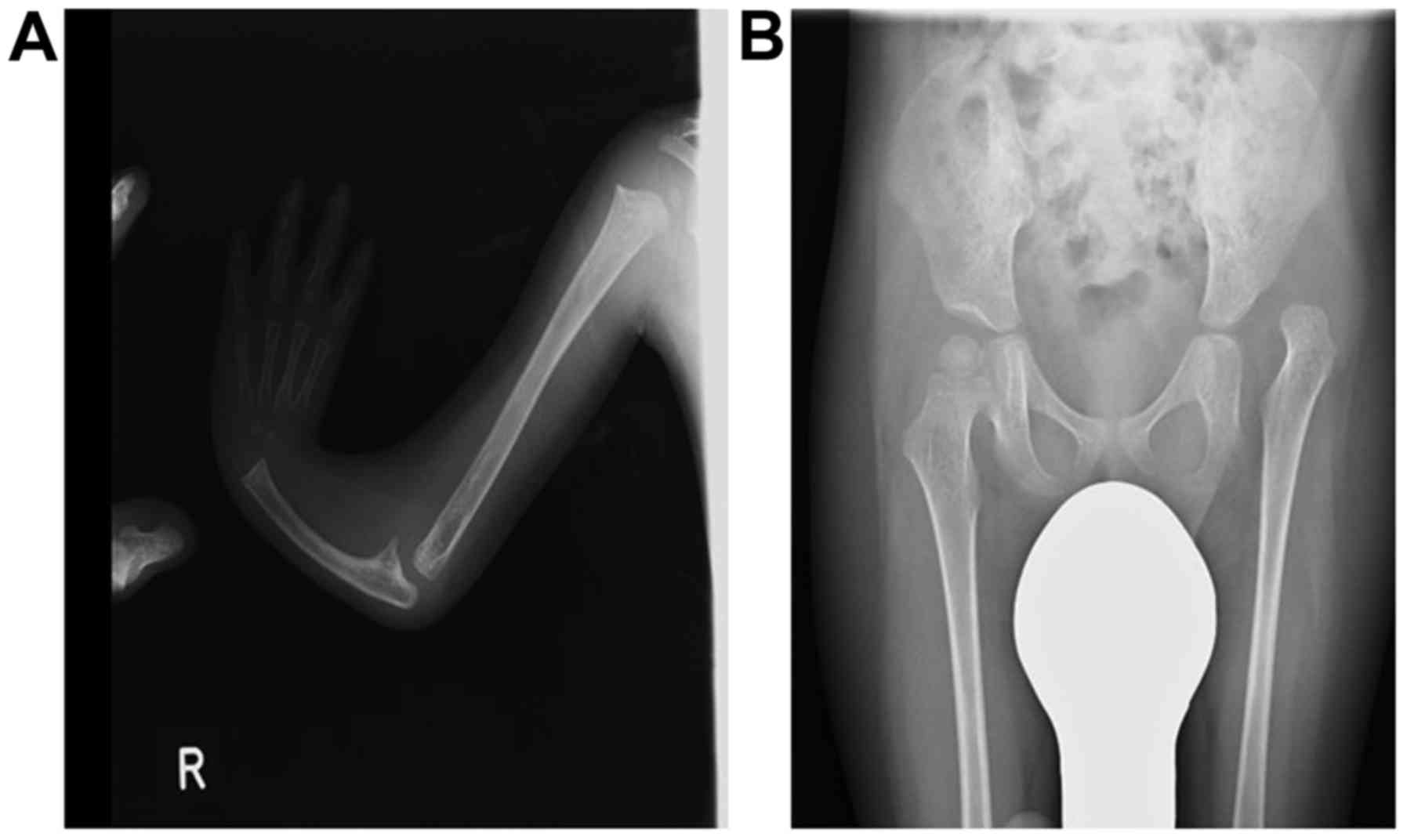
Case 3 was a 4-year-old boy. In addition to craniosynostosis and thumb hypoplasia (Fig. 1), he showed left hip dislocation, left knee joint dislocation, bent elbows, and excessive hand abduction. His intelligence is within the normal range, as determined by a new edition K-type development inspection. At 4 years of age he was still not ambulatory but could sit.

Figure 1.

Skeletal anomalies of case 3 revealed by X-ray examination. Right radial ray defects; (A) absent radius and absent thumb. (B) Left hip dislocation.

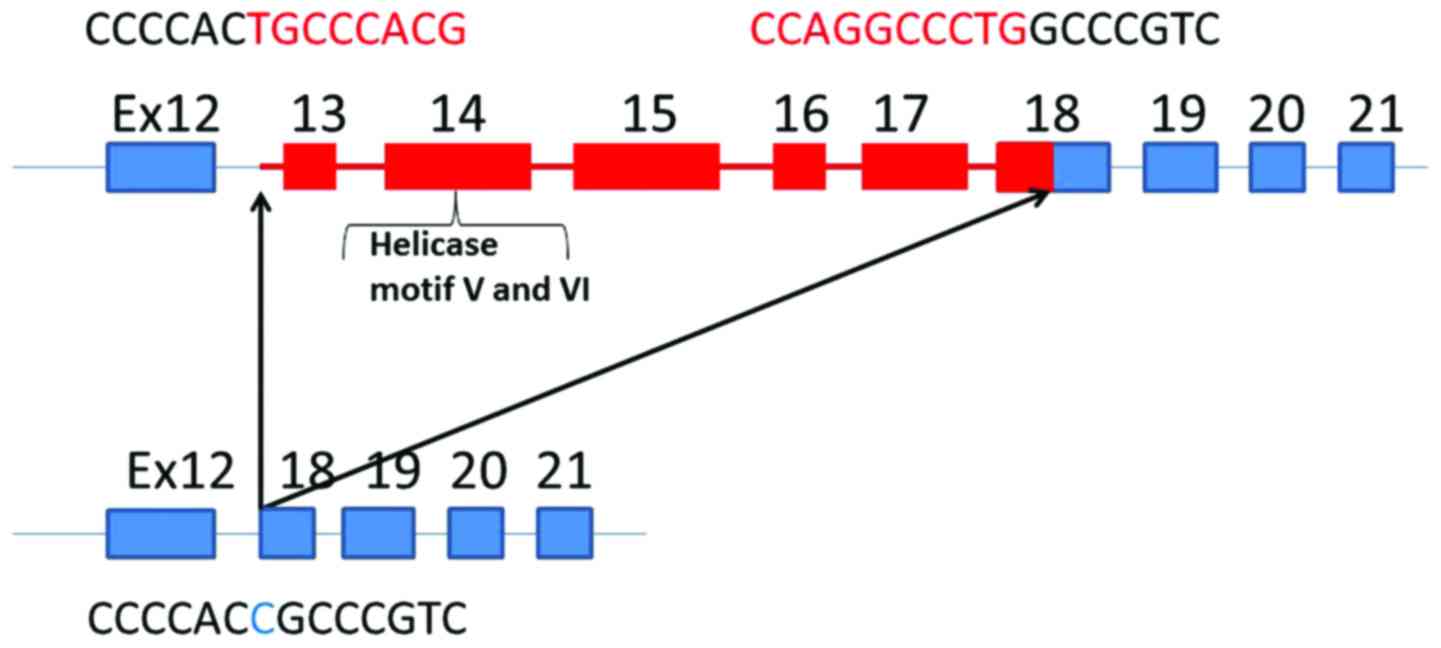
From his clinical features and bone X-ray examination findings he was suspected of having BGS. Therefore, his RECQL4 gene was analyzed. His RECQL4 gene showed a 1,614 bp homozygous deletion and 1 bp (G) insertion (NC_000008.10:g.145737562_145739175delinsC) (Fig. 2A). Deleted DNA spanned from intron 12 to the former part of exon 18, which contained the helicase motif (Fig. 3). Agarose gel analysis (Fig. 2B) showed that his father and mother carried the wild type and mutant RECQL4 genes, respectively.
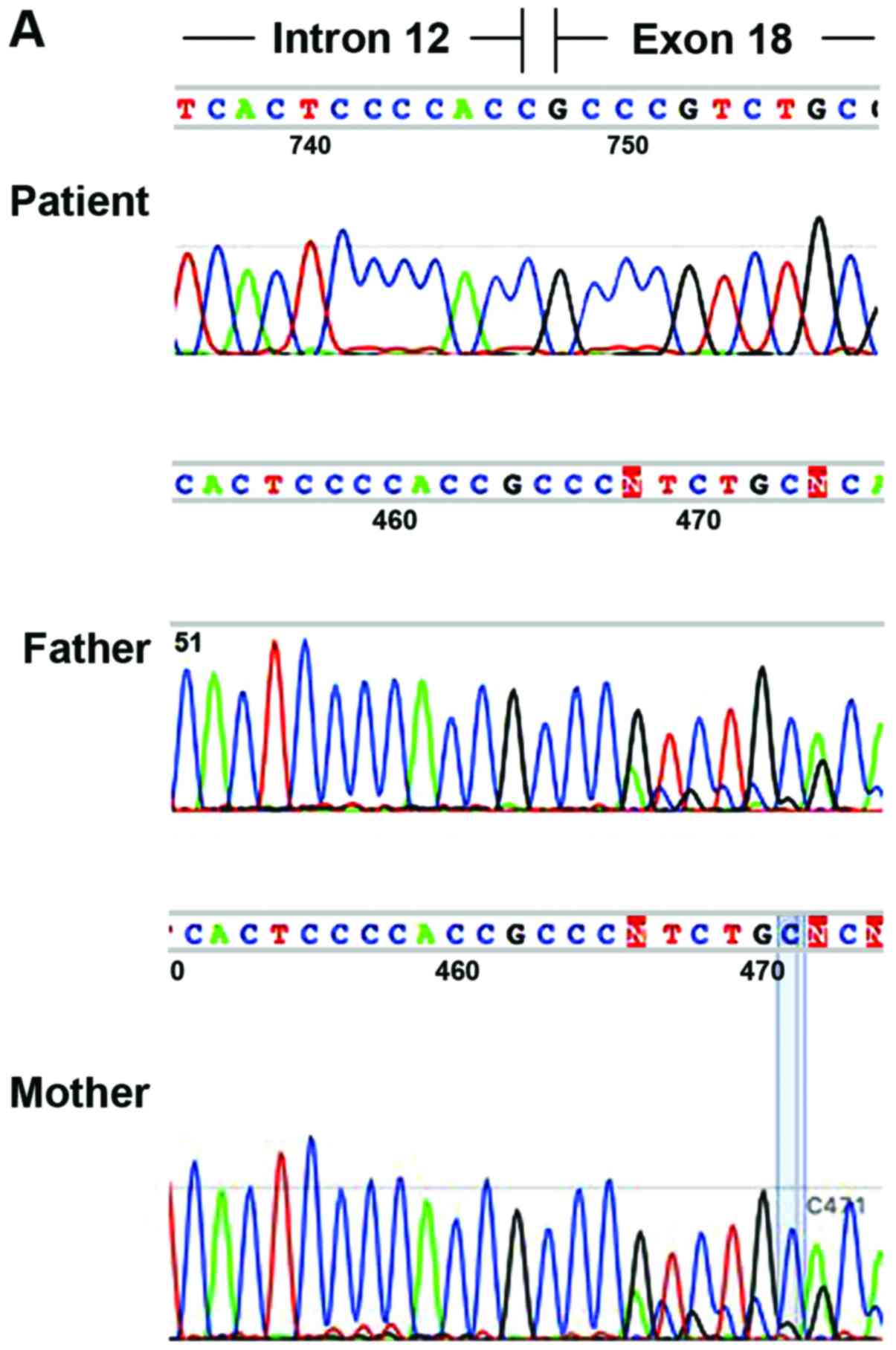
Figure 2.

(A) Chromatogram of DNA sequences at DNA break point (NC_000008.10:g.145737562_145739175delinsC). (B) Large homozygous deletion of RECQL4 gene in case 3 detected by agarose gel electrophoresis. λ/H, HindIII digested DNA marker, M, DNA marker, Co, control, Pt, case 3, Mo, Mother, Fa, Father.

Figure 3.

In case 3, detected homozygous deletion of the RECQL4 gene from intron 12 to the former part of exon 18, resulted in the deletion of amino acids after Ala687. Red boxes indicated the deleted exons and introns. Exon 14 encodes the helicase motif V and VI (1).

Discussion

The prevalence of BGS is unknown; it is probably less than 1:1,000,000 (7). This rarity of BGS makes its diagnosis difficult in some cases. Piard et al (8). Showed that the mean age at referral for BGS was 7 years. In our nationwide survey only two families were identified to have members affected by BGS. All of the affected members had craniosynostosis and radial ray defects. On the other hand Rothmund-Thomson syndrome and RAPADILINO syndrome are two recessively inherited syndromes whose clinical features overlap those of BGS. Rothmund-Thomson syndrome is characterized by poikiloderma. Radial ray hypoplasia or absent thumbs occur in a minority of cases. RAPADILINO syndrome is characterized by radial ray defects. BGS is characterized by craniosynostosis in association with radial hypoplasia. Our cases showed radial ray defect with carniosyonostosis without poikiloderma which is consistent with the characteristic of BGS.

The RECQL4 gene in our genetically analyzed patient showed homozygous deletion from intron 12 to the former part of exon 18 resulting in the deletion of amino acids after Ala687. To our knowledge this large deletion of RECQL4 gene has not been reported in other BGS patients. This deletion spans the RecQ helicase motif from IV to VI. The deleted RECQL4 protein in the patient might not be functional. To the best of our knowledge, this deletion in the RECQL4 gene has not been reported. Piard et al reported that no RECQL4 mutations were found in their BGS group without poikiloderma. However, our patient had café-au-lait-like spots but not poikiloderma (8). The relationship between poikiloderma and RECQL4 gene mutation should be further examined.

In our patient the parents had heterozygous RECQL4 gene mutation without evident consanguinity. A molecular study-based diagnosis is powerful tool for genetic counselling of individuals affected by BGS. Cao et al Reported the case of BGS prenatally diagnosed (9). The cases of BGS diagnosed on the basis of molecular genetics should be accumulated.

Acknowledgements

This study was supported in part by Health and Labor Science Research Grants for Research on Intractable Diseases from The Ministry of Health, Labour and Welfare of Japan (H23-075).

References

1 

Nakayama K: RecQ family helicases: Roles as tumor suppressor proteins. Oncogene. 21:9008–9021. 2002. View Article : Google Scholar : PubMed/NCBI

2 

Kaneko H and Kondo N: Clinical features of Bloom syndrome and function of the causative gene, BLM helicase. Expert Rev Mol Diagn. 4:393–401. 2004. View Article : Google Scholar : PubMed/NCBI

3 

Kitao S, Shimamoto A, Goto M, Miller RW, Smithson WA, Lindor NM and Furuichi Y: Mutations in RECQL4 cause a subset of cases of Rothmund-Thomson syndrome. Nat Genet. 22:82–84. 1999. View Article : Google Scholar : PubMed/NCBI

4 

Larizza L, Roversi G and Volpi L: Rothmund-Thomson syndrome. Orphanet J Rare Dis. 5:22010. View Article : Google Scholar : PubMed/NCBI

5 

Van Maldergem L, Verloes A, Lejeune L and Gillerot Y: The Baller-Gerold syndrome. J Med Genet. 29:266–268. 1992. View Article : Google Scholar : PubMed/NCBI

6 

Van Maldergem L, Siitonen HA, Jalkh N, Chouery E, De Roy M, Delague V, Muenke M, Jabs EW, Cai J, Wang LL, et al: Revisiting the craniosynostosis-radial ray hypoplasia association: Baller-Gerold syndrome caused by mutations in the RECQL4 gene. J Med Genet. 43:148–152. 2006. View Article : Google Scholar : PubMed/NCBI

7 

Van Maldergem L; Pagon RA, Adam MP, Ardinger HH, Wallace SE, Amemiya A, Bean LJH, Bird TD, Fong CT, Mefford HC, Smith RJH and Stephens K: Baller-Gerold Syndrome. Seattle (WA): University of Washington, Seattle; pp. 1993–2016. 2007

8 

Piard J, Aral B, Vabres P, Holder-Espinasse M, Mégarbané A, Gauthier S, Capra V, Pierquin G, Callier P, Baumann C, et al: Search for RECQL4 mutations in 39 patients genotyped for suspected Rothmund-Thomson/Baller-Gerold syndromes. Clin Genet. 87:244–251. 2015. View Article : Google Scholar : PubMed/NCBI

9 

Cao DH, Mu K, Liu DN, Sun JL, Bai XZ, Zhang N, Qiu GB and Ma XW: Identification of novel compound heterozygous RECQL4 mutations and prenatal diagnosis of Baller-Gerold syndrome: A case report. Genet Mol Res. 14:4757–4766. 2015. View Article : Google Scholar : PubMed/NCBI

Related Articles

  • Abstract
  • View
  • Download
  • Twitter
Copy and paste a formatted citation
Spandidos Publications style
Kaneko H, Izumi R, Oda H, Ohara O, Sameshima K, Ohnishi H, Fukao T and Funato M: Nationwide survey of Baller‑Gerold syndrome in Japanese population. Mol Med Rep 15: 3222-3224, 2017.
APA
Kaneko, H., Izumi, R., Oda, H., Ohara, O., Sameshima, K., Ohnishi, H. ... Funato, M. (2017). Nationwide survey of Baller‑Gerold syndrome in Japanese population. Molecular Medicine Reports, 15, 3222-3224. https://doi.org/10.3892/mmr.2017.6408
MLA
Kaneko, H., Izumi, R., Oda, H., Ohara, O., Sameshima, K., Ohnishi, H., Fukao, T., Funato, M."Nationwide survey of Baller‑Gerold syndrome in Japanese population". Molecular Medicine Reports 15.5 (2017): 3222-3224.
Chicago
Kaneko, H., Izumi, R., Oda, H., Ohara, O., Sameshima, K., Ohnishi, H., Fukao, T., Funato, M."Nationwide survey of Baller‑Gerold syndrome in Japanese population". Molecular Medicine Reports 15, no. 5 (2017): 3222-3224. https://doi.org/10.3892/mmr.2017.6408
Copy and paste a formatted citation
x
Spandidos Publications style
Kaneko H, Izumi R, Oda H, Ohara O, Sameshima K, Ohnishi H, Fukao T and Funato M: Nationwide survey of Baller‑Gerold syndrome in Japanese population. Mol Med Rep 15: 3222-3224, 2017.
APA
Kaneko, H., Izumi, R., Oda, H., Ohara, O., Sameshima, K., Ohnishi, H. ... Funato, M. (2017). Nationwide survey of Baller‑Gerold syndrome in Japanese population. Molecular Medicine Reports, 15, 3222-3224. https://doi.org/10.3892/mmr.2017.6408
MLA
Kaneko, H., Izumi, R., Oda, H., Ohara, O., Sameshima, K., Ohnishi, H., Fukao, T., Funato, M."Nationwide survey of Baller‑Gerold syndrome in Japanese population". Molecular Medicine Reports 15.5 (2017): 3222-3224.
Chicago
Kaneko, H., Izumi, R., Oda, H., Ohara, O., Sameshima, K., Ohnishi, H., Fukao, T., Funato, M."Nationwide survey of Baller‑Gerold syndrome in Japanese population". Molecular Medicine Reports 15, no. 5 (2017): 3222-3224. https://doi.org/10.3892/mmr.2017.6408
Follow us
  • Twitter
  • LinkedIn
  • Facebook
About
  • Spandidos Publications
  • Careers
  • Cookie Policy
  • Privacy Policy
How can we help?
  • Help
  • Live Chat
  • Contact
  • Email to our Support Team